

Evolutionary Dynamics of Cryptophyte Plastid Genomes
Open accessThe DOI matches its Crossref record; 84 of the 84 references it cites were found in a registry or an index.
Abstract
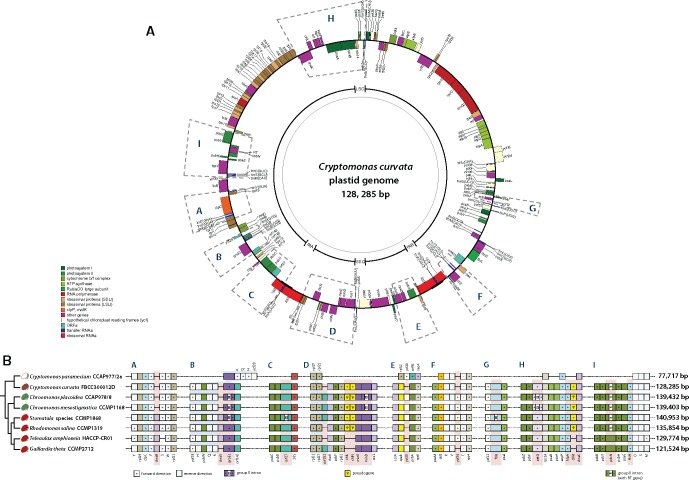
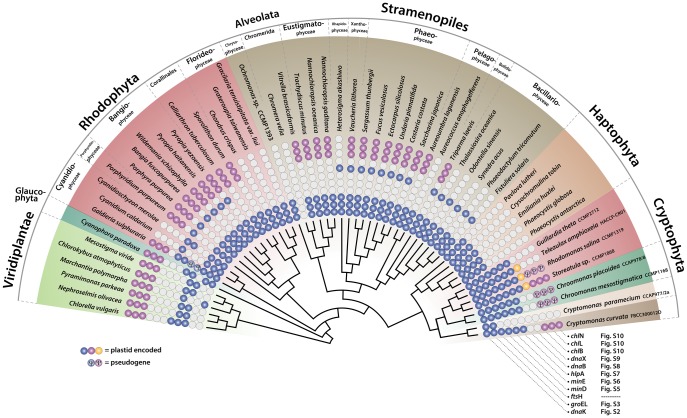
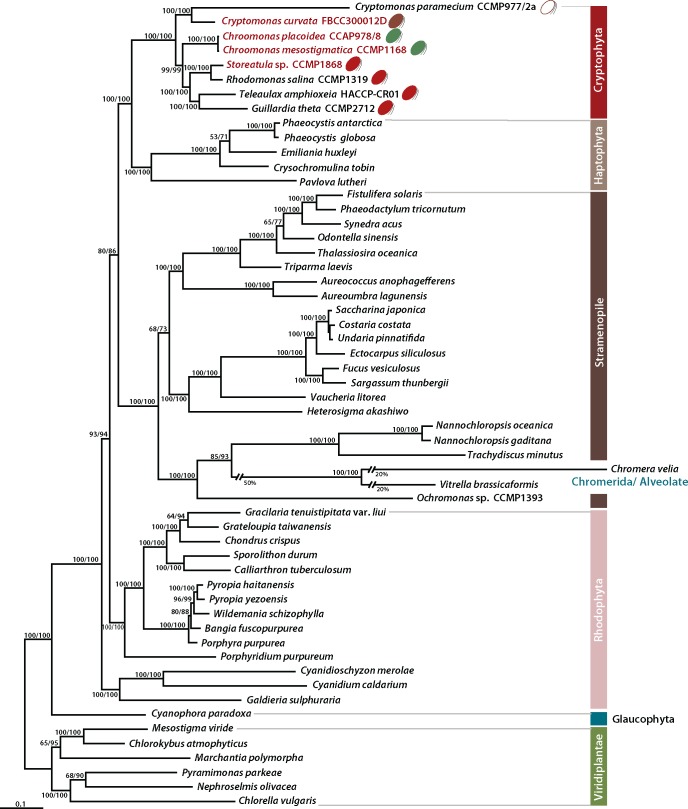
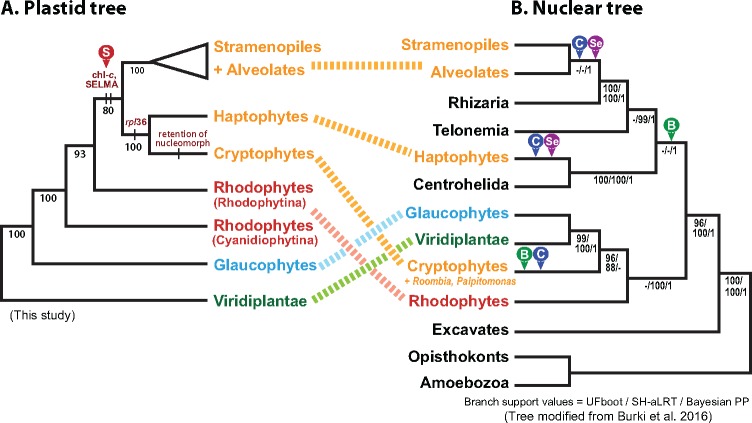
Cryptophytes are an ecologically important group of largely photosynthetic unicellular eukaryotes. This lineage is of great interest to evolutionary biologists because their plastids are of red algal secondary endosymbiotic origin and the host cell retains four different genomes (host nuclear, mitochondrial, plastid, and red algal nucleomorph). Here, we report a comparative analysis of plastid genomes from six representative cryptophyte genera. Four newly sequenced cryptophyte plastid genomes of Chroomonas mesostigmatica, Ch. placoidea, Cryptomonas curvata, and Storeatula sp. CCMP1868 share a number of features including synteny and gene content with the previously sequenced genomes of Cryptomonas paramecium, Rhodomonas salina, Teleaulax amphioxeia, and Guillardia theta. Our analysis of these plastid genomes reveals examples of gene loss and intron insertion. In particular, the chlB/chlL/chlN genes, which encode light-independent (dark active) protochlorophyllide oxidoreductase (LIPOR) proteins have undergone recent gene loss and pseudogenization in cryptophytes. Comparison of phylogenetic trees based on plastid and nuclear genome data sets show the introduction, via secondary endosymbiosis, of a red algal derived plastid in a lineage of chlorophyll-c containing algae. This event was followed by additional rounds of eukaryotic endosymbioses that spread the red lineage plastid to diverse groups such as haptophytes and stramenopiles.
Overview
The claims and statistics of this paper haven’t been checked yet.
Free: it reads the open-access text and checks the first 5 claims that cite a source we can check. Create a free account to check every claim.
Integrity signals
Registry
Cites
Statistics
Figures
Verification
Claims the paper makes
The claims and statistics of this paper haven’t been checked yet.
Free: it reads the open-access text and checks the first 5 claims that cite a source we can check. Create a free account to check every claim.
Claims other papers make about this one
Each is checked against this paper’s own text: does it say what the citing paper says it does?
The source backs part of the claim, not all of it — or backs it for a different population, condition or comparison.
In the citing paper
“At present, the data suggest that red alga-type complex plastids share more recent common ancestry with those of mesophilic red algae such as Porphyra and Chondrus than they do with the plastids of extremophiles such as Cyanidioschyzon and Galdieria (e.g., Ševčíková et al. 2015; Kim et al. 2017; Muñoz-Gómez et al. 2017).”
From Genomic Insights into Plastid Evolution (2020) · cites this paper as Kim et al. 2017
Experimental — accuracy not yet measuredThe cited source says what the claim attributes to it.
In the citing paper
“a trend that has nevertheless emerged is plastid trees that unite haptophytes and cryptophytes to the exclusion of all other complex algae; see, e.g., Janouškovec et al. 2010; Ševčíková et al. 2015; Kim et al. 2017 and references therein for discussion”
From Genomic Insights into Plastid Evolution (2020) · cites this paper as Kim et al. 2017
Self-check
Percentages, sums and reported differences re-computed from the paper’s own numbers.
The self-check needs the paper’s full text.
Citations
Cites
RAxML version 8: a tool for phylogenetic analysis and post-analysis of large phylogenies
Stamatakis, A. (2014) · Bioinformatics · doi:10.1093/bioinformatics/btu033 · Cited by 32,291
MrBayes 3.2: Efficient Bayesian Phylogenetic Inference and Model Choice Across a Large Model Space
Ronquist, F., Teslenko, M., van der Mark, P., Ayres, D. L., Darling, A., Höhna, S., Larget, B., Liu, L., Suchard, M. A., & Huelsenbeck, J. P. (2012) · Systematic Biology · doi:10.1093/sysbio/sys029 · Cited by 27,843
IQ-TREE: A Fast and Effective Stochastic Algorithm for Estimating Maximum-Likelihood Phylogenies
Nguyen, L.-T., Schmidt, H. A., von Haeseler, A., & Minh, B. Q. (2015) · Molecular Biology and Evolution · doi:10.1093/molbev/msu300 · Cited by 26,046
Mauve: Multiple alignment of conserved genomic sequence with rearrangements
Darling, A. C. E., Mau, B., Blattner, F. R., & Perna, N. T. (2004) · Genome Research · doi:10.1101/gr.2289704 · Cited by 4,949
An Improved General Amino Acid Replacement Matrix
Le, S. Q., & Gascuel, O. (2008) · Molecular Biology and Evolution · doi:10.1093/molbev/msn067 · Cited by 3,127
ProtTest 3: fast selection of best-fit models of protein evolution
Darriba, D., Taboada, G. L., Doallo, R., & Posada, D. (2011) · Bioinformatics · doi:10.1093/bioinformatics/btr088 · Cited by 2,672
(2003) · Elsevier eBooks · doi:10.1016/c2009-0-22714-0 · Cited by 2,592
Genomic sequence of the pathogenic and allergenic filamentous fungus Aspergillus fumigatus
Nierman, W. C., Pain, A., Anderson, M. J., Wortman, J. R., Kim, H. S., Arroyo, J., Berriman, M., Abe, K., Archer, D. B., Bermejo, C., et al. (2005) · Nature · doi:10.1038/nature04332 · Cited by 1,391
Ellis, R. J., & van der Vies, S. M. (1991) · Annual Review of Biochemistry · doi:10.1146/annurev.bi.60.070191.001541 · Cited by 1,120
Gene transfer to the nucleus and the evolution of chloroplasts
Martin, W., Stoebe, B., Goremykin, V., Hansmann, S., Hasegawa, M., & Kowallik, K. V. (1998) · Nature · doi:10.1038/30234 · Cited by 772
A common red algal origin of the apicomplexan, dinoflagellate, and heterokont plastids
Janouškovec, J., Horák, A., Oborník, M., Lukeš, J., & Keeling, P. J. (2010) · Proceedings of the National Academy of Sciences · doi:10.1073/pnas.1003335107 · Cited by 489
The Puzzle of Plastid Evolution
Archibald, J. M. (2009) · Current Biology · doi:10.1016/j.cub.2008.11.067 · Cited by 456
Self-citationDiversity and evolutionary history of plastids and their hosts
Keeling, P. J. (2004) · American Journal of Botany · doi:10.3732/ajb.91.10.1481 · Cited by 455
The highly reduced genome of an enslaved algal nucleus
Douglas, S., Zauner, S., Fraunholz, M., Beaton, M., Penny, S., Deng, L.-T., Wu, X., Reith, M., Cavalier-Smith, T., & Maier, U.-G. (2001) · Nature · doi:10.1038/35074092 · Cited by 454
Endosymbiotic theory for organelle origins
Zimorski, V., Ku, C., Martin, W. F., & Gould, S. B. (2014) · Current Opinion in Microbiology · doi:10.1016/j.mib.2014.09.008 · Cited by 453
The genetic data environment an expandable GUI for multiple sequence analysis
Smith, S. W., Overbeek, R., Woese, C. R., Gilbert, W., & Gillevet, P. M. (1994) · Bioinformatics · doi:10.1093/bioinformatics/10.6.671 · Cited by 447
Yoon, H. S., Hackett, J. D., & Bhattacharya, D. (2002) · Proceedings of the National Academy of Sciences · doi:10.1073/pnas.172234799 · Cited by 442
Self-citationAlgal genomes reveal evolutionary mosaicism and the fate of nucleomorphs
Curtis, B. A., Tanifuji, G., Burki, F., Gruber, A., Irimia, M., Maruyama, S., Arias, M. C., Ball, S. G., Gile, G. H., Hirakawa, Y., et al. (2012) · Nature · doi:10.1038/nature11681 · Cited by 417
Self-citationLindahl, M., Spetea, C., Hundal, T., Oppenheim, A. B., Adam, Z., & Andersson, B. (2000) · The Plant Cell · doi:10.1105/tpc.12.3.419 · Cited by 395
The single, ancient origin of chromist plastids
Yoon, H. S., Hackett, J. D., Pinto, G., & Bhattacharya, D. (2002) · Proceedings of the National Academy of Sciences · doi:10.1073/pnas.242379899 · Cited by 380
Self-citationPhotosynthetic eukaryotes unite: endosymbiosis connects the dots
Bhattacharya, D., Yoon, H. S., & Hackett, J. D. (2004) · BioEssays · doi:10.1002/bies.10376 · Cited by 348
Self-citationSingle gene circles in dinoflagellate chloroplast genomes
Zhang, Z., Green, B. R., & Cavalier-Smith, T. (1999) · Nature · doi:10.1038/22099 · Cited by 345
Rampant horizontal transfer and duplication of rubisco genes in eubacteria and plastids
Delwiche, C. F., & Palmer, J. D. (1996) · Molecular Biology and Evolution · doi:10.1093/oxfordjournals.molbev.a025647 · Cited by 310
Genome of the Host-Cell Transforming Parasite Theileria annulata Compared with T. parva
Pain, A., Renauld, H., Berriman, M., Murphy, L., Yeats, C. A., Weir, W., Kerhornou, A., Aslett, M., Bishop, R., Bouchier, C., et al. (2005) · Science · doi:10.1126/science.1110418 · Cited by 306
DEFINING THE MAJOR LINEAGES OF RED ALGAE (RHODOPHYTA)1
Yoon, H. S., Müller, K. M., Sheath, R. G., Ott, F. D., & Bhattacharya, D. (2006) · Journal of Phycology · doi:10.1111/j.1529-8817.2006.00210.x · Cited by 305
Self-citationBurki, F., Kaplan, M., Tikhonenkov, D. V., Zlatogursky, V., Minh, B. Q., Radaykina, L. V., Smirnov, A., Mylnikov, A. P., & Keeling, P. J. (2016) · Proceedings of the Royal Society B: Biological Sciences · doi:10.1098/rspb.2015.2802 · Cited by 301 · cited 5×
“4; Burki et al. 2016).”
BackgroundInfluentialDouglas, S. E., & Penny, S. L. (1999) · Journal of Molecular Evolution · doi:10.1007/pl00006462 · Cited by 299
Bhattacharya, D., & Medlin, L. (1995) · Journal of Phycology · doi:10.1111/j.1529-8817.1995.tb02542.x · Cited by 285
Self-citationCryptomonad algae are evolutionary chimaeras of two phylogenetically distinct unicellular eukaryotes
Douglas, S. E., Murphy, C. A., Spencer, D. F., & Gray, M. W. (1991) · Nature · doi:10.1038/350148a0 · Cited by 284
Ancestral chloroplast genome in Mesostigma viride reveals an early branch of green plant evolution
Lemieux, C., Otis, C., & Turmel, M. (2000) · Nature · doi:10.1038/35001059 · Cited by 277 · cited 1×
“The minD and minE genes are present in several algal plastid genomes (Turmel et al. 1999; Lemieux et al. 2000), but absent from most red algae, with the exception of Galdieria sulphuraria where it is a plastidencoded pseudogene (fig.”
BackgroundMultigene Phylogeny of Choanozoa and the Origin of Animals
Shalchian-Tabrizi, K., Minge, M. A., Espelund, M., Orr, R., Ruden, T., Jakobsen, K. S., & Cavalier-Smith, T. (2008) · PLoS ONE · doi:10.1371/journal.pone.0002098 · Cited by 271
Turmel, M., Otis, C., & Lemieux, C. (1999) · Proceedings of the National Academy of Sciences · doi:10.1073/pnas.96.18.10248 · Cited by 256
Baurain, D., Brinkmann, H., Petersen, J., Rodriguez-Ezpeleta, N., Stechmann, A., Demoulin, V., Roger, A. J., Burger, G., Lang, B. F., & Philippe, H. (2010) · Molecular Biology and Evolution · doi:10.1093/molbev/msq059 · Cited by 249
The evolutionary history of haptophytes and cryptophytes: phylogenomic evidence for separate origins
Burki, F., Okamoto, N., Pombert, J.-F., & Keeling, P. J. (2012) · Proceedings of the Royal Society B: Biological Sciences · doi:10.1098/rspb.2011.2301 · Cited by 240
The chloroplast genome of a chlorophylla+c-containing alga,Odontella sinensis
Kowallik, K. V., Stoebe, B., Schaffran, I., Kroth-Pancic, P., & Freier, U. (1995) · Plant Molecular Biology Reporter · doi:10.1007/bf02669188 · Cited by 222
Ohta, N. (2003) · DNA Research · doi:10.1093/dnares/10.2.67 · Cited by 221
Complete nucleotide sequence of the chlorarachniophyte nucleomorph: Nature’s smallest nucleus
Gilson, P. R., Su, V., Slamovits, C. H., Reith, M. E., Keeling, P. J., & McFadden, G. I. (2006) · Proceedings of the National Academy of Sciences · doi:10.1073/pnas.0600707103 · Cited by 203
Sequence of Plasmodium falciparum chromosomes 1, 3–9 and 13
Hall, N., Pain, A., Berriman, M., Churcher, C., Harris, B., Harris, D., Mungall, K., Bowman, S., Atkin, R., Baker, S., et al. (2002) · Nature · doi:10.1038/nature01095 · Cited by 202
X-ray crystal structure of the light-independent protochlorophyllide reductase
Muraki, N., Nomata, J., Ebata, K., Mizoguchi, T., Shiba, T., Tamiaki, H., Kurisu, G., & Fujita, Y. (2010) · Nature · doi:10.1038/nature08950 · Cited by 200
The evolution of photosynthesis in chromist algae through serial endosymbioses
Stiller, J. W., Schreiber, J., Yue, J., Guo, H., Ding, Q., & Huang, J. (2014) · Nature Communications · doi:10.1038/ncomms6764 · Cited by 194
NIES-Collection list of Strains
Watanabe, M. (1991) · Medical Entomology and Zoology · Cited by 180
Rice, D. W., & Palmer, J. D. (2006) · BMC Biology · doi:10.1186/1741-7007-4-31 · Cited by 170
How do endosymbionts become organelles? Understanding early events in plastid evolution
Bhattacharya, D., Archibald, J. M., Weber, A. P. M., & Reyes‐Prieto, A. (2007) · BioEssays · doi:10.1002/bies.20671 · Cited by 155
Self-citationHoef‐Emden, K., & Melkonian, M. (2003) · Protist · doi:10.1078/143446103322454130 · Cited by 143
Gene-cluster analysis in chloroplast genomics
Stoebe, B., & Kowallik, K. V. (1999) · Trends in Genetics · doi:10.1016/s0168-9525(99)01815-6 · Cited by 129
The remarkable chloroplast genome of dinoflagellates
Howe, C. J., Nisbet, R. E. R., & Barbrook, A. C. (2008) · Journal of Experimental Botany · doi:10.1093/jxb/erm292 · Cited by 127
Ševčíková, T., Horák, A., Klimeš, V., Zbránková, V., Demir-Hilton, E., Sudek, S., Jenkins, J., Schmutz, J., Přibyl, P., Fousek, J., et al. (2015) · Scientific Reports · doi:10.1038/srep10134 · Cited by 125
The origin of alternation of generations in land plants: a focus on matrotrophy and hexose transport
Graham, L. E., & Wilcox, L. W. (2000) · Philosophical Transactions of the Royal Society B Biological Sciences · doi:10.1098/rstb.2000.0614 · Cited by 118
The biliproteins of the Cryptophyceae
Hill, D. R. A., & Rowan, K. S. (1989) · Phycologia · doi:10.2216/i0031-8884-28-4-455.1 · Cited by 116
Muñoz-Gómez, S. A., Mejía-Franco, F. G., Durnin, K., Colp, M., Grisdale, C. J., Archibald, J. M., & Slamovits, C. H. (2017) · Current Biology · doi:10.1016/j.cub.2017.04.054 · Cited by 114
Self-citationProtein Import and the Origin of Red Complex Plastids
Gould, S. B., Maier, U., & Martin, W. F. (2015) · Current Biology · doi:10.1016/j.cub.2015.04.033 · Cited by 114
Hoef‐Emden, K., Marin, B., & Melkonian, M. (2002) · Journal of Molecular Evolution · doi:10.1007/s00239-002-2313-5 · Cited by 114
Nucleomorph genomes: structure, function, origin and evolution
Archibald, J. M. (2007) · BioEssays · doi:10.1002/bies.20551 · Cited by 110
Self-citationKhan, H., Parks, N., Kozera, C., Curtis, B. A., Parsons, B. J., Bowman, S., & Archibald, J. M. (2007) · Molecular Biology and Evolution · doi:10.1093/molbev/msm101 · Cited by 107 · cited 6×
“1I; Khan et al. 2007; this study).”
BackgroundMethodSelf-citationParallel evolution of highly conserved plastid genome architecture in red seaweeds and seed plants
Lee, J., Cho, C. H., Park, S. I., Choi, J. W., Song, H. S., West, J. A., Bhattacharya, D., & Yoon, H. S. (2016) · BMC Biology · doi:10.1186/s12915-016-0299-5 · Cited by 98
Self-citationPuerta, M. V. S. (2005) · DNA Research · doi:10.1093/dnares/12.2.151 · Cited by 95
Newly identified and diverse plastid-bearing branch on the eukaryotic tree of life
Kim, E., Harrison, J. W., Sudek, S., Jones, M. D. M., Wilcox, H. M., Richards, T. A., Worden, A. Z., & Archibald, J. M. (2011) · Proceedings of the National Academy of Sciences · doi:10.1073/pnas.1013337108 · Cited by 93
Self-citationFujita, Y., & Bauer, C. E. (2003) · Elsevier eBooks · doi:10.1016/b978-0-08-092387-1.50010-2 · Cited by 92
CRYPTOMONAD EVOLUTION: NUCLEAR 18S rDNA PHYLOGENY VERSUS CELL MORPHOLOGY AND PIGMENTATION1
Deane, J. A., Strachan, I. M., Saunders, G. W., Hill, D. R. A., & McFadden, G. I. (2002) · Journal of Phycology · doi:10.1046/j.1529-8817.2002.01250.x · Cited by 89
Blinkova, A. L., Hervás, C. G., Stukenberg, P. T., Onrust, R., O’Donnell, M. E., & Walker, J. R. (1993) · Journal of Bacteriology · doi:10.1128/jb.175.18.6018-6027.1993 · Cited by 85
McFadden, G. I., Gilson, P. R., & Hill, D. R. A. (1994) · European Journal of Phycology · doi:10.1080/09670269400650451 · Cited by 84
Hoef‐Emden, K. (2008) · Journal of Phycology · doi:10.1111/j.1529-8817.2008.00530.x · Cited by 82
DnaX Complex of Escherichia coli DNA Polymerase III Holoenzyme
Dallmann, H. G., & McHenry, C. S. (1995) · Journal of Biological Chemistry · doi:10.1074/jbc.270.49.29563 · Cited by 77
Donaher, N., Tanifuji, G., Onodera, N. T., Malfatti, S. A., Chain, P. S. G., Hara, Y., & Archibald, J. M. (2009) · Genome Biology and Evolution · doi:10.1093/gbe/evp047 · Cited by 74
Self-citationIs ftsH the Key to Plastid Longevity in Sacoglossan Slugs?
de Vries, J., Habicht, J., Woehle, C., Huang, C., Christa, G., Wägele, H., Nickelsen, J., Martin, W. F., & Gould, S. B. (2013) · Genome Biology and Evolution · doi:10.1093/gbe/evt205 · Cited by 71
Genetic diversity of goniomonads: an ancient divergence between marine and freshwater species
von der Heyden, S., Chao, E., & Cavalier-Smith, T. (2004) · European Journal of Phycology · doi:10.1080/09670260400005567 · Cited by 70
Tanifuji, G., Onodera, N. T., Wheeler, T. J., Dlutek, M., Donaher, N., & Archibald, J. M. (2011) · Genome Biology and Evolution · doi:10.1093/gbe/evq082 · Cited by 70
Self-citationHunsperger, H. M., Randhawa, T., & Cattolico, R. A. (2015) · BMC Evolutionary Biology · doi:10.1186/s12862-015-0286-4 · Cited by 69
Miyagishima, S., Suzuki, K., Okazaki, K., & Kabeya, Y. (2012) · Molecular Biology and Evolution · doi:10.1093/molbev/mss102 · Cited by 65
Wang, S. L., & Liu, X.-Q. (1991) · Proceedings of the National Academy of Sciences · doi:10.1073/pnas.88.23.10783 · Cited by 59
Size isn't everything: lessons in genetic miniaturisation from nucleomorphs
Gilson, P. R., Maier, U., & McFadden, G. I. (1997) · Current Opinion in Genetics & Development · doi:10.1016/s0959-437x(97)80043-3 · Cited by 59
Length recognition at the N‐terminal tail for the initiation of FtsH‐mediated proteolysis
Chiba, S., Akiyama, Y., Mori, H., Matsuo, E., & Ito, K. (2000) · EMBO reports · doi:10.1093/embo-reports/kvd005 · Cited by 54
Moore, C. E., Curtis, B., Mills, T., Tanifuji, G., & Archibald, J. M. (2012) · Genome Biology and Evolution · doi:10.1093/gbe/evs090 · Cited by 52
Self-citationAnalysis of the complete plastid genome of the unicellular red alga Porphyridium purpureum
Tajima, N., Sato, S., Maruyama, F., Kurokawa, K., Ohta, H., Tabata, S., Sekine, K., Moriyama, T., & Sato, N. (2014) · Journal of Plant Research · doi:10.1007/s10265-014-0627-1 · Cited by 51
Lateral transfer of introns in the cryptophyte plastid genome
Khan, H., & Archibald, J. M. (2008) · Nucleic Acids Research · doi:10.1093/nar/gkn095 · Cited by 41
Self-citationExtreme Features of the Galdieria sulphuraria Organellar Genomes: A Consequence of Polyextremophily?
Jain, K., Krause, K., Grewe, F., Nelson, G. F., Weber, A. P. M., Christensen, A. C., & Mower, J. P. (2014) · Genome Biology and Evolution · doi:10.1093/gbe/evu290 · Cited by 41
The Plastid Genome of the Cryptomonad Teleaulax amphioxeia
Kim, J. I., Yoon, H. S., Yi, G., Kim, H. S., Yih, W., & Shin, W. (2015) · PLoS ONE · doi:10.1371/journal.pone.0129284 · Cited by 35
Self-citationCrasser, K. D., Ritt, C., Krieg, M., Fernández, S., Alonso, J. C., & Grimm, R. (1997) · European Journal of Biochemistry · doi:10.1111/j.1432-1033.1997.00070.x · Cited by 31
Maier, U., Rensing, S. A., Igloi, G. L., & Maerz, M. (1995) · Molecular and General Genetics MGG · doi:10.1007/bf00290141 · Cited by 28
Perrineau, M., Price, D. C., Mohr, G., & Bhattacharya, D. (2015) · PeerJ · doi:10.7717/peerj.1017 · Cited by 25
Self-citationFong, A., & Archibald, J. M. (2008) · Eukaryotic Cell · doi:10.1128/ec.00396-07 · Cited by 25
Self-citationA novice’s guide to analyzing NGS-derived organelle and metagenome data
Song, H. J., Lee, J., Graf, L., Rho, M., Qiu, H., Bhattacharya, D., & Yoon, H. S. (2016) · ALGAE · doi:10.4490/algae.2016.31.6.5 · Cited by 23
Self-citationShi, C., & Shi, X. (2006) · Biotechnology Progress · doi:10.1021/bp060087d · Cited by 17
The complete chloroplast genome of Guillardia theta strain CCMP2712
Tang, X., & Bi, G. (2015) · Mitochondrial DNA Part A · doi:10.3109/19401736.2015.1089554 · Cited by 4
Research works printed but not linked: 2
- Archibald JM, Keeling PJ. 2005 On the origin and evolution of plastids In: Saap J, editor. Microbial phylogeny and evolution. New York: Oxford University Press p. 238– 260.
- McFadden GI. 1993 Second-hand chloroplasts: evolution of cryptomonad algae In: Callow JA, editor. Advances in botanical research. London: Academic Press Limited p. 189– 230.
Cited by
Borowitzka, M. A. (2018) · Elsevier eBooks · doi:10.1016/b978-0-12-811405-6.00003-7 · Cited by 235
Genomic Insights into Plastid Evolution
Sibbald, S. J., & Archibald, J. M. (2020) · Genome Biology and Evolution · doi:10.1093/gbe/evaa096 · Cited by 161
Self-citationDinoflagellates with relic endosymbiont nuclei as models for elucidating organellogenesis
Sarai, C., Tanifuji, G., Nakayama, T., Kamikawa, R., Takahashi, K., Yazaki, E., Matsuo, E., Miyashita, H., Ishida, K.-I., Iwataki, M., et al. (2020) · Proceedings of the National Academy of Sciences · doi:10.1073/pnas.1911884117 · Cited by 82
Get the shovel: morphological and evolutionary complexities of belowground organs in geophytes
Tribble, C. M., Martínez‐Gómez, J., Howard, C. C., Males, J., Sosa, V., Sessa, E. B., Cellinese, N., & Specht, C. D. (2021) · American Journal of Botany · doi:10.1002/ajb2.1623 · Cited by 71
Barre, A., Simplicien, M., Benoist, H., Damme, E. J. M. V., & Rougé, P. (2019) · Marine Drugs · doi:10.3390/md17080440 · Cited by 70
Metadata
- Authors
- Kim, J. I., Moore, C. E., Archibald, J. M., Bhattacharya, D., Yi, G., Yoon, H. S., & Shin, W.
- Affiliations
- Chungnam National University (KR)
- Dalhousie University (CA)
- Rutgers, The State University of New Jersey (US)
- Dongguk University (KR)
- Sungkyunkwan University (KR)
- Corresponding author
- Yoon, Hwan Su
- Shin, Woongghi
- Venue
- Genome Biology and Evolution
- Publisher
- Oxford University Press (OUP)
- Published
- 2017-07
- Volume
- 9
- Issue
- 7
- Pages
- 1859-1872
- ISSN
- 1759-6653 (ISSN-L)
- PMC
- PMC5534331
- OpenAlex
- W2726178529
- Semantic Scholar
- c911f8c7b2b8bd5f8179470a3bd92a099ff5873c
- Cited by
- 70
- References
- 84
- Citations by year
- 2026: 8 · 2025: 8 · 2024: 11 · 2023: 7 · 2022: 7 · 2021: 5 · 2020: 9 · 2019: 5 · 2018: 10
- FWCI
- 2.68
- Type
- journal article
- Language
- en
- Open access
- gold
- doi.org
- Licence
- cc-by-nc
- Locations
- Genome Biology and Evolution (publishedVersion, cc-by-nc)
- PubMed Central (publishedVersion, cc-by-nc)
- PubMed (publishedVersion)
- Rutgers University Community Repository (Rutgers University) (submittedVersion)
- Funders
- National Research Foundation
- Ministry of Science, ICT and Future Planning
- Topics
- Life Sciences › Agricultural and Biological Sciences › Ecology, Evolution, Behavior and Systematics › Protist diversity and phylogeny
- Life Sciences › Biochemistry, Genetics and Molecular Biology › Molecular Biology › Photosynthetic Processes and Mechanisms
- Life Sciences › Biochemistry, Genetics and Molecular Biology › Genetics › Chromosomal and Genetic Variations
- Keywords
- cryptophytes, chloroplast genome, secondary endosymbiosis, nucleomorph, gene loss, pseudogenization, protochlorophyllide oxidoreductase, intron insertion, plastid gene content, plastid phylogeny
- MeSH terms
- Phylogeny, Symbiosis, Sequence Analysis, DNA, Plastids, Evolution, Molecular, Cryptophyta, Genome, Plastid
About these checks
Registry, retraction, Cites and statistics results are computed, not judged, with one exception: a printed reference that no index lists is read once by a model before it counts as a citation error. Claims are extracted by a model and kept only when their quote appears verbatim in the text; each cited source is then checked, with a model’s help, for whether it says what the claim relies on. Those verdicts can be wrong — read the claim’s quote and the cited source before relying on one.
Statistics and arithmetic are recomputed, not judged.
Confidence bands are shown only for fields calibrated on our annotated test set. None is calibrated yet, so no band is shown.
What counts as a claim ›How we measure confidence ›How we check this ›
Are you an author, or do you see a problem with this page? Request a review
Data sources
Bibliographic data: Semantic Scholar, OpenAlex, Crossref.
Contains information from the Semantic Scholar Academic Graph Datasets, made available under the ODC Attribution License (ODC-BY 1.0).
Semantic Scholar’s data is described in: Kinney, R., et al. (2023). The Semantic Scholar Open Data Platform. arXiv:2301.10140.
