

Visual processing in the fly, from photoreceptors to behavior
Open accessThe DOI matches its Crossref record; 365 of the 365 references it cites were found in a registry or an index.
Abstract
Originally a genetic model organism, the experimental use of Drosophila melanogaster has grown to include quantitative behavioral analyses, sophisticated perturbations of neuronal function, and detailed sensory physiology. A highlight of these developments can be seen in the context of vision, where pioneering studies have uncovered fundamental and generalizable principles of sensory processing. Here we begin with an overview of vision-guided behaviors and common methods for probing visual circuits. We then outline the anatomy and physiology of brain regions involved in visual processing, beginning at the sensory periphery and ending with descending motor control. Areas of focus include contrast and motion detection in the optic lobe, circuits for visual feature selectivity, computations in support of spatial navigation, and contextual associative learning. Finally, we look to the future of fly visual neuroscience and discuss promising topics for further study.
Overview
The claims and statistics of this paper haven’t been checked yet.
Free: it reads the open-access text and checks the first 5 claims that cite a source we can check. Create a free account to check every claim.
Integrity signals
Registry
Cites
Statistics
Figures
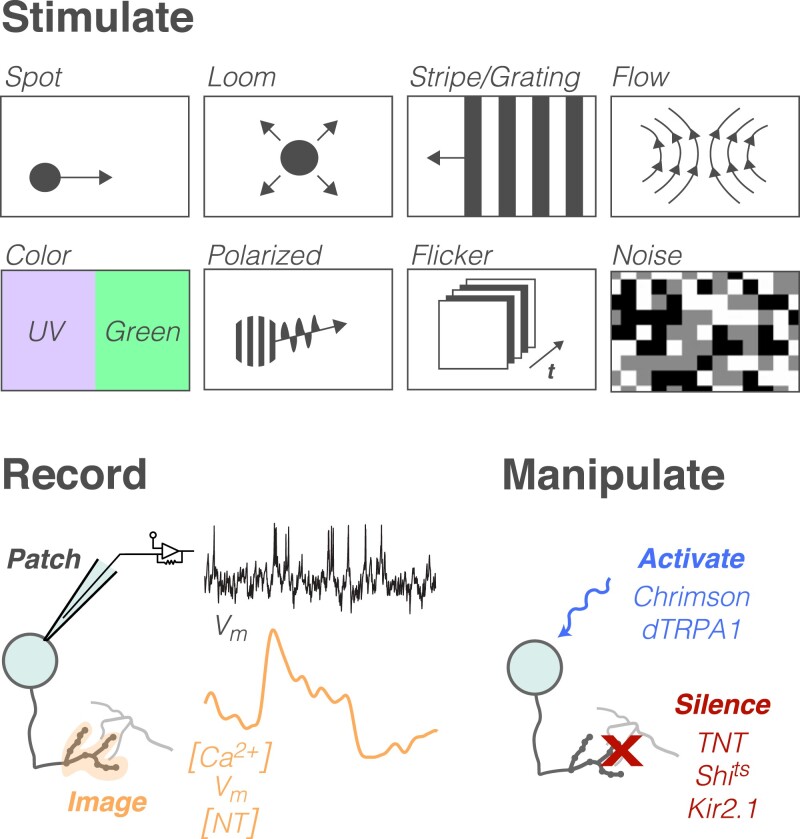
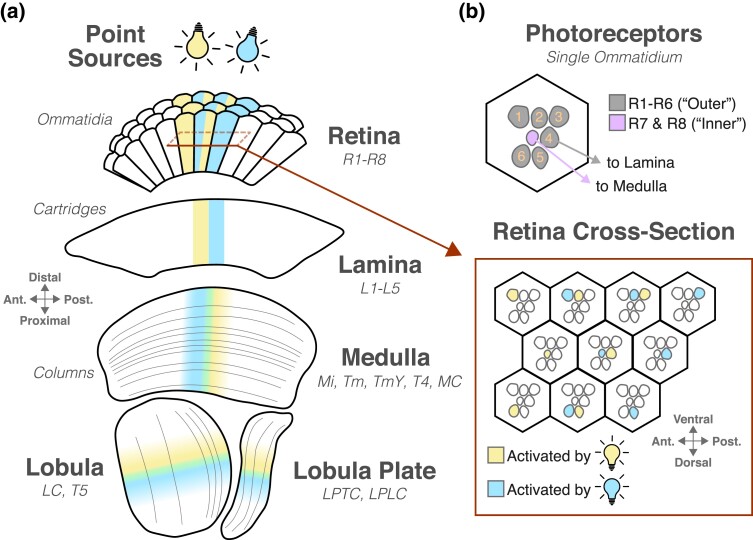
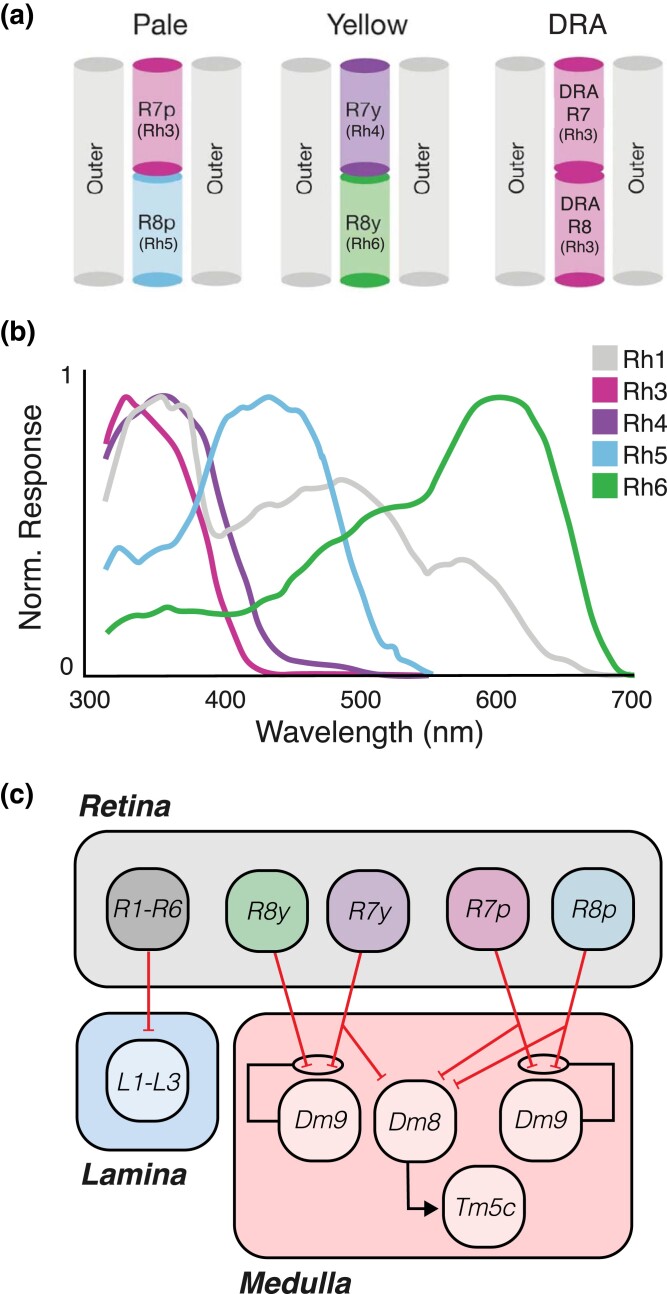
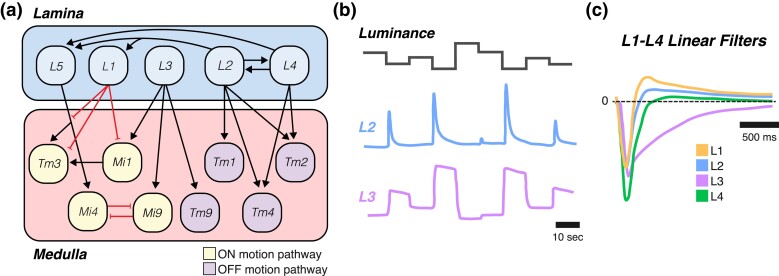
Verification
Claims the paper makes
The claims and statistics of this paper haven’t been checked yet.
Free: it reads the open-access text and checks the first 5 claims that cite a source we can check. Create a free account to check every claim.
Claims other papers make about this one
Each is checked against this paper’s own text: does it say what the citing paper says it does?
The source backs part of the claim, not all of it — or backs it for a different population, condition or comparison.
In the citing paper
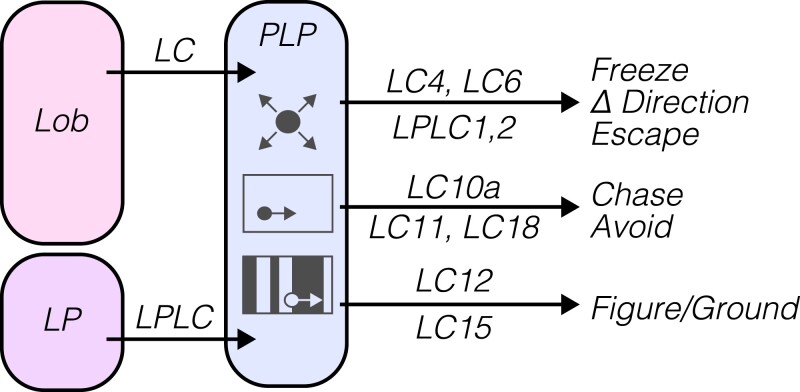
“Even LC types involved in non-social behaviours (for example, escape), such as LC4, LC6, LPLC1 and LPLC221,24,26,38–40, participate in encoding the movements of the female and driving the courtship actions of the male.”
From Mapping model units to visual neurons reveals population code for social behaviour (2024) · cites this paper as [40]
Experimental — accuracy not yet measuredThe cited source says what the claim attributes to it.
In the citing paper
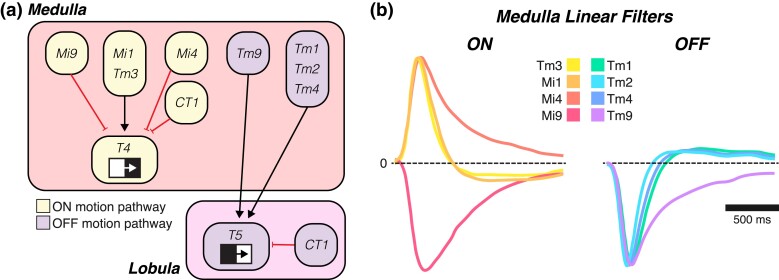
“We found that our connectome-constrained and task-optimized DMN accurately predicts the separation of the visual system into light-increment (ON) and light-decrement (OFF) channels, as well as the generation of direction selectivity in the well-known T4 and T5 motion detector neurons24.”
From Connectome-constrained networks predict neural activity across the fly visual system (2024) · cites this paper as [24]
The cited source says what the claim attributes to it.
In the citing paper
“We considered only the role of this circuit in detecting motion, which is but one of many computations performed by the visual system24.”
From Connectome-constrained networks predict neural activity across the fly visual system (2024) · cites this paper as [24]
Self-check
Percentages, sums and reported differences re-computed from the paper’s own numbers.
The self-check needs the paper’s full text.
Citations
Cites
1 retracted
RETRACTED ARTICLE: Multisensory learning binds neurons into a cross-modal memory engram
Okray, Z., Jacob, P. F., Stern, C., Desmond, K., Otto, N., Talbot, C. B., Vargas-Gutierrez, P., & Waddell, S. (2023) · Nature · doi:10.1038/s41586-023-06013-8 · Cited by 97
RetractedTargeted gene expression as a means of altering cell fates and generating dominant phenotypes
Brand, A. H., & Perrimon, N. (1993) · Development · doi:10.1242/dev.118.2.401 · Cited by 9,612
Ultrasensitive fluorescent proteins for imaging neuronal activity
Chen, T.-W., Wardill, T. J., Sun, Y., Pulver, S. R., Renninger, S. L., Baohan, A., Schreiter, E. R., Kerr, R. A., Orger, M. B., Jayaraman, V., et al. (2013) · Nature · doi:10.1038/nature12354 · Cited by 6,474
Spatiotemporal energy models for the perception of motion
Adelson, E. H., & Bergen, J. R. (1985) · Journal of the Optical Society of America A · doi:10.1364/josaa.2.000284 · Cited by 3,442
Channelrhodopsin-2, a directly light-gated cation-selective membrane channel
Nagel, G., Szellas, T., Huhn, W., Kateriya, S., Adeishvili, N., Berthold, P., Ollig, D., Hegemann, P., & Bamberg, E. (2003) · Proceedings of the National Academy of Sciences · doi:10.1073/pnas.1936192100 · Cited by 2,663
A genome-wide transgenic RNAi library for conditional gene inactivation in Drosophila
Dietzl, G., Chen, D., Schnorrer, F., Su, K.-C., Barinova, Y., Fellner, M., Gasser, B., Kinsey, K., Oppel, S., Scheiblauer, S., et al. (2007) · Nature · doi:10.1038/nature05954 · Cited by 2,644
DISCHARGE PATTERNS AND FUNCTIONAL ORGANIZATION OF MAMMALIAN RETINA
Kuffler, S. W. (1953) · Journal of Neurophysiology · doi:10.1152/jn.1953.16.1.37 · Cited by 2,609 · cited 1×
“…center-surround organizations that form the basis of spatial contrast computations; that is, the same polarity of light (ON or OFF) will cause the cell to either de-polarize or hyperpolarize depending on whether the stimulus is in the center or the edge of the receptive field (Kuffler 1953).”
BackgroundIndependent optical excitation of distinct neural populations
Klapoetke, N. C., Murata, Y., Kim, S. S., Pulver, S. R., Birdsey-Benson, A., Cho, Y. K., Morimoto, T. K., Chuong, A. S., Carpenter, E. J., Tian, Z., et al. (2014) · Nature Methods · doi:10.1038/nmeth.2836 · Cited by 2,344
The mechanism of directionally selective units in rabbit's retina.
Barlow, H. B., & Levick, W. R. (1965) · The Journal of Physiology · doi:10.1113/jphysiol.1965.sp007638 · Cited by 1,576
A GAL4-Driver Line Resource for Drosophila Neurobiology
Jenett, A., Rubin, G. M., Ngo, T.-T. B., Shepherd, D., Murphy, C., Dionne, H., Pfeiffer, B. D., Cavallaro, A., Hall, D., Jeter, J., et al. (2012) · Cell Reports · doi:10.1016/j.celrep.2012.09.011 · Cited by 1,449
Research works printed but not linked: 2
- Vigier P. Méchanisme de la synthèse des impressions lumineuses recueillies par les yeux composés des diptères. CR Acad Sci Paris. 1909; 148: 1221– 1223.
- Zheng L, de Polavieja GG, Wolfram V, Asyali MH, Hardie RC, Juusola M. Feedback network controls photoreceptor output at the layer of first visual synapses in drosophila. J Gen Physiol. 2006; 127(5): 495– 510. doi: 10.1085/jgp.200509470. 16636201 PMC2151524 · DOI · Paper page
Cited by
Connectome-constrained networks predict neural activity across the fly visual system
Lappalainen, J. K., Tschopp, F. D., Prakhya, S., McGill, M., Nern, A., Shinomiya, K., Takemura, S.-Y., Gruntman, E., Macke, J. H., & Turaga, S. C. (2024) · Nature · doi:10.1038/s41586-024-07939-3 · Cited by 128
“We found that our connectome-constrained and task-optimized DMN accurately predicts the separation of the visual system into light-increment (ON) and light-decrement (OFF) channels, as well as the generation of direction selectivity in the well-known T4 and T5 motion detector neurons 24 .”
BackgroundMethodConnectome-driven neural inventory of a complete visual system
Nern, A., Loesche, F., Takemura, S.-Y., Burnett, L. E., Dreher, M., Gruntman, E., Hoeller, J., Huang, G. B., Januszewski, M., Klapoetke, N. C., et al. (2025) · Nature · doi:10.1038/s41586-025-08746-0 · Cited by 93
Neuronal parts list and wiring diagram for a visual system
Matsliah, A., Yu, S.-C., Kruk, K., Bland, D., Burke, A. T., Gager, J., Hebditch, J., Silverman, B., Willie, K. P., Willie, R., et al. (2024) · Nature · doi:10.1038/s41586-024-07981-1 · Cited by 85
“Cluster 16 contains CT1 and Tm9, which are well known to be important for motion computation 4,5 .”
BackgroundMethodInfluentialMapping model units to visual neurons reveals population code for social behaviour
Cowley, B. R., Calhoun, A. J., Rangarajan, N., Ireland, E., Turner, M. H., Pillow, J. W., & Murthy, M. (2024) · Nature · doi:10.1038/s41586-024-07451-8 · Cited by 55
“Even LC types involved in non-social behaviours (for example, escape), such as LC4, LC6, LPLC1 and LPLC2 21,24,26,38–40 , participate in encoding the movements of the female and driving the courtship actions of the male.”
BackgroundPredicting visual function by interpreting a neuronal wiring diagram
Seung, H. S. (2024) · Nature · doi:10.1038/s41586-024-07953-5 · Cited by 49
“The Drosophila compound eye obeys the principle of neural super-position, in which each hexel is sampled by six photoreceptors that are located in neighbouring ommatidia but point at the same optical axis 2,71 .”
Connectome-driven neural inventory of a complete visual system
Nern, A., Loesche, F., Takemura, S.-Y., Burnett, L. E., Dreher, M., Gruntman, E., Hoeller, J., Huang, G. B., Januszewski, M., Klapoetke, N. C., et al. (2024) · doi:10.1101/2024.04.16.589741 · Cited by 98
Diversity of visual inputs to Kenyon cells of the Drosophila mushroom body
Ganguly, I., Heckman, E. L., Litwin-Kumar, A., Clowney, E. J., & Behnia, R. (2024) · Nature Communications · doi:10.1038/s41467-024-49616-z · Cited by 36
Small-field visual projection neurons detect translational optic flow and support walking controlPreprint
Isaacson, M. D., Eliason, J. L. M., Nern, A., Rogers, E. M., Lott, G. K., Tabachnik, T., Rowell, W. J., Edwards, A. W., Korff, W. L., Rubin, G. M., et al. (2023) · bioRxiv (Cold Spring Harbor Laboratory) · doi:10.1101/2023.06.21.546024 · Cited by 31
“1074 (2) 180 s test of mechanical startle responses.”
BackgroundInfluentialSocial state alters vision using three circuit mechanisms in Drosophila
Schretter, C. E., Hindmarsh Sten, T., Klapoetke, N., Shao, M., Nern, A., Dreher, M., Bushey, D., Robie, A. A., Taylor, A. L., Branson, K., et al. (2025) · Nature · doi:10.1038/s41586-024-08255-6 · Cited by 29
Linking neural circuits to the mechanics of animal behavior in Drosophila larval locomotion
Kohsaka, H. (2023) · Frontiers in Neural Circuits · doi:10.3389/fncir.2023.1175899 · Cited by 22
“The same approaches in studying neural circuits with genetic resources and connectomics are applicable in the study of adult flies (Griffith, 2012; Coen and Murthy, 2016; Dubowy and Sehgal, 2017; von Reyn et al., 2017; Guo et al., 2022; Namiki et al., 2022; Currier et al., 2023).”
BackgroundInfrequent strong connections constrain connectomic predictions of neuronal function
Currier, T. A., & Clandinin, T. R. (2025) · Cell · doi:10.1016/j.cell.2025.05.007 · Cited by 20
Self-citationHeterogeneity of synaptic connectivity in the fly visual system
Cornean, J., Molina-Obando, S., Gür, B., Bast, A., Ramos-Traslosheros, G., Chojetzki, J., Lörsch, L., Ioannidou, M., Taneja, R., Schnaitmann, C., et al. (2024) · Nature Communications · doi:10.1038/s41467-024-45971-z · Cited by 20
Wagner, H., Egelhaaf, M., & Carr, C. E. (2024) · Journal of Comparative Physiology A · doi:10.1007/s00359-023-01685-z · Cited by 18
Zhao, A., Nern, A., Koskela, S., Dreher, M., Erginkaya, M., Laughland, C. W., Ludwigh, H., Thomson, A., Hoeller, J., Parekh, R., et al. (2024) · eLife · doi:10.7554/elife.93659.1 · Cited by 17
Zhao, A., Nern, A., Koskela, S., Dreher, M., Erginkaya, M., Laughland, C. W., Ludwigh, H., Thomson, A., Hoeller, J., Parekh, R., et al. (2023) · doi:10.1101/2023.10.16.562634 · Cited by 15
A recurrent neural circuit in Drosophila temporally sharpens visual inputs
Pang, M. M., Chen, F., Xie, M., Druckmann, S., Clandinin, T. R., & Yang, H. H. (2024) · Current Biology · doi:10.1016/j.cub.2024.11.064 · Cited by 12
Self-citationNeural pathways and computations that achieve stable contrast processing tuned to natural scenes
Gür, B., Ramirez, L., Cornean, J., Thurn, F., Molina-Obando, S., Ramos-Traslosheros, G., & Silies, M. (2024) · Nature Communications · doi:10.1038/s41467-024-52724-5 · Cited by 12
Emerging frontiers in visual ecology
Caves, E. M., Cheney, K. L., Dacke, M., Dixit, T., Fialko, K., Franklin, A. M., Jessop, A.-L., Hart, N. S., de Ibarra, N. H., Morehouse, N. I., et al. (2025) · Journal of Experimental Biology · doi:10.1242/jeb.250537 · Cited by 11
Shekhar, S., Tracy, C., Lidsky, P. V., Andino, R., Wert, K. J., & Krämer, H. (2025) · Nature Communications · doi:10.1038/s41467-024-55576-1 · Cited by 10
Rimniceanu, M., Limbania, D., Wasserman, S. M., & Frye, M. A. (2024) · Current Biology · doi:10.1016/j.cub.2024.08.036 · Cited by 9
The fruit fly, Drosophila melanogaster , as a microrobotics platform
Iwasaki, K., Neuhauser, C., Stokes, C., & Rayshubskiy, A. (2025) · Proceedings of the National Academy of Sciences · doi:10.1073/pnas.2426180122 · Cited by 9
Jin, C., Qiao, J., Gong, H., Yu, X., Wang, X., Xi, J., Mi, R., Yu, S., Pan, D., Wang, S., et al. (2025) · Pharmacological Research · doi:10.1016/j.phrs.2025.108043 · Cited by 7
On analogies in vertebrate and insect visual systems
Tanaka, R., & Portugues, R. (2025) · Nature reviews. Neuroscience · doi:10.1038/s41583-025-00932-3 · Cited by 7
Arsenic toxicity in the Drosophila brain at single cell resolution
Chaturvedi, A., Shankar, V., Simkhada, B., Lyman, R. A., Freymuth, P., Howansky, E., Collins, K. M., Mackay, T. F. C., & Anholt, R. R. H. (2025) · Frontiers in Toxicology · doi:10.3389/ftox.2025.1636431 · Cited by 6
Watson, J., Roth, J. R., & Melkani, G. C. (2025) · Journal of Visualized Experiments · doi:10.3791/67791 · Cited by 6
Holguera, I., Chen, Y.-C., Chen, Y., Simon, F., Gaffney, A. G., Rodas, J. D., Córdoba, S., & Desplan, C. (2025) · bioRxiv (Cold Spring Harbor Laboratory) · doi:10.1101/2025.01.06.631439 · Cited by 6
Inhibitory columnar feedback neurons are involved in motion processing in Drosophila
Henning, M., Ketkar, M. D., Lüffe, T., Gohl, D. M., Clandinin, T. R., & Silies, M. (2026) · eLife · doi:10.7554/elife.108529.3 · Cited by 5
Self-citationZhao, A., Nern, A., Koskela, S., Dreher, M., Erginkaya, M., Laughland, C. W., Ludwigh, H., Thomson, A., Hoeller, J., Parekh, R., et al. (2024) · eLife · doi:10.7554/elife.93659 · Cited by 6
Ultrasensitive voltage imaging reveals distinct electrical microdomains in neuronsPreprint
Hao, Y. A., Jayne, L. L., Lee, S., Dittrich, M. N., Zhang, M., Haziza, S., Bendifallah, I., Sims, R. R., Bouazza‐Arostegui, B., White, A. D., et al. (2026) · bioRxiv (Cold Spring Harbor Laboratory) · doi:10.64898/2026.05.27.728040 · Cited by 5
“The visual system of Drosophila melanogaster provides a powerful model for investigating the voltage dynamics underlying information processing in single neurons 18 .”
Self-citationThe organization of visual pathways in the Drosophila brain
Hoeller, J., Zhao, A., Nern, A., Rogers, E. M., Romani, S., & Reiser, M. B. (2026) · Cell · doi:10.1016/j.cell.2026.08.014 · Cited by 4
RODRIGUES, M. C., Jacobs, J. R., Couceiro, J., Brás‐Pereira, C., & Moreno, E. (2025) · Cells · doi:10.3390/cells14242011 · Cited by 3
“Given that photoreceptor neurons, as part of the GMR domain, directly feed into circuits in the central brain responsible for the motor behaviour of the legs and wings, we believe that this paradigm is a valid option to assess the locomotor effects [56].”
Inhibitory columnar feedback neurons are required for motion processing in DrosophilaPreprint
Henning, M., Ketkar, M. D., Lüffe, T., Gohl, D. M., Clandinin, T. R., & Silies, M. (2025) · eLife · doi:10.7554/elife.108529.1 · Cited by 3
Self-citationPaper wasps: A model clade for social cognition
Jernigan, C. M., Mammen, L. C. C., Brown, R. D., & Sheehan, M. J. (2024) · Current Opinion in Neurobiology · doi:10.1016/j.conb.2024.102928 · Cited by 2
Seki, Y., Toriitsuka, Y., Yamada, T., Tanaka, A., Mitsumasu, M., Morimoto, T., & Yamauchi, J. (2025) · Scientific Reports · doi:10.1038/s41598-025-19946-z · Cited by 2
Flexible circuits for visually guided flight control in Drosophila
Schnell, B. (2026) · Trends in Neurosciences · doi:10.1016/j.tins.2025.12.005 · Cited by 2
Lysosomal salvage of neuronal lipids enables glial infiltration of synaptic regions
Theisen, E. K., Rivas‐Serna, I. M., Cheng, P., Lee, R. J., Thomas, C. I., Darehshouri, A., Jay, T. R., Govind, K., Nguyen, T., Mazurak, V. C., et al. (2026) · Neuron · doi:10.1016/j.neuron.2026.02.006 · Cited by 3
Self-citationNeuronal synchronization in Drosophila
Fernández-Chiappe, F., Wappner, M., Morelli, L. G., & Muraro, N. I. (2025) · iScience · doi:10.1016/j.isci.2025.112942 · Cited by 1
“49 But the aMe region does not only host axonal projections, many neuronal somas are located there as well.”
InfluentialGovind, K., Godenschwege, T. A., Sankey, K., Abhilasha, K. V., Acharya, U. R., & Acharya, J. (2026) · Proceedings of the National Academy of Sciences · doi:10.1073/pnas.2605750123 · Cited by 1
Formation of sensory maps: New tools reveal novel insights into neural development
Qi, N., Wood, A., & Grueber, W. B. (2025) · Current Opinion in Neurobiology · doi:10.1016/j.conb.2025.103112 · Cited by 1
How neural feedback enables flexible visual processing in Drosophila
Mickels, C. A., & Turner, M. H. (2025) · Trends in Neurosciences · doi:10.1016/j.tins.2025.10.012 · Cited by 1
Neuropeptide F-expressing neurons in Drosophila constitute centrifugal pathway to optic lobes
Wang, J., & Lehmann, F. (2026) · PLoS ONE · doi:10.1371/journal.pone.0343221 · Cited by 1
“These branches seem to arborize within visual neuropils, likely including the lobula complex and stratified medulla [39,40].”
InfluentialKramer, L. D., Brandwine-Shemmer, T., Pierce, L. R., Liu, Y., Bartels, J.-P., Huber, A., Minke, B., Tao, W. A., & Weake, V. M. (2026) · Science Signaling · doi:10.1126/scisignal.aei4151 · Cited by 1
Integrative models of visually guided steering in DrosophilaPreprint
Canelo, Á., Kim, H., Kim, Y., Park, J. M., & Kim, A. J. (2023) · bioRxiv (Cold Spring Harbor Laboratory) · doi:10.1101/2023.10.11.561122 · Cited by 1
“…behaviors have been studied intensively in recent years, both structurally and functionally (Fenk et al., 2022; Joesch et al., 2010; Takemura et al., 2013; Wu et al., 2016; Hardcastle et al., 2021; Garner et al., 2024; Keles and Frye, 2017) (see Currier et al., 2023; Ryu et al., 2022 for reviews).”
A visual efference copy-based navigation algorithm in Drosophila for complex visual environmentsPreprint
Canelo, Á., Kim, Y., Park, J., & Kim, A. J. (2024) · eLife · doi:10.7554/elife.93487.1 · Cited by 1
Integrative models of visually guided steering in DrosophilaPreprint
Canelo, Á., Kim, H., Kim, Y., Park, J. M., & Kim, A. J. (2025) · eLife · doi:10.7554/elife.93487.2 · Cited by 1
Visual input drives diverse ER calcium signals in neurons in vivoPreprint
Delgado, K. C., Wass, K., Lefebvre, L., Kotla, K. R., & Barnhart, E. L. (2025) · bioRxiv (Cold Spring Harbor Laboratory) · doi:10.64898/2025.12.18.695086 · Cited by 1
“The fly visual system is organized in a retinotopic, laminar fashion (Figure 1A) 27 .”
Inhibitory columnar feedback neurons are involved in motion processing in DrosophilaPreprint
Henning, M., Ketkar, M. D., Lüffe, T., Gohl, D. M., Clandinin, T. R., & Silies, M. (2026) · eLife · doi:10.7554/elife.108529.2 · Cited by 1
Self-citationLim-Kian-Siang, G., Izawa-Ishiguro, A. R., & Rao, Y. (2024) · Molecular Brain · doi:10.1186/s13041-023-01073-3
“Unlike mammalian photoreceptors in which light activation leads to hyperpolarization, light activation of Drosophila photoreceptors causes depolarization [37, 38], leading to the release of the neurotransmitter histamine that induces postsynaptic response in the optic lobe.”
BackgroundIntegrative models of visually guided steering in DrosophilaPreprint
Canelo, Á., Kim, H., Kim, Y., Park, J., & Kim, A. J. (2025) · eLife · doi:10.7554/elife.93487
Barredo, E., Yang, H., Currea, J., Sondhi, Y., Palavalli‐Nettimi, R., Sponberg, S., Tarokh, V., & Theobald, J. C. (2024) · bioRxiv (Cold Spring Harbor Laboratory) · doi:10.1101/2024.07.08.602594
Stimulus Dependence of Visually Guided Behavior in Drosophila Melanogaster
Airhienbuwa, J. (2025) · Scholars Archive - University at Albany (University at Albany, State University of New York) · doi:10.54014/7cmt-qybg
Nair, S. R. (2025) · eDiss (Georg-August-Universität Göttingen) · doi:10.53846/goediss-11446
Oviposition Response to Light With Different Spectra in the Crepuscular Moth Grapholita molesta
Yang, X., Ma, A., Wan, Y., Jiang, Y., Hongfan, R., Niu, Y., & Li, J. (2025) · Ecology and Evolution · doi:10.1002/ece3.72096
A Lightweight Detection Network inspired by the Olfactory Learning Circuit of Caenorhabditis elegans
Zhao, M. Y. (2025) · International Conference on Intelligent Computing (ICIC) · doi:10.65286/icic.v21i2.29520
Organization and processing of gustatory information in the Drosophila brain
Li, J. (2025) · cIRcle (University of British Columbia) · doi:10.14288/1.0448666
Lim-Kian-Siang, G. (2024) · eScholarship@McGill (McGill) · doi:10.82308/23184
Analysis of genetic and protein interactions associated with mutant Huntingtin-induced degeneration
Spicer, R. M. (2024) · ORCA Online Research @Cardiff (Cardiff University)
Multisensory functional and comparative analysis of object tracking in flying fruit flies
Rimniceanu, M. (2024) · eScholarship (California Digital Library)
Imprecision in Vision: Lessons From Neural Circuits in the Fly
Wernet, M. F., & Silies, M. (2026) · BioEssays · doi:10.1002/bies.70122 · Cited by 1
He, Z., & Zhang, Z. (2026) · Expert Systems with Applications · doi:10.1016/j.eswa.2026.132662
Motion-based depth estimation in DrosophilaPreprint
Prech, S., Schmidt-Hamkens, S., Zuidinga, B., Leonte, M.-B., Groschner, L. N., Borst, A., & Haag, J. (2026) · bioRxiv (Cold Spring Harbor Laboratory) · doi:10.64898/2026.05.07.723493
“A large body of research describes in detail how individual neurons compute the direction of visual motion 25,26 , but studies that test the behavioural relevance of this computation under naturalistic conditions are scarce.”
Natario, D., Galant, S., Bunker, J., Mormann, B., Viscido, F., Lin, S., Ciliberti, R. E., Dewett, D., Alejevski, F., Théodore, L., et al. (2026) · bioRxiv (Cold Spring Harbor Laboratory) · doi:10.64898/2026.06.05.730093
Visuo-motor circuits in ant navigation
Dauzere-Peres, O. (2025) · theses.fr (ABES) · doi:10.70675/8fa7db2cz2e89z4bb8zb342zaf5a98c30c43
Visual computation in the cephalopod brain
Allen, V. A., & Niell, C. M. (2026) · Current Opinion in Neurobiology · doi:10.1016/j.conb.2026.103249
“…computational mechanisms including topographic organization, parallel pathways, lateral inhibition, hierarchical feature selectivity, and excitatory-inhibitory balance [1–4], as well as potential high-level principles including efficient coding, predictive processing, and Bayesian inference [5–7].”
Silva, J., Costa, P., & Beatriz, A. (2023) · Specialty journal of Pharmacognosy Phytochemistry and Biotechnology · doi:10.51847/vw1s51o8w6
A canonical neural circuit for motion direction estimationPreprint
Berraquero, M., Serrano‐Pedraza, I., & Bertalmío, M. (2026) · bioRxiv (Cold Spring Harbor Laboratory) · doi:10.64898/2026.10.06.757049
“…properties of DS cells have been established: • DS cells rely on active dendrites (Borst and Euler, 2011; Svirskis et al., 2015; Mauss et al., 2017; Currier et al., 2023; K¨uhn et al., 2025; DePiero et al., 2024); • DS cells require saturation or dynamic nonlinearities (Badwan et al., 2019; Bach…”
Unilateral gene expression via maternally controlled zygotic recombination in DrosophilaPreprint
Currier, T. A., Tadres, D., Troper, J. E., Wang, Y., & Clandinin, T. R. (2026) · bioRxiv (Cold Spring Harbor Laboratory) · doi:10.64898/2026.10.14.759140
“Because this latter region encodes navigation-relevant visual cues 66 , these synaptic partners suggest that LAL089/091 neurons may integrate interhemispheric visuomotor signals to guide navigation.”
Self-citationA neural circuit for stereopsis in the flyPreprint
Mearns, D. S., Park, Y., Shin, I., & Murthy, M. (2026) · bioRxiv (Cold Spring Harbor Laboratory) · doi:10.64898/2026.11.11.765991
Metadata
- Authors
- Currier, T. A., Pang, M. M., & Clandinin, T. R.
- Affiliations
- Stanford Medicine (US)
- Corresponding author
- Clandinin, Thomas R
- Venue
- GENETICS
- Publisher
- Oxford University Press (OUP)
- Published
- 2023-05-02
- Volume
- 224
- Issue
- 2
- ISSN
- 0016-6731 (ISSN-L)
- 1943-2631
- PMC
- PMC10213501
- OpenAlex
- W4367669130
- Semantic Scholar
- 86b6b236145a2a8cc5d8bb40546a4e6d2b3bb73d
- Cited by
- 63
- References
- 362
- Citations by year
- 2026: 12 · 2025: 22 · 2024: 22 · 2023: 7
- FWCI
- 7.64
- Type
- journal article
- Language
- en
- Open access
- hybrid
- doi.org
- Licence
- Locations
- Genetics (publishedVersion, cc-by)
- PubMed Central (publishedVersion, cc-by)
- PubMed (publishedVersion)
- Funders
- National Defense Science & Engineering Graduate
- Topics
- Life Sciences › Neuroscience › Cellular and Molecular Neuroscience › Neurobiology and Insect Physiology Research
- Life Sciences › Neuroscience › Cognitive Neuroscience › Visual perception and processing mechanisms
- Life Sciences › Neuroscience › Cellular and Molecular Neuroscience › Neuroscience and Neuropharmacology Research
- Keywords
- Drosophila melanogaster, fly vision, visual processing, photoreceptors, optic lobe, contrast detection, motion detection, spatial navigation, visual behavior, descending motor control
- MeSH terms
- Animals, Behavior, Animal, Brain, Drosophila melanogaster, Eye, Visual Perception
About these checks
Registry, retraction, Cites and statistics results are computed, not judged, with one exception: a printed reference that no index lists is read once by a model before it counts as a citation error. Claims are extracted by a model and kept only when their quote appears verbatim in the text; each cited source is then checked, with a model’s help, for whether it says what the claim relies on. Those verdicts can be wrong — read the claim’s quote and the cited source before relying on one.
Statistics and arithmetic are recomputed, not judged.
Confidence bands are shown only for fields calibrated on our annotated test set. None is calibrated yet, so no band is shown.
What counts as a claim ›How we measure confidence ›How we check this ›
Are you an author, or do you see a problem with this page? Request a review
Data sources
Bibliographic data: Semantic Scholar, OpenAlex, Crossref.
Contains information from the Semantic Scholar Academic Graph Datasets, made available under the ODC Attribution License (ODC-BY 1.0).
Semantic Scholar’s data is described in: Kinney, R., et al. (2023). The Semantic Scholar Open Data Platform. arXiv:2301.10140.
