

The DOI matches its Crossref record; 52 of the 54 references it cites were found in a registry or an index, and 2 are not checked yet.
Glycans Are a Novel Biomarker of Chronological and Biological Ages
Open accessAbstract
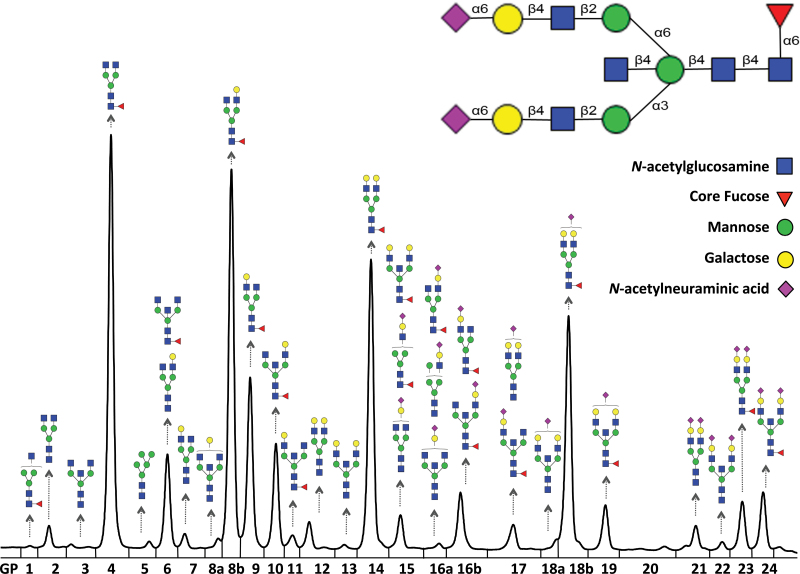
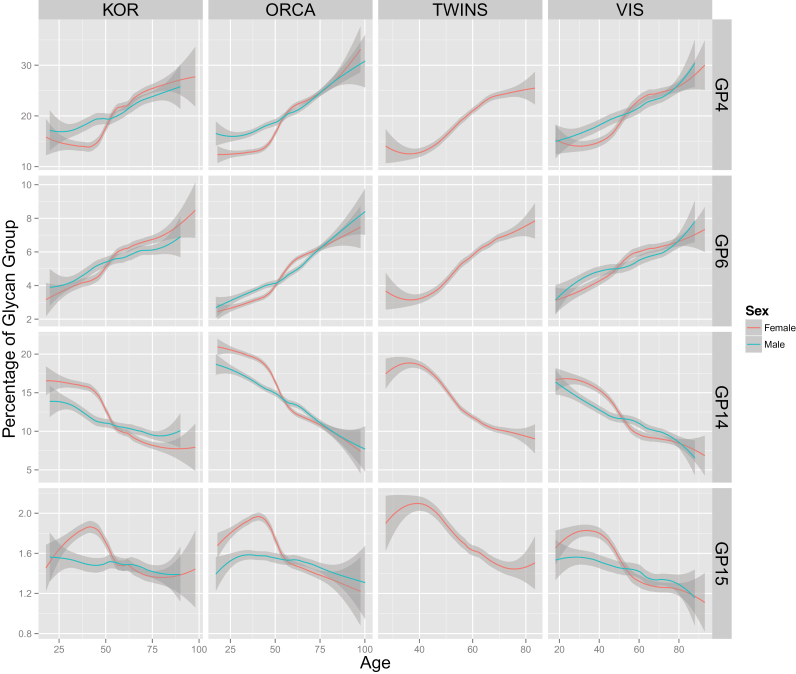
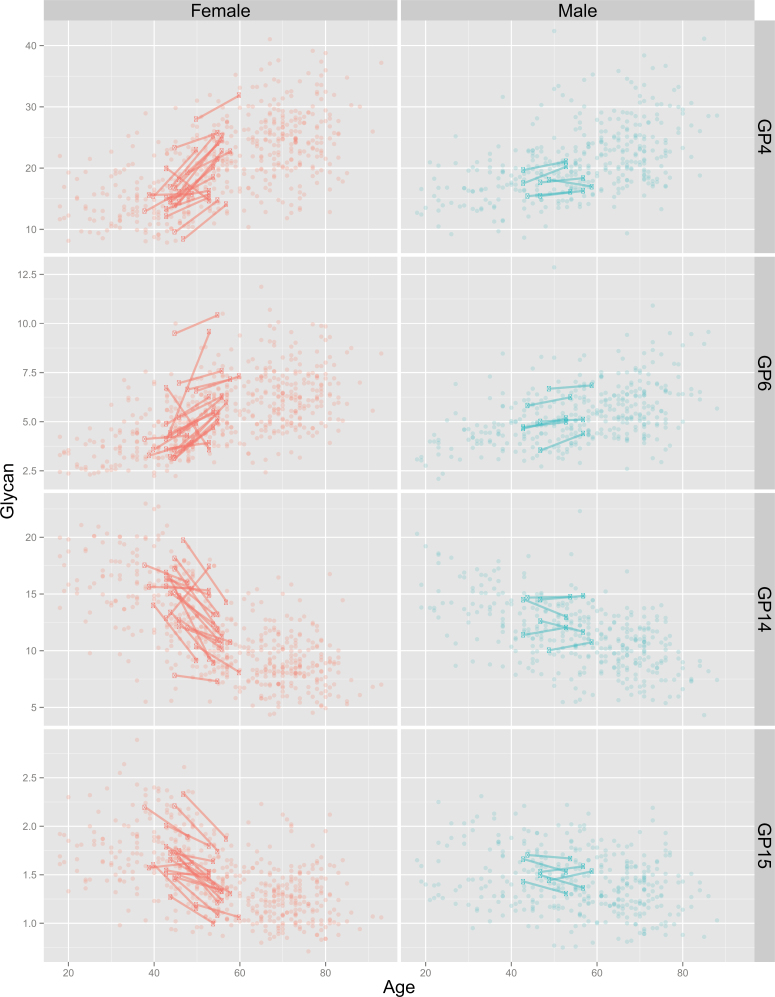
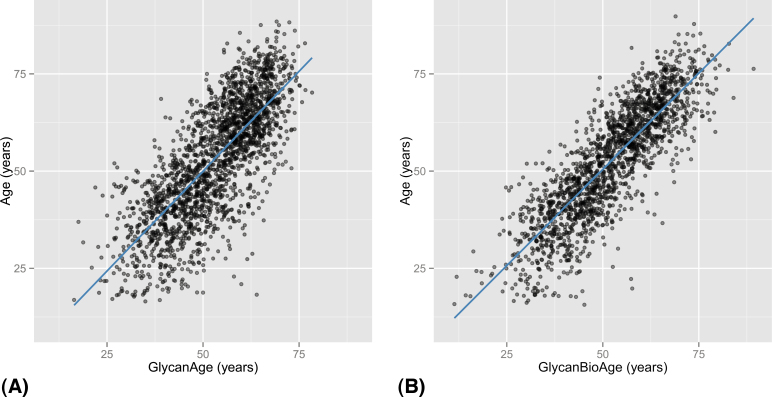
Fine structural details of glycans attached to the conserved N-glycosylation site significantly not only affect function of individual immunoglobulin G (IgG) molecules but also mediate inflammation at the systemic level. By analyzing IgG glycosylation in 5,117 individuals from four European populations, we have revealed very complex patterns of changes in IgG glycosylation with age. Several IgG glycans (including FA2B, FA2G2, and FA2BG2) changed considerably with age and the combination of these three glycans can explain up to 58% of variance in chronological age, significantly more than other markers of biological age like telomere lengths. The remaining variance in these glycans strongly correlated with physiological parameters associated with biological age. Thus, IgG glycosylation appears to be closely linked with both chronological and biological ages. Considering the important role of IgG glycans in inflammation, and because the observed changes with age promote inflammation, changes in IgG glycosylation also seem to represent a factor contributing to aging. SIGNIFICANCE STATEMENT: Glycosylation is the key posttranslational mechanism that regulates function of immunoglobulins, with multiple systemic repercussions to the immune system. Our study of IgG glycosylation in 5,117 individuals from four European populations has revealed very extensive and complex changes in IgG glycosylation with age. The combined index composed of only three glycans explained up to 58% of variance in age, considerably more than other biomarkers of age like telomere lengths. The remaining variance in these glycans strongly correlated with physiological parameters associated with biological age; thus, IgG glycosylation appears to be closely linked with both chronological and biological ages. The ability to measure human biological aging using molecular profiling has practical applications for diverse fields such as disease prevention and treatment, or forensics.
Overview
The claims and statistics of this paper haven’t been checked yet.
Run the check — free, no account needed. It reads the open-access text and checks the sources it cites.
Integrity signals
Registry
Cites
Statistics
Figures
Verification
Claims the paper makes
The claims and statistics of this paper haven’t been checked yet.
Run the check — free, no account needed. It reads the open-access text and checks the sources it cites.
Claims other papers make about this one
Each is checked against this paper’s own text: does it say what the citing paper says it does?
In the citing paper
“Although it is not yet possible to comprehensively survey the glycome, recent mass spectrometry studies examining the concentrations of just a few well-studied glycans have been able to accurately predict chronological age and ageing phenotypes.”
From Measuring biological age using omics data (2022) · cites this paper as [129]
In the citing paper
“Krištić et al.129 observed changes in the N-glycosylation pattern of serum IgG protein, which predicted age in multiple European cohorts.”
From Measuring biological age using omics data (2022) · cites this paper as [129]
In the citing paper
“Moreover, IgG glycan age correlated with clinical markers of metabolic health129.”
From Measuring biological age using omics data (2022) · cites this paper as [129]
In the citing paper
“We could thus not assess the association of facial aging with individual lifestyle parameters, endocrine status, or molecular aging markers (Krištić et al., 2014).”
From Facial aging trajectories: A common shape pattern in male and female faces is disrupted after menopause (2019) · cites this paper as Krištić et al., 2014
Self-check
Percentages, sums and reported differences re-computed from the paper’s own numbers.
The self-check needs the paper’s full text.
Citations
Cites
R: A Language and Environment for Statistical Computing
R Core Team (2000) · doi:10.32614/r.manuals · Cited by 355,893
A new look at the statistical model identification
Akaike, H. (1974) · IEEE Transactions on Automatic Control · doi:10.1109/tac.1974.1100705 · Cited by 51,879
Inflamm‐aging: An Evolutionary Perspective on Immunosenescence
FRANCESCHI, C., BONAFÈ, M., VALENSIN, S., OLIVIERI, F., DE LUCA, M., OTTAVIANI, E., & DE BENEDICTIS, G. (2000) · Annals of the New York Academy of Sciences · doi:10.1111/j.1749-6632.2000.tb06651.x · Cited by 5,358
Algebraic decay in hierarchical graphs
Garcia, A., Sonnino, G., Malek-Mansour, M.-A., & Baras, F. (1998) · Dépôt institutionnel de l'Université libre de Bruxelles (Université Libre de Bruxelles) · doi:10.1023/a · Cited by 5,186
Genome-wide methylation profiles reveal quantitative views of human aging rates
Hannum, G., Guinney, J., Zhao, L., Zhang, L., Hughes, G., Sadda, S., Klotzle, B., Bibikova, M., Fan, J.-B., Gao, Y., et al. (2013) · Molecular Cell · doi:10.1016/j.molcel.2012.10.016 · Cited by 4,270
ANew Look at the Statistical Model Identification
AKAlKE, H. (2011) · Cited by 4,177
Extending Healthy Life Span—From Yeast to Humans
Fontana, L., Partridge, L., & Longo, V. D. (2010) · Science · doi:10.1126/science.1172539 · Cited by 3,023
Physical Fitness and All-Cause Mortality: A Prospective Study of Healthy Men and Women
Blair, S. N. (1989) · JAMA · doi:10.1001/jama.1989.03430170057028 · Cited by 2,658
Glycosylation and the Immune System
Rudd, P. M., Elliott, T., Cresswell, P., Wilson, I. A., & Dwek, R. A. (2001) · Science · doi:10.1126/science.291.5512.2370 · Cited by 1,588
Metabolism of Inflammation Limited by AMPK and Pseudo-Starvation
O'Neill, L. A. J., & Hardie, D. G. (2013) · Nature · doi:10.1038/nature11862 · Cited by 1,133
Research works printed but not linked: 1
- Lauc, 2013, Loci associated with N-glycosylation of human immunoglobulin G show pleiotropy with autoimmune diseases and haematological cancers, PLoS Genet, 9, 10.1371/journal.pgen.1003225 · DOI
Cited by
Sorted by citations
Items 401–401 of 401
Wang, H., Wang, J., Meng, X., Sun, S., Li, J., & Wang, Y. (2026) · Mediators of Inflammation · doi:10.1155/mi/2146565
Metadata
- Authors
- Krištić, J., Vučković, F., Menni, C., Klarić, L., Keser, T., Beceheli, I., Pučić-Baković, M., Novokmet, M., Mangino, M., Thaqi, K., Rudan, P., Novokmet, N., Šarac, J., Missoni, S., Kolčić, I., Polašek, O., Rudan, I., Campbell, H., Hayward, C., Aulchenko, Y., Valdes, A., Wilson, J. F., Gornik, O., Primorac, D., Zoldoš, V., Spector, T., & Lauc, G.
- Affiliations
- King's College London (GB)
- University of Zagreb (HR)
- Institute for Anthropological Research (HR)
- University of Split (HR)
- University of Edinburgh (GB)
- Institute of Genetics and Cancer (GB)
- Institute of Cytology and Genetics (RU)
- University of Osijek (HR)
- Corresponding author
- Krištić, Jasminka
- Vučković, Frano
- ORCID
- Krištić, Jasminka
- Vučković, Frano
- Menni, Cristina
- Klarić, Lucija
- Keser, Toma
- Novokmet, Mislav
- Mangino, Massimo
- Novokmet, Natalija
- Šarac, Jelena
- Missoni, Saša
- Kolčić, Ivana
- Polašek, Ozren
- Rudan, Igor
- Hayward, Caroline
- Aulchenko, Yurii
- Valdes, Ana
- Wilson, James F.
- Gornik, Olga
- Primorac, Dragan
- Zoldoš, Vlatka
- Spector, Tim
- Lauc, Gordan
- Venue
- The Journals of Gerontology: Series A
- Publisher
- Oxford University Press (OUP)
- Published
- 2013-12-10
- Volume
- 69
- Issue
- 7
- Pages
- 779-789
- ISSN
- 1079-5006 (ISSN-L)
- 1758-535X
- PMC
- PMC4049143
- OpenAlex
- W2136722035
- Cited by
- 400
- References
- 52
- Citations by year
- 2026: 33 · 2025: 41 · 2024: 50 · 2023: 41 · 2022: 40 · 2021: 37 · 2020: 44 · 2019: 25 · 2018: 28 · 2017: 18 · 2016: 25 · 2015: 13 · 2014: 2 · 2013: 1
- FWCI
- 6.12
- Type
- journal article
- Language
- en
- Open access
- hybrid
- doi.org
- Licence
- cc-by-nc
- Locations
- The Journals of Gerontology Series A (publishedVersion, cc-by-nc)
- PubMed Central (publishedVersion, cc-by-nc)
- PubMed (publishedVersion)
- Research Portal (King's College London) (publishedVersion, other-oa)
- Archivio Istituzionale della Ricerca (Universita Degli Studi Di Milano) (submittedVersion, other-oa)
- Edinburgh Research Explorer (University of Edinburgh) (submittedVersion, cc-by-nc)
- Funders
- Wellcome Trust
- National Institute for Health and Care Research
- European Commission (305479)
- Russian Foundation for Basic Research
- National Institutes of Health
- Topics
- Life Sciences › Biochemistry, Genetics and Molecular Biology › Molecular Biology › Glycosylation and Glycoproteins Research
- Life Sciences › Biochemistry, Genetics and Molecular Biology › Clinical Biochemistry › Advanced Glycation End Products research
- Life Sciences › Immunology and Microbiology › Immunology › Monoclonal and Polyclonal Antibodies Research
- Keywords
- IgG glycosylation, glycans, biological age, chronological age, aging biomarkers, N-glycosylation, telomere length, inflammation, post-translational modification, IgG
- MeSH terms
- Adolescent, Adult, Aged, Aged, 80 and over, Aging, Female, Glycosylation, United Kingdom, Humans, Immunoglobulin G, Longevity, Male, Middle Aged, Models, Biological, Polysaccharides, Protein Processing, Post-Translational, Scotland, Cohort Studies, Biomarkers, Croatia, Inflammation Mediators, Young Adult
About these checks
Registry, retraction, Cites and statistics results are computed, not judged, with one exception: a printed reference that no index lists is read once by a model before it counts as a citation error. Claims are extracted by a model and kept only when their quote appears verbatim in the text; each cited source is then checked, with a model’s help, for whether it says what the claim relies on. Those verdicts can be wrong — read the claim’s quote and the cited source before relying on one.
Statistics and arithmetic are recomputed, not judged.
Confidence bands are shown only for fields calibrated on our annotated test set. None is calibrated yet, so no band is shown.
What counts as a claim ›How we measure confidence ›How we check this ›
Are you an author, or do you see a problem with this page? Request a review
