

The Development of Life Goals Across the Adult Life Span
The DOI matches its Crossref record; 46 of the 46 references it cites were found in a registry or an index; none of the 37 sources its claims cite is checked for support yet.
Abstract
Abstract Objectives Life goals are important organizing units for individual agency in development. On a societal level, they align with age-normative developmental tasks; on the individual level, they guide people’s attempts at shaping their own development. This study investigates the development of life goals across the adult life span with a focus on differences regarding gender, parental status, education, and region. Method Using longitudinal data from the German Socio-Economic Panel study (N = 52,052, age range: 18–84 years), we estimated the developmental trajectories of importance ratings for 9 life goals across the adult life span using multiple-group latent growth curve modeling. Results Having a happy relationship or marriage, having children, and being there for others are the life goals rated as most important across almost the entire adult life span. Having a happy relationship or marriage differed strongly by gender. Up to middle adulthood it was more important for women, but more important for men in late adulthood. Parental status amplified gender differences in the work and family domain. Low education was associated with a higher perceived importance of being there for others. The largest regional differences (East vs. West) were found for home ownership. Discussion Although the importance of some life goal trajectories reflects typical age-grading in developmental tasks, other life goals (e.g., having children) remain important even after goal attainment or after developmental deadlines have passed.
Overview
CoChat Summary
TL;DR
Using six waves of German Socio-Economic Panel data (N = 52,052; ages 18–84), this study models adult lifespan trajectories of nine life goals and finds that some goals track age-graded developmental tasks while others remain important after deadlines or attainment. Gender, parental status, education, and East/West region moderate several trajectories.
Key findings
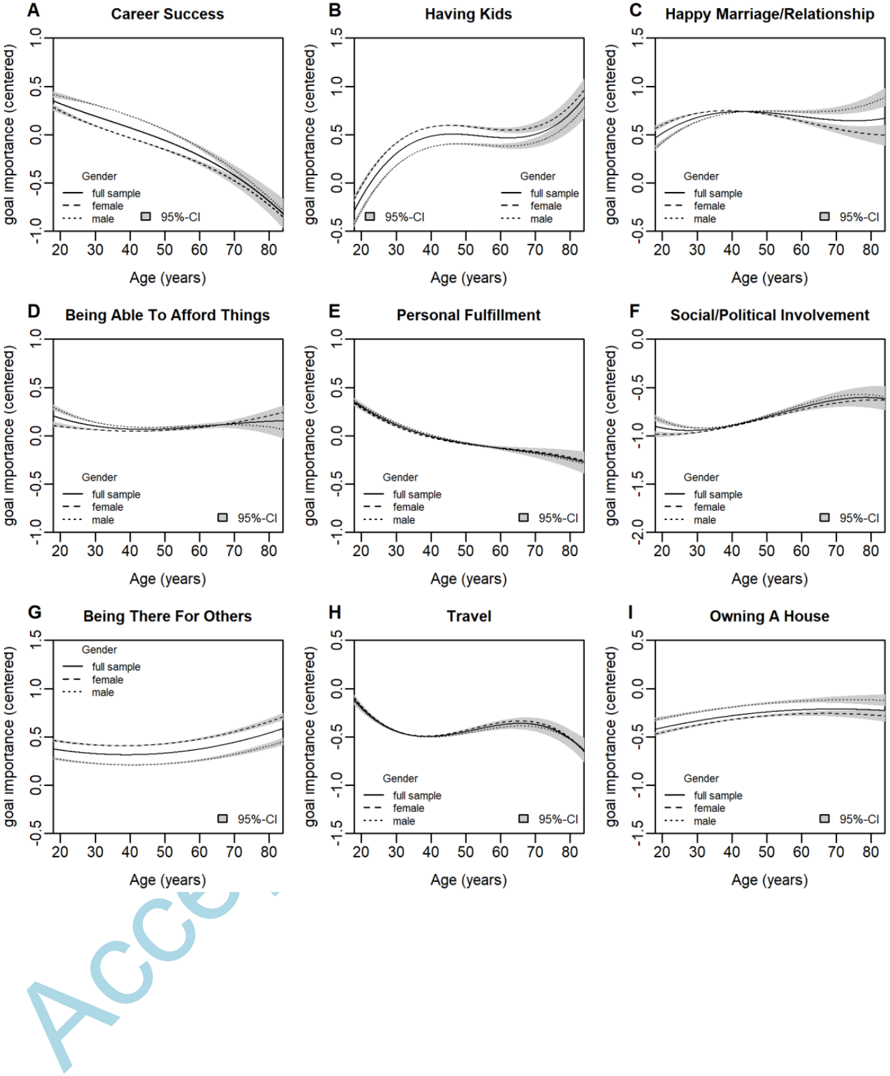
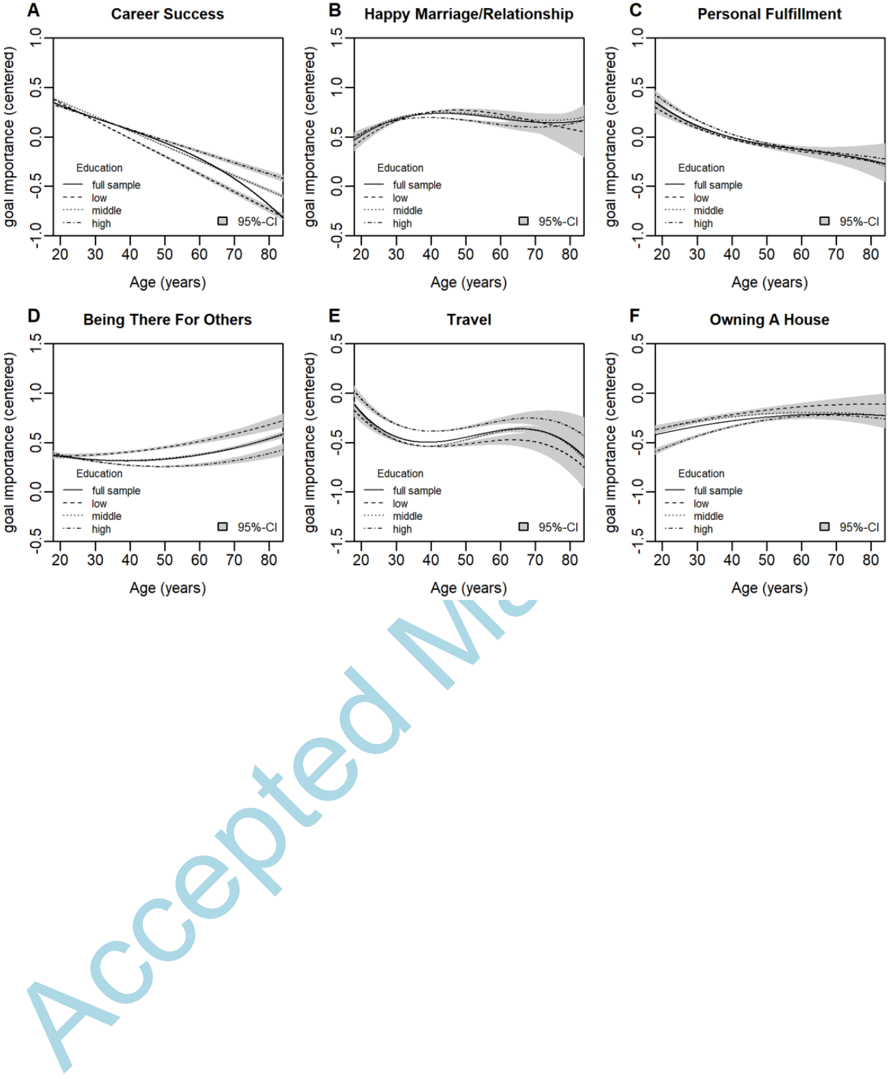
- Having a happy relationship or marriage, having children, and being there for others were rated as most important across almost the entire adult lifespan. The happy relationship/marriage goal differed strongly by gender: it was more important for women up to middle adulthood but more important for men in late adulthood; women rated it highest at age 33 (M = 0.801, SD = 0.464), men at age 84 (M = 0.907, SD = 0.634), with the largest gender difference at age 84 (Δ M84 M-F = 0.542 [0.374; 0.710], t(354) = 6.353, d = 0.680).
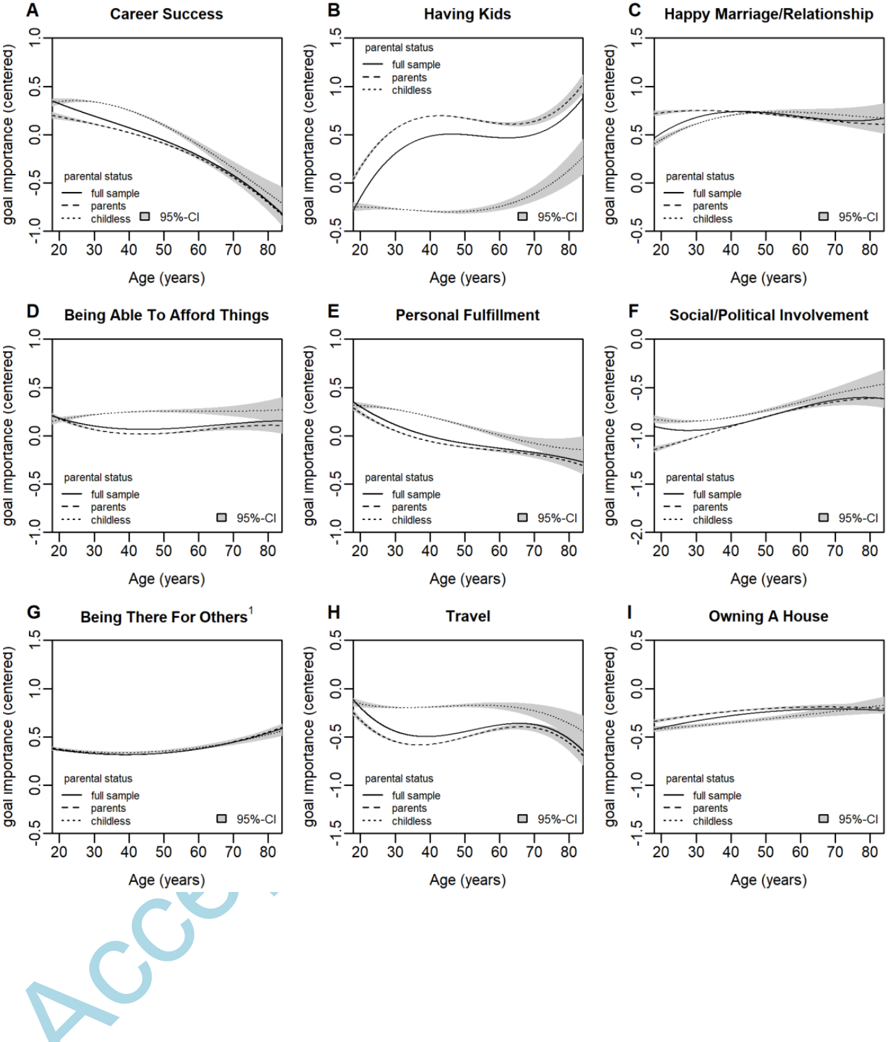
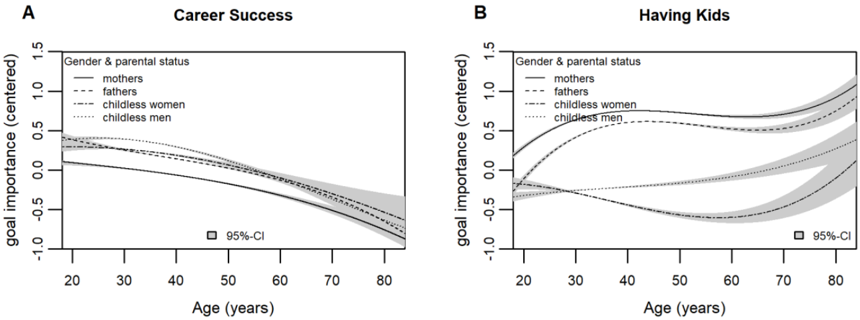
- Parental status amplified gender differences in the work and family domain. Parents and individuals who would later become parents rated life goals outside the family domain as less important than childless participants. Women consistently rated having children as somewhat more important than men (Δ M M-F = −0.356 [−0.421; −0.291], t(2068) = 10.708, d = 0.474), and career success was rated more important by men across all ages (largest difference at 46; Δ M M-F = 0.338 [0.152; 0.239], t(2767) = 8.757, d = 0.334).
- Low education was associated with a higher perceived importance of being there for others, while high education was associated with higher importance of a successful career. At age 60, group differences were highly significant for career [F(2,1636) = 34.22, p = 0.000, η² = 0.06] and being there for others [F(2,1541) = 8.255, p = 0.000, η² = 0.01]. Traveling was consistently more important among participants with high education.
- The largest regional differences (East vs. West) were found for home ownership: former West Germans increased in its importance, while former East Germans decreased after age 50, with the largest difference at age 77 (Δ M W-E = 0.567 [0.450; 0.730], t(884) = 8.2563, d = 0.632). Up to retirement age, career success was more important for individuals from the former East (greatest difference at age 52; Δ M W-E = −0.213 [−0.261; 0.149], t(1967) = −7.190, d = 0.354).
Methods
- Data came from the German Socio-Economic Panel study (SOEP, version 35), an ongoing annual multi-cohort longitudinal study of private households in Germany. The analysis used six waves (1992, 1995, 2004, 2008, 2012, 2016); respondents ranged from 50,616 for “being able to afford things for myself” to 52,052 for “being there for others,” with age range 18–84. Of all respondents, 52.85% were women; average participation was M = 2.20 (SD = 1.36) waves; 61.55% were married and living with spouse; mean children M = 1.47 (SD = 1.35); 28.88% remained childless throughout the study period.
- Nine life goals were assessed with normative importance ratings from 1 (very important) to 4 (not at all important), covering work/family, materialistic, self-realization, and altruistic domains. Ratings were centered at the wave-specific person-mean across all goals to measure priorities rather than response-scale use.
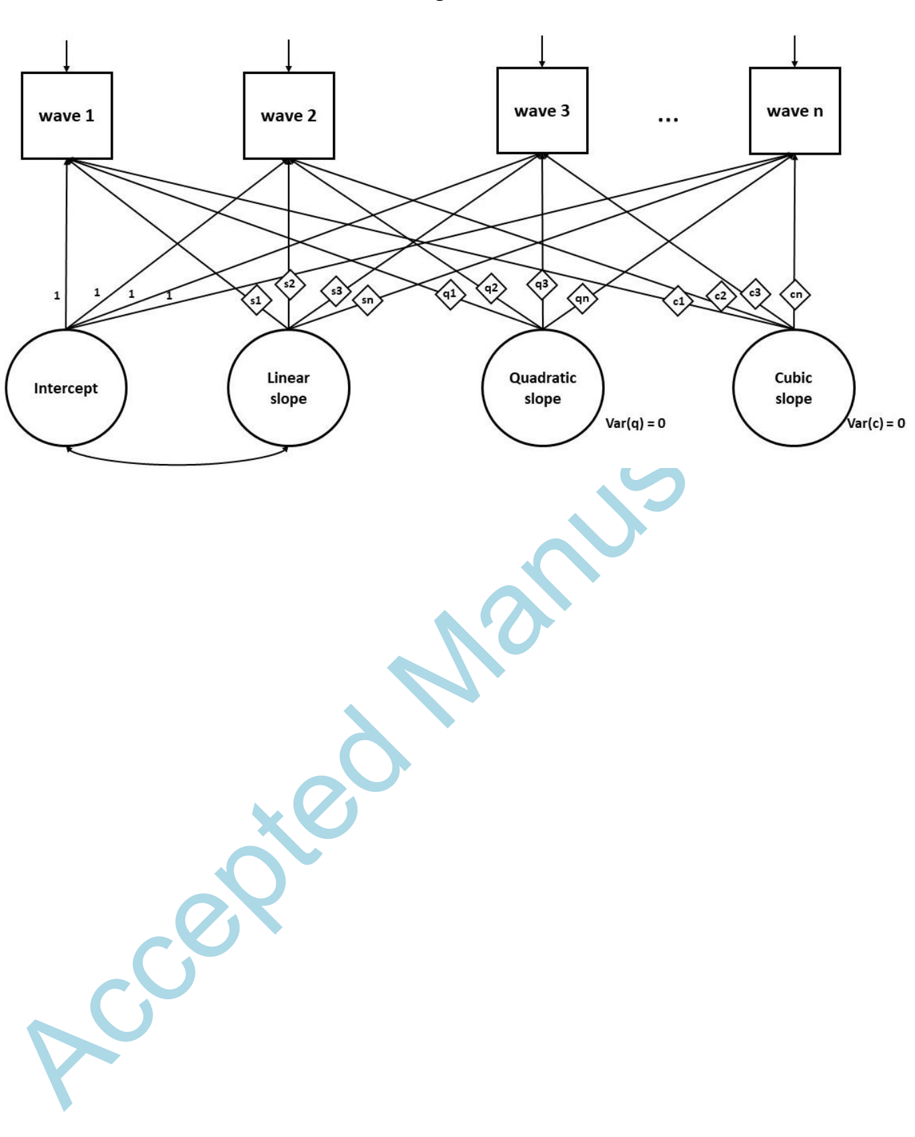
- Trajectories were estimated with multiple-group latent growth curve models in Mplus Version 8, using chronological age rather than measurement wave and individually varying slope loadings. Models included linear, quadratic, and cubic slope factors; model fit was assessed with BIC; moderator effects were tested by comparing constrained and unconstrained multiple-group models. For seven goals the cubic polynomial fit best; for “owning a house” and “being there for others,” the quadratic model had superior fit.
Limitations
- Stated: the SOEP followed participants over 24 years, not the entire lifespan; the cohort-sequential design assumes age-group changes are predominantly intra-individual rather than cohort effects, but cohort-specific analyses indicated this may not hold for all nine goals.
- Stated: the study used single-item measures for each goal and did not infer latent factors, which may allow varied interpretations, though the authors cite research supporting single-item stability and validity.
- Evident from the text: the sample is German SOEP data with East/West regional coding, age restricted below 85, and life goals assessed only in six waves (the 1990 wave was excluded because East German data were unavailable); there were no adoptive parents in the sample. These features limit generalization beyond Germany and beyond the measured goals/waves.
Model-written summary. Check it against the paper before relying on it.
Integrity signals
Registry
Cites
Statistics
Figures


Verification
Claims the paper makes
0 Valid · 6 Not valid · 30 Not checked · 98 Own results and interpretations
A result the paper states — it cites no source for it, so there is none to check. The quote shows it is in the paper.
In the paper
“The results for career success were similar for fathers and childless women.”
plain- Asserted: passes — The authors put it forward as true.
- Checkable: passes — It can be checked against evidence.
- Load-bearing: unclear — It is unclear whether the paper’s conclusions depend on it.
- Based: passes — The paper gives a reason why it holds.
- Rests on an assumption not shown here.
A result the paper reports from its own data — it cites no other source for it, so there is none to check. The quote shows it is in the paper.
In the paper
“Parental status amplified gender differences in the work and family domain.”
plainstates a cause- Asserted: passes — The authors put it forward as true.
- Checkable: passes — It can be checked against evidence.
- Load-bearing: passes — The paper’s conclusions depend on it.
- Based: passes — The paper gives a reason why it holds.
- Rests on an assumption not shown here.
A result the paper reports from its own data — it cites no other source for it, so there is none to check. The quote shows it is in the paper.
In the paper
“The largest regional differences (East vs. West) were found for home ownership.”
plainstates an association- Asserted: passes — The authors put it forward as true.
- Checkable: passes — It can be checked against evidence.
- Load-bearing: unclear — It is unclear whether the paper’s conclusions depend on it.
- Based: passes — The paper gives a reason why it holds.
- Rests on an assumption not shown here.
A result the paper reports from its own data — it cites no other source for it, so there is none to check. The quote shows it is in the paper.
In the paper
“Having a happy relationship or marriage, having children, and being there for others are the life goals rated as most important across almost the entire adult lifespan.”
plainn = 52,052- Asserted: passes — The authors put it forward as true.
- Checkable: passes — It can be checked against evidence.
- Load-bearing: passes — The paper’s conclusions depend on it.
- Based: passes — The paper gives a reason why it holds.
- Rests on an assumption not shown here.
A result the paper reports from its own data — it cites no other source for it, so there is none to check. The quote shows it is in the paper.
In the paper
“For seven life goals, the trajectories of importance ratings were best described by the model that included a cubic polynomial (see Supplementary Table 2).”
plain- Asserted: passes — The authors put it forward as true.
- Checkable: passes — It can be checked against evidence.
- Load-bearing: unclear — It is unclear whether the paper’s conclusions depend on it.
- Based: passes — The paper gives a reason why it holds.
- Rests on an assumption not shown here.
65 more claims
Create a free account to see all 134 claims and to verify the 26 references still open.
- Probably not a substantial claim. 39
- It may state two separate claims as one. 36
Statistics recomputed
Every reported test result, recomputed from its test statistic and degrees of freedom. A result shows as not adding up only once an independent check has confirmed it.
- ConsistentF(2, 1933) = 0.481reported p = .618 · recomputed p = .618
“F(2,1933)=0.481, p = .618”
- ConsistentF(2, 1892) = 1.773reported p = .17 · recomputed p = .170
“F(2,1892)=1.773, p = .170”
Self-check
Percentages, sums and reported differences re-computed from the paper’s own numbers.
Each contradiction between two passages listed here was confirmed by an independent check.
Rated major: it would touch a result — a value a result rests on, reported and recomputed p-values on opposite sides of the significance level, two passages that conflict with no sign which is right, or a cited work retracted before this paper was published.
In the paper
§ Region · p. 13
“∆ M M-F = 0.338”
§ Region · p. 13
“[0.152;0.239]”
Rated minor: it would not touch a result — a value no result rests on, a p-value that stays on the same side of the significance level, or a conflict that is clerical, resolved elsewhere in the paper, or outside its own findings.
In the paper
§ Region · p. 15
“∆ M W-E = -0.213[-0.261; 0.149;]”
§ Region · p. 15
“t (1967)=-7.190”
Rated minor: it would not touch a result — a value no result rests on, a p-value that stays on the same side of the significance level, or a conflict that is clerical, resolved elsewhere in the paper, or outside its own findings.
In the paper
§ Region · p. 12
“∆ Mage83 M-F = -0.217[-0.330;0.104]”
§ Region · p. 12
“t (493)=-3.775”
Rated minor: it would not touch a result — a value no result rests on, a p-value that stays on the same side of the significance level, or a conflict that is clerical, resolved elsewhere in the paper, or outside its own findings.
In the paper
§ Region · p. 12
“∆ M M-F = 0.118”
§ Region · p. 12
“[-0.268;0.033]”
Citations
Cites
An overview of the Schwartz theory of basic values
Schwartz, S. H. (2012) · Online Readings in Psychology and Culture · doi:10.9707/2307-0919.1116 · Cited by 4,147
Goal constructs in psychology: Structure, process, and content.
Austin, J. T., & Vancouver, J. B. (1996) · Psychological Bulletin · doi:10.1037/0033-2909.120.3.338 · Cited by 2,319
A motivational theory of life-span development.
Heckhausen, J., Wrosch, C., & Schulz, R. (2010) · Psychological Review · doi:10.1037/a0017668 · Cited by 1,486
Self-citationHaving less, giving more: The influence of social class on prosocial behavior.
Piff, P. K., Kraus, M. W., Côté, S., Cheng, B. H., & Keltner, D. (2010) · Journal of Personality and Social Psychology · doi:10.1037/a0020092 · Cited by 1,478
Eccles, J. S. (1994) · Psychology of Women Quarterly · doi:10.1111/j.1471-6402.1994.tb01049.x · Cited by 1,291
How do adolescents see their future? A review of the development of future orientation and planning
NURMI, J. (1991) · Developmental Review · doi:10.1016/0273-2297(91)90002-6 · Cited by 1,252
Life Span Theory in Developmental Psychology
Baltes, P. B., Lindenberger, U., & Staudinger, U. M. (2007) · Handbook of Child Psychology · doi:10.1002/9780470147658.chpsy0111 · Cited by 1,240
The German Socio-Economic Panel (SOEP)
Goebel, J., Grabka, M. M., Liebig, S., Kroh, M., Richter, D., Schröder, C., & Schupp, J. (2019) · Jahrbücher für Nationalökonomie und Statistik · doi:10.1515/jbnst-2018-0022 · Cited by 950
Self-citationEbner, N. C., Freund, A. M., & Baltes, P. B. (2006) · Psychology and Aging · doi:10.1037/0882-7974.21.4.664 · Cited by 764
Preacher, K., Wichman, A., MacCallum, R., & Briggs, N. (2008) · doi:10.4135/9781412984737 · Cited by 742
Research works printed but not linked: 3
- Havighurst, 1948, Developmental tasks and education
- Muthén, 1998–2017, Mplus user’s guide
- Stephan, 1990, Lohnstruktur und Lohndifferenzierung in der DDR, Mitteilungen Aus Der Arbeits- Und Berufsforschung, 23, 550
Cited by
Still being checked.
Metadata
- Authors
- Buchinger, L., Richter, D., & Heckhausen, J.
- Affiliations
- German Institute for Economic Research (DE)
- University of California, Irvine (US)
- Corresponding author
- Buchinger, Laura
- Venue
- The Journals of Gerontology: Series B
- Publisher
- Oxford University Press (OUP)
- Published
- 2021-08-21
- Volume
- 77
- Issue
- 5
- Pages
- 905-915
- ISSN
- 1079-5014 (ISSN-L)
- 1758-5368
- OpenAlex
- W3195128044
- Cited by
- 60
- References
- 46
- Citations by year
- 2026: 15 · 2025: 17 · 2024: 17 · 2023: 8 · 2022: 3
- FWCI
- 5.79
- Type
- journal article
- Language
- en
- Open access
- closed
- Licence
- academic.oup.com/journals/pages/open_access/funder_policies/chorus/standard_publication_model (vor)
- Locations
- The Journals of Gerontology Series B (publishedVersion)
- PubMed (publishedVersion)
- RePEc: Research Papers in Economics (submittedVersion)
- Econstor (Econstor) (submittedVersion)
- Funders
- Federal Ministry of Education and Research (01UJ1911BY)
- Topics
- Social Sciences › Psychology › Developmental and Educational Psychology › Aging and Gerontology Research
- Social Sciences › Psychology › Social Psychology › Psychological Well-being and Life Satisfaction
- Social Sciences › Psychology › Developmental and Educational Psychology › Identity, Memory, and Therapy
- Keywords
- life goals, adult development, lifespan development, developmental tasks, gender differences, parental status, regional variation, East and West Germany, homeownership, having children, developmental trajectories, individual agency
- MeSH terms
- Achievement, Adult, Aged, Aged, 80 and over, Educational Status, Female, Goals, Humans, Longevity, Male, Motivation
About these checks
Registry, retraction, Cites and statistics results are computed, not judged, with one exception: a printed reference that no index lists is read once by a model before it counts as a citation error. Claims are extracted by a model and kept only when their quote appears verbatim in the text; each cited source is then checked, with a model’s help, for whether it says what the claim relies on. Those verdicts can be wrong — read the claim’s quote and the cited source before relying on one.
A language model drew the claims from the paper on 2026-11-26, under version 3 of the claim definition (model deepseek-v4.1-flash, prompt extract-v3).
A second model labelled each claim on 2026-11-26 (model jev-1.13-20260917, definition revision gold-guideline-v0.2).
Statistics and arithmetic are recomputed, not judged.
Confidence bands are shown only for fields calibrated on our annotated test set. None is calibrated yet, so no band is shown.
What counts as a claim ›How we measure confidence ›How we check this ›
Are you an author, or do you see a problem with this page? Request a review
Data sources
Bibliographic data: Semantic Scholar, OpenAlex, Crossref.
Contains information from the Semantic Scholar Academic Graph Datasets, made available under the ODC Attribution License (ODC-BY 1.0).
Semantic Scholar’s data is described in: Kinney, R., et al. (2023). The Semantic Scholar Open Data Platform. arXiv:2301.10140.
