

Digital Ageism: Challenges and Opportunities in Artificial Intelligence for Older Adults
Open accessThe DOI matches its Crossref record; 54 of the 56 references it cites were found in a registry or an index; 2 of the 86 sources its claims cite were checked for support.
Abstract
Artificial intelligence (AI) and machine learning are changing our world through their impact on sectors including health care, education, employment, finance, and law. AI systems are developed using data that reflect the implicit and explicit biases of society, and there are significant concerns about how the predictive models in AI systems amplify inequity, privilege, and power in society. The widespread applications of AI have led to mainstream discourse about how AI systems are perpetuating racism, sexism, and classism; yet, concerns about ageism have been largely absent in the AI bias literature. Given the globally aging population and proliferation of AI, there is a need to critically examine the presence of age-related bias in AI systems. This forum article discusses ageism in AI systems and introduces a conceptual model that outlines intersecting pathways of technology development that can produce and reinforce digital ageism in AI systems. We also describe the broader ethical and legal implications and considerations for future directions in digital ageism research to advance knowledge in the field and deepen our understanding of how ageism in AI is fostered by broader cycles of injustice.
Overview
CoChat Summary
TL;DR
This forum article defines digital ageism as age bias in AI and proposes a conceptual model of intersecting technology-development pathways that produce and reinforce it. It argues ageism is largely absent from AI bias literature and ethics guidelines, and calls for including older adults across AI research, design, and policy.
Key findings
- In a search of AlgorithmWatch’s AI Ethics Guidelines Global Inventory, only 34 of 146 English-language documents (23.3%) mentioned ageism, with 53 unique mentions; 19 (54.7%) merely listed “age” as a protected characteristic and only 12 (8.2%) gave slightly more context.
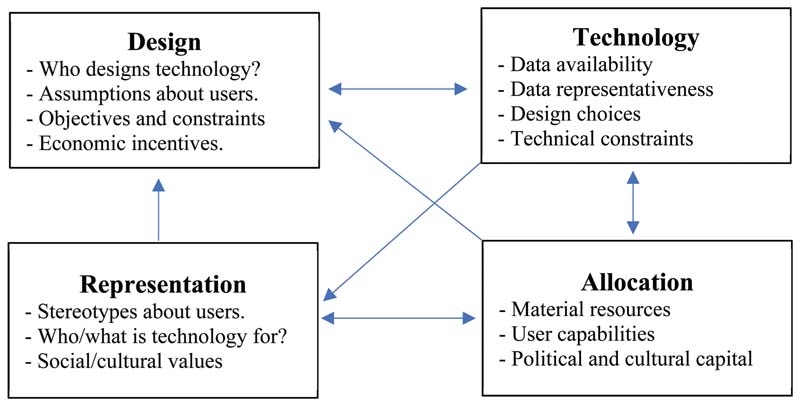
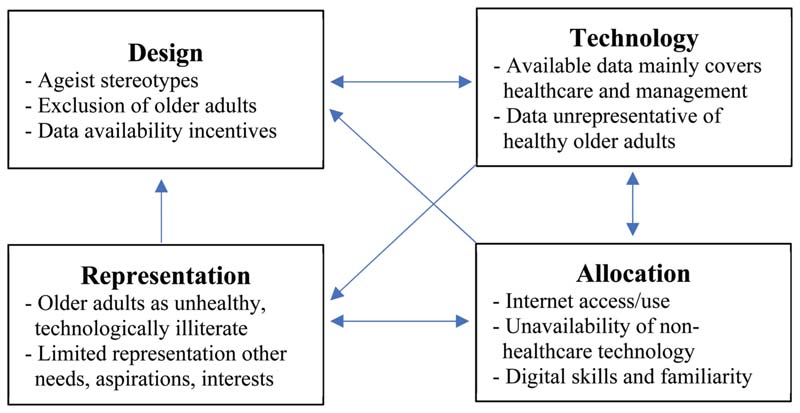
- The article describes a cycle of injustice: ageist stereotypes (representation) shape design assumptions, exclude older adults from research and design, produce health-focused technologies and biased or limited data, entrench the digital divide, and reinforce stereotypes.
- Cited evidence includes Díaz et al.’s finding that sentences containing “young” were 66% more likely to be scored positively than the same sentences containing “old,” and word embeddings associated “youth” with “courageous” and “old”/“older” with “stubborn”/“obstinate.” It also cites internet nonuse rates of 52% among those 65+ and 92% among those 80–84 in 17 European countries, and Toronto data showing 30% of residents 60+ lack an internet-connected device.
- Legal and ethical concerns include AI hiring tools and ad platforms excluding older applicants through graduation-year filters or age-based targeting, raising fair equality of opportunity issues; the paper notes there is no uniform global legal code for AI governance and proprietary algorithms can limit scrutiny.
Methods
- Forum/conceptual article that introduces the term digital ageism and a conceptual model of pathways producing and reinforcing age bias in AI.
- Document review: searched the AI Ethics Guidelines Global Inventory (AlgorithmWatch, 2021), comprising 146 accessible English-language documents, for terms including ageism, age bias, age, old/older, senior(s), and elderly.
- Main analysis is conceptual synthesis of AI bias literature, the digital divide, ageist cycles of injustice, and ethical/legal implications; no primary empirical data collection is reported.
Limitations
- The paper states no formal limitations section.
- Evident from the methods: the ethics-guideline review was limited to 146 English-language documents in one repository, so it may not represent all AI ethics guidance.
- Evident from the article type: as a forum article, it is conceptual and calls for future research; it does not report original empirical tests of age bias in AI systems.
Model-written summary. Check it against the paper before relying on it.
Integrity signals
Registry
Cites
Statistics
Figures
Verification
Claims the paper makes
1 Valid · 2 Not valid · 64 Not checked · 29 Own results and interpretations
The cited sources that could be checked couldn’t confirm or dispute this claim.
In the paper
“Current research examining biases in AI is largely focused on racial and gender biases and the serious consequences that arise as a result (Zhavoronkov et al., 2019)”
§ Digital Ageism: Challenges and Opportunities in Artificial Intelligence for Older Adults > Abstract
What the sources say
- Could not verifycites Zhavoronkov et al., 2019 matched to “Artificial intelligence for aging and longevity research: Recent advances and perspectives” (2019) sourceExperimental — accuracy not yet measured
Our full-text copy (not truncated) contains no discussion of research on AI bias, racial or gender bias, or the consequences thereof. Searches for 'bias/fairness/demographic underrepresentation', 'algorithmic bias/discrimination', and 'ethical challenges/risks' returned only the paper's treatment of reliability, feature interpretability (Sec. 7 and Sec. 1 Introduction), and privacy/regulatory issues (GDPR, FDA/EU medical-device regulation passages under 'AI by making the DNNs more interpretable'). The nearest content is Sec. 4.1.3, which notes that deep biomarkers of aging are population-dependent across ethnic groups (Canada, South Korea, Eastern Europe) and includes patient sex and population type as model features, but that is about population specificity of predictors, not about bias research being focused on racial and gender biases. Nothing in our copy supports or contradicts the attributed statement, so it cannot be verified against this source. (LLM, conf=0.72)
plain- Asserted: passes — The authors put it forward as true.
- Checkable: passes — It can be checked against evidence.
- Load-bearing: passes — The paper’s conclusions depend on it.
- Based: passes — The paper gives a reason why it holds.
- Could not verify
A result the paper states — it cites no source for it, so there is none to check. The quote shows it is in the paper.
In the paper
“concerns about ageism have been largely absent in the AI bias literature”
- Also stated in: § Biases in AI Systems · plain
“In the literature examining biases in AI, age-related bias is seldom discussed in comparison to racial and gender biases.”
- Also stated in: § Abstract · plain
“little attention has been paid to age-related bias (known as ageism) in AI”
§ Digital Ageism: Challenges and Opportunities in Artificial Intelligence for Older Adults > Abstract
plain- Asserted: passes — The authors put it forward as true.
- Checkable: passes — It can be checked against evidence.
- Load-bearing: passes — The paper’s conclusions depend on it.
- Based: passes — The paper gives a reason why it holds.
- Also stated in: § Biases in AI Systems · plain
A result the paper reports from its own data — it cites no other source for it, so there is none to check. The quote shows it is in the paper.
In the paper
“Of these, 19 (54.7%) merely listed “age” as part of a general list of protected characteristics.”
§ Digital Ageism: Challenges and Opportunities in Artificial Intelligence for Older Adults > Ethical and Legal Implications of Ageism in AI
plain- Asserted: passes — The authors put it forward as true.
- Checkable: passes — It can be checked against evidence.
- Load-bearing: passes — The paper’s conclusions depend on it.
- Based: passes — The paper gives a reason why it holds.
- Rests on an assumption not shown here.
A result the paper reports from its own data — it cites no other source for it, so there is none to check. The quote shows it is in the paper.
In the paper
“Ageism is an overlooked bias within AI ethics.”
§ Digital Ageism: Challenges and Opportunities in Artificial Intelligence for Older Adults > Ethical and Legal Implications of Ageism in AI
plain- Asserted: passes — The authors put it forward as true.
- Checkable: passes — It can be checked against evidence.
- Load-bearing: passes — The paper’s conclusions depend on it.
- Based: passes — The paper gives a reason why it holds.
- Rests on an assumption not shown here.
A result the paper reports from its own data — it cites no other source for it, so there is none to check. The quote shows it is in the paper.
In the paper
“We found that only 34 (23.3%) of these documents mention ageism as a bias for a total of 53 unique mentions.”
§ Digital Ageism: Challenges and Opportunities in Artificial Intelligence for Older Adults > Ethical and Legal Implications of Ageism in AI
plain- Asserted: passes — The authors put it forward as true.
- Checkable: passes — It can be checked against evidence.
- Load-bearing: passes — The paper’s conclusions depend on it.
- Based: passes — The paper gives a reason why it holds.
- Rests on an assumption not shown here.
48 more claims
Create a free account to see all 96 claims and to verify the 84 references still open.
- It may state two separate claims as one. 27
- Probably not a substantial claim. 21
Claims other papers make about this one
Each is checked against this paper’s own text: does it say what the citing paper says it does?
The source backs part of the claim, not all of it — or backs it for a different population, condition or comparison.
In the citing paper
“a concept that has emerged and is gaining traction as an outgrowth of it is “digital ageism””
From Algorithmic harms and digital ageism in the use of surveillance technologies in nursing homes (2022) · cites this paper as Chu et al., 2022
Experimental — accuracy not yet measuredThe source backs part of the claim, not all of it — or backs it for a different population, condition or comparison.
In the citing paper
“Researchers are thus making the case that concerns of ageism belong in the AI bias literature alongside racism, ableism, and sexism”
From Algorithmic harms and digital ageism in the use of surveillance technologies in nursing homes (2022) · cites this paper as Chu et al., 2022
Experimental — accuracy not yet measuredThe source backs part of the claim, not all of it — or backs it for a different population, condition or comparison.
In the citing paper
“Older adults' acts of resistance and rejection, along with reports of intentional non-adoption for reasons other than access or digital literacy barriers, are frequently overlooked in the framing of the problem (see Chu et al., 2022).”
From Algorithmic harms and digital ageism in the use of surveillance technologies in nursing homes (2022) · cites this paper as Chu et al., 2022
Experimental — accuracy not yet measured
Self-check
Percentages, sums and reported differences re-computed from the paper’s own numbers.
Each contradiction between two passages listed here was confirmed by an independent check.
Rated minor: it would not touch a result — a value no result rests on, a p-value that stays on the same side of the significance level, or a conflict that is clerical, resolved elsewhere in the paper, or outside its own findings.
In the paper
§ Digital Ageism: Challenges and Opportunities in Artificial Intelligence for Older Adults > Looking Ahead
“(Wiggers, 2021)”
§ Digital Ageism: Challenges and Opportunities in Artificial Intelligence for Older Adults > References
“71. Wiggers K Plum uses AI to hire people ‘that never would have been discovered through a traditional hiring process.’ VentureBeat 2018”
Rated minor: it would not touch a result — a value no result rests on, a p-value that stays on the same side of the significance level, or a conflict that is clerical, resolved elsewhere in the paper, or outside its own findings.
In the paper
“We found that only 34 (23.3%) of these documents mention ageism as a bias for a total of 53 unique mentions. Of these, 19 (54.7%) merely listed "age" as part of a general list of protected characteristics.”
§ Digital Ageism: Challenges and Opportunities in Artificial Intelligence for Older Adults > Ethical and Legal Implications of Ageism in AI
Reported 54.7 · recomputed 55.882353
Citations
Cites
Artificial intelligence: A modern approach
Nilsson, N. J. (1996) · Artificial Intelligence · doi:10.1016/0004-3702(96)00007-0 · Cited by 10,583
Dissecting racial bias in an algorithm used to manage the health of populations
Obermeyer, Z., Powers, B., Vogeli, C., & Mullainathan, S. (2019) · Science · doi:10.1126/science.aax2342 · Cited by 7,137 · cited 1×
“For instance, a widely deployed AI algorithm was shown to underestimate the health risks of Black patients compared to White patients (Obermeyer et al., 2019).”
Semantics derived automatically from language corpora contain human-like biases
Caliskan, A., Bryson, J. J., & Narayanan, A. (2017) · Science · doi:10.1126/science.aal4230 · Cited by 2,887 · cited 1×
“…data but also text (i.e., corpus), which insidiously encodes historical–cultural associations that result in semantic biases, such as associations between stereotypical male names and working in the labor force or, conversely, female names and family/child-rearing (Caliskan et al., 2017).”
Age-Ism: Another Form of Bigotry
Butler, R. N. (1969) · The Gerontologist · doi:10.1093/geront/9.4_part_1.243 · Cited by 2,291 · cited 2×
“, 2019); however, little attention has been paid to agerelated bias (known as ageism) in AI (Butler, 1969).”
The Digital Divide as a Complex and Dynamic Phenomenon
van Dijk, J., & Hacker, K. (2003) · The Information Society · doi:10.1080/01972240309487 · Cited by 1,616
The Handbook of aging and cognition
(1993) · Choice Reviews Online · doi:10.5860/choice.30-3520 · Cited by 1,587
Friedman, B., & Nissenbaum, H. (1996) · ACM Transactions on Information Systems · doi:10.1145/230538.230561 · Cited by 1,203 · cited 2×
“A system discriminates unfairly if it denies an opportunity or a good or if it assigns an undesirable outcome to an individual or group of individuals on grounds that are unreasonable or inappropriate" (Friedman & Nissenbaum, 1996, p. 332).”
Amazon Scraps Secret AI Recruiting Tool that Showed Bias against Women *
Dastin, J. (2022) · Ethics of Data and Analytics · doi:10.1201/9781003278290-44 · Cited by 1,165
Impact of digital surge during COVID-19 pandemic: A viewpoint on research and practice
De’, R., Pandey, N., & Pal, A. (2020) · International Journal of Information Management · doi:10.1016/j.ijinfomgt.2020.102171 · Cited by 1,110 · cited 2×
“There is a pressing need to address these foundational questions especially with the surge of digital technology use during the COVID-19 pandemic (De’ et al., 2020).”
Tech Adoption Climbs Among Older Adults
Perrin, M. A. A. A. (2017) · Cited by 1,069
Research works printed but not linked: 10
- Ajunwa I How artificial intelligence can make employment discrimination worse The Independent 2018 https://suindependent.com/artificial-intelligence-can-make-employment-discrimination-worse/
- American Civil Liberties Union Facebook agrees to sweeping reforms to curb discriminatory ad targeting practices 2019 https://www.aclu.org/press-releases/facebook-agrees-sweeping-reforms-curb-discriminatory-ad-targeting-practices
- Angwin J Kirchner L Larson J Mattu S Machine bias: There’s software used across the country to predict future criminals. And it’s biased against blacks ProPublica 2016
- Brown P Artificial intelligence: The fastest moving technology New York Law Journal 2020 https://www.law.com/newyorklawjournal/2020/03/09/artificial-intelligence-the-fastest-moving-technology/
- Cotten SR McCullough BM Adams RG Technological influences on social ties across the lifespan S 2011 https://www.springerpub.com/
- Crawford K The trouble with bias—NIPS 2017 Keynote—Kate Crawford #NIPS2017 The Artificial Intelligence Channel 2017 https://www.youtube.com/watch?v=fMym_BKWQzk
- Ho C Martin M Ratican S Teneja D West S How to mitigate algorithmic bias in healthcare MedCityNews 2020 https://medcitynews.com/2020/08/how-to-mitigating-algorithmic-bias-in-healthcare/
- Kuei J Mixon M Legal risks of using artificial intelligence in hiring The Center for Association Leadership 2020 https://www.asaecenter.org/resources/articles/an_plus/2020/may/legal-risks-of-using-artificial-intelligence-in-hiring
- Presser J Beatson J Chan G Litigating artificial intelligence Emond Montgomery Publications Limited 2021 https://emond.ca/ai21
- Srinuan C Bohlin E Understanding the digital divide: A literature survey and ways forward 22nd European Regional Conference of the International Telecommunications Society (ITS2011) 2011 https://www.econstor.eu/handle/10419/52191
Cited by
Items 101–200 of 282
Du, J., Jin, T., Niu, R., Zhai, Y., & Fu, X. (2024) · International Symposium of Chinese CHI (Chinese CHI) · doi:10.1145/3758871.3758891 · Cited by 7
AI‐Augmented Leadership: How, Why, and When Leaders' Collaboration With AI Enhances Team Performance
Liu, P., Watts, D. I., Li, X., Wang, X., & Li, A. (2026) · Journal of Organizational Behavior · doi:10.1002/job.70070 · Cited by 7
Liao, J., Wei, Z., Yang, Z., Xu, X., Hui, P., He, C., & Zhou, M. (2025) · CHI Conference on Human Factors in Computing Systems · doi:10.1145/3706598.3713763 · Cited by 6
“These negative stereotypes can lead to a lack of popularity for their content, which may be reflected in platform algorithms’ visibility mechanisms [21].”
Jiang, Y., Pan, C., & Han, X. (2025) · Business & Society · doi:10.1177/00076503251343124 · Cited by 5
“Previous literature on corporate digital responsibility has largely overlooked age as a key factor, particularly the issue of age discrimination in artificial intelligence (Chu et al., 2022; Stypinska, 2021).”
Liu, Z., & Zadeh, R. S. (2025) · Gerontology & Geriatrics Education · doi:10.1080/02701960.2025.2551963 · Cited by 5
Technology anxiety and technology enthusiasm versus digital ageism
Berner, J., Dallora, A. L., Berglund, J. S., & Anderberg, P. (2022) · Gerontechnology · doi:10.4017/gt.2023.21.1.813.02 · Cited by 4
“Those who are slower in the uptake of participating or being online, have been indicative of ageism (Chu et al., 2022).”
BackgroundInfluentialThermal Image Processing for Respiratory Estimation from Cubical Data with Expandable Depth
Szankin, M., Kwaśniewska, A., & Rumiński, J. (2023) · Journal of Imaging · doi:10.3390/jimaging9090184 · Cited by 6
Artificial intelligence and rehabilitation: what’s new and promising
Marks, R. (2023) · International Physical Medicine & Rehabilitation Journal · doi:10.15406/ipmrj.2023.08.00348 · Cited by 4
The impact of AI bias on social justice: challenges and solutions
Ma, J. (2024) · Journal of Computing and Electronic Information Management · doi:10.54097/wz9v0f43 · Cited by 2
“Ultimately, clinical decisions based on AI bias will induce health equity issues and exacerbate the implicit bias of data generation and collection in the process of practical application, creating a vicious cycle of algorithmic bias [18].”
Cheng, H., Yang, H., & Sun, Y. (2025) · International Journal of Educational Research · doi:10.1016/j.ijer.2025.102616 · Cited by 2
Villegas, O. O. V., Sánchez, V. G. C., Rubín-Alvarado, A. A., Gante-Díaz, S. A., Vázquez, J. A. C., Areyzaga-Mendizábal, B., Montiel-Pérez, J. Y., Sossa, H., Huerta-Trujillo, I., & Herrera, R. R. (2025) · Computers · doi:10.3390/computers14100421 · Cited by 3
Jarchow, H., Bobrowski, C., Falk, S. S. I., Hermann, A., Kulaga, A. Y., Põder, J.-C., Unfried, M., Usanov, N., Zendeh, B., Kennedy, B. K., et al. (2025) · npj Digital Medicine · doi:10.1038/s41746-025-01996-2 · Cited by 10
Automation and the Future of Work in Aging Economies
Krishna, M. U. V., Hiremath, S. M., Raja, M. A., Agrawal, R. K., Roy, S. S., Selvakumar, P., & Manjunath, T. C. (2025) · IGI Global eBooks · doi:10.4018/979-8-3373-2550-7.ch007 · Cited by 2
Connections, negotiations, and tensions: Talking tech with older adults
Dalmer, N. K., Katz, S., Marshall, B., & Ellison, K. (2025) · Mobile Media & Communication · doi:10.1177/20501579251394803 · Cited by 2
“Older adults are often portrayed as too dependent, impaired, or simply too old to easily adopt technological products and interventions (Chu et al., 2022; Mannheim et al., 2023).”
Nejadshamsi, S., Chu, C. H., McGilton, K. S., Li, X., Ronquillo, C., & Rahimi, S. A. (2025) · JAMIA Open · doi:10.1093/jamiaopen/ooaf171 · Cited by 3
“Moreover, ethical frameworks proposed by Chu et al. 33 highlight the need for engagement of older adults to address age-related bias as well as Manuel et al. 34 stress the need for diverse stakeholder engagement, such as non-binary individuals or Indigenous populations, in the model development process to address unde…”
Self-citationAn exploratory semantic analysis of age-related stereotypes in OpenAI’s GPT 4o model
Hong, W., & Choi, M. (2025) · The Gerontologist · doi:10.1093/geront/gnaf291 · Cited by 3
Kutsal, Y. G. (2025) · The Turkish Journal of Geriatrics · doi:10.29400/tjgeri.2025.460 · Cited by 2
Pronello, C. (2026) · Transportation Research Interdisciplinary Perspectives · doi:10.1016/j.trip.2025.101802 · Cited by 8
Li, Z., Yu, X., & Tian, K. (2026) · Frontiers in Public Health · doi:10.3389/fpubh.2025.1746304 · Cited by 7
London, A. J., Chang, M. L., Reig, S., & Forlizzi, J. (2026) · AI and Ethics · doi:10.1007/s43681-025-00981-5 · Cited by 3
“Chu et al. [16 ] define digital ageism as age-related bias in AI systems that can marginalize older adults.”
Yang, T., Wang, T., Deng, W., Duan, J., Nie, Z., & Deng, J. (2026) · Humanities and Social Sciences Communications · doi:10.1057/s41599-025-06486-0 · Cited by 4
Artificial intelligence in dementia care: challenges, controversies, and policy implications
Vilor‐Tejedor, N., van Vorstenbosch, R., & Evans, T. E. (2026) · Frontiers in Dementia · doi:10.3389/frdem.2026.1791195 · Cited by 5
“Consequently, the effectiveness and acceptability of AI will differ across disease stage, clinical presentation, living situation, socioeconomic context, language, and cultural background (Chu et al., 2022).”
Ayalon, L. (2026) · International Psychogeriatrics · doi:10.1016/j.inpsyc.2026.100235 · Cited by 4
Conclusion: Production, transmission and reproduction of ageist practices
Fernández-Ardèvol, M. (2023) · Routledge eBooks · doi:10.4324/9781003323686-15 · Cited by 2
Strategies for use of the Internet by the older generation
Galkin, K., & Парфенова, О. (2023) · Народонаселение · doi:10.19181/population.2023.26.2.8 · Cited by 4
Smart ageing with sway: Opportunities and challenges
Su, Z., Zhang, R., McDonnell, D., Bentley, B. L., Adobor, Y. K., Jiang, J., Liu, Y., Yu, X., Chen, R., Alimu, T., et al. (2024) · Archives of Gerontology and Geriatrics Plus · doi:10.1016/j.aggp.2024.100079 · Cited by 2
Vargas, A. M. C., Mina, M. A. E., Catalán, L. L., & López‐Catalán, B. (2024) · IJERI International Journal of Educational Research and Innovation · doi:10.46661/ijeri.10369 · Cited by 6
Time Travel Tours: An Accessible Social VR Storytelling Tool for Older Adults
Sapkota, A., Conte, S., & Munteanu, C. (2025) · CHI Conference Extended Abstracts on Human Factors in Computing Systems (CHI EA) · doi:10.1145/3706599.3721196 · Cited by 2
Sourbati, M., & Stypińska, J. (2025) · Lecture notes in computer science · doi:10.1007/978-3-031-92712-6_14 · Cited by 2
Gallistl, V., & von Laufenberg, R. (2025) · KZfSS Kölner Zeitschrift für Soziologie und Sozialpsychologie · doi:10.1007/s11577-025-01010-3 · Cited by 2
“Consequently, gerontological research adopted concepts of responsibility (Lukkien et al. 2023) or explainability (Khodabandehloo et al. 2021) of AI and argued for the need to engage with value-centred and participatory AI design (Chu et al. 2022).”
Personal intelligent agents: empowering or marginalizing older adults?
Yuan, X. (., Guo, Q., & Gayle, D. B. (2025) · Aslib Journal of Information Management · doi:10.1108/ajim-09-2024-0741 · Cited by 2
Materiality, Corporeality, and Relationality in Older Human–Robot Interaction (OHRI)
Vidovićová, L., & Menšíková, T. (2023) · Societies · doi:10.3390/soc13010015 · Cited by 2
Equal Confusion Fairness: Measuring Group-Based Disparities in Automated Decision Systems
Gürsoy, F., & Kakadiaris, I. A. (2022) · IEEE ... International Conference on Data Mining workshops · doi:10.1109/icdmw58026.2022.00027 · Cited by 8
“Group fairness has been receiving increasing attention from researchers, practitioners, and legislators as many AI systems may exhibit bias based on race [12], gender [13], age [14], disability status [15], political orientation [16], and religion [17].”
BackgroundNostalgia-Driven Design: Creating an Inclusive VR Experience for Older Black Adults
Huang, K.-T. (2024) · Lecture notes in computer science · doi:10.1007/978-3-031-57850-2_32 · Cited by 3
Raposo, D. R. A., Júnior, J. S. A., da Silva, D. T. O., Alves, R. D. A., dos Santos, D. C. M., Alves, T. M., da Silva, J. K. S., Aragão, S. F., & Farias, C. M. S. (2024) · Contribuciones a las Ciencias Sociales · doi:10.55905/revconv.17n.7-417 · Cited by 4
Adoption of Cashless Payments by Retail Enterprises in Legazpi City
Jacob, D. M. (2024) · Journal of interdisciplinary perspectives · doi:10.69569/jip.2024.0391 · Cited by 1
Cheng, H. (2024) · Frontiers in Public Health · doi:10.3389/fpubh.2024.1384527 · Cited by 2
Directions of emerging structural changes in the use of biometric data in Russia
Seliverstova, N. (2024) · Актуальные проблемы экономики и права · doi:10.21202/2782-2923.2024.4.912-925 · Cited by 1
Hung, L., Abdulai, A., Soni, A., Wong, K. L. Y., Ren, L. H., Xia, R., & Davies, K. (2025) · Journal of Rehabilitation and Assistive Technologies Engineering · doi:10.1177/20556683251313773 · Cited by 4
Hung, L., Suchomelová, V., Diallo, K., Wong, J., & Ren, L. H. (2025) · Ethics Medicine and Public Health · doi:10.1016/j.jemep.2025.101074 · Cited by 1
Liu, W., Wang, M., Yan, Y., & Gong, Z. (2025) · Journal of Consumer Behaviour · doi:10.1002/cb.2504 · Cited by 1
Black Older Adults' Perception of Using Voice Assistants to Enact a Medical Recovery Curriculum
Green, A., Polite, G., Hung, I., Fessele, K. L., Billington, S. L., Landay, J. A., & Cuadra, A. (2025) · Proceedings of the ACM on Human-Computer Interaction · doi:10.1145/3710937 · Cited by 3
Bridging Digital Literacy Gaps With AI-Driven Semantic Search Technologies
Hu, B., Malik, I. J., Chen, Q., Xie, H., Sohail, N., & Attar, R. W. (2025) · International Journal on Semantic Web and Information Systems · doi:10.4018/ijswis.380355 · Cited by 3
Representation of Rural Older Adults in AI for Health Research: Systematic Literature Review
Shiroma, K., & Miller, J. (2025) · JMIR Human Factors · doi:10.2196/70057 · Cited by 5
Artificial Intelligence (AI) in Patient–Healthcare Relationships: Psychosocial Perspective
Saikia, M. J., & Borthakur, D. (2025) · IEEE Access · doi:10.1109/access.2025.3611818 · Cited by 3
Wang, Y., Khayami, H., Lee, B., Lazar, A., Kacorri, H., & Choe, E. K. (2025) · Proceedings of the ACM on Interactive Mobile Wearable and Ubiquitous Technologies · doi:10.1145/3770649 · Cited by 4
Integlia, R., Rodgers, J., Ehlman, M. C., Batista, R. W., & Batista, L. (2025) · IEEE International Symposium on Technology and Society (ISTAS) · doi:10.1109/istas65609.2025.11269611 · Cited by 1
“Digital ageism [38], a term used to describe age-related biases in AI systems, has significant implications for the geriatric community.”
Representation biases in remote photoplethysmography datasets – a narrative review
Khan, S. S., & Mostafa, N. (2025) · Applied Computing and Informatics · doi:10.1108/aci-06-2025-0270 · Cited by 1
Self-citationGatting, L., Jones, C. K., Jamshidi, B., Kehagia, A. A., & Waller, J. (2025) · Mayo Clinic Proceedings Digital Health · doi:10.1016/j.mcpdig.2025.100329 · Cited by 2
AI Impacts on Social Inclusion of People with Disabilities and Older Adults in the Labour Market
Gonçalves, M. N., & Basso, L. F. C. (2025) · Gestão org · doi:10.51359/1679-1827.2025.268468 · Cited by 3
“This bias may be evident in hiring algorithms that favour younger candidates or in workplace technologies that are not designed with older users in mind (Chu et al., 2022).”
InfluentialBelotti, F., Fernández-Ardèvol, M., Bozan, V., Comunello, F., & Mulargia, S. (2026) · Big Data & Society · doi:10.1177/20539517261419407 · Cited by 4
“Age-based discrimination, instead, is not very much acknowledged in society (Chu et al., 2022; Rosales et al., 2023); hence, AI systems may not be socialized to properly consider this problem, similarly to what often happens with social class markers (Rama and Airoldi, 2025).”
InfluentialAllen, J. O., Qin, W., Kiefer, M., & Cunnyngham, K. E. (2026) · Aging & Mental Health · doi:10.1080/13607863.2026.2625856 · Cited by 1
Liu, T., Luo, Y. T., He, Z., Pang, P., Chan, K. S., & Lau, Y. (2026) · JMIR Aging · doi:10.2196/80661 · Cited by 1
“On the technical front, digital divides manifest as high learning costs, lack of age-friendly design, and complex functional logic [41].”
Rogers, C., McGeown, W. J., & Moshfeghi, Y. (2026) · JMIR Aging · doi:10.2196/85626 · Cited by 1
“They further suggest that emerging technologies such as Gen-AI may help offset age–related and cognition-related disparities in access [42,62].”
Venegas, M., McCullough, M. B., Hawley, C. E., Beizer, J. L., Hung, W. W., & Moo, L. R. (2026) · JMIR Aging · doi:10.2196/79409 · Cited by 1
“Another critical challenge is digital ageism: the assumption that older individuals are less capable of using digital tools [19].”
Chen, J., Cao, J., & Wang, Q. N. (2026) · The Gerontologist · doi:10.1093/geront/gnag024 · Cited by 2
Zhu, Y., Zhou, Y., Xiong, D., & Chen, Z. (2026) · The Gerontologist · doi:10.1093/geront/gnag025 · Cited by 1
Pröbsting, J. S., Rießenberger, K. A., & Fischer, F. (2026) · BMC Digital Health · doi:10.1186/s44247-026-00254-z · Cited by 1
Older adults and mobile AI: Perceptions, practices, and predictions
McGrane, C., & Hjorth, L. (2026) · Mobile Media & Communication · doi:10.1177/20501579261438062 · Cited by 1
Wu, X., & Chen, S. F. (2026) · International Journal of Human-Computer Interaction · doi:10.1080/10447318.2026.2668041 · Cited by 5
Mannheim, I., Xi, W., Bachner, Y. G., Zhao, Y. (., & Cohn‐Schwartz, E. (2026) · Technology in Society · doi:10.1016/j.techsoc.2026.103399 · Cited by 2
Ethical Framework for Integrating Artificial Intelligence in Open and Distance Learning
Adewale, M. D., Azeta, A., Sambo-Magaji, A., Abayomi-Alli, A. A., Jokthan, G. E., Onwodi, G., Lawal, K. M., & Mafiana, C. (2026) · EAI/Springer Innovations in Communication and Computing · doi:10.1007/978-3-031-94630-1_18 · Cited by 4
Kotsis, K. Τ., & Kotsis, K. Τ. (2026) · Journal of Artificial Intelligence and Technological Development · doi:10.59324/jaitd.2026.2(4).02 · Cited by 1
Mapping artificial intelligence in older adult care: A bibliometric analysis
Wei, Z., Wider, W., Wu, C.-H., Chan, C. K., Xu, Y., & Wu, H. (2026) · Digital Health · doi:10.1177/20552076261466403 · Cited by 1
“56,57 Cluster 2: Assistive robotics, cognitive support, and ageing-in-place technologies Cluster 2 represents a research front focused on assistive robotics, cognitive support systems, fall-risk prediction, and technologies that support ageing in place.”
Akgül, H., Yıldırım, G., & MAYDA, M. (2026) · INQUIRY The Journal of Health Care Organization Provision and Financing · doi:10.1177/00469580261466645 · Cited by 1
Generative AI in the Care of Older Adults: A Position Statement From the American Geriatrics Society
Bharija, A., Khan, A., Pavon, J. M., Hashmi, A. Z., Jindal, S. K., Dredze, M. H., Josyula, A. V., Hung, W., Nothelle, S. K., Patel, N. K., et al. (2026) · Journal of the American Geriatrics Society · doi:10.1111/jgs.70566 · Cited by 5
Alhama, C. C., & Pérez, M. Á. M. (2026) · Politics and Governance · doi:10.17645/pag.12275 · Cited by 2
“As a result, exclusion is no longer analyzed solely as a problem of older adults adapting to technology; rather, it is now conceptualized as a consequence of how institutions create conditions for accessibility, intelligibility, and communicative guidance (Chu et al., 2022; Rosales et al., 2023).”
Roblek, V., Dimovski, V., & Peterlin, J. (2024) · Advances in electronic government, digital divide, and regional development book series · doi:10.4018/979-8-3693-3567-3.ch007 · Cited by 1
Balyasnikova, N., & Martin, S. (2024) · Gateways International Journal of Community Research and Engagement · doi:10.5130/ijcre.v17i1.9043 · Cited by 1
Combating abuse for older adults: examining the impact of robocare in long-term care settings
Chen, M. (2025) · The Journal of Adult Protection · doi:10.1108/jap-12-2024-0076 · Cited by 5
Reflexive case studies on conducting technology implementation research in long-term care homes
Hung, L., Wong, J., Bharucha, H., Ren, L. H., & Chu, C. H. (2025) · Digital Health · doi:10.1177/20552076251354904 · Cited by 2
Self-citationFrom Zeta to Alpha: How AI Is Transforming Generational Interactions
Lanfranchi, G., Sassi, S., & Crupi, A. (2025) · Emerald Group Publishing Limited eBooks · doi:10.1108/978-1-83549-105-820251012 · Cited by 3
Olivos, F., Kamelski, T., & Gac, S. A. (2025) · Teaching Sociology · doi:10.1177/0092055x251397371 · Cited by 4
“…such as biased representation of age, gender, race, and socioeconomic groups (Abid, Farooqi, and Zou 2021; Bai et al. 2025; Bianchi et al. 2023; Chu et al. 2022; Fang et al. 2024; Heikkilä 2023; Hu et al. 2024; Jenka 2023; Kamelski and Klinge 2024; Liu, Panwang, and Gu 2025; Luccioni et al.…”
Focacci, C. N. (2024) · Journal of Population Ageing · doi:10.1007/s12062-024-09462-9 · Cited by 2
Care, Sociality, and Artificial Companionship
Falco, E., & Nyrup, R. (2025) · Oxford University Press eBooks · doi:10.1093/9780198945215.003.0072 · Cited by 1
Self-citationUnderstanding ICTs in Older Life: A Scope Review of ‘The Gerontologist’ and ‘Research on Aging’
Carlo, S., & Nanetti, S. (2023) · Lecture notes in computer science · doi:10.1007/978-3-031-34917-1_29 · Cited by 1
Construction of law and economics litigation service platform based on multimedia retrieval
Cai, K. (2023) · Applied Mathematics and Nonlinear Sciences · doi:10.2478/amns.2023.2.00008
UNDERREPRESENTATION OF OLDER PERSONS IN CLINICAL TRIALS
Kutsal, Y. G., İlgili, Ö., Koç, M., & ÖZYURT, C. S. (2023) · The Turkish Journal of Geriatrics · doi:10.29400/tjgeri.2023.349 · Cited by 1
“…globally and the increase in artificial intelligence applications, it is reported that there is a need to critically examine and monitor the existence of age-related bias in artificial intelligence systems, and its ethical and legal dimensions should definitely be taken into account (27).”
BackgroundLukkien, D., Stolwijk, N. E., Askari, S. I., Hofstede, B. M., Nap, H. H., Boon, W., Peine, A., Moors, E. H. M., & Minkman, M. M. N. (2024) · doi:10.2196/preprints.55962
AGEING, EMPOWERMENT AND TECHNOLOGY NEW OPPORTUNITIES FOR CULTURAL TRADITIONS?
Klein, A. (2024) · International Journal of Social Work · doi:10.5296/ijsw.v11i1.21674
Hwang, E. (2023) · LearnXDesign Conference · doi:10.21606/drslxd.2023.030
“It’s still largely unexplored in the field of gerontology (Erickson, 2019), and severely understudied in design and technology development research (Chu et al., 2022; Mannheim et al., 2023).”
BackgroundHwang, E. (2023) · LearnXDesign Conference · doi:10.21606/drslxd.2024.030
Hyunanda, V. F., Sánchez, P. M., & Andúgar, I. S. (2023) · CONCEPT · doi:10.37130/dq0qh515
“Una de algunas alternativas posibles es asegurar qué valores produce el desarrollo de la IA y su uso a lo largo de la trayectoria de la tecnología (Ruiz, 2018).”
BackgroundQuality of Life in Ageing Challenges Still Pending
Klein, A. (2024) · Journal of Social Science Studies · doi:10.5296/jsss.v11i1.21671
Hung, L., Wong, J., Bharucha, H., Ren, L. H., & Chu, C. H. (2024) · Research Square · doi:10.21203/rs.3.rs-4551669/v1
Self-citationThe patient perspective on big data and its use in clinical care
Tai, K., Babu, C., Kim, Y. E., Subramanian, T., & Rameau, A. (2024) · Elsevier eBooks · doi:10.1016/b978-0-443-10520-3.00004-6
Lyon, G. (2025) · Information Communication & Society · doi:10.1080/1369118x.2025.2451401
“Researchers have increasingly recognized that age has been largely overlooked research on the digital world and cybersecurity (Chu et al., 2022; Rosales et al., 2023).”
Shiroma, K., & Miller, J. (2024) · doi:10.2196/preprints.70057
Smart Home User Perception in Canada: National Cross-Sectional Survey (Preprint)Preprint
Hasan, Z., Campbell, J. P., Mishra, P. K., Buchan, J., Zheng, T., Bianchi, A., Hoey, J., Chu, C. H., & Khan, S. S. (2024) · doi:10.2196/preprints.70638
Self-citationAktives Altern mittels IKT – aktuelle Möglichkeiten und Herausforderungen
Jungreitmayr, S. (2025) · Springer eBooks · doi:10.1007/978-3-662-68241-8_11-1
van Kolfschooten, H. (2025) · SSRN Electronic Journal · doi:10.2139/ssrn.5134880
MUHAMMAD, T., & DAVID, M. (2024) · Innovare Journal of Social Sciences · doi:10.22159/ijss.2024v12i6.52737
NOTICE ‐ ED : Nurse or Technician Insights Into Cognitive Evaluations in the Emergency Department
Nessen, S. J., Chary, A. N., Bhananker, A. R., Muir, K. J., Southerland, L. T., O’Brien, K. S., & Friedman, A. B. (2025) · Journal of the American Geriatrics Society · doi:10.1111/jgs.19578
“Some ML tools based on EHR data have relied on incomplete information [39], perpetuated bias [40], and underrepresented older adults [35, 41].”
Using AI and Concerns in Corporate Learning
Kubovics, M. (2025) · International Journal of Business Law and Education · doi:10.56442/ijble.v6i2.1126 · Cited by 1
Venegas, M. D. R. A., McCullough, M. B., Hawley, C. E., Beizer, J. L., Hung, W. W., & Moo, L. R. (2025) · doi:10.2196/preprints.79409
Evaluating the Influence of Demographic Identity in the Medical Use of Large Language ModelsPreprint
Lee, S., Cho, W. I., Park, C., Lee, Y., Park, C., & Ko, T. (2025) · medRxiv · doi:10.1101/2025.07.09.25331072
Anticipating the adoption of technological innovations for robotic interaction with older adults
Chameau, C., Caritu, S., Landry, A., Pellier, D., & Monfort, E. (2025) · Cognition Technology & Work · doi:10.1007/s10111-025-00821-w
Artificial intelligence can discriminate on the basis of race and gender, and also age
Chu, C. H., Leslie, K., Khan, S. S., & Nyrup, R. (2022) · The Conversation · doi:10.64628/aam.97xuxmjn3 · Cited by 7
Self-citation
Metadata
- Authors
- Chu, C. H., Nyrup, R., Leslie, K., Shi, J., Bianchi, A., Lyn, A., McNicholl, M., Khan, S., Rahimi, S., & Grenier, A.
- Affiliations
- University Health Network (CA)
- University of Cambridge (GB)
- Athabasca University (CA)
- University of Toronto (CA)
- University of London (GB)
- Mila - Quebec Artificial Intelligence Institute (CA)
- Corresponding author
- Chu, Charlene H
- ORCID
- Venue
- The Gerontologist
- Publisher
- Oxford University Press (OUP)
- Published
- 2022-01-20
- Volume
- 62
- Issue
- 7
- Pages
- 947-955
- ISSN
- 0016-9013 (ISSN-L)
- 1758-5341
- PMC
- PMC9372891
- OpenAlex
- W4226067429
- Semantic Scholar
- 1b4912966ff0e91d91067b4b4dd4352b625b6c5c
- Cited by
- 290
- References
- 56
- Citations by year
- 2026: 107 · 2025: 74 · 2024: 56 · 2023: 39 · 2022: 14
- FWCI
- 34.05
- Type
- journal article
- Language
- en
- Open access
- hybrid
- doi.org
- Licence
- Locations
- The Gerontologist (publishedVersion, cc-by)
- PubMed Central (publishedVersion, cc-by)
- PubMed (publishedVersion)
- TSpace (University of Toronto) (submittedVersion, cc-by)
- Apollo (University of Cambridge) (submittedVersion)
- Apollo
- Funders
- Social Sciences and Humanities Research Council of Canada (00362)
- Topics
- Physical Sciences › Computer Science › Artificial Intelligence › Ethics and Social Impacts of AI
- Health Sciences › Medicine › Geriatrics and Gerontology › Technology Use by Older Adults
- Social Sciences › Psychology › Developmental and Educational Psychology › Aging and Gerontology Research
- Keywords
- digital ageism, algorithmic bias, older adults, age bias, intersectionality, conceptual model, ethical implications of AI, legal implications of AI, population aging
- MeSH terms
- Machine Learning, Aged, Artificial Intelligence, Delivery of Health Care, Humans, Racism, Ageism
About these checks
Registry, retraction, Cites and statistics results are computed, not judged, with one exception: a printed reference that no index lists is read once by a model before it counts as a citation error. Claims are extracted by a model and kept only when their quote appears verbatim in the text; each cited source is then checked, with a model’s help, for whether it says what the claim relies on. Those verdicts can be wrong — read the claim’s quote and the cited source before relying on one.
The claim verdicts this report counts are experimental: their accuracy is not yet measured.
A language model drew the claims from the paper on 2026-10-10, under version 3 of the claim definition (model deepseek-v4.1-flash, prompt extract-v3).
A second model labelled each claim on 2026-10-10 (model jev-1.13-20260917, definition revision gold-guideline-v0.2).
Cited sources are checked with a language model’s help (qwen3.8-omni-flash).
Statistics and arithmetic are recomputed, not judged.
Confidence bands are shown only for fields calibrated on our annotated test set. None is calibrated yet, so no band is shown.
What counts as a claim ›How we measure confidence ›How we check this ›
Are you an author, or do you see a problem with this page? Request a review
Data sources
Bibliographic data: Semantic Scholar, OpenAlex, Crossref.
Contains information from the Semantic Scholar Academic Graph Datasets, made available under the ODC Attribution License (ODC-BY 1.0).
Semantic Scholar’s data is described in: Kinney, R., et al. (2023). The Semantic Scholar Open Data Platform. arXiv:2301.10140.
