

Digital Ageism: Challenges and Opportunities in Artificial Intelligence for Older Adults
Open accessThe DOI matches its Crossref record; 54 of the 56 references it cites were found in a registry or an index; 2 of the 86 sources its claims cite were checked for support.
Abstract
Artificial intelligence (AI) and machine learning are changing our world through their impact on sectors including health care, education, employment, finance, and law. AI systems are developed using data that reflect the implicit and explicit biases of society, and there are significant concerns about how the predictive models in AI systems amplify inequity, privilege, and power in society. The widespread applications of AI have led to mainstream discourse about how AI systems are perpetuating racism, sexism, and classism; yet, concerns about ageism have been largely absent in the AI bias literature. Given the globally aging population and proliferation of AI, there is a need to critically examine the presence of age-related bias in AI systems. This forum article discusses ageism in AI systems and introduces a conceptual model that outlines intersecting pathways of technology development that can produce and reinforce digital ageism in AI systems. We also describe the broader ethical and legal implications and considerations for future directions in digital ageism research to advance knowledge in the field and deepen our understanding of how ageism in AI is fostered by broader cycles of injustice.
Overview
CoChat Summary
TL;DR
This forum article defines digital ageism as age bias in AI and proposes a conceptual model of intersecting technology-development pathways that produce and reinforce it. It argues ageism is largely absent from AI bias literature and ethics guidelines, and calls for including older adults across AI research, design, and policy.
Key findings
- In a search of AlgorithmWatch’s AI Ethics Guidelines Global Inventory, only 34 of 146 English-language documents (23.3%) mentioned ageism, with 53 unique mentions; 19 (54.7%) merely listed “age” as a protected characteristic and only 12 (8.2%) gave slightly more context.
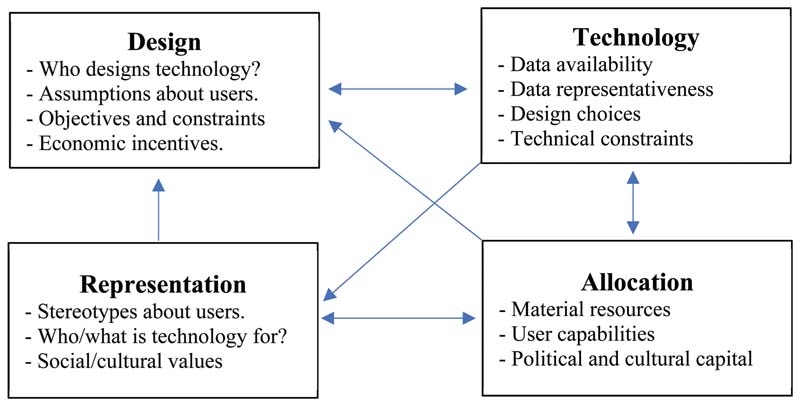
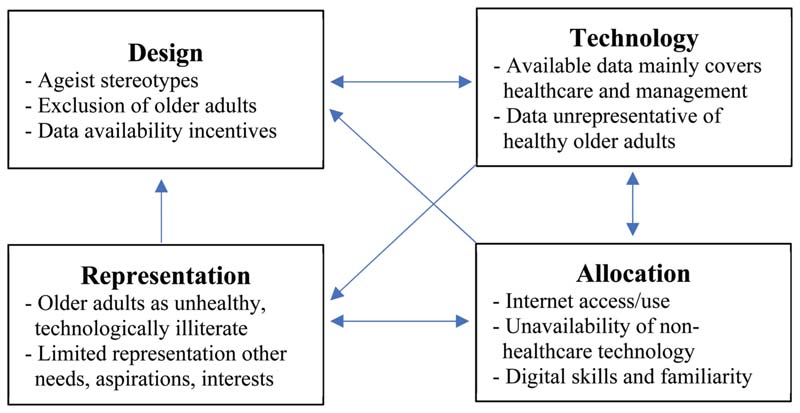
- The article describes a cycle of injustice: ageist stereotypes (representation) shape design assumptions, exclude older adults from research and design, produce health-focused technologies and biased or limited data, entrench the digital divide, and reinforce stereotypes.
- Cited evidence includes Díaz et al.’s finding that sentences containing “young” were 66% more likely to be scored positively than the same sentences containing “old,” and word embeddings associated “youth” with “courageous” and “old”/“older” with “stubborn”/“obstinate.” It also cites internet nonuse rates of 52% among those 65+ and 92% among those 80–84 in 17 European countries, and Toronto data showing 30% of residents 60+ lack an internet-connected device.
- Legal and ethical concerns include AI hiring tools and ad platforms excluding older applicants through graduation-year filters or age-based targeting, raising fair equality of opportunity issues; the paper notes there is no uniform global legal code for AI governance and proprietary algorithms can limit scrutiny.
Methods
- Forum/conceptual article that introduces the term digital ageism and a conceptual model of pathways producing and reinforcing age bias in AI.
- Document review: searched the AI Ethics Guidelines Global Inventory (AlgorithmWatch, 2021), comprising 146 accessible English-language documents, for terms including ageism, age bias, age, old/older, senior(s), and elderly.
- Main analysis is conceptual synthesis of AI bias literature, the digital divide, ageist cycles of injustice, and ethical/legal implications; no primary empirical data collection is reported.
Limitations
- The paper states no formal limitations section.
- Evident from the methods: the ethics-guideline review was limited to 146 English-language documents in one repository, so it may not represent all AI ethics guidance.
- Evident from the article type: as a forum article, it is conceptual and calls for future research; it does not report original empirical tests of age bias in AI systems.
Model-written summary. Check it against the paper before relying on it.
Integrity signals
Registry
Cites
Statistics
Figures
Verification
Claims the paper makes
1 Valid · 2 Not valid · 64 Not checked · 29 Own results and interpretations
The cited sources that could be checked couldn’t confirm or dispute this claim.
In the paper
“Current research examining biases in AI is largely focused on racial and gender biases and the serious consequences that arise as a result (Zhavoronkov et al., 2019)”
§ Digital Ageism: Challenges and Opportunities in Artificial Intelligence for Older Adults > Abstract
What the sources say
- Could not verifycites Zhavoronkov et al., 2019 matched to “Artificial intelligence for aging and longevity research: Recent advances and perspectives” (2019) sourceExperimental — accuracy not yet measured
Our full-text copy (not truncated) contains no discussion of research on AI bias, racial or gender bias, or the consequences thereof. Searches for 'bias/fairness/demographic underrepresentation', 'algorithmic bias/discrimination', and 'ethical challenges/risks' returned only the paper's treatment of reliability, feature interpretability (Sec. 7 and Sec. 1 Introduction), and privacy/regulatory issues (GDPR, FDA/EU medical-device regulation passages under 'AI by making the DNNs more interpretable'). The nearest content is Sec. 4.1.3, which notes that deep biomarkers of aging are population-dependent across ethnic groups (Canada, South Korea, Eastern Europe) and includes patient sex and population type as model features, but that is about population specificity of predictors, not about bias research being focused on racial and gender biases. Nothing in our copy supports or contradicts the attributed statement, so it cannot be verified against this source. (LLM, conf=0.72)
plain- Asserted: passes — The authors put it forward as true.
- Checkable: passes — It can be checked against evidence.
- Load-bearing: passes — The paper’s conclusions depend on it.
- Based: passes — The paper gives a reason why it holds.
- Could not verify
A result the paper states — it cites no source for it, so there is none to check. The quote shows it is in the paper.
In the paper
“concerns about ageism have been largely absent in the AI bias literature”
- Also stated in: § Biases in AI Systems · plain
“In the literature examining biases in AI, age-related bias is seldom discussed in comparison to racial and gender biases.”
- Also stated in: § Abstract · plain
“little attention has been paid to age-related bias (known as ageism) in AI”
§ Digital Ageism: Challenges and Opportunities in Artificial Intelligence for Older Adults > Abstract
plain- Asserted: passes — The authors put it forward as true.
- Checkable: passes — It can be checked against evidence.
- Load-bearing: passes — The paper’s conclusions depend on it.
- Based: passes — The paper gives a reason why it holds.
- Also stated in: § Biases in AI Systems · plain
A result the paper reports from its own data — it cites no other source for it, so there is none to check. The quote shows it is in the paper.
In the paper
“Of these, 19 (54.7%) merely listed “age” as part of a general list of protected characteristics.”
§ Digital Ageism: Challenges and Opportunities in Artificial Intelligence for Older Adults > Ethical and Legal Implications of Ageism in AI
plain- Asserted: passes — The authors put it forward as true.
- Checkable: passes — It can be checked against evidence.
- Load-bearing: passes — The paper’s conclusions depend on it.
- Based: passes — The paper gives a reason why it holds.
- Rests on an assumption not shown here.
A result the paper reports from its own data — it cites no other source for it, so there is none to check. The quote shows it is in the paper.
In the paper
“Ageism is an overlooked bias within AI ethics.”
§ Digital Ageism: Challenges and Opportunities in Artificial Intelligence for Older Adults > Ethical and Legal Implications of Ageism in AI
plain- Asserted: passes — The authors put it forward as true.
- Checkable: passes — It can be checked against evidence.
- Load-bearing: passes — The paper’s conclusions depend on it.
- Based: passes — The paper gives a reason why it holds.
- Rests on an assumption not shown here.
A result the paper reports from its own data — it cites no other source for it, so there is none to check. The quote shows it is in the paper.
In the paper
“We found that only 34 (23.3%) of these documents mention ageism as a bias for a total of 53 unique mentions.”
§ Digital Ageism: Challenges and Opportunities in Artificial Intelligence for Older Adults > Ethical and Legal Implications of Ageism in AI
plain- Asserted: passes — The authors put it forward as true.
- Checkable: passes — It can be checked against evidence.
- Load-bearing: passes — The paper’s conclusions depend on it.
- Based: passes — The paper gives a reason why it holds.
- Rests on an assumption not shown here.
48 more claims
Create a free account to see all 96 claims and to verify the 84 references still open.
- It may state two separate claims as one. 27
- Probably not a substantial claim. 21
Claims other papers make about this one
Each is checked against this paper’s own text: does it say what the citing paper says it does?
The source backs part of the claim, not all of it — or backs it for a different population, condition or comparison.
In the citing paper
“a concept that has emerged and is gaining traction as an outgrowth of it is “digital ageism””
From Algorithmic harms and digital ageism in the use of surveillance technologies in nursing homes (2022) · cites this paper as Chu et al., 2022
Experimental — accuracy not yet measuredThe source backs part of the claim, not all of it — or backs it for a different population, condition or comparison.
In the citing paper
“Researchers are thus making the case that concerns of ageism belong in the AI bias literature alongside racism, ableism, and sexism”
From Algorithmic harms and digital ageism in the use of surveillance technologies in nursing homes (2022) · cites this paper as Chu et al., 2022
Experimental — accuracy not yet measuredThe source backs part of the claim, not all of it — or backs it for a different population, condition or comparison.
In the citing paper
“Older adults' acts of resistance and rejection, along with reports of intentional non-adoption for reasons other than access or digital literacy barriers, are frequently overlooked in the framing of the problem (see Chu et al., 2022).”
From Algorithmic harms and digital ageism in the use of surveillance technologies in nursing homes (2022) · cites this paper as Chu et al., 2022
Experimental — accuracy not yet measured
Self-check
Percentages, sums and reported differences re-computed from the paper’s own numbers.
Each contradiction between two passages listed here was confirmed by an independent check.
Rated minor: it would not touch a result — a value no result rests on, a p-value that stays on the same side of the significance level, or a conflict that is clerical, resolved elsewhere in the paper, or outside its own findings.
In the paper
§ Digital Ageism: Challenges and Opportunities in Artificial Intelligence for Older Adults > Looking Ahead
“(Wiggers, 2021)”
§ Digital Ageism: Challenges and Opportunities in Artificial Intelligence for Older Adults > References
“71. Wiggers K Plum uses AI to hire people ‘that never would have been discovered through a traditional hiring process.’ VentureBeat 2018”
Rated minor: it would not touch a result — a value no result rests on, a p-value that stays on the same side of the significance level, or a conflict that is clerical, resolved elsewhere in the paper, or outside its own findings.
In the paper
“We found that only 34 (23.3%) of these documents mention ageism as a bias for a total of 53 unique mentions. Of these, 19 (54.7%) merely listed "age" as part of a general list of protected characteristics.”
§ Digital Ageism: Challenges and Opportunities in Artificial Intelligence for Older Adults > Ethical and Legal Implications of Ageism in AI
Reported 54.7 · recomputed 55.882353
Citations
Cites
Artificial intelligence: A modern approach
Nilsson, N. J. (1996) · Artificial Intelligence · doi:10.1016/0004-3702(96)00007-0 · Cited by 10,583
Dissecting racial bias in an algorithm used to manage the health of populations
Obermeyer, Z., Powers, B., Vogeli, C., & Mullainathan, S. (2019) · Science · doi:10.1126/science.aax2342 · Cited by 7,137 · cited 1×
“For instance, a widely deployed AI algorithm was shown to underestimate the health risks of Black patients compared to White patients (Obermeyer et al., 2019).”
Semantics derived automatically from language corpora contain human-like biases
Caliskan, A., Bryson, J. J., & Narayanan, A. (2017) · Science · doi:10.1126/science.aal4230 · Cited by 2,887 · cited 1×
“…data but also text (i.e., corpus), which insidiously encodes historical–cultural associations that result in semantic biases, such as associations between stereotypical male names and working in the labor force or, conversely, female names and family/child-rearing (Caliskan et al., 2017).”
Age-Ism: Another Form of Bigotry
Butler, R. N. (1969) · The Gerontologist · doi:10.1093/geront/9.4_part_1.243 · Cited by 2,291 · cited 2×
“, 2019); however, little attention has been paid to agerelated bias (known as ageism) in AI (Butler, 1969).”
The Digital Divide as a Complex and Dynamic Phenomenon
van Dijk, J., & Hacker, K. (2003) · The Information Society · doi:10.1080/01972240309487 · Cited by 1,616
The Handbook of aging and cognition
(1993) · Choice Reviews Online · doi:10.5860/choice.30-3520 · Cited by 1,587
Friedman, B., & Nissenbaum, H. (1996) · ACM Transactions on Information Systems · doi:10.1145/230538.230561 · Cited by 1,203 · cited 2×
“A system discriminates unfairly if it denies an opportunity or a good or if it assigns an undesirable outcome to an individual or group of individuals on grounds that are unreasonable or inappropriate" (Friedman & Nissenbaum, 1996, p. 332).”
Amazon Scraps Secret AI Recruiting Tool that Showed Bias against Women *
Dastin, J. (2022) · Ethics of Data and Analytics · doi:10.1201/9781003278290-44 · Cited by 1,165
Impact of digital surge during COVID-19 pandemic: A viewpoint on research and practice
De’, R., Pandey, N., & Pal, A. (2020) · International Journal of Information Management · doi:10.1016/j.ijinfomgt.2020.102171 · Cited by 1,110 · cited 2×
“There is a pressing need to address these foundational questions especially with the surge of digital technology use during the COVID-19 pandemic (De’ et al., 2020).”
Tech Adoption Climbs Among Older Adults
Perrin, M. A. A. A. (2017) · Cited by 1,059
Research works printed but not linked: 10
- Ajunwa I How artificial intelligence can make employment discrimination worse The Independent 2018 https://suindependent.com/artificial-intelligence-can-make-employment-discrimination-worse/
- American Civil Liberties Union Facebook agrees to sweeping reforms to curb discriminatory ad targeting practices 2019 https://www.aclu.org/press-releases/facebook-agrees-sweeping-reforms-curb-discriminatory-ad-targeting-practices
- Angwin J Kirchner L Larson J Mattu S Machine bias: There’s software used across the country to predict future criminals. And it’s biased against blacks ProPublica 2016
- Brown P Artificial intelligence: The fastest moving technology New York Law Journal 2020 https://www.law.com/newyorklawjournal/2020/03/09/artificial-intelligence-the-fastest-moving-technology/
- Cotten SR McCullough BM Adams RG Technological influences on social ties across the lifespan S 2011 https://www.springerpub.com/
- Crawford K The trouble with bias—NIPS 2017 Keynote—Kate Crawford #NIPS2017 The Artificial Intelligence Channel 2017 https://www.youtube.com/watch?v=fMym_BKWQzk
- Ho C Martin M Ratican S Teneja D West S How to mitigate algorithmic bias in healthcare MedCityNews 2020 https://medcitynews.com/2020/08/how-to-mitigating-algorithmic-bias-in-healthcare/
- Kuei J Mixon M Legal risks of using artificial intelligence in hiring The Center for Association Leadership 2020 https://www.asaecenter.org/resources/articles/an_plus/2020/may/legal-risks-of-using-artificial-intelligence-in-hiring
- Presser J Beatson J Chan G Litigating artificial intelligence Emond Montgomery Publications Limited 2021 https://emond.ca/ai21
- Srinuan C Bohlin E Understanding the digital divide: A literature survey and ways forward 22nd European Regional Conference of the International Telecommunications Society (ITS2011) 2011 https://www.econstor.eu/handle/10419/52191
Cited by
Items 201–282 of 282
Chen, Z., Liu, C., Ren, Y., et al. (2025) · SSRN Electronic Journal · doi:10.2139/ssrn.5434096
A Multi‐User Virtual Reality Game Based on Gesture Recognition From RGB Information
Gkoutzios, S., & Vrigkas, M. (2025) · Computer Animation and Virtual Worlds · doi:10.1002/cav.70063 · Cited by 2
Tultabayev, M., Zhumanova, U., Tultabayeva, T., & Shoman, A. (2025) · Frontiers in Nutrition · doi:10.3389/fnut.2025.1626046
Artificial Intelligence and Social Work
Holmes, A., & Goldkind, L. (2025) · Oxford University Press eBooks · doi:10.1093/obo/9780195389678-0346
Alam, A. (2025) · Advances in computational intelligence and robotics book series · doi:10.4018/979-8-3373-5462-0.ch010 · Cited by 1
Manikandan, C., & Nahak, F. M. (2025) · International Conference on Circuits, Power and Intelligent Systems (CCPIS) · doi:10.1109/ccpis65231.2025.11234013
Campaigning an educational website on ageism: lessons from a failed attempt
Ayalon, L., & Okun, . (2025) · The Gerontologist · doi:10.1093/geront/gnaf264
Artificial intelligence in geriatric medicine: potential and challenges. Systematic review
Martynenko, A. (2025) · Russian Journal of Geriatric Medicine · doi:10.37586/2686-8636-4-2025-557-570 · Cited by 3
Aktives Altern mittels IKT – aktuelle Möglichkeiten und Herausforderungen
Jungreitmayr, S. (2025) · Springer eBooks · doi:10.1007/978-3-662-70475-2_11
Rogers, C., McGeown, W. J., & Moshfeghi, Y. (2025) · doi:10.2196/preprints.85626
Kyomen, H. H. (2025) · American Journal of Geriatric Psychiatry · doi:10.1016/j.jagp.2025.12.012 · Cited by 1
Liu, Y., & Siau, K. L. (2026) · Lecture notes in computer science · doi:10.1007/978-3-032-13167-6_8 · Cited by 2
Wei, M., Gupta, S., Yang, X., & Wang, Y. (2026) · Technological Forecasting and Social Change · doi:10.1016/j.techfore.2025.124509
Bridging Artificial Intelligence and Care—Smart Assistive Technologies for Long-Term Care
Lehner, K., & Gallistl, V. (2026) · Health informatics · doi:10.1007/978-3-032-11938-4_7
Ensemble of Regressors to Handle Bias in Predicting Age from Facial Images
Khan, S. S., Shi, T., Chu, C. H., Moustafa, N., & Ashraf, A. (2025) · IEEE International Conference on Emerging Trends in Engineering and Computing (ETECOM) · doi:10.1109/etecom66111.2025.11319054
“The under-representation of older adults in facial image datasets is one manifestation of digital ageism, which refers to the exclusion or disadvantage experienced by older adults in the design, development, or deployment of AI driven technologies [7].”
Self-citationArtificial intelligence in the diagnosis and prognosis of multimorbidity in the elderly
Мартыненко, А. В. (2026) · Bulletin of Siberian Medicine · doi:10.20538/1682-0363-2025-4-164-171
Mannheim, I., Xi, W., Bachner, Y. G., Zhao, Y. C., & Cohn‐Schwartz, E. (2026) · SSRN Electronic Journal · doi:10.2139/ssrn.6141458
Rathore, B. (2026) · Advances in computational intelligence and robotics book series · doi:10.4018/979-8-3373-6618-0.ch022
Decision Neuroscience of Aging: 20 Years In
Lighthall, N. R., Doheny, M. M., & Wang, S. (2026) · Springer eBooks · doi:10.1007/978-3-032-02925-6_28
Armeni, P., Polat, I., Rossi, L. M. D., Diaferia, L., Padova, S. D., Gatti, A., & Meregalli, S. (2026) · Frontiers in Aging · doi:10.3389/fragi.2026.1687784 · Cited by 1
“To counteract digital ageism, future research and policy initiatives must actively integrate inclusivity into their agendas (Chu et al., 2022).”
Redlich, M.-C., Schaller, M., Nordmann, K., & Fischer, F. (2026) · Springer eBooks · doi:10.1007/978-3-030-68127-2_458-1 · Cited by 1
How robust are linguistic markers of aging? The case of aging-related social media text
Cong, Y., Hu, J., Reese, T., & Liu, H. (2026) · Natural Language Processing Journal · doi:10.1016/j.nlp.2026.100203 · Cited by 1
Human–AI collaboration: the dual role of explanation on human closeness and threat
Wang, J., Zhuang, X., & Santoso, H. B. (2026) · Behaviour and Information Technology · doi:10.1080/0144929x.2026.2633771 · Cited by 2
Artificial Intelligence Integration for the Older Workforce
Zorjan, T., & Meško, M. (2026) · doi:10.18690/um.fov.3.2026.66
Go, E., & Harbke, C. R. (2026) · AI & Society · doi:10.1007/s00146-026-02989-9
“For older adults, these characteristics may generate uncertainty regarding how personal information is collected, stored, shared, and interpreted (Chu et al. 2022; Wong et al. 2025).”
Jin, Y., Zhang, Y., Cai, W., Yu, S., Doherty, G., Jiang, T., & Chen, L. (2026) · SSRN Electronic Journal · doi:10.2139/ssrn.6462428
New Technologies in Libraries: An Overview of Practices and Prospects for Implementation
Beskaravainaya, E. V. (2026) · Science management theory and practice · doi:10.19181/smtp.2026.8.1.12
Atlı, T., & Ayan, H. A. (2026) · İstanbul Hukuk Mecmuası / Istanbul Law Review · doi:10.26650/mecmua.2026.84.1.00020
Nayak, M., Patro, M., Choudhury, O. P., & Satapathy, S. (2026) · Advances in computational intelligence and robotics book series · doi:10.4018/406028
Xue, L. A., Guan, F. Y., Ong, P., Palo, T., Kaipainen, A., & Åker, A.-P. (2026) · Lecture notes in computer science · doi:10.1007/978-3-032-15501-6_14
Wang, T., Sandhu, A., Vamvakas, K., Bergman, H., Grad, R. M., Vedel, I., Gagnon, M., Yousefi, S., & Abbasgholizadeh-Rahimi, S. (2026) · FACETS · doi:10.1139/facets-2025-0049
Helali, M. M., Mostafa, M. M., Aldawsari, H. K., Ibrahim, A. N., Bukhamseen, A. M., & Nemt-allah, M. A. (2026) · Frontiers in Psychology · doi:10.3389/fpsyg.2026.1810679 · Cited by 2
Aging and Self-Determination in a Digitalized World
Omerbasic-Schiliro, A. (2026) · Philosophia · doi:10.1007/s11406-026-00972-8
“24 See Köttl et al., 2021, p. 2; Choi et al., 2020, 1214, as well as Chu et al., 2022, 947.”
Ardenghi, S., Bani, M., Russo, S., Cremona, N., Zorzi, F., Sarnè, G. M. L., & Strepparava, M. G. (2026) · Research Square · doi:10.21203/rs.3.rs-9254457/v1
Truby, J., & Kantiana, I. D. (2026) · The Journal of Law Medicine & Ethics · doi:10.1017/jme.2026.10262 · Cited by 1
Penna, G. D., Buzzi, M., & Leporini, B. (2026) · Universal Access in the Information Society · doi:10.2139/ssrn.6643942
The Role of Artificial Intelligence in Medication Management for Older Adults: A Systematic Review
Das, D. C., Rony, M. K. K., Dutta, S., Zujbe, M. S. A. Z., Bhattacharjee, T., Debnath, N., Maruf, S. A., Mortuza, C. G., Rahman, F., & Das, A. (2026) · Aging Medicine · doi:10.1002/agm2.70074 · Cited by 2
“These innovations are especially important for older adults who frequently manage complex and changing drug regimens due to chronic comorbidities [54, 55].”
Huang, J., Yu, J., Jiang, D., Chen, X., Zhou, S., Zhao, Y., Li, X., Feng, H., & Wu, X. H. (2026) · The Gerontologist · doi:10.1093/geront/gnag068
Chen, X. S., Wen, W., Choi, S., Andrade, F. C. D., & Mejía, S. T. (2026) · Aging & Mental Health · doi:10.1080/13607863.2026.2664078 · Cited by 2
Features for designing AI-supported learning environments for older people
Kırmacı, Ö., & Flórez‐Revuelta, F. (2026) · Studies in the Education of Adults · doi:10.1080/02660830.2026.2669407
Narrowing the Digital Divide: A Generative AI-Enabled Intervention Model for Aging Smart Education
Yu, L., Ye, Z., Hamsan, H. H., Singh, S. S. D., & Cheng, L. (2026) · Lecture notes in educational technology · doi:10.1007/978-981-95-9418-4_4
Te, T. T., Bui, A. A. T., Speier, W. F., & Fung, C. H. (2026) · Journal of the American Geriatrics Society · doi:10.1111/jgs.70527
Cohen, E., Gannot, R. N., & Adler, Y. (2026) · BMC Medical Ethics · doi:10.1186/s12910-026-01488-2
Ebara, M., Kawazoe, Y., Seki, T., Shinohara, E., Nakazawa, E., & Ohe, K. (2026) · AI and Ethics · doi:10.1007/s43681-026-00998-4
Jung, D., Seo, H., & Yoo, L. (2026) · Journal of Korean Gerontological Nursing · doi:10.17079/jkgn.2026.00143
A framework for increasing the inclusion of older adults in virtual research methods
Weil, J. (2026) · Gerontology & Geriatrics Education · doi:10.1080/02701960.2026.2681600 · Cited by 1
Ayalon, L., & Tesch‐Römer, C. (2026) · Cambridge University Press eBooks · doi:10.1017/9781009766838
Computational Method for Predicting Visual Attention in Older Adults with Age-Related Features
Li, X. C., Shi, X., Gu, H., et al. (2026) · Multimodal Technologies and Interaction · doi:10.3390/mti10060063
“Older adults require longer viewing times to extract information from complex scenes [13,14], exhibit altered fixation distributions compared to younger adults [15], and show different attentional responses to emotional content [14].”
Li, H., Abhulimen, P. O., Yu, Q., Cheng, W., & Njunge, L. W. (2026) · Ageing Research Reviews · doi:10.1016/j.arr.2026.103205 · Cited by 2
How two AI models depict ageing: a cross-cultural analysis of ChatGPT and Doubao
Zhong, X. (2026) · Social Semiotics · doi:10.1080/10350330.2026.2686256
Everyday Technologies in Older Adults’ Homes
Palladino, S., & Fasulo, A. (2026) · Convergências. · doi:10.34024/8ewcg739
Nallo, E. D., Chu, C. H., Hasan, Z., Mishra, P. K., Buchan, J., Zheng, T., Bianchi, A., Hoey, J., & Khan, S. S. (2026) · JMIR Formative Research · doi:10.2196/70638
Self-citationAgeing differently: Older adults’ perspectives on digital inclusion
van Leeuwen, C., Craffert, L., & Jacobs, A. (2026) · Convergence The International Journal of Research into New Media Technologies · doi:10.1177/13548565261463998
Leveraging Real-World Data for Clinical Decision Making in Geriatric Oncology
González-Serrano, A., Jean, C., Baldini, C., & Soto‐Pérez‐de‐Celis, E. (2026) · Drugs & Aging · doi:10.1007/s40266-026-01314-9
“Ensuring that older adults and other underrepresented populations are adequately represented in training datasets will therefore be critical to ensure equitable implementation of AI-based decision support tools [93].”
Bilgili, E., Tokgöz, E., Ayaz, N. D., Derinsu, G., & Güneş, G. (2026) · Healthcare · doi:10.3390/healthcare14131907
“Variables such as the intended purpose of the AI tool, the prerequisite knowledge required, its ease of use, and the extent to which it simplifies daily tasks all contribute to shaping perceptions, thereby diminishing age as a negative factor in this relationship [44].”
Perceived Social Connectedness in Senescence: A Human-Centered Approach for the Digital Age
Bangert, A. S., Ruiz, C., Menendez, Y. C., & Villanueva‐Rosales, N. (2026) · Lecture notes in computer science · doi:10.1007/978-3-032-30414-8_21
Kolarov, L. (2026) · Lecture notes in computer science · doi:10.1007/978-3-032-30421-6_18
Cai, J., Yu, L., Huang, H., Yanlan, G., & Shi, F. (2026) · Frontiers in Psychology · doi:10.3389/fpsyg.2026.1879051
Integral Human Accountability and AI: Anticipatory Ethics for Fragile Stakeholders
Fioravante, R., & Vaccaro, A. (2026) · Humanism in business series · doi:10.1007/978-3-032-17121-4_6
Everyday algorithmic imaginaries: Visibility practices of older Chinese women content creators
Wang, X., & Wang, W. (2026) · Journal of Women & Aging · doi:10.1080/08952841.2026.2705910
Malhotra, S. (2026) · IntechOpen eBooks · doi:10.5772/intechopen.1015983
La representación discursiva del edadismo en relatos de personas mayores
Martínez-Sanz, R., Lobato, J. M. P., & Acero, Á. E. (2026) · Prisma social · doi:10.65598/rps.6025
Muhiddin, S., Alfitra, N. F., Bellani, E., & Sudirman, I. (2026) · Journal of Asian and African Studies · doi:10.1177/19367244261463488
RetractedResearch on the Digital Integration Dilemma of the Elderly and Solutions in the Algorithm Era
黄, 宛. (2026) · Aging Research · doi:10.12677/ar.2026.138544
Stefanacci, R. G. (2026) · Journal of the American Geriatrics Society · doi:10.1111/jgs.70669
Cohen, E., Adler, Y., & Gannot, R. N. (2026) · Healthcare · doi:10.3390/healthcare14162642
“Similarly, the healthcare-cost proxy example demonstrates how historical institutional patterns can be encoded into a prediction model [3], but its extension to age-specific discrimination remains a reasoned hypothesis that requires direct testing in older populations [5].”
InfluentialKonti, E., & Kotsis, K. Τ. (2026) · International Journal of Changes in Education · doi:10.29333/ijce/19185
“Previous research indicates that younger persons generally exhibit more acceptance and PEOU of technology, while older adults may encounter obstacles to digital access, confidence, and literacy (Ball et al., 2019; Chu et al., 2022; Park et al., 2021; Wong et al., 2025).”
Actis, B. R., Cobo, S. D. P., & Cortés-Ruiz, M. (2026) · Advances in computational intelligence and robotics book series · doi:10.4018/979-8-2600-3930-4.ch008
Nguyễn, H. V., Le, N. K. N., Nguyen, T. H. T., Tran, N. M., Phu, G. T., Nguyen, N. T., & Nguyen, K. M. (2026) · China Finance Review International · doi:10.1108/cfri-07-2025-0470 · Cited by 1
Cooper, R. A., McNamara, L., Wolfe, B. H., Oh, Y. J., Choung, H., Cui, X., & Chopik, W. J. (2026) · Computers in Human Behavior Reports · doi:10.1016/j.chbr.2026.101286
Learning, memory, and belonging: how older adults use conversational AI beyond information seeking
Gómez, J. E. A., Hernández, J. I. S., Chiappe, A., & Mella-Norambuena, J. (2026) · Cogent Education · doi:10.1080/2331186x.2026.2720995
The Promise and Peril of AI in Later Life Leisure
Standridge, S. H. (2026) · Leisure Sciences · doi:10.1080/01490400.2026.2729924
Lifespan developmental perspectives on the reciprocal influences of technology and aging
Mejía, S. T., & Wen, W. (2026) · Elsevier eBooks · doi:10.1016/b978-0-443-27490-9.00018-x · Cited by 1
Muhiddin, S., Alfitra, N. F., Bellani, E., & Sudirman, I. (2026) · Journal of Applied Social Science · doi:10.1177/19367244261481685
Active Aging Through ICT—Current Opportunities and Challenges
Jungreitmayr, S. (2026) · Springer eBooks · doi:10.1007/978-3-662-73013-3_11
Horiuchi, S. (2026) · AI & Society · doi:10.1007/s00146-026-03381-3
Kim, G., & Jung, A. (2026) · Research in Community and Public Health Nursing · doi:10.12799/rcphn.2026.01809
“Digital ageist attitudes among this group may thus be embedded in technology design, service delivery, and educational practices in ways that do not assume older adults to be active users, thereby potentially constraining older adults’ digital experiences [3].”
Kotsis, K. Τ., & Konti, E. (2026) · Journal of Artificial Intelligence and Technological Development · doi:10.59324/jaitd.2026.2(5).04
AI AND AGEISM: DIGITAL EXCLUSION AND WORKPLACE CHALLENGES FOR OLDER INDIVIDUALS
Tümtürk, T., & ÇEVİK, Ö. C. (2026) · Akademi Sosyal Bilimler Dergisi · doi:10.65083/asbider.1984719
Metadata
- Authors
- Chu, C. H., Nyrup, R., Leslie, K., Shi, J., Bianchi, A., Lyn, A., McNicholl, M., Khan, S., Rahimi, S., & Grenier, A.
- Affiliations
- University Health Network (CA)
- University of Cambridge (GB)
- Athabasca University (CA)
- University of Toronto (CA)
- University of London (GB)
- Mila - Quebec Artificial Intelligence Institute (CA)
- Corresponding author
- Chu, Charlene H
- ORCID
- Venue
- The Gerontologist
- Publisher
- Oxford University Press (OUP)
- Published
- 2022-01-20
- Volume
- 62
- Issue
- 7
- Pages
- 947-955
- ISSN
- 0016-9013 (ISSN-L)
- 1758-5341
- PMC
- PMC9372891
- OpenAlex
- W4226067429
- Semantic Scholar
- 1b4912966ff0e91d91067b4b4dd4352b625b6c5c
- Cited by
- 290
- References
- 56
- Citations by year
- 2026: 107 · 2025: 74 · 2024: 56 · 2023: 39 · 2022: 14
- FWCI
- 34.05
- Type
- journal article
- Language
- en
- Open access
- hybrid
- doi.org
- Licence
- Locations
- The Gerontologist (publishedVersion, cc-by)
- PubMed Central (publishedVersion, cc-by)
- PubMed (publishedVersion)
- TSpace (University of Toronto) (submittedVersion, cc-by)
- Apollo (University of Cambridge) (submittedVersion)
- Apollo
- Funders
- Social Sciences and Humanities Research Council of Canada (00362)
- Topics
- Physical Sciences › Computer Science › Artificial Intelligence › Ethics and Social Impacts of AI
- Health Sciences › Medicine › Geriatrics and Gerontology › Technology Use by Older Adults
- Social Sciences › Psychology › Developmental and Educational Psychology › Aging and Gerontology Research
- Keywords
- digital ageism, algorithmic bias, older adults, age bias, intersectionality, conceptual model, ethical implications of AI, legal implications of AI, population aging
- MeSH terms
- Machine Learning, Aged, Artificial Intelligence, Delivery of Health Care, Humans, Racism, Ageism
About these checks
Registry, retraction, Cites and statistics results are computed, not judged, with one exception: a printed reference that no index lists is read once by a model before it counts as a citation error. Claims are extracted by a model and kept only when their quote appears verbatim in the text; each cited source is then checked, with a model’s help, for whether it says what the claim relies on. Those verdicts can be wrong — read the claim’s quote and the cited source before relying on one.
The claim verdicts this report counts are experimental: their accuracy is not yet measured.
A language model drew the claims from the paper on 2026-10-10, under version 3 of the claim definition (model deepseek-v4.1-flash, prompt extract-v3).
A second model labelled each claim on 2026-10-10 (model jev-1.13-20260917, definition revision gold-guideline-v0.2).
Cited sources are checked with a language model’s help (qwen3.8-omni-flash).
Statistics and arithmetic are recomputed, not judged.
Confidence bands are shown only for fields calibrated on our annotated test set. None is calibrated yet, so no band is shown.
What counts as a claim ›How we measure confidence ›How we check this ›
Are you an author, or do you see a problem with this page? Request a review
Data sources
Bibliographic data: Semantic Scholar, OpenAlex, Crossref.
Contains information from the Semantic Scholar Academic Graph Datasets, made available under the ODC Attribution License (ODC-BY 1.0).
Semantic Scholar’s data is described in: Kinney, R., et al. (2023). The Semantic Scholar Open Data Platform. arXiv:2301.10140.
