

Genetic demultiplexing of pooled single-cell RNA-sequencing samples in cancer facilitates effective experimental design
Open accessPublished version of a preprint
The DOI matches its Crossref record; 46 of the 46 references it cites were found in a registry or an index.
Abstract
Background: Pooling cells from multiple biological samples prior to library preparation within the same single-cell RNA sequencing experiment provides several advantages, including lower library preparation costs and reduced unwanted technological variation, such as batch effects. Computational demultiplexing tools based on natural genetic variation between individuals provide a simple approach to demultiplex samples, which does not require complex additional experimental procedures. However, to our knowledge these tools have not been evaluated in cancer, where somatic variants, which could differ between cells from the same sample, may obscure the signal in natural genetic variation. Results: Here, we performed in silico benchmark evaluations by combining raw sequencing reads from multiple single-cell samples in high-grade serous ovarian cancer, which has a high copy number burden, and lung adenocarcinoma, which has a high tumor mutational burden. Our results confirm that genetic demultiplexing tools can be effectively deployed on cancer tissue using a pooled experimental design, although high proportions of ambient RNA from cell debris reduce performance. Conclusions: This strategy provides significant cost savings through pooled library preparation. To facilitate similar analyses at the experimental design phase, we provide freely accessible code and a reproducible Snakemake workflow built around the best-performing tools found in our in silico benchmark evaluations, available at https://github.com/lmweber/snp-dmx-cancer.
Overview
The claims and statistics of this paper haven’t been checked yet.
Free: it reads the open-access text and checks the first 5 claims that cite a source we can check. Create a free account to check every claim.
Integrity signals
Registry
Cites
Statistics
Figures
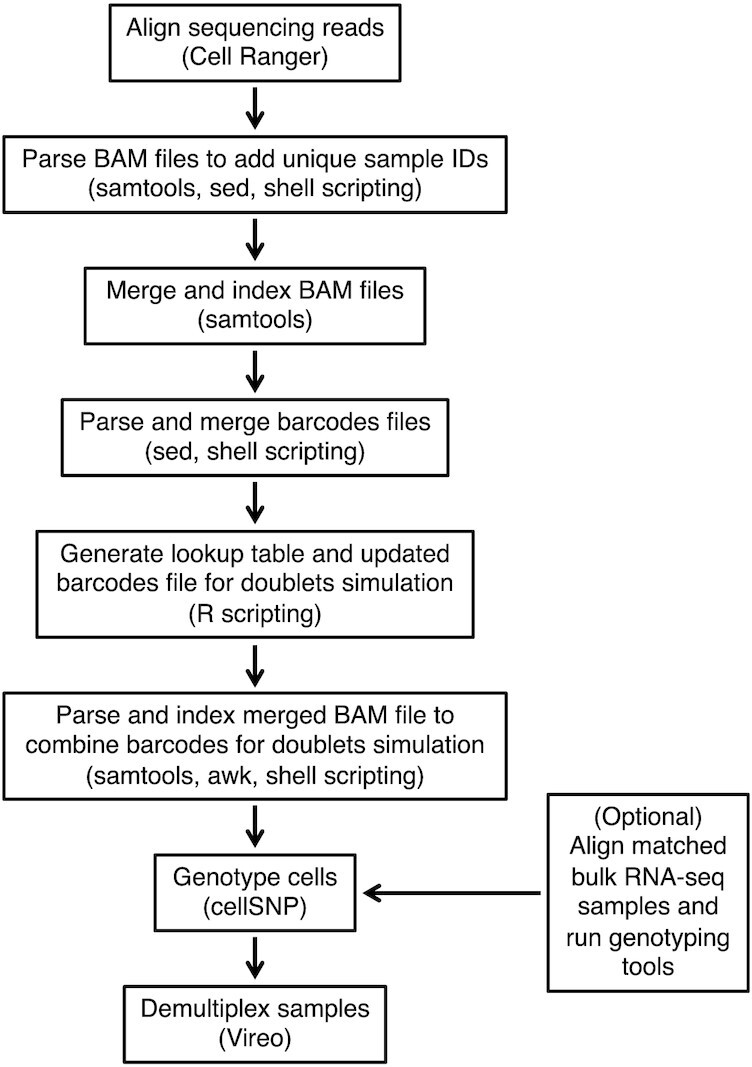
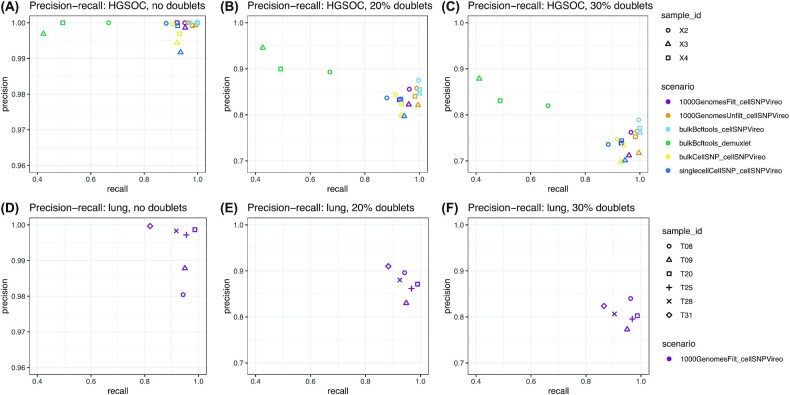
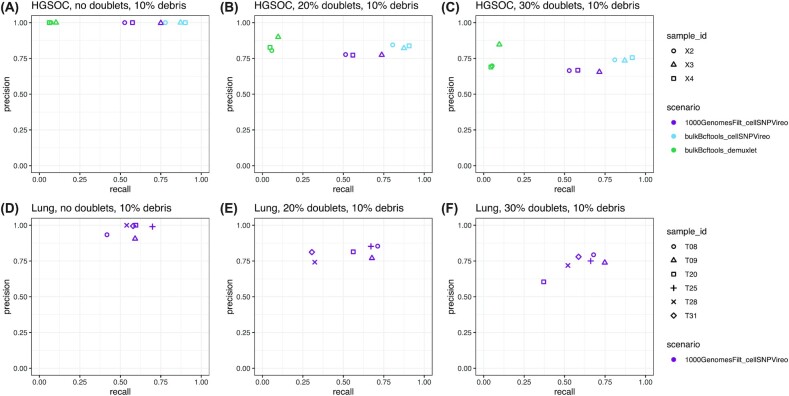
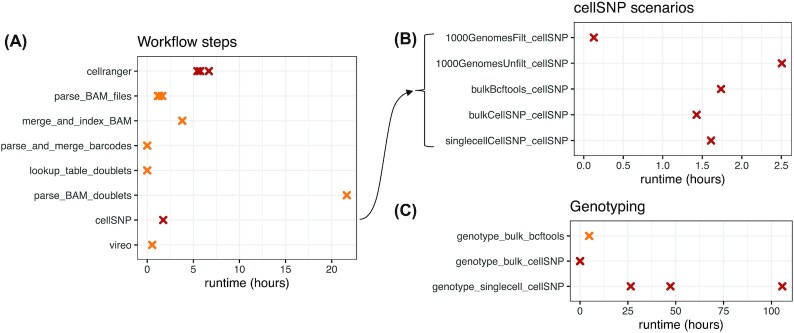
Verification
Claims the paper makes
The claims and statistics of this paper haven’t been checked yet.
Free: it reads the open-access text and checks the first 5 claims that cite a source we can check. Create a free account to check every claim.
Claims other papers make about this one
Each is checked against this paper’s own text: does it say what the citing paper says it does?
The source backs part of the claim, not all of it — or backs it for a different population, condition or comparison.
In the citing paper
“These tools were chosen since probabilistic method-based tools performed best in previous benchmarking studies [33, 37].”
From Benchmarking of computational demultiplexing methods for single-nucleus RNA sequencing data (2025) · cites this paper as [37]
Experimental — accuracy not yet measured
Self-check
Percentages, sums and reported differences re-computed from the paper’s own numbers.
The self-check needs the paper’s full text.
Citations
Cites
The Sequence Alignment/Map format and SAMtools
Li, H., Handsaker, B., Wysoker, A., Fennell, T., Ruan, J., Homer, N., Marth, G., Abecasis, G., Durbin, R., & 1000 Genome Project Data Processing Subgroup (2009) · Bioinformatics · doi:10.1093/bioinformatics/btp352 · Cited by 62,041 · cited 2×
“…(high CNV) and lung adenocarcinoma (high SNV) using a set of benchmark evaluations and Snakemake [33] workflow built around freely available tools including Cell Ranger [35], samtools [36], bcftools [37], Unix string manipulation tools (sed and awk), cellSNP [38], and Vireo [3] (Methods and Fig.”
Wickham, H. (2016) · Use R! · doi:10.1007/978-3-319-24277-4 · Cited by 33,115
A global reference for human genetic variation
The 1000 Genomes Project Consortium, authors, C., Auton, A., Abecasis, G. R., Steering committee, Altshuler, D. M., Durbin, R. M., Abecasis, G. R., Bentley, D. R., Chakravarti, A., et al. (2015) · Nature · doi:10.1038/nature15393 · Cited by 18,247 · cited 3×
“Depending on the method, there is also the option to improve performance by providing either sample-specific genotypes, such as from matched bulk RNA sequencing, or a list of population SNPs, such as from the 1000 Genomes Project [21] for human samples.”
Influentialggplot2: Elegant Graphics for Data Analysis
Wickham, H. (2009) · doi:10.1007/978-0-387-98141-3 · Cited by 14,447
Wickham, H. (2016) · Use R! · doi:10.1007/978-3-319-24277-4_9 · Cited by 12,516
dbSNP: the NCBI database of genetic variation
Sherry, S. T. (2001) · Nucleic Acids Research · doi:10.1093/nar/29.1.308 · Cited by 7,502 · cited 1×
“For example, population SNPs with minor allele frequency > 1% are thought to occur on the order of once per 1,000 nucleotides on average, or 1,000 SNPs per megabase [28].”
Massively parallel digital transcriptional profiling of single cells
Zheng, G. X. Y., Terry, J. M., Belgrader, P., Ryvkin, P., Bent, Z. W., Wilson, R., Ziraldo, S. B., Wheeler, T. D., McDermott, G. P., Zhu, J., et al. (2017) · Nature Communications · doi:10.1038/ncomms14049 · Cited by 7,353
Li, H. (2011) · Bioinformatics · doi:10.1093/bioinformatics/btr509 · Cited by 6,486
McGinnis, C. S., Murrow, L. M., & Gartner, Z. J. (2019) · Cell Systems · doi:10.1016/j.cels.2019.03.003 · Cited by 4,521
Analysis of 100,000 human cancer genomes reveals the landscape of tumor mutational burden
Chalmers, Z. R., Connelly, C. F., Fabrizio, D., Gay, L., Ali, S. M., Ennis, R., Schrock, A., Campbell, B., Shlien, A., Chmielecki, J., et al. (2017) · Genome Medicine · doi:10.1186/s13073-017-0424-2 · Cited by 3,519
Cited by
Itahashi, K., Irie, T., Yuda, J., Kumagai, S., Tanegashima, T., Lin, Y.-T., Watanabe, S., Goto, Y., Suzuki, J., Aokage, K., et al. (2022) · Science Immunology · doi:10.1126/sciimmunol.abk0957 · Cited by 112
miQC: An adaptive probabilistic framework for quality control of single-cell RNA-sequencing data
Hippen, A. A., Falco, M. M., Weber, L. M., Erkan, E. P., Zhang, K., Doherty, J. A., Vähärautio, A., Greene, C. S., & Hicks, S. C. (2021) · PLOS Computational Biology · doi:10.1371/journal.pcbi.1009290 · Cited by 105
Self-citationHippen, A. A., Omran, D. K., Weber, L. M., Jung, E., Drapkin, R., Doherty, J. A., Hicks, S. C., & Greene, C. S. (2023) · Genome biology · doi:10.1186/s13059-023-03077-7 · Cited by 47
Self-citationCaporale, N., Castaldi, D., Rigoli, M. T., Cheroni, C., Valenti, A., Stucchi, S., Lessi, M., Bulgheresi, D., Trattaro, S., Pezzali, M., et al. (2024) · Nature Methods · doi:10.1038/s41592-024-02555-5 · Cited by 45
Approaches for single-cell RNA sequencing across tissues and cell types
Sant, P., Rippe, K., & Mallm, J. (2023) · Transcription · doi:10.1080/21541264.2023.2200721 · Cited by 39
An agentic AI framework for ingestion and standardization of single-cell RNA-seq data analysis
Nouri, N., Artzi, R., & Savova, V. (2026) · npj Artificial Intelligence · doi:10.1038/s44387-025-00064-0 · Cited by 29
Hawkins, A. G., Shapiro, J. A., Spielman, S. J., Mejia, D. S., Prasad, D. V., Ichihara, N., Yakovets, A., Gottlieb, A. M., Wheeler, K. G., Bethell, C. J., et al. (2026) · Cell Genomics · doi:10.1016/j.xgen.2026.101283 · Cited by 25
Self-citationHartoularos, G. C., Si, Y., Zhang, F., Kathail, P., Lee, D. S., Ogorodnikov, A., Sun, Y., Song, Y. S., Kang, H. M., & Ye, C. (2023) · bioRxiv (Cold Spring Harbor Laboratory) · doi:10.1101/2023.05.29.542756 · Cited by 22
Evaluation of genetic demultiplexing of single-cell sequencing data from model species
Cardiello, J. F., Joven Araus, A., Giatrellis, S., Helsens, C., Simon, A., & Leigh, N. D. (2023) · Life Science Alliance · doi:10.26508/lsa.202301979 · Cited by 21
“SNP-based approaches have been benchmarked and shown to be highly effective at separating human samples (Kang et al, 2018; Huang et al, 2019; Xu et al, 2019; Heaton et al, 2020; Weber et al, 2021).”
BackgroundSampleQC: robust multivariate, multi-cell type, multi-sample quality control for single-cell data
Macnair, W., & Robinson, M. D. (2023) · Genome biology · doi:10.1186/s13059-023-02859-3 · Cited by 20
Suzuki, Y., Emoto, T., Sato, S., Yoshida, T., Shoda, M., Endoh, H., Nagao, M., Hamana, T., Inoue, T., Hayashi, T., et al. (2024) · Communications Biology · doi:10.1038/s42003-024-07308-w · Cited by 17
Lee, M. K., Azizgolshani, N., Shapiro, J. A., Nguyen, L., Kolling, F., Zanazzi, G. J., Frost, H. R., & Christensen, B. C. (2024) · Nature Communications · doi:10.1038/s41467-024-47712-8 · Cited by 13
hadge: a comprehensive pipeline for donor deconvolution in single-cell studies
Curion, F., Wu, X., Heumos, L., André, M. M. G., Halle, L., Ozols, M., Grant‐Peters, M., Rich‐Griffin, C., Yeung, H., Dendrou, C. A., et al. (2024) · Genome biology · doi:10.1186/s13059-024-03249-z · Cited by 10
Yang, B., & Dai, M. (2024) · Translational Oncology · doi:10.1016/j.tranon.2024.101917 · Cited by 9
Huang, L., Stolze, L. K., Chen, H., Gelbard, A. H., Shyr, Y., Liu, Q., & Sheng, Q. (2023) · Computational and Structural Biotechnology Journal · doi:10.1016/j.csbj.2023.08.013 · Cited by 8
Application of single cell gene expression technologies to neurotoxicology
Tukker, A. M., & Bowman, A. B. (2023) · Current Opinion in Toxicology · doi:10.1016/j.cotox.2023.100458 · Cited by 7
DemoTape : Computational demultiplexing of targeted single-cell sequencing dataPreprint
Borgsmüller, N., Kuipers, J., Gawron, J., Roncador, M., Pohly, M. F., Acar, İ. E., Do, T. H. L., Reisenauer, S., Feldkamp, M., Beisel, C., et al. (2024) · bioRxiv (Cold Spring Harbor Laboratory) · doi:10.1101/2024.12.06.627152 · Cited by 7
Lai, W., Xie, R., Chen, C., Lou, W., Yang, H., Deng, L., Lu, Q., & Tang, X. (2024) · Heliyon · doi:10.1016/j.heliyon.2024.e28490 · Cited by 7
Lee, M. K., Azizgolshani, N., Zhang, Z., Perreard, L., Kolling, F., Nguyen, L., Zanazzi, G. J., Salas, L. A., & Christensen, B. C. (2024) · Nature Communications · doi:10.1038/s41467-024-47943-9 · Cited by 6
Wong, J., Jassowicz, L., Herold‐Mende, C. C., Seiffert, M., Mallm, J., Lichter, P., & Zapatka, M. (2023) · BMC Bioinformatics · doi:10.1186/s12859-023-05440-8 · Cited by 6
Benchmarking of computational demultiplexing methods for single-nucleus RNA sequencing data
Fu, Y., Youness, M., Virzì, A., Song, X., Tubeeckx, M. R. L., De Keulenaer, G. W., Heidbuchel, H., Segers, V. F. M., Sipido, K. R., Thienpont, B., et al. (2025) · Briefings in Bioinformatics · doi:10.1093/bib/bbaf371 · Cited by 5
“Although the overall accuracy of the demultiplexing tool is the most important aspect of evaluating the performance, computational efficiency is another important criterion to evaluate the software, which is a deficiency in previous benchmarking work [37].”
Fiorini, M. R., Amiri, S., Dilliott, A. A., Ohki, C. M. Y., Smigielski, L., Walitza, S., Fon, E. A., Grünblatt, E., Thomas, R. A., & Farhan, S. M. K. (2025) · Genome biology · doi:10.1186/s13059-025-03643-1 · Cited by 5
Deconvolution reveals compositional differences in high-grade serous ovarian cancer subtypesPreprint
Hippen, A. A., Davidson, N. R., Barnard, M. E., Weber, L. M., Gertz, J., Doherty, J. A., Hicks, S. C., & Greene, C. S. (2023) · bioRxiv (Cold Spring Harbor Laboratory) · doi:10.1101/2023.06.14.544991 · Cited by 5
Self-citationLi, T., Alvarez, M., Liu, C., Abuhanna, K. D., Sun, Y., Ernst, J., Plath, K., Balliu, B., Luo, C., & Zaitlen, N. (2025) · eLife · doi:10.7554/elife.106769.1 · Cited by 3
demuxSNP: supervised demultiplexing single-cell RNA sequencing using cell hashing and SNPs
Lynch, M. P., Wang, Y., Sui, S. H., Gatto, L., & Culhane, A. C. (2024) · GigaScience · doi:10.1093/gigascience/giae090 · Cited by 3
Li, T., Alvarez, M., Liu, C., Abuhanna, K. D., Sun, Y. F., Ernst, J., Plath, K., Balliu, B., Luo, C., & Zaitlen, N. (2025) · bioRxiv (Cold Spring Harbor Laboratory) · doi:10.1101/2025.02.06.636969 · Cited by 3
Chai, R., Zheng, K., Xu, T., Wang, H., Cheng, X., Lu, C., & Kang, Y. (2025) · Biomedicines · doi:10.3390/biomedicines13051021 · Cited by 3
Walsh, E. S., Ghashghaei, H. T., & Peng, X. (2021) · IEEE International Conference on Bioinformatics and Biomedicine (BIBM) · doi:10.1109/bibm52615.2021.9669819 · Cited by 3
Li, W., Grieshober, L., Gertz, J., Ivich, A., Doherty, J. A., Greene, C. S., & Hicks, S. C. (2026) · Genome Research · doi:10.1101/gr.281433.125 · Cited by 2
Self-citationLi, T., Alvarez, M., Liu, C., Abuhanna, K. D., Sun, Y. F., Ernst, J., Plath, K., Balliu, B., Luo, C., & Zaitlen, N. (2025) · Research Square · doi:10.21203/rs.3.rs-5977005/v1 · Cited by 1
Zhang, Z., Chen, M., & Peng, X. (2024) · Heliyon · doi:10.1016/j.heliyon.2024.e33367 · Cited by 1
Enabling reproducible and reusable genetic demultiplexing benchmarking with Nextflow and ApptainerPreprint
Lynch, M. P., Gatto, L., & Culhane, A. C. (2025) · bioRxiv (Cold Spring Harbor Laboratory) · doi:10.1101/2025.08.06.668897
oddSNP: a predictive framework for optimizing multiplexed single-cell RNA-seq experiments
Osorio, R. S. A., Nishimura, T., Shigihara, Y., Kimura, M., Takebe, T., & Nemoto, T. (2026) · Bioinformatics Advances · doi:10.64898/2025.12.08.692882
Wong, J. K. L., Jassowicz, L., Herold-Mende, C., Seiffert, M., Mallm, J.-P., Lichter, P., & Zapatka, M. (2023) · Figshare · doi:10.6084/m9.figshare.24070251
Metadata
- Authors
- Weber, L. M., Hippen, A. A., Hickey, P. F., Berrett, K. C., Gertz, J., Doherty, J. A., Greene, C. S., & Hicks, S. C.
- Affiliations
- Johns Hopkins University (US)
- University of Pennsylvania (US)
- Walter and Eliza Hall Institute of Medical Research (AU)
- University of Utah (US)
- University of Colorado Anschutz (US)
- Corresponding author
- Hicks, Stephanie C
- ORCID
- Venue
- GigaScience
- Publisher
- Oxford University Press (OUP)
- Published
- 2021-09
- Volume
- 10
- Issue
- 9
- ISSN
- 2047-217X (ISSN-L)
- PMC
- PMC8458035
- OpenAlex
- W3199486250
- Semantic Scholar
- 21c86324a94eda25882627d075d9ba610eee1e71
- Cited by
- 37
- References
- 44
- Citations by year
- 2026: 3 · 2025: 8 · 2024: 10 · 2023: 11 · 2022: 2 · 2021: 3
- FWCI
- 2.04
- Type
- journal article
- Language
- en
- Open access
- gold
- doi.org
- Licence
- Locations
- GigaScience (publishedVersion, cc-by)
- bioRxiv (Cold Spring Harbor Laboratory) (acceptedVersion, cc-by)
- Europe PMC (PubMed Central) (publishedVersion, other-oa)
- PubMed Central (publishedVersion, cc-by)
- PubMed (publishedVersion)
- Minerva Access (University of Melbourne) (submittedVersion, cc-by)
- Funders
- National Institutes of Health
- National Cancer Institute (R01CA237170, P30 CA042014)
- Huntsman Cancer Foundation
- Topics
- Life Sciences › Biochemistry, Genetics and Molecular Biology › Molecular Biology › Single-cell and spatial transcriptomics
- Life Sciences › Biochemistry, Genetics and Molecular Biology › Molecular Biology › Genomics and Phylogenetic Studies
- Life Sciences › Biochemistry, Genetics and Molecular Biology › Molecular Biology › Gene expression and cancer classification
- Keywords
- single-cell RNA sequencing, natural genetic variation, somatic mutations, high-grade serous ovarian cancer, lung adenocarcinoma, tumor mutational burden, batch effects, Snakemake workflow, benchmark evaluation
- MeSH terms
- Humans, Neoplasms, Research Design, RNA, Software, Gene Library, High-Throughput Nucleotide Sequencing
About these checks
Registry, retraction, Cites and statistics results are computed, not judged, with one exception: a printed reference that no index lists is read once by a model before it counts as a citation error. Claims are extracted by a model and kept only when their quote appears verbatim in the text; each cited source is then checked, with a model’s help, for whether it says what the claim relies on. Those verdicts can be wrong — read the claim’s quote and the cited source before relying on one.
Statistics and arithmetic are recomputed, not judged.
Confidence bands are shown only for fields calibrated on our annotated test set. None is calibrated yet, so no band is shown.
What counts as a claim ›How we measure confidence ›How we check this ›
Are you an author, or do you see a problem with this page? Request a review
Data sources
Bibliographic data: Semantic Scholar, OpenAlex, Crossref.
Contains information from the Semantic Scholar Academic Graph Datasets, made available under the ODC Attribution License (ODC-BY 1.0).
Semantic Scholar’s data is described in: Kinney, R., et al. (2023). The Semantic Scholar Open Data Platform. arXiv:2301.10140.
