

Formulation of geopotential difference determination using optical-atomic clocks onboard satellites and on ground based on Doppler cancellation system
Open accessThe DOI matches its Crossref record; 33 of the 38 references it cites were found in a registry or an index.
Abstract
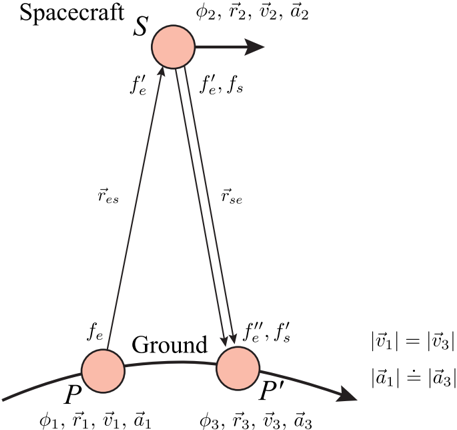
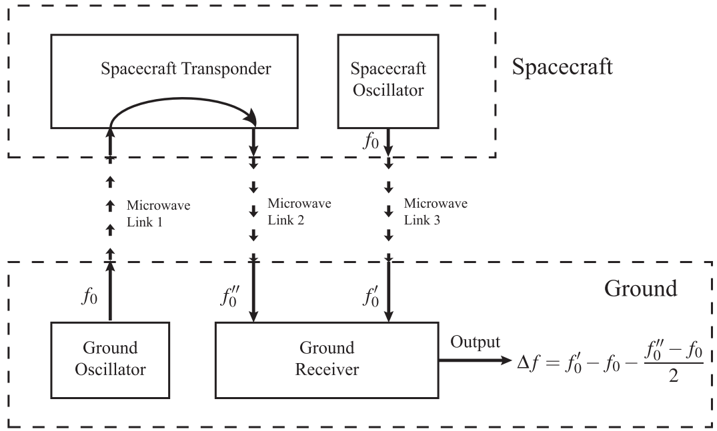
In this study, we propose an approach for determining the geopotential difference using high-frequency-stability microwave links between satellite and ground station based on Doppler cancellation system. Suppose a satellite and a ground station are equipped with precise optical-atomic clocks (OACs) and oscillators. The ground oscillator emits a signal with frequency fa towards the satellite and the satellite receiver (connected with the satellite oscillator) receives this signal with frequency fb which contains the gravitational frequency shift effect and other signals and noises. After receiving this signal, the satellite oscillator transmits and emits, respectively, two signals with frequencies fb and fc towards the ground station. Via Doppler cancellation technique, the geopotential difference between the satellite and the ground station can be determined based on gravitational frequency shift equation by a combination of these three frequencies. For arbitrary two stations on ground, based on similar procedures as described above, we may determine the geopotential difference between these two stations via a satellite. Our analysis shows that the accuracy can reach 1 m2 s− 2 based on the clocks’ inaccuracy of about 10−17 (s s−1) level. Since OACs with instability around 10−18 in several hours and inaccuracy around 10−18 level have been generated in laboratory, the proposed approach may have prospective applications in geoscience, and especially, based on this approach a unified world height system could be realized with one-centimetre level accuracy in the near future.
Overview
The claims and statistics of this paper haven’t been checked yet.
Free: it reads the open-access text and checks the first 5 claims that cite a source we can check. Create a free account to check every claim.
Integrity signals
Registry
Cites
Statistics
Figures
Verification
Claims the paper makes
The claims and statistics of this paper haven’t been checked yet.
Free: it reads the open-access text and checks the first 5 claims that cite a source we can check. Create a free account to check every claim.
Self-check
Percentages, sums and reported differences re-computed from the paper’s own numbers.
The self-check needs the paper’s full text.
Citations
Cites
GRACE Measurements of Mass Variability in the Earth System
Tapley, B. D., Bettadpur, S., Ries, J. C., Thompson, P. F., & Watkins, M. M. (2004) · Science · doi:10.1126/science.1099192 · Cited by 2,555
An optical lattice clock with accuracy and stability at the 10−18 level
Bloom, B. J., Nicholson, T. L., Williams, J. R., Campbell, S. L., Bishof, M., Zhang, X., Zhang, W., Bromley, S. L., & Ye, J. (2014) · Nature · doi:10.1038/nature12941 · Cited by 1,073
A new version of the NeQuick ionosphere electron density model
Nava, B., Coïsson, P., & Radicella, S. M. (2008) · Journal of Atmospheric and Solar-Terrestrial Physics · doi:10.1016/j.jastp.2008.01.015 · Cited by 819
An Atomic Clock with 10 –18 Instability
Hinkley, N., Sherman, J. A., Phillips, N. B., Schioppo, M., Lemke, N. D., Beloy, K., Pizzocaro, M., Oates, C. W., & Ludlow, A. D. (2013) · Science · doi:10.1126/science.1240420 · Cited by 817
The Constants in the Equation for Atmospheric Refractive Index at Radio Frequencies
Smith, E., & Weintraub, S. (1953) · Proceedings of the IRE · doi:10.1109/jrproc.1953.274297 · Cited by 742
The International Reference Ionosphere 2012 – a model of international collaboration
Bilitza, D., Altadill, D., Zhang, Y., Mertens, C., Truhlik, V., Richards, P., McKinnell, L.-A., & Reinisch, B. (2014) · Journal of Space Weather and Space Climate · doi:10.1051/swsc/2014004 · Cited by 632
Cryogenic optical lattice clocks
Ushijima, I., Takamoto, M., Das, M., Ohkubo, T., & Katori, H. (2015) · Nature Photonics · doi:10.1038/nphoton.2015.5 · Cited by 627
First GOCE gravity field models derived by three different approaches
Pail, R., Bruinsma, S., Migliaccio, F., Förste, C., Goiginger, H., Schuh, W.-D., Höck, E., Reguzzoni, M., Brockmann, J. M., Abrikosov, O., et al. (2011) · Journal of Geodesy · doi:10.1007/s00190-011-0467-x · Cited by 502
Earth gravitational model 2008
Pavlis, N., Kenyon, S., Factor, J., & Holmes, S. (2008) · SEG Technical Program Expanded Abstracts 2008 · doi:10.1190/1.3063757 · Cited by 381
Die Feldgleichungen der Gravitation
Einstein, A. (2005) · Albert Einstein: Akademie‐Vorträge · doi:10.1002/3527608958.ch5 · Cited by 370
Research works printed but not linked: 2
- Hofmann-Wellenhof B. Moritz H. Physical Geodesy. Springer Science & Business Media; 2006.
- Shen, 1993, On relativistic geoid, Boll. Geod. Sci. Aff., 52, 207
Cited by
Determination of a high spatial resolution geopotential model using atomic clock comparisons
Lion, G., Panet, I., Wolf, P., Guerlin, C., Bize, S., & Delva, P. (2017) · Journal of Geodesy · doi:10.1007/s00190-016-0986-6 · Cited by 66
“Beyond the application considered in this work, the clocks can also contribute to the unification of height systems realizations (Shen et al. 2011, 2016; Denker 2013; Kopeikin et al. 2016; Takano et al. 2016), connecting distant points to a highresolution reference potential network.”
BackgroundTesting gravitational redshift based on microwave frequency links onboard the China Space Station
Shen, W., Zhang, P., Shen, Z., Xu, R. L., Xiao, S., Ashry, M., Ruby, A., Xu, W., Wu, K., Wu, Y., et al. (2023) · Physical review. D/Physical review. D. · doi:10.1103/physrevd.108.064031 · Cited by 32
Self-citationShen, Z., Shen, W.-B., & Zhang, S. (2017) · Surveys in Geophysics · doi:10.1007/s10712-017-9414-6 · Cited by 25
Self-citationShen, Z., Shen, W., Zhao, P., Liu, T., Zhang, S., & Chao, D. (2019) · Journal of Earth Science · doi:10.1007/s12583-018-0834-0 · Cited by 24
Self-citationShen, Z., Shen, W., Zhang, T., He, L., Cai, Z., Tian, X., & Zhang, P. (2021) · Advances in Space Research · doi:10.1016/j.asr.2021.07.004 · Cited by 15
Self-citation
Metadata
- Authors
- Shen, Z., Shen, W.-B., & Zhang, S.
- Affiliations
- Wuhan University (CN)
- Venue
- Geophysical Journal International
- Publisher
- Oxford University Press (OUP)
- Published
- 2016-06-09
- Volume
- 206
- Issue
- 2
- Pages
- 1162-1168
- ISSN
- 0956-540X (ISSN-L)
- 1365-246X
- OpenAlex
- W2410172721
- Cited by
- 29
- References
- 38
- Citations by year
- 2026: 2 · 2025: 4 · 2024: 3 · 2023: 5 · 2022: 3 · 2021: 3 · 2020: 5 · 2019: 1 · 2018: 1 · 2017: 2
- FWCI
- 0.63
- Type
- journal article
- Language
- en
- Open access
- hybrid
- doi.org
- Licence
- cc-by
- Locations
- Geophysical Journal International (publishedVersion, cc-by)
- HighWire Press Open Archive (submittedVersion)
- Topics
- Physical Sciences › Physics and Astronomy › Atomic and Molecular Physics, and Optics › Advanced Frequency and Time Standards
- Physical Sciences › Earth and Planetary Sciences › Geophysics › Geophysics and Gravity Measurements
- Physical Sciences › Engineering › Aerospace Engineering › GNSS positioning and interference
- Keywords
- geopotential difference, optical atomic clocks, gravitational frequency shift, satellite gravimetry, clock instability, geoid determination
About these checks
Registry, retraction, Cites and statistics results are computed, not judged, with one exception: a printed reference that no index lists is read once by a model before it counts as a citation error. Claims are extracted by a model and kept only when their quote appears verbatim in the text; each cited source is then checked, with a model’s help, for whether it says what the claim relies on. Those verdicts can be wrong — read the claim’s quote and the cited source before relying on one.
Statistics and arithmetic are recomputed, not judged.
Confidence bands are shown only for fields calibrated on our annotated test set. None is calibrated yet, so no band is shown.
What counts as a claim ›How we measure confidence ›How we check this ›
Are you an author, or do you see a problem with this page? Request a review
How to cite
Cite CoChat for the checks on this page, and the paper for its own findings.
- This page
- CoChat. (2026). Citation check: Formulation of geopotential difference determination using optical-atomic clocks onboard satellites and on ground based on Doppler cancellation system. https://app.cochat.ai/papers/10.1093/gji/ggw198
- The paper
- Shen, Z., Shen, W.-B., & Zhang, S. (2016). Formulation of geopotential difference determination using optical-atomic clocks onboard satellites and on ground based on Doppler cancellation system. Geophysical Journal International. https://doi.org/10.1093/gji/ggw198
Data sources
Bibliographic data: Semantic Scholar, OpenAlex, Crossref.
Contains information from the Semantic Scholar Academic Graph Datasets, made available under the ODC Attribution License (ODC-BY 1.0).
Semantic Scholar’s data is described in: Kinney, R., et al. (2023). The Semantic Scholar Open Data Platform. arXiv:2301.10140.
