

Understanding China's shifting priorities and priority-setting processes in development assistance for health
Open accessThe DOI matches its Crossref record; 34 of the 34 references it cites were found in a registry or an index.
Abstract
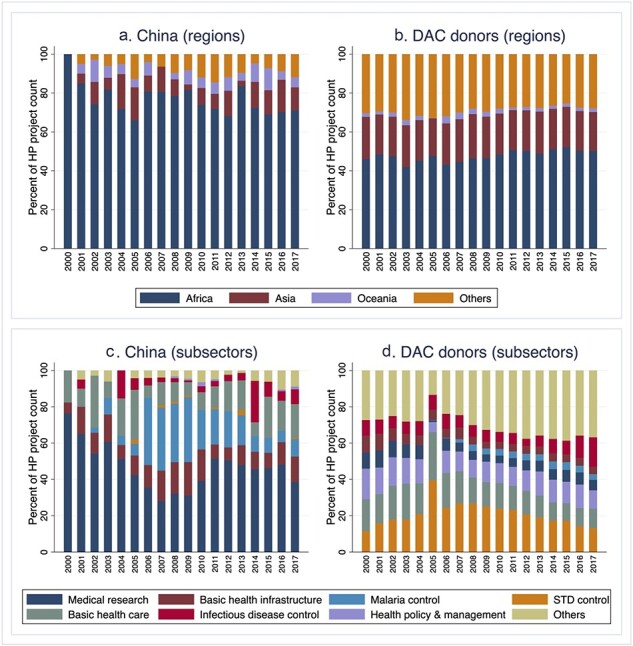
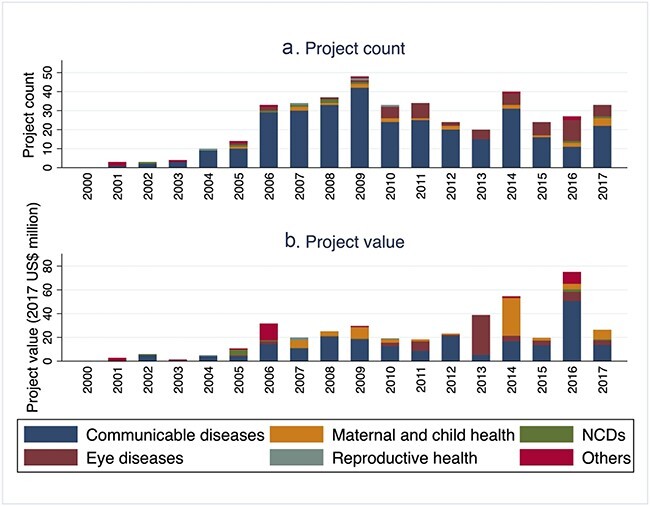
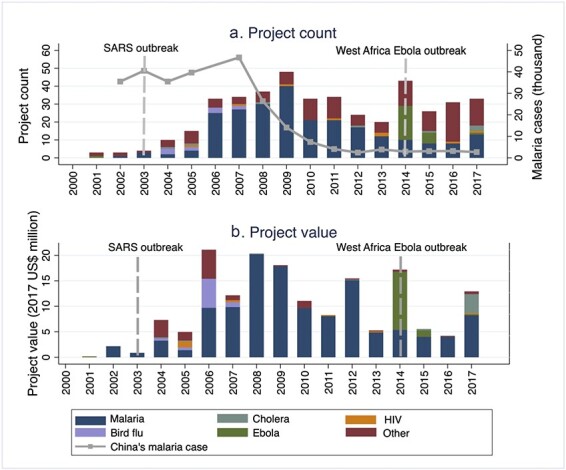
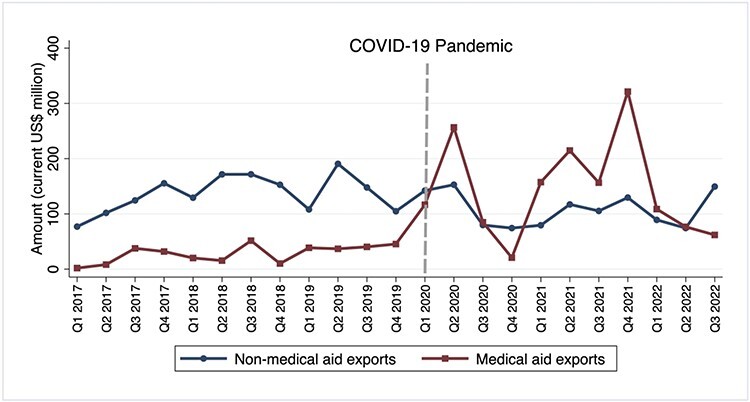
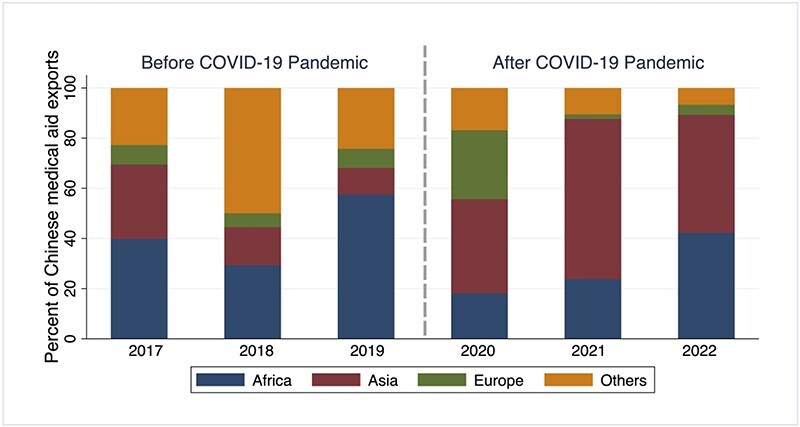
Over the past two decades, China has become a distinctive and increasingly important donor of development assistance for health (DAH). However, little is known about what factors influence China’s priority-setting for DAH. In this study, we provide an updated analysis of trends in the priorities of Chinese DAH and compare them to comparable trends among OECD Development Assistance Committee (DAC) donors using data from the AidData’s Global Chinese Development Finance Dataset (2000–2017, version 2.0) and the Creditor Reporting System (CRS) database (2000–2017). We also analyse Chinese medical aid exports before and after the start of the COVID-19 pandemic using a Chinese Aid Exports Database. We further explore the potential factors influencing China’s shifting priority-setting processes by reviewing Chinese official documents following Walt and Gilson’s policy analysis framework (context–actors–process–content) and by testing our conjectures empirically. We find that China has become an important DAH donor to most regions if measured using project value, including but not limited to Africa. China has prioritized aid to African and Asian countries as well as to CRS subsectors that are not prioritized by DAC donors, such as medical services and basic health infrastructure. Chinese quarterly medical aid exports almost quintupled after the start of the COVID-19 pandemic. Noticeably, China has allocated more attention to Asia, eye diseases and infectious disease outbreaks over time. In contrast, the priority given to malaria has declined over the same period. Regarding factors affecting priority shifts, the outbreaks of SARS and Ebola, the launch of the Belt and Road Initiative and the COVID-19 pandemic appear to be important milestones in the timeline of Chinese DAH. Unlike stereotypes of China as a ‘lone wolf’ donor, our analysis suggests multilateral processes are influential in informing and setting Chinese DAH priorities.
Overview
The claims and statistics of this paper haven’t been checked yet.
Free: it reads the open-access text and checks the first 5 claims that cite a source we can check. Create a free account to check every claim.
Integrity signals
Registry
Cites
Statistics
Figures
Verification
Claims the paper makes
The claims and statistics of this paper haven’t been checked yet.
Free: it reads the open-access text and checks the first 5 claims that cite a source we can check. Create a free account to check every claim.
Self-check
Percentages, sums and reported differences re-computed from the paper’s own numbers.
The self-check needs the paper’s full text.
Citations
Cites
Burnside, C., & Dollar, D. (2000) · American Economic Review · doi:10.1257/aer.90.4.847 · Cited by 3,728
The dragon's gift: the real story of China in Africa
(2010) · Choice Reviews Online · doi:10.5860/choice.48-0383 · Cited by 1,613
Reforming the health sector in developing countries: the central role of policy analysis
WALT, G., & GILSON, L. (1994) · Health Policy and Planning · doi:10.1093/heapol/9.4.353 · Cited by 1,439
WOODS, N. (2008) · International Affairs · doi:10.1111/j.1468-2346.2008.00765.x · Cited by 710 · cited 1×
“The rise of ‘emerging’ donors and lenders such as China, India, various Middle Eastern countries and Russia raises questions about the changing influence of these new players and ‘traditional’ donors and creditors (Woods, 2008).”
BackgroundFinancing of global health: tracking development assistance for health from 1990 to 2007
Ravishankar, N., Gubbins, P., Cooley, R. J., Leach-Kemon, K., Michaud, C. M., Jamison, D. T., & Murray, C. J. (2009) · The Lancet · doi:10.1016/s0140-6736(09)60881-3 · Cited by 558
Dreher, A., Sturm, J.-E., & Vreeland, J. R. (2009) · Journal of Development Economics · doi:10.1016/j.jdeveco.2008.02.003 · Cited by 509
Foreign Aid and Policy Concessions
de Mesquita, B. B., & Smith, A. (2007) · Journal of Conflict Resolution · doi:10.1177/0022002706297696 · Cited by 356
Testing Models of U.S. Foreign Policy: Foreign Aid during and after the Cold War
Meernik, J., Krueger, E. L., & Poe, S. C. (1998) · The Journal of Politics · doi:10.2307/2648001 · Cited by 340
Changing aid regimes? U.S. foreign aid from the Cold War to the War on Terror
Fleck, R. K., & Kilby, C. (2010) · Journal of Development Economics · doi:10.1016/j.jdeveco.2009.09.011 · Cited by 297
Banking on Beijing: The Aims and Impacts of China's Overseas Development Program
Dreher, A., Fuchs, A., Parks, B., Strange, A., & Tierney, M. J. (2022) · Cambridge University Press eBooks · doi:10.1017/9781108564496 · Cited by 242 · cited 2×
“The primary data source was AidData’s Global Chinese Development Finance Dataset (2000–2017, version 2.0) (AidData 2.0) (Custer et al. , 2021; Dreher et al. , 2022).”
MethodInfluentialSelf-citationDieleman, J. L., Schneider, M. T., Haakenstad, A., Singh, L., Sadat, N., Birger, M., Reynolds, A., Templin, T., Hamavid, H., Chapin, A., et al. (2016) · The Lancet · doi:10.1016/s0140-6736(16)30168-4 · Cited by 234
China's Silk Road and global health
Tang, K., Li, Z., Li, W., & Chen, L. (2017) · The Lancet · doi:10.1016/s0140-6736(17)32898-2 · Cited by 172
China's distinctive engagement in global health
Liu, P., Guo, Y., Qian, X., Tang, S., Li, Z., & Chen, L. (2014) · The Lancet · doi:10.1016/s0140-6736(14)60725-x · Cited by 150
Health Diplomacy in Pandemical Times
Fazal, T. M. (2020) · International Organization · doi:10.1017/s0020818320000326 · Cited by 139 · cited 1×
“…has typically been a more cooperative, multilateral area of international development—even amidst donor competition (Manela, 2010)—but appears to be increasingly shaped by competition rather than coordination, as epitomized by the international response to the COVID-19 pandemic (Fazal, 2020).”
BackgroundA Pox on Your Narrative: Writing Disease Control into Cold War History
Manela, E. (2010) · Diplomatic History · doi:10.1111/j.1467-7709.2009.00850.x · Cited by 131 · cited 1×
“Public health has typically been a more cooperative, multilateral area of international development—even amidst donor competition (Manela, 2010)—but appears to be increasingly shaped by competition rather than coordination, as epitomized by the international response to the COVID-19 pandemic…”
BackgroundGrépin, K. A., Fan, V. Y., Shen, G. C., & Chen, L. (2014) · Globalization and Health · doi:10.1186/s12992-014-0084-6 · Cited by 81
Self-citationGuillon, M., & Mathonnat, J. (2019) · China Economic Review · doi:10.1016/j.chieco.2019.01.004 · Cited by 73
Hercot, D., Meessen, B., Ridde, V., & Gilson, L. (2011) · Health Policy and Planning · doi:10.1093/heapol/czr063 · Cited by 69
Chronic eye disease and the WHO Universal Eye Health Global Action Plan 2014-2019
Gupta, N., & Kocur, I. (2014) · Canadian Journal of Ophthalmology · doi:10.1016/j.jcjo.2014.08.014 · Cited by 52
Xi Jinping’s ‘Major Country Diplomacy:’ A Paradigm Shift?
Wang, J. (2018) · Journal of Contemporary China · doi:10.1080/10670564.2018.1497907 · Cited by 50 · cited 1×
“Existing literature suggests Chinese diplomacy strategy has shifted away from Deng Xiaoping’s “‘Tao Guang Yang Hui” (keeping a low profile)’ to ‘major country diplomacy’ during Xi’s tenure (Wang, 2019).”
BackgroundThe Health Silk Road: How China Adapts the Belt and Road Initiative to the COVID-19 Pandemic
Huang, Y. (2022) · American Journal of Public Health · doi:10.2105/ajph.2021.306647 · Cited by 49 · cited 1×
“Health has explicitly been linked to the BRI with specific goals to promote health along the ‘Health Silk Route’ (Huang, 2022).”
BackgroundLyra, T. M., de Albuquerque, M. D. S. V., de Oliveira, R. S., Miranda, G. M. D., de Oliveira, M. A., de Carvalho, M. E. L., Santos, H., Penn‐Kekana, L., & Kuper, H. (2022) · Health Policy and Planning · doi:10.1093/heapol/czac051 · Cited by 41
China's provincial diplomacy to Africa: applications to health cooperation
Shen, G. C., & Fan, V. Y. (2014) · Contemporary Politics · doi:10.1080/13569775.2014.907993 · Cited by 35 · cited 1×
“For example, past research has indicated that China’s role as a donor depends on Chinese provinces working with assigned partner nations (Shen and Fan, 2014), but due to limited data availability, specific province-to-country relationships were not analysed in this study.”
BackgroundSelf-citationTracking development assistance for health from China, 2007–2017
Micah, A. E., Zhao, Y., Chen, C. S., Zlavog, B. S., Tsakalos, G., Chapin, A., Gloyd, S. S., Jonas, J. B., Lee, P. H., Liu, S., et al. (2019) · BMJ Global Health · doi:10.1136/bmjgh-2019-001513 · Cited by 28
Tracking the flow of health aid from BRICS countries
Fan, V. Y., Grépin, K. A., Shen, G. C., & Chen, L. (2014) · Bulletin of the World Health Organization · doi:10.2471/blt.13.132472 · Cited by 26 · cited 1×
“For example, past research has indicated that China’s role as a donor depends on Chinese provinces working with assigned partner nations (Shen and Fan, 2014), but due to limited data availability, specific province-to-country relationships were not analysed in this study.”
BackgroundSelf-citationTrade in Medical Goods in the Context of Tackling COVID-19
World Trade Organization (2020) · Covid-19 reports · doi:10.30875/df0632ef-en · Cited by 22 · cited 2×
“Further, the dataset defined medical aid exports according to the World Trade Organization (WTO)’s definition whose full lists have been provided elsewhere (Helble, 2012; WTO, 2020).”
BackgroundMethodDebunking Myths about China: The Determinants of China’s Official Financing to the Pacific
van Grieken, B. J., & Kantorowicz, J. (2019) · Geopolitics · doi:10.1080/14650045.2019.1654459 · Cited by 14
Enhancing global health engagement in 21st century China
Wu, J., Bhuyan, S. S., & Fu, X. (2020) · BMJ Global Health · doi:10.1136/bmjgh-2019-002194 · Cited by 13
Factors influencing the allocation of China’s development assistance for health
Zhao, Y., Kennedy, K., & Tang, K. (2018) · Journal of Global Health · doi:10.7189/jogh.08.020502 · Cited by 11
McDade, K. K., Kleidermacher, P., Yamey, G., & Mao, W. (2022) · BMJ Global Health · doi:10.1136/bmjgh-2022-010408 · Cited by 11
Is there a Strategy in China’s Health Official Development Assistance to African Countries?
Guillon, M., & Mathonnat, J. (2019) · Revue d économie politique · doi:10.3917/redp.294.0619 · Cited by 10
More Trade for Better Health? - International Trade and Tariffs on Health ProductsPreprint
Helble, M. C. (2012) · SSRN Electronic Journal · doi:10.2139/ssrn.2165734 · Cited by 9 · cited 2×
“Further, the dataset defined medical aid exports according to the World Trade Organization (WTO)’s definition whose full lists have been provided elsewhere (Helble, 2012; WTO, 2020).”
The Belt and Road Initiative: Implications for China's Foreign Aid
Zhang, M. (2021) · China An International Journal · doi:10.1353/chn.2021.0042 · Cited by 6 · cited 2×
“Although not a foreign aid programme per se, due to the inclusion of many low-and middle-income countries (LMICs), as well as its focus on infrastructure, the BRI has been seen by many as a platform through which China is increasingly advancing its global development agenda (Zhang, 2021).”
BackgroundHHI: Stata module to compute Herfindahl index
Ansari, M. R. (2012) · RePEc: Research Papers in Economics · Cited by 2
Research works printed but not linked: 3
- Custer S, Dreher A, Elston TB et al. 2021. Tracking Chinese Development Finance: An Application of AidData’s TUFF 2.0 Methodology. Williamsburg, VA: AidData at William and Mary.
- Luo YH. 2011. Discussion on the effects and challenges of ‘Global Health Diplomacy’ on China. The Journal of International Studies 2: 45– 61.
- Xian Y, Wang ML, Shao T et al. 2017. Analysis on the evolution and trend of malaria prevention and control policies in China. Chinese Journal of Health Policy 10: 70– 4.
Cited by
Global health 2050: the path to halving premature death by mid-century
Jamison, D. T., Summers, L. H., Chang, A. Y., Karlsson, O., Mao, W., Norheim, O. F., Ogbuoji, O., Schäferhoff, M., Watkins, D., Adeyi, O., et al. (2024) · The Lancet · doi:10.1016/s0140-6736(24)01439-9 · Cited by 125
Self-citationProtecting Africa's children from extreme risk: a runway of sustainability for PEPFAR programmes
Cluver, L. D., Makangila, G., Hillis, S. D., N’konzi, J.-P. N., Flaxman, S. R., Unwin, H. J. T., Eaton, J. W., Chtimbire, V., Sherr, L., Ng'ang'a, J., et al. (2025) · The Lancet · doi:10.1016/s0140-6736(25)00401-5 · Cited by 39
“For example, two recent studies of China’s foreign assistance policy 87,88 show that China has become an important health donor to Africa when measured in project value, with a shifting focus towards infectious diseases.”
Artemisinin production strategies for industrial scale: Current progress and future directions
Qamar, F., Ashrafi, K., Singh, A., Dash, P. K., & Abdin, M. Z. (2024) · Industrial Crops and Products · doi:10.1016/j.indcrop.2024.118937 · Cited by 25
Still rethinking external assistance for health
Sparkes, S. P., Shroff, Z. C., & Hanson, K. (2023) · Health Policy and Planning · doi:10.1093/heapol/czad103 · Cited by 5
The Domestic Consequences of Defunding Global Health
Amon, J. J., & Sharfstein, J. M. (2025) · JAMA Health Forum · doi:10.1001/jamahealthforum.2025.2462 · Cited by 3
Metadata
- Authors
- Guo, B., Fan, V., Strange, A., & Grépin, K. A.
- Affiliations
- University of Hong Kong (HK)
- Center for Global Development (US)
- Corresponding author
- Grépin, Karen Ann
- Venue
- Health Policy and Planning
- Publisher
- Oxford University Press (OUP)
- Published
- 2024-01-01
- Volume
- 39
- Issue
- Supplement_1
- Pages
- i65-i78
- ISSN
- 0268-1080 (ISSN-L)
- 1460-2237
- PMC
- PMC10803198
- OpenAlex
- W4391116185
- Cited by
- 8
- References
- 34
- Citations by year
- 2026: 1 · 2025: 4 · 2024: 2
- FWCI
- 7.19
- Type
- journal article
- Language
- en
- Open access
- gold
- doi.org
- Licence
- Locations
- Health Policy and Planning (publishedVersion, cc-by-nc)
- PubMed Central (publishedVersion, cc-by-nc)
- PubMed (publishedVersion)
- The HKU Scholars Hub (University of Hong Kong) (submittedVersion, cc-by-nc-nd)
- Research Explorer (The University of Manchester) (submittedVersion)
- Topics
- Social Sciences › Development › International Development and Aid
- Social Sciences › Political Science and International Relations › Public health and occupational medicine
- Social Sciences › Arts and Humanities › History › Historical and Contemporary Political Dynamics
- Keywords
- COVID-19 pandemic, Belt and Road Initiative, SARS, Ebola, malaria, infectious disease outbreaks, eye diseases, health infrastructure, China-Africa relations
- MeSH terms
- COVID-19, Africa, Asia, China, Humans, Pandemics
About these checks
Registry, retraction, Cites and statistics results are computed, not judged, with one exception: a printed reference that no index lists is read once by a model before it counts as a citation error. Claims are extracted by a model and kept only when their quote appears verbatim in the text; each cited source is then checked, with a model’s help, for whether it says what the claim relies on. Those verdicts can be wrong — read the claim’s quote and the cited source before relying on one.
Statistics and arithmetic are recomputed, not judged.
Confidence bands are shown only for fields calibrated on our annotated test set. None is calibrated yet, so no band is shown.
What counts as a claim ›How we measure confidence ›How we check this ›
Are you an author, or do you see a problem with this page? Request a review
Data sources
Bibliographic data: Semantic Scholar, OpenAlex, Crossref.
Contains information from the Semantic Scholar Academic Graph Datasets, made available under the ODC Attribution License (ODC-BY 1.0).
Semantic Scholar’s data is described in: Kinney, R., et al. (2023). The Semantic Scholar Open Data Platform. arXiv:2301.10140.
