

Who serves the urban poor? A geospatial and descriptive analysis of health services in slum settlements in Dhaka, Bangladesh
Open accessThe DOI matches its Crossref record; 22 of the 22 references it cites were found in a registry or an index.
Abstract
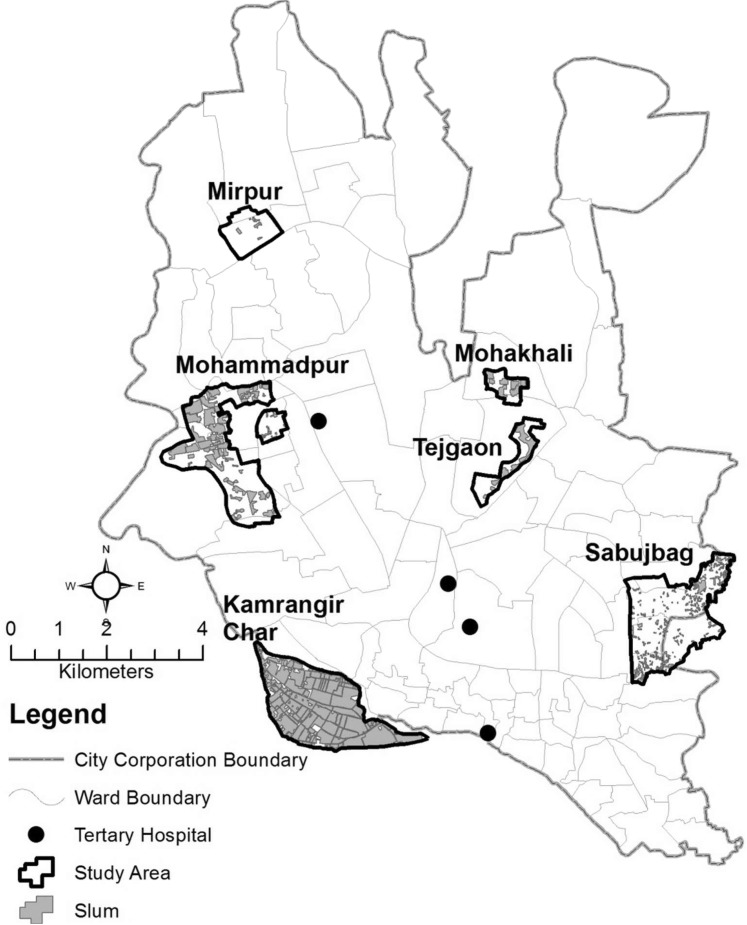
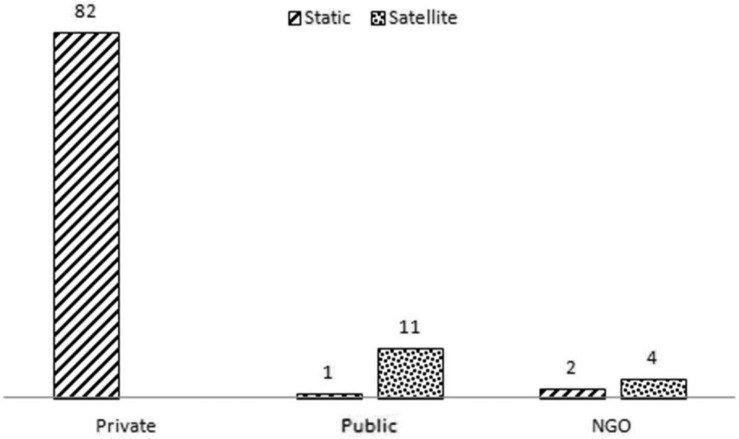
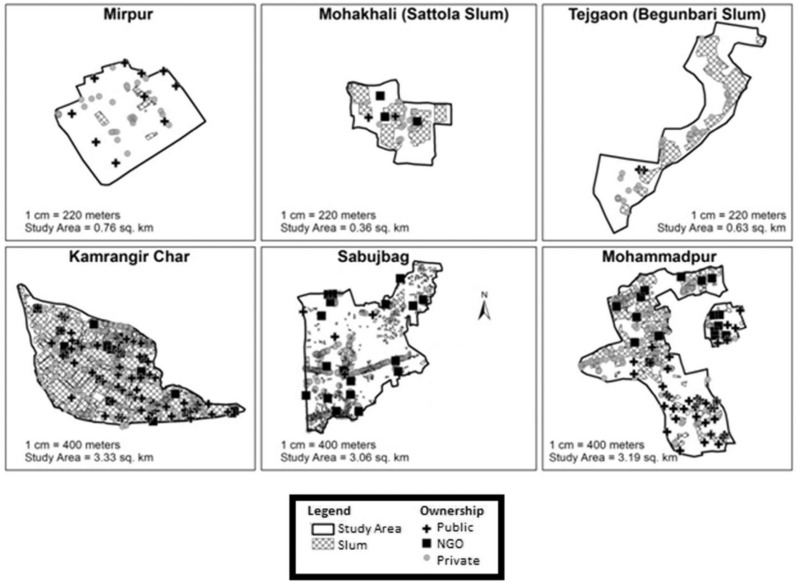
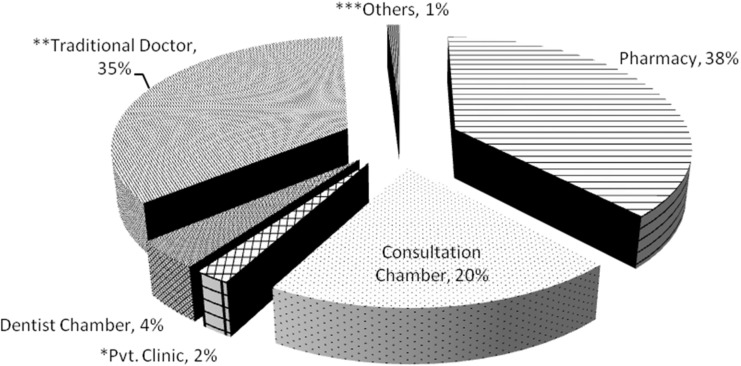
In Bangladesh, the health risks of unplanned urbanization are disproportionately shouldered by the urban poor. At the same time, affordable formal primary care services are scarce, and what exists is almost exclusively provided by non-government organizations (NGOs) working on a project basis. So where do the poor go for health care? A health facility mapping of six urban slum settlements in Dhaka was undertaken to explore the configuration of healthcare services proximate to where the poor reside. Three methods were employed: (1) Social mapping and listing of all Health Service Delivery Points (HSDPs); (2) Creation of a geospatial map including Global Positioning System (GPS) co-ordinates of all HSPDs in the six study areas and (3) Implementation of a facility survey of all HSDPs within six study areas. Descriptive statistics are used to examine the number, type and concentration of service provider types, as well as indicators of their accessibility in terms of location and hours of service. A total of 1041 HSDPs were mapped, of which 80% are privately operated and the rest by NGOs and the public sector. Phamacies and non-formal or traditional doctors make up 75% of the private sector while consultation chambers account for 20%. Most NGO and Urban Primary Health Care Project (UPHCP) static clinics are open 5-6 days/week, but close by 4-5 pm in the afternoon. Evening services are almost exclusively offered by private HSDPs; however, only 37% of private sector health staff possess some kind of formal medical qualification. This spatial analysis of health service supply in poor urban settlements emphasizes the importance of taking the informal private sector into account in efforts to increase effective coverage of quality services. Features of informal private sector service provision that have facilitated market penetration may be relevant in designing formal services that better meet the needs of the urban poor.
Overview
The claims and statistics of this paper haven’t been checked yet.
Free: it reads the open-access text and checks the first 5 claims that cite a source we can check. Create a free account to check every claim.
Integrity signals
Registry
Cites
Statistics
Figures
Verification
Claims the paper makes
The claims and statistics of this paper haven’t been checked yet.
Free: it reads the open-access text and checks the first 5 claims that cite a source we can check. Create a free account to check every claim.
Claims other papers make about this one
Each is checked against this paper’s own text: does it say what the citing paper says it does?
The source backs part of the claim, not all of it — or backs it for a different population, condition or comparison.
In the citing paper
“Many urban informal settlement residents rely on informal health providers as their first entry into the health care system, either due to cost, trust, or access issues [50].”
From Slum Health: Arresting COVID-19 and Improving Well-Being in Urban Informal Settlements (2020) · cites this paper as [50]
Experimental — accuracy not yet measured
Self-check
Percentages, sums and reported differences re-computed from the paper’s own numbers.
The self-check needs the paper’s full text.
Citations
Cites
State of the World's Cities 2012/2013
Habitat, U. (2013) · Routledge eBooks · doi:10.4324/9780203756171 · Cited by 502 · cited 1×
“To conduct population-based analysis, we applied projected population growth rates (UN-Habitat 2013) on previously reported population density figures for slum and non slum areas in Dhaka given the absence of current census data delineated by slum.”
MethodWhat Is the Role of Informal Healthcare Providers in Developing Countries? A Systematic Review
Sudhinaraset, M., Ingram, M., Lofthouse, H. K., & Montagu, D. (2013) · PLoS ONE · doi:10.1371/journal.pone.0054978 · Cited by 351 · cited 2×
“A systematic review on informal providers (Sudhinaraset et al. 2013) provided three criteria in this regard; however, they were found to be unsuitable to healthcare providers in urban settings.”
BackgroundHidden cities: unmasking and overcoming health inequities in urban settings
Ompad, D. C. (2010) · Cited by 336
One Illness Away: Why People Become Poor and How They Escape Poverty
Krishna, A. (2010) · Oxford University Press eBooks · doi:10.1093/acprof:osobl/9780199584512.001.0001 · Cited by 303
What can be done about the private health sector in low-income countries?
MILLS, A. J., Brugha, R., Hanson, K., & McPake, B. (2002) · PubMed · doi:10.1590/s0042-96862002000400012 · Cited by 288 · cited 6×
“Unlike the large majority of private sector studies undertaken globally (Mills et al. 2002), this study mapped a full spectrum of formal and non-formal Table 7 Service availability in HSDPs by management entity (n1⁄4 1007; multiple response)”
BackgroundInfluentialCommunity-based approaches and partnerships: innovations in health-service delivery in Bangladesh
El Arifeen, S., Christou, A., Reichenbach, L., Osman, F. A., Azad, K., Islam, K. S., Ahmed, F., Perry, H. B., & Peters, D. H. (2013) · The Lancet · doi:10.1016/s0140-6736(13)62149-2 · Cited by 244 · cited 1×
“While outreach services are intended to increase utilization in slum populations following the successful application of this approach in rural Bangladesh (Arifeen et al. 2013), its effectiveness in the urban context has not been systematically assessed.”
BackgroundState of the World's Cities 2012/2013: Prosperity of Cities
Habitat, U. (2013) · Cited by 241
Population Challenges for Bangladesh in the Coming Decades
Streatfield, P. K., & Karar, Z. A. (2009) · Journal of Health, Population and Nutrition · doi:10.3329/jhpn.v26i3.1894 · Cited by 179 · cited 2×
“A geospatial and descriptive analysis of health services in slum settlements in Dhaka, Bangladesh”
BackgroundMethodInformal sector providers in Bangladesh: how equipped are they to provide rational health care?
Ahmed, S. M., Hossain, M. A., & Chowdhury, M. R. (2009) · Health Policy and Planning · doi:10.1093/heapol/czp037 · Cited by 174 · cited 3×
“…66 per 1000 live births in urban non-poor and rural populations, respectively (National Institute of Population Research and Training (NIPORT) 2008; Ahmed et al. 2009; Bangladesh Bureau of Statistics Planning Division and Ministry of Planning Government of the People’s Republic of Bangladesh 2010).”
BackgroundA Theory of Urban Squatting and Land-Tenure Formalization in Developing Countries
Brueckner, J. K., & Selod, H. (2008) · American Economic Journal Economic Policy · doi:10.1257/pol.1.1.28 · Cited by 168 · cited 1×
“Given that the large majority of slums in Bangladesh are located on private land that is frequently contested (Brueckner and Selod 2009), negotiating for space and security of tenure are complex and difficult to assure.”
Background
Research works printed but not linked: 2
- Badiane A (Ed.) The State of Africa s Cities 2008 A framework for addressing urban challenges in Africa 2008 Nairobi UN-HABITAT
- Ministry of Health and Family Welfare (MoHFW), Bangladesh Health Bulletin 2012 2012 Ministry of Health and Family Welfare, Government of People's Republic of Bangladesh
Cited by
Items 101–129 of 129
Goodman, A., Faruque, M., & Clark, R. M. (2016) · Health · doi:10.4236/health.2016.812127
“In the city of Dhaka, 30% of the population are slum dwellers [44].”
BackgroundDev, A. (2016) · CUNY Academic Works (City University of New York)
Rebolledo, E. A. S. (2019) · Digital Library of Theses and Dissertations (Universidade de São Paulo) · doi:10.11606/t.6.2019.tde-27082019-145403
Outcomes of Health Care Reform Implementation in Slum Areas of Isfahan: a qualitative study
Raeisi, A. R., Shaarbafchizadeh, N., Aghdak, P., & Fouladi, Z. (2019) · Research Information System of Ardabil University of Medical Sciences (Ardabil University of Medical Sciences)
Rahman, C. M. R., Wahab, L. C. M. A., Alam, L. C. L. M. F., & Jahan, I. (2020) · Scholars Journal of Applied Medical Sciences · doi:10.36347/sjams.2020.v08i07.028
“health services in the formal sector [16].”
Razzaque, A., Clair, K. S., Chin, B., Islam, M. Z., Mia, M. N., Chowdhury, R., Mustafa, A. G., & Kuhn, R. (2020) · Journal of Urban Health · doi:10.1007/s11524-019-00414-9
UNICOMB, L. E., Nizame, F. A., Uddin, M. R., Nahar, P., Lucas, P. J., Khisa, N., Akter, S., Islam, M. A., Rahman, M. M., & Rousham, E. K. (2020) · Research Square · doi:10.21203/rs.3.rs-121170/v1
Rajesh, S. (2024) · INTERANTIONAL JOURNAL OF SCIENTIFIC RESEARCH IN ENGINEERING AND MANAGEMENT · doi:10.55041/ijsrem30357
Sumboh, J., Elsey, H., de Siqueira-Filha, N. T., & Suhrcke, M. (2025) · medRxiv · doi:10.1101/2025.06.08.25329231
Aktar, B., Waldman, L., Rashid, S. F., Theobald, S., & Ozano, K. (2025) · Journal of community systems for health / · doi:10.36368/jcsh.v2i1.1246
“Adams et al. (2015) and Islam & Shafi (2020) describe this as an entrenched dual sys-tem of healthcare that contributes to inverse equity [8,39].”
Win, H., Wallenborn, J. T., Probst-Hensch, N., & Fink, G. (2021) · Figshare · doi:10.6084/m9.figshare.17104107
Hossain, M. B. (2024) · CentAUR (University of Reading) · doi:10.48683/1926.00116089
Ganle, J. K., Baatiema, L., Ayamah, P., Ofori, C. A. E., Ameyaw, E. K., Seidu, A.-A., & Ankomah, A. (2021) · Figshare · doi:10.6084/m9.figshare.15568893
de Siqueira Filha, N. T., Li, J., Phillips‐Howard, P. A., Quayyum, Z., Kibuchi, E., Mithu, M. I. H., Vidyasagaran, A. L., Sai, V., Manzoor, F., Karuga, R., et al. (2024) · Figshare · doi:10.6084/m9.figshare.26558525
Healthcare Challenges in Rural Bangladesh: Community Clinic Services and Satisfaction Gaps
Islam, M. R., & Fatema, N. (2025) · Springer eBooks · doi:10.1007/978-3-030-68127-2_844-1
Israt, J., Mazumder, J., Ahmed, F., & Uddin, M. N. (2026) · Journal of South Asian Issues (JSAI) · doi:10.65826/jsai.1.1.2026.50
Ahmed, S. (2023) · TSpace (University of Toronto)
Shahrin, A., Berry, N. S., Richards, J. G., Janes, C. R., & Halim, A. (2026) · Health Policy and Planning · doi:10.1093/heapol/czag012
“While this private-sector expansion has increased physical access to care, a growing body of literature raises critical concerns about its implications for quality, equity, and accountability, particularly for marginalized populations (Adams et al. 2015, Baru 2020).”
Rafi, M. A., Anika, U. S., & Hossain, M. G. (2026) · PLOS Global Public Health · doi:10.1371/journal.pgph.0006712
“Socioeconomically disadvantaged urban residents may face barriers such as high out-of-pocket expenditure in private facilities, fragmented public services, and informal healthcare practices, resulting in poorer continuity of care and treatment adherence [30,31].”
Gadeka, D. D., Dawkins, B., de Siqueira-Filha, N. T., Chowdhury, A. H., Bhattarai, A., Mbachu, C. O., Saify, M. B., Okudzeto, H., da Silva, M. R., Baral, S., et al. (2026) · Health Policy and Planning · doi:10.1093/heapol/czag087
“…urban LMIC contexts, IHPs are preferred because they have long-standing relationships with community members, have built trust over time, share social and cultural norms, and are perceived as responsive to patient needs (Sudhinaraset et al. 2013, Adams et al. 2015, Thapa et al. 2021, Kumah 2022).”
Joshi, D., Elsey, H., Shrestha, G., Neupane, R., Sapkota, P. M., Adhikari, B., Kakchapati, S., Giri, S., Arjyal, A., Sharma, S., et al. (2026) · Journal of Global Health · doi:10.7189/jogh.16.04218
“This aligns with evidence across LMICs that informal and formal private providers, particularly pharmacies, are frequently the first point of contact for low-income urban residents [ 49 , 50 ].”
Megacities in Crisis: Addressing Land Pollution and Degradation for Sustainable Development
Panda, C., Singh, R. M., & Tripathi, V. K. (2026) · Springer eBooks · doi:10.1007/978-3-032-28583-6_7
Ajit, S. (2025) · Anusandhanvallari
Hasan, M. M., Webb, E., Quayyum, Z., & Ensor, T. (2026) · Applied Health Economics and Health Policy · doi:10.1007/s40258-026-01076-w
Islam, N., Georgi, N. W., Hossen, M. S., Aktar, B., Karki, J., Theobald, S., & Rashid, S. F. (2026) · Journal of community systems for health / · doi:10.36368/jcsh.v3i1.1448
Barua, P., Kibuchi, E., Aktar, B., Chowdhury, S. F., Mithu, I. H., Quayyum, Z., Filha, N. T. D. S., Leyland, A. H., Rashid, S. F., & Gray, L. (2023) · doi:10.1371/journal.pgph.0001588.r003
Mansoor, M., de Glanville, W. A., Alam, R., Aslam, K., Ahmed, M., Isaakidis, P., & Pasha, A. (2023) · doi:10.1371/journal.pgph.0002076.r002
Jannat, K., Kader, M. A., Parvez, S. M., Thomson, R., Rahman, M., Kabir, M., Agho, K., Haque, R., & Merom, D. (2023) · doi:10.3389/frmbi.2023.1029839.s001
Metadata
- Authors
- Adams, A. M., Islam, R., & Ahmed, T.
- Corresponding author
- Adams, A. M.
- Venue
- Health Policy and Planning
- Publisher
- Oxford University Press (OUP)
- Published
- 2015-03-01
- Volume
- 30
- Issue
- suppl 1
- Pages
- i32-i45
- ISSN
- 0268-1080 (ISSN-L)
- 1460-2237
- PMC
- PMC4353891
- OpenAlex
- W2147996212
- Cited by
- 107
- References
- 21
- Citations by year
- 2026: 10 · 2025: 8 · 2024: 8 · 2023: 12 · 2022: 7 · 2021: 10 · 2020: 14 · 2019: 12 · 2018: 14 · 2017: 6 · 2016: 6
- FWCI
- 35.78
- Type
- journal article
- Language
- en
- Open access
- hybrid
- doi.org
- Licence
- cc-by-nc
- Locations
- Health Policy and Planning (publishedVersion, cc-by-nc)
- Europe PMC (PubMed Central) (publishedVersion, cc-by-nc)
- PubMed Central (publishedVersion, cc-by-nc)
- PubMed (publishedVersion)
- Funders
- Department for International Development, UK Government
- Department for International Development
- International Centre for Diarrhoeal Disease Research, Bangladesh
- Topics
- Social Sciences › Urban Studies › Urban and Rural Development Challenges
- Health Sciences › Medicine › Public Health, Environmental and Occupational Health › Healthcare Systems and Reforms
- Social Sciences › Health › Public Health and Social Inequalities
- Keywords
- urban slums, urban poor, health care access, health facility mapping, non-governmental organizations, primary care, unplanned urbanization, health workforce qualification, hours of service, Dhaka
- MeSH terms
- Bangladesh, Health Personnel, Health Services Accessibility, Humans, Poverty Areas, Urban Population, Private Sector, Public Sector, Geography, Medical
About these checks
Registry, retraction, Cites and statistics results are computed, not judged, with one exception: a printed reference that no index lists is read once by a model before it counts as a citation error. Claims are extracted by a model and kept only when their quote appears verbatim in the text; each cited source is then checked, with a model’s help, for whether it says what the claim relies on. Those verdicts can be wrong — read the claim’s quote and the cited source before relying on one.
Statistics and arithmetic are recomputed, not judged.
Confidence bands are shown only for fields calibrated on our annotated test set. None is calibrated yet, so no band is shown.
What counts as a claim ›How we measure confidence ›How we check this ›
Are you an author, or do you see a problem with this page? Request a review
Data sources
Bibliographic data: Semantic Scholar, OpenAlex, Crossref.
Contains information from the Semantic Scholar Academic Graph Datasets, made available under the ODC Attribution License (ODC-BY 1.0).
Semantic Scholar’s data is described in: Kinney, R., et al. (2023). The Semantic Scholar Open Data Platform. arXiv:2301.10140.
