

ART in Europe, 2018: results generated from European registries by ESHRE
Open accessThe DOI matches its Crossref record; 18 of the 18 references it cites were found in a registry or an index.
Abstract
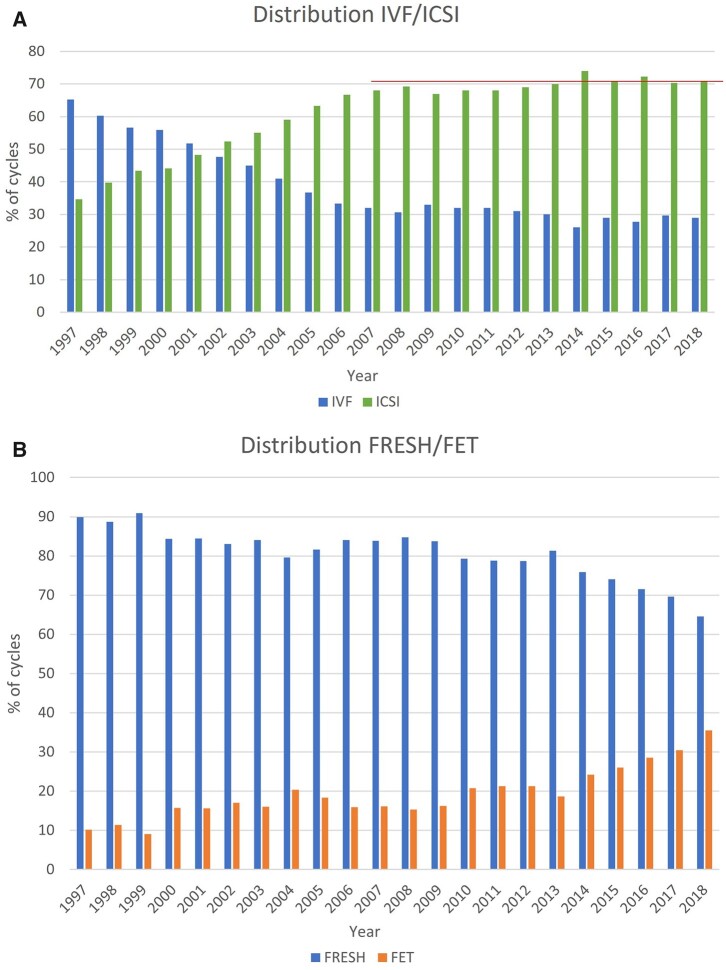
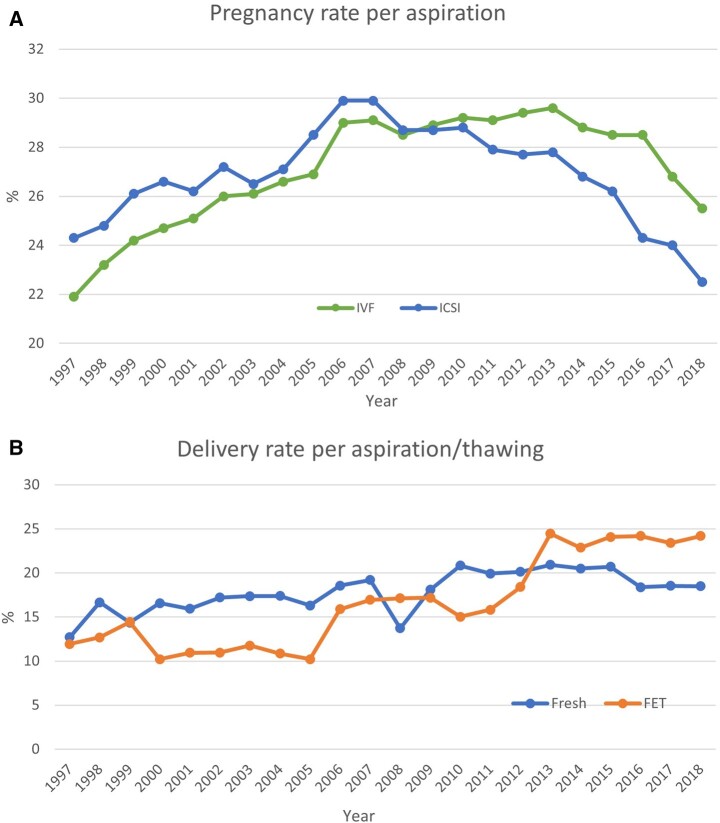
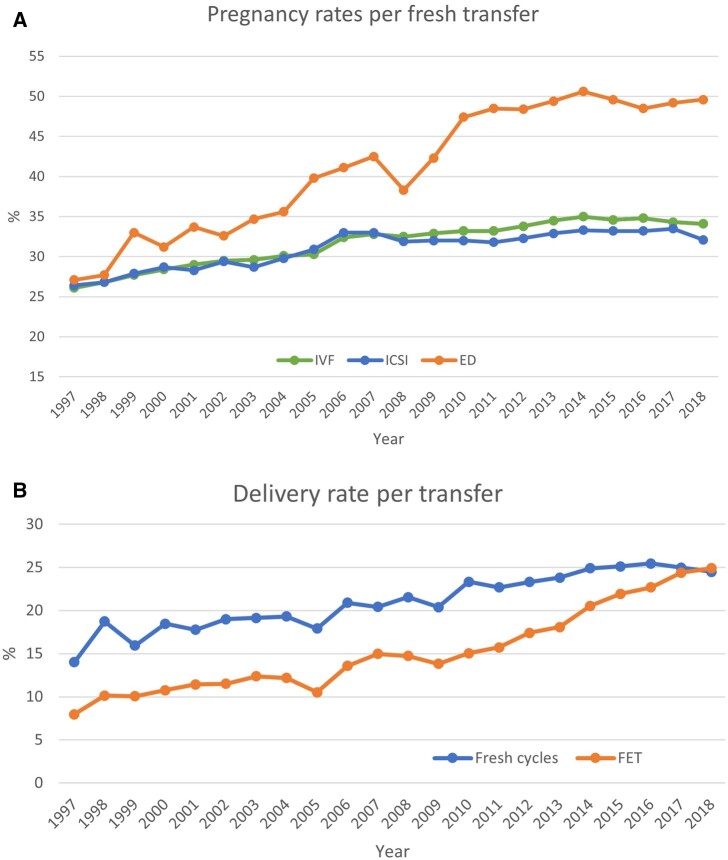
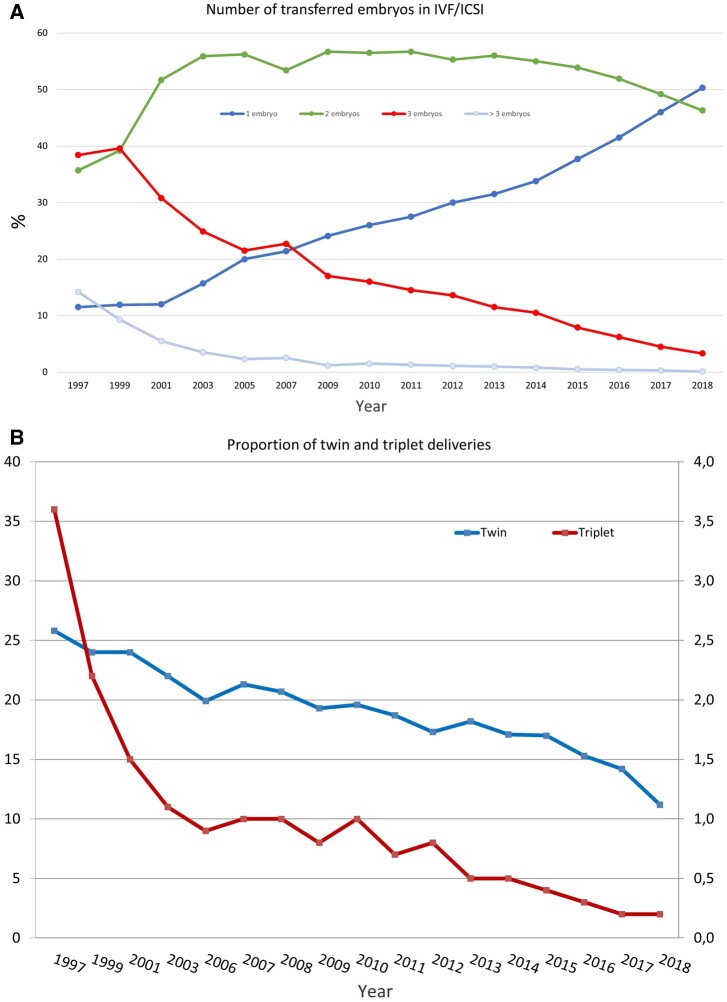
STUDY QUESTION: What are the data and trends on ART and IUI cycle numbers and their outcomes, and on fertility preservation (FP) interventions, reported in 2018 as compared to previous years? SUMMARY ANSWER: The 22nd ESHRE report shows a continued increase in reported numbers of ART treatment cycles and children born in Europe, a decrease in transfers with more than one embryo with a further reduction of twin delivery rates (DRs) as compared to 2017, higher DRs per transfer after fresh IVF or ICSI cycles (without considering freeze-all cycles) than after frozen embryo transfer (FET) with higher pregnancy rates (PRs) after FET and the number of reported IUI cycles decreased while their PR and DR remained stable. WHAT IS KNOWN ALREADY: ART aggregated data generated by national registries, clinics or professional societies have been gathered and analysed by the European IVF-monitoring Consortium (EIM) since 1997 and reported in 21 manuscripts published in Human Reproduction and Human Reproduction Open. STUDY DESIGN, SIZE, DURATION: Data on medically assisted reproduction (MAR) from European countries are collected by EIM for ESHRE on a yearly basis. The data on treatment cycles performed between 1 January and 31 December 2018 were provided by either national registries or registries based on initiatives of medical associations and scientific organizations or committed persons of 39 countries. PARTICIPANTS/MATERIALS, SETTING, METHODS: Overall, 1422 clinics offering ART services in 39 countries reported a total of more than 1 million (1 007 598) treatment cycles for the first time, including 162 837 with IVF, 400 375 with ICSI, 309 475 with FET, 48 294 with preimplantation genetic testing, 80 641 with egg donation (ED), 532 with IVM of oocytes and 5444 cycles with frozen oocyte replacement (FOR). A total of 1271 institutions reported data on IUI cycles using either husband/partner’s semen (IUI-H; n = 148 143) or donor semen (IUI-D; n = 50 609) in 31 countries and 25 countries, respectively. Sixteen countries reported 20 994 interventions in pre- and post-pubertal patients for FP including oocyte, ovarian tissue, semen and testicular tissue banking. MAIN RESULTS AND THE ROLE OF CHANCE: In 21 countries (21 in 2017) in which all ART clinics reported to the registry, 410 190 treatment cycles were registered for a total population of ∼ 300 million inhabitants, allowing a best estimate of a mean of 1433 cycles performed per million inhabitants (range: 641–3549). Among the 39 reporting countries, for IVF, the clinical PR per aspiration slightly decreased while the PR per transfer remained similar compared to 2017 (25.5% and 34.1% in 2018 versus 26.8% and 34.3% in 2017). In ICSI, the corresponding rates showed similar evolutions in 2018 compared to 2017 (22.5% and 32.1% in 2018 versus 24.0% and 33.5% in 2017). When freeze-all cycles were not considered for the calculations, the clinical PRs per aspiration were 28.8% (29.4% in 2017) and 27.3% (27.3% in 2017) for IVF and ICSI, respectively. After FET with embryos originating from own eggs, the PR per thawing was 33.4% (versus 30.2% in 2017), and with embryos originating from donated eggs 41.8% (41.1% in 2017). After ED, the PR per fresh embryo transfer was 49.6% (49.2% in 2017) and per FOR 44.9% (43.3% in 2017). In IVF and ICSI together, the trend towards the transfer of fewer embryos continues with the transfer of 1, 2, 3 and ≥4 embryos in 50.7%, 45.1%, 3.9% and 0.3% of all treatments, respectively (corresponding to 46.0%, 49.2%. 4.5% and 0.3% in 2017). This resulted in a reduced proportion of twin DRs of 12.4% (14.2% in 2017) and similar triplet DR of 0.2%. Treatments with FET in 2018 resulted in twin and triplet DRs of 9.4% and 0.1%, respectively (versus 11.2% and 0.2%, respectively in 2017). After IUI, the DRs remained similar at 8.8% after IUI-H (8.7% in 2017) and at 12.6% after IUI-D (12.4% in 2017). Twin and triplet DRs after IUI-H were 8.4% and 0.3%, respectively (in 2017: 8.1% and 0.3%), and 6.4% and 0.2% after IUI-D (in 2017: 6.9% and 0.2%). Among 20 994 FP interventions in 16 countries (18 888 in 13 countries in 2017), cryopreservation of ejaculated sperm (n = 10 503, versus 11 112 in 2017) and of oocytes (n = 9123 versus 6588 in 2017) were the most frequently reported. LIMITATIONS, REASONS FOR CAUTION: The results should be interpreted with caution as data collection systems and completeness of reporting vary among European countries. Some countries were unable to deliver data about the number of initiated cycles and/or deliveries. WIDER IMPLICATIONS OF THE FINDINGS: The 22nd ESHRE data collection on ART, IUI and FP interventions shows a continuous increase of reported treatment numbers and MAR-derived livebirths in Europe. Although it is the largest data collection on MAR in Europe, further efforts towards optimization of both the collection and reporting, with the aim of improving surveillance and vigilance in the field of reproductive medicine, are awaited. STUDY FUNDING/COMPETING INTEREST(S): The study has received no external funding and all costs are covered by ESHRE. There are no competing interests.
Overview
The claims and statistics of this paper haven’t been checked yet.
Free: it reads the open-access text and checks the first 5 claims that cite a source we can check. Create a free account to check every claim.
Integrity signals
Registry
Cites
Statistics
Figures
Verification
Claims the paper makes
The claims and statistics of this paper haven’t been checked yet.
Free: it reads the open-access text and checks the first 5 claims that cite a source we can check. Create a free account to check every claim.
Claims other papers make about this one
Each is checked against this paper’s own text: does it say what the citing paper says it does?
The source backs part of the claim, not all of it — or backs it for a different population, condition or comparison.
In the citing paper
“Also, the share of treatments provided to women age 40+ has increased considerably: about 22% of in vitro fertilization (IVF) /intracytoplasmic sperm injection treatments were provided to women aged 40+ in 2018, compared with 15% in 2005 (author ' s calculations for 21 European countries based on Andersen et al., 2009; Wyns et al., 2022).”
From Delayed Fertility as a Driver of Fertility Decline? (2023) · cites this paper as Wyns et al., 2022
Experimental — accuracy not yet measured
Self-check
Percentages, sums and reported differences re-computed from the paper’s own numbers.
The self-check needs the paper’s full text.
Citations
Cites
The international glossary on infertility and fertility care, 2017
Zegers-Hochschild, F., Adamson, G. D., Dyer, S., Racowsky, C., de Mouzon, J., Sokol, R., Rienzi, L., Sunde, A., Schmidt, L., Cooke, I. D., et al. (2017) · Human Reproduction · doi:10.1093/humrep/dex234 · Cited by 1,320 · cited 1×
“The terminology used was based on the glossary of The International Committee for Monitoring Assisted Reproductive Technology (Zegers-Hochschild et al., 2017).”
MethodCleavage stage versus blastocyst stage embryo transfer in assisted reproductive technology
Glujovsky, D., Farquhar, C., Quinteiro Retamar, A. M., Alvarez Sedo, C. R., & Blake, D. (2016) · Cochrane Database of Systematic Reviews · doi:10.1002/14651858.cd002118.pub5 · Cited by 706
Sullivan, E. A., Zegers-Hochschild, F., Mansour, R., Ishihara, O., de Mouzon, J., Nygren, K. G., & Adamson, G. D. (2013) · Human Reproduction · doi:10.1093/humrep/det036 · Cited by 414
Chambers, G. M., Dyer, S., Zegers-Hochschild, F., de Mouzon, J., Ishihara, O., Banker, M., Mansour, R., Kupka, M. S., & Adamson, G. D. (2021) · Human Reproduction · doi:10.1093/humrep/deab198 · Cited by 298
Self-citationART in Europe, 2016: results generated from European registries by ESHRE†
The European IVF-monitoring Consortium (EIM)‡ for the European Society of Human Reproduction and Embryology (ESHRE), Wyns, C., Gliozheni, O., Hambartsoumian, E., Strohmer, H., Petrovskaya, E., Tishkevich, O., Bogaerts, K., Wyns, C., Balic, D., et al. (2020) · Human Reproduction Open · doi:10.1093/hropen/hoaa032 · Cited by 274
Self-citationSurvey on ART and IUI: legislation, regulation, funding and registries in European countries
Calhaz-Jorge, C., De Geyter, C. H., Kupka, M. S., Wyns, C., Mocanu, E., Motrenko, T., Scaravelli, G., Smeenk, J., Vidakovic, S., & Goossens, V (2020) · Human Reproduction Open · doi:10.1093/hropen/hoz044 · Cited by 262
Self-citationRisks and complications in assisted reproduction techniques: Report of an ESHRE consensus meeting
Land, J. A. (2003) · Human Reproduction · doi:10.1093/humrep/deg081 · Cited by 234
ART in Europe, 2015: results generated from European registries by ESHRE†
De Geyter, C., Calhaz-Jorge, C., Kupka, M. S., Wyns, C., Mocanu, E., Motrenko, T., Scaravelli, G., Smeenk, J., Vidakovic, S., Goossens, V, et al. (2020) · Human Reproduction Open · doi:10.1093/hropen/hoz038 · Cited by 213
Self-citationDe Geyter, C., Wyns, C., Calhaz-Jorge, C., de Mouzon, J., Ferraretti, A. P., Kupka, M., Nyboe Andersen, A., Nygren, K. G., & Goossens, V (2020) · Human Reproduction · doi:10.1093/humrep/deaa250 · Cited by 195
Self-citationART in Europe, 2017: results generated from European registries by ESHRE
The European IVF-Monitoring Consortium (EIM) for the European Society of Human Reproduction and Embryology (ESHRE), Gliozheni, O., Hambartsoumian, E., Strohmer, H., Kreuz-Kinderwunschzentrum, O. &. S. P. G., Petrovskaya, E., Tishkevich, O., Bogaerts, K., I-Biostat, C. W., Balic, D., et al. (2021) · Human Reproduction Open · doi:10.1093/hropen/hoab026 · Cited by 192
Self-citation
Cited by
Items 101–200 of 282
Takae, S., Harada, M., Nakamura, K., Furuyama, S., Ono, M., Osuga, Y., & Suzuki, N. (2024) · Journal of obstetrics and gynaecology research · doi:10.1111/jog.15893 · Cited by 8
Turrini, M., & Otín‐Gavín, J. (2025) · Sociology of Health & Illness · doi:10.1111/1467-9566.13876 · Cited by 8
Impact of organelle architecture on oocyte developmental potential
Nikalayevich, E., Zollo, N., & Verlhac, M. (2025) · Current Opinion in Cell Biology · doi:10.1016/j.ceb.2025.102556 · Cited by 8
Molas, A. (2023) · Medical Anthropology · doi:10.1080/01459740.2023.2263806 · Cited by 8
Massarotti, C., Cimadomo, D., Spadoni, V., Conforti, A., Zacà, C., Carosso, A. R., Vaiarelli, A., Venturella, R., Vitagliano, A., Busnelli, A., et al. (2024) · Journal of Assisted Reproduction and Genetics · doi:10.1007/s10815-024-03197-4 · Cited by 8
Is It Time for Andrology and Endocrinology Professionals in Assisted Reproduction Centers?
Cannarella, R., Marino, M., Condorelli, R. A., Vignera, S. L., & Calogero, A. E. (2023) · The World Journal of Men s Health · doi:10.5534/wjmh.220253 · Cited by 8
Lemardeley, G., Porcu‐Buisson, G., Pirrello, O., Gane, J., Dieterlé, S., Astrugue, C., Charbonnier, T., Lucas-Samuel, S., & Couchoud, C. (2023) · Human Reproduction · doi:10.1093/humrep/dead232 · Cited by 8
The intergenerational economics of infertility, childrearing, and assisted reproduction
Connolly, M. P., Kotsopoulos, N., & Eisenberg, M. L. (2022) · Fertility and Sterility · doi:10.1016/j.fertnstert.2022.12.011 · Cited by 8
Reproductive outcomes in women and men conceived by assisted reproductive technologies
Doulgeraki, T., & Iliodromiti, S. (2023) · BMJ Medicine · doi:10.1136/bmjmed-2023-000547 · Cited by 8
Song, W., Li, C., Wu, T., Wang, Z., Dang, Y., Ding, L., & Qin, Y. (2023) · Human Reproduction · doi:10.1093/humrep/dead220 · Cited by 7
Cobo, A. C., Coello, A., Santos, M. J. D. L., Remohi, J. A., & Bellver, J. (2024) · American Journal of Obstetrics and Gynecology · doi:10.1016/j.ajog.2024.03.033 · Cited by 7
Embryo development and live birth in women with one previously failed full IVF/ICSI cycle
Wen, W., Zhang, D., Liu, X., Shi, J., & Cai, H. (2024) · Journal of Assisted Reproduction and Genetics · doi:10.1007/s10815-024-03107-8 · Cited by 7
Wang, J., Chen, L., Yong, Y., Xiang, Y., Chen, Y., Jie, Z., Xia, X., Cui, Y., Diao, F., Liu, J., et al. (2025) · BJOG An International Journal of Obstetrics & Gynaecology · doi:10.1111/1471-0528.18044 · Cited by 7
Sciorio, R., Greco, P., Tramontano, L., Gullo, G., & Greco, E. (2025) · Journal of Clinical Medicine · doi:10.3390/jcm14082827 · Cited by 7
Skedgel, C. D., Cubí‐Mollá, P., Mott, D. J., Gameiro, S., Boivin, J., Al‐Janabi, H., Brazier, J. E., Markert, M., Andersson, F. L., & Jofre‐Bonet, M. (2023) · PharmacoEconomics - Open · doi:10.1007/s41669-023-00402-5 · Cited by 8
“However, the increasing demand we see for fertility services [24, 25], along with evidence of a substantial willingness to pay for improvements in the likelihood of ART success [26], suggests that such ‘irrationality’ is an artefact of measurement.”
BackgroundKarahan, G., Martel, J., Rahimi, S., Farag, M., Matias, F. M. G., MacFarlane, A. J., Chan, D., & Trasler, J. M. (2023) · Human Molecular Genetics · doi:10.1093/hmg/ddad160 · Cited by 8
Liao, M., Xu, Q., Mao, X., Zhang, J., Wu, L., & Chen, Q. (2023) · American Journal of Obstetrics and Gynecology · doi:10.1016/j.ajog.2023.11.1224 · Cited by 7
Association Between Assisted Reproductive Technology and Cerebral Palsy: A Meta-Analysis
Cavero-Ibiricu, A., Canelas-Fernández, J., Gómez‐Acebo, I., Alonso-Molero, J., Martínez-Jiménez, D., Llorca, J., Cabero-Pérez, M. J., & Dierssen‐Sotos, T. (2023) · Pediatric Neurology · doi:10.1016/j.pediatrneurol.2023.12.019 · Cited by 7
Medically assisted reproduction in Italy, 2020 data from the Italian MAR Register
Scaravelli, G., LUCA, R. D., Spoletini, R., Speziale, L., Fedele, F., Bolli, S., MAZZOLA, M., BERTINI, A., MONTE, C. D., & Vigiliano, V. (2024) · Minerva Obstetrics and Gynecology · doi:10.23736/s2724-606x.23.05375-7 · Cited by 7
Self-citationLoreti, S., Roelens, C., Aktöz, F., Niero, M., Munck, N. D., Tournaye, H. J., Mackens, S., & Blockeel, C. (2024) · Human Reproduction · doi:10.1093/humrep/deae101 · Cited by 7
Takae, S., Harada, M., Nakamura, K., Furuyama, S., Ono, M., Osuga, Y., & Suzuki, N. (2024) · Reproductive Medicine and Biology · doi:10.1002/rmb2.12581 · Cited by 7
Vanbelleghem, E., Muyshond, V., Colman, R., Meerschaut, F. V., Stoop, D., Janssens, S., & Tilleman, K. (2023) · Reproductive BioMedicine Online · doi:10.1016/j.rbmo.2023.04.015 · Cited by 7
Suero, C., Compans, M., & Beaujouan, É. (2025) · Advances in Life Course Research · doi:10.1016/j.alcr.2025.100672 · Cited by 6
“…focuses on Spain, a context characterized by exceptionally late transitions to adulthood (Bueno & Brinton, 2019; del Rey et al., 2023; Nishikido et al., 2022), and a significant increase in the use of ART over recent decades (Wyns et al., 2022), with these technologies being widely accessible.”
Linehan, L. A., Hennessy, M., & O’Donoghue, K. (2023) · European Journal of Obstetrics & Gynecology and Reproductive Biology · doi:10.1016/j.ejogrb.2023.01.002 · Cited by 6
Vlasenko, P., & Pavone, V. (2025) · Science Technology & Human Values · doi:10.1177/01622439251336630 · Cited by 6
Sandvei, M. S., Pinborg, A. B., Gissler, M., Bergh, C., Romundstad, L. B., van Leeuwen, F. E., Spaan, M., Tiitinen, A. E., Wennerholm, U., Henningsen, A.-K. A., et al. (2022) · British Journal of Cancer · doi:10.1038/s41416-022-02097-7 · Cited by 6
“Over the last decades, the use of ART has increased steadily [21].”
BackgroundSelf-citationGender inequality and utilization of ART: an international cross-sectional and longitudinal analysis
Fitzgerald, O., Dyer, S., Zegers-Hochschild, F., Keller, E., Adamson, G. D., & Chambers, G. M. (2023) · Human Reproduction · doi:10.1093/humrep/dead225 · Cited by 6
Nikolaeva, M. A., Arefieva, A., Анатольевна, Б. А., Va, A., Zhukova, Z. A. С., Kalinina, E. A., Krechetova, K. L. V., & Sukhikh, G. T. (2024) · Reproductive Sciences · doi:10.1007/s43032-024-01486-y · Cited by 5
Borget, I., Benchaïb, M., Poignant, P., Rey, L., Harty, G. T., Chaudhari, V., D'Hooghe, T., Schwarze, J.-E., Cédrin‐Durnerin, I., Roeder, C., et al. (2024) · Gynecologic and Obstetric Investigation · doi:10.1159/000542074 · Cited by 5
Genest, G., Hochberg, A., Boivin, M., Ferreira, A., Liu, Z., Beauchamp, C., Beltempo, M., Dahan, M. H., Dahdouh, E. M., Demirtaş, E., et al. (2025) · American Journal of Reproductive Immunology · doi:10.1111/aji.70131 · Cited by 5
Success Rates of Assisted Reproduction in Couples with Poor Ovarian Response and Oligospermia
Wyroba, J., Kochan, J., Brązert, M., & Kordowitzki, P. (2025) · Cells · doi:10.3390/cells14191492 · Cited by 5
Sperm selection for assisted reproductive technology: do we have a winner?
Li, Y., Wang, H., Sun, X., Li, Q., & Xu, J. (2025) · Journal of Assisted Reproduction and Genetics · doi:10.1007/s10815-025-03684-2 · Cited by 5
“While advancements in ART have significantly improved clinical success rates, recent data indicate a plateau in pregnancy and live birth outcomes, underscoring unresolved challenges [5].”
Autoimmune thyroid disease in infertility and assisted reproductive technology: A review
Pires, M. F. A., Póvoa, A. M., & Soares, S. (2025) · Porto Biomedical Journal · doi:10.1097/j.pbj.0000000000000307 · Cited by 5
Granholm, R. L., Cantineau, A. E., Hoek, A., & Stulp, G. (2026) · Human Reproduction · doi:10.1093/humrep/deag006 · Cited by 5
van Bentem, K., van der Hoorn, M., Lith, J. M. M. V., le Cessie, S., & Lashley, E. E. L. O. (2022) · BMJ Open · doi:10.1136/bmjopen-2021-059594 · Cited by 5
Raudonis, V., Bartašienė, R., Minajeva, A., Saare, M., Drejerienė, E., Kozlovskaja-Gumbrienė, A., & Salumets, A. (2024) · Applied Sciences · doi:10.3390/app14135715 · Cited by 5
Galati, G., Esposito, G., Somigliana, E., Muzii, L., Franchi, M., Corrao, G., & Parazzini, F. (2023) · Journal of Assisted Reproduction and Genetics · doi:10.1007/s10815-023-02732-z · Cited by 5
Advancing bovine in vitro fertilization through 3D printing: the effect of the 3D printed materials
Belda-Pérez, R., Heras, S., Cimini, C., Romero‐Aguirregomezcorta, J., Valbonetti, L., Colosimo, A., Colosimo, B. M., Santoni, S., Barboni, B., Bernabò, N., et al. (2023) · Frontiers in Bioengineering and Biotechnology · doi:10.3389/fbioe.2023.1260886 · Cited by 5
Infertility treatment and offspring blood pressure—a systematic review and meta-analysis
Yeung, E. H., Ryan, I., Clayton, P., Polinski, K. J., Livinski, A. A., & Putnick, D. L. (2024) · Human Reproduction Update · doi:10.1093/humupd/dmae029 · Cited by 5
Plouvier, P., Marcilly, R., Robin, G., Benamar, C., Robin, C., Simon, V., Piau, A. S., Cambay, I., Schiro, J., & Decanter, C. (2025) · JMIR Human Factors · doi:10.2196/63570 · Cited by 5
“In 2018, the European Society of Human Reproduction and Embryology’s 22nd report on medically assisted reproduction (MAR) in Europe highlighted a continuous increase in the number of treatment cycles and the broad range of techniques used [1].”
Zheleznyakova, I. A., Волкова, О. А., Fedyaev, D. V., Сергеевна, П. О., Mazurov, A. M., Lazareva, M. L., & Kotsenbina, E. V. (2023) · Medical Technologies Assessment and Choice · doi:10.17116/medtech20234502123 · Cited by 5
Home-based monitoring prior to frozen embryo transfer: the new gold standard?
Mackens, S., & Blockeel, C. (2023) · The Lancet · doi:10.1016/s0140-6736(23)01798-1 · Cited by 5
Jiesisibieke, D., Tian, T., Zhu, X., Fang, S., Zhang, N., Ma, J., Xia, Y., Li, R., Liu, P., Qiao, J., et al. (2024) · Reproductive Sciences · doi:10.1007/s43032-023-01444-0 · Cited by 5
“Furthermore, we compared the effect of ICSI over conventional IVF on clinical pregnancy rate (CPR), live birth rate (LBR), abortion rate (AR), and preterm delivery rate after adjusting for potential confounding factors, which may provide information for clinical decision-making.”
BackgroundA humán reprodukcióval kapcsolatos hazai regiszterek
Vesztergom, D., Szabó, M., Sziller, I., Valek, A., Turi, Z., Szekrényes, Á., Szöllősi, K., Krádi, A., Kéki, Z., Vita, E., et al. (2024) · Orvosi Hetilap · doi:10.1556/650.2024.33072 · Cited by 5
Freeze-all indications in women with subfertility undergoing IVF: a cohort study
Moens, V., Jiménez, J. F., Serrano, M. F., Pérez, D. O., Muñoz, E., Pinochet, C. Á., Sánchez, M. F., Rosado, A. R., Vives, M. T., Augé, E., et al. (2024) · Reproductive BioMedicine Online · doi:10.1016/j.rbmo.2024.104491 · Cited by 4
Bin, C., Zhong, H., Zhang, S., Luo, Y., Su, J., Li, M., & Wei, S. (2025) · Journal of Assisted Reproduction and Genetics · doi:10.1007/s10815-025-03489-3 · Cited by 4
Uncertain commodities: egg banking and value in Ukraine
Vlasenko, P. (2023) · BioSocieties · doi:10.1057/s41292-023-00307-w · Cited by 4
Pape, J., Levy, J., Makieva, S., & von Wolff, M. (2024) · Reproductive BioMedicine Online · doi:10.1016/j.rbmo.2024.104483 · Cited by 4
Aslih, N., Atzmon, Y., Bilgory, A., Raya, Y. S. A., Sharqawi, M., & Shalom‐Paz, E. (2024) · Journal of Clinical Medicine · doi:10.3390/jcm13237254 · Cited by 4
In Vitro Embryo Culture Impacts Heart Mitochondria in Male Adolescent Sheep
Amanollahi, R., Holman, S. L., Meakin, A. S., Padhee, M., Botting, K. J., Zhang, S., MacLaughlin, S. M., Kleemann, D. O., Walker, S. K., Kelly, J. M., et al. (2025) · Journal of Developmental Biology · doi:10.3390/jdb13020017 · Cited by 4
Ma, K., Jin, S., Zhao, C., Wang, R., Yang, L., Ma, J., Gao, C., Sun, L., Zhang, Q., & Wang, L. (2025) · Annals of Medicine · doi:10.1080/07853890.2025.2541420 · Cited by 4
“In the United States, ART accounted for up to 5.1% of live births, while in Europe, the proportion had reached 7.9% [12,13].”
InfluentialCross-border Reproductive Care in Czechia: Insights from National Registry Data
Volejníková, A., Šťastná, A., & Kocourková, J. (2025) · Comparative Population Studies · doi:10.12765/cpos-2025-12 · Cited by 4
Sokol, P., Clua, E., Pons, M. C., García, S., Racca, A., Fréour, T., & Polyzos, N. P. (2024) · Reproductive BioMedicine Online · doi:10.1016/j.rbmo.2024.103890 · Cited by 4
Benlioğlu, C., Aydın, Y., Bahçeci, M., Baltacı, V., Kuran, S. B., Demir, A., Dilbaz, S., Ergin, E., Fındıklı, N., Çelik, H. G., et al. (2024) · Journal of the Turkish-German Gynecological Association · doi:10.4274/jtgga.galenos.2023.2023-3-12 · Cited by 4
Self-citationConnolly, M. P., Kotsopoulos, N., Li, J., & Chambers, G. M. (2025) · Journal of health economics and outcomes research · doi:10.36469/001c.133796 · Cited by 4
Siargkas, A., Tsakiridis, I. G., Kappou, D., Mamopoulos, A. M., Papastefanou, I., & Dagklis, T. (2025) · Medicina · doi:10.3390/medicina61061093 · Cited by 4
Body composition as an indicator of metabolic changes in mice obtained by in vitro fertilization
Anisimova, M. V., Gon, Y., Kontsevaya, G. V., Romashchenko, A. V., Хоцкин, Н. В., Stanova, A. K., Gerlinskaya, L. A., & Moshkin, M. P. (2023) · Vavilov Journal of Genetics and Breeding · doi:10.18699/vjgb-23-43 · Cited by 4
Lehmann, M., Arbo, E., Pouly, J. L., Barrière, P., Boland, L. A., Bean, S. G., & Jenkins, J. M. (2024) · European Journal of Obstetrics & Gynecology and Reproductive Biology X · doi:10.1016/j.eurox.2024.100311 · Cited by 4
Milostić-Srb, A., Srb, N., Talapko, J., Meštrović, T., Žiger, T., Pačarić, S., Fureš, R., Makarović, V., & Škrlec, I. (2024) · Diseases · doi:10.3390/diseases12090201 · Cited by 4
Deep Learning for the Automation of Embryo Selection in an In Vitro Fertilization Laboratory
Bosch, E. (2024) · RiuNet (Universitat Politècnica de València) · doi:10.4995/thesis/10251/206839 · Cited by 4
Skodvin, S. N., Gjessing, H. K., Jugessur, A., Romanowska, J., Page, C. M., Corfield, E. C., Lee, Y., Håberg, S. E., & Gjerdevik, M. (2023) · Genetic Epidemiology · doi:10.1002/gepi.22534 · Cited by 3
“The use of assisted reproductive technologies (ARTs) as fertility treatment has increased steadily in many parts of the world over the last couple of decades (Chambers et al., 2021; Wyns et al., 2022).”
BackgroundLafeber, G., van der Endt, V. H. W., Louwers, Y. V., le Cessie, S., van der Hoorn, M., & Lashley, E. E. L. O. (2024) · BMJ Open · doi:10.1136/bmjopen-2023-079394 · Cited by 3
Is the Beck Depression Inventory (BDI) a Useful Tool for Predicting IVF Success?
Šljivančanin, D., Vidakovic, S., Kisić-Tepavčević, D., Petrović, B., Šljivančanin, U., & Đokić, M. (2025) · Medicina · doi:10.3390/medicina61010099 · Cited by 3
Self-citationvon Kappelgaard, L. M., Framke, E., Vassard, D., Pinborg, A. B., Schwarze, J.-E., Sabidó, M., & Magyari, M. (2025) · BMJ Neurology Open · doi:10.1136/bmjno-2025-001092 · Cited by 3
“7 8 9–11 The relapse activity during pregnancy is generally regarded as low; immune response changes during pregnancy are thought to lead to lower inflammation and thereby fewer relapses, particularly in the third trimester.”
Pónusz-Kovács, D., Csákvári, T., Pónusz, R., Kovács, B., Kajos, L., Elmer, D., Bódis, J., Várnagy, Á., Vesztergom, D., & Boncz, I. (2025) · Orvosi Hetilap · doi:10.1556/650.2025.33330 · Cited by 3
Berntsen, S., Zedeler, A., Grøndahl, M. L., Gabrielsen, A. V., Petersen, M. R., Skipper, D. F., Nøhr, B., Englund, A. L. M., Løkkegaard, E., Prætorius, L., et al. (2025) · Human Reproduction · doi:10.1093/humrep/deaf157 · Cited by 3
Liu, R., Wu, T., Ding, G., Song, Y., Ma, Z., Dang, Y., & Ma, J. (2026) · Reproductive Medicine and Biology · doi:10.1002/rmb2.70025 · Cited by 3
Nakazato, M., Matsuzaki, M., Okai, D., Takeuchi, E., Seki, M., Takeuchi, M., Fukui, E., & Matsumoto, H. (2024) · PNAS Nexus · doi:10.1093/pnasnexus/pgae114 · Cited by 3
Tocariu, R., Dinulescu, A., Prejmereanu, A., Maier, C., Coricovac, A.-M., Archir, E.-D., Niculae, L. E., & Brătilă, E. (2024) · Journal of Clinical Medicine · doi:10.3390/jcm13216470 · Cited by 3
Marino, A. A., Volpes, A., Sammartano, F., MODICA, M., Scaglione, P., Gullo, S., Quintero, L., & Allegra, A. (2024) · Minerva Obstetrics and Gynecology · doi:10.23736/s2724-606x.24.05538-6 · Cited by 3
Separation of sperm based on rheotaxis mechanism using a microfluidic device
Torkashvand, H., Shabani, R., Pilehvari, S., Moghimi, M., Torkashvand, L., Mehdizadeh, R., Derakhshan, R., & Mehdizadeh, M. (2025) · Daehan saengsik uihak hoeji/Clinical and experimental reproductive medicine · doi:10.5653/cerm.2024.07304 · Cited by 3
Manual of Embryo Selection in Human Assisted Reproduction
Sunde, A., Lundin, K., Bolton, V. N., Salamonsen, L. A., Edgell, T. A., Nie, G., Evans, J., Punjani, N., Hayden, R. P., Schlegel, P. N., et al. (2023) · Cambridge University Press eBooks · doi:10.1017/9781009025218 · Cited by 3
Pregnancy Rates After Frozen Embryo Transfer: Insights from an Indian Government Hospital
Acharya, S., Balakrishnan, S., & Rath, D. (2025) · International Journal of Multidisciplinary Research and Growth Evaluation · doi:10.54660/.ijmrge.2025.6.2.965-972 · Cited by 3
Oocyte donation from medical professionals’ view
Chalova, L., Lokshin, V. N., & Kinzhibayev, A. (2022) · Russian Journal of Human Reproduction · doi:10.17116/repro20222806179 · Cited by 3
Self-citationRapport 23-07. Santé à moyen et à long terme des enfants conçus par fécondation in vitro (FIV)
Jouannet, P., Claris, O., & Bouc, Y. L. (2023) · Bulletin de l Académie Nationale de Médecine · doi:10.1016/j.banm.2023.04.015 · Cited by 3
Szabó, G., Judit Szigeti, F., Sipos, M., Várbíró, S., & Gonda, X. (2024) · Scientific Reports · doi:10.1038/s41598-024-63343-x · Cited by 3
Локшин, В. Н., Сулейменова, М. Д., Карибаева, Ш. К., Байкошкарова, С. Б., Ибрагимов, А. К., Ажетова, Ж. Р., Джусубалиев, Н. М., Яхьярова, М. П., Мухамедьяров, Д. А., Ахметова, А. А., et al. (2024) · Репродуктивная медицина · doi:10.37800/rm.1.2024.8-16 · Cited by 2
Liu, C., Fukui, E., & Matsumoto, H. (2025) · Reproductive Medicine and Biology · doi:10.1002/rmb2.12633 · Cited by 2
Vágvölgyi, A., Vedelek, V., Keller, N., Szöllősi, D., Lada, S., Nemes, A., Kempler, P., Menyhárt, A., Baczkó, I., Várkonyi, T. T., et al. (2025) · Frontiers in Endocrinology · doi:10.3389/fendo.2025.1548587 · Cited by 2
Crafa, A., Cannarella, R., Navarro‐Gomezlechon, A., Pacheco-Rendón, R. M., Condorelli, R. A., Vignera, S. L., Calogero, A. E., & Garrido, N. (2025) · Reproductive BioMedicine Online · doi:10.1016/j.rbmo.2025.105209 · Cited by 2
Boynukalın, F. K., Tohma, Y. A., Demir, B., Gültomruk, M., Polyzos, N. P., Bahçeci, M., & Bozdağ, G. (2025) · Journal of Assisted Reproduction and Genetics · doi:10.1007/s10815-025-03646-8 · Cited by 2
Kink, A., Mehdipour, P., Hiscock, R. J., Vollenhoven, B. J., Stern, C. J., Walker, S. P., Green, M. P., Osianlis, T., Agresta, F., Wilkinson, D., et al. (2025) · Australian and New Zealand Journal of Obstetrics and Gynaecology · doi:10.1111/ajo.70070 · Cited by 2
Fares, K., Whaibeh, E. R., Matta, E. E., Atallah, H., Kaadi, E. S., Zeid, L. J. A., Hammoud, I. H., Hachem, H. E., Nakhlé, M. M., & Tayeh, G. A. (2026) · Reproductive Health · doi:10.1186/s12978-025-02253-1 · Cited by 2
Lédée, N., Habeichi, N. J., Rahmati, M., Dray, G., Kerkhoven, N., Vicaut, É., Diallo, A., Cassuto, N. G., Ruoso, L., Prat-Ellenberg, L., et al. (2026) · Frontiers in Immunology · doi:10.3389/fimmu.2026.1706032 · Cited by 2
Czech, R., Wójcik, D., Skweres, T., Sliwiński, W., Zamkowska, D., & Ciepiela, P. (2026) · PLoS ONE · doi:10.1371/journal.pone.0346711 · Cited by 2
Vascular health of fathers with history of intracytoplasmic sperm injection
Li, P., Langer, M., Vilsmaier, T., Kramer, M., Sciuk, F., Kolbinger, B., Jakob, A., Rogenhofer, N., Dalla‐Pozza, R., Thaler, C., et al. (2024) · The Aging Male · doi:10.1080/13685538.2024.2360529 · Cited by 2
Li, Y., Niu, Y., Liu, M., Lan, X., Qin, R., Ma, K., & Zhao, H. (2023) · Journal of Hypertension · doi:10.1097/hjh.0000000000003498 · Cited by 2
“According to the 22nd ESHRE report, there is a continued increase in the proportion of FET cycles [2].”
BackgroundZarei, A., Keshavarzi, A., & Zare, M. (2023) · Zygote · doi:10.1017/s096719942300031x · Cited by 2
Sanchez, A. D. B., Fialová, J., Konečná, H., & Güell, F. (2024) · Czech Sociological Review · doi:10.13060/csr.2024.019 · Cited by 2
“The increase in the number of third party reproduction cycles is illustrated by Human Fertilisation & Embryology Authority (HFEA) statistics ( Fertility treatment 2019: trends and figures , 2021) and European Society of Human Reproduction and Embryology (ESHRE) statistics (Gliozheni et al., 2022).”
Plaza, C. Á., & Machín, R. (2024) · Revista de Bioética y Derecho · doi:10.1344/rbd2024.61.45068 · Cited by 2
Havrljenko, J., Kopitović, V., Trninić-Pjević, A., Milatović, S., Kalember, S., Katanić, F., Pavlica, T., Andric, N. L., & Pogrmic‐Majkic, K. (2025) · Medicina · doi:10.3390/medicina61020303 · Cited by 2
Ejzenberg, D., Callado, G. Y., Gomes, T. J. D. O., Cavalcanti, G. S., Soares, J. M., Baracat, E. C., & Monteleone, P. A. A. (2025) · International Journal of Gynecology & Obstetrics · doi:10.1002/ijgo.70104 · Cited by 2
Bouet, P., Bruand, M., Bellaïche, K., Vielle, B., Legendre, G., Descamps, P., Corroënne, R., May‐Panloup, P., & Hachem, H. E. (2022) · Scientific Reports · doi:10.1038/s41598-022-23470-9 · Cited by 2
Kirchengast, S., & Hartmann, B. W. (2023) · Human Biology and Public Health · doi:10.52905/hbph2023.2.74 · Cited by 2
Editorial: Challenges in fertilization and implantation success
Massarotti, C., Makieva, S., & Stigliani, S. (2023) · Frontiers in Cell and Developmental Biology · doi:10.3389/fcell.2023.1268635 · Cited by 2
The experience of in vitro fertilization data collection in Turkey
Işıkoğlu, M., & de Mouzon, J. (2021) · Journal of the Turkish-German Gynecological Association · doi:10.4274/jtgga.galenos.2021.2020.0222 · Cited by 1
Female smoking does not affect live birth rate after frozen thawed blastocyst transfer cycle
Redon, C., Chaillot, M., Reignier, A., Caillet, P., Lefebvre, T., & Fréour, T. (2024) · Journal of Gynecology Obstetrics and Human Reproduction · doi:10.1016/j.jogoh.2024.102793 · Cited by 1
Sperm-micromotors for assisted reproduction and drug delivery
Striggow, F., Akbar, F., Aziz, A., & Medina‐Sánchez, M. (2024) · Elsevier eBooks · doi:10.1016/b978-0-443-13385-5.00003-9 · Cited by 1
Antinuclear antibodies do not affect euploidy rate in preimplantation genetic testing for aneuploidy
Liu, M., Hu, Y., Diao, H., Tian, L., Zhang, C., & Zhang, Y. (2024) · Reproductive BioMedicine Online · doi:10.1016/j.rbmo.2024.104734 · Cited by 1
Assessing Willingness to Pay for IVF Among Infertile Women in Greece: A Single‐Center Case Study
Ntais, C., Artsita, M., Talias, Μ. A., Fanourgiakis, J., & Kontodimopoulos, N. (2025) · Health Science Reports · doi:10.1002/hsr2.70402 · Cited by 1
Metadata
- Authors
- European IVF Monitoring Consortium (EIM), F. T. E. S. O. H. R. A. E. (., Gliozheni, O., Hambartsoumian, E., Strohmer, H., Petrovskaya, E., Tishkevich, O., de Neubourg, D., Bogaerts, K., Balic, D., Sibincic, S., Antonova, I., Vrcic, H., Ljiljak, D., Rezabek, K., Markova, J., Kirk, J., Sõritsa, D., Gissler, M., Pelkonen, S., de Mouzon, J., Tandler, A., Vrachnis, N., Urbancsek, J., Kosztolanyi, G., Bjorgvinsson, H., Wingfield, M., Leyden, J., Scaravelli, G., de Luca, R., Lokshin, V., Karibayeva, S., Magomedova, V., Bausyte, R., Masliukaite, I., Schilling, C., Calleja-Agius, J., Moshin, V., Simic, T. M., Vukicevic, D., Smeenk, J. M. J., Petanovski, Z., Romundstad, L. B., Janicka, A., Calhaz-Jorge, C., Guimaraes, J. M. M., Laranjeira, A. R., Rugescu, I., Doroftei, B., Korsak, V., Vidakovic, S., Kovacic, B., Sáiz, I. C., Mondéjar, F. P., Bergh, C., Weder, M., Buttarelli, M., Isikoglu, M., Balaban, B., Baranowski, R., Gryshchenko, M., Wyns, C., De Geyter, C., Calhaz-Jorge, C., Kupka, M. S., Motrenko, T., Smeenk, J., Bergh, C., Tandler-Schneider, A., Rugescu, I. A., & Goossens, V
- Affiliations
- European Society of Human Reproduction and Embryology (BE)
- Cliniques Universitaires Saint-Luc (BE)
- Reproductive Medicine and Gynecological Endocrinology (RME), University Hospital, University of Basel , Basel, Switzerland
- Faculdade de Medicina da Universidade de Lisboa , Lisbon, Portugal
- Fertility Center—Gynaekologicum , Hamburg, Germany
- Human Reproduction Center Budva , Budva, Montenegro
- Elisabeth Twee Steden Ziekenhuis , Tilburg, The Netherlands
- Department of Obstetrics and Gynecology, Institute of Clinical Sciences, Göteborg University , Göteborg, Sweden
- Fertility Center Berlin , Berlin, Germany
- National Transplant Agency , Bucharest, Romania
- Corresponding author
- Strohmer, Heinz
- Wyns, C
- ORCID
- Venue
- Human Reproduction Open
- Publisher
- Oxford University Press (OUP)
- Published
- 2022-01-01
- Volume
- 2022
- Issue
- 3
- Pages
- hoac022-hoac022
- ISSN
- 2399-3529 (ISSN-L)
- PMC
- PMC9252765
- OpenAlex
- W4285208352
- Cited by
- 229
- References
- 18
- Citations by year
- 2026: 11 · 2025: 48 · 2024: 59 · 2023: 93 · 2022: 15
- FWCI
- 58.95
- Type
- journal article
- Language
- en
- Open access
- gold
- doi.org
- Locations
- Human Reproduction Open (publishedVersion, cc-by)
- PubMed Central (publishedVersion, cc-by)
- PubMed (publishedVersion)
- Digital Access to Libraries (submittedVersion, other-oa)
- Funders
- ESHRE
- Topics
- Health Sciences › Medicine › Pediatrics, Perinatology and Child Health › Assisted Reproductive Technology and Twin Pregnancy
- Health Sciences › Medicine › Reproductive Medicine › Reproductive Health and Technologies
- Health Sciences › Medicine › Reproductive Medicine › Reproductive Biology and Fertility
- Keywords
- assisted reproduction, in vitro fertilization, intracytoplasmic sperm injection, frozen embryo transfer, intrauterine insemination, fertility preservation, embryo transfer outcomes, pregnancy rate, preimplantation genetic testing, oocyte donation, ovarian tissue banking, ESHRE
About these checks
Registry, retraction, Cites and statistics results are computed, not judged, with one exception: a printed reference that no index lists is read once by a model before it counts as a citation error. Claims are extracted by a model and kept only when their quote appears verbatim in the text; each cited source is then checked, with a model’s help, for whether it says what the claim relies on. Those verdicts can be wrong — read the claim’s quote and the cited source before relying on one.
Statistics and arithmetic are recomputed, not judged.
Confidence bands are shown only for fields calibrated on our annotated test set. None is calibrated yet, so no band is shown.
What counts as a claim ›How we measure confidence ›How we check this ›
Are you an author, or do you see a problem with this page? Request a review
Data sources
Bibliographic data: Semantic Scholar, OpenAlex, Crossref.
Contains information from the Semantic Scholar Academic Graph Datasets, made available under the ODC Attribution License (ODC-BY 1.0).
Semantic Scholar’s data is described in: Kinney, R., et al. (2023). The Semantic Scholar Open Data Platform. arXiv:2301.10140.
