

The DOI matches its Crossref record; 67 of the 67 references it cites were found in a registry or an index.
Maternal body mass index during early pregnancy, gestational weight gain, and risk of autism spectrum disorders: Results from a Swedish total population and discordant sibling study.
Open accessAbstract
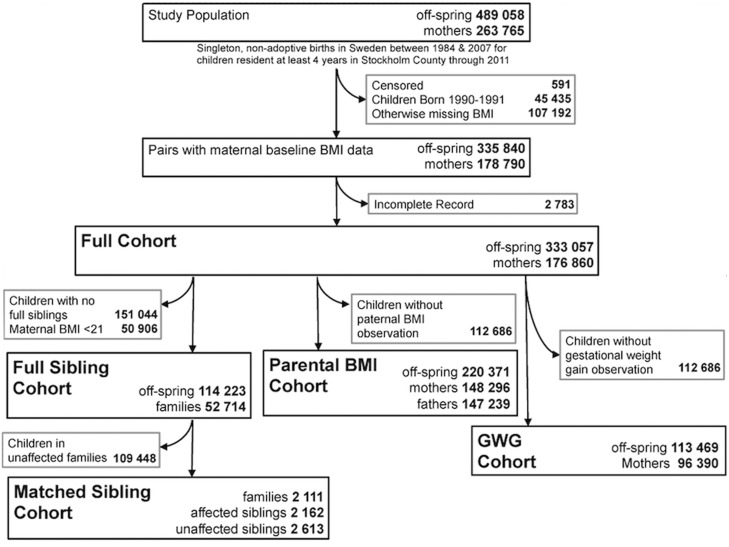
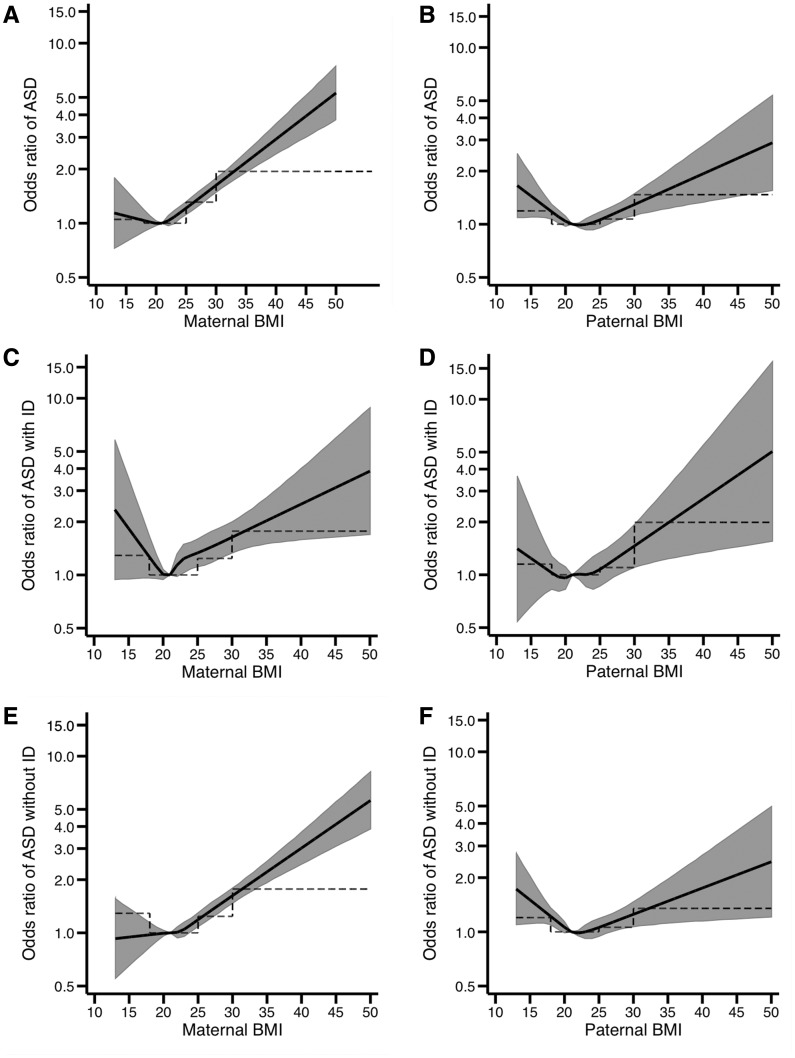
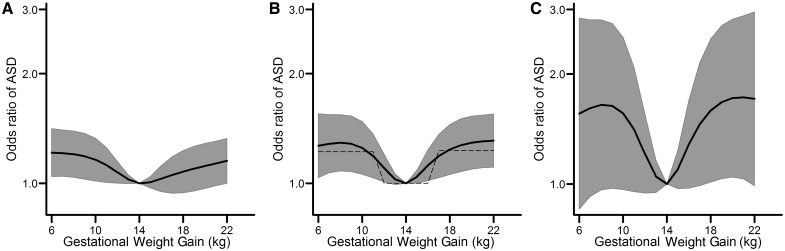
BACKGROUND: Prenatal environmental factors such as maternal adiposity may influence the risk of offspring autism spectrum disorders (ASD), though current evidence is inconsistent. The objective of this study was to assess the relationship of parental BMI and gestational weight gain (GWG) with risk of offspring ASD in a population-based cohort study using family-based study designs. METHODS: The cohort was based in Stockholm County, Sweden, including 333,057 individuals born 1984-2007, of whom 6420 were diagnosed with an ASD. We evaluated maternal body mass index (BMI) at first antenatal visit, GWG and paternal BMI at the time of conscription into the Swedish military as exposures using general estimating equation (GEE) models with logit link. RESULTS: At the population level, maternal overweight/obesity was associated with increased risk of offspring ASD [odds ratio (OR)25 ≤ BMI < 30 1.31, 95% confidence interval = 1.21-1.41; ORBMI ≥ 30 1.94, 1.72-2.17], as was paternal underweight (ORBMI < 18.5, 1.19, 1.06-1.33) and obesity (ORBMI ≥ 30 1.47, 1.12-1.92) in mutually adjusted models. However, in matched sibling analyses, the relationship between elevated maternal BMI and ASD risk was not apparent. GWG had a U-shaped association with offspring ASD at the population level (ORinsufficient 1.22, 1.07-1.40; ORexcessive 1.23, 1.08-1.40). Matched sibling analyses were suggestive of elevated risk with excessive GWG (ORinsufficient 1.12, 0.68-1.84; ORexcessive 1.48, 0.93-2.38). CONCLUSIONS: Whereas population-level results suggested that maternal BMI was associated with ASD, sibling analyses and paternal BMI analyses indicate that maternal BMI may also be a proxy marker for other familial risk factors. Evidence is stronger for a direct link between GWG and ASD risk.
Overview
The claims and statistics of this paper haven’t been checked yet.
Run the check — free, no account needed. It reads the open-access text and checks the sources it cites.
Integrity signals
Registry
Cites
Statistics
Figures
Verification
Claims the paper makes
The claims and statistics of this paper haven’t been checked yet.
Run the check — free, no account needed. It reads the open-access text and checks the sources it cites.
Claims other papers make about this one
Each is checked against this paper’s own text: does it say what the citing paper says it does?
In the citing paper
“To calculate CIs, instead of relying on the assumption that estimates follow an asymptotic normal distribution, we calculated 2-sided 95% CIs using profile likelihood methods.23”
From Association of Genetic and Environmental Factors With Autism in a 5-Country Cohort (2019) · cites this paper as [23]
Self-check
Percentages, sums and reported differences re-computed from the paper’s own numbers.
The self-check needs the paper’s full text.
Citations
Cites
Genetics of Food Intake Self-Regulation in Childhood: Literature Review and Research Opportunities
Faith, M. S., Carnell, S., & Kral, T. V. E. (2013) · Human Heredity · doi:10.1159/000353879 · Cited by 7,633
Physical Status: The Use and Interpretation of Anthropometry
Frisancho, A. R. (1996) · American Journal of Clinical Nutrition · doi:10.1093/ajcn/64.5.830 · Cited by 6,569
Baio, J., Wiggins, L., Christensen, D. L., Maenner, M. J., Daniels, J., Warren, Z., Kurzius-Spencer, M., Zahorodny, W., Robinson, C., Rosenberg, et al. (2018) · MMWR. Surveillance Summaries · doi:10.15585/mmwr.ss6706a1 · Cited by 6,078
Weight Gain During Pregnancy: Reexamining the Guidelines
Rasmussen, K. M., & Yaktine, A. L. (2009) · Cited by 4,052
Finucane, M. M., Stevens, G. A., Cowan, M. J., Danaei, G., Lin, J. K., Paciorek, C. J., Singh, G. M., Gutierrez, H. R., Lu, Y., Bahalim, A. N., et al. (2011) · The Lancet · doi:10.1016/s0140-6736(10)62037-5 · Cited by 4,050
Maenner, M. J., Shaw, K. A., Baio, J., EdS1, Washington, A., Patrick, M., DiRienzo, M., Christensen, D. L., Wiggins, L. D., Pettygrove, S., et al. (2020) · MMWR. Surveillance Summaries · doi:10.15585/mmwr.ss6904a1 · Cited by 3,780
Association analyses of 249,796 individuals reveal 18 new loci associated with body mass index
MAGIC, Speliotes, E. K., on behalf of Procardis Consortium, Willer, C. J., Berndt, S. I., Monda, K. L., Thorleifsson, G., Jackson, A. U., Allen, H. L., Lindgren, C. M., et al. (2010) · Nature Genetics · doi:10.1038/ng.686 · Cited by 2,912
Functional impact of global rare copy number variation in autism spectrum disorders
Pinto, D., Pagnamenta, A. T., Klei, L., Anney, R., Merico, D., Regan, R., Conroy, J., Magalhaes, T. R., Correia, C., Abrahams, B. S., et al. (2010) · Nature · doi:10.1038/nature09146 · Cited by 2,013 · cited 8×
“Some reports suggest that maternal obesity in early pregnancy2,3 and excessive weight gain during pregnancy2,4 increase risk of offspring ASD.”
BackgroundInfluentialNegative Controls: A Tool for Detecting Confounding and Bias in Observational Studies
Lipsitch, M., Tchetgen Tchetgen, E., & Cohen, T. (2010) · Epidemiology · doi:10.1097/ede.0b013e3181d61eeb · Cited by 1,583
Naarden Braun, K. V., Lopez, M., White, T., et al. (2023) · Carolina Digital Repository (University of North Carolina at Chapel Hill) · doi:10.17615/y3kk-5x30 · Cited by 1,381
Cited by
Sorted by citations
Influence of Maternal Obesity on the Long-Term Health of Offspring
Godfrey, K. M., Reynolds, R. M., Prescott, S. L., Nyirenda, M., Jaddoe, V. W. V., Eriksson, J. G., & Broekman, B. F. P. (2017) · The Lancet Diabetes & Endocrinology · doi:10.1016/s2213-8587(16)30107-3 · Cited by 1,059
Association of Genetic and Environmental Factors With Autism in a 5-Country Cohort
Bai, D., Yip, B. H. K., Windham, G. C., Sourander, A., Francis, R., Yoffe, R., Glasson, E., Mahjani, B., Suominen, A., Leonard, H., et al. (2019) · JAMA Psychiatry · doi:10.1001/jamapsychiatry.2019.1411 · Cited by 683
The contribution of environmental exposure to the etiology of autism spectrum disorder
Bölte, S., Girdler, S., & Marschik, P. B. (2019) · Cellular and Molecular Life Sciences · doi:10.1007/s00018-018-2988-4 · Cited by 509
Maternal pre‐pregnancy obesity and child neurodevelopmental outcomes: a meta‐analysis
Sanchez, C. E., Barry, C., Sabhlok, A., Russell, K., Majors, A., Kollins, S. H., & Fuemmeler, B. F. (2018) · Obesity Reviews · doi:10.1111/obr.12643 · Cited by 304
“Some studies that did assess gestational weight gain found it was not related to neurodevelopmental outcomes beyond prepregnancy weight (59,65), whereas others found significant positive associations with neurodevelopmental outcomes (44,52,58,62).”
BackgroundMethodMaternal obesity and neurodevelopmental and psychiatric disorders in offspring
Edlow, A. G. (2016) · Prenatal Diagnosis · doi:10.1002/pd.4932 · Cited by 326
“with offspring ASD risk, even in those studies that failed to find an association with maternal pre-pregnancy obesity.(26,27) Paternal obesity has also been demonstrated to be independently associated with increased ASD risk in offspring.”
MethodResult
Metadata
- Authors
- Gardner, R. M., Lee, B. K., Magnusson, C., Rai, D., Frisell, T., Karlsson, H., Idring, S., & Dalman, C.
- Affiliations
- Karolinska Institutet (SE)
- Drexel University (US)
- Region Stockholm (SE)
- Avon and Wiltshire Mental Health Partnership NHS Trust (GB)
- Corresponding author
- Gardner, Renee M
- Venue
- International Journal of Epidemiology
- Publisher
- Oxford University Press (OUP)
- Published
- 2015-06
- Volume
- 44
- Issue
- 3
- Pages
- 870-883
- ISSN
- 0300-5771 (ISSN-L)
- 1464-3685
- PMC
- PMC4521130
- OpenAlex
- W1902120875
- Cited by
- 141
- References
- 67
- Citations by year
- 2026: 7 · 2025: 10 · 2024: 16 · 2023: 16 · 2022: 7 · 2021: 8 · 2020: 22 · 2019: 14 · 2018: 15 · 2017: 13 · 2016: 12 · 2015: 1
- FWCI
- 8.22
- Type
- journal article
- Language
- en
- Open access
- hybrid
- doi.org
- Licence
- cc-by-nc
- Locations
- International Journal of Epidemiology (publishedVersion, cc-by-nc)
- PubMed Central (publishedVersion, cc-by-nc)
- PubMed (publishedVersion)
- Bristol Research (University of Bristol) (publishedVersion)
- Funders
- Autism Speaks
- Forskningsrådet för Arbetsliv och Socialvetenskap (2007-2064)
- Stockholms Läns Landsting (2007008)
- Vetenskapsrådet (523‐2010‐1052)
- Topics
- Life Sciences › Neuroscience › Cognitive Neuroscience › Autism Spectrum Disorder Research
- Health Sciences › Medicine › Obstetrics and Gynecology › Gestational Diabetes Research and Management
- Health Sciences › Medicine › Pediatrics, Perinatology and Child Health › Birth, Development, and Health
- Keywords
- autism spectrum disorder, maternal body mass index, gestational weight gain, maternal obesity, paternal BMI, prenatal environmental exposure, family risk factors
- MeSH terms
- Autism Spectrum Disorder, Adolescent, Adult, Birth Weight, Child, Child, Preschool, Female, Humans, Male, Obesity, Pregnancy, Pregnancy Complications, Risk Factors, Sweden, Cohort Studies, Weight Gain, Body Mass Index, Odds Ratio, Siblings, Pregnant People, Young Adult
About these checks
Registry, retraction, Cites and statistics results are computed, not judged, with one exception: a printed reference that no index lists is read once by a model before it counts as a citation error. Claims are extracted by a model and kept only when their quote appears verbatim in the text; each cited source is then checked, with a model’s help, for whether it says what the claim relies on. Those verdicts can be wrong — read the claim’s quote and the cited source before relying on one.
Statistics and arithmetic are recomputed, not judged.
Confidence bands are shown only for fields calibrated on our annotated test set. None is calibrated yet, so no band is shown.
What counts as a claim ›How we measure confidence ›How we check this ›
Are you an author, or do you see a problem with this page? Request a review
