

The DOI matches its Crossref record; 47 of the 48 references it cites were found in a registry or an index.
Extraintestinal Pathogenic Escherichia coli , a Common Human Pathogen: Challenges for Vaccine Development and Progress in the Field
Open accessAbstract
Extraintestinal pathogenic Escherichia coli (ExPEC) is the most common gram-negative bacterial pathogen in humans. ExPEC causes the vast majority of urinary tract infections (UTIs), is a leading cause of adult bacteremia, and is the second most common cause of neonatal meningitis. Increasing multidrug resistance among ExPEC strains constitutes a major obstacle to treatment and is implicated in increasing numbers of hospitalizations and deaths and increasing healthcare costs associated with ExPEC infections. An effective vaccine against ExPEC infection is urgently needed. The O antigen, a component of the surface lipopolysaccharide, has been identified as a promising vaccine target. With the availability of a novel bioconjugation technology it is expected that multivalent O antigen conjugate vaccines can be produced at industrial scale. Clinical proof of concept of a 4-valent O antigen conjugate vaccine is ongoing. An ExPEC vaccine effective against strains that are associated with major diseases and resistant to multiple drugs could be routinely delivered to individuals at risk of developing severe E. coli infection, such as elderly people, individuals undergoing abdominal surgery and prostatic biopsy procedures, and persons at risk of recurrent and/or complicated UTI.
Overview
The claims and statistics of this paper haven’t been checked yet.
Run the check — free, no account needed. It reads the open-access text and checks the sources it cites.
Integrity signals
Registry
Cites
Statistics
Figures
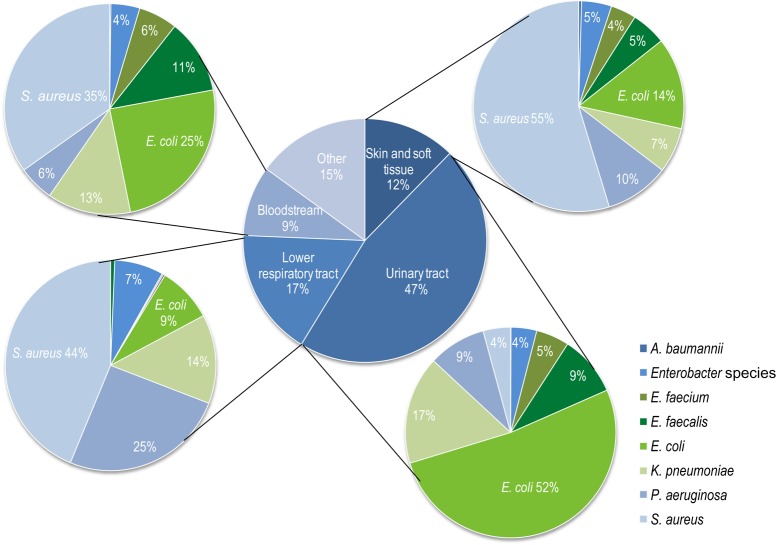
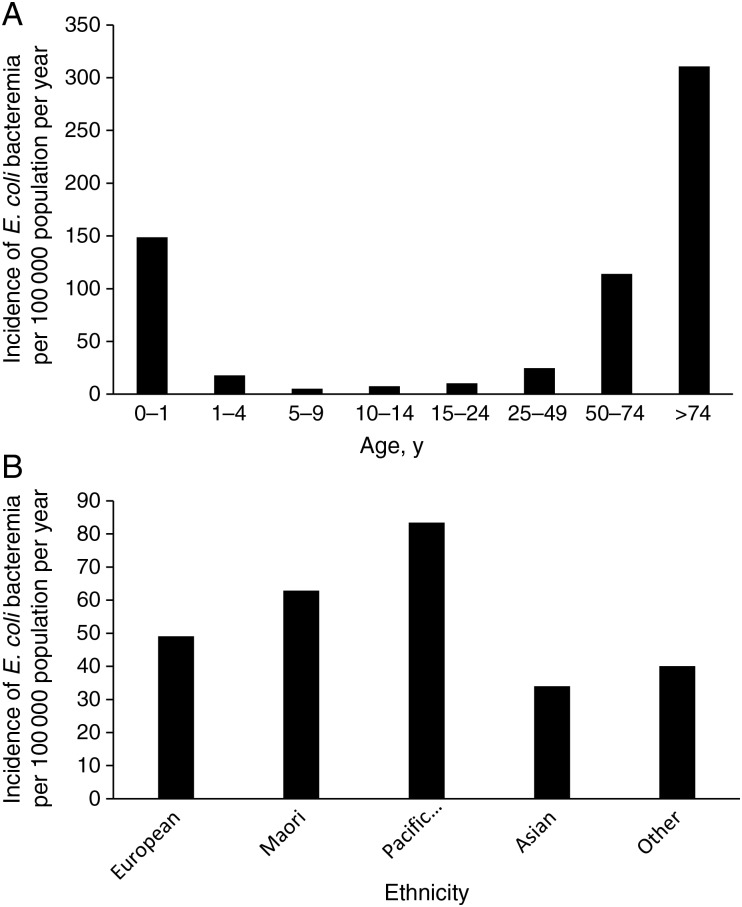
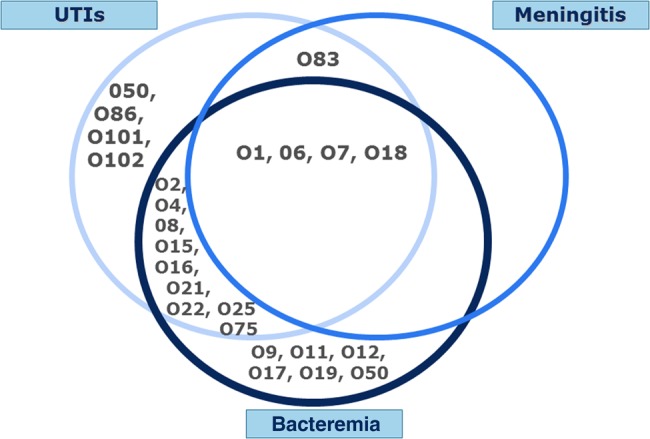
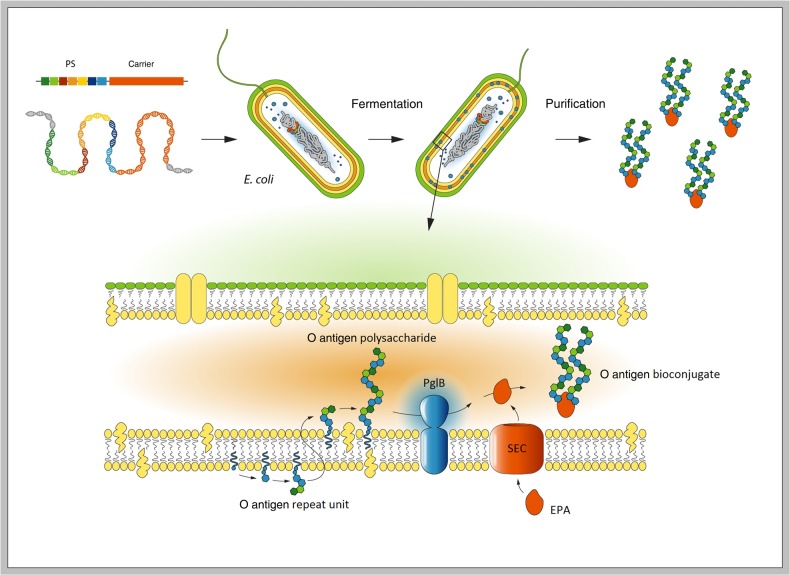
Verification
Claims the paper makes
The claims and statistics of this paper haven’t been checked yet.
Run the check — free, no account needed. It reads the open-access text and checks the sources it cites.
Claims other papers make about this one
Each is checked against this paper’s own text: does it say what the citing paper says it does?
The source backs part of the claim, not all of it — or backs it for a different population, condition or comparison.
In the citing paper
“There are no licensed vaccines against E. coli or group B S. agalactiae, despite these two pathogens being the major causes of bacterial meningitis in neonates.”
From Global etiology of bacterial meningitis: A systematic review and meta-analysis. (2018) · cites this paper as [14]
Experimental — accuracy not yet measured
Self-check
Percentages, sums and reported differences re-computed from the paper’s own numbers.
The self-check needs the paper’s full text.
Citations
Cites
Diversity of the Human Intestinal Microbial Flora
Eckburg, P. B., Bik, E. M., Bernstein, C. N., Purdom, E., Dethlefsen, L., Sargent, M., Gill, S. R., Nelson, K. E., & Relman, D. A. (2005) · Science · doi:10.1126/science.1110591 · Cited by 7,913
Hidron, A. I., Edwards, J. R., Patel, J., Horan, T. C., Sievert, D. M., Pollock, D. A., Fridkin, S. K., & National Healthcare Safety Network Team and Participating National Healthcare Safety Network Facilities (2008) · Infection Control & Hospital Epidemiology · doi:10.1086/591861 · Cited by 3,724
Sievert, D. M., Ricks, P., Edwards, J. R., Schneider, A. K., Patel, J. B., Srinivasan, A., Kallen, A. J., Limbago, B. M., Fridkin, S. K., & National Healthcare Safety Network (NHSN) Team and Participating NHSN Facilities (2012) · Infection Control and Hospital Epidemiology · doi:10.1086/668770 · Cited by 1,593
Urinary Tract Infection Syndromes
Foxman, B. (2013) · Infectious Disease Clinics of North America · doi:10.1016/j.idc.2013.09.003 · Cited by 1,336
Biosynthesis and Assembly of Capsular Polysaccharides in Escherichia coli
Whitfield, C. (2006) · Annual Review of Biochemistry · doi:10.1146/annurev.biochem.75.103004.142545 · Cited by 993
Russo, T. A., & Johnson, J. R. (2003) · Microbes and Infection · doi:10.1016/s1286-4579(03)00049-2 · Cited by 801
The benefit of appropriate empirical antibiotic treatment in patients with bloodstream infection
Leibovici, Shraga, Drucker, Konigsberger, Samra, Pitlik, & Pitlik (1998) · Journal of Internal Medicine · doi:10.1046/j.1365-2796.1998.00379.x · Cited by 685
Johnson, J. R., Johnston, B., Clabots, C., Kuskowski, M. A., & Castanheira, M. (2010) · Clinical Infectious Diseases · doi:10.1086/653932 · Cited by 511
Feldman, M. F., Wacker, M., Hernandez, M., Hitchen, P. G., Marolda, C. L., Kowarik, M., Morris, H. R., Dell, A., Valvano, M. A., & Aebi, M. (2005) · Proceedings of the National Academy of Sciences · doi:10.1073/pnas.0500044102 · Cited by 442
Self-citationThe structures of Escherichia coli O-polysaccharide antigens
Stenutz, R., Weintraub, A., & Widmalm, G. (2006) · FEMS Microbiology Reviews · doi:10.1111/j.1574-6976.2006.00016.x · Cited by 410
Research works printed but not linked: 4
- Vahlne, 1945, Serological typing of the colon bacteria, with special reference to the occurrence of B. coli in man under normal and pathological conditions, particularly in appendicitis, Acta Path Microbiol Scand, 62, 1
- Sjostedt, 1946, Pathogenicity of certain serological types of B. coli: their mouse toxicity, hemolytic power, capacity for skin necrosis and resistance to phagocytosis and bactericidal faculties of human blood, Acta Path Microbiol Scand, 63, 1
- Elixhauser A , Friedman B , Stranges E . Septicemia in U.S. Hospitals, 2009. Statistical brief 122. Healthcare Cost and Utilization Project (HCUP) Statistical Briefs. Rockville, MD: Agency for Health Care Policy and Research, 2006. http://www.ncbi.nlm.nih.gov/books/NBK65391/ . Accessed 27 January 2015.
- Antimicrobial Resistance: Tackling a crisis for the health and wealth of nations. The Review on Antimicrobial Resistance Chaired by Jim O'Neill, 2014. http://www.his.org.uk/files/4514/1829/6668/AMR_Review_Paper_-_Tackling_a_crisis_for_the_health_and_wealth_of_nations_1.pdf . Accessed 26 December 2014.
Cited by
Sorted by citations
Terlizzi, M., Gribaudo, G., & Maffei, M. (2017) · Frontiers in Microbiology · doi:10.3389/fmicb.2017.01566 · Cited by 627
Progress in Alternative Strategies to Combat Antimicrobial Resistance: Focus on Antibiotics
Murugaiyan, J., Kumar, P. A., Rao, G. S., Iskandar, K., Hawser, S., Hays, J. P., Mohsen, Y., Adukkadukkam, S., Awuah, W. A., Alvarez, M. J. R., et al. (2022) · Antibiotics · doi:10.3390/antibiotics11020200 · Cited by 628
Liu, C. G., Green, S. I., Min, L., Clark, J. R., Salazar, K. C., Terwilliger, A. L., Kaplan, H. B., Trautner, B. W., Ramig, R. F., & Maresso, A. W. (2020) · mBio · doi:10.1128/mbio.01462-20 · Cited by 411
Genomic surveillance for antimicrobial resistance — a One Health perspective
Djordjevic, S. P., Jarocki, V. M., Seemann, T., Cummins, M. L., Watt, A. E., Drigo, B., Wyrsch, E. R., Reid, C. J., Donner, E., & Howden, B. P. (2023) · Nature Reviews Genetics · doi:10.1038/s41576-023-00649-y · Cited by 388
The role of vaccines in preventing bacterial antimicrobial resistance
Jansen, K. U., Knirsch, C. A., & Anderson, A. S. (2018) · Nature Medicine · doi:10.1038/nm.4465 · Cited by 355
Metadata
- Authors
- Poolman, J. T., & Wacker, M.
- Affiliations
- Janssen (Netherlands) (NL)
- Corresponding author
- Poolman, Jan T.
- ORCID
- Poolman, Jan T.
- Venue
- Journal of Infectious Diseases
- Publisher
- Oxford University Press (OUP)
- Published
- 2015-09-02
- Volume
- 213
- Issue
- 1
- Pages
- 6-13
- ISSN
- 0022-1899 (ISSN-L)
- 1537-6613
- PMC
- PMC4676548
- OpenAlex
- W2243816940
- Cited by
- 246
- References
- 48
- Citations by year
- 2026: 20 · 2025: 25 · 2024: 31 · 2023: 29 · 2022: 30 · 2021: 21 · 2020: 27 · 2019: 26 · 2018: 15 · 2017: 11 · 2016: 11
- FWCI
- 1.36
- Type
- journal article
- Language
- en
- Open access
- hybrid
- doi.org
- Licence
- cc-by-nc-nd
- Locations
- The Journal of Infectious Diseases (publishedVersion, cc-by-nc-nd)
- Europe PMC (PubMed Central) (publishedVersion, cc-by-nc-nd)
- PubMed Central (publishedVersion, cc-by-nc-nd)
- PubMed (publishedVersion)
- Topics
- Life Sciences › Immunology and Microbiology › Microbiology › Escherichia coli research studies
- Health Sciences › Medicine › Urology › Urinary Tract Infections Management
- Life Sciences › Immunology and Microbiology › Microbiology › Bacterial Infections and Vaccines
- Keywords
- extraintestinal pathogenic Escherichia coli, vaccine development, lipopolysaccharide, urinary tract infection, bacteremia, neonatal meningitis, multidrug resistance, bioconjugation, multivalent vaccine, vaccine targets
- MeSH terms
- Escherichia coli, Escherichia coli Infections, Humans, Urinary Tract Infections, O Antigens, Escherichia coli Vaccines, Drug Resistance, Bacterial
About these checks
Registry, retraction, Cites and statistics results are computed, not judged, with one exception: a printed reference that no index lists is read once by a model before it counts as a citation error. Claims are extracted by a model and kept only when their quote appears verbatim in the text; each cited source is then checked, with a model’s help, for whether it says what the claim relies on. Those verdicts can be wrong — read the claim’s quote and the cited source before relying on one.
Statistics and arithmetic are recomputed, not judged.
Confidence bands are shown only for fields calibrated on our annotated test set. None is calibrated yet, so no band is shown.
What counts as a claim ›How we measure confidence ›How we check this ›
Are you an author, or do you see a problem with this page? Request a review
