

Improving patient safety governance and systems through learning from successes and failures: qualitative surveys and interviews with international experts
Open accessThe DOI matches its Crossref record; 40 of the 40 references it cites were found in a registry or an index.
Abstract
Patient harm is a leading cause of global disease burden with considerable morbidity, mortality, and economic impacts for individuals, families, and wider society. Large bodies of evidence exist for strategies to improve safety and reduce harm. However, it is not clear which patient safety issues are being addressed globally, and which factors are the most (or least) important contributors to patient safety improvements. We aimed to explore the perspectives of international patient safety experts to identify: (1) the nature and range of patient safety issues being addressed, and (2) aspects of patient safety governance and systems that are perceived to provide value (or not) in improving patient outcomes. English-speaking Fellows and Experts of the International Society for Quality in Healthcare participated in a web-based survey and in-depth semistructured interview, discussing their experience in implementing interventions to improve patient safety. Data collection focused on understanding the elements of patient safety governance that influence outcomes. Demographic survey data were analysed descriptively. Qualitative data were coded, analysed thematically (inductive approach), and mapped deductively to the System-Theoretic Accident Model and Processes framework. Findings are presented as themes and a patient safety governance model. The study was approved by the University of South Australia Human Research Ethics Committee. Twenty-seven experts (59% female) participated. Most hailed from Africa (n = 6, 22%), Australasia, and the Middle East (n = 5, 19% each). The majority were employed in hospital settings (n = 23, 85%), and reported blended experience across healthcare improvement (89%), accreditation (76%), organizational operations (64%), and policy (60%). The number and range of patient safety issues within our sample varied widely with 14 topics being addressed. Thematically, 532 textual segments were grouped into 90 codes (n = 44 barriers, n = 46 facilitators) and used to identify and arrange key patient safety governance actors and factors as a ‘system’ within the System-Theoretic Accident Model and Processes framework. Four themes for improved patient safety governance were identified: (1) ‘safety culture’ in healthcare organizations, (2) ‘policies and procedures’ to investigate, implement, and demonstrate impact from patient safety initiatives, (3) ‘supporting staff’ to upskill and share learnings, and (4) ‘patient engagement, experiences, and expectations’. For sustainable patient safety governance, experts highlighted the importance of safety culture in healthcare organizations, national patient safety policies and regulatory standards, continuing education for staff, and meaningful patient engagement approaches. Our proposed ‘patient safety governance model’ provides policymakers and researchers with a framework to develop data-driven patient safety policy.
Overview
The claims and statistics of this paper haven’t been checked yet.
Free: it reads the open-access text and checks the first 5 claims that cite a source we can check. Create a free account to check every claim.
Integrity signals
Registry
Cites
Statistics
Figures
Verification
Claims the paper makes
The claims and statistics of this paper haven’t been checked yet.
Free: it reads the open-access text and checks the first 5 claims that cite a source we can check. Create a free account to check every claim.
Self-check
Percentages, sums and reported differences re-computed from the paper’s own numbers.
The self-check needs the paper’s full text.
Citations
Cites
Using thematic analysis in psychology
Braun, V., & Clarke, V. (2006) · Qualitative Research in Psychology · doi:10.1191/1478088706qp063oa · Cited by 194,414
Qualitative Data Analysis: An Expanded Sourcebook
(1994) · Journal of Environmental Psychology · doi:10.1016/s0272-4944(05)80231-2 · Cited by 48,420 · cited 1×
“Using the constant comparison method, participants’ perspectives were deductively mapped to the content of the STAMP framework [20–22], and then iteratively refined into a novel overarching systems model with key themes for patient safety governance and improvement.”
How to Design and Evaluate Research in Education
Fraenkel, J. R., & Wallen, N. E. (1990) · Cited by 15,027
Saturation in qualitative research: exploring its conceptualization and operationalization
Saunders, B., Sim, J., Kingstone, T., Baker, S., Waterfield, J., Bartlam, B., Burroughs, H., & Jinks, C. (2018) · Quality & Quantity · doi:10.1007/s11135-017-0574-8 · Cited by 12,033 · cited 3×
“In the inductive analysis, the researchers ensured that no new codes or themes were being generated and no new theoretical insights gained from the data [23].”
BackgroundInfluentialFereday, J., & Muir-Cochrane, E. (2006) · International Journal of Qualitative Methods · doi:10.1177/160940690600500107 · Cited by 11,829 · cited 1×
“Survey and interview data were analysed thematically using inductive and deductive approaches [13].”
Method(1990) · Cited by 11,110
The art of case study research
Savolainen, R. (1996) · Library & Information Science Research · doi:10.1016/s0740-8188(96)90053-5 · Cited by 8,190
Vasileiou, K., Barnett, J., Thorpe, S., & Young, T. (2018) · BMC Medical Research Methodology · doi:10.1186/s12874-018-0594-7 · Cited by 3,115 · cited 1×
“Our sample size of 27 experts was appropriate to explore study aims and achieve data saturation, within pragmatic considerations [24].”
BackgroundCrowe, S., Cresswell, K., Robertson, A., Huby, G., Avery, A., & Sheikh, A. (2011) · BMC Medical Research Methodology · doi:10.1186/1471-2288-11-100 · Cited by 2,697 · cited 2×
“We studied multiple cases simultaneously (a collective case study approach) to enable a broad understanding of the effectiveness of patient safety governance [9, 10].”
BackgroundPromoting a Culture of Safety as a Patient Safety Strategy: A Systematic Review
Weaver, S. J., Lubomksi, L. H., Wilson, R. F., Pfoh, E. R., Martinez, K. A., & Dy, S. M. (2013) · Annals of Internal Medicine · doi:10.7326/0003-4819-158-5-201303051-00002 · Cited by 602
The global burden of unsafe medical care: analytic modelling of observational studies
Jha, A. K., Larizgoitia, I., Audera-Lopez, C., Prasopa-Plaizier, N., Waters, H., & Bates, D. W. (2013) · BMJ Quality & Safety · doi:10.1136/bmjqs-2012-001748 · Cited by 572 · cited 3×
“Avoidable patient harm remains one of the leading causes of global disease burden, despite considerable progress being made, especially in developing nations [1].”
BackgroundHealth Care Professionals as Second Victims after Adverse Events: A Systematic Review
Seys, D., Wu, A. W., Gerven, E. V., Vleugels, A., Euwema, M., Panella, M., Scott, S. D., Conway, J., Sermeus, W., & Vanhaecht, K. (2013) · Evaluation & the Health Professions · doi:10.1177/0163278712458918 · Cited by 517
Ten recommendations for using implementation frameworks in research and practice
Moullin, J. C., Dickson, K. S., Stadnick, N. A., Albers, B., Nilsen, P., Broder-Fingert, S., Mukasa, B., & Aarons, G. A. (2020) · Implementation Science Communications · doi:10.1186/s43058-020-00023-7 · Cited by 488 · cited 1×
“…themes could inform further explorations of key factors for effective patient safety governance via implementation mechanistic and logic modelling [45], with findings used to design and pilot test interventional approaches across healthcare organizations and settings to explore outcomes and the…”
BackgroundRapid-Response Systems as a Patient Safety Strategy: A Systematic Review
Winters, B. D., Weaver, S. J., Pfoh, E. R., Yang, T., Pham, J. C., & Dy, S. M. (2013) · Annals of Internal Medicine · doi:10.7326/0003-4819-158-5-201303051-00009 · Cited by 438
Kwan, J. L., Lo, L., Sampson, M., & Shojania, K. G. (2013) · Annals of Internal Medicine · doi:10.7326/0003-4819-158-5-201303051-00006 · Cited by 422 · cited 2×
“…increasing recognition of the importance of patient safety has catalyzed the formation of international and national quality and safety alliances to set priorities and shape policy, and there is now a large body of evidence relating to improvement strategies for reducing harm in health care [3–6].”
BackgroundHospital-Initiated Transitional Care Interventions as a Patient Safety Strategy: A Systematic Review
Rennke, S., Nguyen, O. K., Shoeb, M. H., Magan, Y., Wachter, R. M., & Ranji, S. R. (2013) · Annals of Internal Medicine · doi:10.7326/0003-4819-158-5-201303051-00011 · Cited by 263 · cited 1×
“…and demonstrate impact from initiatives [3]; supporting staff to foster appetite, capacity, and participation in safety efforts, and offering upskilling and shared learning opportunities; and [4] engaging patients to explore and enhance their experiences and expectations of safe health care.”
BackgroundHale, A., & Hovden, J. F. (1998) · CRC Press eBooks · doi:10.1201/9780203212493.ch11 · Cited by 200
Occupational Injury: Risk, Prevention And Intervention
Feyer, A.-M., & Williamson, A. (2007) · Cited by 194
Brenner, M. J., Pandian, V., Milliren, C. E., Graham, D. A., Zaga, C., Morris, L. L., Bedwell, J. R., Das, P., Zhu, H., Lee Y. Allen, J., et al. (2020) · British Journal of Anaesthesia · doi:10.1016/j.bja.2020.04.054 · Cited by 190 · cited 1×
“In this way, data-driven solutions can be formulated to ‘close the loop’ and facilitate sustained learning, implementation, and evaluation of patient safety initiatives [35, 36].”
BackgroundAction after Adverse Events in Healthcare: An Integrative Literature Review
Liukka, M., Steven, A., Vizcaya-Moreno, M. F., Sara-Aho, A., Khakurel, J., Pearson, P. H., Turunen, H. E., & Tella, S. (2020) · International Journal of Environmental Research and Public Health · doi:10.3390/ijerph17134717 · Cited by 161 · cited 1×
“Support resources for those affected by patient safety incidents aim to provide psychological first aid, foster coping strategies, and promote individual resilience [40].”
BackgroundWiles, L., Kay, D., Luker, J. A., Worley, A., Austin, J., Ball, A., Bevan, A., Cousins, M. S., Dalton, S. E., Hodges, E., et al. (2022) · PLoS ONE · doi:10.1371/journal.pone.0261808 · Cited by 156 · cited 2×
“…based on an unwillingness to participate from patients (e.g. fear of reprisals, health literacy) and healthcare professionals (e.g. potential legal ramifications, attitude/knowledge limitations), coupled with organizational constraints (e.g. power-dynamic cultures, limited resourcing) [43].”
BackgroundSelf-citationHardigan, P. C., Popovici, I., & Carvajal, M. J. (2015) · Research in Social and Administrative Pharmacy · doi:10.1016/j.sapharm.2015.07.003 · Cited by 152 · cited 1×
“%) was low but consistent with expectations for a large-scale email circulation approach [25].”
ResultSalmon, P. M., Read, G. J. M., & Stevens, N. (2016) · Accident Analysis & Prevention · doi:10.1016/j.aap.2016.05.025 · Cited by 120 · cited 2×
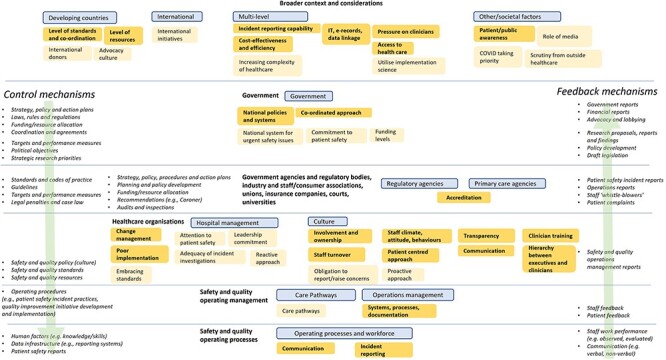
“…of 532 textual segments (n = 247 barriers, n = 285 facilitators) were grouped into 90 factors (n = 44 barriers, n = 46 facilitators) and were used to identify key factors relating to patient safety governance which were aligned with prioritized STAMP framework hierarchical levels [14] (Figure 1).”
MethodPeople, systems and safety: resilience and excellence in healthcare practice
Smith, A. F., & Plunkett, E. (2018) · Anaesthesia · doi:10.1111/anae.14519 · Cited by 117 · cited 2×
“Here, the focus is on trying to understand and strengthen everyday features of work within complex sociotechnologi-cal systems that promote safety [29].”
BackgroundNewman, B., Joseph, K., Chauhan, A., Seale, H., Li, J., Manias, E., Walton, M., Mears, S. R., Jones, B., & Harrison, R. (2021) · Health Expectations · doi:10.1111/hex.13343 · Cited by 112 · cited 1×
“Based on available evidence [44], future engagement approaches should be proactive and employ collaborative patient-professional partnerships, user-friendly patient safety feedback systems (e.g. succinct, plain language, integrated with documentation systems), and strategies to empower patients and…”
BackgroundSecond victim phenomenon: Is ‘just culture’ a reality? An integrative review
White, R. M., & Delacroix, R. (2020) · Applied Nursing Research · doi:10.1016/j.apnr.2020.151319 · Cited by 111 · cited 1×
“Continuing the focus on the need for continued efforts to support a culture of safety, the theme of supporting staff in nonpunitive pro-learning environments has been reported in the literature and can assist their wellbeing and motivate reflective practice and behavioural change [37–39].”
BackgroundExpert involvement in policy development: A systematic review of current practice
Fischer, A. R. H., Wentholt, M. T. A., Rowe, G., & Frewer, L. J. (2013) · Science and Public Policy · doi:10.1093/scipol/sct062 · Cited by 85 · cited 1×
“A key study strength was the international perspectives captured through ISQua members, and the triangulation of contexts across countries, health services, and policy settings [26].”
BackgroundHumanizing harm: Using a restorative approach to heal and learn from adverse events
Wailling, J., Kooijman, A., Hughes, J., & O'Hara, J. K. (2022) · Health Expectations · doi:10.1111/hex.13478 · Cited by 62 · cited 1×
“…where all those affected by an adverse event come together in a safe and supportive environment, with the help of skilled facilitators, to speak openly about what happened, to understand the human impacts, and to clarify responsibility for the actions required for healing and learning’ [32].”
BackgroundThe Barriers and Enhancers to Trust in a Just Culture in Hospital Settings: A Systematic Review
van Marum, S., Verhoeven, D., & de Rooy, D. (2022) · Journal of Patient Safety · doi:10.1097/pts.0000000000001012 · Cited by 47 · cited 2×
“This definition speaks directly to the themes identified by study participants, with our findings further supported by a recent systematic review [33] which framed trust as a key tenet to just culture in hospital settings, and achievable through strategies that address organizational and team…”
BackgroundSexton, J. B., Adair, K. C., Profit, J., Milne, J., McCulloh, M., Scott, S. S., & Frankel, A. S. (2020) · The Joint Commission Journal on Quality and Patient Safety · doi:10.1016/j.jcjq.2020.12.001 · Cited by 45
The International Society for Quality in Health Care
Tregloan, L. (1999) · International Journal for Quality in Health Care · doi:10.1093/intqhc/11.5.453 · Cited by 37 · cited 1×
“At the time of the study, ISQua had 1555 Experts, Fellows, and Academy members, with representation across 83 countries and 6 continents [12].”
BackgroundAstier, A., Carlet, J. M., Hoppe‐Tichy, T., Jacklin, A., Jeanes, A., McManus, S., Pletz, M. W., Seifert, H., & Fitzpatrick, R. (2020) · Journal of Patient Safety and Risk Management · doi:10.1177/2516043520975661 · Cited by 33 · cited 1×
“In this way, data-driven solutions can be formulated to ‘close the loop’ and facilitate sustained learning, implementation, and evaluation of patient safety initiatives [35, 36].”
BackgroundWilder, A. V., Bruyneel, L., Ridder, D. J. M. K. D., Seys, D., Brouwers, J., Claessens, F., Cox, B., & Vanhaecht, K. (2021) · International Journal for Quality in Health Care · doi:10.1093/intqhc/mzab085 · Cited by 28 · cited 1×
“Mirroring related literature, restorative approaches are scaffolded by adequate resourcing [31] and accreditation processes within a ‘quality-of-care (accreditation, inspection and public reporting)’ [34] paradigm.”
BackgroundImproving responses to safety incidents: we need to talk about justice
Cribb, A., O'Hara, J. K., & Waring, J. J. (2022) · BMJ Quality & Safety · doi:10.1136/bmjqs-2021-014333 · Cited by 25 · cited 1×
“Therefore, our study’s key contribution to the literature lies in the findings embodying restorative just culture principles [30], and operationalizing these within a patient safety governance system [31].”
BackgroundSheridan, S. E., Sherman, H. B., Kooijman, A., Vazquez, E., Kirk, K., Metwally, N., & Cardinali, F. (2020) · Springer eBooks · doi:10.1007/978-3-030-59403-9_6 · Cited by 21
Hamim, O. F., Debnath, M., Hasanat-E-Rabbi, S., Hoque, M. S., McIlroy, R. C., Plant, K. L., & Stanton, N. A. (2021) · Ergonomics · doi:10.1080/00140139.2021.1876928 · Cited by 15 · cited 1×
“STAMP is generally applied to accidents or hazard analysis; however, it has been used to analyse systems for governance, for example in road safety [15], electronic medical record safety [16], and risk management in hospitals [17].”
BackgroundMason-Blakley, F., Habibi, R., Weber, J. H., & Price, M. (2017) · IEEE International Conference on Healthcare Informatics (ICHI) · doi:10.1109/ichi.2017.97 · Cited by 11 · cited 1×
“STAMP is generally applied to accidents or hazard analysis; however, it has been used to analyse systems for governance, for example in road safety [15], electronic medical record safety [16], and risk management in hospitals [17].”
BackgroundElectronic medical records and risk management in hospitals of Saudi Arabia
Al-Barnawi, A., He, Y., Maglaras, L. A., & Janicke, H. (2018) · Informatics for Health and Social Care · doi:10.1080/17538157.2018.1434181 · Cited by 10 · cited 1×
“STAMP is generally applied to accidents or hazard analysis; however, it has been used to analyse systems for governance, for example in road safety [15], electronic medical record safety [16], and risk management in hospitals [17].”
BackgroundBrouwers, J., Claessens, F., Castro, E. M., Wilder, A. V., Eeckloo, K., Bruyneel, L., Ridder, D. J. M. K. D., & Vanhaecht, K. (2022) · The International Journal of Health Planning and Management · doi:10.1002/hpm.3559 · Cited by 6 · cited 2×
“Therefore, our study’s key contribution to the literature lies in the findings embodying restorative just culture principles [30], and operationalizing these within a patient safety governance system [31].”
BackgroundStukus, P. D. (2017) · Cited by 5
Research works printed but not linked: 5
- 2. World Health Organization. Global patient safety action plan 2021-2030: towards eliminating avoidable harm in health care. Report No.: Licence: CC BY-NC-SA 3.0. Geneva: IGO. 2021.
- 7. Development OoEC-oa. Measuring Patient Safety: Opening the Black Box. France: OECD Paris, 2018.
- 8. Yin RK. Design and methods. In: Case Study Research. 2nd Edition edn. Vol. 3, SAGE, 2003.
- 26. Conway J, Federico F, Stewart K et al. Respectful Management of Serious Clinical Adverse Events. Cambridge, MA: Institute for Healthcare Improvement, 2011.
- 40. NHS England and NHS Improvement. Patient Safety Incident Response Framework 2020. London: NHS England and NHS Improvement, 2020.
Cited by
Poor quality care in healthcare settings: an overlooked epidemic
Kumah, A. (2025) · Frontiers in Public Health · doi:10.3389/fpubh.2025.1504172 · Cited by 75
Patient safety culture in resource-limited healthcare settings: A multicentre survey
Fekadu, G., Muir, R., Tobiano, G., Bime, A. E., Ireland, M. J., & Marshall, A. P. (2025) · PLoS ONE · doi:10.1371/journal.pone.0326320 · Cited by 32
Data Quality in the Age of AI: A Review of Governance, Ethics, and the FAIR Principles
Guillen-Aguinaga, M., Aguinaga-Ontoso, E., Guillen-Aguinaga, L., Guillen-Grima, F., & Aguinaga-Ontoso, I. (2025) · Data · doi:10.3390/data10120201 · Cited by 37
Patient safety culture through the lenses of surgical patients: a qualitative study
Vikan, M., Haugen, A. S., Valeberg, B. T., Bjørnnes, A. K., Husby, V. K. S., Deilkås, E. C. T., & Danielsen, S. O. (2025) · BMC Health Services Research · doi:10.1186/s12913-025-12366-9 · Cited by 22
Hibbert, P. D., Ying-hua, Y., Molloy, C. J., Ames, M., Brown, D., Berrill, J., Fernance, Z., Morris, J., & Watson, L. (2025) · Health Expectations · doi:10.1111/hex.70281 · Cited by 9
“…interviews with CRs, designed as semi ‐ structured schedules (Supporting Information: Appendix A) that were developed from the patient safety literature [27], with a focus on CRs' perceptions and experiences of their roles, including benefits, challenges, risks and training and support required.”
Self-citation
Metadata
- Authors
- Hibbert, P. D., Stewart, S., Wiles, L. K., Braithwaite, J., Runciman, W. B., & Thomas, M. J. W.
- Affiliations
- University of South Australia (AU)
- Macquarie University (AU)
- Central Queensland University (AU)
- Corresponding author
- Hibbert, Peter D
- ORCID
- Venue
- International Journal for Quality in Health Care
- Publisher
- Oxford University Press (OUP)
- Published
- 2023-10-01
- Volume
- 35
- Issue
- 4
- Pages
- 0-0
- ISSN
- 1353-4505 (ISSN-L)
- 1464-3677
- PMC
- PMC10656601
- OpenAlex
- W4388801178
- Cited by
- 42
- References
- 39
- Citations by year
- 2026: 19 · 2025: 21 · 2024: 2
- FWCI
- 14.17
- Type
- journal article
- Language
- en
- Open access
- hybrid
- doi.org
- Licence
- Locations
- International Journal for Quality in Health Care (publishedVersion, cc-by)
- PubMed Central (publishedVersion, cc-by-nc-sa)
- PubMed (publishedVersion)
- UniSA Research Outputs Repository (University of South Australia) (submittedVersion, other-oa)
- Funders
- Australian Patient Safety Foundation
- Topics
- Health Sciences › Medicine › Public Health, Environmental and Occupational Health › Patient Safety and Medication Errors
- Health Sciences › Medicine › Public Health, Environmental and Occupational Health › Healthcare Quality and Management
- Health Sciences › Nursing › Leadership and Management › Hospital Admissions and Outcomes
- Keywords
- patient harm, safety culture, patient safety interventions, patient engagement, employee training, organizational learning, healthcare quality improvement, barriers and facilitators
- MeSH terms
- Australia, Delivery of Health Care, Female, Hospitals, Humans, Male, Patient Safety
About these checks
Registry, retraction, Cites and statistics results are computed, not judged, with one exception: a printed reference that no index lists is read once by a model before it counts as a citation error. Claims are extracted by a model and kept only when their quote appears verbatim in the text; each cited source is then checked, with a model’s help, for whether it says what the claim relies on. Those verdicts can be wrong — read the claim’s quote and the cited source before relying on one.
Statistics and arithmetic are recomputed, not judged.
Confidence bands are shown only for fields calibrated on our annotated test set. None is calibrated yet, so no band is shown.
What counts as a claim ›How we measure confidence ›How we check this ›
Are you an author, or do you see a problem with this page? Request a review
Data sources
Bibliographic data: Semantic Scholar, OpenAlex, Crossref.
Contains information from the Semantic Scholar Academic Graph Datasets, made available under the ODC Attribution License (ODC-BY 1.0).
Semantic Scholar’s data is described in: Kinney, R., et al. (2023). The Semantic Scholar Open Data Platform. arXiv:2301.10140.
