

The DOI matches its Crossref record; the references it cites are not checked yet.
Investigating microbial and environmental drivers of nitrification in alkaline forest soil
Open accessAbstract
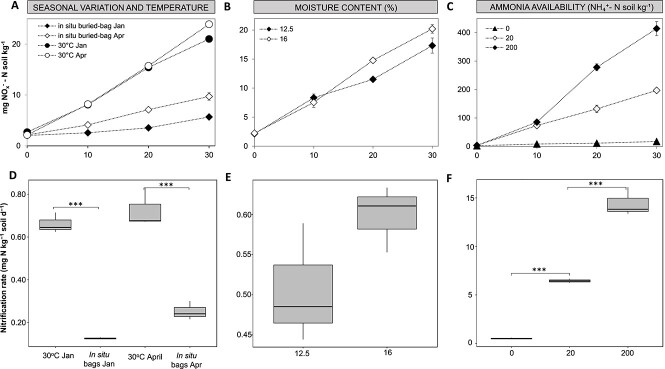
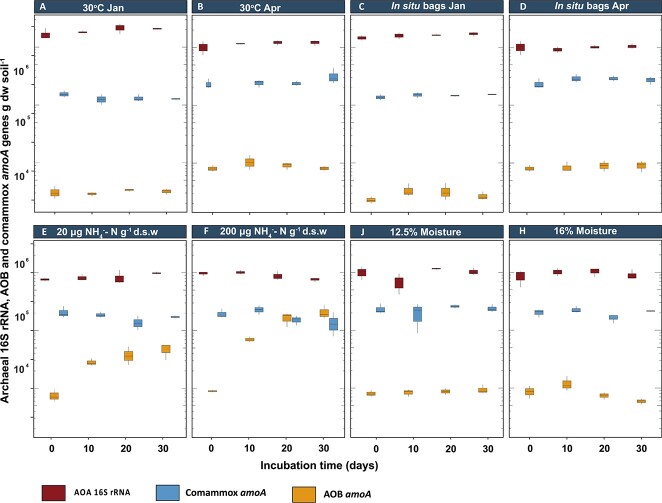
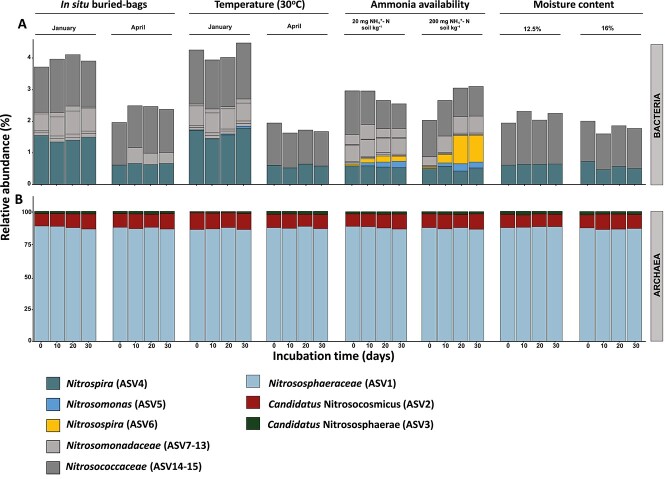
Ammonia oxidation is a key step in the biogeochemical cycling of nitrogen, and soils are important ecosystems for nitrogen flux globally. Approximately 25% of the world’s soils are alkaline. While nitrification has been studied more extensively in agricultural alkaline soils, less is known about natural, unfertilized alkaline soils. In this study, microorganisms responsible for ammonia oxidation and several environmental factors (season, temperature, ammonia concentration, and moisture content) known to affect nitrification were studied in an alkaline forest soil with a pH ranging from 8.36 to 8.77. Ammonia-oxidizing bacteria (AOB), ammonia-oxidizing archaea, and comammox were present, and AOB belonging to genera Nitrosospira and Nitrosomonas, originally comprising <0.01% of the total bacterial community, responded rapidly to ammonia addition to the soil. No significant difference was observed in nitrification rates between seasons, but there was a significant difference between in situ field nitrification rates and rates in laboratory microcosms. Surprisingly, nitrification took place under many of the tested conditions, but there was no detectable increase in the abundance of any recognizable group of ammonia oxidizers. This study raises questions about the role of low-abundance microorganisms in microbial processes and of situations where zero or very low microbial growth coincides with metabolic activity. In addition, this study provides insights into nitrification in unfertilized alkaline soil and supports previous studies, which found that AOB play an important role in alkaline soils supplemented with ammonia, including agricultural ecosystems.
Overview
The claims and statistics of this paper haven’t been checked yet.
Run the check — free, no account needed. It reads the open-access text and checks the sources it cites.
Integrity signals
Registry
Cites
Statistics
Figures
Verification
Claims the paper makes
The claims and statistics of this paper haven’t been checked yet.
Run the check — free, no account needed. It reads the open-access text and checks the sources it cites.
Self-check
Percentages, sums and reported differences re-computed from the paper’s own numbers.
The self-check needs the paper’s full text.
Citations
The citation lists haven’t been fetched yet
References 85 · Cited by 10
Research works printed but not linked: 84
- Elser, 2007, Global analysis of nitrogen and phosphorus limitation of primary producers in freshwater, marine and terrestrial ecosystems, Ecol Lett, 10, 1135, 10.1111/j.1461-0248.2007.01113.x · DOI
- Du, 2020, Global patterns of terrestrial nitrogen and phosphorus limitation, Nat Geosci, 13, 221, 10.1038/s41561-019-0530-4 · DOI
- Fowler, 2013, The global nitrogen cycle in the twenty-first century, Philos Trans R Soc Lond Ser B Biol Sci, 368, 20130165, 10.1098/rstb.2013.0165 · DOI
- Gruber, 2008, An Earth-system perspective of the global nitrogen cycle, Nature, 451, 293, 10.1038/nature06592 · DOI
- Zhang, 2020, Global nitrogen cycle: critical enzymes, organisms, and processes for nitrogen budgets and dynamics, Chem Rev, 120, 5308, 10.1021/acs.chemrev.9b00613 · DOI
- Castellano-Hinojosa, 2019, Effect of nitrogen fertilisers on nitrous oxide emission, nitrifier and denitrifier abundance and bacterial diversity in closed ecological systems, Appl Soil Ecol, 145, 103380, 10.1016/j.apsoil.2019.103380 · DOI
- Meinhardt, 2018, Ammonia-oxidizing bacteria are the primary N2O producers in an ammonia-oxidizing archaea dominated alkaline agricultural soil, Environ Microbiol, 20, 2195, 10.1111/1462-2920.14246 · DOI
- Bouwman, 2013, Global trends and uncertainties in terrestrial denitrification and N2O emissions, Philos Trans R Soc Lond Ser B Biol Sci, 368, 20130112, 10.1098/rstb.2013.0112 · DOI
- Stein, 2016, The nitrogen cycle, Curr Biol, 26, R94, 10.1016/j.cub.2015.12.021 · DOI
- Diaz, 2008, Spreading dead zones and consequences for marine ecosystems, Science, 321, 926, 10.1126/science.1156401 · DOI · Paper page
- Beusen, 2016, Global riverine N and P transport to ocean increased during the 20th century despite increased retention along the aquatic continuum, Biogeosciences, 13, 2441, 10.5194/bg-13-2441-2016 · DOI
- Le Moal, 2019, Eutrophication: a new wine in an old bottle?, Sci Total Environ, 651, 1, 10.1016/j.scitotenv.2018.09.139 · DOI
- Konneke, 2005, Isolation of an autotrophic ammonia-oxidizing marine archaeon, Nature, 437, 543, 10.1038/nature03911 · DOI
- Treusch, 2005, Novel genes for nitrite reductase and Amo-related proteins indicate a role of uncultivated mesophilic crenarchaeota in nitrogen cycling, Environ Microbiol, 7, 1985, 10.1111/j.1462-2920.2005.00906.x · DOI
- van Kessel, 2015, Complete nitrification by a single microorganism, Nature, 528, 555, 10.1038/nature16459 · DOI
- Daims, 2015, Complete nitrification by Nitrospira bacteria, Nature, 528, 504, 10.1038/nature16461 · DOI
- De Boer, 2001, Nitrification in acid soils: micro-organisms and mechanisms, Soil Biol Biochem, 33, 853, 10.1016/S0038-0717(00)00247-9 · DOI
- Kuypers, 2018, The microbial nitrogen-cycling network, Nat Rev Microbiol, 16, 263, 10.1038/nrmicro.2018.9 · DOI
- Prosser, 2008, Relative contributions of archaea and bacteria to aerobic ammonia oxidation in the environment, Environ Microbiol, 10, 2931, 10.1111/j.1462-2920.2008.01775.x · DOI
- Lehtovirta-Morley, 2018, Ammonia oxidation: ecology, physiology, biochemistry and why they must all come together, FEMS Microbiol Lett, 365, 10.1093/femsle/fny058 · DOI
- López-Bucio, 2000, Developments in plant genetics and breeding, 159
- Rao, 1983, Ammonia volatilization from applied nitrogen in alkali soils, Plant Soil, 70, 219, 10.1007/BF02374782 · DOI
- Hu, 2022, The contributions of ammonia oxidizing bacteria and archaea to nitrification-dependent N(2)O emission in alkaline and neutral purple soils, Sci Rep, 12, 19928, 10.1038/s41598-022-23084-1 · DOI
- Tzanakakis, 2018, Ammonia oxidizing archaea do not respond to ammonium or urea supply in an alkaline soil, Appl Soil Ecol, 132, 194, 10.1016/j.apsoil.2018.08.002 · DOI
- Norton, 2019, Controls and adaptive management of nitrification in agricultural soils, Front Microbiol, 10, 10.3389/fmicb.2019.01931 · DOI
- Ouyang, 2017, Ammonium availability and temperature control contributions of ammonia oxidizing bacteria and archaea to nitrification in an agricultural soil, Soil Biol Biochem, 113, 161, 10.1016/j.soilbio.2017.06.010 · DOI
- Tan, 2022, Comammox Nitrospira play a minor role in N2O emissions from an alkaline arable soil, Soil Biol Biochem, 171, 108720, 10.1016/j.soilbio.2022.108720 · DOI
- Daebeler, 2023, Rapid nitrification involving comammox and canonical Nitrospira at extreme pH in saline-alkaline lakes, Environ Microbiol, 25, 1055, 10.1111/1462-2920.16337 · DOI
- Martens-Habbena, 2009, Ammonia oxidation kinetics determine niche separation of nitrifying archaea and bacteria, Nature, 461, 976, 10.1038/nature08465 · DOI
- Prosser, 2012, Archaeal and bacterial ammonia-oxidisers in soil: the quest for niche specialisation and differentiation, Trends Microbiol, 20, 523, 10.1016/j.tim.2012.08.001 · DOI
- Kits, 2017, Kinetic analysis of a complete nitrifier reveals an oligotrophic lifestyle, Nature, 549, 269, 10.1038/nature23679 · DOI
- Jung, 2022, Ammonia-oxidizing archaea possess a wide range of cellular ammonia affinities, The ISME Journal, 16, 272, 10.1038/s41396-021-01064-z · DOI
- Wang, 2019, Comammox Nitrospira clade B contributes to nitrification in soil, Soil Biol Biochem, 135, 392, 10.1016/j.soilbio.2019.06.004 · DOI
- Di, 2010, Ammonia-oxidizing bacteria and archaea grow under contrasting soil nitrogen conditions, FEMS Microbiol Ecol, 72, 386, 10.1111/j.1574-6941.2010.00861.x · DOI
- Sterngren, 2015, Archaeal ammonia oxidizers dominate in numbers, but bacteria drive gross nitrification in N-amended grassland soil, Front Microbiol, 6, 10.3389/fmicb.2015.01350 · DOI
- Verhamme, 2011, Ammonia concentration determines differential growth of ammonia-oxidising archaea and bacteria in soil microcosms, ISME J, 5, 1067, 10.1038/ismej.2010.191 · DOI
- Li, 2020, Niche differentiation of clade a comammox Nitrospira and canonical ammonia oxidizers in selected forest soils, Soil Biol Biochem, 149, 107925, 10.1016/j.soilbio.2020.107925 · DOI
- Wang, 2019, Adaptive responses of comammox Nitrospira and canonical ammonia oxidizers to long-term fertilizations: implications for the relative contributions of different ammonia oxidizers to soil nitrogen cycling, Sci Total Environ, 668, 224, 10.1016/j.scitotenv.2019.02.427 · DOI
- Li, 2019, Comammox Nitrospira play an active role in nitrification of agricultural soils amended with nitrogen fertilizers, Soil Biol Biochem, 138, 107609, 10.1016/j.soilbio.2019.107609 · DOI
- Yao, 2013, Multi-factorial drivers of ammonia oxidizer communities: evidence from a national soil survey, Environ Microbiol, 15, 2545, 10.1111/1462-2920.12141 · DOI
- Aigle, 2020, Experimental testing of hypotheses for temperature- and pH-based niche specialization of ammonia oxidizing archaea and bacteria, Environ Microbiol, 22, 4032, 10.1111/1462-2920.15192 · DOI
- Suzuki, 1974, Ammonia or ammonium ion as substrate for oxidation by Nitrosomonas europaea cells and extracts, J Bacteriol, 120, 556, 10.1128/jb.120.1.556-558.1974 · DOI
- Lehtovirta-Morley, 2011, Cultivation of an obligate acidophilic ammonia oxidizer from a nitrifying acid soil, Proc Natl Acad Sci USA, 108, 15892, 10.1073/pnas.1107196108 · DOI
- Hayatsu, 2017, An acid-tolerant ammonia-oxidizing γ-proteobacterium from soil, ISME J, 11, 1130, 10.1038/ismej.2016.191 · DOI
- Fumasoli, 2017, Growth of Nitrosococcus-related ammonia oxidizing bacteria coincides with extremely low pH values in wastewater with high ammonia content, Environ Sci Technol, 51, 6857, 10.1021/acs.est.7b00392 · DOI
- Hu, 2017, Comammox-a newly discovered nitrification process in the terrestrial nitrogen cycle, J Soils Sediments, 17, 2709, 10.1007/s11368-017-1851-9 · DOI
- Picone, 2021, Ammonia oxidation at pH 2.5 by a new gammaproteobacterial ammonia-oxidizing bacterium, ISME J, 15, 1150, 10.1038/s41396-020-00840-7 · DOI
- Shi, 2018, Niche separation of comammox Nitrospira and canonical ammonia oxidizers in an acidic subtropical forest soil under long-term nitrogen deposition, Soil Biol Biochem, 126, 114, 10.1016/j.soilbio.2018.09.004 · DOI
- Gubry-Rangin, 2010, Archaea rather than bacteria control nitrification in two agricultural acidic soils, FEMS Microbiol Ecol, 74, 566, 10.1111/j.1574-6941.2010.00971.x · DOI
- Zhang, 2012, Ammonia-oxidizing archaea have more important role than ammonia-oxidizing bacteria in ammonia oxidation of strongly acidic soils, ISME J, 6, 1032, 10.1038/ismej.2011.168 · DOI
- Li, 2018, Nitrification and nitrifiers in acidic soils, Soil Biol Biochem, 116, 290, 10.1016/j.soilbio.2017.10.023 · DOI
- Sims, 1995, Microscale determination of inorganic nitrogen in water and soil extracts, Commun Soil Sci Plant Anal, 26, 303, 10.1080/00103629509369298 · DOI
- Miranda, 2001, A rapid, simple spectrophotometric method for simultaneous detection of nitrate and nitrite, Nitric Oxide, 5, 62, 10.1006/niox.2000.0319 · DOI
- Garcia-Robledo, 2014, A fast and direct spectrophotometric method for the sequential determination of nitrate and nitrite at low concentrations in small volumes, Mar Chem, 162, 30, 10.1016/j.marchem.2014.03.002 · DOI
- Eno, 1960, Nitrate production in the field by incubating the soil in polyethylene bags, Soil Sci Soc Am J, 24, 277, 10.2136/sssaj1960.03615995002400040019x · DOI
- Sakoula, 2021, Enrichment and physiological characterization of a novel comammox Nitrospira indicates ammonium inhibition of complete nitrification, ISME J, 15, 1010, 10.1038/s41396-020-00827-4 · DOI
- Norton, 2002, Diversity of ammonia monooxygenase operon in autotrophic ammonia-oxidizing bacteria, Arch Microbiol, 177, 139, 10.1007/s00203-001-0369-z · DOI
- Herlemann, 2011, Transitions in bacterial communities along the 2000 km salinity gradient of the Baltic Sea, ISME J, 5, 1571, 10.1038/ismej.2011.41 · DOI · Paper page
- Caporaso, 2012, Ultra-high-throughput microbial community analysis on the Illumina HiSeq and MiSeq platforms, ISME J, 6, 1621, 10.1038/ismej.2012.8 · DOI · Paper page
- Takai, 2000, Rapid detection and quantification of members of the archaeal community by quantitative PCR using fluorogenic probes, Appl Environ Microbiol, 66, 5066, 10.1128/AEM.66.11.5066-5072.2000 · DOI
- Callahan, 2016, DADA2: high-resolution sample inference from Illumina amplicon data, Nat Methods, 13, 581, 10.1038/nmeth.3869 · DOI · Paper page
- R. Core Team, 2013, A Language and Environment for Statistical Computing
- Quast, 2013, The SILVA ribosomal RNA gene database project: improved data processing and web-based tools, Nucleic Acids Res, 41, D590, 10.1093/nar/gks1219 · DOI · Paper page
- McMurdie, 2013, Phyloseq: an R package for reproducible interactive analysis and graphics of microbiome census data, PLoS One, 8, 10.1371/journal.pone.0061217 · DOI
- Hall, 1999, BioEdit: a user-friendly biological sequence alignment editor and analysis program for Windows 95/98/NT, Nucleic Acids Symp Ser, 41, 95
- Tamura, 2021, MEGA11: molecular evolutionary genetics analysis version 11, Mol Biol Evol, 38, 3022, 10.1093/molbev/msab120 · DOI
- Raison, 1987, Methodology for studying fluxes of soil mineral-N in situ, Soil Biol Biochem, 19, 521, 10.1016/0038-0717(87)90094-0 · DOI
- Owen, 2003, Net N mineralization and nitrification rates in a forested ecosystem in northeastern Taiwan, For Ecol Manag, 176, 519, 10.1016/S0378-1127(02)00225-6 · DOI
- Lawson, 2018, Complete ammonia oxidation: an important control on nitrification in engineered ecosystems?, Curr Opin Biotechnol, 50, 158, 10.1016/j.copbio.2018.01.015 · DOI
- Lehtovirta-Morley, 2013, Effect of nitrification inhibitors on the growth and activity of Nitrosotalea devanaterra in culture and soil, Soil Biol Biochem, 62, 129, 10.1016/j.soilbio.2013.01.020 · DOI
- Levičnik-Höfferle, 2012, Stimulation of thaumarchaeal ammonia oxidation by ammonia derived from organic nitrogen but not added inorganic nitrogen, FEMS Microbiol Ecol, 80, 114, 10.1111/j.1574-6941.2011.01275.x · DOI
- Gubry-Rangin, 2017, Temperature responses of soil ammonia-oxidising archaea depend on pH, Soil Biol Biochem, 106, 61, 10.1016/j.soilbio.2016.12.007 · DOI
- Hausmann, 2016, Consortia of low-abundance bacteria drive sulfate reduction-dependent degradation of fermentation products in peat soil microcosms, The ISME Journal., 10, 2365, 10.1038/ismej.2016.42 · DOI
- Campbell, 2011, Activity of abundant and rare bacteria in a coastal ocean, Proc Natl Acad Sci, 108, 12776, 10.1073/pnas.1101405108 · DOI
- Blazewicz, 2020, Taxon-specific microbial growth and mortality patterns reveal distinct temporal population responses to rewetting in a California grassland soil, The ISME Journal., 14, 1520, 10.1038/s41396-020-0617-3 · DOI
- Tourna, 2008, Growth, activity and temperature responses of ammonia-oxidizing archaea and bacteria in soil microcosms, Environ Microbiol, 10, 1357, 10.1111/j.1462-2920.2007.01563.x · DOI
- Rütting, 2021, The contribution of ammonia-oxidizing archaea and bacteria to gross nitrification under different substrate availability, Soil Biol Biochem, 160, 108353, 10.1016/j.soilbio.2021.108353 · DOI
- Chen, 2023, Challenges in upscaling laboratory studies to ecosystems in soil microbiology research, Glob Chang Biol, 29, 569, 10.1111/gcb.16537 · DOI
- Hazard, 2021, Use and abuse of potential rates in soil microbiology, Soil Biol Biochem, 157, 108242, 10.1016/j.soilbio.2021.108242 · DOI
- Taylor, 2017, Modeling of soil nitrification responses to temperature reveals thermodynamic differences between ammonia-oxidizing activity of archaea and bacteria, The ISME Journal, 11, 896, 10.1038/ismej.2016.179 · DOI
- Stark, 1996, Modeling the temperature response of nitrification, Biogeochemistry, 35, 433, 10.1007/BF02183035 · DOI
- Alves, 2018, Unifying the global phylogeny and environmental distribution of ammonia-oxidising archaea based on amoA genes, Nat Commun, 9, 1517, 10.1038/s41467-018-03861-1 · DOI
- Zhang, 2024, Shifts in soil ammonia-oxidizing community maintain the nitrogen stimulation of nitrification across climatic conditions, Glob Chang Biol, 30, e16989, 10.1111/gcb.16989 · DOI
- Chisholm, 2023, Soil moisture is a primary driver of comammox Nitrospira abundance in New Zealand soils, Sci Total Environ, 858, 159961, 10.1016/j.scitotenv.2022.159961 · DOI
Metadata
- Authors
- Poghosyan, L., & Lehtovirta-Morley, L. E.
- Affiliations
- University of East Anglia (GB)
- School of Biological Sciences, University of East Anglia , Norwich NR4 7TJ, United Kingdom
- ORCID
- Poghosyan, Lianna
- Venue
- ISME Communications
- Publisher
- Oxford University Press (OUP)
- Published
- 2024-01
- Volume
- 4
- Issue
- 1
- Pages
- ycae093-ycae093
- ISSN
- 2730-6151 (ISSN-L)
- PMC
- PMC11310595
- OpenAlex
- W4400524406
- Cited by
- 10
- References
- 85
- Citations by year
- 2026: 4 · 2025: 4 · 2024: 2
- FWCI
- 1.99
- Type
- journal article
- Language
- en
- Open access
- gold
- doi.org
- Locations
- ISME Communications (publishedVersion, cc-by)
- PubMed Central (publishedVersion, cc-by)
- PubMed (publishedVersion)
- UEA Digital Repository (University of East Anglia) (submittedVersion)
- Funders
- Royal Society Dorothy Hodgkin Fellowship (DH150187)
- ERC Starting Grant (UNITY 852993)
- Topics
- Life Sciences › Agricultural and Biological Sciences › Soil Science › Soil Carbon and Nitrogen Dynamics
- Physical Sciences › Environmental Science › Pollution › Wastewater Treatment and Nitrogen Removal
- Physical Sciences › Environmental Science › Ecology › Microbial Community Ecology and Physiology
- Keywords
- nitrification, ammonia oxidation, alkaline soils, forest soils, ammonia-oxidizing bacteria, ammonia-oxidizing archaea, comammox, Nitrosospira, Nitrosomonas, nitrogen cycling, seasonal variation, soil moisture, ammonia addition
About these checks
Registry, retraction, Cites and statistics results are computed, not judged, with one exception: a printed reference that no index lists is read once by a model before it counts as a citation error. Claims are extracted by a model and kept only when their quote appears verbatim in the text; each cited source is then checked, with a model’s help, for whether it says what the claim relies on. Those verdicts can be wrong — read the claim’s quote and the cited source before relying on one.
Statistics and arithmetic are recomputed, not judged.
Confidence bands are shown only for fields calibrated on our annotated test set. None is calibrated yet, so no band is shown.
What counts as a claim ›How we measure confidence ›How we check this ›
Are you an author, or do you see a problem with this page? Request a review
How to cite
Cite CoChat for the checks on this page, and the paper for its own findings.
- This page
- CoChat. (2026). Citation check: Investigating microbial and environmental drivers of nitrification in alkaline forest soil. https://app.cochat.ai/papers/10.1093/ismeco/ycae093
- The paper
- Poghosyan, L., & Lehtovirta-Morley, L. E. (2024). Investigating microbial and environmental drivers of nitrification in alkaline forest soil. ISME Communications. https://doi.org/10.1093/ismeco/ycae093
