

Are active and passive social media use related to mental health, wellbeing, and social support outcomes? A meta-analysis of 141 studies
Open accessPublished version of a preprint
The DOI matches its Crossref record; 68 of the 71 references it cites were found in a registry or an index; 14 of the 48 sources its claims cite were checked for support.
Abstract
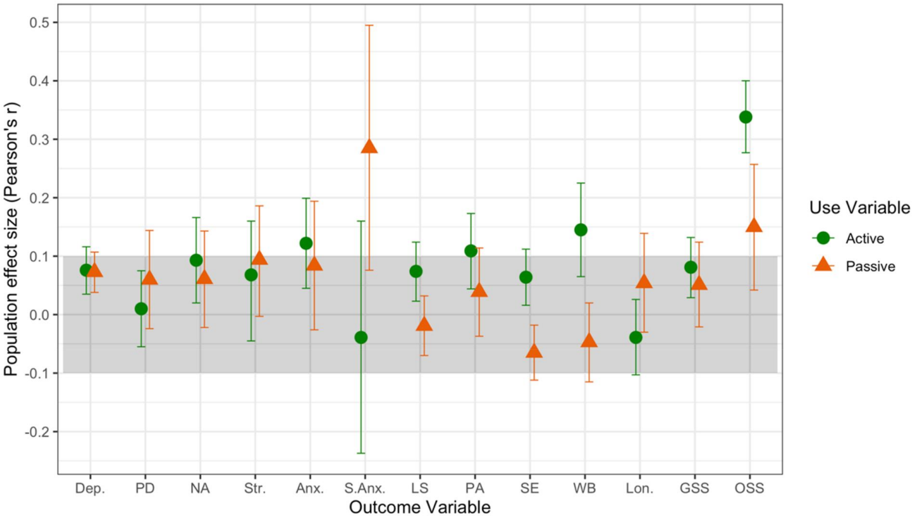
The relationships between active (e.g., creating content) and passive (e.g., scrolling) social media (SM) use (SMU) and mental health, wellbeing, and social support outcomes have received significant attention, yet findings have been mixed. We conducted a meta-analysis of 141 studies (N ≈ 145,000) containing 897 effect sizes (ESs) between active and passive SMU and 13 outcomes. Most ESs were negligible (|r| < .10), with the exception of between-person associations for active SMU and greater online support (r = .34), wellbeing (r = .15), positive affect (r = .11), and symptoms of anxiety (r = .12), and passive SMU and greater online support (r = .15). Moderator analyses revealed that passive use was associated with worse emotional outcomes in general SM contexts, but not in the context of SM groups. User age also emerged as an important contextual factor. Implications for future research, theory development, and healthy SMU are discussed.
Overview
CoChat Summary
TL;DR
This meta-analysis of 141 studies found that active and passive social media use had mostly negligible associations with mental health, wellbeing, and social support outcomes. The clearest exceptions were between-person links between both active and passive use and greater online social support, and between active use and greater anxiety symptoms.
Key findings
- Most effect sizes were negligible (|r| < .10). Between-person exceptions included active use with greater online social support (r = .34), general wellbeing (r = .15), positive affect (r = .11), and anxiety symptoms (r = .12); passive use was linked with greater online social support (r = .15) and social anxiety symptoms (r = .29, k = 3).
- Passive use was associated with greater illbeing in general social media contexts (r = .11), but not in social media groups (r = −.01, p = .003).
- Age moderated the passive use–wellbeing association: adults showed near-zero effects (r = .03), while emerging adults (r = −.08) and adolescents (r = −.06) showed slight negative associations.
- All within-subjects effects were negligible at the population level for both active and passive use.
Methods
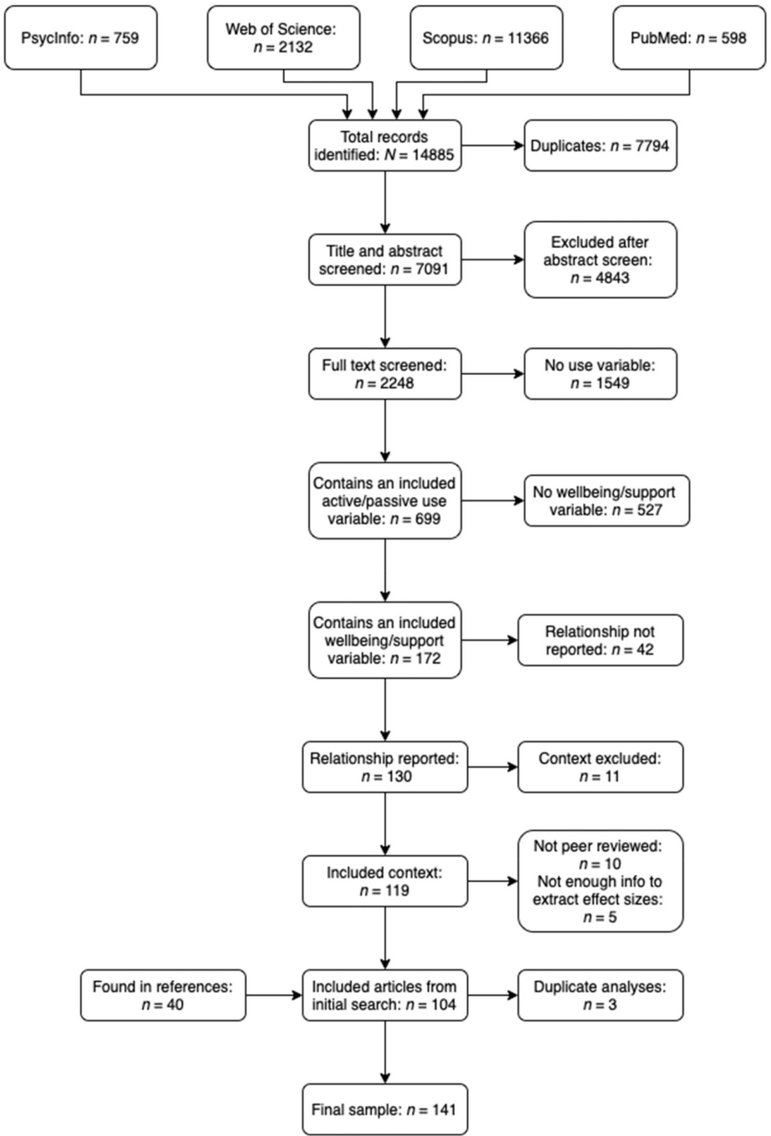
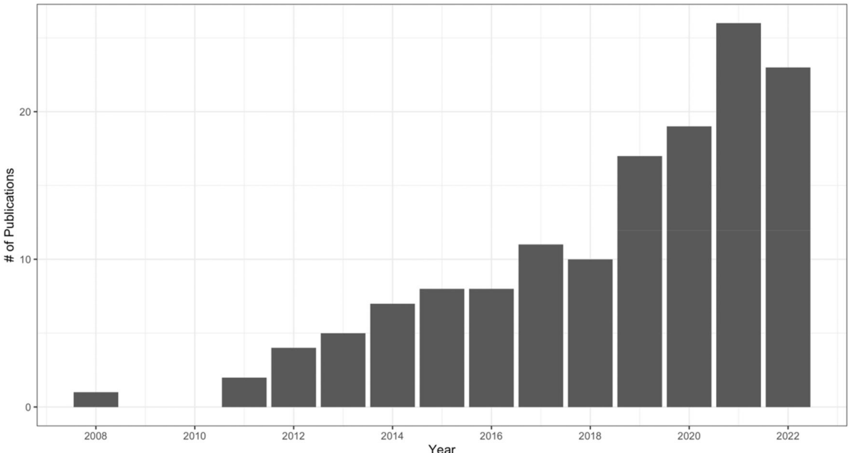
- Systematic meta-analysis following PRISMA 2020; searched PsychInfo, Scopus, Web of Science, and PubMed through September 2022, yielding 141 articles published 2008–2022, 897 effect sizes (562 active, 334 passive), and 145,394 participants.
- Coded 13 distinct mental health, wellbeing, and social support outcomes; analyzed between- and within-subjects effects separately using R package metafor, with random- or fixed-effects models, publication bias tests, and an a priori smallest effect size of interest of |r| = .10.
- Tested moderators including social media groups vs. general social media use, user age, type of active use (broadcasting vs. directed communication), and study methods/measures.
Limitations
- The paper states that the a priori SESOI may have obscured small effects that accumulate over time; some outcomes had few studies and wide confidence intervals (e.g., social anxiety); domain-specific wellbeing outcomes (e.g., body image, eating disorder symptoms) were excluded; within-subjects effects were too few and combined concurrent and lagged effects; and the social media group vs. general use distinction may overlap, with captured groups largely health-related.
- Evident from the text: most effect sizes came from cross-sectional studies (64%) and non-validated self-report measures (68%), and only 32 studies (23%) included theoretical justification, limiting causal inference and measurement precision.
Model-written summary. Check it against the paper before relying on it.
Integrity signals
Registry
Cites
Statistics
Figures
Verification
Claims the paper makes
13 Valid · 1 Not valid · 28 Not checked · 98 Own results and interpretations
The cited sources support only part of this claim — read each source’s verdict below.
In the paper
“In contrast, social support was the only outcome to show consistently beneficial associations”
§ Are active and passive social media use related to mental health, wellbeing, and social support outcomes? A meta-analysis of 141 studies > SM and wellbeing recent meta
What the sources say
- Partly supportedcites Domahidi, 2018 matched to “The associations between online media use and users’ perceived social resources: A meta-analysis” (2018) sourceExperimental — accuracy not yet measured
In “Different concepts and dimensions of PSR” (page unavailable), the meta-analysis finds a positive association between online media use and perceived social support (r = .10, p ≤ .001). It does not support calling social support the only consistently beneficial outcome: perceived social capital also has a positive association, and the paper reports variation across media and measures of use. (LLM, conf=0.88)
- Not checked — no full text of the sourcecites Liu et al., 2016 matched to “A meta-analysis of social networking online and social capital” (2016) source
- Not checked — no full text of the sourcecites Liu et al., 2018 matched to “A meta-analysis of social network site use and social support” (2018) source
plainstates an association- Asserted: passes — The authors put it forward as true.
- Checkable: passes — It can be checked against evidence.
- Load-bearing: passes — The paper’s conclusions depend on it.
- Based: passes — The paper gives a reason why it holds.
- Partly supported
The cited sources support only part of this claim — read each source’s verdict below.
In the paper
“the only study that compared older and younger/middle-aged adults (Sakurai et al., 2021) found generally more positive associations of active and passive SMUs for older adults.”
§ Are active and passive social media use related to mental health, wellbeing, and social support outcomes? A meta-analysis of 141 studies > Developmental lifespan perspective
What the sources say
- Partly supportedcites Sakurai et al., 2021 matched to “Who is mentally healthy? Mental health profiles of Japanese social networking service users with a focus on LINE, Facebook, Twitter, and Instagram” (2021) sourceExperimental — accuracy not yet measured
The Results section (page not provided) compares young, middle-aged, and older adults and finds that both posting and checking on LINE are associated with better well-being in older adults. But the Discussion’s summary reports positive associations for different services in younger and middle-aged adults and no common positive association across generations; the Facebook discussion finds a positive association only for middle-aged adults. The paper therefore supports an older-adult finding for LINE, not generally more positive associations of active and passive social media use among older adults. (LLM, conf=0.86)
plainstates an associationSingle case- Asserted: passes — The authors put it forward as true.
- Checkable: passes — It can be checked against evidence.
- Load-bearing: unclear — It is unclear whether the paper’s conclusions depend on it.
- Based: passes — The paper gives a reason why it holds.
- Partly supported
The cited sources that could be checked couldn’t confirm or dispute this claim.
In the paper
“we found no significant differences in ESs between measures of private, public, and general active use.”
§ Are active and passive social media use related to mental health, wellbeing, and social support outcomes? A meta-analysis of 141 studies > Moderators of active and passive SMU
What the sources say
- Could not verifycites Verduyn et al., 2022 matched to “Do social networking sites influence well-being? The extended active–passive model” (2022) sourceExperimental — accuracy not yet measured
Our copy of Verduyn, Gugushvili & Kross (2022) is a conceptual/theory article: it defines private (e.g., direct messaging) versus public targeted (e.g., commenting) and nontargeted (e.g., status updating) active use in 'Decomposing active use' and argues the effect of active use 'is unlikely to be identical for all types of active use,' but it reports no meta-analysis or effect-size comparison of its own and never states that effect sizes for measures of private, public, and general active use did not differ significantly (the only ES-type comparison it relays is Liu et al., 2019's targeted-vs-nontargeted contrast, credited to that other work). Searched: 'no significant differences in effect sizes between private, public, and general active use', 'meta-analytic effect size estimates active use well-being moderator analysis', 'general active use measure private public direct messaging operationalization', 'effect sizes did not differ significantly across subsamples' — no passage addresses the claim's empirical result. (LLM, conf=0.72)
plain- Asserted: passes — The authors put it forward as true.
- Checkable: passes — It can be checked against evidence.
- Load-bearing: passes — The paper’s conclusions depend on it.
- Based: passes — The paper gives a reason why it holds.
- Could not verify
The cited sources support only part of this claim — read each source’s verdict below.
In the paper
“Emerging research highlights the potential benefits of passive SMU for marginalized populations, such as LGBTQþ individuals (Fish et al., 2020), autistic people (Gillespie- Lynch et al., 2014), and people with physical disabilities (Sannon et al., 2019).”
§ Are active and passive social media use related to mental health, wellbeing, and social support outcomes? A meta-analysis of 141 studies > A greater focus on vulnerable populations
What the sources say
- Partly supportedcites Fish et al., 2020 matched to ““I’m kinda stuck at home with unsupportive parents right now”: LGBTQ youths’ experiences with COVID-19 and the importance of online support” (2020) sourceExperimental — accuracy not yet measured
The Results ('Online support and resources'; page unavailable) describe LGBTQ youths watching and reading identity-specific online content, alongside using online platforms to maintain connections and seek support. The paper highlights benefits of online support, but does not establish that passive social media use specifically provides those benefits. This citation attaches only to LGBTQ+ individuals, not the other populations in the sentence. (LLM, conf=0.84)
- Not checked — no full text of the sourcecites Gillespie-Lynch et al., 2014 matched to “Intersections between the autism spectrum and the internet: Perceived benefits and preferred functions of computer-mediated communication” (2014) source
- Not checked — no full text of the sourcecites Sannon et al., 2019 matched to “"I was really, really nervous posting it": Communicating about Invisible Chronic Illnesses across Social Media Platforms” (2019) source
hedgedstates a possible cause- Asserted: passes — The authors put it forward as true.
- Checkable: passes — It can be checked against evidence.
- Load-bearing: unclear — It is unclear whether the paper’s conclusions depend on it.
- Based: passes — The paper gives a reason why it holds.
- Partly supported
A result the paper reports from its own data — it cites no other source for it, so there is none to check. The quote shows it is in the paper.
In the paper
“and used non-validated self-report measures (68%; see Table 1).”
§ Are active and passive social media use related to mental health, wellbeing, and social support outcomes? A meta-analysis of 141 studies > Results
plain- Asserted: passes — The authors put it forward as true.
- Checkable: passes — It can be checked against evidence.
- Load-bearing: unclear — It is unclear whether the paper’s conclusions depend on it.
- Based: passes — The paper gives a reason why it holds.
- Rests on 2 assumptions not shown here.
96 more claims
Create a free account to see all 140 claims and to verify the 13 references still open.
- Probably not a substantial claim. 33
- It may state two separate claims as one. 9
- The quote only partly states this claim. 1
Claims other papers make about this one
Each is checked against this paper’s own text: does it say what the citing paper says it does?
The source backs part of the claim, not all of it — or backs it for a different population, condition or comparison.
In the citing paper
“However, the role of social media use in the formation of maladaptive social safety schemas (e.g. indexed via interpersonal distrust [53]) has not been addressed in any age group, even though there is mixed evidence on the association between social media use and perceived social support in adults [60–63].”
From Adolescent social media use and psychiatric outcomes: a longitudinal mediation analysis via interpersonal distrust, sleep, and self-image. (2026) · cites this paper as [61]
Experimental — accuracy not yet measured
Citations
Cites
A theory of social comparison processes
Festinger, L. (1954) · Human Relations · doi:10.1177/001872675400700202 · Cited by 20,926
Conducting Meta-Analyses in R with the metafor Package
Viechtbauer, W. (2010) · Journal of Statistical Software · doi:10.18637/jss.v036.i03 · Cited by 20,464
The PRISMA 2020 statement: an updated guideline for reporting systematic reviews
Page, M. J., McKenzie, J. E., Bossuyt, P. M., Boutron, I., Hoffmann, T. C., Mulrow, C. D., Shamseer, L., Tetzlaff, J. M., Akl, E. A., Brennan, S. E., et al. (2021) · Systematic Reviews · doi:10.1186/s13643-021-01626-4 · Cited by 13,874
Social Relationships and Mortality Risk: A Meta-analytic Review
Holt-Lunstad, J., Smith, T. B., & Layton, J. B. (2010) · PLoS Medicine · doi:10.1371/journal.pmed.1000316 · Cited by 7,272
(1996) · Institutional Research Information System University of Turin (University of Turin) · doi:10.1111/j · Cited by 5,486
Handbook of emotion regulation
(2014) · Choice Reviews Online · doi:10.5860/choice.52-1127 · Cited by 3,280
Uchino, B. N. (2006) · Journal of Behavioral Medicine · doi:10.1007/s10865-006-9056-5 · Cited by 2,507
Handbook of research methods in personality psychology
(2007) · Choice Reviews Online · doi:10.5860/choice.45-2315 · Cited by 2,373
A new look at social support: A theoretical perspective on thriving through relationships
Feeney, B. C., & Collins, N. L. (2015) · Personality and Social Psychology Review · doi:10.1177/1088868314544222 · Cited by 1,521
Uchino, B. N. (2009) · Perspectives on Psychological Science · doi:10.1111/j.1745-6924.2009.01122.x · Cited by 1,506
Cited by
Hall, J. A. (2024) · Annals of the New York Academy of Sciences · doi:10.1111/nyas.15275 · Cited by 41
“Godard and Holtzman 40 conclude in their meta-analysis, “Encouraging social media users to increase active use (e.g., post more) or reduce passive use (e.g., spend less time scrolling) is unlikely to result in meaningful improvements to mental health and wellbeing.””
InfluentialElsayed, H. A. E. (2025) · Frontiers in Psychology · doi:10.3389/fpsyg.2025.1582572 · Cited by 67
Ten Myths About the Effect of Social Media Use on Well-Being
Hall, J. A. (2024) · Journal of Medical Internet Research · doi:10.2196/59585 · Cited by 26
“Although intuitive, encouraging more active and less passive use does not seem to be a solution [95].”
Wang, L., Ma, Y., Yan, Z., Zhang, L., Hu, Y., & Zhao, S. (2025) · Computers in Human Behavior · doi:10.1016/j.chb.2025.108669 · Cited by 26
Will restricting the age of access to social media reduce mental illness in Australian youth?
Blake, J. A., Sourander, A., Kato, A., & Scott, J. G. (2025) · Australian & New Zealand Journal of Psychiatry · doi:10.1177/00048674241308692 · Cited by 27
“Further, subgroups of users who are marginalised or lack access to support derive some benefits but also experience increased anxiety from both passive and active use (Godard and Holtzman, 2024).”
Choi, E. J., Christiaans, E., & Duerden, E. G. (2025) · Computers in Human Behavior · doi:10.1016/j.chb.2025.108688 · Cited by 31
van der Wal, A., Beyens, I., Janssen, L. H. C., & Valkenburg, P. M. (2025) · Current Psychology · doi:10.1007/s12144-025-08893-7 · Cited by 32
“…youth mental health remain highly contested, with some arguing that social media are the primary driver of the youth mental health crisis (Haidt, 2020; Twenge et al., 2022), while others contend that their impact is negligible (Ferguson et al., 2025) – or even beneficial (Godard & Holtzman, 2024 ).”
Baumgartner, S. E. (2025) · Communication Theory · doi:10.1093/ct/qtaf017 · Cited by 22
“Whether media affect well-being is still highly de-bated in the field (see for example, Godard & Holtzman, 2023; Haidt, 2024), and empirical evidence for effects is mixed with some studies showing positive, some negative and some null effects (e.g., Houghton et al., 2018; Kross et al., 2021;…”
Wu, Q. J., Ngien, A., Jiang, S., & Dong, Y. (2024) · Computers in Human Behavior · doi:10.1016/j.chb.2024.108218 · Cited by 16
The impact of active social media use on the mental health of older adults
Wei, N., Sun, D., & Li, J. (2025) · BMC Psychology · doi:10.1186/s40359-025-02642-y · Cited by 16
“Although active social media use may not be necessary to achieve beneficial effects [59].”
Social media use and loneliness among adolescents: the moderating role of media literacy
Kim, Y., & Lee, M. (2024) · Online Information Review · doi:10.1108/oir-12-2023-0664 · Cited by 13
Kim, H. S., Kim, S., & Lee, E.-J. (2025) · Human Communication Research · doi:10.1093/hcr/hqaf005 · Cited by 10
Association Between Short-Form Video Use and Mental Health: Systematic Review and Meta-Analysis
Tang, D., Zhang, X., Gou, P., Feng, J., Hu, R., & Sum, R. K. W. (2026) · Journal of Medical Internet Research · doi:10.2196/82503 · Cited by 18
“…outcomes to be higher than previously established correlations for problematic phone use, internet use, social media use, and screen time [80-82, 85, 86 First, the algorithmic recommendation mechanisms of SFV platforms may more intensely reinforce user immersion and platform stickiness [87-89].”
Problematic Online Dating: Systematic Review of Definitions, Correlates, and Study Designs
Thomas, M. F., Dörfler, S., Mittmann, G., & Steiner‐Hofbauer, V. (2025) · Journal of Medical Internet Research · doi:10.2196/72850 · Cited by 13
“As outcomes, researchers examined, for example, cybervictimization, social support [10,34], self-control, anxiety, depression, self-esteem [1], sleep quality [35], and undesired academic, social, or sexual behaviors [7,25].”
InfluentialDeprivation's role in adolescent social media use and its links to life satisfaction
Kurten, S., Ghai, S., Odgers, C. L., Kievit, R., & Orben, A. C. (2024) · Computers in Human Behavior · doi:10.1016/j.chb.2024.108541 · Cited by 15
Browse or broadcast? The influence of active and passive social media use on mood
Li, S. H., Corkish, B., & Werner-Seidler, A. (2025) · Cognition and Emotion · doi:10.1080/02699931.2024.2439435 · Cited by 7
“For example, a recent meta-analysis concluded that while active social media use was associated with better mental health and more positive emotions, it was also associated with greater anxiety (Godard & Holtzman, 2024).”
ICT Use Among Older Adults Around the World
Gu, D., Feng, Q., Wang, K., & Lee, H. Y. (2025) · Advances in studies of aging and health · doi:10.1007/978-3-031-98964-3_2 · Cited by 7
Zhao, L. (2024) · Current Psychology · doi:10.1007/s12144-024-06652-8 · Cited by 9
“The use of social media can enable col - lege students to engage in online socializing and gain online emotional support (Godard & Holtzman, 2024 ).”
Harvey, A. G., & Aikman, S. N. (2025) · Journal of Technology in Behavioral Science · doi:10.1007/s41347-025-00504-3 · Cited by 9
Tsomokos, D. I. (2026) · Social Psychiatry and Psychiatric Epidemiology · doi:10.1007/s00127-025-02999-w · Cited by 5
The development and validation of the extended active-passive social media use scale
Niu, X., Verduyn, P., Gaskin, J. E., Scherr, S., McDonnell, D., & Wang, J. (2025) · Cyberpsychology Journal of Psychosocial Research on Cyberspace · doi:10.5817/cp2025-3-1 · Cited by 9
Yan, X., Yan, J., Tan, C., Fu, Y., & Wang, S. (2025) · Frontiers in Psychology · doi:10.3389/fpsyg.2025.1515575 · Cited by 7
Supti, T. I., Yankouskaya, A., Alshakhsi, S. A. A., Babiker, A., Al‐Thani, D., & Ali, R. (2025) · Lecture notes in business information processing · doi:10.1007/978-3-031-92474-3_21 · Cited by 5
Prolonged social media use is not fundamentally problematic in a Hungarian representative study
Zsila, Á., Bognár, B., & Shabahang, R. (2026) · Scientific Reports · doi:10.1038/s41598-026-36896-2 · Cited by 6
“A recent meta-analysis further found that users engaging in active social media use tend to report higher well-being and positive emotions, but also more symptoms of anxiety 56 .”
Wang, H., Zheng, B., Zhang, X., Wang, D., Chen, Z., Xu, Z., & Fu, R. (2026) · Telematics and Informatics · doi:10.1016/j.tele.2026.102378 · Cited by 6
Depression is associated with higher sensitivity to social media rewardsPreprint
Mirea, D.-M., Mildner, J. N., Kelley, S., Gillan, C. M., Nook, E. C., & Niv, Y. (2024) · PsyArXiv (OSF Preprints) · doi:10.31234/osf.io/4ynbc · Cited by 7
Onishi, R. (2024) · JMIR Pediatrics and Parenting · doi:10.2196/59029 · Cited by 7
“Passive use of SNSs is often linked to negative impacts on mental health [35].”
BackgroundSchumann, S., Kenyon, J., & Binder, J. F. (2025) · Computers in Human Behavior · doi:10.1016/j.chb.2025.108646 · Cited by 3
Pennington, C. R., Murray, E. A. H., Kaye, L. K., Burgess, A., Kessler, K., & Shaw, D. J. (2025) · Computers in Human Behavior Reports · doi:10.1016/j.chbr.2025.100753 · Cited by 6
Gugushvili, N., Masciantonio, A., Nitschinsk, L., Rozgonjuk, D., Täht, K., Kross, E. F., Ruiter, R. A. C., & Verduyn, P. (2025) · International Journal of Human-Computer Interaction · doi:10.1080/10447318.2025.2531288 · Cited by 7
“Similarly, recent meta-analytic evidence revealed that associations between active and passive SNS use and mental health outcomes are typically also only small (Godard & Holtzman, 2023).”
Firth, J., Linardon, J., Sawyer, C. S., French, C., Stubbs, B., Firth, J. A., Solmi, M., Torous, J. B., Berhe, K., Hallal, P. C., et al. (2026) · Journal of Physical Activity and Health · doi:10.1123/jpah.2026-0550 · Cited by 3
Kuhney, F. S., Strauss, G. P., Walker, E. F., James, S. H., & Mittal, V. A. (2025) · Schizophrenia Bulletin · doi:10.1093/schbul/sbaf032 · Cited by 7
Song, Y., Liang, Q., & Wang, W. (2025) · Asia Pacific Business Review · doi:10.1080/13602381.2025.2521065 · Cited by 5
Kostyrka‐Allchorne, K., Stoilova, M., Bourgaize, J., Murray, A. L., Azeri, E., Hollis, C. P., Townsend, E., Livingstone, S., & Sonuga-Barke, E. J. S. (2024) · BMJ Open · doi:10.1136/bmjopen-2024-085061 · Cited by 4
Unravelling passive social media use through screenomesPreprint
Yee, A. Z. H., Krause, H.-V., Meier, A., Ng, L. Y., & Loy, G. P. (2024) · PsyArXiv (OSF Preprints) · doi:10.31234/osf.io/9uywm · Cited by 4
Lassota, I., Oleksy, T., Wnuk, A., & Gambin, M. (2025) · Current Psychology · doi:10.1007/s12144-025-07893-x · Cited by 2
“Of particular relevance are the associations between prolonged engagement in virtual places and symptoms of anxiety and depression, which have been highlighted in recent studies (Godard & Holtzman, 2024 ; Hofer & Har - gittai, 2024; Teng et al., 2021 ).”
Kovačič, M., & Orso, C. E. (2025) · Review of Economics of the Household · doi:10.1007/s11150-025-09796-z · Cited by 5
“This is important evidence since passive social media use has been associated with different psychological outcomes compared to active engagement in the existing literature (Cabeza Martínez et al., 2025; Evans, Hardacre, Rubin and Tran, 2023; Godard and Holtzman, 2024; Yue, Zhang and Xiao, 2022).”
Ferguson, C. J. (2026) · Current Psychology · doi:10.1007/s12144-026-09205-3 · Cited by 5
Liang, R., Star, A. P., Tsur, N., Shmueli, M., & O’Rourke, N. (2026) · JMIR Formative Research · doi:10.2196/90751 · Cited by 2
“Moreover, we found no association between passive SMU and online social support [6].”
InfluentialDifferent Social Media Use Types, Psychological Needs, and Adolescents’ Mental Health: A Panel Study
(2026) · doi:10.2147/prbm.s555515 · Cited by 2
“8,13 Accordingly, this study reasonably speculates that the quality of adolescents’ offline relationships may influence the relationship between different types of social media use and psychological need fulfillment.”
InfluentialLin, Y., & Wang, X. (2026) · Frontiers in Psychology · doi:10.3389/fpsyg.2026.1848596 · Cited by 5
“…the relationship between social media communication and loneliness (Heo et al., 2015; Zhang et al., 2021), and social support in particular emerges as the outcome most robustly associated with active social media use across over 140 studies (Godard and Holtzman, 2024; Meier and Reinecke, 2021).”
InfluentialSocial Media use is Associated with, but is not a Major Cause of Mental Disorder among Adolescents
Elhai, J. D., Demetrovics, Z., Casale, S., & Montag, C. (2026) · Current Addiction Reports · doi:10.1007/s40429-026-00769-5 · Cited by 3
“Also, what one specifically does on social media matters, with social and active use being more beneficial to well-being than non-social, passive use, reviewed in [73].”
Boothroyd, S., Chou, F., Black, T., & Liu, S. (2024) · Journal of Child and Adolescent Counseling · doi:10.1080/23727810.2024.2363741 · Cited by 4
Calvin, A. J., Chen, Y. A., & Selkie, E. M. (2025) · Computers in Human Behavior Reports · doi:10.1016/j.chbr.2025.100748 · Cited by 4
“Lastly, multiple meta-analyses call for studies to include more diverse samples (Godard & Holtzman, 2024; Hancock et al., 2022).”
InfluentialGlobal Analysis of Perceived Social Media Effects on Well-Being
Dienlin, T., Šmahel, D., & Orben, A. C. (2025) · Cyberpsychology Behavior and Social Networking · doi:10.1177/21522715251359204 · Cited by 5
Döveling, K., Sanders, M. S., & Sommer, D. (2025) · Oxford University Press eBooks · doi:10.1093/oxfordhb/9780197689875.013.0009 · Cited by 3
Chen, Y., Yang, W., Zhang, X., & Wu, Y. (2025) · Health Communication · doi:10.1080/10410236.2025.2567514 · Cited by 3
“Firstly, previous research on the correlation between SMU and health has largely focused on measuring usage frequency and intensity (Parry et al., 2021) or adopting a dichotomous framework of active versus passive use (Godard & Holtzman, 2024).”
InfluentialKambara, K., Toya, A., Lee, S., Shimizu, H., Abe, K., Shigematsu, J., Zhang, Q., Abe, N., Hayase, R., Abe, N., et al. (2024) · Asian Journal Of Social Psychology · doi:10.1111/ajsp.12658 · Cited by 3
Effects of SNSs use and social intelligence on users’ subjective well-being
Dang, V. T., Wong, W. M., & Vu, T. T. (2025) · Journal of Trade Science · doi:10.1108/jts-12-2024-0070 · Cited by 1
Pedrollo, L. F. S., Miasso, A. I., Molina, N. P. F. M., Donato, G. D., & Vedana, K. G. G. (2025) · Mental Illness · doi:10.1155/mij/1245527 · Cited by 1
“Contemporary research indicates that the quality and type of engagement, for instance, whether use is active or passive, may be more critical determinants of mental health outcomes than the sheer amount of time spent online [63].”
Vasiliu, V., Shibli, H., & Yavetz, G. (2025) · Media War & Conflict · doi:10.1177/17506352251392725 · Cited by 1
Jin, L. T., & Choi, Y. J. (2026) · Computers in Human Behavior · doi:10.1016/j.chb.2026.108916 · Cited by 3
Adolescent technology use and affective well-being: Taking a more nuanced look
Godard, R., France, K. D., Ng, Z. J., & Hoffmann, J. D. (2026) · Current Psychology · doi:10.1007/s12144-025-08977-4 · Cited by 2
Self-citationLao, C. H., Skandalakis, A., & Marshall, T. C. (2026) · Media Psychology · doi:10.1080/15213269.2026.2626701 · Cited by 2
From platforms to features: A cross-platform framework for Social Network Sites and mental health
Masciantonio, A., Wormley, A. S., Kross, E. F., & Verduyn, P. (2026) · SSM - Mental Health · doi:10.1016/j.ssmmh.2026.100601 · Cited by 2
Liu, W. (2026) · Frontiers in Public Health · doi:10.3389/fpubh.2026.1766808 · Cited by 2
“Active engagement, such as direct communication or purposeful participation in online communities (40), can promote social support and connectedness (41, 42).”
Kim, H. E., Kim, B.-H., Cho, Y., Ko, Y., & Kim, J.-J. (2026) · Computers in Human Behavior · doi:10.1016/j.chb.2026.108976 · Cited by 1
Choi, N. G., & Marti, C. N. (2026) · Clinical Gerontologist · doi:10.1080/07317115.2026.2655427 · Cited by 1
“…may visit SNS platforms in an effort to cope with social disconnection, yet such use may not provide the meaningful interaction or reciprocity needed to reduce loneliness, especially when such use entails passive (e.g., browsing) rather than active participation (Godard & Holtzman, 2024).”
Whelan, E. (2026) · Acta Psychologica · doi:10.1016/j.actpsy.2026.106783 · Cited by 1
Angelini, F., Marino, C., Canale, N., & Gini, G. (2026) · Human Behavior and Emerging Technologies · doi:10.1155/hbe2/5710890 · Cited by 1
Boyington, M., Landrin, O., & Olejniczak, R. (2025) · Frontiers The Interdisciplinary Journal of Study Abroad · doi:10.36366/frontiers.v37i1.995 · Cited by 3
Impact of Parasocial Relationships and Communication on Mental Health in Digital Fandom
Saputra, N., & Rezkianiza, A. (2025) · International Conference on Creative Communication and Innovative Technology (ICCIT) · doi:10.1109/iccit65724.2025.11166696 · Cited by 1
“Social support theory highlights the critical role of social networks in mental health, providing emotional, informational, and instrumental support that aids individuals in managing stress and maintaining psychological well-being [15].”
Social Media Use, Loneliness and Emotional Distress Among Young People in EuropePreprint
Martínez, B. C., d’Hombres, B., & Kovačič, M. (2025) · SSRN Electronic Journal · doi:10.2139/ssrn.5089729 · Cited by 6
Ahorsu, D. K., Üztemur, S., Huang, P., Fung, X. C. C., Tu, H., Ruckwongpatr, K., Griffiths, M. D., & Lin, C.-Y. (2025) · Elsevier eBooks · doi:10.1016/b978-0-443-26629-4.00026-5 · Cited by 1
Editorial: The role of technology and social media in sport
Levy, S., Barry, C. T., & Vveinhardt, J. (2025) · Frontiers in Sports and Active Living · doi:10.3389/fspor.2025.1750115 · Cited by 1
Social Media Engagement and Identity: The Loneliness and FOMO Experience of Young People
Doktorová, D., Mghari, S. E., & Tokovská, M. (2025) · Communication Today · doi:10.34135/communicationtoday.2025.vol.16.no.1.10 · Cited by 4
Turner, C., Heidorn, D., King, A. J., Tovar, I., Millar, M. M., Codden, R. R., Guo, J., Johnson, S. B., Kirchhoff, A. C., Raber, M. R., et al. (2025) · JMIR Cancer · doi:10.2196/65887
“While studies like this are an important step toward establishing the prevalence of misinformation exposure, self-reports are notably unreliable and underestimated, in part due to differences in active (eg, posting and interacting) versus passive (eg, viewing and scrolling) online activity [9,11].”
Pallathadka, H. (2024) · International Research Journal of Education and Technology (IRJET). · doi:10.70127/irjedt.vol.8.issue06.767
DocTalks on TikTok: Self-Diagnosis Among Young Adults Exposed to Mental Health Trends Online
Alejos, A. J., Manalili, R. M., Monteverde, J., Nalus, J. D., & Valencia, A. (2025) · Psychology and Education A Multidisciplinary Journal · doi:10.70838/pemj.410105
Dalisay, F. S., Yamamoto, M., Kawabata, Y., Pokhrel, P., & Okamoto, S. K. (2025) · PLOS mental health. · doi:10.1371/journal.pmen.0000275 · Cited by 3
“Existing meta-analyses show that social media use is also positively associated with perceived online social support, positive affect, and well-being, particularly when users actively engage with interactive features [13, 14, 15].”
Kim, Y., & Lee, M. (2025) · Behavioral Sciences · doi:10.3390/bs15070964 · Cited by 5
“A meta-analysis also indicated that active SMU is associated with greater well-being and positive affect (Godard & Holtzman, 2024).”
Nitschinsk, L., Tobin, S. J., Gugushvili, N., McComb, C., & Verduyn, P. (2025) · Cyberpsychology Journal of Psychosocial Research on Cyberspace · doi:10.5817/cp2025-4-3 · Cited by 2
“More recent theoretical models have suggested it may be beneficial to explore additional decompositions of active SNS usage (Frison & Eggermont, 2020; Godard & Holtzman, 2024; Verduyn et al., 2022; Yang, 2016).”
The effect of municipality-level social media use on youth mental health
Tveit, O. B., & Biele, G. (2025) · BMC Public Health · doi:10.1186/s12889-025-24727-4 · Cited by 2
“…many studies have examined whether differences in outcomes can be explained by whether social media is used actively (e.g., posting messages) or passively (e.g., scrolling), although evidence for consistent differences in their association with anxiety and depression has been limited [9, 10].”
Chen, S., Jeong, R., Fellows, M., Sibenaller, I., & Demaray, M. K. (2025) · Exploration of Digital Health Technologies · doi:10.37349/edht.2025.101164
Social media and its impact on mental health in rheumatic diseases
Krusche, M., Kremer, P., & Haase, I. (2025) · Joint Bone Spine · doi:10.1016/j.jbspin.2025.105992
Passive Social Media Use, Depressive Symptoms, and Mindfulness Among College Students
Delo, M. (2025) · Psychology and Education A Multidisciplinary Journal · doi:10.70838/pemj.480309 · Cited by 1
Nam, J., & Choi, M. Y. (2025) · Asian Communication Research · doi:10.20879/acr.2025.22.017
Are public social interactions on Twitter associated with mental health outcomes?
Joinson, D., Simpson, E., Haworth, C. M. A., Cristianini, N., Cara, N. H. D., & Davis, O. S. P. (2025) · Computers in Human Behavior Reports · doi:10.1016/j.chbr.2025.100874
RetractedOnline Sociality and Literary Representation: Tracing Modern Friendship
Pihl, M. L. (2025) · Journal for Cultural Research · doi:10.1080/14797585.2025.2592219
“…up by empirical studies that have found a connection between dissatisfaction with social media use and passive consumption (passive use being closely related to one-sided parasoci-ality), whereas more active engagement can foster relations and rewarding experiences (Godard and Holtzman, 2024).”
Quilghini, F., Giannotta, F., Settanni, M., & Marengo, D. (2025) · Current Psychology · doi:10.1007/s12144-025-08790-z · Cited by 1
“Recent studies have found strikingly inconsistent findings adopting this framework patterns (Meier & Krause, 2023; Valkenburg et al., 2022; Godard & Holtzman, 2024; Marciano et al., 2024), and moved the field towards examining more nuanced factors for further understanding the heterogeneous effects…”
Liao, W., Kim, C., & Feng, B. (2025) · Communication Research · doi:10.1177/00936502251401636
Career Benefits of Networking Face-to-Face and Via LinkedIn
Kashian, N. (2026) · International Journal of Business Communication · doi:10.1177/23294884251408450
Latsi, I. C., Gasparinatou, A. A., & Kontodimopoulos, N. (2026) · Healthcare · doi:10.3390/healthcare14030326 · Cited by 1
“Problematic use, characterized by compulsivity and emotional dependence, is more consistently associated with adverse outcomes than excessive use per se [18,21,23–26].”
InfluentialInstagram Passive Active Use Measure (iPAUM): Development, validation and relation to self-esteem
Tølbøll, K. B., Gerson, J., & Plagnol, A. C. (2026) · Cyberpsychology Journal of Psychosocial Research on Cyberspace · doi:10.5817/cp2026-1-10
“A recent meta-analysis of 141 studies found a positive association between active SNS use and well-being ( r = .15) and positive affect ( r = .11; Godard & Holtzman, 2024).”
Cabezas, A. V. V., Escobar, J. N. P., Meza, D. C. V., & Guananga, L. C. S. (2026) · Esprint Investigación · doi:10.61347/ei.v5i1.240
SOCIAL MEDIA AND INTERPERSONAL SKILL DEVELOPMENT: EXPLORING GENERATION Z’S SOCIAL DYNAMICS
Baharuddin, F. A. B., Ismail, S. A. A., & Shukor, M. F. A. (2025) · International Journal of Education Psychology and Counseling · doi:10.35631/ijepc.1061064
Godard, R., Draper, Z. A., Holtzman, S., & O’Connor, B. P. (2026) · Current Psychology · doi:10.1007/s12144-026-09064-y
“Our findings support these concerns in relation to the PAUM and MSFU and suggest that lack of reliability and conceptual clarity may be a factor behind the inconsistent findings in this literature (Godard & Holtzman, 2024a).”
InfluentialSelf-citationLutz, S., Schneider, F. M., & Halfmann, A. (2026) · Computers in Human Behavior Reports · doi:10.1016/j.chbr.2026.100977 · Cited by 2
Perera, C. R., Hewege, C., & Hassan, S. (2025) · Emerald Group Publishing Limited eBooks · doi:10.1108/978-1-83708-844-720251013
Çavdar, D., Dölek, M., & Oğuz, Ö. (2026) · Journal of Fluency Disorders · doi:10.1016/j.jfludis.2026.106214 · Cited by 1
Social media use, time management and occupational balance among housewives: A cross-sectional study
Yalçın, A., Abaoğlu, H., & Atasoy, S. N. (2026) · British Journal of Occupational Therapy · doi:10.1177/03080226261423386
“These patterns suggest that social media often serves as a means of passive relaxation, information-seeking, and maintaining indirect social engagement (Godard and Holtzman, 2024).”
Mehjabeen, D., Blignault, I., Reavley, N. J., & Slewa‐Younan, S. (2026) · BMC Health Services Research · doi:10.1186/s12913-026-14344-1
“As well as being passive, there is potential for disturbing or harmful content [56].”
Gao, F., & Lin, X. (2026) · SAGE Open · doi:10.1177/21582440261429682
Krongbooncho, C., Boonchutima, S., & Mazahir, I. (2026) · Cogent Arts and Humanities · doi:10.1080/23311983.2026.2647143 · Cited by 2
Mabodi, R., Mbunge, E., Makaba, T., & Ntshingila, N. (2026) · Applied Sciences · doi:10.3390/app16073489 · Cited by 1
Helvich, J., Novák, L., Meier, Z., Heveri, M., & Tavel, P. (2026) · Child and Adolescent Psychiatry and Mental Health · doi:10.1186/s13034-026-01081-w · Cited by 1
“While even frequent social media use may be normative [37, 72], PSMU is described by compulsive features resembling behavioral addictions.”
Social media use, loneliness and emotional distress among young people in Europe
d’Hombres, B., Kovačič, M., & Martínez, B. C. (2026) · SSM - Mental Health · doi:10.1016/j.ssmmh.2026.100621 · Cited by 3
Toma, C. L., Choi, J., Olson, C., & Brown, B. (2026) · SSRN Electronic Journal · doi:10.2139/ssrn.6621562
Morán-Pallero, N., Castaño, E. F., Delgado, M. G., & Rojas-Valverde, M. (2026) · Behavioral Sciences · doi:10.3390/bs16040619
Cumulative Exposure: Scholarly Responses to 50 Years of Cultivation Research
Meirick, P. C., Busselle, R. W., Bilandzić, H., Gross, L. P., Nabi, R. L., Potter, W. J., Römer, D., & Scharrer, E. (2026) · Mass Communication & Society · doi:10.1080/15205436.2026.2644823
Metadata
- Authors
- Godard, R., & Holtzman, S.
- Affiliations
- University of British Columbia (CA)
- Corresponding author
- Godard, Rebecca
- Venue
- Journal of Computer-Mediated Communication
- Publisher
- Oxford University Press (OUP)
- Published
- 2023-11-08
- Volume
- 29
- Issue
- 1
- ISSN
- 1083-6101 (ISSN-L)
- OpenAlex
- W4391455785
- Cited by
- 171
- References
- 64
- Citations by year
- 2026: 104 · 2025: 52 · 2024: 15
- FWCI
- 8.62
- Type
- journal article
- Language
- en
- Open access
- diamond
- doi.org
- Licence
- Locations
- Journal of Computer-Mediated Communication (publishedVersion, cc-by)
- PsyArXiv (OSF Preprints) (submittedVersion, cc-by)
- Funders
- Social Sciences and Humanities Research Council of Canada (435-2017-0781)
- Topics
- Social Sciences › Sociology and Political Science › Impact of Technology on Adolescents
- Social Sciences › Psychology › Social Psychology › Mental Health via Writing
- Social Sciences › Communication › Media and Digital Communication
- Keywords
- active social media use, passive social media use, mental health, well-being, social support, online support, anxiety, positive affect, user age, social media groups, healthy social media use
About these checks
Registry, retraction, Cites and statistics results are computed, not judged, with one exception: a printed reference that no index lists is read once by a model before it counts as a citation error. Claims are extracted by a model and kept only when their quote appears verbatim in the text; each cited source is then checked, with a model’s help, for whether it says what the claim relies on. Those verdicts can be wrong — read the claim’s quote and the cited source before relying on one.
The claim verdicts this report counts are experimental: their accuracy is not yet measured.
A language model drew the claims from the paper on 2026-10-10, under version 3 of the claim definition (model deepseek-v4.1-flash, prompt extract-v3).
A second model labelled each claim on 2026-10-10 (model jev-1.13-20260917, definition revision gold-guideline-v0.2).
Cited sources are checked with a language model’s help (gpt-6-sol and qwen3.8-omni-flash).
Statistics and arithmetic are recomputed, not judged.
Confidence bands are shown only for fields calibrated on our annotated test set. None is calibrated yet, so no band is shown.
What counts as a claim ›How we measure confidence ›How we check this ›
Are you an author, or do you see a problem with this page? Request a review
Data sources
Bibliographic data: Semantic Scholar, OpenAlex, Crossref.
Contains information from the Semantic Scholar Academic Graph Datasets, made available under the ODC Attribution License (ODC-BY 1.0).
Semantic Scholar’s data is described in: Kinney, R., et al. (2023). The Semantic Scholar Open Data Platform. arXiv:2301.10140.
