

Are active and passive social media use related to mental health, wellbeing, and social support outcomes? A meta-analysis of 141 studies
Open accessPublished version of a preprint
The DOI matches its Crossref record; 68 of the 71 references it cites were found in a registry or an index; 14 of the 48 sources its claims cite were checked for support.
Abstract
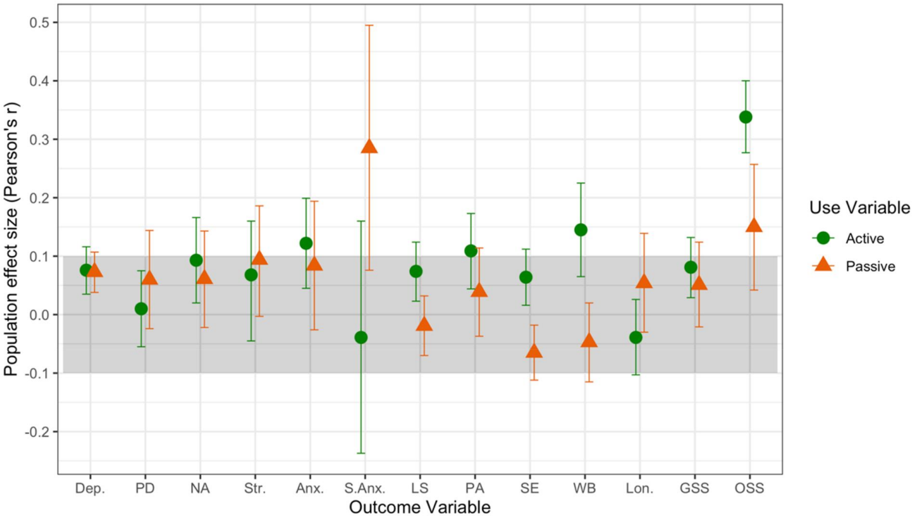
The relationships between active (e.g., creating content) and passive (e.g., scrolling) social media (SM) use (SMU) and mental health, wellbeing, and social support outcomes have received significant attention, yet findings have been mixed. We conducted a meta-analysis of 141 studies (N ≈ 145,000) containing 897 effect sizes (ESs) between active and passive SMU and 13 outcomes. Most ESs were negligible (|r| < .10), with the exception of between-person associations for active SMU and greater online support (r = .34), wellbeing (r = .15), positive affect (r = .11), and symptoms of anxiety (r = .12), and passive SMU and greater online support (r = .15). Moderator analyses revealed that passive use was associated with worse emotional outcomes in general SM contexts, but not in the context of SM groups. User age also emerged as an important contextual factor. Implications for future research, theory development, and healthy SMU are discussed.
Overview
CoChat Summary
TL;DR
This meta-analysis of 141 studies found that active and passive social media use had mostly negligible associations with mental health, wellbeing, and social support outcomes. The clearest exceptions were between-person links between both active and passive use and greater online social support, and between active use and greater anxiety symptoms.
Key findings
- Most effect sizes were negligible (|r| < .10). Between-person exceptions included active use with greater online social support (r = .34), general wellbeing (r = .15), positive affect (r = .11), and anxiety symptoms (r = .12); passive use was linked with greater online social support (r = .15) and social anxiety symptoms (r = .29, k = 3).
- Passive use was associated with greater illbeing in general social media contexts (r = .11), but not in social media groups (r = −.01, p = .003).
- Age moderated the passive use–wellbeing association: adults showed near-zero effects (r = .03), while emerging adults (r = −.08) and adolescents (r = −.06) showed slight negative associations.
- All within-subjects effects were negligible at the population level for both active and passive use.
Methods
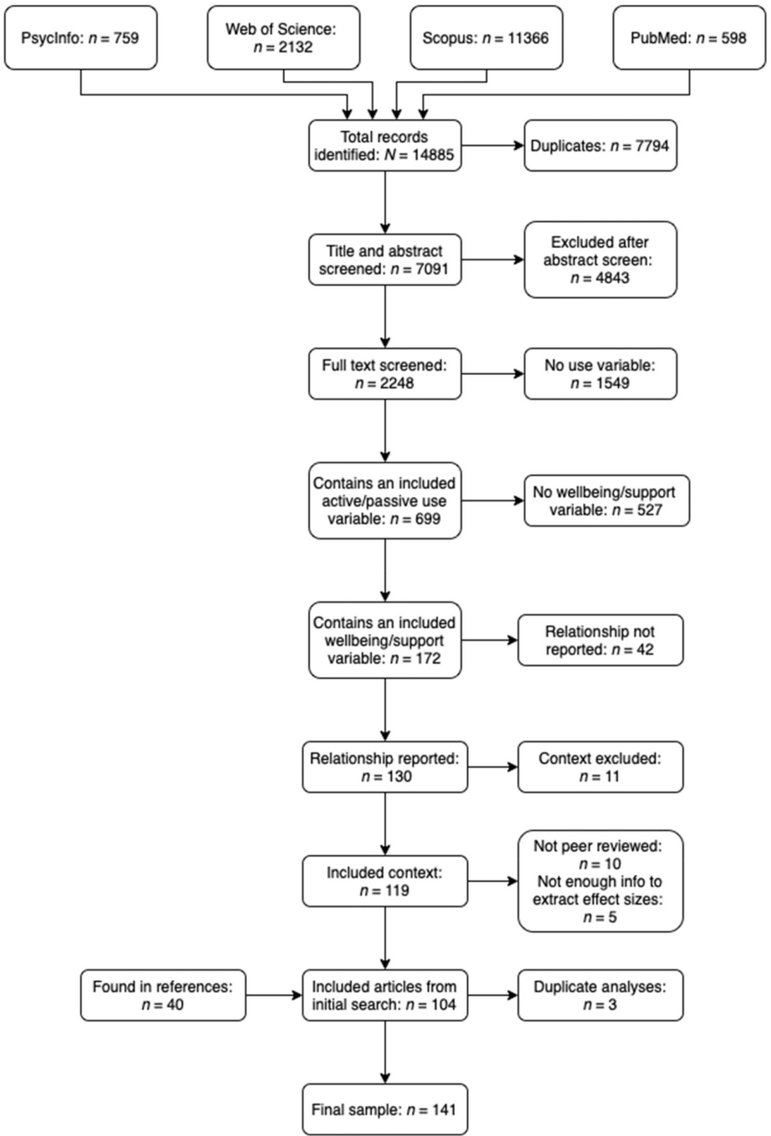
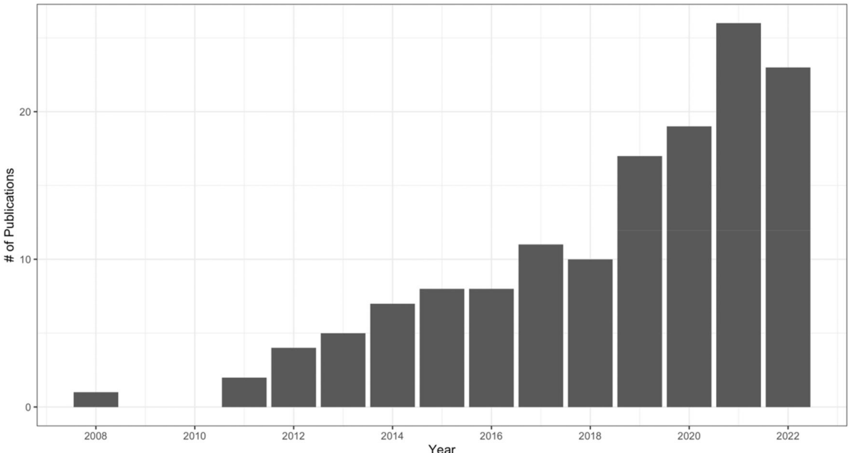
- Systematic meta-analysis following PRISMA 2020; searched PsychInfo, Scopus, Web of Science, and PubMed through September 2022, yielding 141 articles published 2008–2022, 897 effect sizes (562 active, 334 passive), and 145,394 participants.
- Coded 13 distinct mental health, wellbeing, and social support outcomes; analyzed between- and within-subjects effects separately using R package metafor, with random- or fixed-effects models, publication bias tests, and an a priori smallest effect size of interest of |r| = .10.
- Tested moderators including social media groups vs. general social media use, user age, type of active use (broadcasting vs. directed communication), and study methods/measures.
Limitations
- The paper states that the a priori SESOI may have obscured small effects that accumulate over time; some outcomes had few studies and wide confidence intervals (e.g., social anxiety); domain-specific wellbeing outcomes (e.g., body image, eating disorder symptoms) were excluded; within-subjects effects were too few and combined concurrent and lagged effects; and the social media group vs. general use distinction may overlap, with captured groups largely health-related.
- Evident from the text: most effect sizes came from cross-sectional studies (64%) and non-validated self-report measures (68%), and only 32 studies (23%) included theoretical justification, limiting causal inference and measurement precision.
Model-written summary. Check it against the paper before relying on it.
Integrity signals
Registry
Cites
Statistics
Figures
Verification
Claims the paper makes
13 Valid · 1 Not valid · 28 Not checked · 98 Own results and interpretations
The cited sources support only part of this claim — read each source’s verdict below.
In the paper
“In contrast, social support was the only outcome to show consistently beneficial associations”
§ Are active and passive social media use related to mental health, wellbeing, and social support outcomes? A meta-analysis of 141 studies > SM and wellbeing recent meta
What the sources say
- Partly supportedcites Domahidi, 2018 matched to “The associations between online media use and users’ perceived social resources: A meta-analysis” (2018) sourceExperimental — accuracy not yet measured
In “Different concepts and dimensions of PSR” (page unavailable), the meta-analysis finds a positive association between online media use and perceived social support (r = .10, p ≤ .001). It does not support calling social support the only consistently beneficial outcome: perceived social capital also has a positive association, and the paper reports variation across media and measures of use. (LLM, conf=0.88)
- Not checked — no full text of the sourcecites Liu et al., 2016 matched to “A meta-analysis of social networking online and social capital” (2016) source
- Not checked — no full text of the sourcecites Liu et al., 2018 matched to “A meta-analysis of social network site use and social support” (2018) source
plainstates an association- Asserted: passes — The authors put it forward as true.
- Checkable: passes — It can be checked against evidence.
- Load-bearing: passes — The paper’s conclusions depend on it.
- Based: passes — The paper gives a reason why it holds.
- Partly supported
The cited sources support only part of this claim — read each source’s verdict below.
In the paper
“the only study that compared older and younger/middle-aged adults (Sakurai et al., 2021) found generally more positive associations of active and passive SMUs for older adults.”
§ Are active and passive social media use related to mental health, wellbeing, and social support outcomes? A meta-analysis of 141 studies > Developmental lifespan perspective
What the sources say
- Partly supportedcites Sakurai et al., 2021 matched to “Who is mentally healthy? Mental health profiles of Japanese social networking service users with a focus on LINE, Facebook, Twitter, and Instagram” (2021) sourceExperimental — accuracy not yet measured
The Results section (page not provided) compares young, middle-aged, and older adults and finds that both posting and checking on LINE are associated with better well-being in older adults. But the Discussion’s summary reports positive associations for different services in younger and middle-aged adults and no common positive association across generations; the Facebook discussion finds a positive association only for middle-aged adults. The paper therefore supports an older-adult finding for LINE, not generally more positive associations of active and passive social media use among older adults. (LLM, conf=0.86)
plainstates an associationSingle case- Asserted: passes — The authors put it forward as true.
- Checkable: passes — It can be checked against evidence.
- Load-bearing: unclear — It is unclear whether the paper’s conclusions depend on it.
- Based: passes — The paper gives a reason why it holds.
- Partly supported
The cited sources that could be checked couldn’t confirm or dispute this claim.
In the paper
“we found no significant differences in ESs between measures of private, public, and general active use.”
§ Are active and passive social media use related to mental health, wellbeing, and social support outcomes? A meta-analysis of 141 studies > Moderators of active and passive SMU
What the sources say
- Could not verifycites Verduyn et al., 2022 matched to “Do social networking sites influence well-being? The extended active–passive model” (2022) sourceExperimental — accuracy not yet measured
Our copy of Verduyn, Gugushvili & Kross (2022) is a conceptual/theory article: it defines private (e.g., direct messaging) versus public targeted (e.g., commenting) and nontargeted (e.g., status updating) active use in 'Decomposing active use' and argues the effect of active use 'is unlikely to be identical for all types of active use,' but it reports no meta-analysis or effect-size comparison of its own and never states that effect sizes for measures of private, public, and general active use did not differ significantly (the only ES-type comparison it relays is Liu et al., 2019's targeted-vs-nontargeted contrast, credited to that other work). Searched: 'no significant differences in effect sizes between private, public, and general active use', 'meta-analytic effect size estimates active use well-being moderator analysis', 'general active use measure private public direct messaging operationalization', 'effect sizes did not differ significantly across subsamples' — no passage addresses the claim's empirical result. (LLM, conf=0.72)
plain- Asserted: passes — The authors put it forward as true.
- Checkable: passes — It can be checked against evidence.
- Load-bearing: passes — The paper’s conclusions depend on it.
- Based: passes — The paper gives a reason why it holds.
- Could not verify
The cited sources support only part of this claim — read each source’s verdict below.
In the paper
“Emerging research highlights the potential benefits of passive SMU for marginalized populations, such as LGBTQþ individuals (Fish et al., 2020), autistic people (Gillespie- Lynch et al., 2014), and people with physical disabilities (Sannon et al., 2019).”
§ Are active and passive social media use related to mental health, wellbeing, and social support outcomes? A meta-analysis of 141 studies > A greater focus on vulnerable populations
What the sources say
- Partly supportedcites Fish et al., 2020 matched to ““I’m kinda stuck at home with unsupportive parents right now”: LGBTQ youths’ experiences with COVID-19 and the importance of online support” (2020) sourceExperimental — accuracy not yet measured
The Results ('Online support and resources'; page unavailable) describe LGBTQ youths watching and reading identity-specific online content, alongside using online platforms to maintain connections and seek support. The paper highlights benefits of online support, but does not establish that passive social media use specifically provides those benefits. This citation attaches only to LGBTQ+ individuals, not the other populations in the sentence. (LLM, conf=0.84)
- Not checked — no full text of the sourcecites Gillespie-Lynch et al., 2014 matched to “Intersections between the autism spectrum and the internet: Perceived benefits and preferred functions of computer-mediated communication” (2014) source
- Not checked — no full text of the sourcecites Sannon et al., 2019 matched to “"I was really, really nervous posting it": Communicating about Invisible Chronic Illnesses across Social Media Platforms” (2019) source
hedgedstates a possible cause- Asserted: passes — The authors put it forward as true.
- Checkable: passes — It can be checked against evidence.
- Load-bearing: unclear — It is unclear whether the paper’s conclusions depend on it.
- Based: passes — The paper gives a reason why it holds.
- Partly supported
A result the paper reports from its own data — it cites no other source for it, so there is none to check. The quote shows it is in the paper.
In the paper
“and used non-validated self-report measures (68%; see Table 1).”
§ Are active and passive social media use related to mental health, wellbeing, and social support outcomes? A meta-analysis of 141 studies > Results
plain- Asserted: passes — The authors put it forward as true.
- Checkable: passes — It can be checked against evidence.
- Load-bearing: unclear — It is unclear whether the paper’s conclusions depend on it.
- Based: passes — The paper gives a reason why it holds.
- Rests on 2 assumptions not shown here.
96 more claims
Create a free account to see all 140 claims and to verify the 13 references still open.
- Probably not a substantial claim. 33
- It may state two separate claims as one. 9
- The quote only partly states this claim. 1
Claims other papers make about this one
Each is checked against this paper’s own text: does it say what the citing paper says it does?
The source backs part of the claim, not all of it — or backs it for a different population, condition or comparison.
In the citing paper
“However, the role of social media use in the formation of maladaptive social safety schemas (e.g. indexed via interpersonal distrust [53]) has not been addressed in any age group, even though there is mixed evidence on the association between social media use and perceived social support in adults [60–63].”
From Adolescent social media use and psychiatric outcomes: a longitudinal mediation analysis via interpersonal distrust, sleep, and self-image. (2026) · cites this paper as [61]
Experimental — accuracy not yet measured
Citations
Cites
A theory of social comparison processes
Festinger, L. (1954) · Human Relations · doi:10.1177/001872675400700202 · Cited by 20,926
Conducting Meta-Analyses in R with the metafor Package
Viechtbauer, W. (2010) · Journal of Statistical Software · doi:10.18637/jss.v036.i03 · Cited by 20,464
The PRISMA 2020 statement: an updated guideline for reporting systematic reviews
Page, M. J., McKenzie, J. E., Bossuyt, P. M., Boutron, I., Hoffmann, T. C., Mulrow, C. D., Shamseer, L., Tetzlaff, J. M., Akl, E. A., Brennan, S. E., et al. (2021) · Systematic Reviews · doi:10.1186/s13643-021-01626-4 · Cited by 13,874
Social Relationships and Mortality Risk: A Meta-analytic Review
Holt-Lunstad, J., Smith, T. B., & Layton, J. B. (2010) · PLoS Medicine · doi:10.1371/journal.pmed.1000316 · Cited by 7,272
(1996) · Institutional Research Information System University of Turin (University of Turin) · doi:10.1111/j · Cited by 5,486
Handbook of emotion regulation
(2014) · Choice Reviews Online · doi:10.5860/choice.52-1127 · Cited by 3,280
Uchino, B. N. (2006) · Journal of Behavioral Medicine · doi:10.1007/s10865-006-9056-5 · Cited by 2,507
Handbook of research methods in personality psychology
(2007) · Choice Reviews Online · doi:10.5860/choice.45-2315 · Cited by 2,373
A new look at social support: A theoretical perspective on thriving through relationships
Feeney, B. C., & Collins, N. L. (2015) · Personality and Social Psychology Review · doi:10.1177/1088868314544222 · Cited by 1,521
Uchino, B. N. (2009) · Perspectives on Psychological Science · doi:10.1111/j.1745-6924.2009.01122.x · Cited by 1,506
Cited by
Items 101–158 of 158
Ren, L., Gu, C., Sun, J., Wei, W., Yang, Q., & Yang, F. (2026) · Acta Psychologica · doi:10.1016/j.actpsy.2026.106928
The Comprehensive Assessment of Social Media Use: Development and Validation Study
Lowry, N. J., Gebert, R. R., Rogers, Z., Cha, C., & Jacobson, C. M. (2026) · JMIR Formative Research · doi:10.2196/87599
“…assert that passive use is more associated with negative mental health outcomes [21-23], though null associations [24], individual differences [25], and inconsistencies across contexts [20,26] cast doubt on whether a passive-active distinction alone can predict poor outcomes from social media use.”
From ‘French leave’ to ‘Irish goodbyes’: why you may be right to exit a party without saying goodbye
Meehan, T. (2026) · The Conversation · doi:10.64628/ab.ygjs3uqxv
Regrets, I’ve Had a Few; But Then Again, Time on Social Media May Not Be One of Them
Whelan, E. (2026) · Cyberpsychology Behavior and Social Networking · doi:10.1177/21522715261449334
“15,16 For example, the bene fi ts of self-expression, identity exploration, and social support 17,18 coincide with the risks of privacy loss, 19 cyberhate, 20 and body dissatisfaction.”
“Sair à francesa”: por que você pode estar certo em deixar uma festa sem se despedir
Meehan, T. (2026) · The Conversation · doi:10.64628/ade.64fue55vw
Zhu, N., Schoedel, R., Sust, L. N. N., Bühner, M., & Terhorst, Y. (2026) · doi:10.2196/preprints.101850
The association between social media use and eating disorders in young adults: a systematic review
Fomínová, V., Vňuková, M., Anders, M., Kitzlerová, E., & Trávnícková, E. (2026) · Journal of Eating Disorders · doi:10.1186/s40337-026-01653-3 · Cited by 2
“These aspects are frequently explored in relation to other mental health outcomes, such as depression, anxiety, and overall well-being (e.g., [13, 37]).”
Patterns of Short Video Use and Mental Health Among Adolescents: A Latent Profile Analysis
Chao, M., Wang, Y., & Gu, L. (2026) · Psychiatric Quarterly · doi:10.1007/s11126-026-10292-5 · Cited by 1
Etter, C., Eder, A., & Penker, M. (2026) · Journal of Public Health · doi:10.1007/s10389-026-02792-2
Ozimek, P., Spannenkrebs, A. H., Bohl, E., Rohmann, E., Hoffmann, D., & Bierhoff, H. (2026) · Behavioral Sciences · doi:10.3390/bs16091512 · Cited by 1
“Recent reviews have questioned the assumption that passive use is inherently detrimental and have shown that associations between active or passive use and well-being are generally small and dependent on contextual and methodological factors (Valkenburg et al., 2022; Godard & Holtzman, 2024).”
Chen, S., Vermol, V. V., Yu, J., & Jiang, H. (2026) · Frontiers in Psychology · doi:10.3389/fpsyg.2026.1829947 · Cited by 1
Le, D. H., Pham, Q. D., Ha, L. T., Thi, K. A. N., & Xiao, N. (2026) · International Journal of Applied Positive Psychology · doi:10.1007/s41042-026-00278-w
Life satisfaction in the digital age: The role of smartphone use and experience
Verhofstadt, E., OOTEGEM, L. V., Jacobs, A., & Abeele, M. V. (2026) · Computers in Human Behavior Reports · doi:10.1016/j.chbr.2026.101172 · Cited by 1
Is Social Media Use Disorder a Thing?
Desatnik, D., Shmueli, M., Tsur, N., Star, A. P., & O’Rourke, N. (2026) · Psychiatry International · doi:10.3390/psychiatryint7030139
“Most effect sizes between SMU and mental health are negligible [4].”
Tian, Q. (2026) · Frontiers in Humanities and Social Sciences · doi:10.54691/ac8ntd63
Third-Person Perceptions of Generative AI Detection and DeceptionPreprint
Hardy, B. W., Santos, G., LaMarre, H. L., Chein, J. M., Tallapragada, M., & Hutler, B. (2026) · SSRN Electronic Journal · doi:10.2139/ssrn.6966676
Longobardi, C., Fabris, M. A., Mastrokoukou, S., & Marengo, D. (2026) · Family Relations · doi:10.1111/fare.70247
The Reinforcement Effect of Social Media Likes in Depression
Mirea, D.-M., Chen, S., Ding, J., Palacio-Soto, K., Mildner, J. N., Kelley, S. W., Gillan, C. M., Nook, E. C., & Niv, Y. (2026) · JAMA Psychiatry · doi:10.1001/jamapsychiatry.2026.1430 · Cited by 1
Intergenerational patterns of digital use: Evidence from a large cross-sectional study
Erfani, G., Steven, A., Young‐Murphy, L., Charlton, W., Luca, H. D., & Wilson, G. (2026) · PLoS ONE · doi:10.1371/journal.pone.0353185 · Cited by 1
“Recent meta-analysis evidence shows that passive and active digital use generate different behavioural and well-being outcomes [43], highlighting why time-based metrics alone may obscure qualitative differences in digital engagement.”
Yan, Z., & Zhang, W. (2026) · Frontiers in Psychology · doi:10.3389/fpsyg.2026.1890073
“…that passive social media use can be linked to affective well-being, but MACO extends it by including private saving, searching, repeated watching, and anonymous participation as potentially active forms of psychological engagement (Verduyn et al., 2015, 2017, 2022; Godard and Holtzman, 2024).”
Anter, L., Fischer, M., & Kümpel, A. S. (2026) · Social Media + Society · doi:10.1177/20563051261464421
“Research distinguishes between active use, marked by regular engagement, and passive use, where users scroll through feeds without visibly engaging (Godard & Holtzman, 2023).”
Zheng, W., Wang, X., Xia, C., & Weng, W. (2026) · Frontiers in Psychology · doi:10.3389/fpsyg.2026.1805325
“These suggestions are consistent with calls for activity-specific and mechanism-focused approaches to digital wellbeing (Valkenburg, 2022; Godard and Holtzman, 2024).”
Social Media Use and Self-Objectification among Female Undergraduates
Hou, Q. (2026) · Advances in Management and Intelligent Technologies · doi:10.62177/amit.v2i4.1536
“A meta-analysis showed that both active and passive social media use are related to perceived online social support, suggesting that social media has certain positive significance in relationship maintenance and social support [1] .”
Hou, Q. (2026) · Advances in Management and Intelligent Technologies · doi:10.62177/amit.v2i4.1535
“Previous research has regarded appearance-ideal internalization as an important component of sociocultural influences on body image [4] .”
Twenge, J. M., Rodriguez, L. M., Hanjra, T., Chen, S., Rio, A., & Diomino, A. (2026) · Journal of Mood and Anxiety Disorders · doi:10.1016/j.xjmad.2026.100193
Zhu, N., Schoedel, R., Sust, L. N. N., Bühner, M., & Terhorst, Y. (2026) · Journal of Medical Internet Research · doi:10.2196/101850
“Third, positive affect and relationship satisfaction may depend more strongly on the quality and subjective meaning of activities and interactions than on the behavioral quantities captured by the sensing variables [100].”
InfluentialStar, A. P., Bachner, Y. G., Tsur, N., Shmueli, M., & O’Rourke, N. (2026) · BMC Public Health · doi:10.1186/s12889-026-28582-9
“The type of platform and mode of SMU may play a role [12].”
Xie, Z., Zhang, Z., Bi, K., & Du, J. (2026) · Journal of Affective Disorders · doi:10.1016/j.jad.2026.122342
Han, J. (2026) · Frontiers in Psychology · doi:10.3389/fpsyg.2026.1767929
Domahidi, E., & Scharkow, M. (2026) · Springer eBooks · doi:10.1007/978-3-658-46851-4_50-1
Lone, A., Dar, I. A., Alfarhan, M. F. A., Gulfishan, S., Pathath, A. W., Quadri, S. A. Q., Khashram, N. A., Alnaim, A. A., & Jan, M. (2026) · Frontiers in Medicine · doi:10.3389/fmed.2026.1883808
“Moreover, passive or emotionally driven forms of SNS engagement appear more strongly associated with stress-related outcomes than active and purposeful engagement (52).”
Chen, D., Wang, Q., & Yan, Y. (2026) · Frontiers in Psychology · doi:10.3389/fpsyg.2026.1930871
“Recent meta-analytic evidence indicates that the negative effects of PSMU on well-being vary across contexts, such as whether passive use occurs within social media groups (Godard and Holtzman, 2024).”
Hu, J., Liu, L., & Zou, Y. (2026) · Frontiers in Public Health · doi:10.3389/fpubh.2026.1887437
“…research has begun to dismantle the assumption that digital engagement is a homogeneous whole, categorizing it based on content into heterogeneous types such as learning, socializing, and entertainment, or distinguishing between active and passive engagement according to user attitudes (8, 9).”
Park, S. (2026) · Technology in Society · doi:10.1016/j.techsoc.2026.103528
Lopes, M. V., Davis, C. G., & Goldfield, G. S. (2026) · Journal of Affective Disorders · doi:10.1016/j.jad.2026.122426
Qiao, J., & Ji, M. (2026) · Behavioral Sciences · doi:10.3390/bs16091543
“In contrast, in contexts where perceived support is high, individuals are more likely to successfully fulfill their social or emotional needs through public ASMU, leading to greater levels of well-being (Godard & Holtzman, 2024).”
Matook, S., Bala, H., & Karanasios, S. (2026) · European Journal of Information Systems · doi:10.1080/0960085x.2026.2714833
Karasavva, V., Khalis, A., & Mikami, A. Y. (2026) · Journal of Social Media Research · doi:10.29329/jsomer.107
“One meta-analysis found that passive IG/FB use was linked to poorer mental health (Godard & Holtzman, 2024).”
Designing Social Media Health Warnings for Teenagers and Young Adults: A Randomized Clinical Trial
Grummon, A. H., Ulm, C., Zeitlin, A. B., Hall, M. G., Falbe, J., Kline, N. T., & Robinson, T. N. (2026) · JAMA Health Forum · doi:10.1001/jamahealthforum.2026.3014
Beyond Text: Embodiment and Robots
Perry, A., & Cameron, C. D. (2026) · Cambridge University Press eBooks · doi:10.1017/9781009639057.016
From Social Media to Empathic Artificial Intelligence: Applying Past Lessons to Future Technologies
Rodriguez, M., Motyl, M., & Schroeder, J. (2026) · Cambridge University Press eBooks · doi:10.1017/9781009639057.023 · Cited by 1
Ziyud, A., Al-Thelaya, K., & Schneider, J. (2026) · Frontiers in Psychology · doi:10.3389/fpsyg.2026.1763151
“Meta-analytic evidence shows that active behaviors (e.g., creating and interacting) and passive behaviors (e.g., scrolling and observing) lead to markedly different social and psychological outcomes, necessitating tailored intervention strategies (Godard and Holtzman, 2024).”
Guo, X., Papagiannidis, S., & Alamanos, E. (2026) · International Journal of Management Reviews · doi:10.1111/ijmr.70038 · Cited by 2
Solitude, social isolation, and loneliness
Hoppmann, C. A., & Pauly, T. (2026) · Elsevier eBooks · doi:10.1016/b978-0-443-27490-9.00019-1 · Cited by 1
Masciantonio, A., Gugushvili, N., & Verduyn, P. (2026) · Springer eBooks · doi:10.1007/978-3-031-52643-5_167-1
Singh, G. K., & Jaswal, V. (2026) · Research Square · doi:10.21203/rs.3.rs-10909926/v1
Social Media Use and Empathy among College Students: A Cross-Sectional Study
Fleeger, K., Henry, T., & Streidl, C. (2026) · Journal of Social Work and Social Welfare Policy · doi:10.33790/jswwp1100209
Aktay, A., Bilici, M. V., Karataş, M. V., & Yıldırmaz, A. (2026) · Frontiers in Public Health · doi:10.3389/fpubh.2026.1941229
“A meta-analysis of 141 active–passive studies found most pooled associations negligible (| r | 0.10), with age as a key moderator (17), and a scoping review of the active–passive distinction (18) and Kross and colleagues’ review (19) likewise favor person-and content-specific susceptibility over…”
InfluentialThe Digital Paradox: Allostasis and Vulnerability in the Era of Permanent Connectivity
Teșu, M. A., Ștefănescu, C., & Ştefănescu, B. (2026) · Bulletin of Integrative Psychiatry · doi:10.36219/bpi.2026.3.04
Ardian, P. A., Sugiarto, K. C., William, L., Wibowo, F. V., & Hartono, S. (2026) · International Conference on Information Management and Technology (ICIMTech) · doi:10.1109/icimtech202671078.2026.11698958
Social media and search engines as sources of psychological help for university students
Ateş, F. B., & Kurt, İ. E. (2026) · Current Psychology · doi:10.1007/s12144-026-10106-8
“This interpretation is also consistent with meta-analytic evidence showing that passive social media use can foster a sense of support, particularly when users perceive themselves as similar to the people represented in the content (Godard & Holtzman, 2024).”
Validation of the Motives to Use Social Network Sites Scale (MOTUS) in Argentine adults
Villarrubia, M. D., Morán, V. E., Vieyra, V., Nicola, R., Giovannini, V., & Díaz, E. H. (2026) · CES Psicología · doi:10.21615/cesp.8060
Personality determinants of the experience of loneliness in adolescents in the digital world
Rubtsova, N. E., & Lenkov, S. L. (2026) · Journal of Modern Foreign Psychology · doi:10.17759/jmfp.2026150305
Social Media Use Motives and Mental Health Among Adolescents: Cross-Sectional Study
Lian, J., Künzi, M., Andrews, J. L., Gallacher, J., & Bauermeister, S. (2026) · JMIR Mental Health · doi:10.2196/111020 · Cited by 1
The ReDiKid framework: a transdisciplinary systems approach to child resilience in the digital age
Pelclová, J., d'Haenens, L., Potenza, M. N., Suchá, J., Gába, A., Větrovský, T., Šmahel, D., Procházka, R., & Shafi, A. A. (2026) · Frontiers in Psychology · doi:10.3389/fpsyg.2026.1919590 · Cited by 1
Tao, W., & Arikkatt, R. M. (2026) · Journal of Technology in Behavioral Science · doi:10.1007/s41347-026-00724-1
Metadata
- Authors
- Godard, R., & Holtzman, S.
- Affiliations
- University of British Columbia (CA)
- Corresponding author
- Godard, Rebecca
- Venue
- Journal of Computer-Mediated Communication
- Publisher
- Oxford University Press (OUP)
- Published
- 2023-11-08
- Volume
- 29
- Issue
- 1
- ISSN
- 1083-6101 (ISSN-L)
- OpenAlex
- W4391455785
- Cited by
- 171
- References
- 64
- Citations by year
- 2026: 104 · 2025: 52 · 2024: 15
- FWCI
- 8.62
- Type
- journal article
- Language
- en
- Open access
- diamond
- doi.org
- Licence
- Locations
- Journal of Computer-Mediated Communication (publishedVersion, cc-by)
- PsyArXiv (OSF Preprints) (submittedVersion, cc-by)
- Funders
- Social Sciences and Humanities Research Council of Canada (435-2017-0781)
- Topics
- Social Sciences › Sociology and Political Science › Impact of Technology on Adolescents
- Social Sciences › Psychology › Social Psychology › Mental Health via Writing
- Social Sciences › Communication › Media and Digital Communication
- Keywords
- active social media use, passive social media use, mental health, well-being, social support, online support, anxiety, positive affect, user age, social media groups, healthy social media use
About these checks
Registry, retraction, Cites and statistics results are computed, not judged, with one exception: a printed reference that no index lists is read once by a model before it counts as a citation error. Claims are extracted by a model and kept only when their quote appears verbatim in the text; each cited source is then checked, with a model’s help, for whether it says what the claim relies on. Those verdicts can be wrong — read the claim’s quote and the cited source before relying on one.
The claim verdicts this report counts are experimental: their accuracy is not yet measured.
A language model drew the claims from the paper on 2026-10-10, under version 3 of the claim definition (model deepseek-v4.1-flash, prompt extract-v3).
A second model labelled each claim on 2026-10-10 (model jev-1.13-20260917, definition revision gold-guideline-v0.2).
Cited sources are checked with a language model’s help (gpt-6-sol and qwen3.8-omni-flash).
Statistics and arithmetic are recomputed, not judged.
Confidence bands are shown only for fields calibrated on our annotated test set. None is calibrated yet, so no band is shown.
What counts as a claim ›How we measure confidence ›How we check this ›
Are you an author, or do you see a problem with this page? Request a review
Data sources
Bibliographic data: Semantic Scholar, OpenAlex, Crossref.
Contains information from the Semantic Scholar Academic Graph Datasets, made available under the ODC Attribution License (ODC-BY 1.0).
Semantic Scholar’s data is described in: Kinney, R., et al. (2023). The Semantic Scholar Open Data Platform. arXiv:2301.10140.
