

The DOI matches its Crossref record; 42 of the 43 references it cites were found in a registry or an index.
Internet-Delivered Cognitive-Behavioral Therapy for Insomnia in Breast Cancer Survivors: A Randomized Controlled Trial
Open accessAbstract
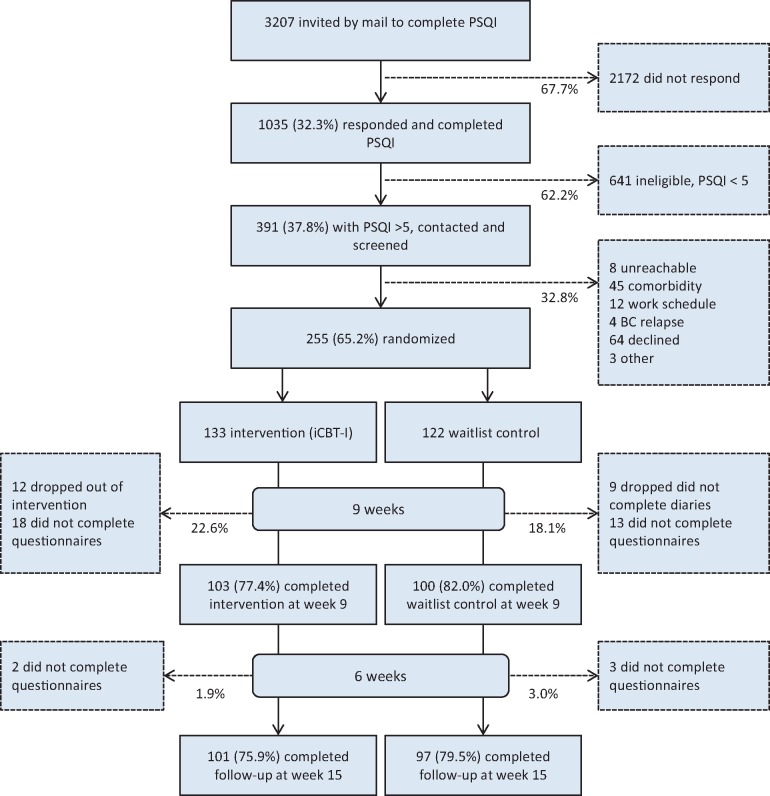
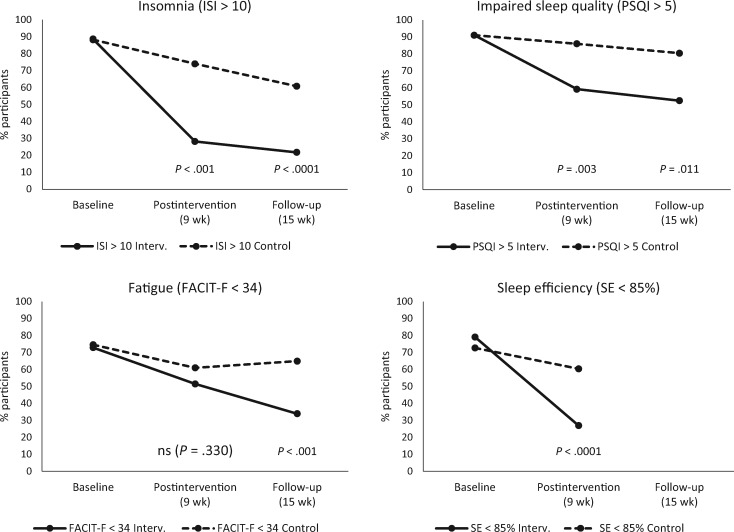
Background: Insomnia is two to three times more prevalent in cancer survivors than in the general population, where it is estimated to be 10% to 20%. Cognitive-behavioral therapy for insomnia (CBT-I) is the recommended treatment for chronic insomnia, but meeting survivor needs remains a challenge. Internet-delivered CBT-I (iCBT-I) has been shown efficacious in otherwise healthy adults. We tested the efficacy of iCBT-I in breast cancer survivors with clinically significant sleep disturbance. Methods: Women from a national sample of Danish breast cancer survivors who experienced clinically significant sleep disturbance were randomly allocated to iCBT-I or waitlist control (55:45). The fully automated iCBT-I program consisted of six cores. Online measures of insomnia severity, sleep quality, and fatigue were collected at baseline, postintervention (nine weeks), and follow-up (15 weeks). Online sleep diaries were completed over two-week periods pre- and postintervention. Intention-to-treat analyses (time × group interactions) were conducted with mixed linear models and corrected for multiple outcomes. All statistical tests were two-sided. Results: A total of 255 women were randomly allocated to iCBT-I (n = 133) or waitlist control (n = 122). Statistically significant (P ≤ .02) time × group interactions were found for all sleep-related outcomes from pre- to postintervention. Effect sizes (Cohen's d) ranged from 0.33 (95% confidence interval [CI] = 0.06 to 0.61) for wake after sleep onset to 1.17 (95% CI = 0.87 to 1.47) for insomnia severity. Improvements were maintained for outcomes measured at follow-up (d = 0.66-1.10). Conclusions: iCBT-I appears to be effective in breast cancer survivors, with additional benefit in terms of reduced fatigue. This low-cost treatment could be incorporated in cancer rehabilitation programs.
Overview
The claims and statistics of this paper haven’t been checked yet.
Run the check — free, no account needed. It reads the open-access text and checks the sources it cites.
Integrity signals
Registry
Cites
Statistics
Figures
Verification
Claims the paper makes
The claims and statistics of this paper haven’t been checked yet.
Run the check — free, no account needed. It reads the open-access text and checks the sources it cites.
Claims other papers make about this one
Each is checked against this paper’s own text: does it say what the citing paper says it does?
The cited source says what the claim attributes to it.
In the citing paper
“Randomized clinical studies have demonstrated that digital health may play an important role in facilitating patient empowerment and improving symptom management in survivors of BC.49-54”
From Implementing a PROACTive Care Pathway to Empower and Support Survivors of Breast Cancer (2023) · cites this paper as [53]
Self-check
Percentages, sums and reported differences re-computed from the paper’s own numbers.
The self-check needs the paper’s full text.
Citations
Cites
Controlling the False Discovery Rate: A Practical and Powerful Approach to Multiple Testing
Benjamini, Y., & Hochberg, Y. (1995) · Journal of the Royal Statistical Society Series B: Statistical Methodology · doi:10.1111/j.2517-6161.1995.tb02031.x · Cited by 109,482
Statistical Power Analysis for the Behavioral Sciences
Muller, K. E., & Cohen, J. (1989) · Technometrics · doi:10.2307/1270020 · Cited by 99,603
Statistical power analysis for the behavioral sciences
Cohen, J. (1990) · Computers Environment and Urban Systems · doi:10.1016/0198-9715(90)90050-4 · Cited by 65,417
The Pittsburgh Sleep Quality Index: a new instrument for psychiatric practice and research
Buysse, D. J., Reynolds, C. F., Monk, T. H., Berman, S. R., & Kupfer, D. J. (1989) · Psychiatry Research · doi:10.1016/0165-1781(89)90047-4 · Cited by 35,234
A Simple Sequentially Rejective Multiple Test Procedure
(1979) · Scandinavian Journal of Statistics · doi:10.2307/4615733 · Cited by 21,526
Missing data: our view of the state of the art
Schafer, J. L., & Graham, J. W. (2002) · Psychological Methods · doi:10.1037/1082-989x.7.2.147 · Cited by 11,638
Validation of the Insomnia Severity Index as an outcome measure for insomnia research
Bastien, C. (2001) · Sleep Medicine · doi:10.1016/s1389-9457(00)00065-4 · Cited by 8,067
Morin, C. M., Belleville, G., Bélanger, L., & Ivers, H. (2011) · Sleep · doi:10.1093/sleep/34.5.601 · Cited by 4,620
(1993) · Medical Entomology and Zoology · Cited by 2,324
The consensus sleep diary: standardizing prospective sleep self-monitoring
Carney, C. E., Buysse, D. J., Ancoli-Israel, S., Edinger, J. D., Krystal, A. D., Lichstein, K. L., & Morin, C. M. (2012) · Sleep · doi:10.5665/sleep.1642 · Cited by 2,172 · cited 1×
“An online version of the consensus sleep diary (31) was completed daily over a two-week period by both groups at pre- and postintervention (but not at follow-up).”
Background
Cited by
Sorted by citations
Items 201–212 of 212
Andersson, G., Käll, A., Enström, M., Jonsson, L., Ehnsiö, K., Nilsson-Ihrfelt, E., Carlbring, P., & Fjällskog, M.-L. (2026) · Cognitive Behaviour Therapy · doi:10.1080/16506073.2026.2635464
Huang, Y., Yuan, L., Zhu, Y., Chen, M., & Zheng, H. (2026) · Behaviour Research and Therapy · doi:10.1016/j.brat.2026.105017
Liu, L., Jiang, S., Ye, M., Zhang, Y., Guo, Z., Hu, Y., Wang, X., 陈跃来, Jin, Y., Zhu, W., et al. (2026) · Frontiers in Psychiatry · doi:10.3389/fpsyt.2026.1816187
Tsai, C.-S., Szewczyk, W., Lee, H., Drerup, M. L., Blakeney, E. A., Greenlee, H., Heffner, J. L., Vasbinder, A. L., & Reding, K. W. (2026) · JMIR Formative Research · doi:10.2196/85386
Chan, J., Ng, D. W. L., Fong, D. Y. T., Chan, M. C. H., Shi, Y., & Lam, W. W. T. (2026) · Frontiers in Psychology · doi:10.3389/fpsyg.2026.1811748
Lifestyle and Behavioral Factors and Cancer Survivorship in Women
Szewczyk, W., Vasbinder, A. L., Tsai, C.-S., Lee, H., Park, H. C., Cleary, E., Judish, S., Peterson, R., Taheri, A., Frates, B., et al. (2026) · American Journal of Lifestyle Medicine · doi:10.1177/15598276261472804
He, H., Hu, M., Li, S., & Yue, F. (2026) · Frontiers in Psychiatry · doi:10.3389/fpsyt.2026.1878379
Ngo, A., Tanderup, K., Juul, T., Ammitzbøll, G., Tanderup, J., Christensen, P., Dalton, S. O., Fokdal, L. U., Johansen, C., Kjær, S. K., et al. (2026) · Cancers · doi:10.3390/cancers18162683
Lee, C.-I., Mukminin, M. A., Jan, Y.-W., Wang, T., Huang, T., & Chiu, H. (2026) · Psycho-Oncology · doi:10.1002/pon.70593
Digitally enabled patient-centred survivorship care: from hype to implementation-aware impact
Franzoi, M. A., Mussault, E., & Vaz-Luís, I. (2026) · The Lancet Digital Health · doi:10.1016/j.landig.2026.101071
Tong, Z., Ye, G., Fan, S., Li, Y., Zhang, J., Zhang, H., Chen, Q., Wang, H., Li, H., & Wang, J. (2026) · BMC Medicine · doi:10.1186/s12916-026-05129-8
Population-Specific Applications of Digital CBT-I: Evidence, Adaptations, and Emerging Directions
Lee, R. M., & Garland, S. N. (2026) · Current Sleep Medicine Reports · doi:10.1007/s40675-026-00400-z
Metadata
- Authors
- Zachariae, R., Amidi, A., Damholdt, M. F., Clausen, C. D. R., Dahlgaard, J., Lord, H., Thorndike, F. P., & Ritterband, L. M.
- Affiliations
- Aarhus University (DK)
- Unit for Psychooncology and Health Psychology, Department of Oncology, Aarhus University Hospital and Department of Psychology, Aarhus University, Aarhus, Denmark
- VIA University College (DK)
- University of Virginia (US)
- Charlotte School of Law (US)
- Corresponding author
- Zachariae, Robert
- ORCID
- Venue
- JNCI: Journal of the National Cancer Institute
- Publisher
- Oxford University Press (OUP)
- Published
- 2018-02-20
- Volume
- 110
- Issue
- 8
- Pages
- 880-887
- ISSN
- 0027-8874 (ISSN-L)
- 1460-2105
- PMC
- PMC6093474
- OpenAlex
- W2972485842
- Cited by
- 212
- References
- 43
- Citations by year
- 2026: 16 · 2025: 34 · 2024: 31 · 2023: 30 · 2022: 32 · 2021: 30 · 2020: 21 · 2019: 11 · 2018: 6
- FWCI
- 13.53
- Type
- journal article
- Language
- en
- Open access
- hybrid
- doi.org
- Licence
- Locations
- JNCI Journal of the National Cancer Institute (publishedVersion, cc-by-nc)
- Europe PMC (PubMed Central) (publishedVersion, cc-by-nc)
- PubMed Central (publishedVersion, cc-by-nc)
- PubMed (publishedVersion)
- Funders
- TrygFonden (7-12.0736)
- Danish Cancer Society (R48-A2585-11-S3)
- Topics
- Social Sciences › Psychology › Experimental and Cognitive Psychology › Sleep and related disorders
- Social Sciences › Psychology › Applied Psychology › Digital Mental Health Interventions
- Health Sciences › Medicine › Oncology › Cancer survivorship and care
- Keywords
- insomnia, breast cancer survivors, sleep disorders, fatigue, wake after sleep onset, sleep quality, cancer rehabilitation
- MeSH terms
- Cancer Survivors, Adolescent, Adult, Aged, Breast Neoplasms, Denmark, Female, Humans, Sleep Initiation and Maintenance Disorders, Middle Aged, Sleep, Waiting Lists, Cognitive Behavioral Therapy, Treatment Outcome, Telemedicine, Internet, Young Adult, Intention to Treat Analysis
About these checks
Registry, retraction, Cites and statistics results are computed, not judged, with one exception: a printed reference that no index lists is read once by a model before it counts as a citation error. Claims are extracted by a model and kept only when their quote appears verbatim in the text; each cited source is then checked, with a model’s help, for whether it says what the claim relies on. Those verdicts can be wrong — read the claim’s quote and the cited source before relying on one.
Statistics and arithmetic are recomputed, not judged.
Confidence bands are shown only for fields calibrated on our annotated test set. None is calibrated yet, so no band is shown.
What counts as a claim ›How we measure confidence ›How we check this ›
Are you an author, or do you see a problem with this page? Request a review
