

Identification of candidate genes affecting Δ9-tetrahydrocannabinol biosynthesis in Cannabis sativa
Open accessThe DOI matches its Crossref record; 62 of the 63 references it cites were found in a registry or an index.
Abstract
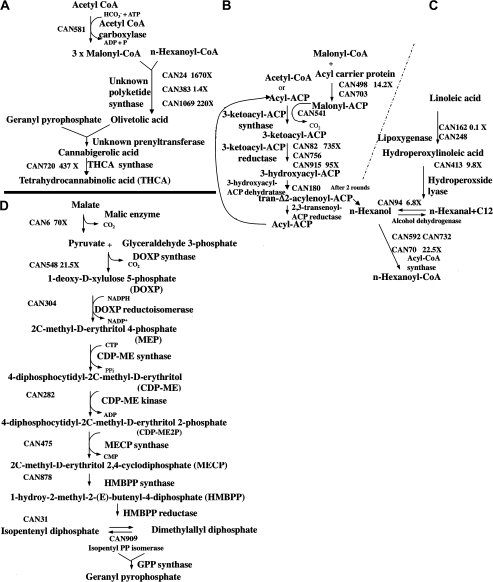
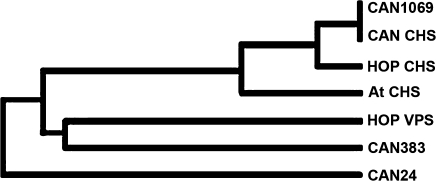
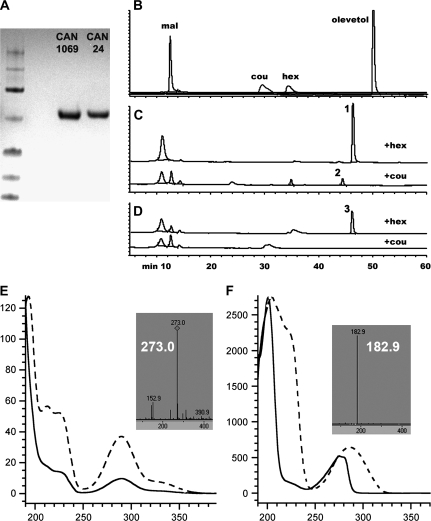
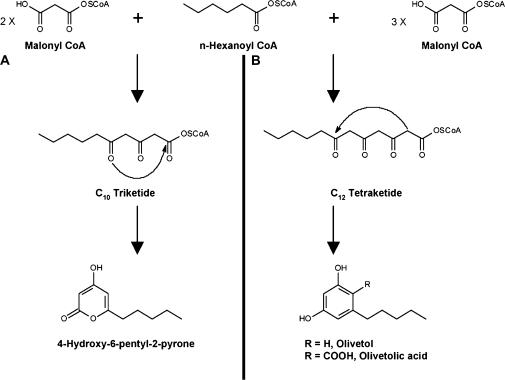
RNA isolated from the glands of a Delta(9)-tetrahydrocannabinolic acid (THCA)-producing strain of Cannabis sativa was used to generate a cDNA library containing over 100 000 expressed sequence tags (ESTs). Sequencing of over 2000 clones from the library resulted in the identification of over 1000 unigenes. Candidate genes for almost every step in the biochemical pathways leading from primary metabolites to THCA were identified. Quantitative PCR analysis suggested that many of the pathway genes are preferentially expressed in the glands. Hexanoyl-CoA, one of the metabolites required for THCA synthesis, could be made via either de novo fatty acids synthesis or via the breakdown of existing lipids. qPCR analysis supported the de novo pathway. Many of the ESTs encode transcription factors and two putative MYB genes were identified that were preferentially expressed in glands. Given the similarity of the Cannabis MYB genes to those in other species with known functions, these Cannabis MYBs may play roles in regulating gland development and THCA synthesis. Three candidates for the polyketide synthase (PKS) gene responsible for the first committed step in the pathway to THCA were characterized in more detail. One of these was identical to a previously reported chalcone synthase (CHS) and was found to have CHS activity. All three could use malonyl-CoA and hexanoyl-CoA as substrates, including the CHS, but reaction conditions were not identified that allowed for the production of olivetolic acid (the proposed product of the PKS activity needed for THCA synthesis). One of the PKS candidates was highly and specifically expressed in glands (relative to whole leaves) and, on the basis of these expression data, it is proposed to be the most likely PKS responsible for olivetolic acid synthesis in Cannabis glands.
Overview
The claims and statistics of this paper haven’t been checked yet.
Free: it reads the open-access text and checks the first 5 claims that cite a source we can check. Create a free account to check every claim.
Integrity signals
Registry
Cites
Statistics
Figures
Verification
Claims the paper makes
The claims and statistics of this paper haven’t been checked yet.
Free: it reads the open-access text and checks the first 5 claims that cite a source we can check. Create a free account to check every claim.
Claims other papers make about this one
Each is checked against this paper’s own text: does it say what the citing paper says it does?
The cited source says what the claim attributes to it.
In the citing paper
“It is important to mention here that two transcription factors belonging to the MYB family were already shown to be preferentially expressed in Cannabis glands (Marks et al., 2009) and therefore represent ideal candidates to express.”
From Cannabis sativa: The Plant of the Thousand and One Molecules (2016) · cites this paper as Marks et al., 2009
The cited source says what the claim attributes to it.
In the citing paper
“These genes show homology with Arabidopsis thaliana MYB112 and MYB12, which are known to be involved in the tolerance to oxidative stress and flavonol biosynthesis, respectively (Marks et al., 2009 and references therein).”
From Cannabis sativa: The Plant of the Thousand and One Molecules (2016) · cites this paper as Marks et al., 2009
Self-check
Percentages, sums and reported differences re-computed from the paper’s own numbers.
The self-check needs the paper’s full text.
Citations
Cites
Molecular Cloning: A Laboratory Manual
Sambrook, J., Fritsch, E., & Maniatis, T. (1989) · UCLA - Biblioteca de Ciencias de la Salud · Cited by 133,589
Gene Ontology: tool for the unification of biology
Ashburner, M., Ball, C. A., Blake, J. A., Botstein, D., Butler, H., Cherry, J. M., Davis, A. P., Dolinski, K., Dwight, S. S., Eppig, J. T., et al. (2000) · Nature Genetics · doi:10.1038/75556 · Cited by 43,206 · cited 1×
“Gene Ontology (GO) analysis was performed on the sequence dataset (Ashburner et al., 2000).”
MethodP HYTOCHELATINS AND M ETALLOTHIONEINS : Roles in Heavy Metal Detoxification and Homeostasis
Cobbett, C., & Goldsbrough, P. (2002) · Annual Review of Plant Biology · doi:10.1146/annurev.arplant.53.100301.135154 · Cited by 2,518 · cited 2×
“All three of these proteins have functions related to biotic or abiotic stress responses (Cobbett and Goldsbrough, 2002; Granger et al., 2002; Van den Bergh et al., 2004).”
BackgroundThe R2R3-MYB gene family in Arabidopsis thaliana
Stracke, R., Werber, M., & Weisshaar, B. (2001) · Current Opinion in Plant Biology · doi:10.1016/s1369-5266(00)00199-0 · Cited by 2,197 · cited 1×
“CAN833 and CAN738 are most similar to the Arabidopsis MYBs related to AtMYB112 and AtMYB12, respectively (see Supplementary Table 5 at JXB online; Stracke et al., 2001).”
BackgroundComprehensive natural products chemistry
(1999) · Choice Reviews Online · doi:10.5860/choice.37-0939 · Cited by 1,617
Rohmer, M., & Rohmer, M. (1999) · Natural Product Reports · doi:10.1039/a709175c · Cited by 1,193 · cited 1×
“Two different biochemical pathways support the synthesis of isoprenoids in plants (Eisenreich et al., 1998; Rohmer, 1999).”
BackgroundThe chalcone synthase superfamily of type III polyketide synthases
Austin, M. B., & Noel, J. P. (2003) · Natural Product Reports · doi:10.1039/b100917f · Cited by 993 · cited 2×
“For example, both monoterpenes and sesquiterpenes have been identified and candidate ESTs encoding activities to produce these compounds have been identified.”
BackgroundInfluentialMehrtens, F., Kranz, H., Bednarek, P., & Weisshaar, B. (2005) · Plant Physiology · doi:10.1104/pp.104.058032 · Cited by 831 · cited 1×
“AtMYB12 controls the synthesis of flavonol secondary metabolites in Arabidopsis and can induce the synthesis of similar compounds in tobacco (Mehrtens et al., 2005; Luo et al., 2008).”
BackgroundCannabinoid pharmacology: the first 66 years
Pertwee, R. G. (2006) · British Journal of Pharmacology · doi:10.1038/sj.bjp.0706406 · Cited by 782
Xanthohumol and related prenylflavonoids from hops and beer: to your good health!
Stevens, J. F., & Page, J. E. (2004) · Phytochemistry · doi:10.1016/j.phytochem.2004.04.025 · Cited by 673 · cited 1×
“Hop glands produce the bitter acid humulone, which is important for beer flavour, and the prenylated chalcone xanthohumol, which has several potential health beneficial properties (Stevens and Page, 2004).”
Background
Cited by
Items 101–143 of 143
A novel efficient liquid–liquid solvent extraction process for cannabinoid mimic recovery
Li, W., Lu, H. T., Doblin, M. S., Bacic, A., Stevens, G. W., & Mumford, K. A. (2022) · Separation and Purification Technology · doi:10.1016/j.seppur.2022.123011 · Cited by 7
Understanding the role of oxylipins in Cannabis to enhance cannabinoid production
Senevirathne, G. I., Gendall, A. R., Johnson, K. L., & Welling, M. T. (2025) · Frontiers in Plant Science · doi:10.3389/fpls.2025.1568548 · Cited by 6
Agronomic evaluation of Cannabis sativa (L.) cultivars in northern Colombia
Araméndiz-Tatis, H., Ayala, C., Camacho, M. M. E., Herrera-Contreras, A., & Villalba-Soto, A. (2023) · Revista Colombiana de Ciencias Hortícolas · doi:10.17584/rcch.2023v17i1.15695 · Cited by 5
Metabolomics, proteomics, and transcriptomics of Cannabis sativa L. trichomes
Happyana, N. (2014) · Technische Universität Dortmund Eldorado (Technische Universität Dortmund) · doi:10.17877/de290r-7006 · Cited by 7
Research Advances in Cannabinoids of Cannabis sativa
Chen, X., Ming, Y., & Hongyan, G. (2011) · Chinese Bulletin of Botany · doi:10.3724/sp.j.1259.2011.00197 · Cited by 4
Mwangi, J. W. (2026) · Plant Biosystems - An International Journal Dealing with all Aspects of Plant Biology · doi:10.1007/s44473-026-00159-9 · Cited by 3
“The inclusion of cannabigerol (m/z 317.2462) at 11.86 min aligns with precursor roles in biosynthetic pathways noted in Marks et al. (Marks et al. 2009), though Table 6 shows fewer terpenes, possibly due to extraction focusing on polar methanolic fractions rather than exhaustive solvent systems.”
InfluentialA comprehensive molecular approach to the detection of drug-type versus fiber-type hemp varieties
Forlani, G., & Petrollino, D. (2021) · Forensic Science International Genetics · doi:10.1016/j.fsigen.2021.102464 · Cited by 3
Barbosa‐Xavier, K., & Venâncio, T. M. (2026) · Planta · doi:10.1007/s00425-026-05043-6 · Cited by 2
“Enrichment of unsaturated fatty acid bio-synthesis and fatty acid metabolism point to the generation of precursors for signaling molecules like jasmonic acid, a key hormone in plant defense (Luo et al. 2019; Marks et al. 2009).”
Selvaraj, G., Mishra, A. K., Jakše, J., & Matoušek, J. (2015) · HAL · Cited by 2
Zirpel, B. (2018) · Technische Universität Dortmund Eldorado (Technische Universität Dortmund) · doi:10.17877/de290r-19091 · Cited by 4
1H NMR-based metabolomics differentiation and real time PCR analysis of medicinalCannabisorgans
Happyana, N., & Kayser, O. (2016) · Acta Horticulturae · doi:10.17660/actahortic.2016.1125.3 · Cited by 3
Role of Cannabis sativa L. in the Cosmetic Industry: Opportunities and Challenges
Sarkar, A. K., & Sadhukhan, S. (2023) · Advances in medical diagnosis, treatment, and care (AMDTC) book series · doi:10.4018/978-1-6684-5718-4.ch006 · Cited by 3
Void the Analogue ActPreprint
Fels, A. (2020) · SSRN Electronic Journal · doi:10.2139/ssrn.3736304 · Cited by 1
Pamplaniyil, K. (2016) · Technische Universität Dortmund Eldorado (Technische Universität Dortmund) · doi:10.17877/de290r-18338 · Cited by 1
Blerot, B. (2016) · theses.fr (ABES) · doi:10.70675/95508bfez3e35z47bazbdeaz56fbc6d809c1 · Cited by 3
THE POLYKETIDE ORIGINS OF CANNABINOIDS IN CANNABIS SATIVA
Gagne, S. J. (2013) · University Library - University of Saskatchewan (University of Saskatchewan) · Cited by 1
Investigation of Genotype/chemotype Correlations in Cannabis Sativa
Allen, L. N. (2015) · SHAREOK (University of Oklahoma; Oklahoma State University; Central Oklahoma University)
Exploring Novel Treatment Approaches for Post-Traumatic Stress Disorder
Murkar, A. (2020) · uO Research (University of Ottawa) · doi:10.20381/ruor-24279 · Cited by 1
Void the Analogue ActPreprint
Fels, A. (2020) · SSRN Electronic Journal
Identification and Optimization of more Efficient Olivetolic Acid Synthases
Yang, Y., Liu, S., Li, Z., Lai, C., Wu, H., Li, Z., Xia, W., Du, Q., Huang, L., Wang, W., et al. (2024) · Cannabis and Cannabinoid Research · doi:10.1089/can.2023.0226 · Cited by 1
Fakhrah, S., Chauhan, A., Mishra, P., Asif, M. H., Jena, S. N., & Mohanty, C. S. (2024) · SSRN Electronic Journal · doi:10.2139/ssrn.4846944
Genetics parameters and path analysis in Cannabis sativa L.
Araméndiz-Tatis, H., Ayala, C., Camacho, M. M. E., & Pastrana, I. (2024) · Revista Colombiana de Ciencias Hortícolas · doi:10.19053/uptc.24223719.16862
Tontiworachai, B., Deewatthanawong, R., Mitsuda, N., Sakamoto, S., Chung, K., & Montri, N. (2024) · Acta Horticulturae · doi:10.17660/actahortic.2024.1404.50 · Cited by 1
Use of Cannabis Derivatives in Veterinary Medicine
(2025) · Frontiers research topics · doi:10.3389/978-2-8325-6147-8
Dyrkningsaspekter ved produktion af medicinsk cannabis
Ottosen, C., Steenberg, T., Nicolaisen, M., Madsen, M. V., & Enkegaard, A. (2020)
Schachtsiek, J. (2019) · Technische Universität Dortmund Eldorado (Technische Universität Dortmund) · doi:10.17877/de290r-20468 · Cited by 1
Tang, Q., Xu, Y., Gao, F., Cheng, C., Deng, C., Chen, J., Yuan, X., Zhang, X., & Su, J. (2024) · Figshare · doi:10.6084/m9.figshare.26649516
Tang, Q., Xu, Y., Gao, F., Cheng, C., Deng, C., Chen, J., Yuan, X., Zhang, X., & Su, J. (2024) · Figshare · doi:10.6084/m9.figshare.26649519
Evaluation of C-prenylating enzymes for the heterologous biosynthesis of cannabigerolic acid
Degenhardt, S. F. (2018) · Technische Universität Dortmund Eldorado (Technische Universität Dortmund) · doi:10.17877/de290r-19882
Gojon, F. (2024) · Portuguese National Funding Agency for Science, Research and Technology (RCAAP Project by FCT) · doi:10.34626/r0m2-h142
Tang, Q., Xu, Y., Gao, F., Cheng, C., Deng, C., Chen, J., Yuan, X., Zhang, X., & Su, J. (2024) · Figshare · doi:10.6084/m9.figshare.24743003
Tang, Q., Xu, Y., Gao, F., Cheng, C., Deng, C., Chen, J., Yuan, X., Zhang, X., & Su, J. (2023) · Figshare · doi:10.6084/m9.figshare.24741938
Tang, Q., Xu, Y., Gao, F., Cheng, C., Deng, C., Chen, J., Yuan, X., Zhang, X., & Su, J. (2024) · Figshare · doi:10.6084/m9.figshare.26649513
Tang, Q., Xu, Y., Gao, F., Cheng, C., Deng, C., Chen, J., Yuan, X., Zhang, X., & Su, J. (2024) · Figshare · doi:10.6084/m9.figshare.26649510
Tanney, C. A. S. (2023) · eScholarship@McGill (McGill) · doi:10.82308/50891 · Cited by 1
Spitzer, S. (2025) · Technische Universität Dortmund Eldorado (Technische Universität Dortmund) · doi:10.17877/de290r-26192
Haiden, S. R., Torres, A., Provatas, A. A., & Berkowitz, G. A. (2026) · Plant Molecular Biology · doi:10.1007/s11103-026-01690-1
“…robust co-regulatory system involving transcription factors, hormonal signaling pathways, protein-protein interactions, and transporters that integrate cannabinoid production with developmental timing in C. sativa (Haiden et al. 2022 ; Liu et al. 2021 ; Livingston et al. 2020 ; Marks et al. 2009 ).”
First Detection of Exoplanetary Cannabinoids: Evidence for THC and CBD in the Atmosphere of K2-18bPreprint
Chism, A. J., van der Pot, M. J., Hasheau, B. P., Grasmann, H.-J., McToke, B., Wellington-Kush, B., Hierba-Verde, M., & Magic, P. D. (2026) · arXiv (Cornell University) · doi:10.48550/arxiv.2603.29700
Alternative polyadenylation and the sex-specific gene expression program in hempPreprint
Shivakumar, A. P., Hunt, A. G., & Chakrabarti, M. (2026) · bioRxiv (Cold Spring Harbor Laboratory) · doi:10.64898/2026.05.13.725035
Biosynthesis of Bibenzyls and Bisbibenzyls in Bryophytes: A Minireview
Sen, K., Paul, R., & Asakawa, Y. (2026) · Natural Products Chemistry Pharmacology and Nutrition · doi:10.68540/npcpn.2026.0215
Lange, B. M., Willis, M. A., Orozco, L. R., Alt, A. J., Karim, A., Srividya, N., & Zager, J. J. (2026) · Frontiers in Plant Science · doi:10.3389/fpls.2026.1850941
Metadata
- Authors
- Marks, M. D., Tian, L., Wenger, J. P., Omburo, S. N., Soto-Fuentes, W., He, J., Gang, D. R., Weiblen, G. D., & Dixon, R. A.
- Affiliations
- University of Minnesota (US)
- Noble Research Institute (US)
- University of Arizona (US)
- Corresponding author
- Marks, M. David
- ORCID
- Venue
- Journal of Experimental Botany
- Publisher
- Oxford University Press (OUP)
- Published
- 2009-07-06
- Volume
- 60
- Issue
- 13
- Pages
- 3715-3726
- ISSN
- 0022-0957 (ISSN-L)
- 1460-2431
- PMC
- PMC2736886
- OpenAlex
- W2167526734
- Semantic Scholar
- 096ca37e7f7d4ff330d4cf20eb3bf9aec7b02f37
- Cited by
- 125
- References
- 63
- Citations by year
- 2026: 4 · 2025: 3 · 2024: 5 · 2023: 10 · 2022: 7 · 2021: 15 · 2020: 15 · 2019: 10 · 2018: 9 · 2017: 10 · 2016: 8 · 2015: 6 · 2014: 2 · 2013: 5 · 2012: 7
- FWCI
- 2.15
- Type
- journal article
- Language
- en
- Open access
- hybrid
- doi.org
- Licence
- cc-by-nc
- Locations
- Journal of Experimental Botany (publishedVersion, cc-by-nc)
- Europe PMC (PubMed Central) (publishedVersion, cc-by-nc)
- PubMed Central (publishedVersion, cc-by-nc)
- PubMed (publishedVersion)
- University of North Texas Digital Library (University of North Texas) (submittedVersion)
- eScholarship (California Digital Library) (submittedVersion)
- eScholarship (California Digital Library) (submittedVersion, cc-by-nc)
- Funders
- Samuel Roberts Noble Foundation
- University of Minnesota
- Directorate for Biological Sciences
- National Institute on Drug Abuse (N01 DA 57746)
- Topics
- Life Sciences › Biochemistry, Genetics and Molecular Biology › Molecular Biology › Plant biochemistry and biosynthesis
- Health Sciences › Medicine › Pharmacology (medical) › Cannabis and Cannabinoid Research
- Life Sciences › Biochemistry, Genetics and Molecular Biology › Molecular Biology › Plant Gene Expression Analysis
- Keywords
- Cannabis sativa, expressed sequence tags, glandular trichomes, candidate genes, MYB transcription factors, chalcone synthase, polyketide synthase, olivetolic acid, de novo lipogenesis, tetrahydrocannabinolic acid, gland development, gene expression
- MeSH terms
- Cannabis, Molecular Sequence Data, Plant Proteins, Dronabinol, Biosynthetic Pathways
About these checks
Registry, retraction, Cites and statistics results are computed, not judged, with one exception: a printed reference that no index lists is read once by a model before it counts as a citation error. Claims are extracted by a model and kept only when their quote appears verbatim in the text; each cited source is then checked, with a model’s help, for whether it says what the claim relies on. Those verdicts can be wrong — read the claim’s quote and the cited source before relying on one.
Statistics and arithmetic are recomputed, not judged.
Confidence bands are shown only for fields calibrated on our annotated test set. None is calibrated yet, so no band is shown.
What counts as a claim ›How we measure confidence ›How we check this ›
Are you an author, or do you see a problem with this page? Request a review
Data sources
Bibliographic data: Semantic Scholar, OpenAlex, Crossref.
Contains information from the Semantic Scholar Academic Graph Datasets, made available under the ODC Attribution License (ODC-BY 1.0).
Semantic Scholar’s data is described in: Kinney, R., et al. (2023). The Semantic Scholar Open Data Platform. arXiv:2301.10140.
