

CMB power spectra and cosmological parameters from Planck PR4 with CamSpec
Open accessThe DOI matches its Crossref record; 46 of the 46 references it cites were found in a registry or an index.
Abstract
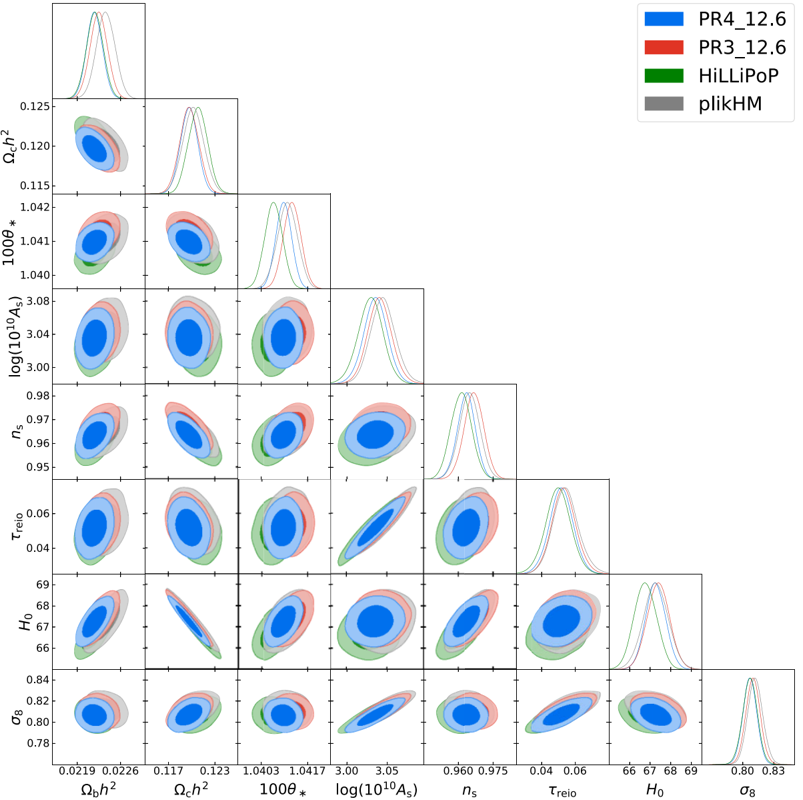
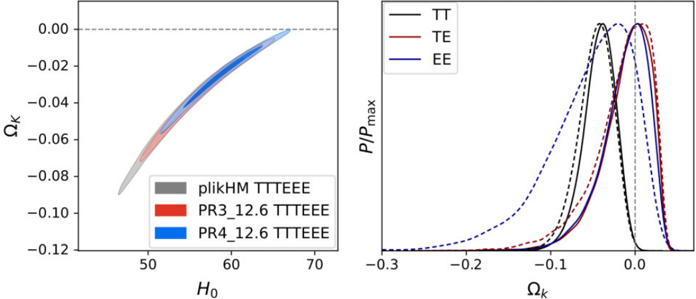
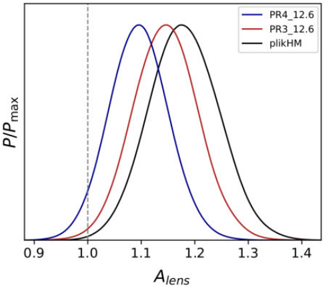
We present angular power spectra and cosmological parameter constraints derived from the Planck PR4 (NPIPE) maps of the cosmic microwave background. NPIPE, released by the Planck Collaboration in 2020, is a new processing pipeline for producing calibrated frequency maps from Planck data. We have created new versions of the CamSpec likelihood using these maps and applied them to constrain the lambda cold dark matter (ΛCDM) model and single-parameter extensions. We find excellent consistency between NPIPE and the Planck 2018 maps at the parameter level, showing that the Planck cosmology is robust to substantial changes in the mapmaking. The lower noise of NPIPE leads to ~10 per cent tighter constraints, and we see both smaller error bars and a shift towards the ΛCDM values for beyond-ΛCDM parameters including ΩK and AL.
Overview
The claims and statistics of this paper haven’t been checked yet.
Free: it reads the open-access text and checks the first 5 claims that cite a source we can check. Create a free account to check every claim.
Integrity signals
Registry
Cites
Statistics
Figures

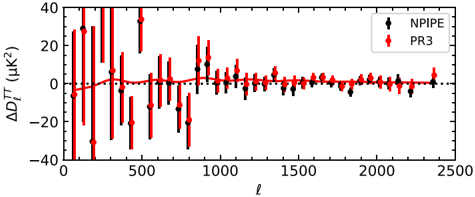
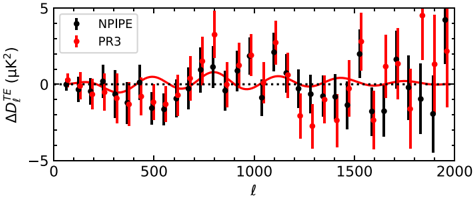
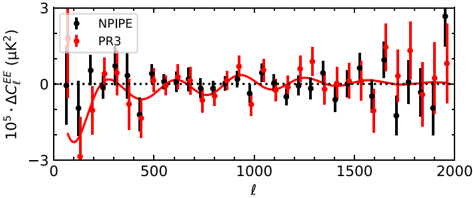
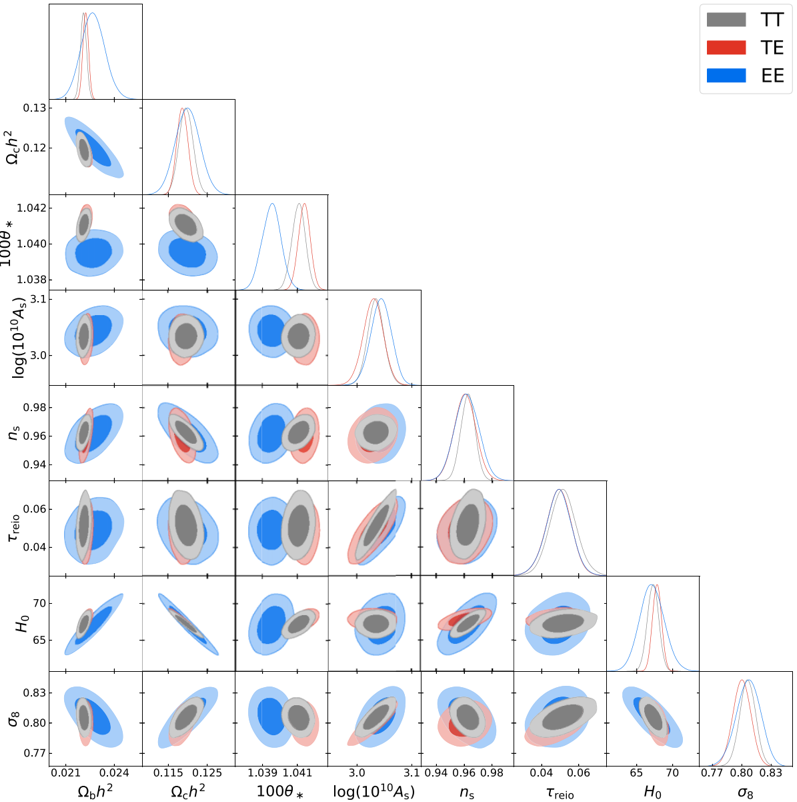
Verification
Claims the paper makes
The claims and statistics of this paper haven’t been checked yet.
Free: it reads the open-access text and checks the first 5 claims that cite a source we can check. Create a free account to check every claim.
Claims other papers make about this one
Each is checked against this paper’s own text: does it say what the citing paper says it does?
The source backs part of the claim, not all of it — or backs it for a different population, condition or comparison.
In the citing paper
“the reduction of its significance is due to the modification of the EE power spectrum, which is shifting all the parameters towards ΛCDM.”
From Challenges of the Standard Cosmological Model (2022) · cites this paper as [81]
Experimental — accuracy not yet measuredThe source backs part of the claim, not all of it — or backs it for a different population, condition or comparison.
In the citing paper
“a tension at more than 3σ between TT and EE”
From Challenges of the Standard Cosmological Model (2022) · cites this paper as [81]
Experimental — accuracy not yet measuredThe source backs part of the claim, not all of it — or backs it for a different population, condition or comparison.
In the citing paper
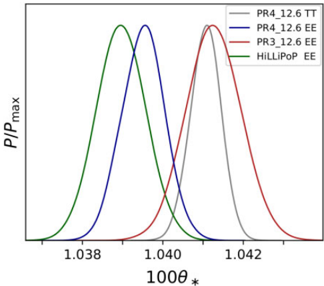
“this change in EE is also producing a significant shift in the acoustic scale parameter θ (see Figure 15 of Ref. [81])”
From Challenges of the Standard Cosmological Model (2022) · cites this paper as [81]
Experimental — accuracy not yet measuredThe cited source says what the claim attributes to it.
In the citing paper
“looking at Table 6 of Ref. [81], it is clear that the significance of Ω k < 0 from the temperature power spectrum is mostly unchanged for the new PR4 release with CamSpec.”
From Challenges of the Standard Cosmological Model (2022) · cites this paper as [81]
The cited source says what the claim attributes to it.
In the citing paper
“looking at Table 6 of Ref. [81], it is clear that the problem in the temperature power spectrum is not solved and the significance of A lens > 1 is unchanged for this probe”
From Challenges of the Standard Cosmological Model (2022) · cites this paper as [81]
2 more claims about this paper
Create a free account to see every claim other papers make about this one.
Self-check
Percentages, sums and reported differences re-computed from the paper’s own numbers.
The self-check needs the paper’s full text.
Citations
Cites
Matplotlib: a 2D graphics environment
Hunter, J. D. (2007) · Computing in Science & Engineering · doi:10.1109/mcse.2007.55 · Cited by 39,249
SciPy 1.0: fundamental algorithms for scientific computing in Python
Virtanen, P., Gommers, R., Oliphant, T. E., Haberland, M., Reddy, T., Cournapeau, D., Burovski, E., Peterson, P., Weckesser, W., Bright, J., et al. (2020) · Nature Methods · doi:10.1038/s41592-019-0686-2 · Cited by 38,430
Harris, C. R., Millman, K. J., van der Walt, S. J., Gommers, R., Virtanen, P., Cournapeau, D., Wieser, E., Taylor, J., Berg, S., Smith, N. J., et al. (2020) · Nature · doi:10.1038/s41586-020-2649-2 · Cited by 23,826
Harris, C., Millman, K., van der Walt, S., Gommers, R., Virtanen, P., Cournapeau, D., Wieser, E., Taylor, J., Berg, S., Smith, N., et al. (2020) · RePEc: Research Papers in Economics · Cited by 17,844
Astropy: A community Python package for astronomy
The Astropy Collaboration, Robitaille, T. P., Tollerud, E. J., Greenfield, P., Droettboom, M., Bray, E., Aldcroft, T., Davis, M., Ginsburg, A., Price-Whelan, A. M., et al. (2013) · Astronomy & Astrophysics · doi:10.1051/0004-6361/201322068 · Cited by 14,620
Planck 2018 results: VI. Cosmological parameters
Planck Collaboration, Aghanim, N., Akrami, Y., Ashdown, M., Aumont, J., Baccigalupi, C., Ballardini, M., Banday, A. J., Barreiro, R. B., Bartolo, N., et al. (2020) · Astronomy & Astrophysics · doi:10.1051/0004-6361/201833910 · Cited by 14,258
Self-citationSciPy 1.0: fundamental algorithms for scientific computing in Python
Virtanen, P., Gommers, R., Oliphant, T. E., Haberland, M., Reddy, T., Cournapeau, D., Burovski, E., Peterson, P., Weckesser, W., Bright, J., et al. (2019) · Apollo - University of Cambridge Repository · doi:10.17863/cam.64134 · Cited by 10,460
The Astropy Project: Building an Open-science Project and Status of the v2.0 Core Package*
The Astropy Collaboration, Price-Whelan, A. M., Sipőcz, B. M., Günther, H. M., Lim, P. L., Crawford, S. M., Conseil, S., Shupe, D. L., Craig, M. W., Dencheva, N., et al. (2018) · The Astronomical Journal · doi:10.3847/1538-3881/aabc4f · Cited by 7,687
Gorski, K. M., Hivon, E., Banday, A. J., Wandelt, B. D., Hansen, F. K., Reinecke, M., & Bartelmann, M. (2005) · The Astrophysical Journal · doi:10.1086/427976 · Cited by 5,958
Lewis, A., Challinor, A., & Lasenby, A. (2000) · The Astrophysical Journal · doi:10.1086/309179 · Cited by 4,920
Research works printed but not linked: 4
- Cartis C., Fiala J., Marteau B., Roberts L., 2018a, preprint ( arXiv:1804.00154 ) · arXiv
- Dutcher D. et al., 2021, Phys. Rev. D, 104, 022003
- Handley W., Lemos P., 2021, Phys. Rev. D, 103, 063529
- Tristram, 2022, Phys. Rev. D, 083524
Cited by
Items 101–200 of 226
Free-streaming neutrinos and their phase shift in current and future CMB power spectra
Montefalcone, G., Wallisch, B., & Freese, K. (2025) · Journal of Cosmology and Astroparticle Physics · doi:10.1088/1475-7516/2025/08/051 · Cited by 19
“CamSpec : we replace the Planck PR3 plik high-ℓ TTTEEE likelihood with the more recent PR4 CamSpec likelihood [111, 112], while retaining the same low-ℓ like-lihoods from the plik combination, namely commander and SimAll for the TT and EE spectra, respectively.”
InfluentialModified gravity constraints with the Planck ISW-lensing bispectrum
Chudaykin, A., Kunz, M., & Carron, J. (2025) · Physical review. D/Physical review. D. · doi:10.1103/9zjh-8htv · Cited by 22
A joint analysis of 3D clustering and galaxy × CMB-lensing cross-correlations with DESI DR1 galaxies
Maus, M., White, M. J., Sailer, N., Lizancos, A. B., Ferraro, S., Chen, S.-F., DeRose, J., Aguilar, J., Ahlen, S. P., BenZvi, S., et al. (2025) · Journal of Cosmology and Astroparticle Physics · doi:10.1088/1475-7516/2025/11/077 · Cited by 15
“0067 from [123] that used the Planck PR4 temperature and polarization maps the 0 .”
Galloni, G., Versillé, S., & Tristram, M. (2024) · Physical review. D/Physical review. D. · doi:10.1103/physrevd.110.063511 · Cited by 18
Impact of baryonic feedback on HSC-Y1 weak lensing non-Gaussian statistics
Grandón, D., Marques, G. A., Thiele, L., Cheng, S., Shirasaki, M., & Liu, J. (2024) · Physical review. D/Physical review. D. · doi:10.1103/physrevd.110.103539 · Cited by 18
“014 [80, 81].”
Abundance and properties of dark radiation from the cosmic microwave background
Saravanan, M. M., Brinckmann, T., Loverde, M., & Weiner, Z. J. (2025) · Journal of Cosmology and Astroparticle Physics · doi:10.1088/1475-7516/2025/08/040 · Cited by 18
“The PR4 and PR3 data releases largely yield consistent inferences of ΛCDM parameters; in general, the PR4 release reduces parameter uncertainties by 10% to 20% [41, 69].”
InfluentialLi, T.-N., Zhang, Y.-M., Yao, Y.-H., Du, G.-H., Wu, P.-J., Zhang, J.-F., & Zhang, X. (2025) · Journal of Cosmology and Astroparticle Physics · doi:10.1088/1475-7516/2025/12/048 · Cited by 46
“…anisotropies, C TTℓ , C TEℓ , and C EEℓ , at small scales ( ℓ > 30), are obtained from measurements using the Planck CamSpec likelihood [1, 161, 162]; (ii) the spectrum of temperature anisotropies, C TTℓ , at large scales (2 ≤ ℓ ≤ 30), is obtained from measurements using the Planck Commander…”
Evidence for evolving dark energy from DESI DR2 BAO and Pantheon$$^+$$, DES-Dovekie, and Union3
Chaudhary, H., Capozzıello, S., Sharma, V. K., Gómez-Vargas, I., & Mustafa, G. (2026) · The European Physical Journal C · doi:10.1140/epjc/s10052-026-15806-w · Cited by 53
“In those analyses, the full CMB information is used from the temperature ( TT ), polarization ( EE ), and cross ( TE ) power spectra from Planck , using the Commander likelihood for ℓ 30 and CamSpec for ℓ ≥ 30 [142, 143], together with the combination of Planck and ACT DR6 CMB lensing [144–147].”
Dark energy and lensing anomaly in Planck CMB data
Peng, Z.-Y., & Piao, Y.-S. (2025) · Physical review. D/Physical review. D. · doi:10.1103/72vh-rn68 · Cited by 20
Tuning the cosmic instrument: robust cosmology through combined probes
Reeves, A., Nicola, A., & Refregier, A. R. (2025) · Journal of Cosmology and Astroparticle Physics · doi:10.1088/1475-7516/2025/06/042 · Cited by 16
Cosmology from Planck CMB lensing and DESI DR1 quasar tomography
de Belsunce, R., Krolewski, A., Chaussidon, E., Ferraro, S., Farren, G. S., Hadzhiyska, B., Tamone, A., Chiarenza, S., Sailer, N., Ravoux, C., et al. (2025) · Journal of Cosmology and Astroparticle Physics · doi:10.1088/1475-7516/2025/10/077 · Cited by 20
“Additionally, we show constraints from CMB lensing (ACT DR6, PR4) combined with unWISE galaxy clustering and uncalibrated supernovae from the Pantheon+ dataset [40] (teal) and constraints from the primary CMB (including the low-ℓ SRoll2 data) [110, 111, 120, 121].”
Plaza, F., León, G., & Kraiselburd, L. (2025) · The European Physical Journal C · doi:10.1140/epjc/s10052-025-14995-0 · Cited by 20
Gong, Z., Halder, A., Bohrdt, A., Seitz, S., & Gebauer, D. (2024) · The Astrophysical Journal · doi:10.3847/1538-4357/ad582e · Cited by 14
Escudero, H. G., Mirpoorian, S. H., & Pogosian, L. (2026) · The Astrophysical Journal Letters · doi:10.3847/2041-8213/ae40bf · Cited by 24
“This is 2.1 σ below the SH0ES Cepheid-based distance-ladder measurement ( A. G. Riess et al. 2022 ) and 2.4 σ above the Planck Λ CDM value ( E. Rosenberg et al. 2022 ) , consistent with alternative distance-ladder determinations ( W. L. Freedman et al. 2025 ) .”
InfluentialThe Atacama Cosmology Telescope: DR6 power spectrum foreground model and validation
Beringue, B., Surrao, K. M., Hill, J. C., Atkins, Z., Battaglia, N., Bolliet, B., Calabrese, E., Choi, S. K., Clark, S. E., Duivenvoorden, A. J., et al. (2025) · Journal of Cosmology and Astroparticle Physics · doi:10.1088/1475-7516/2025/10/082 · Cited by 34
Monodromic dark energy and DESI
Goldstein, S. J., Celoria, M., & Schmidt, F. (2026) · Physical review. D/Physical review. D. · doi:10.1103/396l-5txp · Cited by 27
Ballardini, M., & Finelli, F. (2022) · Journal of Cosmology and Astroparticle Physics · doi:10.1088/1475-7516/2022/10/083 · Cited by 12
Evaluating extensions to LCDM: an application of Bayesian model averaging and selection
Paradiso, S., McGee, G., & Percival, W. J. (2024) · Journal of Cosmology and Astroparticle Physics · doi:10.1088/1475-7516/2024/10/021 · Cited by 11
“While the standard ΛCDM model is based on a flat Universe with Ω k = 0, CMB data showed a tension with this when Ω K was included in the analysis of previous Planck data [2, 31, 32].”
Sailer, N., DeRose, J., Ferraro, S., Chen, S.-F., Zhou, R., White, M. J., Kim, J., & Madhavacheril, M. S. (2025) · Physical review. D/Physical review. D. · doi:10.1103/27rg-tq8z · Cited by 19
“We plot our magnification constraint in pink and the Planck +ACT ΛCDM evolution of σ 8 ( z ) in black [39, 83, 84].”
Speeding up the Universe with a generalised axion-like potential
Boiza, C. G., & Bouhmadi-López, M. (2025) · The European Physical Journal C · doi:10.1140/epjc/s10052-025-14490-6 · Cited by 10
“…the model with a suite of up-to-date cosmological datasets, including CMB measurements (Planck 2018 low-ℓ TTEE [66], NPIPE CamSpec high-ℓ TTTEEE [67], and PR4 CMB lensing [68, 69]), BAO data from DESI DR1 [21, 70, 71], the Pantheon+ Type Ia supernovae compilation [72], low-redshift H 0 anchors…”
Revisiting CPL with sign-switching density: To cross or not to cross the NECB
Gökçen, M., Akarsu, Ö., & Valentino, E. D. (2026) · Physics of the Dark Universe · doi:10.1016/j.dark.2026.102273 · Cited by 34
“Specifically, we include the low-ℓ ( ℓ 30) TT Commander likelihood, the low-ℓ EE SimAll likelihood, and the high-ℓ ( ℓ ≥ 30) CamSpec likelihood [387, 388], together with the NPIPE PR4 lensing likelihood [389].”
Cosmic tensions indirectly correlate with reionization optical depth
Allali, I. J., Li, L., Singh, P., & Fan, J. (2026) · Physical review. D/Physical review. D. · doi:10.1103/14tf-4nk2 · Cited by 23
Exploring the discrepancy between Planck PR3 and ACT DR4
Hazra, D. K., Beringue, B., Errard, J., Shafieloo, A., & Smoot, G. F. (2024) · Journal of Cosmology and Astroparticle Physics · doi:10.1088/1475-7516/2024/12/038 · Cited by 15
“In figure 9, we present the results our analysis with where we replace Plik likelihood based on Planck PR3 with CamSPEC likelihood [28] based on Planck PR4 NPIPE [29] data.”
Aspects of Everpresent Λ. Part II. Cosmological tests of current models
Das, S., Nasiri, A., & Yazdi, Y. K. (2024) · Journal of Cosmology and Astroparticle Physics · doi:10.1088/1475-7516/2024/10/076 · Cited by 19
“The cosmic microwave background (CMB) is the most critical probe in this context [14, 55, 56].”
Bound on thermal y distortion of the cosmic neutrino background
Barenboim, G., Sanchis, H., Kinney, W. H., & Rios, D. (2024) · Physical review. D/Physical review. D. · doi:10.1103/physrevd.110.123535 · Cited by 7
Status of early dark energy after DESI: The role of Ω m and r s H 0
Jiang, J.-Q. (2025) · Physics of the Dark Universe · doi:10.1016/j.dark.2025.101902 · Cited by 27
How theory-informed priors affect DESI evidence for evolving dark energy
Toomey, M. W., Montefalcone, G., McDonough, E., & Freese, K. (2026) · Physical review. D/Physical review. D. · doi:10.1103/snyr-qs56 · Cited by 39
Lower tensor-to-scalar ratio as possible signature of modified gravity
Capistrano, A. J. S., Nunes, R. C., & Cabral, L. A. (2024) · Physical review. D/Physical review. D. · doi:10.1103/physrevd.109.123517 · Cited by 9
“In sections V and IV, we examine the model in contrast with cosmological data with the latest NPIPE Planck DR4 likelihoods [54, 55], the BI-CEP2/Keck collaboration [56] and a junction of Large-scale structure (LSS) catalogue with 6dF Galaxy Survey [57], the Seventh Data Release of SDSS Main Galaxy…”
MethodForconi, M., & Valentino, E. D. (2025) · Physics of the Dark Universe · doi:10.1016/j.dark.2025.101904 · Cited by 15
Searching for inflationary particle production in Planck data
Philcox, O. H. E., Kumar, S., & Hill, J. C. (2025) · Physical review. D/Physical review. D. · doi:10.1103/physrevd.111.103523 · Cited by 7
Knot reconstruction of the scalar primordial power spectrum with Planck, ACT, and SPT CMB data
Raffaelli, A., & Ballardini, M. (2025) · Journal of Cosmology and Astroparticle Physics · doi:10.1088/1475-7516/2025/07/077 · Cited by 14
“We consider the high-multipole likelihood based on Planck PR4 maps ( NPIPE ) [121] using the CamSpec likelihood [122, 123].”
Constraints on spatial curvature and dark energy dynamics in the wCDM model from DESI DR1 and DR2
Yadav, M., Dixit, A., Barak, M. S., & Pradhan, A. (2025) · Journal of High Energy Astrophysics · doi:10.1016/j.jheap.2025.100514 · Cited by 17
“Complementary analyses using CamSpec [29, 30] also indicate a closed geometry at > 99% confidence, a result that persists in the Planck PR4 temperature-only dataset [31].”
Exponential quintessence with momentum coupling to dark matter
Pourtsidou, A. (2026) · Journal of Cosmology and Astroparticle Physics · doi:10.1088/1475-7516/2026/02/014 · Cited by 15
“We use the following datasets and likelihoods: CMB: Planck 2018 low-ℓ temperature and polarisation likelihood [47], the CamSpec high-ℓ TTTEEE temperature and polarization likelihood using NPIPE ( Planck PR4) data [48], and the Planck PR4 lensing likelihood [2, 49].”
Alleviating cosmological tensions with a hybrid dark sector
Teixeira, E. M., Poulot, G., van de Bruck, C., Valentino, E. D., & Poulin, V. (2026) · Physical review. D/Physical review. D. · doi:10.1103/9lf2-33zf · Cited by 18
Lensing amplitude anomaly and varying electron mass alleviate the Hubble and S 8 tensions
Wang, Y.-Y., Lei, L., Tang, S.-P., & Fan, Y.-Z. (2026) · Journal of Cosmology and Astroparticle Physics · doi:10.1088/1475-7516/2026/01/009 · Cited by 18
“Compared with the Ω K + A lens scenario, Ω K +∆ m e and Ω K + A lens +∆ m e scenarios predict a higher electron mass, further advances the recombination epoch, reduces the sound horizon, thereby drives H 0 to higher values.”
Toda, Y., & Seto, O. (2025) · Physics of the Dark Universe · doi:10.1016/j.dark.2025.102035 · Cited by 17
Resonant neutrino self-interactions: Insights from the full shape galaxy power spectrum
Noriega, H. E., De-Santiago, J., Garcia-Arroyo, G., Venzor, J., & Pérez-Lorenzana, A. (2025) · Physical review. D/Physical review. D. · doi:10.1103/b9x4-hnqn · Cited by 14
“CamSpec [113] reduces the constraints in log 10 G eff ,ν to a 6% factor for the heavy mediator.”
Unified dark fluid with null sound speed as an alternative to phantom dark energy
Kou, R., & Lewis, A. (2026) · Journal of Cosmology and Astroparticle Physics · doi:10.1088/1475-7516/2026/01/014 · Cited by 16
“…evolution of the equation of state of the UDF as a function of scale factor, using the best-fit values for w 0 , w a and Ω c obtained using Planck (PR4 NPIPE [32] at high multipoles, 2018 [33] at low multipoles), DESI BAO DR2 [1, 34] and supernovae from the Dark Energy Survey Year 5 (DESY5) [35].”
Testing f(R) Gravity from Cosmic Shear Measurements
Bai, J. Y., Xia, J.-Q., & Zhao, G. (2025) · The Astrophysical Journal · doi:10.3847/1538-4357/ae07c4 · Cited by 9
“To improve sensitivity to small-scale CMB fluctuations, we incorporate the latest Planck PR4 data products (Rosenberg et al. 2022), specifically the CamSpec high-multipole (high-ℓ ) TTTEEE likelihoods and the most recent CMB lensing data from Carron et al. (2022).”
Exploring the interplay of late-time dynamical dark energy and new physics before recombination
González-Fuentes, A., & Gómez-Valent, A. (2026) · Journal of Cosmology and Astroparticle Physics · doi:10.1088/1475-7516/2026/07/040 · Cited by 23
“26 km/s/Mpc [3].”
Scale-dependence in Λ CDM parameters inferred from the CMB: A possible sign of early dark energy
Jiang, J.-Q. (2025) · Physical review. D/Physical review. D. · doi:10.1103/physrevd.111.043528 · Cited by 11
Primordial sharp features through the nonlinear regime of structure formation
Stahl, C., Werth, D., & Poulin, V. (2025) · Physical review. D/Physical review. D. · doi:10.1103/physrevd.111.123514 · Cited by 11
$Λ$CDM is alive and wellPreprint
Blanchard, A., Héloret, J.-Y., Ilić, S., Lamine, B., & Tutusaus, I. (2022) · arXiv (Cornell University) · doi:10.48550/arxiv.2205.05017 · Cited by 28
Primordial neutrinos fade to gray: Constraints from cosmological observables
Barenboim, G., Froustey, J., Pitrou, C., & Sanchis, H. (2025) · Physical review. D/Physical review. D. · doi:10.1103/kg29-yq85 · Cited by 7
“We then use the CamSpec [75] likelihood, which makes use of Planck’s PR4 (NPIPE) [76] maps.”
Li, H.-H., Zhang, X.-Z., Qiu, T., & Xia, J.-Q. (2025) · Journal of Cosmology and Astroparticle Physics · doi:10.1088/1475-7516/2025/07/056 · Cited by 7
“0065 (68%, Planck2018 TT,TE,EE+lowE+lesing ), in PL-ΛCDM+Ω k model [4, 38, 49, 77], which implies that our universe is closed.”
Choice of Planck CMB likelihood in cosmological analyses
Jense, H. T., Viña, M., Calabrese, E., & Hill, J. C. (2026) · Physical review. D/Physical review. D. · doi:10.1103/ff9j-skyj · Cited by 16
Cosmological neutrino mass: a frequentist overview in light of DESI
Chebat, D., Yèche, C., Armengaud, E., Schöneberg, N., Walther, M. R., de Mattia, A., Rohlf, J. W., Aguilar, J., Ahlen, S. P., Bianchi, D., et al. (2026) · Journal of Cosmology and Astroparticle Physics · doi:10.1088/1475-7516/2026/01/041 · Cited by 6
“161 eV [56], which is of the same order as the 68% C.L. confidence limit of the loosest profile in fig.”
InfluentialNew multiprobe analysis of modified gravity and evolving dark energy
Lu, Z., & Simon, T. (2026) · Physical review. D/Physical review. D. · doi:10.1103/hfxk-bdr3 · Cited by 12
Limits on self-interacting neutrinos from the BAO and CMB phase shift
Whitford, A. M., Howlett, C., Davis, T. M., Camarena, D., & Cyr-Racine, F.-Y. (2026) · Journal of Cosmology and Astroparticle Physics · doi:10.1088/1475-7516/2026/03/064 · Cited by 9
“[34] find that DESI BAO [11] data combined with CMB data from the new Planck analysis [39, 40] prefers neutrinos with strong self-interactions over Λ CDM, with the difference between the minimum χ 2 in each case as − 4 .”
Neutrino decays as a natural explanation of the neutrino mass tension
Abellán, G. F. (2026) · Physical review. D/Physical review. D. · doi:10.1103/lwdv-qrcc · Cited by 10
“In particular, we replace the Plik high-ℓ TTTEEE likelihood with CamSpec , which is built on the latest NPIPE Planck PR4 data release [69].”
Sign-switching dark energy: Smooth transitions with recent DESI DR2 observations
Ibarra-Uriondo, B., & Bouhmadi-López, M. (2026) · Physics of the Dark Universe · doi:10.1016/j.dark.2026.102351 · Cited by 19
“We also plot the reconstructed Hubble rate and energy density normalized to the Planck PR4 values for Λ CDM, for which Ω m 0 = 0.315 and H 0 = 67.26 km/s/Mpc [127].”
InfluentialPan, J.-D., Wu, P.-J., Du, G., Li, Y., & Zhang, X. (2025) · Journal of Cosmology and Astroparticle Physics · doi:10.1088/1475-7516/2025/01/080 · Cited by 11
“The second scenario involves two telescopes with significant differences in latitude, resulting in a very small common observable sky area.”
Reconstructing the epoch of reionisation with Planck PR4
Ilić, S., Tristram, M., Douspis, M., Gorce, A., Versillé, S., Hergt, L. T., Langer, M., McBride, L., Muñoz-Echeverría, M., Pointecouteau, É., et al. (2025) · Astronomy and Astrophysics · doi:10.1051/0004-6361/202555196 · Cited by 16
Abellán, G. F., Montel, N. A., Savchenko, O., & Weniger, C. (2025) · Physical review. D/Physical review. D. · doi:10.1103/ws4b-7qrw · Cited by 7
Kou, R., & Lewis, A. (2025) · Journal of Cosmology and Astroparticle Physics · doi:10.1088/1475-7516/2025/01/033 · Cited by 7
“We therefore run a MCMC using the Planck NPIPE likelihood [84] for the high-ℓ TT, TE and EE power spectra, and the low-ℓ TT and EE 2018 likelihoods [85].”
Observational constraints on generalised axion-like potentials for the late Universe
Chiang, H.-W., Boiza, C. G., & Bouhmadi-López, M. (2025) · Journal of Cosmology and Astroparticle Physics · doi:10.1088/1475-7516/2025/08/064 · Cited by 14
“…Monte Carlo (MCMC) analysis on cosmological datasets from various sources, including CMB (Planck2018 low-ℓ TTEE [39], NPIPE CamSpec high-ℓ TTTEEE [16], PR4 CMB lensing [40, 41]) , BAO (DESI DR1 without full-shape [42–44]), supernovae (Pantheon+ SNe catalog [18] without anchoring of SNe…”
InfluentialPredictions for new physics in the CMB damping tail
Smith, T. L., & Schöneberg, N. (2025) · Physical review. D/Physical review. D. · doi:10.1103/sp34-j91r · Cited by 19
Philcox, O. H. E., Silverstein, E. M., & Torroba, G. (2026) · Physical review. D/Physical review. D. · doi:10.1103/162y-rmsv · Cited by 17
Multiprobe constraints on early and late time dark energy
Reeves, A. G., Ferraro, S., Nicola, A., & Refregier, A. R. (2026) · Physical review. D/Physical review. D. · doi:10.1103/w737-nk6r · Cited by 15
Anonymous, Iovino, A. J., & Vagnozzi, S. (2026) · Physical review. D/Physical review. D. · doi:10.1103/3j59-xdf6 · Cited by 15
Deviations From μ‐τ Symmetry Using Δ(27) Group on Neutrino Masses and Mixings
Wilina, P., & Singh, N. N. (2024) · Advances in High Energy Physics · doi:10.1155/ahep/5985092 · Cited by 3
Ali, A. (2026) · Zenodo (CERN European Organization for Nuclear Research) · doi:10.5281/zenodo.20633582 · Cited by 3
Cosmological constraints on neutrino masses in a second-order CPL dark energy model
Barua, S., & Desai, S. (2026) · Physics of the Dark Universe · doi:10.1016/j.dark.2026.102229 · Cited by 12
Revisiting ΛCDM extensions in light of re-analyzed CMB data
Asorey, J., & Pérez, J. D. C. (2026) · Physics of the Dark Universe · doi:10.1016/j.dark.2026.102283 · Cited by 8
“The NPIPE maps have been used to build two different approaches to the Planck likelihoods for cosmological parameter estimation, the PR4-CamSpec [57] and the combined PR4-LoLLiPoP and PR4-HiLLiPoP likelihoods [58].”
Zhong, J.-H., Yang, J., Yang, T., Ding, X., Fan, X.-L., Liao, K., & You, B. (2026) · Physical review. D/Physical review. D. · doi:10.1103/f8qm-lnv4 · Cited by 2
Dark Energy Survey: DESI-independent angular BAO measurement
Mena-Fernández, J., Avila, S., Porredon, A., Camacho, H., Muir, J., Sanchez, E., Adamów, M., Bechtol, K., Camilleri, R., Campailla, G., et al. (2026) · Physical review. D/Physical review. D. · doi:10.1103/d474-zzzf · Cited by 11
The open-universe signal in late-time observations: a model artifact rather than genuine curvature
Wu, P.-J. (2026) · Journal of Cosmology and Astroparticle Physics · doi:10.1088/1475-7516/2026/07/075 · Cited by 6
Intertwined constraints in extended cosmologies: Dark energy, curvature, neutrinos, and inflation
Giarè, W., Lee, D. H., & Valentino, E. D. (2026) · New Astronomy Reviews · doi:10.1016/j.newar.2026.101759 · Cited by 27
Generalised axion-like dark energy: From theory to observations
Bouhmadi-López, M., Chiang, H.-W., & Boiza, C. G. (2025) · Physics of the Dark Universe · doi:10.1016/j.dark.2025.101968 · Cited by 4
Stahl, C., Poulin, V., Famaey, B., & Ibata, R. (2025) · Journal of Cosmology and Astroparticle Physics · doi:10.1088/1475-7516/2025/06/021 · Cited by 12
“Although subsequent reanalyses of KiDS, DES [27] and Planck data [28, 29] have yielded slightly different values for the S 8 parameter over the years, the tension between weak-lensing results and CMB-derived measurements remained present until recently.”
Dynamical system analysis and observational constraints of cosmological models in mimetic gravity
Fritis, A., Villalobos-Silva, D., Vásquez, Y., López-Caraballo, C. H., & Helo, J. C. (2024) · Physics of the Dark Universe · doi:10.1016/j.dark.2024.101650 · Cited by 3
Assessing the growth of structure over cosmic time with cosmic microwave background lensing
Madhavacheril, M. S. (2025) · Philosophical Transactions of the Royal Society A Mathematical Physical and Engineering Sciences · doi:10.1098/rsta.2024.0025 · Cited by 4
“It amplitude has been noted [8] that the of lensing inferred through the 2-point statistics is higher than that seen through the 4-point information in the CMB lensing reconstruction (though with the PR4 re-processing, this discrepancy has come down significantly [11]).”
Fast and accurate implementation of the effective fluid approximation for ultralight axions
Moss, A., Gaughan, L., & Green, A. M. (2025) · Physical review. D/Physical review. D. · doi:10.1103/fy1y-rjst · Cited by 1
An alternative approach to the exact solution of FRW-type spacetime with a generalized Chaplygin gas
Panigrahi, D. (2025) · Physics of the Dark Universe · doi:10.1016/j.dark.2025.101982 · Cited by 1
Testing influence of Hubble tension on the early Universe
Zhang, M.-J., Yang, M., & Wang, J. (2025) · The European Physical Journal C · doi:10.1140/epjc/s10052-025-14491-5 · Cited by 1
Power suppression and lensing anomaly: A phenomenological investigation
Roshna, K., & Sreenath, V. (2025) · Physical review. D/Physical review. D. · doi:10.1103/ksdc-pb3h · Cited by 1
Cosmology in warped massive gravity
García-Sáenz, S., Wei, Y., & Zhou, X. (2026) · Physical review. D/Physical review. D. · doi:10.1103/hqyh-fhc9 · Cited by 3
“…from the Simall likelihood; (iii) high multipole power spectra of temperature and polarization anisotropies, C TTℓ , C TEℓ , C EEℓ , derived from the NPIPE PR4 Planck CamSpec likelihood [46]; (iv) the lensing potential power spectrum, derived from the NPIPE PR4 lensing reconstruction data [47, 48].”
Inferring the impacts of baryonic feedback from kinetic Sunyaev-Zel’dovich cross-correlations
Laguë, A., Madhavacheril, M. S., Borrow, J., Smith, K. M., Chen, X., Schaller, M., & Schaye, J. (2026) · Physical review. D/Physical review. D. · doi:10.1103/tn2r-by6b · Cited by 7
Probing the type 3 interacting dark-energy model using matter pairwise velocity
Luo, K. H., Chu, M. C., & Zhang, W. (2026) · Physical review. D/Physical review. D. · doi:10.1103/jpt9-hzrg · Cited by 4
Neutrino mass limits and decaying dark matter: background evolution versus perturbations
Montandon, T., Poulin, V., Rink, T., & Schwetz, T. (2026) · Journal of Cosmology and Astroparticle Physics · doi:10.1088/1475-7516/2026/06/022 · Cited by 8
Anonymous, & Cervantes–Cota, J. L. (2026) · Physical review. D/Physical review. D. · doi:10.1103/c7j9-ykx6 · Cited by 15
Nonminimally coupled quintessence with sign-switching interaction
Wang, J.-Q., Cai, R.-G., Guo, Z., Li, Y.-H., Wang, S.-J., & Zhang, X. (2026) · Physical review. D/Physical review. D. · doi:10.1103/4sl7-m1qc · Cited by 25
“…datasets used in this work include: • CMB : the CamSpec likelihood based on the Planck PR4 NPIPE high-multipole ( ℓ > 30 ) TT, TE, and EE spectra [74], together with the low-multipole temperature and E-mode polarization power spectra, C TTℓ and C EEℓ , derived using Commander and SimAll [75],…”
Ye, G., Lin, S., Pan, J., de Boe, D., Verhoeve, S., Raveri, M., Hu, B., Frusciante, N., & Silvestri, A. (2026) · Journal of Cosmology and Astroparticle Physics · doi:10.1088/1475-7516/2026/07/041 · Cited by 4
“We performed nested sampling analysis using Cobaya interfaced with Polychord [75, 76] over the combined dataset of Planck CMB low and high-ℓ TTTEEE spectra [77, 78], Planck PR4 lensing [79], type Ia supernova from Pantheon+ [80] and DESI DR2 BAO [10].”
Conformal killing gravity: New constraints from DESI DR2 BAO datasets
Chaudhary, H., Capozzıello, S., Mantica, C. A., Molinari, L. G., Gogoi, D. J., & Mustafa, G. (2026) · Physics of the Dark Universe · doi:10.1016/j.dark.2026.102444 · Cited by 3
“…our analysis makes use of the Planck temperature (TT), polarization (EE), and temperature–polarization cross-correlation (TE) power spectra, combining the low-ℓ Commander and simall likelihoods ( ℓ 30 ) with the high-ℓ CamSpec likelihood ( ℓ ≥ 30 ) from the Planck PR4 (NPIPE) release [15, 16].”
Estimating Baryon Density through the CAMB and Assessing its Reliability
Lee, S. (2024) · International STEAM Communications · doi:10.37906/isteamc.22024.2 · Cited by 1
Can the late dark energy parameterization reconcile the Hubble tension?*
Zhang, M.-J., 陈, L. 丽. C., Yang, M., & 王, J. 俊. W. (2024) · Chinese Physics C · doi:10.1088/1674-1137/ad3f95 · Cited by 2
A Measurement of Gravitational Lensing of the Cosmic Microwave Background Using SPT-3G 2018 DataPreprint
Pan, Z., Bianchini, F., Wu, W. L. K., Ade, P. A. R., Ahmed, Z., Anderes, E., Anderson, A. J., Ansarinejad, B., Archipley, M., Aylor, K., et al. (2023) · arXiv (Cornell University) · doi:10.48550/arxiv.2308.11608 · Cited by 1
“(cid:80) While tritium beta decay end-point experiments like KA-TRIN have put constraints on the effective electron anti-neutrino mass at the level of (cid:80) m ν 800 meV [90% C.L., 105], and are expected to improve by a factor of four, cosmological measurements already have a stronger (albeit…”
A Bayesian estimator for peculiar velocity correction in cosmological inference from supernovae data
Upadhyay, U., Saini, T. D., & Sethi, S. K. (2026) · Monthly Notices of the Royal Astronomical Society · doi:10.1093/mnras/stag381 · Cited by 2
Accurate and efficient likelihood modeling for large-scale CMB data
Galloni, G., Campeti, P., Pagano, L., Gerbino, M., Lattanzi, M., & Natolia, P. (2025) · Journal of Cosmology and Astroparticle Physics · doi:10.1088/1475-7516/2025/12/052 · Cited by 4
“Finally, the single-field HL tends to align with the HL also in this case.”
Exploring Non-Cold Dark Matter in the Scenario of Dynamical Dark Energy with Desi Dr2 DataPreprint
Zhang, X. (2025) · SSRN Electronic Journal · doi:10.2139/ssrn.5367416
Netto, J. M. C., González, J. E., & Silva, H. H. B. (2025) · SSRN Electronic Journal · doi:10.2139/ssrn.5870727
Specogna, E., Vardanyan, T., Giarè, W., & Valentino, E. D. (2026) · Physical review. D/Physical review. D. · doi:10.1103/dy2d-z3cc · Cited by 6
Panigrahi, D., Chatterjee, S., & Paul, B. C. (2026) · The European Physical Journal C · doi:10.1140/epjc/s10052-026-16134-9
Cosmology on a Principal Bundle with the Non-Abelian Lie group SU(2) with a Bi-Invariant Metric
Krym, V. R. (2025) · Vestnik St Petersburg University Mathematics · doi:10.1134/s1063454125700633
“To estimate the error of the model parameters, it is necessary to use the χ 2 statistic (38) where σ i is the variance of the measured photometric distance modulus μ i .”
Robust evidence for dynamical dark energy in light of DESI DR2 and joint ACT, SPT, and Planck dataPreprint
Zhang, X., Li, T.-N., Du, G., Zhou, S., Li, Y.-H., & Zhang, J.-F. (2026) · SSRN Electronic Journal · doi:10.2139/ssrn.6215384
Shadows and amplitude luminosity of an embedded rotating black hole
Capistrano, A. J. S., Gutiérrez-Piñeres, A. C., & Coimbra-Araújo, C. H. (2026) · The European Physical Journal C · doi:10.1140/epjc/s10052-026-15374-z
Netto, J. P. C., Gonzalez, J. E., & Silva, H. H. B. (2026) · Physics of the Dark Universe · doi:10.1016/j.dark.2026.102261
Dallari, E., Castagna, F., Castorina, E., Archidiacono, M., & Salvioni, E. (2026) · Journal of Cosmology and Astroparticle Physics · doi:10.1088/1475-7516/2026/09/003
“These are obtained by fitting the model to CMB and BAO data, using the following definitions for the different datasets: TT/EE/TE [53].”
Posta, A. L. (2023) · theses.fr (ABES) · doi:10.70675/db157fb0zeb7ez4d8dzbcf9z09f379bf6180
Mosbech, M. R., Benso, C., & Kahlhoefer, F. (2026) · Journal of Cosmology and Astroparticle Physics · doi:10.1088/1475-7516/2026/09/099
Metadata
- Authors
- Rosenberg, E., Gratton, S., & Efstathiou, G.
- Affiliations
- University of Cambridge (GB)
- Corresponding author
- Rosenberg, Erik
- Venue
- Monthly Notices of the Royal Astronomical Society
- Publisher
- Oxford University Press (OUP)
- Published
- 2022-09-26
- Volume
- 517
- Issue
- 3
- Pages
- 4620-4636
- ISSN
- 0035-8711 (ISSN-L)
- 1365-2966
- OpenAlex
- W4297302508
- Cited by
- 225
- References
- 43
- Citations by year
- 2026: 70 · 2025: 101 · 2024: 36 · 2023: 14 · 2022: 4
- FWCI
- 15.60
- Type
- journal article
- Language
- en
- Open access
- hybrid
- doi.org
- Licence
- Locations
- Monthly Notices of the Royal Astronomical Society (publishedVersion, cc-by)
- arXiv (Cornell University) (acceptedVersion)
- Apollo (University of Cambridge) (submittedVersion, cc-by)
- OSTI OAI (U.S. Department of Energy Office of Scientific and Technical Information) (submittedVersion)
- arXiv (Cornell University)
- Apollo (cc-by)
- Funders
- University of Cambridge
- Engineering and Physical Sciences Research Council (EP/T022159/1)
- Science and Technology Facilities Council
- National Energy Research Scientific Computing Center
- U.S. Department of Energy
- Office of Science
- Lawrence Berkeley National Laboratory (DE-AC02-05CH11231)
- Topics
- Physical Sciences › Physics and Astronomy › Astronomy and Astrophysics › Cosmology and Gravitation Theories
- Physical Sciences › Physics and Astronomy › Nuclear and High Energy Physics › Dark Matter and Cosmic Phenomena
- Physical Sciences › Physics and Astronomy › Astronomy and Astrophysics › Galaxies: Formation, Evolution, Phenomena
- Keywords
- cosmic microwave background, angular power spectrum, cosmological parameter constraints, Planck PR4, LambdaCDM model, dark energy equation of state
About these checks
Registry, retraction, Cites and statistics results are computed, not judged, with one exception: a printed reference that no index lists is read once by a model before it counts as a citation error. Claims are extracted by a model and kept only when their quote appears verbatim in the text; each cited source is then checked, with a model’s help, for whether it says what the claim relies on. Those verdicts can be wrong — read the claim’s quote and the cited source before relying on one.
Statistics and arithmetic are recomputed, not judged.
Confidence bands are shown only for fields calibrated on our annotated test set. None is calibrated yet, so no band is shown.
What counts as a claim ›How we measure confidence ›How we check this ›
Are you an author, or do you see a problem with this page? Request a review
Data sources
Bibliographic data: Semantic Scholar, OpenAlex, Crossref.
Contains information from the Semantic Scholar Academic Graph Datasets, made available under the ODC Attribution License (ODC-BY 1.0).
Semantic Scholar’s data is described in: Kinney, R., et al. (2023). The Semantic Scholar Open Data Platform. arXiv:2301.10140.
