

UFBoot2: Improving the Ultrafast Bootstrap Approximation
Open accessPublished version of a preprint
The DOI matches its Crossref record; 32 of the 32 references it cites were found in a registry or an index.
Abstract
The standard bootstrap (SBS), despite being computationally intensive, is widely used in maximum likelihood phylogenetic analyses. We recently proposed the ultrafast bootstrap approximation (UFBoot) to reduce computing time while achieving more unbiased branch supports than SBS under mild model violations. UFBoot has been steadily adopted as an efficient alternative to SBS and other bootstrap approaches. Here, we present UFBoot2, which substantially accelerates UFBoot and reduces the risk of overestimating branch supports due to polytomies or severe model violations. Additionally, UFBoot2 provides suitable bootstrap resampling strategies for phylogenomic data. UFBoot2 is 778 times (median) faster than SBS and 8.4 times (median) faster than RAxML rapid bootstrap on tested data sets. UFBoot2 is implemented in the IQ-TREE software package version 1.6 and freely available at http://www.iqtree.org.
Overview
The claims and statistics of this paper haven’t been checked yet.
Free: it reads the open-access text and checks the first 5 claims that cite a source we can check. Create a free account to check every claim.
Integrity signals
Registry
Cites
Statistics
Figures
Verification
Claims the paper makes
The claims and statistics of this paper haven’t been checked yet.
Free: it reads the open-access text and checks the first 5 claims that cite a source we can check. Create a free account to check every claim.
Claims other papers make about this one
Each is checked against this paper’s own text: does it say what the citing paper says it does?
The cited source says what the claim attributes to it.
In the citing paper
“Branch support was assessed using the ultrafast bootstrap approximation using a hill-climbing nearest neighbor interchange (NNI) search (Hoang et al. 2018) with 1,000 repeats.”
From Mitochondrial retrograde control of transcription evolves with respiratory stress, metabolic adaptation, and virulence in budding yeasts (2026) · cites this paper as Hoang et al. 2018
The cited source says what the claim attributes to it.
In the citing paper
“The maximum likelihood phylogeny was performed using IQTREE (IQ-TREE multicore version 1.6.12 for Mac OS X 64-bit) software [62], under 1000 Ultra-Fast bootstrap replications [63].”
From Emergent and Neglected Equine Filariosis in Egypt: Species Diversity and Host Immune Response (2022) · cites this paper as [63]
The cited source says what the claim attributes to it.
In the citing paper
“We also performed 1,000 ultrafast bootstraps (Hoang et al., 2018) to assess statistical support for each node.”
From Enigmas no longer: using ultraconserved elements to place several unusual hawk taxa and address the non-monophyly of the genus Accipiter (Accipitriformes: Accipitridae) (2025) · cites this paper as Hoang et al., 2018
In the citing paper
“Support was assessed with 1000 ultrafast boostrap replicates 13 .”
From Available data do not rule out Ctenophora as the sister group to all other Metazoa (2023) · doi:10.1038/s41467-023-36151-6 · cites this paper as [13]
Self-check
Percentages, sums and reported differences re-computed from the paper’s own numbers.
The self-check needs the paper’s full text.
Citations
Cites
CONFIDENCE LIMITS ON PHYLOGENIES: AN APPROACH USING THE BOOTSTRAP
Felsenstein, J. (1985) · Evolution · doi:10.1111/j.1558-5646.1985.tb00420.x · Cited by 44,647 · cited 1×
“Standard nonparametric bootstrap (SBS) (Efron 1979; Felsenstein 1985) is widely used in maximum likelihood (ML) phylogenetic analyses to estimate branch supports of a phylogenetic tree inferred from a multiple sequence alignment (MSA).”
MethodIQ-TREE: A Fast and Effective Stochastic Algorithm for Estimating Maximum-Likelihood Phylogenies
Nguyen, L.-T., Schmidt, H. A., von Haeseler, A., & Minh, B. Q. (2015) · Molecular Biology and Evolution · doi:10.1093/molbev/msu300 · Cited by 26,046
Self-citationGuindon, S., Dufayard, J.-F., Lefort, V., Anisimova, M., Hordijk, W., & Gascuel, O. (2010) · Systematic Biology · doi:10.1093/sysbio/syq010 · Cited by 18,376 · cited 2×
“Although fast ML-tree search algorithms exist for large data sets (Vinh and von Haeseler 2004; Stamatakis 2006; Guindon et al. 2010; Nguyen et al. 2015) SBS is still very computationally intensive.”
MethodBootstrap methods: another look at the jackknife
Efron, B. (1979) · The Annals of Statistics · doi:10.1214/aos/1176344552 · Cited by 17,602
RAxML-VI-HPC: maximum likelihood-based phylogenetic analyses with thousands of taxa and mixed models
Stamatakis, A. (2006) · Bioinformatics · doi:10.1093/bioinformatics/btl446 · Cited by 15,582 · cited 2×
“Although fast ML-tree search algorithms exist for large data sets (Vinh and von Haeseler 2004; Stamatakis 2006; Guindon et al. 2010; Nguyen et al. 2015) SBS is still very computationally intensive.”
MethodEvolutionary trees from DNA sequences: A maximum likelihood approach.
Felsenstein, J. (1981) · Journal of Molecular Evolution · doi:10.1007/bf01734359 · Cited by 14,571 · cited 1×
“The pruning algorithm (Felsenstein 1981) efficiently computes the likelihood of phylogenetic trees, but still does not scale well for large data sets.”
MethodA Rapid Bootstrap Algorithm for the RAxML Web Servers
Stamatakis, A., Hoover, P., & Rougemont, J. (2008) · Systematic Biology · doi:10.1080/10635150802429642 · Cited by 7,028 · cited 2×
“To improve computing time, rapid bootstrap (RBS; Stamatakis et al. 2008) and the ultrafast bootstrap (UFBoot; Minhetal.2013)weredeveloped.”
MethodUltrafast Approximation for Phylogenetic Bootstrap
Minh, B. Q., Nguyen, M. A. T., & von Haeseler, A. (2013) · Molecular Biology and Evolution · doi:10.1093/molbev/mst024 · Cited by 4,844 · cited 8×
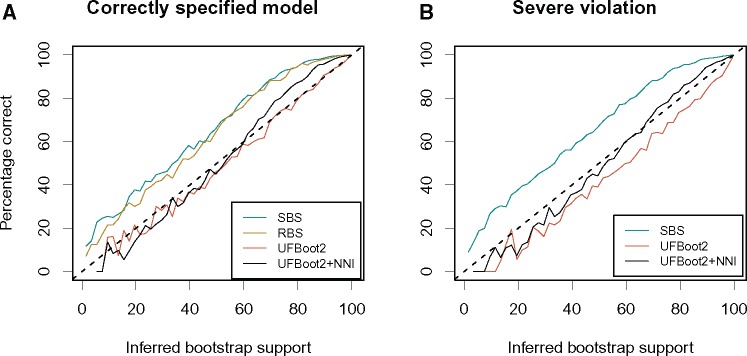
“This conservative behavior of SBS and RBS corroborates previous studies (Hillis and Bull 1993; Minh et al. 2013).”
BackgroundMethodResultInfluentialSelf-citationAn Empirical Test of Bootstrapping as a Method for Assessing Confidence in Phylogenetic Analysis
Hillis, D. M., & Bull, J. J. (1993) · Systematic Biology · doi:10.1093/sysbio/42.2.182 · Cited by 3,631 · cited 2×
“The accuracy of a bootstrap method M is defined by f M x ð Þ , the percentage of branches with support value x (across all reconstructed trees) that occur in the true tree (Hillis and Bull 1993).”
MethodResultAn Empirical Test of Bootstrapping as a Method for Assessing Confidence in Phylogenetic Analysis
Hillis, D. M., & Bull, J. J. (1993) · Systematic Biology · doi:10.2307/2992540 · Cited by 3,423
Terrace Aware Data Structure for Phylogenomic Inference from Supermatrices
Chernomor, O., von Haeseler, A., & Minh, B. Q. (2016) · Systematic Biology · doi:10.1093/sysbio/syw037 · Cited by 2,252 · cited 2×
“Figure 2 shows the ML tree inferred with IQTREE under edge-unlinked partition model (Chernomor et al. 2016), which allows separate sets of branch lengths across partitions.”
MethodSelf-citationRambaut, A., & Grass, N. C. (1997) · Bioinformatics · doi:10.1093/bioinformatics/13.3.235 · Cited by 1,574
Maximum likelihood inference of protein phylogeny and the origin of chloroplasts
Kishino, H., Miyata, T., & Hasegawa, M. (1990) · Journal of Molecular Evolution · doi:10.1007/bf02109483 · Cited by 883 · cited 1×
“To speed up likelihood computation even further for bootstrap MSAs, IQ-TREE employed the resampling estimated log-likelihood (RELL) strategy (Kishino et al. 1990).”
MethodStatistical tests of models of DNA substitution
Goldman, N. (1993) · Journal of Molecular Evolution · doi:10.1007/bf00166252 · Cited by 736 · cited 1×
“Users are advised to apply model violation detection methods (Goldman 1993; Weiss and von Haeseler 2003; Nguyen et al. 2011) before bootstrap analyses.”
MethodInferring ancient divergences requires genes with strong phylogenetic signals
Salichos, L., & Rokas, A. (2013) · Nature · doi:10.1038/nature12130 · Cited by 616 · cited 3×
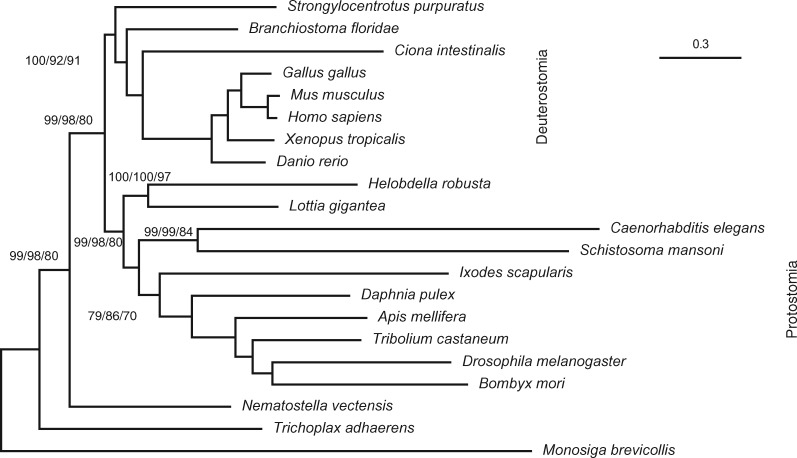
“To investigate the impact of the three resampling strategies, we reanalyzed the metazoan data with 21 species, 225 genes, and a total of 171,077 amino-acid sites (Salichos and Rokas 2013).”
BackgroundMethodSpringer, M. S., Meredith, R. W., Gatesy, J., Emerling, C. A., Park, J., Rabosky, D. L., Stadler, T., Steiner, C., Ryder, O. A., Janečka, J. E., et al. (2012) · PLoS ONE · doi:10.1371/journal.pone.0049521 · Cited by 520 · cited 2×
“By further examining 14 other empirical data sets (Bouchenak-Khelladi et al. 2008; Fabre et al. 2009; van der Linde et al. 2010; Stamatakis and Alachiotis 2010; Pyron et al. 2011; Nyakatura and Bininda-Emonds 2012; Springer et al. 2012; Hinchliff and Roalson 2013; Salichos and Rokas 2013; Dell’Ampio et al. 2014), we o…”
BackgroundResultGadagkar, S. R., Rosenberg, M. S., & Kumar, S. (2005) · Journal of Experimental Zoology Part B: Molecular and Developmental Evolution · doi:10.1002/jez.b.21026 · Cited by 480 · cited 2×
“within each gene (gene-site resampling, invoked via “-bsam GENESITE” option) (Gadagkar et al. 2005).”
BackgroundMethodInfluentialNyakatura, K., & Bininda-Emonds, O. R. (2012) · BMC Biology · doi:10.1186/1741-7007-10-12 · Cited by 474
Pyron, R. A., Burbrink, F. T., Colli, G. R., de Oca, A. N. M., Vitt, L. J., Kuczynski, C. A., & Wiens, J. J. (2011) · Molecular Phylogenetics and Evolution · doi:10.1016/j.ympev.2010.11.006 · Cited by 321 · cited 2×
“(Bouchenak-Khelladi et al. 2008; Fabre et al. 2009; Stamatakis and Alachiotis 2010; van der Linde et al. 2010; Pyron et al. 2011; Nyakatura and Bininda-Emonds 2012; Springer et al. 2012; Hinchliff and Roalson 2013; Salichos and Rokas 2013; Dell’Ampio et al. 2014), we observed more discrepancies between resampling stra…”
BackgroundBouchenak-Khelladi, Y., Salamin, N., Savolainen, V., Forest, F., Bank, M. V. D., Chase, M. W., & Hodkinson, T. R. (2008) · Molecular Phylogenetics and Evolution · doi:10.1016/j.ympev.2008.01.035 · Cited by 235 · cited 1×
“By further examining 14 other empirical data sets (Bouchenak-Khelladi et al. 2008; Fabre et al. 2009; Stamatakis and Alachiotis 2010; van der Linde et al. 2010; Pyron et al. 2011; Nyakatura and Bininda-Emonds 2012; Springer et al. 2012; Hinchliff and Roalson 2013; Salichos and Rokas 2013;…”
BackgroundPhylogenomic Insights into Animal Evolution
Telford, M. J., Budd, G. E., & Philippe, H. (2015) · Current Biology · doi:10.1016/j.cub.2015.07.060 · Cited by 213 · cited 1×
“Rokas 2013) and shows the Protostomia clade (Telford et al. 2015).”
BackgroundFabre, P. H., Rodrigues, A., & Douzery, E. J. P. (2009) · Molecular Phylogenetics and Evolution · doi:10.1016/j.ympev.2009.08.004 · Cited by 211
IQPNNI: Moving Fast Through Tree Space and Stopping in Time
Vinh, L. S. (2004) · Molecular Biology and Evolution · doi:10.1093/molbev/msh176 · Cited by 165 · cited 1×
“Although fast ML-tree search algorithms exist for large data sets (Vinh and von Haeseler 2004; Stamatakis 2006; Guindon et al. 2010; Nguyen et al. 2015) SBS is still very computationally intensive.”
MethodA supermatrix-based molecular phylogeny of the family Drosophilidae
van der Linde, K., Houle, D., Spicer, G. S., & Steppan, S. J. (2010) · Genetics Research · doi:10.1017/s001667231000008x · Cited by 145 · cited 1×
“By further examining 14 other empirical data sets (Bouchenak-Khelladi et al. 2008; Fabre et al. 2009; Stamatakis and Alachiotis 2010; van der Linde et al. 2010; Pyron et al. 2011; Nyakatura and Bininda-Emonds 2012; Springer et al. 2012; Hinchliff and Roalson 2013; Salichos and Rokas 2013;…”
BackgroundDell’Ampio, E., Meusemann, K., Szucsich, N. U., Peters, R. S., Meyer, B., Borner, J., Petersen, M., Aberer, A. J., Stamatakis, A., Walzl, M. G., et al. (2013) · Molecular Biology and Evolution · doi:10.1093/molbev/mst196 · Cited by 134 · cited 2×
“…2009; Stamatakis and Alachiotis 2010; van der Linde et al. 2010; Pyron et al. 2011; Nyakatura and Bininda-Emonds 2012; Springer et al. 2012; Hinchliff and Roalson 2013; Salichos and Rokas 2013; Dell’Ampio et al. 2014), we observed more discrepancies between resampling strategies (data not shown).”
BackgroundSelf-citationStamatakis, A., & Alachiotis, N. (2010) · Bioinformatics · doi:10.1093/bioinformatics/btq205 · Cited by 122 · cited 2×
“(Bouchenak-Khelladi et al. 2008; Fabre et al. 2009; Stamatakis and Alachiotis 2010; van der Linde et al. 2010; Pyron et al. 2011; Nyakatura and Bininda-Emonds 2012; Springer et al. 2012; Hinchliff and Roalson 2013; Salichos and Rokas 2013; Dell’Ampio et al. 2014), we observed more discrepancies between resampling stra…”
BackgroundUsing Supermatrices for Phylogenetic Inquiry: An Example Using the Sedges
Hinchliff, C. E., & Roalson, E. H. (2012) · Systematic Biology · doi:10.1093/sysbio/sys088 · Cited by 94 · cited 1×
“…et al. 2009; Stamatakis and Alachiotis 2010; van der Linde et al. 2010; Pyron et al. 2011; Nyakatura and Bininda-Emonds 2012; Springer et al. 2012; Hinchliff and Roalson 2013; Salichos and Rokas 2013; Dell’Ampio et al. 2014), we observed more discrepancies between resampling strategies (data not…”
BackgroundWhelan, S., de Bakker, P. I. W., Quevillon, E., Rodriguez, N., & Goldman, N. (2005) · Nucleic Acids Research · doi:10.1093/nar/gkj087 · Cited by 82 · cited 1×
“The simulations include 5,690 DNA MSAs (DOI 10.5281/zenodo.854445) generated by Seq-Gen (Rambaut and Grass 1997), where the model parameters and the tree (which we will call the true tree in the following) were inferred from the original MSAs downloaded from the PANDIT database (Whelan et al. 2006).”
MethodInfluentialDivergent maximum-likelihood-branch-support values for polytomies.
Simmons, M. P., & Norton, A. (2014) · Molecular Phylogenetics and Evolution · doi:10.1016/j.ympev.2014.01.018 · Cited by 59
Testing Substitution Models Within a Phylogenetic Tree
Weiss, G. (2003) · Molecular Biology and Evolution · doi:10.1093/molbev/msg073 · Cited by 23 · cited 1×
“Users are advised to apply model violation detection methods (Goldman 1993; Weiss and von Haeseler 2003; Nguyen et al. 2011) before bootstrap analyses.”
MethodThe Prevalence of Multifurcations in Tree-space and Their Implications for Tree-search
Whelan, S., & Money, D. (2010) · Molecular Biology and Evolution · doi:10.1093/molbev/msq163 · Cited by 16 · cited 1×
“When resolving polytomies, there might be multiple equivalently optimal bifurcating trees (Whelan and Money 2010).”
BackgroundMISFITS: Evaluating the Goodness of Fit between a Phylogenetic Model and an Alignment
Nguyen, M. A., Klaere, S., & von Haeseler, A. (2010) · Molecular Biology and Evolution · doi:10.1093/molbev/msq180 · Cited by 15 · cited 1×
“Users are advised to apply model violation detection methods (Goldman 1993; Weiss and von Haeseler 2003; Nguyen et al. 2011) before bootstrap analyses.”
Method
Cited by
IQ-TREE 2: New Models and Efficient Methods for Phylogenetic Inference in the Genomic Era
Minh, B. Q., Schmidt, H. A., Chernomor, O., Schrempf, D., Woodhams, M. D., von Haeseler, A., & Lanfear, R. (2020) · Molecular Biology and Evolution · doi:10.1093/molbev/msaa015 · Cited by 16,873
“Moreover, IQ-TREE 2 is well suited for partitioned models because it provides the site, gene, and gene-site bootstrap resampling schemes (Hoang et al. 2018).”
BackgroundSelf-citationZheng, J., Wittouck, S., Salvetti, E., Franz, C. M. A. P., Harris, H. M. B., Mattarelli, P., O’Toole, P. W., Pot, B., Vandamme, P., Walter, J., et al. (2020) · International Journal of Systematic and Evolutionary Microbiology · doi:10.1099/ijsem.0.004107 · Cited by 3,313
“Branch support was calculated using 1000 bootstrap trees with the UFBoot2 algorithm [31].”
MethodAllio, R., Schomaker‐Bastos, A., Romiguier, J., Prosdocimi, F., Nabholz, B., & Delsuc, F. (2020) · Molecular Ecology Resources · doi:10.1111/1755-0998.13160 · Cited by 1,963
“Statistical node support was estimated using ultrafast bootstrap (UFBS) with 1,000 replicates (Hoang, Chernomor, von Haeseler, Minh, & Vinh, 2018).”
MethodImproving cytidine and adenine base editors by expression optimization and ancestral reconstruction
Koblan, L. W., Doman, J. L., Wilson, C., Levy, J. M., Tay, T., Newby, G. A., Maianti, J. P., Raguram, A., & Liu, D. R. (2018) · Nature Biotechnology · doi:10.1038/nbt.4172 · Cited by 944
Avanzato, V. A., Matson, M. J., Seifert, S. N., Pryce, R., Williamson, B. N., Anzick, S. L., Barbian, K., Judson, S. D., Fischer, E. R., Martens, C., et al. (2020) · Cell · doi:10.1016/j.cell.2020.10.049 · Cited by 716
“, 2017) and ultrafast bootstrap (Hoang et al., 2018) implemented in IQ-TREE (Nguyen et al.”
Metadata
- Authors
- Hoang, D. T., Chernomor, O., von Haeseler, A., Minh, B. Q., & Vinh, L. S.
- Affiliations
- Vietnam National University, Hanoi (VN)
- University of Vienna (AT)
- Center for Integrative Bioinformatics Vienna, Max F. Perutz Laboratories, University of Vienna, Medical University Vienna, Vienna, Austria
- Faculty of Information Technology, University of Engineering and Technology, Vietnam National University, Hanoi, Vietnam
- Venue
- Molecular Biology and Evolution
- Publisher
- Oxford University Press (OUP)
- Published
- 2017-10-25
- Volume
- 35
- Issue
- 2
- Pages
- 518-522
- ISSN
- 0737-4038 (ISSN-L)
- 1537-1719
- PMC
- PMC5850222
- OpenAlex
- W2951464304
- Cited by
- 10,881
- References
- 32
- Citations by year
- 2026: 1853 · 2025: 1810 · 2024: 1925 · 2023: 1540 · 2022: 1336 · 2021: 1145 · 2020: 758 · 2019: 390 · 2018: 114 · 2017: 1
- FWCI
- 141.14
- Type
- journal article
- Language
- en
- Open access
- hybrid
- doi.org
- Licence
- cc-by-nc
- Locations
- Molecular Biology and Evolution (publishedVersion, cc-by-nc)
- bioRxiv (Cold Spring Harbor Laboratory) (acceptedVersion, cc-by)
- PubMed Central (publishedVersion, cc-by-nc)
- PubMed (publishedVersion)
- Greater South Information System
- Funders
- National Foundation for Science and Technology Development (102.01-2013.04)
- Topics
- Life Sciences › Biochemistry, Genetics and Molecular Biology › Molecular Biology › Genomics and Phylogenetic Studies
- Life Sciences › Biochemistry, Genetics and Molecular Biology › Molecular Biology › RNA and protein synthesis mechanisms
- Life Sciences › Agricultural and Biological Sciences › Ecology, Evolution, Behavior and Systematics › Plant Diversity and Evolution
- Keywords
- maximum likelihood phylogeny, branch support, polytomies, model violations, bootstrapping, IQ-TREE, computational acceleration
- MeSH terms
- Models, Genetic, Phylogeny, Software, Likelihood Functions
About these checks
Registry, retraction, Cites and statistics results are computed, not judged, with one exception: a printed reference that no index lists is read once by a model before it counts as a citation error. Claims are extracted by a model and kept only when their quote appears verbatim in the text; each cited source is then checked, with a model’s help, for whether it says what the claim relies on. Those verdicts can be wrong — read the claim’s quote and the cited source before relying on one.
Statistics and arithmetic are recomputed, not judged.
Confidence bands are shown only for fields calibrated on our annotated test set. None is calibrated yet, so no band is shown.
What counts as a claim ›How we measure confidence ›How we check this ›
Are you an author, or do you see a problem with this page? Request a review
Data sources
Bibliographic data: Semantic Scholar, OpenAlex, Crossref.
Contains information from the Semantic Scholar Academic Graph Datasets, made available under the ODC Attribution License (ODC-BY 1.0).
Semantic Scholar’s data is described in: Kinney, R., et al. (2023). The Semantic Scholar Open Data Platform. arXiv:2301.10140.
