

The PRIDE database resources in 2022: a hub for mass spectrometry-based proteomics evidences
Open accessThe DOI matches its Crossref record; 60 of the 61 references it cites were found in a registry or an index.
Abstract
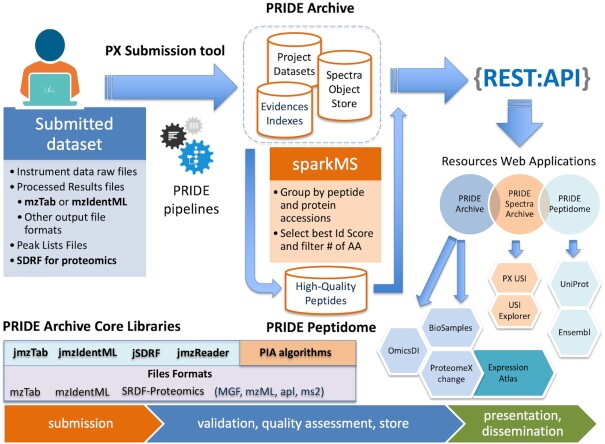
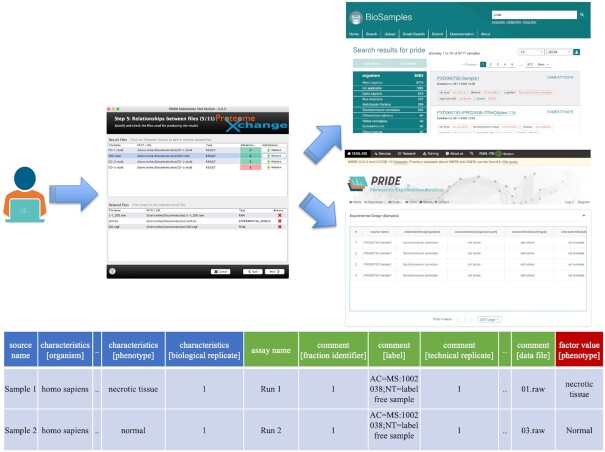
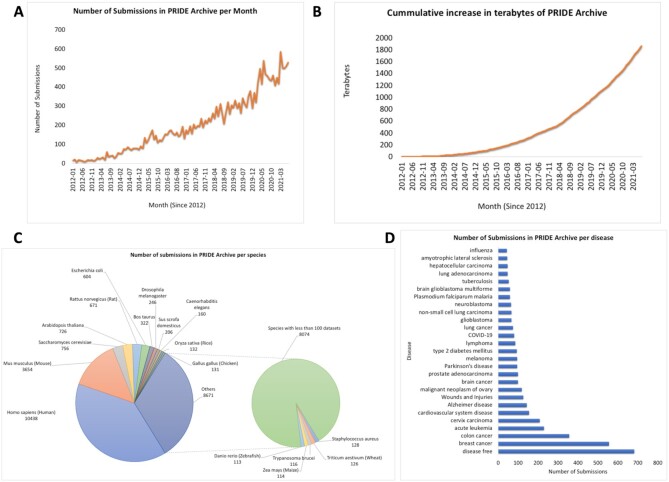
The PRoteomics IDEntifications (PRIDE) database (https://www.ebi.ac.uk/pride/) is the world's largest data repository of mass spectrometry-based proteomics data. PRIDE is one of the founding members of the global ProteomeXchange (PX) consortium and an ELIXIR core data resource. In this manuscript, we summarize the developments in PRIDE resources and related tools since the previous update manuscript was published in Nucleic Acids Research in 2019. The number of submitted datasets to PRIDE Archive (the archival component of PRIDE) has reached on average around 500 datasets per month during 2021. In addition to continuous improvements in PRIDE Archive data pipelines and infrastructure, the PRIDE Spectra Archive has been developed to provide direct access to the submitted mass spectra using Universal Spectrum Identifiers. As a key point, the file format MAGE-TAB for proteomics has been developed to enable the improvement of sample metadata annotation. Additionally, the resource PRIDE Peptidome provides access to aggregated peptide/protein evidences across PRIDE Archive. Furthermore, we will describe how PRIDE has increased its efforts to reuse and disseminate high-quality proteomics data into other added-value resources such as UniProt, Ensembl and Expression Atlas.
Overview
The claims and statistics of this paper haven’t been checked yet.
Free: it reads the open-access text and checks the first 5 claims that cite a source we can check. Create a free account to check every claim.
Integrity signals
Registry
Cites
Statistics
Figures
Verification
Claims the paper makes
The claims and statistics of this paper haven’t been checked yet.
Free: it reads the open-access text and checks the first 5 claims that cite a source we can check. Create a free account to check every claim.
Claims other papers make about this one
Each is checked against this paper’s own text: does it say what the citing paper says it does?
In the citing paper
“General proteomics repositories (e.g., PRIDE/ProteomeXchange) host raw and processed MS-based proteomics but do not harmonize thermal shift/solubility readouts into queryable, per-protein effect sizes across compounds and cell lines (16).”
From DORSSAA: Drug-Target interactOmics Resource Based on Stability/Solubility Alteration Assay (2026) · cites this paper as [16]
Self-check
Percentages, sums and reported differences re-computed from the paper’s own numbers.
The self-check needs the paper’s full text.
Citations
Cites
Cox, J., & Mann, M. (2008) · Nature Biotechnology · doi:10.1038/nbt.1511 · Cited by 14,855 · cited 4×
“Since 2020, overall, 240 and 30 dataset submissions have been performed using mzTab generated from Mascot and MaxQuant, respectively.”
BackgroundInfluentialPerkins, D. N., Pappin, D. J. C., Creasy, D. M., & Cottrell, J. S. (1999) · Electrophoresis · doi:10.1002/(sici)1522-2683(19991201)20:18<3551::aid-elps3551>3.0.co;2-2 · Cited by 8,203
Perez-Riverol, Y., Csordas, A., Bai, J., Bernal-Llinares, M., Hewapathirana, S., Kundu, D. J., Inuganti, A., Griss, J., Mayer, G., Eisenacher, M., et al. (2019) · Nucleic Acids Research · doi:10.1093/nar/gky1106 · Cited by 6,693 · cited 8×
“Since 2019, PRIDE has started to provide peptide evidences to Ensembl using the ‘TrackHub’ registry (2).”
BackgroundMethodInfluentialSelf-citationUniProt: the universal protein knowledgebase in 2021
The UniProt Consortium, Bateman, A., Martin, M.-J., Orchard, S., Magrane, M., Agivetova, R., Ahmad, S., Alpi, E., Bowler-Barnett, E. H., Britto, R., et al. (2021) · Nucleic Acids Research · doi:10.1093/nar/gkaa1100 · Cited by 6,372
ProteomeXchange provides globally coordinated proteomics data submission and dissemination
Vizcaíno, J. A., Deutsch, E. W., Wang, R., Csordas, A., Reisinger, F., Ríos, D., Dianes, J. A., Sun, Z., Farrah, T., Bandeira, N., et al. (2014) · Nature Biotechnology · doi:10.1038/nbt.2839 · Cited by 2,729 · cited 3×
“For every submitted dataset to PRIDE Archive, general metadata about the study must be provided including the title, submitters’ details, dataset description, sample and data protocols, instrument, and the associated publication once it is published (2,4,8).”
MethodSelf-citationiProX: an integrated proteome resource
Ma, J., Chen, T., Wu, S., Yang, C., Bai, M., Shu, K., Li, K., Zhang, G., Jin, Z., He, F., et al. (2019) · Nucleic Acids Research · doi:10.1093/nar/gky869 · Cited by 1,978 · cited 1×
“As of 2021, the resources PeptideAtlas (13), including its related resource PASSEL (PeptideAtlas SRM Experiment Library) (14), MassIVE (15), jPOST (16), iProX (17) and Panorama Public (18) are the active members of the consortium.”
BackgroundYates, A. D., Achuthan, P., Akanni, W., Allen, J., Allen, J., Alvarez-Jarreta, J., Amode, M. R., Armean, I. M., Azov, A. G., Bennett, R., et al. (2019) · Nucleic Acids Research · doi:10.1093/nar/gkz966 · Cited by 1,152
mzML—a Community Standard for Mass Spectrometry Data
Martens, L., Chambers, M., Sturm, M., Kessner, D., Levander, F., Shofstahl, J., Tang, W. H., Römpp, A., Neumann, S., Pizarro, A. D., et al. (2011) · Molecular & Cellular Proteomics · doi:10.1074/mcp.r110.000133 · Cited by 745 · cited 1×
“as mzTab (5), mzIdentML (6) and mzML (7) to store, process and visualize the proteomics data deposited.”
BackgroundThe ProteomeXchange consortium in 2020: enabling ‘big data’ approaches in proteomics
Deutsch, E. W., Bandeira, N., Sharma, V., Perez-Riverol, Y., Carver, J. J., Kundu, D. J., García-Seisdedos, D., Jarnuczak, A. F., Hewapathirana, S., Pullman, B. S., et al. (2019) · Nucleic Acids Research · doi:10.1093/nar/gkz984 · Cited by 697 · cited 3×
“The PRIDE database was one of the founders of the PX consortium in 2011 (3,8).”
BackgroundMethodSelf-citationMGnify: the microbiome analysis resource in 2020
Mitchell, A. L., Almeida, A., Beracochea, M., Boland, M., Burgin, J., Cochrane, G., Crusoe, M. R., Kale, V., Potter, S. C., Richardson, L. J., et al. (2019) · Nucleic Acids Research · doi:10.1093/nar/gkz1035 · Cited by 562 · cited 2×
“In addition, we aim to increasingly perform in-house data reuse (including data re-analysis) and disseminate high-quality proteomics data from PRIDE into the already mentioned added-value resources (Ensembl, UniProt, Expression Atlas, and MGnify in the near future).”
Background
Cited by
Szklarczyk, D., Kirsch, R., Koutrouli, M., Nastou, K., Mehryary, F., Hachilif, R., Gable, A. L., Fang, T., Doncheva, N. T., Pyysalo, S., et al. (2023) · Nucleic Acids Research · doi:10.1093/nar/gkac1000 · Cited by 9,726
UniProt: the Universal Protein Knowledgebase in 2025
The UniProt Consortium, Bateman, A., Martin, M.-J., Orchard, S., Magrane, M., Adesina, A., Ahmad, S., Bowler-Barnett, E. H., Bye-A-Jee, H., Carpentier, D., et al. (2025) · Nucleic Acids Research · doi:10.1093/nar/gkae1010 · Cited by 2,537
The PRIDE database at 20 years: 2025 update
Perez-Riverol, Y., Bandla, C., Kundu, D. J., Kamatchinathan, S., Bai, J., Hewapathirana, S., John, N. S., Prakash, A., Walzer, M., Wang, S., et al. (2025) · Nucleic Acids Research · doi:10.1093/nar/gkae1011 · Cited by 1,995
Self-citationThe ProteomeXchange consortium at 10 years: 2023 update
Deutsch, E. W., Bandeira, N., Perez-Riverol, Y., Sharma, V., Carver, J. J., Mendoza, L., Kundu, D. J., Wang, S., Bandla, C., Kamatchinathan, S., et al. (2023) · Nucleic Acids Research · doi:10.1093/nar/gkac1040 · Cited by 819
“Please see the latest update manuscripts of the individual PX resources for more comprehensive information about each of them separately (5,9,10,14).”
BackgroundMethodSelf-citationGENCODE: reference annotation for the human and mouse genomes in 2023
Frankish, A., Carbonell-Sala, S., Diekhans, M., Jungreis, I., Loveland, J. E., Mudge, J. M., Sisu, C., Wright, J. C., Arnan, C., Barnes, I., et al. (2023) · Nucleic Acids Research · doi:10.1093/nar/gkac1071 · Cited by 597
“Experimental data has been used to build spectral libraries to identify peptides in large sets of public spectra in the PRIDE (25) repository, finding 88 peptides with a significant identification.”
Method
Metadata
- Authors
- Perez-Riverol, Y., Bai, J., Bandla, C., García-Seisdedos, D., Hewapathirana, S., Kamatchinathan, S., Kundu, D. J., Prakash, A., Frericks-Zipper, A., Eisenacher, M., Walzer, M., Wang, S., Brazma, A., & Vizcaíno, J. A.
- Affiliations
- European Molecular Biology Laboratory, European Bioinformatics Institute (EMBL-EBI), Wellcome Trust Genome Campus, Hinxton, Cambridge CB10 1SD, UK
- European Bioinformatics Institute (GB)
- Ruhr University Bochum (DE)
- Corresponding author
- Vizcaíno, Juan Antonio
- ORCID
- Venue
- Nucleic Acids Research
- Publisher
- Oxford University Press (OUP)
- Published
- 2021-11-01
- Volume
- 50
- Issue
- D1
- Pages
- D543-D552
- ISSN
- 0305-1048 (ISSN-L)
- 1362-4962
- PMC
- PMC8728295
- OpenAlex
- W3208691473
- Cited by
- 6,125
- References
- 61
- Citations by year
- 2026: 494 · 2025: 1312 · 2024: 2003 · 2023: 1569 · 2022: 735 · 2021: 5
- FWCI
- 406.89
- Type
- journal article
- Language
- en
- Open access
- gold
- doi.org
- Licence
- Locations
- Nucleic Acids Research (publishedVersion, cc-by)
- PubMed Central (publishedVersion, cc-by)
- PubMed (publishedVersion)
- Funders
- Wellcome (208391/Z/17/Z)
- BBSRC (BB/P024599/1, BB/S01781X/1, BB/T019670/1)
- UK-Japan Partnership award (BB/N022440/1)
- NIH (R24 GM127667-01)
- EU H2020 (823839)
- Open Targets (OTAR-043)
- Luxembourg National Research Fund (C19/BM/13684739)
- EMBL
- German Federal Ministry of Education and Research (FKZ 031 A 534A)
- Ministry of Innovation, Science and Research of North-Rhine Westphalia, Germany
- Topics
- Physical Sciences › Chemistry › Spectroscopy › Advanced Proteomics Techniques and Applications
- Physical Sciences › Computer Science › Information Systems › Research Data Management Practices
- Life Sciences › Biochemistry, Genetics and Molecular Biology › Molecular Biology › Bioinformatics and Genomic Networks
- Keywords
- mass spectrometry-based proteomics, ProteomeXchange, data dissemination, UniProt, Ensembl, Expression Atlas
- MeSH terms
- Metadata, Amino Acid Sequence, Humans, Peptides, Proteins, Software, Mass Spectrometry, Bibliometrics, Information Storage and Retrieval, Sequence Alignment, Internet, Databases, Protein, Proteomics, Molecular Sequence Annotation, Datasets as Topic
About these checks
Registry, retraction, Cites and statistics results are computed, not judged, with one exception: a printed reference that no index lists is read once by a model before it counts as a citation error. Claims are extracted by a model and kept only when their quote appears verbatim in the text; each cited source is then checked, with a model’s help, for whether it says what the claim relies on. Those verdicts can be wrong — read the claim’s quote and the cited source before relying on one.
Statistics and arithmetic are recomputed, not judged.
Confidence bands are shown only for fields calibrated on our annotated test set. None is calibrated yet, so no band is shown.
What counts as a claim ›How we measure confidence ›How we check this ›
Are you an author, or do you see a problem with this page? Request a review
How to cite
Cite CoChat for the checks on this page, and the paper for its own findings.
- This page
- CoChat. (2026). Citation check: The PRIDE database resources in 2022: a hub for mass spectrometry-based proteomics evidences. https://app.cochat.ai/papers/10.1093/nar/gkab1038
- The paper
- Perez-Riverol, Y., Bai, J., Bandla, C., García-Seisdedos, D., Hewapathirana, S., Kamatchinathan, S., Kundu, D. J., Prakash, A., Frericks-Zipper, A., Eisenacher, M., Walzer, M., Wang, S., Brazma, A., & Vizcaíno, J. A. (2022). The PRIDE database resources in 2022: a hub for mass spectrometry-based proteomics evidences. Nucleic Acids Research. https://doi.org/10.1093/nar/gkab1038
Data sources
Bibliographic data: Semantic Scholar, OpenAlex, Crossref.
Contains information from the Semantic Scholar Academic Graph Datasets, made available under the ODC Attribution License (ODC-BY 1.0).
Semantic Scholar’s data is described in: Kinney, R., et al. (2023). The Semantic Scholar Open Data Platform. arXiv:2301.10140.
