

PPDB, the Plant Proteomics Database at Cornell
Open accessThe DOI matches its Crossref record; 23 of the 23 references it cites were found in a registry or an index.
Abstract
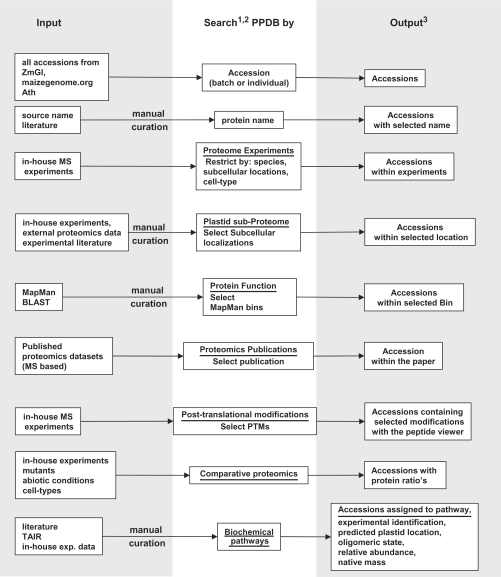
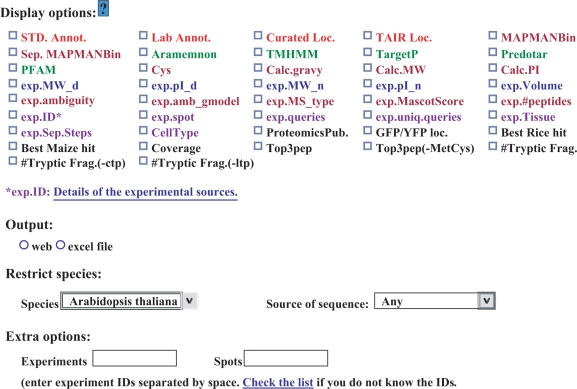
The Plant Proteomics Database (PPDB; http://ppdb.tc.cornell.edu), launched in 2004, provides an integrated resource for experimentally identified proteins in Arabidopsis and maize (Zea mays). Internal BLAST alignments link maize and Arabidopsis information. Experimental identification is based on in-house mass spectrometry (MS) of cell type-specific proteomes (maize), or specific subcellular proteomes (e.g. chloroplasts, thylakoids, nucleoids) and total leaf proteome samples (maize and Arabidopsis). So far more than 5000 accessions both in maize and Arabidopsis have been identified. In addition, more than 80 published Arabidopsis proteome datasets from subcellular compartments or organs are stored in PPDB and linked to each locus. Using MS-derived information and literature, more than 1500 Arabidopsis proteins have a manually assigned subcellular location, with a strong emphasis on plastid proteins. Additional new features of PPDB include searchable posttranslational modifications and searchable experimental proteotypic peptides and spectral count information for each identified accession based on in-house experiments. Various search methods are provided to extract more than 40 data types for each accession and to extract accessions for different functional categories or curated subcellular localizations. Protein report pages for each accession provide comprehensive overviews, including predicted protein properties, with hyperlinks to the most relevant databases.
Overview
The claims and statistics of this paper haven’t been checked yet.
Free: it reads the open-access text and checks the first 5 claims that cite a source we can check. Create a free account to check every claim.
Integrity signals
Registry
Cites
Statistics
Figures

Verification
Claims the paper makes
The claims and statistics of this paper haven’t been checked yet.
Free: it reads the open-access text and checks the first 5 claims that cite a source we can check. Create a free account to check every claim.
Claims other papers make about this one
Each is checked against this paper’s own text: does it say what the citing paper says it does?
In the citing paper
“Proteomic databases exist for plant species95 and, more recently, for human tissues9,23 but public data on protein localisation and abundance across the brain are currently far less mature than their RNA equivalent.”
From Decoding neuroproteomics: integrating the genome, translatome and functional anatomy (2014) · cites this paper as [95]
Self-check
Percentages, sums and reported differences re-computed from the paper’s own numbers.
The self-check needs the paper’s full text.
Citations
Cites
Thimm, O., Bläsing, O., Gibon, Y., Nagel, A., Meyer, S., Krüger, P., Selbig, J., Müller, L. A., Rhee, S. Y., & Stitt, M. (2004) · The Plant Journal · doi:10.1111/j.1365-313x.2004.02016.x · Cited by 3,352 · cited 5×
“We thank the curators of MapMan bin for providing us all MapMan bin assignments to Arabidopsis accessions.”
MethodInfluentialA Model for Random Sampling and Estimation of Relative Protein Abundance in Shotgun Proteomics
Liu, H., Sadygov, R. G., & Yates, J. R. (2004) · Analytical Chemistry · doi:10.1021/ac0498563 · Cited by 2,500
Quantitative mass spectrometry in proteomics: a critical review
Bantscheff, M., Schirle, M., Sweetman, G., Rick, J., & Kuster, B. (2007) · Analytical and Bioanalytical Chemistry · doi:10.1007/s00216-007-1486-6 · Cited by 1,669
Peng, J., Elias, J. E., Thoreen, C. C., Licklider, L. J., & Gygi, S. P. (2003) · Journal of Proteome Research · doi:10.1021/pr025556v · Cited by 1,647 · cited 1×
“The instrument settings and database searches (always using Mascot) and filter criteria (aimed at < 1% false positive rate for peptide identification, with cutoff set by decoy database searches (8)) are standardized (9–11).”
MethodComparison of Label-free Methods for Quantifying Human Proteins by Shotgun Proteomics
Old, W. M., Meyer-Arendt, K., Aveline-Wolf, L., Pierce, K. G., Mendoza, A., Sevinsky, J. R., Resing, K. A., & Ahn, N. G. (2005) · Molecular & Cellular Proteomics · doi:10.1074/mcp.m500084-mcp200 · Cited by 1,206
Lu, P., Vogel, C., Wang, R., Yao, X., & Marcotte, E. M. (2007) · Nature Biotechnology · doi:10.1038/nbt1270 · Cited by 1,139
Sorting Signals, N-Terminal Modifications and Abundance of the Chloroplast Proteome
Zybailov, B., Rutschow, H., Friso, G., Rudella, A., Emanuelsson, O., Sun, Q., & van Wijk, K. J. (2008) · PLoS ONE · doi:10.1371/journal.pone.0001994 · Cited by 637 · cited 2×
“In a recent paper, we showed that ‘spectral counting’ can indeed provide large-scale protein quantification for Arabidopsis (9), if experiments are carefully designed with attention to reproducibility at every step of the process and if appropriate thresholds are applied for the minimum number of matched spectral coun…”
BackgroundSelf-citationAnalysis and validation of proteomic data generated by tandem mass spectrometry
Nesvizhskii, A. I., Vitek, O., & Aebersold, R. (2007) · Nature Methods · doi:10.1038/nmeth1088 · Cited by 629
Friso, G., Giacomelli, L., Ytterberg, A. J., Peltier, J.-B., Rudella, A., Sun, Q., & Wijk, K. J. V. (2004) · The Plant Cell · doi:10.1105/tpc.017814 · Cited by 482
Self-citationZybailov, B., Coleman, M. K., Florens, L., & Washburn, M. P. (2005) · Analytical Chemistry · doi:10.1021/ac050846r · Cited by 349
Self-citation
Cited by
Ferro, M., Brugière, S., Salvi, D., Seigneurin-Berny, D., Court, M., Moyet, L., Ramus, C., Miras, S., Mellal, M., Le Gall, S., et al. (2010) · Molecular & Cellular Proteomics · doi:10.1074/mcp.m900325-mcp200 · Cited by 472
“Indeed, subcellular proteomics has attracted considerable interest within the last few years (3–6), and databases such as the Plant Protein Database (PPDB)(1) (7), the subcellular proteomics database SUBA (8), or the Plastid Protein Database (plprot) (9) gather plastid proteomics data that help and induce further targ…”
BackgroundRazi, K., & Muneer, S. (2021) · Critical Reviews in Biotechnology · doi:10.1080/07388551.2021.1874280 · Cited by 333
“Furthermore, chloroplasts provide protection to plants and resistance to various abiotic stress like drought stress by the assistance of metabolites synthesized during the photosynthesis and the key proteins which are involved in the metabolic process in all plants [54].”
BackgroundRole of Plastid Protein Phosphatase TAP38 in LHCII Dephosphorylation and Thylakoid Electron Flow
Pribil, M., Pesaresi, P., Hertle, A., Barbato, R., & Leister, D. (2010) · PLoS Biology · doi:10.1371/journal.pbio.1000288 · Cited by 319
“thaliana [30,31].”
Arabidopsis Plasmodesmal Proteome
Fernandez-Calvino, L., Faulkner, C., Walshaw, J., Saalbach, G., Bayer, E., Benitez-Alfonso, Y., & Maule, A. (2011) · PLoS ONE · doi:10.1371/journal.pone.0018880 · Cited by 293
“Each protein was placed in one of the MapMan ‘‘bins’’, using the online search facility of the Plant Proteome Database (PPDB, [90]).”
MethodOguz, M. C., Aycan, M., Oguz, E., Poyraz, I., & Yildiz, M. (2022) · Physiologia · doi:10.3390/physiologia2040015 · Cited by 287
“With the help of metabolites synthesized during photosynthesis and key proteins involved in the metabolic process, chloroplasts provide resistance against various abiotic stresses such as drought [114].”
Background
Metadata
- Authors
- Sun, Q., Zybailov, B., Majeran, W., Friso, G., Olinares, P. D. B., & van Wijk, K. J.
- Affiliations
- Cornell University (US)
- Venue
- Nucleic Acids Research
- Publisher
- Oxford University Press (OUP)
- Published
- 2008-10-02
- Volume
- 37
- Issue
- suppl_1
- Pages
- D969-D974
- ISSN
- 0305-1048 (ISSN-L)
- 1362-4962
- PMC
- PMC2686560
- OpenAlex
- W2117056672
- Cited by
- 400
- References
- 23
- Citations by year
- 2026: 8 · 2025: 13 · 2024: 17 · 2023: 18 · 2022: 18 · 2021: 15 · 2020: 23 · 2019: 19 · 2018: 22 · 2017: 13 · 2016: 23 · 2015: 17 · 2014: 32 · 2013: 38 · 2012: 40
- FWCI
- 12.13
- Type
- journal article
- Language
- en
- Open access
- gold
- doi.org
- Licence
- Locations
- Nucleic Acids Research (publishedVersion, cc-by-nc)
- PubMed Central (publishedVersion, cc-by-nc)
- PubMed (publishedVersion)
- Funders
- National Science Foundation (0211935, 0343444, 0701736, 0718897)
- U.S. Department of Energy (DE‐FG02‐, FG02-04ER15560)
- Office of Science
- Topics
- Physical Sciences › Chemistry › Spectroscopy › Advanced Proteomics Techniques and Applications
- Life Sciences › Biochemistry, Genetics and Molecular Biology › Molecular Biology › Bioinformatics and Genomic Networks
- Life Sciences › Biochemistry, Genetics and Molecular Biology › Molecular Biology › Machine Learning in Bioinformatics
- Keywords
- Arabidopsis thaliana, maize, plant proteomics, subcellular localization, plastid proteins, chloroplast proteome, post-translational modification, proteotypic peptides, spectral counts
- MeSH terms
- Zea mays, Peptides, Plant Proteins, Mass Spectrometry, Arabidopsis Proteins, Databases, Protein, Proteomics
About these checks
Registry, retraction, Cites and statistics results are computed, not judged, with one exception: a printed reference that no index lists is read once by a model before it counts as a citation error. Claims are extracted by a model and kept only when their quote appears verbatim in the text; each cited source is then checked, with a model’s help, for whether it says what the claim relies on. Those verdicts can be wrong — read the claim’s quote and the cited source before relying on one.
Statistics and arithmetic are recomputed, not judged.
Confidence bands are shown only for fields calibrated on our annotated test set. None is calibrated yet, so no band is shown.
What counts as a claim ›How we measure confidence ›How we check this ›
Are you an author, or do you see a problem with this page? Request a review
How to cite
Cite CoChat for the checks on this page, and the paper for its own findings.
- This page
- CoChat. (2026). Citation check: PPDB, the Plant Proteomics Database at Cornell. https://app.cochat.ai/papers/10.1093/nar/gkn654
- The paper
- Sun, Q., Zybailov, B., Majeran, W., Friso, G., Olinares, P. D. B., & van Wijk, K. J. (2009). PPDB, the Plant Proteomics Database at Cornell. Nucleic Acids Research. https://doi.org/10.1093/nar/gkn654
Data sources
Bibliographic data: Semantic Scholar, OpenAlex, Crossref.
Contains information from the Semantic Scholar Academic Graph Datasets, made available under the ODC Attribution License (ODC-BY 1.0).
Semantic Scholar’s data is described in: Kinney, R., et al. (2023). The Semantic Scholar Open Data Platform. arXiv:2301.10140.
