

The DOI matches its Crossref record; 30 of the 30 references it cites were found in a registry or an index.
FuzDB: database of fuzzy complexes, a tool to develop stochastic structure-function relationships for protein complexes and higher-order assemblies
Open accessAbstract
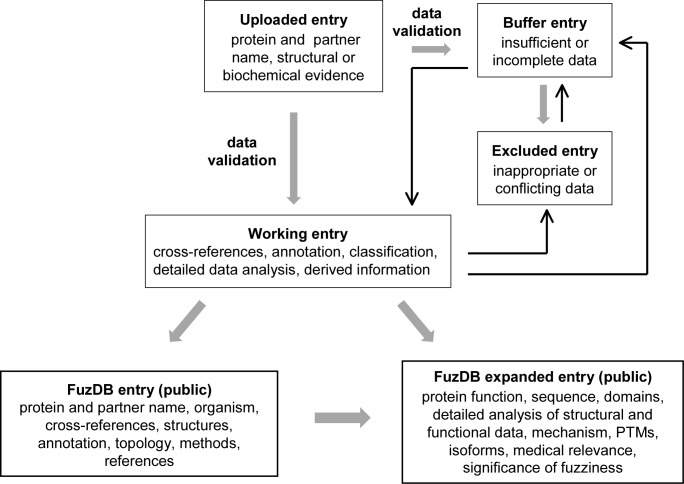
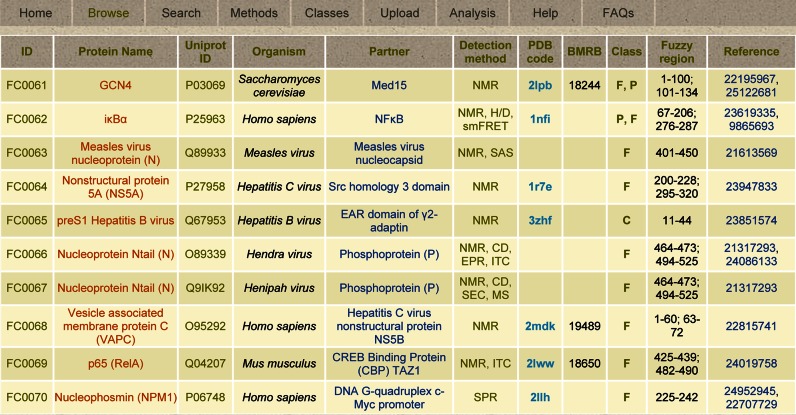
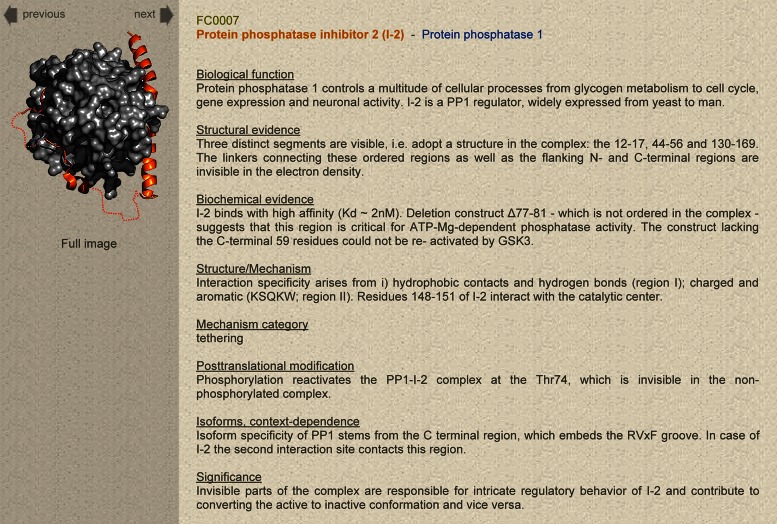
FuzDB (http://protdyn-database.org) compiles experimentally observed fuzzy protein complexes, where intrinsic disorder (ID) is maintained upon interacting with a partner (protein, nucleic acid or small molecule) and directly impacts biological function. Entries in the database have both (i) structural evidence demonstrating the structural multiplicity or dynamic disorder of the ID region(s) in the partner bound form of the protein and (ii) in vitro or in vivo biological evidence that indicates the significance of the fuzzy region(s) in the formation, function or regulation of the assembly. Unlike the other intrinsically disordered or unfolded protein databases, FuzDB focuses on ID regions within a biological context, including higher-order assemblies and presents a detailed analysis of the structural and functional data. FuzDB also provides interpretation of experimental results to elucidate the molecular mechanisms by which fuzzy regions-classified on the basis of topology and mechanism-interfere with the structural ensembles and activity of protein assemblies. Regulatory sites generated by alternative splicing (AS) or post-translational modifications (PTMs) are also collected. By assembling all this information, FuzDB could be utilized to develop stochastic structure-function relationships for proteins and could contribute to the emergence of a new paradigm.
Overview
The claims and statistics of this paper haven’t been checked yet.
Run the check — free, no account needed. It reads the open-access text and checks the sources it cites.
Integrity signals
Registry
Cites
Statistics
Figures
Verification
Claims the paper makes
The claims and statistics of this paper haven’t been checked yet.
Run the check — free, no account needed. It reads the open-access text and checks the sources it cites.
Claims other papers make about this one
Each is checked against this paper’s own text: does it say what the citing paper says it does?
In the citing paper
“since many (not all) IDRs can undergo coupled folding and binding into context-specific threedimensional structures, 26,45”
From AlphaFold and Implications for Intrinsically Disordered Proteins (2021) · cites this paper as [26]
Self-check
Percentages, sums and reported differences re-computed from the paper’s own numbers.
The self-check needs the paper’s full text.
Citations
Cites
Intrinsically disordered proteins in cellular signalling and regulation
Wright, P. E., & Dyson, H. J. (2014) · Nature Reviews Molecular Cell Biology · doi:10.1038/nrm3920 · Cited by 2,482
Classification of Intrinsically Disordered Regions and Proteins
van der Lee, R., Buljan, M., Lang, B., Weatheritt, R. J., Daughdrill, G. W., Dunker, A. K., Fuxreiter, M., Gough, J., Gsponer, J., Jones, D. T., et al. (2014) · Chemical Reviews · doi:10.1021/cr400525m · Cited by 2,249
Self-citationStructural Characterization of Flexible Proteins Using Small-Angle X-ray Scattering
Bernadó, P., Mylonas, E., Petoukhov, M. V., Blackledge, M. J., & Svergun, D. I. (2007) · Journal of the American Chemical Society · doi:10.1021/ja069124n · Cited by 1,172
Fuzzy complexes: polymorphism and structural disorder in protein–protein interactions
Tompa, P., & Fuxreiter, M. (2007) · Trends in Biochemical Sciences · doi:10.1016/j.tibs.2007.10.003 · Cited by 1,080
Self-citationIntrinsically Disordered Proteins and Intrinsically Disordered Protein Regions
Oldfield, C. J., & Dunker, A. K. (2014) · Annual Review of Biochemistry · doi:10.1146/annurev-biochem-072711-164947 · Cited by 1,057
Wright, P. E., & Dyson, H. J. (2009) · Current Opinion in Structural Biology · doi:10.1016/j.sbi.2008.12.003 · Cited by 1,012
Structural basis for the binding of proline-rich peptides to SH3 domains
Yu, H., Chen, J., Feng, S., Dalgarno, D. C., Brauer, A. W., & Schrelber, S. L. (1994) · Cell · doi:10.1016/0092-8674(94)90367-0 · Cited by 1,003
DisProt: the Database of Disordered Proteins
Sickmeier, M. D., Hamilton, J. A., LeGall, T., Vacic, V., Cortese, M. S., Tantos, Á., Szabó, B., Tompa, P., Chen, J. Y., Uversky, V. N., et al. (2006) · Nucleic Acids Research · doi:10.1093/nar/gkl893 · Cited by 796
D2P2: database of disordered protein predictions
Oates, M. E., Romero, P., Ishida, T., Ghalwash, M., Mizianty, M. J., Xue, B., Dosztányi, Z., Uversky, V. N., Obradovic, Z., Kurgan, L., et al. (2012) · Nucleic Acids Research · doi:10.1093/nar/gks1226 · Cited by 705
The Structure and Dynamics of Higher-Order Assemblies: Amyloids, Signalosomes, and Granules
Wu, H., & Fuxreiter, M. (2016) · Cell · doi:10.1016/j.cell.2016.05.004 · Cited by 352
Self-citation
Cited by
Sorted by citations
Mészáros, B., Erdős, G., & Dosztányi, Z. (2018) · Nucleic Acids Research · doi:10.1093/nar/gky384 · Cited by 1,454
AlphaFold and Implications for Intrinsically Disordered Proteins
Ruff, K. M., & Pappu, R. V. (2021) · Journal of Molecular Biology · doi:10.1016/j.jmb.2021.167208 · Cited by 635
Analyzing Protein Disorder with IUPred2A
Erdős, G., & Dosztányi, Z. (2020) · Current Protocols in Bioinformatics · doi:10.1002/cpbi.99 · Cited by 322
MobiDB: intrinsically disordered proteins in 2021
Piovesan, D., Necci, M., Escobedo, N., Monzón, A. M., Hatos, A., Mičetić, I., Quaglia, F., Paladin, L., Ramasamy, P., Dosztányi, Z., et al. (2020) · Nucleic Acids Research · doi:10.1093/nar/gkaa1058 · Cited by 218
Self-citationPiovesan, D., Tabaro, F., Paladin, L., Necci, M., Mičetić, I., Camilloni, C., Davey, N. E., Dosztányi, Z., Mészáros, B., Monzón, A. M., et al. (2017) · Nucleic Acids Research · doi:10.1093/nar/gkx1071 · Cited by 208
Metadata
- Authors
- Miskei, M., Antal, C., & Fuxreiter, M.
- Affiliations
- University of Debrecen (HU)
- Venue
- Nucleic Acids Research
- Publisher
- Oxford University Press (OUP)
- Published
- 2016-10-28
- Volume
- 45
- Issue
- D1
- Pages
- D228-D235
- ISSN
- 0305-1048 (ISSN-L)
- 1362-4962
- PMC
- PMC5210525
- OpenAlex
- W2541950838
- Cited by
- 119
- References
- 30
- Citations by year
- 2026: 6 · 2025: 4 · 2024: 6 · 2023: 11 · 2022: 8 · 2021: 9 · 2020: 20 · 2019: 21 · 2018: 19 · 2017: 15
- FWCI
- 9.53
- Type
- journal article
- Language
- en
- Open access
- gold
- doi.org
- Licence
- Locations
- Nucleic Acids Research (publishedVersion, cc-by)
- PubMed Central (publishedVersion, cc-by)
- PubMed (publishedVersion)
- University of Debrecen Electronic Archive (University of Debrecen) (submittedVersion, other-oa)
- University of Debrecen Electronic Archive (University of Debrecen) (submittedVersion)
- HighWire Press Open Archive (submittedVersion)
- Padua Research Archive (University of Padova) (submittedVersion)
- Funders
- Magyar Tudományos Akadémia
- Debreceni Egyetem
- Topics
- Life Sciences › Biochemistry, Genetics and Molecular Biology › Molecular Biology › Protein Structure and Dynamics
- Life Sciences › Biochemistry, Genetics and Molecular Biology › Molecular Biology › RNA Research and Splicing
- Life Sciences › Biochemistry, Genetics and Molecular Biology › Structural Biology › Enzyme Structure and Function
- Keywords
- fuzzy complexes, intrinsically disordered proteins, protein complexes, structural ensembles, protein-protein interaction, alternative splicing, post-translational modification, protein-ligand interactions
- MeSH terms
- Carrier Proteins, Models, Molecular, Protein Binding, Proteins, Software, Structure-Activity Relationship, Computational Biology, Databases, Protein, Multiprotein Complexes, Web Browser
About these checks
Registry, retraction, Cites and statistics results are computed, not judged, with one exception: a printed reference that no index lists is read once by a model before it counts as a citation error. Claims are extracted by a model and kept only when their quote appears verbatim in the text; each cited source is then checked, with a model’s help, for whether it says what the claim relies on. Those verdicts can be wrong — read the claim’s quote and the cited source before relying on one.
Statistics and arithmetic are recomputed, not judged.
Confidence bands are shown only for fields calibrated on our annotated test set. None is calibrated yet, so no band is shown.
What counts as a claim ›How we measure confidence ›How we check this ›
Are you an author, or do you see a problem with this page? Request a review
