

Integration-defective lentiviral vector mediates efficient gene editing through homology-directed repair in human embryonic stem cells
Open accessThe DOI matches its Crossref record; 49 of the 49 references it cites were found in a registry or an index.
Abstract
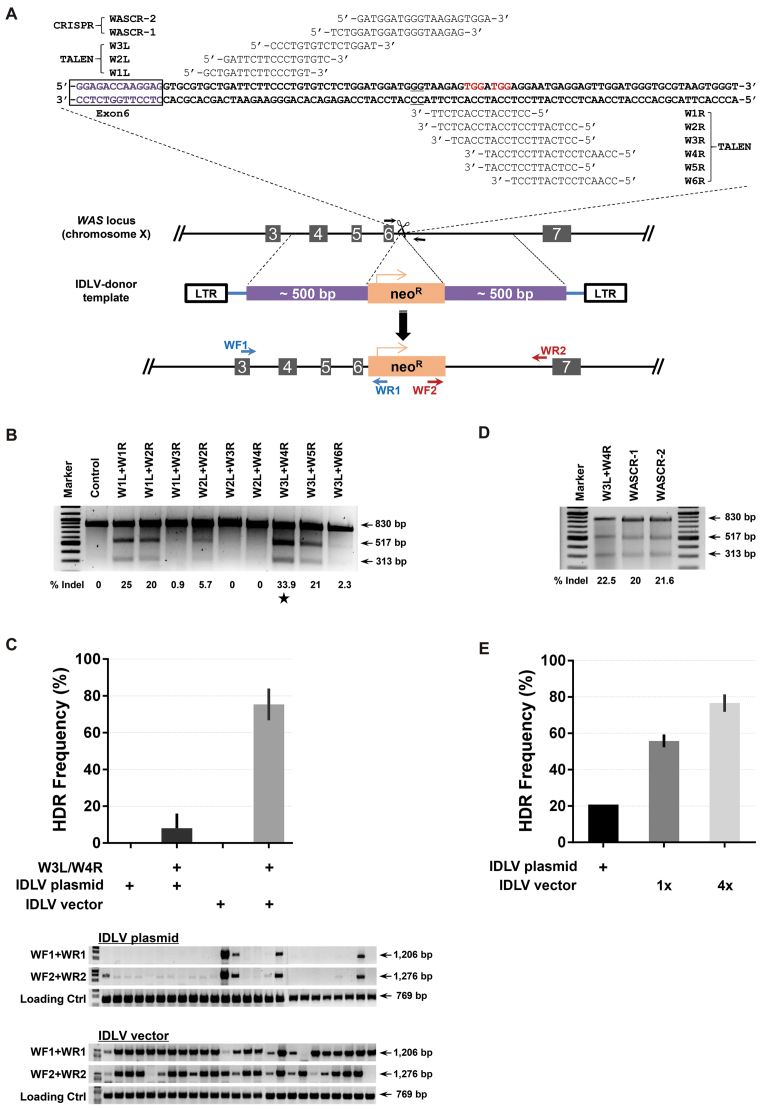
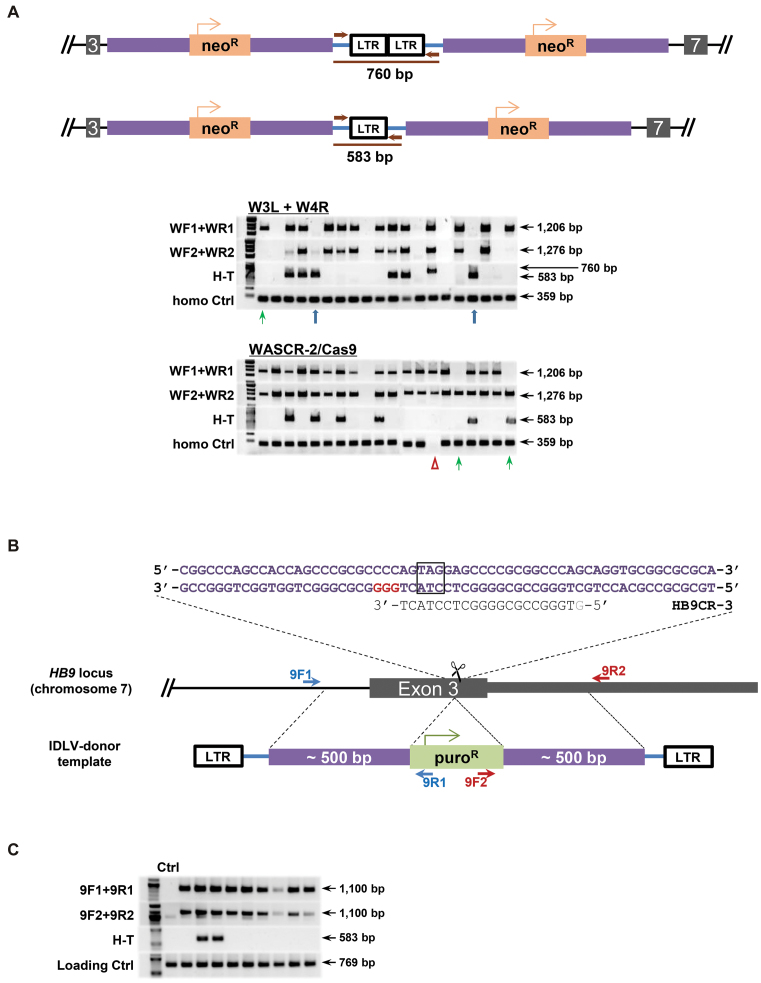
Human embryonic stem cells (hESCs) are used as platforms for disease study, drug screening and cell-based therapy. To facilitate these applications, it is frequently necessary to genetically manipulate the hESC genome. Gene editing with engineered nucleases enables site-specific genetic modification of the human genome through homology-directed repair (HDR). However, the frequency of HDR remains low in hESCs. We combined efficient expression of engineered nucleases and integration-defective lentiviral vector (IDLV) transduction for donor template delivery to mediate HDR in hESC line WA09. This strategy led to highly efficient HDR with more than 80% of the selected WA09 clones harboring the transgene inserted at the targeted genomic locus. However, certain portions of the HDR clones contained the concatemeric IDLV genomic structure at the target site, probably resulted from recombination of the IDLV genomic input before HDR with the target. We found that the integrase protein of IDLV mediated the highly efficient HDR through the recruitment of a cellular protein, LEDGF/p75. This study demonstrates that IDLV-mediated HDR is a powerful and broadly applicable technology to carry out site-specific gene modification in hESCs.
Overview
The claims and statistics of this paper haven’t been checked yet.
Free: it reads the open-access text and checks the first 5 claims that cite a source we can check. Create a free account to check every claim.
Integrity signals
Registry
Cites
Statistics
Figures

Verification
Claims the paper makes
The claims and statistics of this paper haven’t been checked yet.
Free: it reads the open-access text and checks the first 5 claims that cite a source we can check. Create a free account to check every claim.
Claims other papers make about this one
Each is checked against this paper’s own text: does it say what the citing paper says it does?
The source backs part of the claim, not all of it — or backs it for a different population, condition or comparison.
In the citing paper
“This system enables transient delivery of sgRNA and donor DNA without genomic integration, minimising off-target and random risks while bypassing the need for electroporation [9,10].”
From Rapid and Robust Generation of Homozygous Fluorescent Reporter Knock-In Cell Pools by CRISPR-Cas9 (2025) · cites this paper as [9]
Experimental — accuracy not yet measured
Self-check
Percentages, sums and reported differences re-computed from the paper’s own numbers.
The self-check needs the paper’s full text.
Citations
Cites
1 retracted
Mitosis Inhibits DNA Double-Strand Break Repair to Guard Against Telomere Fusions
Orthwein, A., Fradet-Turcotte, A., Noordermeer, S. M., Canny, M. D., Brun, C. M., Strecker, J., Escribano-Diaz, C., & Durocher, D. (2014) · Science · doi:10.1126/science.1248024 · Cited by 319
RetractedMultiplex Genome Engineering Using CRISPR/Cas Systems
Cong, L., Ran, F. A., Cox, D., Lin, S., Barretto, R., Habib, N., Hsu, P. D., Wu, X., Jiang, W., Marraffini, L. A., et al. (2013) · Science · doi:10.1126/science.1231143 · Cited by 15,339
The mechanism of double-strand DNA break repair by the nonhomologous DNA end-joining pathway
Lieber, M. R. (2010) · Annual Review of Biochemistry · doi:10.1146/annurev.biochem.052308.093131 · Cited by 2,882
Cermak, T., Doyle, E. L., Christian, M., Wang, L., Zhang, Y., Schmidt, C., Baller, J. A., Somia, N. V., Bogdanove, A. J., & Voytas, D. F. (2011) · Nucleic Acids Research · doi:10.1093/nar/gkr218 · Cited by 1,787
Human CtIP promotes DNA end resection
Sartori, A. A., Lukas, C., Coates, J., Mistrik, M., Fu, S., Bartek, J., Baer, R., Lukas, J., & Jackson, S. P. (2007) · Nature · doi:10.1038/nature06337 · Cited by 1,362 · cited 14×
“The frequency of HDR is generally lower and more variable than NHEJ, likely caused by the competition with NHEJ for repairing DSBs and specific suppression of HDR in M and early G1 phases to prevent telomere fusion (5).”
BackgroundInfluentialRegulation of DNA double-strand break repair pathway choice
Shrivastav, M., De Haro, L. P., & Nickoloff, J. A. (2008) · Cell Research · doi:10.1038/cr.2007.111 · Cited by 1,329
Chu, V. T., Weber, T., Wefers, B., Wurst, W., Sander, S., Rajewsky, K., & Kühn, R. (2015) · Nature Biotechnology · doi:10.1038/nbt.3198 · Cited by 1,210
A guide to genome engineering with programmable nucleases
Kim, H., & Kim, J.-S. (2014) · Nature Reviews Genetics · doi:10.1038/nrg3686 · Cited by 1,163
Maruyama, T., Dougan, S. K., Truttmann, M. C., Bilate, A. M., Ingram, J. R., & Ploegh, H. L. (2015) · Nature Biotechnology · doi:10.1038/nbt.3190 · Cited by 1,137
Regulation of Homologous Recombination in Eukaryotes
Heyer, W.-D., Ehmsen, K. T., & Liu, J. (2010) · Annual Review of Genetics · doi:10.1146/annurev-genet-051710-150955 · Cited by 1,066
Cited by
CRISPR-Cas9-mediated homology-directed repair for precise gene editing
Liao, H., Wu, J., VanDusen, N. J., Li, Y., & Zheng, Y. (2024) · Molecular Therapy Nucleic Acids · doi:10.1016/j.omtn.2024.102344 · Cited by 164
Zhang, B.-C., Luo, B.-Y., Zou, J., Wu, P., Jiang, J., Le, J., Zhao, R., Chen, L., & Shao, J. (2020) · ACS Applied Materials & Interfaces · doi:10.1021/acsami.0c17660 · Cited by 141
Liu, B., He, X., Xu, C., Xu, L., Ai, S., Cheng, S., & Zhuo, R. (2018) · Biomacromolecules · doi:10.1021/acs.biomac.8b00511 · Cited by 68
Efficient Homology-Directed Repair with Circular Single-Stranded DNA Donors
Iyer, S., Mir, A., Vega‐Badillo, J., Roscoe, B. P., Ibraheim, R., Zhu, L. J., Lee, J., Liu, P., Luk, K., Mintzer, E., et al. (2022) · The CRISPR Journal · doi:10.1089/crispr.2022.0058 · Cited by 69
Approach for in vivo delivery of CRISPR/Cas system: a recent update and future prospect
Chuang, Y.-F., Phipps, A. J., Lin, F., Hecht, V. F. G., Hewitt, A. W., Wang, P., & Liu, G. (2021) · Cellular and Molecular Life Sciences · doi:10.1007/s00018-020-03725-2 · Cited by 57
Metadata
- Authors
- Wang, Y., Wang, Y., Chang, T., Huang, H., & Yee, J.-K.
- Affiliations
- City Of Hope National Medical Center (US)
- First Affiliated Hospital Zhejiang University (CN)
- Corresponding author
- Huang, He
- Yee, Jiing-Kuan
- Venue
- Nucleic Acids Research
- Publisher
- Oxford University Press (OUP)
- Published
- 2016-11-29
- Volume
- 45
- Issue
- 5
- Pages
- e29-e29
- ISSN
- 0305-1048 (ISSN-L)
- 1362-4962
- PMC
- PMC5389720
- OpenAlex
- W2558737962
- Cited by
- 26
- References
- 49
- Citations by year
- 2026: 1 · 2025: 2 · 2024: 2 · 2023: 2 · 2022: 2 · 2021: 4 · 2020: 3 · 2019: 4 · 2018: 3 · 2017: 3
- FWCI
- 1.73
- Type
- journal article
- Language
- en
- Open access
- gold
- doi.org
- Licence
- Locations
- Nucleic Acids Research (publishedVersion, cc-by-nc)
- Europe PMC (PubMed Central) (publishedVersion, cc-by-nc)
- PubMed Central (publishedVersion, cc-by-nc)
- PubMed (publishedVersion)
- Funders
- City of Hope (P30CA033572)
- National Natural Science Foundation of China (81230014, 81520108002)
- National Institutes of Health
- National Cancer Institute (P30CA033572)
- Natural Science Foundation of Zhejiang Province (81230014)
- Topics
- Life Sciences › Biochemistry, Genetics and Molecular Biology › Molecular Biology › CRISPR and Genetic Engineering
- Life Sciences › Biochemistry, Genetics and Molecular Biology › Genetics › Virus-based gene therapy research
- Life Sciences › Biochemistry, Genetics and Molecular Biology › Molecular Biology › Pluripotent Stem Cells Research
- Keywords
- homology-directed repair, human embryonic stem cells, engineered nucleases, LEDGF/p75, integrase
- MeSH terms
- Human Embryonic Stem Cells, Gene Editing, Base Sequence, Cell Line, Genetic Vectors, Humans, Transcription Factors, Viral Proteins, Genome, Human, Lentivirus, Integrases, DNA, Concatenated, Adaptor Proteins, Signal Transducing, Recombinational DNA Repair
About these checks
Registry, retraction, Cites and statistics results are computed, not judged, with one exception: a printed reference that no index lists is read once by a model before it counts as a citation error. Claims are extracted by a model and kept only when their quote appears verbatim in the text; each cited source is then checked, with a model’s help, for whether it says what the claim relies on. Those verdicts can be wrong — read the claim’s quote and the cited source before relying on one.
Statistics and arithmetic are recomputed, not judged.
Confidence bands are shown only for fields calibrated on our annotated test set. None is calibrated yet, so no band is shown.
What counts as a claim ›How we measure confidence ›How we check this ›
Are you an author, or do you see a problem with this page? Request a review
How to cite
Cite CoChat for the checks on this page, and the paper for its own findings.
- This page
- CoChat. (2026). Citation check: Integration-defective lentiviral vector mediates efficient gene editing through homology-directed repair in human embryonic stem cells. https://app.cochat.ai/papers/10.1093/nar/gkw1057
- The paper
- Wang, Y., Wang, Y., Chang, T., Huang, H., & Yee, J.-K. (2017). Integration-defective lentiviral vector mediates efficient gene editing through homology-directed repair in human embryonic stem cells. Nucleic Acids Research. https://doi.org/10.1093/nar/gkw1057
Data sources
Bibliographic data: Semantic Scholar, OpenAlex, Crossref.
Contains information from the Semantic Scholar Academic Graph Datasets, made available under the ODC Attribution License (ODC-BY 1.0).
Semantic Scholar’s data is described in: Kinney, R., et al. (2023). The Semantic Scholar Open Data Platform. arXiv:2301.10140.
