

The DOI matches its Crossref record; 43 of the 43 references it cites were found in a registry or an index.
How far from the SNP may the causative genes be?
Open accessAbstract
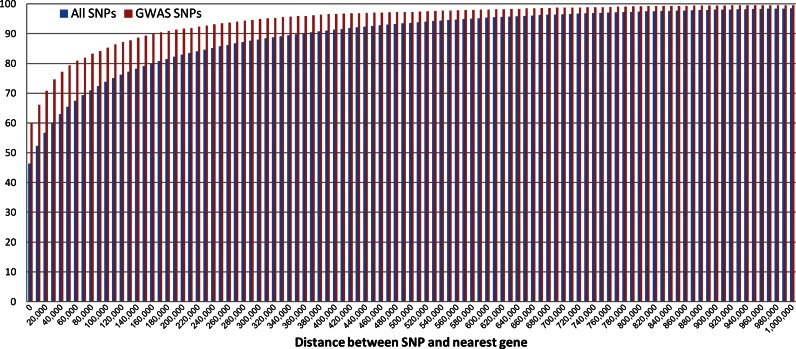
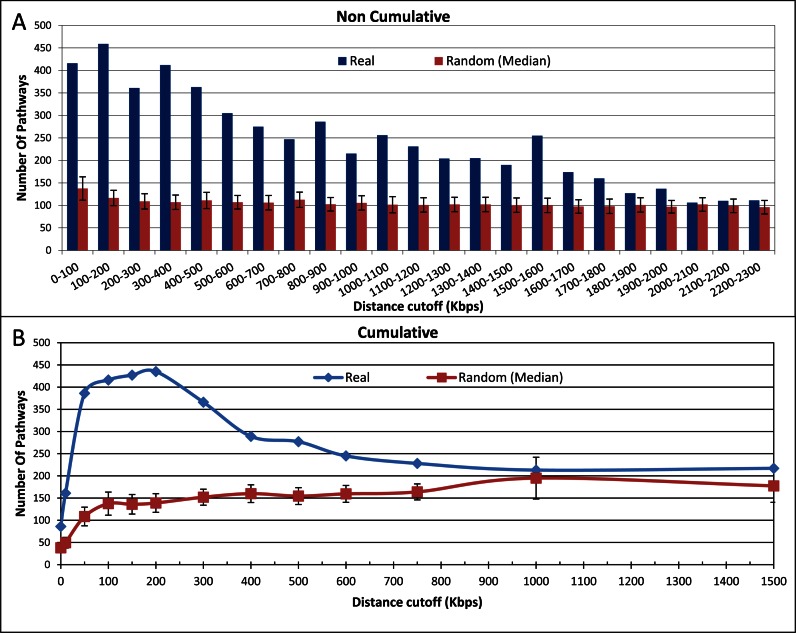
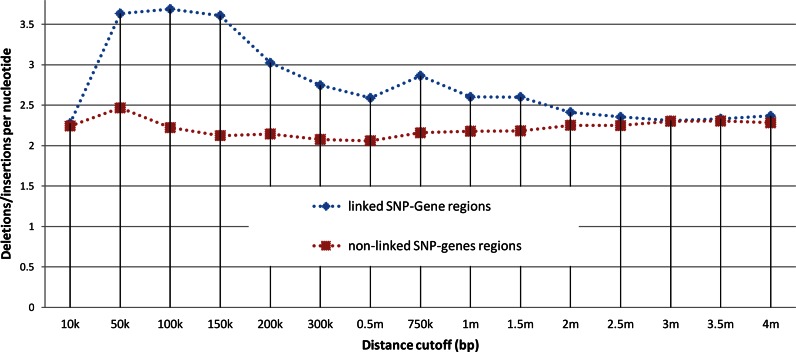
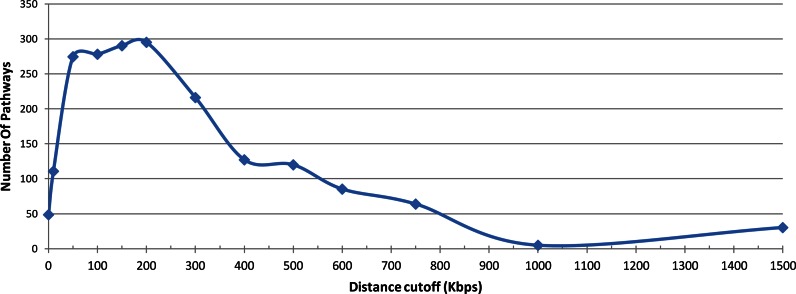
While GWAS identify many disease-associated SNPs, using them to decipher disease mechanisms is hindered by the difficulty in mapping SNPs to genes. Most SNPs are in non-coding regions and it is often hard to identify the genes they implicate. To explore how far the SNP may be from the affected genes we used a pathway-based approach. We found that affected genes are often up to 2 Mbps away from the associated SNP, and are not necessarily the closest genes to the SNP. Existing approaches for mapping SNPs to genes leave many SNPs unmapped to genes and reveal only 86 significant phenotype-pathway associations for all known GWAS hits combined. Using the pathway-based approach we propose here allows mapping of virtually all SNPs to genes and reveals 435 statistically significant phenotype-pathway associations. In search for mechanisms that may explain the relationships between SNPs and distant genes, we found that SNPs that are mapped to distant genes have significantly more large insertions/deletions around them than other SNPs, suggesting that these SNPs may sometimes be markers for large insertions/deletions that may affect large genomic regions.
Overview
The claims and statistics of this paper haven’t been checked yet.
Run the check — free, no account needed. It reads the open-access text and checks the sources it cites.
Integrity signals
Registry
Cites
Statistics
Figures
Verification
Claims the paper makes
The claims and statistics of this paper haven’t been checked yet.
Run the check — free, no account needed. It reads the open-access text and checks the sources it cites.
Claims other papers make about this one
Each is checked against this paper’s own text: does it say what the citing paper says it does?
In the citing paper
“There has been a growing appreciation in recent years that simply assigning a GWAS-identified SNP to the nearest gene in linear genomic space may lead to false associations [174].”
From Genetic architecture of Alzheimer's disease (2020) · cites this paper as [174]
Self-check
Percentages, sums and reported differences re-computed from the paper’s own numbers.
The self-check needs the paper’s full text.
Citations
Cites
Comprehensive Mapping of Long-Range Interactions Reveals Folding Principles of the Human Genome
Lieberman-Aiden, E., van Berkum, N. L., Williams, L., Imakaev, M., Ragoczy, T., Telling, A., Amit, I., Lajoie, B. R., Sabo, P. J., Dorschner, M. O., et al. (2009) · Science · doi:10.1126/science.1181369 · Cited by 8,898
dbSNP: the NCBI database of genetic variation
Sherry, S. T. (2001) · Nucleic Acids Research · doi:10.1093/nar/29.1.308 · Cited by 7,502
Hindorff, L. A., Sethupathy, P., Junkins, H. A., Ramos, E. M., Mehta, J. P., Collins, F. S., & Manolio, T. A. (2009) · Proceedings of the National Academy of Sciences · doi:10.1073/pnas.0903103106 · Cited by 4,013
The NHGRI GWAS Catalog, a curated resource of SNP-trait associations
Welter, D., MacArthur, J., Morales, J., Burdett, T., Hall, P., Junkins, H., Klemm, A., Flicek, P., Manolio, T., Hindorff, L., et al. (2014) · Nucleic Acids Research · doi:10.1093/nar/gkt1229 · Cited by 2,707
KEGG for representation and analysis of molecular networks involving diseases and drugs
Kanehisa, M., Goto, S., Furumichi, M., Tanabe, M., & Hirakawa, M. (2010) · Nucleic Acids Research · doi:10.1093/nar/gkp896 · Cited by 2,322
The Framingham Heart Study and the epidemiology of cardiovascular disease: a historical perspective
Mahmood, S. S., Levy, D., Vasan, R. S., & Wang, T. J. (2014) · The Lancet · doi:10.1016/s0140-6736(13)61752-3 · Cited by 1,622
Genetic Mapping in Human Disease
Altshuler, D., Daly, M. J., & Lander, E. S. (2008) · Science · doi:10.1126/science.1156409 · Cited by 1,452
The Database of Genomic Variants: a curated collection of structural variation in the human genome
MacDonald, J. R., Ziman, R., Yuen, R. K. C., Feuk, L., & Scherer, S. W. (2013) · Nucleic Acids Research · doi:10.1093/nar/gkt958 · Cited by 1,370
Enhancer function: new insights into the regulation of tissue-specific gene expression
Ong, C.-T., & Corces, V. G. (2011) · Nature Reviews Genetics · doi:10.1038/nrg2957 · Cited by 929
Pathway-Based Approaches for Analysis of Genomewide Association Studies
Wang, K., Li, M., & Bućan, M. (2007) · The American Journal of Human Genetics · doi:10.1086/522374 · Cited by 860
Cited by
Sorted by citations
Immune complement and coagulation dysfunction in adverse outcomes of SARS-CoV-2 infection
Ramlall, V., Thangaraj, P., Meydan, C., Foox, J., Butler, D., Kim, J., May, B., Freitas, J. K. D., Glicksberg, B. S., Mason, C. E., et al. (2020) · Nature Medicine · doi:10.1038/s41591-020-1021-2 · Cited by 356
Dapas, M., Lin, F. T. J., Nadkarni, G. N., Sisk, R., Legro, R. S., Urbanek, M., Hayes, M. G., & Dunaif, A. (2020) · PLOS Medicine · doi:10.1371/journal.pmed.1003132 · Cited by 297
Genetic variants in mRNA untranslated regions
Steri, M., Idda, M. L., Whalen, M. B., & Orrù, V. (2018) · Wiley Interdisciplinary Reviews - RNA · doi:10.1002/wrna.1474 · Cited by 209
Biophysical and Mechanistic Models for Disease-Causing Protein Variants
Stein, A., Fowler, D. M., Hartmann‐Petersen, R., & Lindorff‐Larsen, K. (2019) · Trends in Biochemical Sciences · doi:10.1016/j.tibs.2019.01.003 · Cited by 167
Liu, Y., Wang, D., He, F., Wang, J., Joshi, T., & Xu, D. H. (2019) · Frontiers in Genetics · doi:10.3389/fgene.2019.01091 · Cited by 160
Metadata
- Authors
- Brodie, A., Azaria, J. R., & Ofran, Y.
- Affiliations
- Bar-Ilan University (IL)
- Corresponding author
- Ofran, Yanay
- Venue
- Nucleic Acids Research
- Publisher
- Oxford University Press (OUP)
- Published
- 2016-06-06
- Volume
- 44
- Issue
- 13
- Pages
- 6046-6054
- ISSN
- 0305-1048 (ISSN-L)
- 1362-4962
- PMC
- PMC5291268
- OpenAlex
- W2411890015
- Cited by
- 172
- References
- 43
- Citations by year
- 2026: 14 · 2025: 14 · 2024: 10 · 2023: 18 · 2022: 26 · 2021: 25 · 2020: 21 · 2019: 23 · 2018: 15 · 2017: 5 · 2016: 1
- FWCI
- 11.85
- Type
- journal article
- Language
- en
- Open access
- gold
- doi.org
- Licence
- Locations
- Nucleic Acids Research (publishedVersion, cc-by-nc)
- PubMed Central (publishedVersion, cc-by-nc)
- PubMed (publishedVersion)
- HighWire Press Open Archive (submittedVersion)
- Topics
- Life Sciences › Biochemistry, Genetics and Molecular Biology › Genetics › Genetic Associations and Epidemiology
- Life Sciences › Biochemistry, Genetics and Molecular Biology › Molecular Biology › Bioinformatics and Genomic Networks
- Life Sciences › Biochemistry, Genetics and Molecular Biology › Genetics › Genetic Mapping and Diversity in Plants and Animals
- Keywords
- single nucleotide polymorphisms, disease-associated SNPs, non-coding SNPs, indels, structural variants, disease mechanisms, genetic distance
- MeSH terms
- Genotype, Humans, Phenotype, Linkage Disequilibrium, Genetic Predisposition to Disease, Polymorphism, Single Nucleotide, INDEL Mutation, Genome-Wide Association Study, Genetic Association Studies
About these checks
Registry, retraction, Cites and statistics results are computed, not judged, with one exception: a printed reference that no index lists is read once by a model before it counts as a citation error. Claims are extracted by a model and kept only when their quote appears verbatim in the text; each cited source is then checked, with a model’s help, for whether it says what the claim relies on. Those verdicts can be wrong — read the claim’s quote and the cited source before relying on one.
Statistics and arithmetic are recomputed, not judged.
Confidence bands are shown only for fields calibrated on our annotated test set. None is calibrated yet, so no band is shown.
What counts as a claim ›How we measure confidence ›How we check this ›
Are you an author, or do you see a problem with this page? Request a review
