

COFACTOR: improved protein function prediction by combining structure, sequence and protein–protein interaction information
Open accessThe DOI matches its Crossref record; 41 of the 41 references it cites were found in a registry or an index.
Abstract
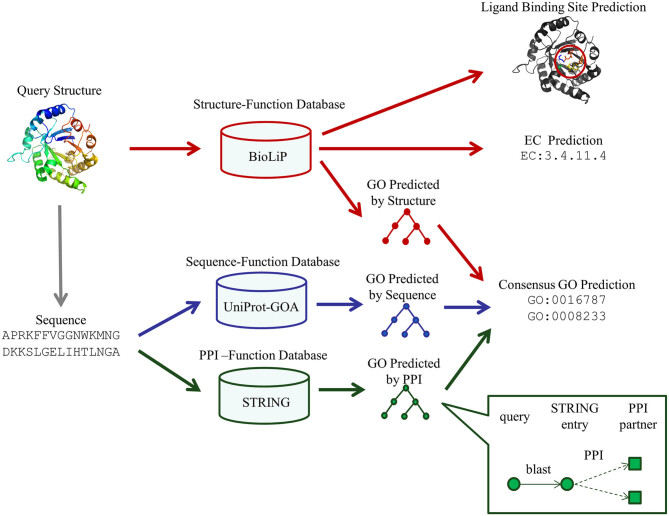
The COFACTOR web server is a unified platform for structure-based multiple-level protein function predictions. By structurally threading low-resolution structural models through the BioLiP library, the COFACTOR server infers three categories of protein functions including gene ontology, enzyme commission and ligand-binding sites from various analogous and homologous function templates. Here, we report recent improvements of the COFACTOR server in the development of new pipelines to infer functional insights from sequence profile alignments and protein–protein interaction networks. Large-scale benchmark tests show that the new hybrid COFACTOR approach significantly improves the function annotation accuracy of the former structure-based pipeline and other state-of-the-art functional annotation methods, particularly for targets that have no close homology templates. The updated COFACTOR server and the template libraries are available at http://zhanglab.ccmb.med.umich.edu/COFACTOR/.
Overview
The claims and statistics of this paper haven’t been checked yet.
Free: it reads the open-access text and checks the first 5 claims that cite a source we can check. Create a free account to check every claim.
Integrity signals
Registry
Cites
Statistics
Figures
Verification
Claims the paper makes
The claims and statistics of this paper haven’t been checked yet.
Free: it reads the open-access text and checks the first 5 claims that cite a source we can check. Create a free account to check every claim.
Claims other papers make about this one
Each is checked against this paper’s own text: does it say what the citing paper says it does?
The source backs part of the claim, not all of it — or backs it for a different population, condition or comparison.
In the citing paper
“Each predicted function has a confidence score (C-scoreFunc) ranging from 0 to 1, with C-scoreFunc > 0.5 corresponding to a confident function prediction.22,25”
From Functions of Essential Genes and a Scale-Free Protein Interaction Network Revealed by Structure-Based Function and Interaction Prediction for a Minimal Genome (2021) · cites this paper as [22]
Experimental — accuracy not yet measuredThe source backs part of the claim, not all of it — or backs it for a different population, condition or comparison.
In the citing paper
“Contrary to popular belief that high resolution structures are required, using ligand homology modeling,45–48 low resolution structures are adequate, with at most a 20% improvement in enrichment factor on going from lower resolution (TM-score > 0.4) to crystal structures.”
From AlphaFold 2: Why It Works and Its Implications for Understanding the Relationships of Protein Sequence, Structure, and Function (2021) · cites this paper as [46]
Experimental — accuracy not yet measuredThe check wasn’t confident either way, so it gives no verdict — never disputed.
In the citing paper
“This pipeline has been shown to accurately assign functions for many proteins in microbes22 and in humans25 and is among the top predictors in the most recent Critical Assessment of Function Annotation round 3 (CAFA3) and CAFA PI competitions.26”
From Functions of Essential Genes and a Scale-Free Protein Interaction Network Revealed by Structure-Based Function and Interaction Prediction for a Minimal Genome (2021) · cites this paper as [22]
Experimental — accuracy not yet measuredIn the citing paper
“We have recently shown that the inclusion of protein structural information, even from computationally predicted structures, can substantially enhance the accuracy of function predictions for difficult annotation targets.22,23”
Self-check
Percentages, sums and reported differences re-computed from the paper’s own numbers.
The self-check needs the paper’s full text.
Citations
Cites
Basic local alignment search tool
Altschul, S. F., Gish, W., Miller, W., Myers, E. W., & Lipman, D. J. (1990) · Journal of Molecular Biology · doi:10.1006/jmbi.1990.9999 · Cited by 98,669
Gapped BLAST and PSI-BLAST: a new generation of protein database search programs
Altschul, S. (1997) · Nucleic Acids Research · doi:10.1093/nar/25.17.3389 · Cited by 73,302
STRING v10: protein–protein interaction networks, integrated over the tree of life
Szklarczyk, D., Franceschini, A., Wyder, S., Forslund, K., Heller, D., Huerta-Cepas, J., Simonovic, M., Roth, A., Santos, A., Tsafou, K. P., et al. (2015) · Nucleic Acids Research · doi:10.1093/nar/gku1003 · Cited by 10,436
The Phyre2 web portal for protein modeling, prediction and analysis
Kelley, L. A., Mezulis, S., Yates, C. M., Wass, M. N., & Sternberg, M. J. E. (2015) · Nature Protocols · doi:10.1038/nprot.2015.053 · Cited by 9,652 · cited 1×
“In the absence of an experimentally solved structure, the user can use models generated by the online structure prediction tools, such as I-TASSER (33,34), QUARK (35), Rosetta (36), HHpred (37) or Phyre2 (38).”
MethodAmino acid substitution matrices from protein blocks.
Henikoff, S., & Henikoff, J. G. (1992) · Proceedings of the National Academy of Sciences · doi:10.1073/pnas.89.22.10915 · Cited by 6,218
I-TASSER: a unified platform for automated protein structure and function prediction
Roy, A., Kucukural, A., & Zhang, Y. (2010) · Nature Protocols · doi:10.1038/nprot.2010.5 · Cited by 6,170
Self-citationThe I-TASSER Suite: protein structure and function prediction
Yang, J., Yan, R., Roy, A., Xu, D., Poisson, J., & Zhang, Y. (2015) · Nature Methods · doi:10.1038/nmeth.3213 · Cited by 5,596 · cited 5×
“The input structures for COFACTOR were predicted by I-TASSER (23) with all homologous structural templates with a sequence identity >30% to the query excluded, thus simulating predictions for a target without any close homologs.”
MethodInfluentialSelf-citationI-TASSER server for protein 3D structure prediction
Zhang, Y. (2008) · BMC Bioinformatics · doi:10.1186/1471-2105-9-40 · Cited by 5,124
Self-citationUniProt: a hub for protein information
The UniProt Consortium (2015) · Nucleic Acids Research · doi:10.1093/nar/gku989 · Cited by 5,106
Intrinsically unstructured proteins and their functions
Dyson, H. J., & Wright, P. E. (2005) · Nature Reviews Molecular Cell Biology · doi:10.1038/nrm1589 · Cited by 3,871
TM-align: a protein structure alignment algorithm based on the TM-score
Zhang, Y. (2005) · Nucleic Acids Research · doi:10.1093/nar/gki524 · Cited by 3,774
Self-citationXSEDE: Accelerating Scientific Discovery
Towns, J., Cockerill, T., Dahan, M., Foster, I., Gaither, K., Grimshaw, A., Hazlewood, V., Lathrop, S., Lifka, D., Peterson, G. D., et al. (2014) · Computing in Science & Engineering · doi:10.1109/mcse.2014.80 · Cited by 3,109
Announcing the worldwide Protein Data Bank
Berman, H., Henrick, K., & Nakamura, H. (2003) · Nature Structural & Molecular Biology · doi:10.1038/nsb1203-980 · Cited by 3,093
Scoring function for automated assessment of protein structure template quality
Zhang, Y., & Skolnick, J. (2004) · Proteins: Structure, Function, and Bioinformatics · doi:10.1002/prot.20264 · Cited by 2,392
Self-citationProtein structure prediction and analysis using the Robetta server
Kim, D. E., Chivian, D., & Baker, D. (2004) · Nucleic Acids Research · doi:10.1093/nar/gkh468 · Cited by 2,111
UniRef clusters: a comprehensive and scalable alternative for improving sequence similarity searches
Suzek, B. E., Wang, Y., Huang, H., McGarvey, P. B., Wu, C. H., & the UniProt Consortium (2015) · Bioinformatics · doi:10.1093/bioinformatics/btu739 · Cited by 1,928
Fpocket: An open source platform for ligand pocket detection
Le Guilloux, V., Schmidtke, P., & Tuffery, P. (2009) · BMC Bioinformatics · doi:10.1186/1471-2105-10-168 · Cited by 1,653
A large-scale evaluation of computational protein function prediction
Radivojac, P., Clark, W. T., Oron, T. R., Schnoes, A. M., Wittkop, T., Sokolov, A., Graim, K., Funk, C., Verspoor, K., Ben-Hur, A., et al. (2013) · Nature Methods · doi:10.1038/nmeth.2340 · Cited by 1,028 · cited 4×
“Supplementary Figure S1 in the Supplementary Data shows the performance of the COFACTOR server on the three aspects of GO terms: molecular function (MF), biological process (BP) and cellular component (CC); results are shown in comparison with those of the GoFDR program (25), one of the top performing methods in CAFA2…”
MethodInfluentialRogers, D. J., & Tanimoto, T. T. (1960) · Science · doi:10.1126/science.132.3434.1115 · Cited by 877
Xu, D., & Zhang, Y. (2012) · Proteins: Structure, Function, and Bioinformatics · doi:10.1002/prot.24065 · Cited by 856
Self-citationBoutet, E., Lieberherr, D., Tognolli, M., Schneider, M., Bansal, P., Bridge, A. J., Poux, S., Bougueleret, L., & Xenarios, I. (2016) · Methods in Molecular Biology · doi:10.1007/978-1-4939-3167-5_2 · Cited by 807
BioLiP: a semi-manually curated database for biologically relevant ligand–protein interactions
Yang, J., Roy, A., & Zhang, Y. (2012) · Nucleic Acids Research · doi:10.1093/nar/gks966 · Cited by 759
Self-citationCOFACTOR: an accurate comparative algorithm for structure-based protein function annotation
Roy, A., Yang, J., & Zhang, Y. (2012) · Nucleic Acids Research · doi:10.1093/nar/gks372 · Cited by 706
Self-citationNagano, N., Orengo, C. A., & Thornton, J. M. (2002) · Journal of Molecular Biology · doi:10.1016/s0022-2836(02)00649-6 · Cited by 617
The GOA database in 2009--an integrated Gene Ontology Annotation resource
Barrell, D., Dimmer, E., Huntley, R. P., Binns, D., O'Donovan, C., & Apweiler, R. (2009) · Nucleic Acids Research · doi:10.1093/nar/gkn803 · Cited by 554
EcoCyc: fusing model organism databases with systems biology
Keseler, I. M., Mackie, A., Peralta-Gil, M., Santos-Zavaleta, A., Gama-Castro, S., Bonavides-Martínez, C., Fulcher, C., Huerta, A. M., Kothari, A., Krummenacker, M., et al. (2013) · Nucleic Acids Research · doi:10.1093/nar/gks1027 · Cited by 542
Fast and accurate automatic structure prediction with HHpred
Hildebrand, A., Remmert, M., Biegert, A., & Söding, J. (2009) · Proteins: Structure, Function, and Bioinformatics · doi:10.1002/prot.22499 · Cited by 469
Capra, J. A., Laskowski, R. A., Thornton, J. M., Singh, M., & Funkhouser, T. A. (2009) · PLoS Computational Biology · doi:10.1371/journal.pcbi.1000585 · Cited by 458
Webb, E. C. (1992) · Academic Press eBooks · Cited by 444
An expanded evaluation of protein function prediction methods shows an improvement in accuracy
Jiang, Y., Oron, T. R., Clark, W. T., Bankapur, A. R., D’Andrea, D., Lepore, R., Funk, C. S., Kahanda, I., Verspoor, K. M., Ben-Hur, A., et al. (2016) · Genome Biology · doi:10.1186/s13059-016-1037-6 · Cited by 396
A threading-based method (FINDSITE) for ligand-binding site prediction and functional annotation
Brylinski, M., & Skolnick, J. (2008) · Proceedings of the National Academy of Sciences · doi:10.1073/pnas.0707684105 · Cited by 333
Protein structure prediction: when is it useful?
Zhang, Y. (2009) · Current Opinion in Structural Biology · doi:10.1016/j.sbi.2009.02.005 · Cited by 277
Self-citationHanson, R. M., Prilusky, J., Renjian, Z., Nakane, T., & Sussman, J. L. (2013) · Israel Journal of Chemistry · doi:10.1002/ijch.201300024 · Cited by 261
Wang, C. D., Buck, M. A., & Fraser, C. M. (1991) · Molecular Pharmacology · doi:10.1016/s0026-895x(25)12922-2 · Cited by 223
The Catalytic Site Atlas 2.0: cataloging catalytic sites and residues identified in enzymes
Furnham, N., Holliday, G. L., de Beer, T. A. P., Jacobsen, J. O. B., Pearson, W. R., & Thornton, J. M. (2014) · Nucleic Acids Research · doi:10.1093/nar/gkt1243 · Cited by 181
Roy, A., & Zhang, Y. (2012) · Structure · doi:10.1016/j.str.2012.03.009 · Cited by 125
Self-citationQuantitative sequence-function relationships in proteins based on gene ontology
Sangar, V., Blankenberg, D. J., Altman, N., & Lesk, A. M. (2007) · BMC Bioinformatics · doi:10.1186/1471-2105-8-294 · Cited by 106
BSP‐SLIM: A blind low‐resolution ligand‐protein docking approach using predicted protein structures
Lee, H. S., & Zhang, Y. (2011) · Proteins Structure Function and Bioinformatics · doi:10.1002/prot.23165 · Cited by 85
Self-citationGoFDR: A sequence alignment based method for predicting protein functions
Gong, Q., Ning, W., & Tian, W. (2015) · Methods · doi:10.1016/j.ymeth.2015.08.009 · Cited by 83
Assessment of ligand‐binding residue predictions in CASP9
Schmidt, T., Haas, J., Cassarino, T. G., & Schwede, T. F. (2011) · Proteins Structure Function and Bioinformatics · doi:10.1002/prot.23174 · Cited by 83
Yu, C., Zavaljevski, N., Desai, V., et al. (2008) · BMC Bioinformatics · doi:10.1186/1471-2105-9-52 · Cited by 33
Cited by
Zitnik, M., Nguyen, F., Wang, B., Leskovec, J., Goldenberg, A., & Hoffman, M. M. (2019) · Information Fusion · doi:10.1016/j.inffus.2018.09.012 · Cited by 675
PrankWeb: a web server for ligand binding site prediction and visualization
Jendele, L., Krivak, R., Skoda, P., Novotny, M., & Hoksza, D. (2019) · Nucleic Acids Research · doi:10.1093/nar/gkz424 · Cited by 529
Zhou, X., Zheng, W., Li, Y., Pearce, R., Zhang, C., Bell, E. W., Zhang, G., & Zhang, Y. (2022) · Nature Protocols · doi:10.1038/s41596-022-00728-0 · Cited by 519
Self-citationUS-align: universal structure alignments of proteins, nucleic acids, and macromolecular complexes
Zhang, C., Shine, M., Pyle, A. M., & Zhang, Y. (2022) · Nature Methods · doi:10.1038/s41592-022-01585-1 · Cited by 511
Self-citationEnzyme function prediction using contrastive learning
Yu, T., Cui, H., Li, J. C., Luo, Y., Jiang, G., & Zhao, H. (2023) · Science · doi:10.1126/science.adf2465 · Cited by 440
Metadata
- Authors
- Zhang, C., Freddolino, L., & Zhang, Y.
- Affiliations
- University of Michigan (US)
- Corresponding author
- Zhang, Yang
- Venue
- Nucleic Acids Research
- Publisher
- Oxford University Press (OUP)
- Published
- 2017-05-02
- Volume
- 45
- Issue
- W1
- Pages
- W291-W299
- ISSN
- 0305-1048 (ISSN-L)
- 1362-4962
- PMC
- PMC5793808
- OpenAlex
- W2611792444
- Cited by
- 606
- References
- 41
- Citations by year
- 2026: 34 · 2025: 62 · 2024: 76 · 2023: 100 · 2022: 91 · 2021: 92 · 2020: 80 · 2019: 47 · 2018: 21 · 2017: 3
- FWCI
- 16.86
- Type
- journal article
- Language
- en
- Open access
- gold
- doi.org
- Licence
- Locations
- Nucleic Acids Research (publishedVersion, cc-by-nc)
- PubMed Central (publishedVersion, cc-by-nc)
- PubMed (publishedVersion)
- Funders
- National Science Foundation (1564756)
- National Institutes of Health
- National Institute of General Medical Sciences (R01GM116960, R01GM083107, R00GM097033)
- Topics
- Life Sciences › Biochemistry, Genetics and Molecular Biology › Molecular Biology › Protein Structure and Dynamics
- Life Sciences › Biochemistry, Genetics and Molecular Biology › Molecular Biology › Bioinformatics and Genomic Networks
- Life Sciences › Biochemistry, Genetics and Molecular Biology › Molecular Biology › Machine Learning in Bioinformatics
- Keywords
- protein function prediction, protein-protein interaction network, Gene Ontology, ligand binding sites
- MeSH terms
- Binding Sites, Enzymes, Ligands, Protein Conformation, Proteins, Software, Sequence Alignment, Internet, Sequence Analysis, Protein, Protein Interaction Mapping, Molecular Sequence Annotation, Gene Ontology
About these checks
Registry, retraction, Cites and statistics results are computed, not judged, with one exception: a printed reference that no index lists is read once by a model before it counts as a citation error. Claims are extracted by a model and kept only when their quote appears verbatim in the text; each cited source is then checked, with a model’s help, for whether it says what the claim relies on. Those verdicts can be wrong — read the claim’s quote and the cited source before relying on one.
Statistics and arithmetic are recomputed, not judged.
Confidence bands are shown only for fields calibrated on our annotated test set. None is calibrated yet, so no band is shown.
What counts as a claim ›How we measure confidence ›How we check this ›
Are you an author, or do you see a problem with this page? Request a review
Data sources
Bibliographic data: Semantic Scholar, OpenAlex, Crossref.
Contains information from the Semantic Scholar Academic Graph Datasets, made available under the ODC Attribution License (ODC-BY 1.0).
Semantic Scholar’s data is described in: Kinney, R., et al. (2023). The Semantic Scholar Open Data Platform. arXiv:2301.10140.
