

The DOI matches its Crossref record; 64 of the 65 references it cites were found in a registry or an index.
Using neural networks for reducing the dimensions of single-cell RNA-Seq data
Open accessPublished version of a preprint
Abstract
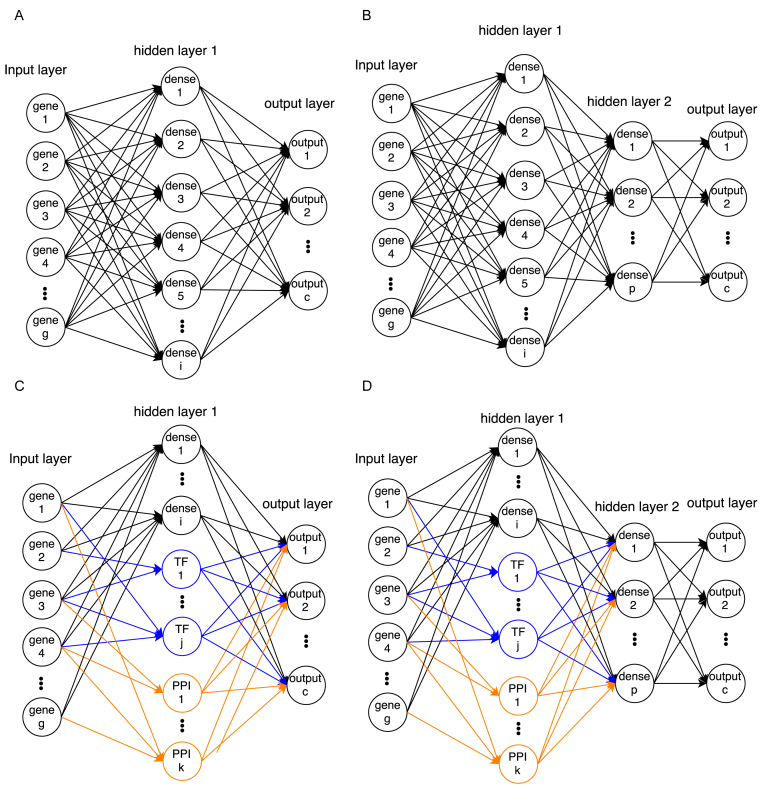
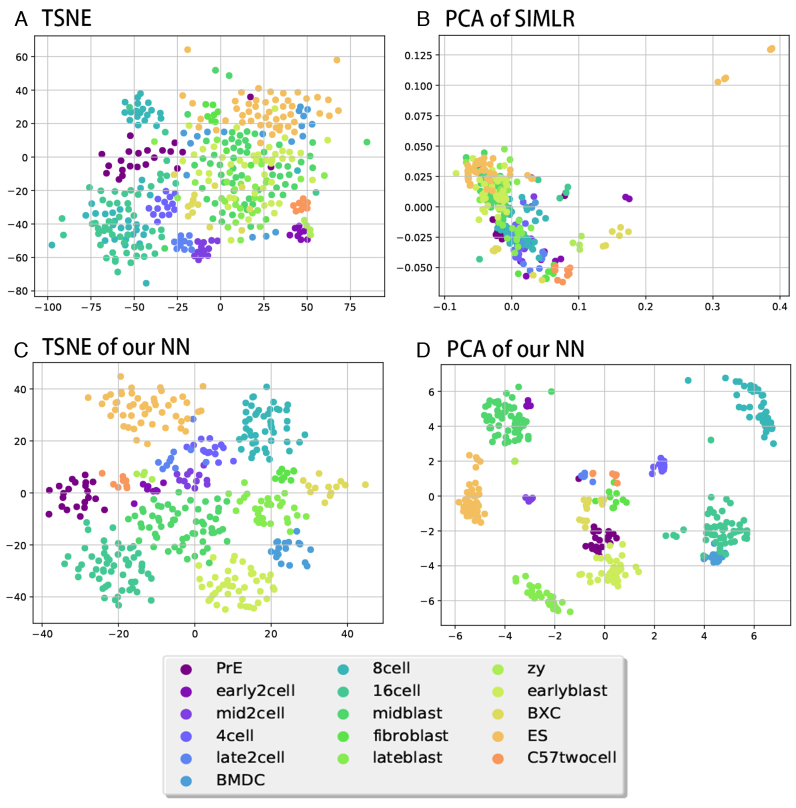
While only recently developed, the ability to profile expression data in single cells (scRNA-Seq) has already led to several important studies and findings. However, this technology has also raised several new computational challenges. These include questions about the best methods for clustering scRNA-Seq data, how to identify unique group of cells in such experiments, and how to determine the state or function of specific cells based on their expression profile. To address these issues we develop and test a method based on neural networks (NN) for the analysis and retrieval of single cell RNA-Seq data. We tested various NN architectures, some of which incorporate prior biological knowledge, and used these to obtain a reduced dimension representation of the single cell expression data. We show that the NN method improves upon prior methods in both, the ability to correctly group cells in experiments not used in the training and the ability to correctly infer cell type or state by querying a database of tens of thousands of single cell profiles. Such database queries (which can be performed using our web server) will enable researchers to better characterize cells when analyzing heterogeneous scRNA-Seq samples.
Overview
The claims and statistics of this paper haven’t been checked yet.
Run the check — free, no account needed. It reads the open-access text and checks the sources it cites.
Integrity signals
Registry
Cites
Statistics
Figures
Verification
Claims the paper makes
The claims and statistics of this paper haven’t been checked yet.
Run the check — free, no account needed. It reads the open-access text and checks the sources it cites.
Claims other papers make about this one
Each is checked against this paper’s own text: does it say what the citing paper says it does?
In the citing paper
“This idea was recently explored by Lin et al. (2017), who predicted cell type and state using a deep neural network for which the structure was determined based on the hierarchical organization of transcriptional regulatory factors in the nucleus.”
From Visible Machine Learning for Biomedicine (2018) · cites this paper as Lin et al., 2017
In the citing paper
“In contrast, direct incorporation of the biological structure of cells and tissues, such as explored by Lin et al. (2017) and Ma et al. (2018), leads to a ready-made working model of how biological inputs, such as genotype, are compressed to determine outcomes.”
From Visible Machine Learning for Biomedicine (2018) · cites this paper as Lin et al., 2017
Self-check
Percentages, sums and reported differences re-computed from the paper’s own numbers.
The self-check needs the paper’s full text.
Citations
Cites
Multilayer feedforward networks are universal approximators
Hornik, K., Stinchcombe, M., & White, H. (1989) · Neural Networks · doi:10.1016/0893-6080(89)90020-8 · Cited by 21,728 · cited 1×
“These networks are universal function approximators (17) and, while training such networks takes longer than the unsupervised methods discussed above, they are very scalable in terms of training when using GPUs.”
BackgroundReducing the dimensionality of data with neural networks
Hinton, G. E., & Salakhutdinov, R. R. (2006) · Science · doi:10.1126/science.1127647 · Cited by 20,928
(2010) · Cited by 14,134
(2016) · Cited by 11,679
NCBI GEO: archive for functional genomics data sets—update
Barrett, T., Wilhite, S. E., Ledoux, P., Evangelista, C., Kim, I. F., Tomashevsky, M., Marshall, K. A., Phillippy, K. H., Sherman, P. M., Holko, M., et al. (2012) · Nucleic Acids Research · doi:10.1093/nar/gks1193 · Cited by 10,418 · cited 2×
“We collected a total of 33 datasets with more than 17 000 single cell expression profiles from published papers and from the Gene Expression Omnibus (21) (GEO).”
MethodMultilayer feedforward networks are universal approximators
HornikK., StinchcombeM., & WhiteH. (1989) · Neural Networks · doi:10.5555/70405.70408 · Cited by 9,266
Hubert, L., & Arabie, P. (1985) · Journal of Classification · doi:10.1007/bf01908075 · Cited by 8,219
(2007) · doi:10.5555/1283383.1283494 · Cited by 7,364
Trapnell, C., Cacchiarelli, D., Grimsby, J., Pokharel, P., Li, S., Morse, M., Lennon, N. J., Livak, K. J., Mikkelsen, T. S., & Rinn, J. L. (2014) · Nature Biotechnology · doi:10.1038/nbt.2859 · Cited by 7,314
Missing Value Estimation Methods for DNA Microarrays
Troyanskaya, O., Cantor, M., Sherlock, G., Brown, P., Hastie, T., Tibshirani, R., Botstein, D., & Altman, R. B. (2001) · Bioinformatics · doi:10.1093/bioinformatics/17.6.520 · Cited by 4,230
Cited by
Sorted by citations
High-performance medicine: the convergence of human and artificial intelligence
Topol, E. J. (2019) · Nature Medicine · doi:10.1038/s41591-018-0300-7 · Cited by 10,450
Deep generative modeling for single-cell transcriptomics
Lopez, R., Regier, J., Cole, M. B., Jordan, M. I., & Yosef, N. (2018) · Nature Methods · doi:10.1038/s41592-018-0229-2 · Cited by 2,530
“In [18], neural networks are used as function approximators reducing the dimension of single-cell RNA sequencing data; however, this model is a supervised learning method and inherently relies on some labeling of the cells.”
MethodOpportunities and obstacles for deep learning in biology and medicine
Ching, T., Himmelstein, D. S., Beaulieu-Jones, B. K., Kalinin, A. A., Do, B. T., Way, G. P., Ferrero, E., Agapow, P.-M., Zietz, M., Hoffman, M. M., et al. (2018) · Journal of The Royal Society Interface · doi:10.1098/rsif.2017.0387 · Cited by 2,310
Eleven grand challenges in single-cell data science
Lähnemann, D., Köster, J., Szczurek, E., McCarthy, D. J., Hicks, S. C., Robinson, M. D., Vallejos, C. A., Campbell, K. R., Beerenwinkel, N., Mahfouz, A., et al. (2020) · Genome Biology · doi:10.1186/s13059-020-1926-6 · Cited by 1,327
Deep learning: new computational modelling techniques for genomics
Eraslan, G., Avsec, Ž., Gagneur, J., & Theis, F. J. (2019) · Nature Reviews Genetics · doi:10.1038/s41576-019-0122-6 · Cited by 1,270
Metadata
- Authors
- Lin, C., Jain, S., Kim, H., & Bar-Joseph, Z.
- Affiliations
- Carnegie Mellon University (US)
- Machine Learning Department, School of Computer Science, Carnegie Mellon University, Pittsburgh, PA 15213, USA
- Venue
- Nucleic Acids Research
- Publisher
- Oxford University Press (OUP)
- Published
- 2017-07-31
- Volume
- 45
- Issue
- 17
- Pages
- e156-e156
- ISSN
- 0305-1048 (ISSN-L)
- 1362-4962
- PMC
- PMC5737331
- OpenAlex
- W2741564801
- Semantic Scholar
- c4d33e602615608d29bb296591591fe4e51b7bf2
- Cited by
- 197
- References
- 65
- Citations by year
- 2026: 4 · 2025: 8 · 2024: 15 · 2023: 14 · 2022: 21 · 2021: 31 · 2020: 43 · 2019: 37 · 2018: 23 · 2017: 1
- FWCI
- 11.62
- Type
- journal article
- Language
- en
- Open access
- gold
- doi.org
- Licence
- Locations
- Nucleic Acids Research (publishedVersion, cc-by-nc)
- bioRxiv (Cold Spring Harbor Laboratory) (acceptedVersion, cc-by-nc-nd)
- PubMed Central (publishedVersion, cc-by-nc)
- PubMed (publishedVersion)
- Funders
- National Science Foundation (1356505)
- National Institutes of Health
- National Heart, Lung, and Blood Institute (U01HL122626)
- Topics
- Life Sciences › Biochemistry, Genetics and Molecular Biology › Molecular Biology › Single-cell and spatial transcriptomics
- Life Sciences › Biochemistry, Genetics and Molecular Biology › Molecular Biology › Gene expression and cancer classification
- Life Sciences › Biochemistry, Genetics and Molecular Biology › Molecular Biology › Gene Regulatory Network Analysis
- Keywords
- single-cell RNA sequencing, dimensionality reduction, artificial neural networks, cell clustering, cell type annotation, heterogeneous cell populations, web server
- MeSH terms
- Gene Expression Regulation, Humans, RNA, Software, Cluster Analysis, Neural Networks, Computer, Sequence Analysis, RNA, Computational Biology, Gene Expression Profiling, Protein Interaction Mapping, Databases, Genetic, Multifactor Dimensionality Reduction, Single-Cell Analysis, Datasets as Topic
About these checks
Registry, retraction, Cites and statistics results are computed, not judged, with one exception: a printed reference that no index lists is read once by a model before it counts as a citation error. Claims are extracted by a model and kept only when their quote appears verbatim in the text; each cited source is then checked, with a model’s help, for whether it says what the claim relies on. Those verdicts can be wrong — read the claim’s quote and the cited source before relying on one.
Statistics and arithmetic are recomputed, not judged.
Confidence bands are shown only for fields calibrated on our annotated test set. None is calibrated yet, so no band is shown.
What counts as a claim ›How we measure confidence ›How we check this ›
Are you an author, or do you see a problem with this page? Request a review
