

The DOI matches its Crossref record; 61 of the 61 references it cites were found in a registry or an index.
Pushing the limits of de novo genome assembly for complex prokaryotic genomes harboring very long, near identical repeats
Published version of a preprint
Abstract
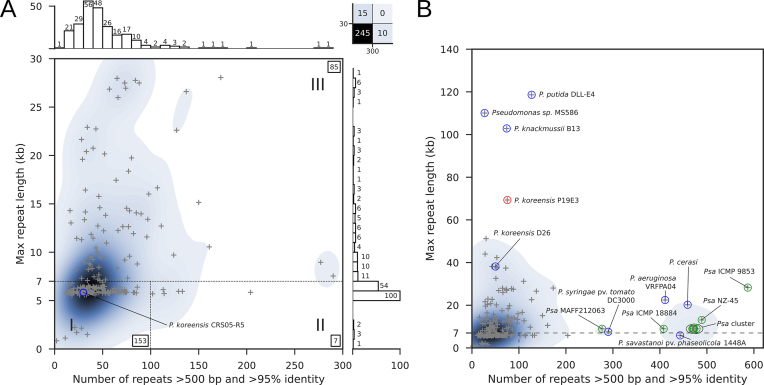
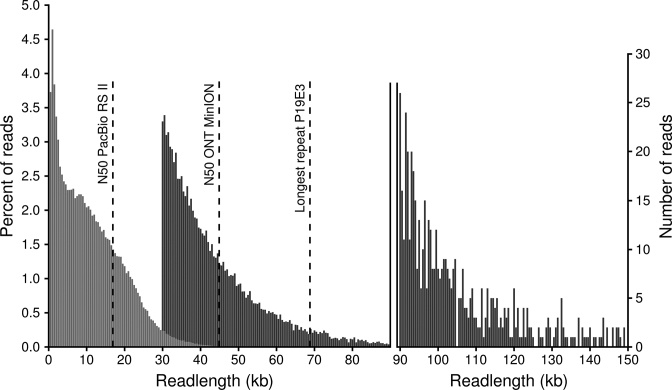
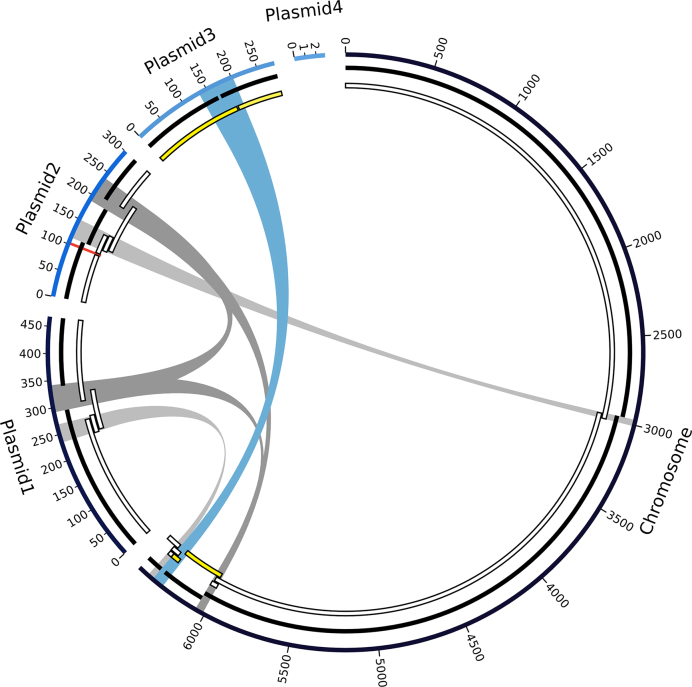
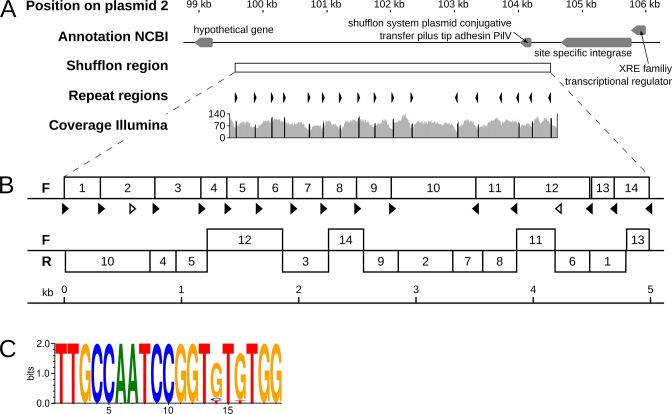
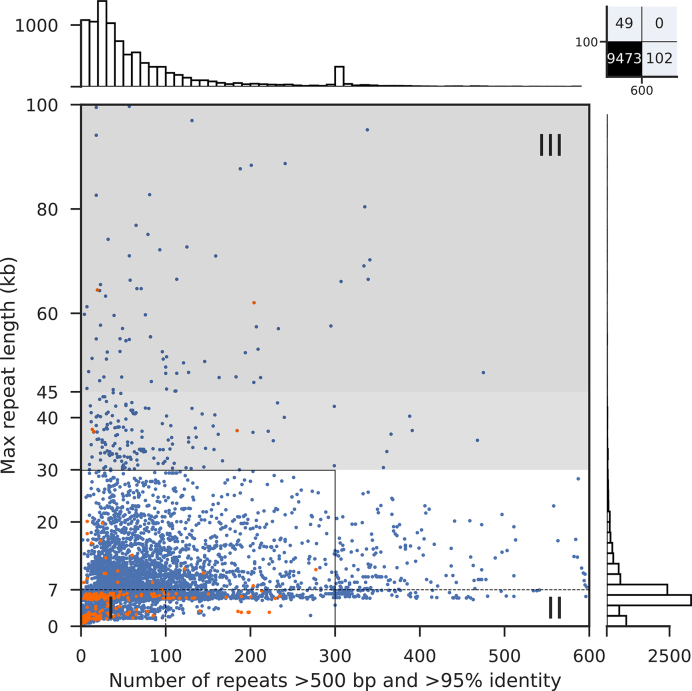
Generating a complete, de novo genome assembly for prokaryotes is often considered a solved problem. However, we here show that Pseudomonas koreensis P19E3 harbors multiple, near identical repeat pairs up to 70 kilobase pairs in length, which contained several genes that may confer fitness advantages to the strain. Its complex genome, which also included a variable shufflon region, could not be de novo assembled with long reads produced by Pacific Biosciences' technology, but required very long reads from Oxford Nanopore Technologies. Importantly, a repeat analysis, whose results we release for over 9600 prokaryotes, indicated that very complex bacterial genomes represent a general phenomenon beyond Pseudomonas. Roughly 10% of 9331 complete bacterial and a handful of 293 complete archaeal genomes represented this 'dark matter' for de novo genome assembly of prokaryotes. Several of these 'dark matter' genome assemblies contained repeats far beyond the resolution of the sequencing technology employed and likely contain errors, other genomes were closed employing labor-intense steps like cosmid libraries, primer walking or optical mapping. Using very long sequencing reads in combination with assembly algorithms capable of resolving long, near identical repeats will bring most prokaryotic genomes within reach of fast and complete de novo genome assembly.
Overview
The claims and statistics of this paper haven’t been checked yet.
Run the check — free, no account needed. It reads the open-access text and checks the sources it cites.
Integrity signals
Registry
Cites
Statistics
Figures
Verification
Claims the paper makes
The claims and statistics of this paper haven’t been checked yet.
Run the check — free, no account needed. It reads the open-access text and checks the sources it cites.
Claims other papers make about this one
Each is checked against this paper’s own text: does it say what the citing paper says it does?
The source backs part of the claim, not all of it — or backs it for a different population, condition or comparison.
In the citing paper
“One extreme example of a LTR is Pseudomonas koreensis P19E3 where a 70 kbp repeat could not be resolved by PacBio sequencing reads (85).”
From Tandem repeats lead to sequence assembly errors and impose multi-level challenges for genome and protein databases (2019) · cites this paper as [85]
Experimental — accuracy not yet measuredIn the citing paper
“However, by utilizing very long reads from Oxford Nanopore in addition to PacBio and Illumina sequences, the researchers were able to properly resolve this LTR (85).”
From Tandem repeats lead to sequence assembly errors and impose multi-level challenges for genome and protein databases (2019) · cites this paper as [85]
In the citing paper
“For prokaryotes, substantial coverage in PacBio reads (60×), plus some Illumina reads (50×) and some coverage in very long Nanopore reads as described earlier would likely lead to complete prokaryote genome assemblies (85).”
From Tandem repeats lead to sequence assembly errors and impose multi-level challenges for genome and protein databases (2019) · cites this paper as [85]
Self-check
Percentages, sums and reported differences re-computed from the paper’s own numbers.
The self-check needs the paper’s full text.
Citations
Cites
The Sequence Alignment/Map format and SAMtools
Li, H., Handsaker, B., Wysoker, A., Fennell, T., Ruan, J., Homer, N., Marth, G., Abecasis, G., Durbin, R., & 1000 Genome Project Data Processing Subgroup (2009) · Bioinformatics · doi:10.1093/bioinformatics/btp352 · Cited by 62,041
MUSCLE: multiple sequence alignment with high accuracy and high throughput
Edgar, R. C. (2004) · Nucleic Acids Research · doi:10.1093/nar/gkh340 · Cited by 44,662
BEDTools: a flexible suite of utilities for comparing genomic features
Quinlan, A. R., & Hall, I. M. (2010) · Bioinformatics · doi:10.1093/bioinformatics/btq033 · Cited by 27,437
SPAdes: A New Genome Assembly Algorithm and Its Applications to Single-Cell Sequencing
Bankevich, A., Nurk, S., Antipov, D., Gurevich, A. A., Dvorkin, M., Kulikov, A. S., Lesin, V. M., Nikolenko, S. I., Pham, S., Prjibelski, A. D., et al. (2012) · Journal of Computational Biology · doi:10.1089/cmb.2012.0021 · Cited by 25,987
WebLogo: A Sequence Logo Generator: Figure 1
Crooks, G. E., Hon, G., Chandonia, J.-M., & Brenner, S. E. (2004) · Genome Research · doi:10.1101/gr.849004 · Cited by 12,386
QUAST: quality assessment tool for genome assemblies
Gurevich, A., Saveliev, V., Vyahhi, N., & Tesler, G. (2013) · Bioinformatics · doi:10.1093/bioinformatics/btt086 · Cited by 11,172
Circos: An information aesthetic for comparative genomics
Krzywinski, M., Schein, J., Birol, İ., Connors, J., Gascoyne, R., Horsman, D., Jones, S. J., & Marra, M. A. (2009) · Genome Research · doi:10.1101/gr.092759.109 · Cited by 10,964
Integrative Genomics Viewer (IGV): high-performance genomics data visualization and exploration
Thorvaldsdottir, H., Robinson, J. T., & Mesirov, J. P. (2013) · Briefings in Bioinformatics · doi:10.1093/bib/bbs017 · Cited by 9,049
Canu: scalable and accurate long-read assembly via adaptive k -mer weighting and repeat separationPreprint
Koren, S., Walenz, B. P., Berlin, K., Miller, J. R., Bergman, N. H., & Phillippy, A. M. (2017) · Genome Research · doi:10.1101/gr.215087.116 · Cited by 7,329
NCBI prokaryotic genome annotation pipeline
Tatusova, T. A., DiCuccio, M. N., Badretdin, A. J., Chetvernin, V., Nawrocki, E. P., Zaslavsky, L. Y., Lomsadze, A., Pruitt, K. D., Borodovsky, M. Y., & Ostell, J. (2016) · Nucleic Acids Research · doi:10.1093/nar/gkw569 · Cited by 7,141
Research works printed but not linked: 2
- Motahari, 2013, Optimal DNA shotgun sequencing: Noisy reads are as good as noiseless reads, 1640
- Koren, 2013, Reducing assembly complexity of microbial genomes with single-molecule sequencing, Genome Biol., 14, R101, 10.1186/gb-2013-14-9-r101 · DOI
Cited by
Assembly of long, error-prone reads using repeat graphs
Kolmogorov, M., Yuan, J., Lin, Y., & Pevzner, P. A. (2019) · Nature Biotechnology · doi:10.1038/s41587-019-0072-8 · Cited by 5,986
Towards population-scale long-read sequencing
De Coster, W., Weissensteiner, M. H., & Sedlazeck, F. J. (2021) · Nature Reviews Genetics · doi:10.1038/s41576-021-00367-3 · Cited by 323
Tørresen, O. K., Star, B., Mier, P., Andrade-Navarro, M. A., Bateman, A., Jarnot, P., Gruca, A., Grynberg, M., Kajava, A. V., Promponas, V. J., et al. (2019) · Nucleic Acids Research · doi:10.1093/nar/gkz841 · Cited by 347
Metadata
- Authors
- Schmid, M., Frei, D., Patrignani, A., Schlapbach, R., Frey, J. E., Remus-Emsermann, M. N. P., & Ahrens, C. H.
- Affiliations
- Agroscope, Molecular Diagnostics, Genomics & Bioinformatics, Wädenswil CH-8820, Switzerland
- Functional Genomics Center Zurich, University of Zurich & ETH Zurich, Zurich CH-8057, Switzerland
- School of Biological Sciences, University of Canterbury, Christchurch 8140, New Zealand
- ORCID
- Ahrens, Christian H
- Venue
- Nucleic Acids Research
- Publisher
- Oxford University Press (OUP)
- Published
- 2018-08-23
- Volume
- 46
- Issue
- 17
- Pages
- 8953-8965
- ISSN
- 0305-1048
- 1362-4962
- PMC
- PMC6158609
- Cited by
- 92
- References
- 61
- Language
- en
- Funders
- Swiss National Science Foundation (31003A-156320)
About these checks
Registry, retraction, Cites and statistics results are computed, not judged, with one exception: a printed reference that no index lists is read once by a model before it counts as a citation error. Claims are extracted by a model and kept only when their quote appears verbatim in the text; each cited source is then checked, with a model’s help, for whether it says what the claim relies on. Those verdicts can be wrong — read the claim’s quote and the cited source before relying on one.
Statistics and arithmetic are recomputed, not judged.
Confidence bands are shown only for fields calibrated on our annotated test set. None is calibrated yet, so no band is shown.
What counts as a claim ›How we measure confidence ›How we check this ›
Are you an author, or do you see a problem with this page? Request a review
How to cite
Cite CoChat for the checks on this page, and the paper for its own findings.
- This page
- CoChat. (2026). Citation check: Pushing the limits of de novo genome assembly for complex prokaryotic genomes harboring very long, near identical repeats. https://app.cochat.ai/papers/10.1093/nar/gky726
- The paper
- Schmid, M., Frei, D., Patrignani, A., Schlapbach, R., Frey, J. E., Remus-Emsermann, M. N. P., & Ahrens, C. H. (2018). Pushing the limits of de novo genome assembly for complex prokaryotic genomes harboring very long, near identical repeats. Nucleic Acids Research. https://doi.org/10.1093/nar/gky726
Data sources
Bibliographic data: Semantic Scholar, OpenAlex, Crossref.
Contains information from the Semantic Scholar Academic Graph Datasets, made available under the ODC Attribution License (ODC-BY 1.0).
Semantic Scholar’s data is described in: Kinney, R., et al. (2023). The Semantic Scholar Open Data Platform. arXiv:2301.10140.
