

Effects of the sodium–glucose co-transporter 2 inhibitor dapagliflozin in patients with type 2 diabetes and Stages 3b–4 chronic kidney disease
Open accessThe DOI matches its Crossref record; 28 of the 47 references it cites were found in a registry or an index.
Abstract
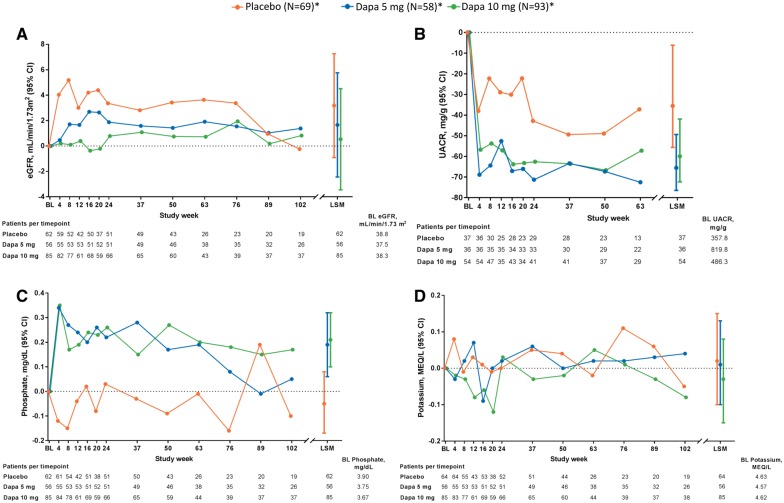
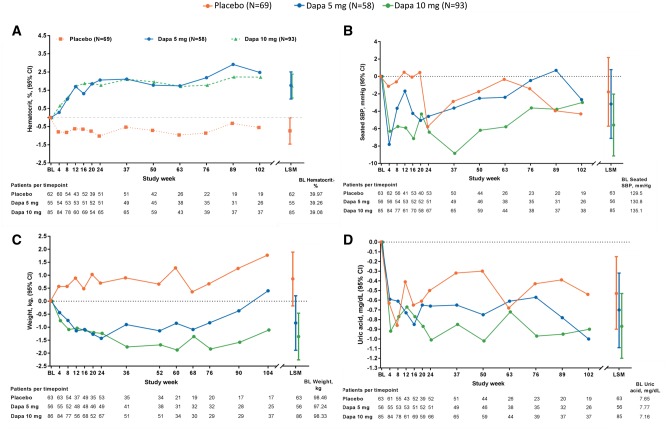
Background: The sodium-glucose co-transporter 2 inhibitor dapagliflozin decreases haemoglobin A1c (HbA1c), body weight, blood pressure (BP) and urinary albumin:creatinine ratio (UACR) in patients with type 2 diabetes. The efficacy and safety of this drug have not been properly defined in patients with type 2 diabetes and Stages 3b-4 chronic kidney disease (CKD). Methods: In a pooled analysis of 11 phase 3 randomized controlled clinical trials, we determined least square mean changes in HbA1c, body weight, BP, estimated glomerular filtration rate (eGFR) and UACR over 102 weeks in patients with type 2 diabetes and an eGFR between 12 to less than 45 mL/min/1.73 m2 receiving placebo (n = 69) or dapagliflozin 5 or 10 mg (n = 151). Effects on UACR were determined in a subgroup of patients with baseline UACR ≥30 mg/g (n = 136). Results: Placebo-corrected changes in HbA1c with dapagliflozin 5 and 10 mg were 0.03% [95% confidence interval (CI) -0.3-0.3] and 0.03% (95% CI -0.2-0.3) during the overall 102-week period. Dapagliflozin 5 and 10 mg compared with placebo reduced UACR by - 47.1% (95% CI -64.8 to - 20.6) and -38.4% (95% CI -57.6 to - 10.3), respectively. Additionally, dapagliflozin 5 and 10 mg compared with placebo reduced BP and body weight. eGFR increased with placebo during the first 4 weeks but did not change with dapagliflozin. There were no between-group differences in eGFR at the end of follow-up. Adverse events associated with renal function occurred more frequently in the dapagliflozin 10-mg group. These events were mainly asymptomatic increases in serum creatinine. Conclusions: Dapagliflozin did not decrease HbA1c in patients with type 2 diabetes and Stages 3b-4 CKD, but decreased UACR, BP and body weight to a clinically meaningful extent. These results support a large outcome trial in this population to confirm long-term safety and efficacy in reducing adverse clinical endpoints.
Overview
The claims and statistics of this paper haven’t been checked yet.
Free: it reads the open-access text and checks the first 5 claims that cite a source we can check. Create a free account to check every claim.
Integrity signals
Registry
Cites
Statistics
Figures
Verification
Claims the paper makes
The claims and statistics of this paper haven’t been checked yet.
Free: it reads the open-access text and checks the first 5 claims that cite a source we can check. Create a free account to check every claim.
Claims other papers make about this one
Each is checked against this paper’s own text: does it say what the citing paper says it does?
The source backs part of the claim, not all of it — or backs it for a different population, condition or comparison.
In the citing paper
“Despite their effects on intravascular volume, BP lowering with SGLT2 inhibitors is not accompanied by a compensatory increase in heart rate.29”
From Blood Pressure Effects of Canagliflozin and Clinical Outcomes in Type 2 Diabetes and Chronic Kidney Disease: Insights From the CREDENCE Trial (2021) · cites this paper as [29]
Experimental — accuracy not yet measured
Self-check
Percentages, sums and reported differences re-computed from the paper’s own numbers.
The self-check needs the paper’s full text.
Citations
Cites
Canagliflozin and Cardiovascular and Renal Events in Type 2 Diabetes
Neal, B., Perkovic, V., Mahaffey, K. W., de Zeeuw, D., Fulcher, G., Erondu, N., Shaw, W., Law, G., Desai, M., & Matthews, D. R. (2017) · New England Journal of Medicine · doi:10.1056/nejmoa1611925 · Cited by 7,830
Empagliflozin and Progression of Kidney Disease in Type 2 Diabetes
Wanner, C., Inzucchi, S. E., Lachin, J. M., Fitchett, D., von Eynatten, M., Mattheus, M., Johansen, O. E., Woerle, H. J., Broedl, U. C., & Zinman, B. (2016) · New England Journal of Medicine · doi:10.1056/nejmoa1515920 · Cited by 3,655 · cited 2×
“In addition, randomized placebo-controlled trial data also indicate that the risk of acute kidney injury (AKI) is not increased during SGLT2 inhibition [5, 26].”
BackgroundHeerspink, H. J. L., Perkins, B. A., Fitchett, D. H., Husain, M., & Cherney, D. Z. I. (2016) · Circulation · doi:10.1161/circulationaha.116.021887 · Cited by 1,376 · cited 1×
“in the S1 segment of the proximal tubule, thereby augmenting urinary glucose and sodium excretion [3].”
BackgroundSelf-citationKidney disease and increased mortality risk in type 2 diabetes
Afkarian, M., Sachs, M. C., Kestenbaum, B., Hirsch, I. B., Tuttle, K. R., Himmelfarb, J., & de Boer, I. H. (2013) · Journal of the American Society of Nephrology · doi:10.1681/asn.2012070718 · Cited by 1,298 · cited 1×
“Both diabetes and CKD account for an increased risk of premature mortality, cardiovascular morbidity and end-stage kidney failure [2].”
BackgroundBailey, C. J., Gross, J. L., Pieters, A., Bastien, A., & List, J. F. (2010) · The Lancet · doi:10.1016/s0140-6736(10)60407-2 · Cited by 860
Ferrannini, E., Ramos, S. J., Salsali, A., Tang, W., & List, J. F. (2010) · Diabetes Care · doi:10.2337/dc10-0612 · Cited by 716
Glomerular hyperfiltration: definitions, mechanisms and clinical implications
Helal, I., Fick-Brosnahan, G. M., Reed-Gitomer, B., & Schrier, R. W. (2012) · Nature Reviews Nephrology · doi:10.1038/nrneph.2012.19 · Cited by 673 · cited 1×
“In many primary and secondary kidney diseases, for example, focal segmental glomerulosclerosis, immunoglobulin A (IgA) nephropathy, hypertensive nephrosclerosis and obesity-induced nephropathy, maladaptive functional renal hemodynamic changes are thought to occur, including increases in renal blood flow, GFR and filtr…”
BackgroundKohan, D. E., Fioretto, P., Tang, W., & List, J. F. (2014) · Kidney International · doi:10.1038/ki.2013.356 · Cited by 652
Barnett, A. H., Mithal, A., Manassie, J., Jones, R., Rattunde, H., Woerle, H. J., & Broedl, U. C. (2014) · The Lancet Diabetes & Endocrinology · doi:10.1016/s2213-8587(13)70208-0 · Cited by 574 · cited 4×
“The previous studies including patients with Stage 3 CKD and a small group of patients with Stage 4 CKD produced similar reductions in UACR, BP and body weight, but during a shorter follow-up period [6, 8].”
BackgroundMethodResultInfluentialBolinder, J., Ljunggren, Ö., Johansson, L., Wilding, J., Langkilde, A. M., Sjöström, C. D., Sugg, J., & Parikh, S. (2014) · Diabetes, Obesity and Metabolism · doi:10.1111/dom.12189 · Cited by 482 · cited 1×
“It has been speculated that this increase in phosphate may precipitate fractures, but recent data with dapagliflozin in patients with type 2 diabetes indicate no increased fracture risk or increased rate of bone turnover as assessed by biomarkers [15, 29, 30].”
ResultSelf-citation
Cited by
KDIGO 2020 Clinical practice guideline for diabetes management in chronic kidney disease
de Boer, I. H., Caramori, M. L., Chan, J. C. N., Heerspink, H. J. L., Hurst, C., Khunti, K., Liew, A., Michos, E. D., Navaneethan, S. D., Olowu, W. A., et al. (2020) · Kidney International · doi:10.1016/j.kint.2020.06.019 · Cited by 1,399
Self-citationKDIGO 2022 Clinical Practice Guideline for Diabetes Management in Chronic Kidney Disease
Rossing, P., Caramori, M. L., Chan, J. C. N., Heerspink, H. J. L., Hurst, C., Khunti, K., Liew, A., Michos, E. D., Navaneethan, S. D., Olowu, W. A., et al. (2022) · Kidney International · doi:10.1016/j.kint.2022.06.008 · Cited by 1,373
Self-citationToyama, T., Neuen, B. L., Jun, M., Ohkuma, T., Neal, B., Jardine, M. J., Heerspink, H. L., Wong, M. G., Ninomiya, T., Wada, T., et al. (2019) · Diabetes, Obesity and Metabolism · doi:10.1111/dom.13648 · Cited by 330
Self-citationKraus, B. J., Weir, M. R., Bakris, G. L., Mattheus, M., Cherney, D. Z. I., Sattar, N., Heerspink, H. J. L., Ritter, I., von Eynatten, M., Zinman, B., et al. (2021) · Kidney International · doi:10.1016/j.kint.2020.10.031 · Cited by 219
Self-citationHeerspink, H. J. L., Stefansson, B. V., Chertow, G. M., Correa-Rotter, R., Greene, T., Hou, F.-F., Lindberg, M., McMurray, J., Rossing, P., Toto, R., et al. (2020) · Nephrology Dialysis Transplantation · doi:10.1093/ndt/gfz290 · Cited by 218
Self-citationPollock, C., Stefánsson, B., Reyner, D., Rossing, P., Sjöström, C. D., Wheeler, D. C., Langkilde, A. M., & Heerspink, H. J. L. (2019) · The Lancet Diabetes & Endocrinology · doi:10.1016/s2213-8587(19)30086-5 · Cited by 205
Self-citationvan Baar, M. J. B., van Ruiten, C. C., Muskiet, M. H. A., van Bloemendaal, L., IJzerman, R. G., & van Raalte, D. H. (2018) · Diabetes Care · doi:10.2337/dc18-0588 · Cited by 199
Perry, R. J., & Shulman, G. I. (2020) · Journal of Biological Chemistry · doi:10.1074/jbc.rev120.008387 · Cited by 147
“Whereas it is possible, given their mechanism, that the chronic effects of SGLT2 inhibition to improve cardiovascular outcomes are partially dependent on their ability to improve glycemic control in individuals with diabetes, the renal benefits were observed independent of any glucose-lowering effect (154, 156, 157) a…”
BackgroundBakris, G., Oshima, M., Mahaffey, K. W., Agarwal, R., Cannon, C. P., Capuano, G., Charytan, D. M., de Zeeuw, D., Edwards, R., Greene, T., et al. (2020) · Clinical Journal of the American Society of Nephrology · doi:10.2215/cjn.10140620 · Cited by 142
Self-citationYe, N., Jardine, M. J., Oshima, M., Hockham, C., Heerspink, H. J. L., Agarwal, R., Bakris, G., Schutte, A. E., Arnott, C., Chang, T. I., et al. (2021) · Circulation · doi:10.1161/circulationaha.120.048740 · Cited by 115
Self-citationDekkers, C. C. J., Sjöström, C. D., Greasley, P. J., Cain, V., Boulton, D. W., & Heerspink, H. J. L. (2019) · Diabetes, Obesity and Metabolism · doi:10.1111/dom.13855 · Cited by 106
Self-citationEffects of Dapagliflozin on Circulating Markers of Phosphate Homeostasis
de Jong, M. A., Petrykiv, S. I., Laverman, G. D., van Herwaarden, A. E., de Zeeuw, D., Bakker, S. J. L., Heerspink, H. J. L., & de Borst, M. H. (2018) · Clinical Journal of the American Society of Nephrology · doi:10.2215/cjn.04530418 · Cited by 104
“A pertinent question is whether alterations of FGF23, PTH, and 1,25(OH)2D are sustained over the full duration of SGLT-2 treatment, especially because the effect of dapagliflozin on serum phosphate is consistent over multiple years (20).”
BackgroundSelf-citationLevin, A., Perkovic, V., Wheeler, D. C., Hantel, S., George, J. T., von Eynatten, M., Koitka-Weber, A., Wanner, C., & on behalf of the EMPA-REG OUTCOME Investigators (2020) · Clinical Journal of the American Society of Nephrology · doi:10.2215/cjn.14901219 · Cited by 90
“5–10 301 (27) 597 (27) 159 (24) 344 (26) 69 (19) 156 (22) 35 (19) 64 (18) .”
ResultSelf-citationSGLT2 inhibitor counteracts NLRP3 inflammasome via tubular metabolite itaconate in fibrosis kidney
Ke, Q., Shi, C., Lv, Y., Wang, L., Luo, J., Jiang, L., Yang, J., & Zhou, Y. (2021) · The FASEB Journal · doi:10.1096/fj.202100909rr · Cited by 97
Giorgino, F., Vora, J. P., Fenici, P., & Solini, A. (2020) · Cardiovascular Diabetology · doi:10.1186/s12933-020-01163-9 · Cited by 100
Role and mechanisms of SGLT-2 inhibitors in the treatment of diabetic kidney disease
Dai, Z.-C., Chen, J., Zou, R., Liang, X.-B., Tang, J., & Yao, C. (2023) · Frontiers in Immunology · doi:10.3389/fimmu.2023.1213473 · Cited by 84
“Furthermore, other related studies have also suggested a higher likelihood of genital fungal infections in patients with type 2 diabetic CKD stages 3b-4 who use dapagliflozin (21).”
BackgroundInfluentialNew Diabetes Therapies and Diabetic Kidney Disease Progression: the Role of SGLT-2 Inhibitors
Dekkers, C. C. J., Gansevoort, R. T., & Heerspink, H. J. L. (2018) · Current Diabetes Reports · doi:10.1007/s11892-018-0992-6 · Cited by 82
Self-citationNatale, P., Tunnicliffe, D. J., Toyama, T., Palmer, S. C., Saglimbene, V. M., Ruospo, M., Gargano, L., Stallone, G., Gesualdo, L., & Strippoli, G. F. (2024) · Cochrane Database of Systematic Reviews · doi:10.1002/14651858.cd015588.pub2 · Cited by 70
Yen, F., Hwu, C., Liu, J., Wu, Y., Chong, K., & Hsu, C. (2024) · Annals of Internal Medicine · doi:10.7326/m23-1874 · Cited by 69
Diabetic nephropathy: newer therapeutic perspectives
Keri, K., Samji, N. S., & Blumenthal, S. S. (2018) · Journal of Community Hospital Internal Medicine Perspectives · doi:10.1080/20009666.2018.1500423 · Cited by 70
“dapagliflozin was analysed on changes in eGFR and UACRs [26].”
MethodScheen, A. J. (2018) · Diabetes & Metabolism · doi:10.1016/j.diabet.2018.10.003 · Cited by 65
Sodium-glucose cotransporter 2 inhibitors: extending the indication to non-diabetic kidney disease?
Dekkers, C. C. J., & Gansevoort, R. T. (2020) · Nephrology Dialysis Transplantation · doi:10.1093/ndt/gfz264 · Cited by 63
Self-citationWang, H., Li, T., Sun, F., Liu, Z., Zhang, D., Teng, X., Morel, L. M., Wang, X., & Ye, S. (2022) · RMD Open · doi:10.1136/rmdopen-2022-002686 · Cited by 60
Rhee, J. J., Jardine, M., Chertow, G. M., & Mahaffey, K. W. (2020) · Diabetes Obesity and Metabolism · doi:10.1111/dom.13987 · Cited by 57
SGLT2 inhibitors and the kidney: Effects and mechanisms
Tsimihodimos, V., Filippatos, T. D., & Elisaf, M. S. (2018) · Diabetes & Metabolic Syndrome: Clinical Research & Reviews · doi:10.1016/j.dsx.2018.06.003 · Cited by 46
Lim, S. K., Eckel, R. H., & Koh, K. K. (2018) · Atherosclerosis · doi:10.1016/j.atherosclerosis.2018.03.013 · Cited by 48
Metabolic risk profile in kidney transplant candidates and recipients
Piotti, G., Gandolfini, I., Palmisano, A., & Maggiore, U. (2018) · Nephrology Dialysis Transplantation · doi:10.1093/ndt/gfy151 · Cited by 48
Deng, X., Sun, L., Lai, X., Xiang, L., Li, Q., Zhang, W., Zhang, L., & Sun, S. (2018) · Journal of Agricultural and Food Chemistry · doi:10.1021/acs.jafc.8b04819 · Cited by 48
The Off-Target Effects, Electrolyte and Mineral Disorders of SGLT2i
Cianciolo, G., Pascalis, A. D., Gasperoni, L., Tondolo, F., Zappulo, F., Capelli, I., Cappuccilli, M. L., & Manna, G. L. (2020) · Molecules · doi:10.3390/molecules25122757 · Cited by 50
“This property of SGLT2i seems, albeit indirectly, confirmed by the post-hoc analysis of a trial subgroup with CKD stages 3B to 4, demonstrating an insignificant reduction in glucose levels and eGFR whilst albuminuria and blood pressure were reduced [13].”
ResultEmpagliflozin protects against renal ischemia/reperfusion injury in mice
Wang, Q., Ju, F., Li, J., Liu, T., Zuo, Y., Abbott, G. W., & Hu, Z. (2022) · Scientific Reports · doi:10.1038/s41598-022-24103-x · Cited by 47
Preventing and treating kidney disease in patients with type 2 diabetes
Delanaye, P., & Scheen, A. J. (2018) · Expert Opinion on Pharmacotherapy · doi:10.1080/14656566.2018.1551362 · Cited by 47
SGLT2 inhibition to address the unmet needs in diabetic nephropathy
Barutta, F., Bernardi, S., Gargiulo, G., Durazzo, M., & Gruden, G. (2019) · Diabetes/Metabolism Research and Reviews · doi:10.1002/dmrr.3171 · Cited by 48
“In addition, the reduction in UACR was consistent across eGFR strata and dapagliflozin also displayed anti‐proteinuric properties in DM2 patients with stage 3‐ 4 CKD.37,38 Therefore, treatment with SGLT2i may be a valuable approach for providing greater reduction in albuminuria and ultimately renoprotection.”
BackgroundInfluentialJohansen, M. E., & Argyropoulos, C. (2020) · Clinical Cardiology · doi:10.1002/clc.23508 · Cited by 43
“Even more disappointing from the perspective of A1c lowering is the dramatic loss of antiglycemic efficacy of these agents as kidney function declines.(2,3) Yet clinical trials in cardiovascular (safety) outcome trials (CVOT), trials in in heart failure with reduced ejection fraction (HFrEF) and in chronic Received: 1…”
BackgroundChronic Kidney Disease in the Older Adult Patient with Diabetes
Ravender, R., Roumelioti, M., Schmidt, D. W., Unruh, M. L., & Argyropoulos, C. (2024) · Journal of Clinical Medicine · doi:10.3390/jcm13020348 · Cited by 43
Sodium-glucose cotransporter 2 inhibition: towards an indication to treat diabetic kidney disease
Górriz, J. L., Navarro‐González, J. F., Ortíz, A., Vergara, A., Núñez, J. E., Jacobs-Cachá, C., Martínez‐Castelao, A., & Soler, M. J. (2020) · Nephrology Dialysis Transplantation · doi:10.1093/ndt/gfz237 · Cited by 40
Major advancements in slowing diabetic kidney disease progression: focus on SGLT2 inhibitors
Bakris, G. L. (2019) · American Journal of Kidney Diseases · doi:10.1053/j.ajkd.2019.05.009 · Cited by 37
Khan, M. S., Bakris, G. L., Shahid, I., Weir, M. R., & Butler, J. (2022) · JAMA Cardiology · doi:10.1001/jamacardio.2021.5151 · Cited by 36
Henry, R. R., Frías, J. P., Walsh, B., Skare, S., Hemming, J., Burns, C. M., Bicsak, T. A., Baron, A., & Fineman, M. S. (2018) · PLoS ONE · doi:10.1371/journal.pone.0203946 · Cited by 35
Scheen, A. J. (2020) · Expert Opinion on Drug Safety · doi:10.1080/14740338.2020.1733967 · Cited by 35
Huynh, D. J., Renelus, B. D., & Jamorabo, D. S. (2023) · BMC Gastroenterology · doi:10.1186/s12876-023-03085-8 · Cited by 31
Sugiyama, S., Jinnouchi, H., Yoshida, A., Hieshima, K., Kurinami, N., Jinnouchi, K., Tanaka, M., Suzuki, T., MIYAMOTO, F., Kajiwara, K., et al. (2019) · Journal of Clinical Medicine Research · doi:10.14740/jocmr3761 · Cited by 31
SGLT2 inhibitors, sodium and off-target effects: an overview
Pascalis, A. D., Cianciolo, G., Capelli, I., Brunori, G., & Manna, G. L. (2020) · Journal of Nephrology · doi:10.1007/s40620-020-00845-7 · Cited by 32
Chan, G. C., Ng, J. K., Chow, K. M., & Szeto, C. (2022) · Diabetes Research and Clinical Practice · doi:10.1016/j.diabres.2022.110200 · Cited by 29
Differential pharmacology and clinical utility of dapagliflozin in type 2 diabetes
Papakitsou, I., Vougiouklakis, G., Elisaf, M., & Filippatos, T. D. (2019) · Clinical Pharmacology Advances and Applications · doi:10.2147/cpaa.s172353 · Cited by 29
Li, Q., Ge, C., Tan, J., Sun, Y., Kuang, Q., Dai, X., Zhong, S., Yi, C., Hu, L., Lou, D., et al. (2021) · International Immunopharmacology · doi:10.1016/j.intimp.2020.107340 · Cited by 29
Polychronopoulou, E., Wuerzner, G., & Burnier, M. (2021) · Vascular Health and Risk Management · doi:10.2147/vhrm.s292522 · Cited by 26
Nusca, A., Piccirillo, F., Viscusi, M. M., Giannone, S., Mangiacapra, F., Melfi, R., Ricottini, E., Ussia, G. P., & Grigioni, F. (2022) · Journal of Cardiovascular Pharmacology · doi:10.1097/fjc.0000000000001329 · Cited by 25
Miyoshi, H., Kameda, H., Yamashita, K., Nakamura, A., & Kurihara, Y. (2019) · Journal of Diabetes Investigation · doi:10.1111/jdi.13064 · Cited by 23
KDIGO 2022 Clinical Practice Guideline For Diabetes Management in Chronic Kidney Disease
Статья, Р. (2023) · Nephrology and Dialysis · doi:10.28996/2618-9801-2023-2-141-221 · Cited by 22
Damianaki, A., Polychronopoulou, E., Wuerzner, G., & Burnier, M. (2021) · High Blood Pressure & Cardiovascular Prevention · doi:10.1007/s40292-021-00495-1 · Cited by 20
Shin, Y., Moon, J. H., Chin, H. J., Ferrannini, E., & Lim, S. K. (2020) · Endocrinology and Metabolism · doi:10.3803/enm.2020.35.2.329 · Cited by 19
“These beneficial renal effects have been attributed to a reduction in intraglomerular pressure [15,24,25].”
BackgroundScheen, A. J. (2020) · Clinical Pharmacokinetics · doi:10.1007/s40262-020-00885-z · Cited by 19
“6%), with 5 mg and 10 mg of dapagliflozin, respectively [49].”
BackgroundSodium-glucose cotransporter 2 inhibitors as the first universal treatment of chronic kidney disease
Din, U. A. S. E., Salem, M. M., & Abdulazim, D. O. (2021) · Nefrología (English Edition) · doi:10.1016/j.nefro.2021.03.014 · Cited by 18
Targeting Glomerular Hemodynamics for Kidney Protection
Savedchuk, S., Phachu, D., Shankar, M., Sparks, M. A., & Harrison‐Bernard, L. M. (2023) · Advances in Kidney Disease and Health · doi:10.1053/j.akdh.2022.12.003 · Cited by 18
Murashima, M., Tanaka, T., Kasugai, T., Tomonari, T., Ide, A., Ono, M., Mizuno, M., Suzuki, T., & Hamano, T. (2021) · Journal of Diabetes Investigation · doi:10.1111/jdi.13717 · Cited by 17
Plant Compounds for the Treatment of Diabetes, a Metabolic Disorder: NF-κB as a Therapeutic Target
Ravi, S., Punabaka, J., Shanmugam, B., Ganjikunta, V. S., Shanmugam, K. R., & Kesireddy, S. R. (2020) · Current Pharmaceutical Design · doi:10.2174/1381612826666200730221035 · Cited by 16
Miyazaki, R., & Miyagi, K. (2022) · BMC Nephrology · doi:10.1186/s12882-022-02793-9 · Cited by 15
Milder, T. Y., STOCKER, S. L., Samocha‐Bonet, D., Day, R. O., & Greenfield, J. R. (2019) · European Journal of Clinical Pharmacology · doi:10.1007/s00228-019-02732-y · Cited by 15
Georgianos, P. I., Vaios, V., Roumeliotis, S. K., Leivaditis, K., Eleftheriadis, T., & Liakopoulos, V. (2022) · Journal of Personalized Medicine · doi:10.3390/jpm12020223 · Cited by 15
“Other analyses also showed that the initial eGFR drop in response to SGLT-2 inhibitor therapy is even fully absent in patients with advanced-stage 3b or 4 CKD, but the reduction in albuminuria and long-term stabilization of kidney function persist [26,27].”
BackgroundWen, S., Yuan, Y., Li, Y., Xu, C., Chen, L., Ren, Y., Wang, C., He, Y., Li, X., Gong, M., et al. (2025) · BMC Endocrine Disorders · doi:10.1186/s12902-025-01985-2 · Cited by 14
Does SGLT2 Inhibition Affect Sympathetic Nerve Activity in Type 2 Diabetes?
Dimova, R. B., & Tankova, T. I. (2020) · Hormone and Metabolic Research · doi:10.1055/a-1298-4205 · Cited by 12
“Although dapagliflozin does not affect HbA1c level in patients with type 2 diabetes and chronic kidney disease stages 3b–4, it significantly decreases blood pressure and weight in the studied cohort [24].”
BackgroundZhang, X., Zhong, Z., Li, Y., & Li, W. (2020) · Diabetes/Metabolism Research and Reviews · doi:10.1002/dmrr.3303 · Cited by 11
“No significant impact was found on eGFR levels of patients.(62) Improvements of albuminuria were also observed in studies which included patients with T2DM and CKD in our meta-analysis,(11,25,46) but the difference”
BackgroundResultInfluentialSäemann, M. D., Cejka, D., Schmaldienst, S., Rosenkranz, A. R., & Mayer, G. J. (2022) · Wiener klinische Wochenschrift · doi:10.1007/s00508-022-02096-x · Cited by 10
Conte, C., Maggiore, U., Cappelli, G., Ietto, G., Lai, Q., Salis, P., Marchetti, P., Piemonti, L., Secchi, A., Capocasale, E., et al. (2020) · Nutrition Metabolism and Cardiovascular Diseases · doi:10.1016/j.numecd.2020.05.004 · Cited by 10
“On the other hand, because of their mechanism of action, these drugs may be less effective in reducing HbA1c in patients with impaired renal graft function [83].”
BackgroundCarbohydrate metabolism in chronic renal disease
Adamczak, M., Ritz, E., & Więcek, A. (2021) · Elsevier eBooks · doi:10.1016/b978-0-12-818540-7.00005-7 · Cited by 9
Palomo‐Piñón, S., Aguilar-Alonso, J. A., Chavez-Iñiguez, J. S., Hernández-Arellanes, F. E., Mariano-Murga, J. A., Flores-Rodríguez, J. C., Pérez-López, M. J., Pérez, F. P., Treviño–Becerra, A., Guillén-Graf, A. E., et al. (2024) · Frontiers in Medicine · doi:10.3389/fmed.2024.1376115 · Cited by 9
Renal outcomes with sodium-glucose cotransporters 2 inhibitors
Sun, X., & Wang, G. (2022) · Frontiers in Endocrinology · doi:10.3389/fendo.2022.1063341 · Cited by 9
Cardiorenal Protections of SGLT2 Inhibitors in the Treatment of Type 2 Diabetes
Nazari, S., & Mirkhani, H. (2022) · Current Diabetes Reviews · doi:10.2174/1573399819666221222160035 · Cited by 8
Sodium-Glucose Cotransporter-2 (SGLT2) Inhibitors
Kataria, A., & Argyropoulos, C. (2022) · Springer eBooks · doi:10.1007/978-3-030-86020-2_25 · Cited by 7
Stompór, T. P., Adamczak, M., Masajtis‐Zagajewska, A., Mazanowska, O., Maziarska, K., Witkowska, A., & Więcek, A. (2020) · Endokrynologia Polska · doi:10.5603/ep.a2019.0064 · Cited by 6
Miyazaki, R., Miyagi, K., & Yoshida, M. (2020) · Renal Replacement Therapy · doi:10.1186/s41100-020-00303-x · Cited by 5
Safety Profile of SGLT-2 Inhibitors in Older Adults: A Systematic Review and Network Meta-Analysis
Sridharan, K., & Sivaramakrishnan, G. (2026) · Medical Sciences · doi:10.3390/medsci14010153 · Cited by 4
Borrelli, S., Garofalo, C., Reboldi, G., Coppola, A., Chiodini, P., Simeoni, M., Mazzieri, A., Volpe, L. D., Gallieni, M. A., Zummo, C., et al. (2024) · Clinical Kidney Journal · doi:10.1093/ckj/sfae316 · Cited by 4
Dapagliflozin Improves the Clinical Outcomes of Patients with Chronic Kidney Disease and Albuminuria
Patrick, S., Dabal, T. D., & Jackson, C. (2021) · Journal of General Internal Medicine · doi:10.1007/s11606-021-06871-w · Cited by 4
Guo, Y., Gao, W., Li, S., An, X., & Liu, Z. (2026) · Frontiers in Endocrinology · doi:10.3389/fendo.2025.1596888 · Cited by 3
Liu, H., Zhang, X., Cui, Y., Xiong, S., Huang, L., Li, M., Shao, C., & Hu, X. (2026) · International Journal of Molecular Medicine · doi:10.3892/ijmm.2026.5842 · Cited by 3
Dapagliflozin for Chronic Kidney Disease
Khangura, S. D., & Severn, M. (2022) · Canadian Journal of Health Technologies · doi:10.51731/cjht.2022.354 · Cited by 3
(2024) · Frontiers research topics · doi:10.3389/978-2-8325-4643-7 · Cited by 3
Hyaluronan Inhibition as a Therapeutic Target for Diabetic Kidney Disease: What Is Next?
Salman, L. H., Martinez, L., Faddoul, G., Manning, C., Ali, K., Salman, M., & Vázquez-Padrón, R. I. (2023) · Kidney360 · doi:10.34067/kid.0000000000000126 · Cited by 3
SGLT-2 Inhibitors and Renal Outcomes in Non-Diabetic Patients: A Systematic Review
Sousa, M., Almeida, C., Marchão, N., Godinho, I., Lopes, J. A., & Gameiro, J. (2023) · Portuguese Journal of Nephrology & Hypertension · doi:10.32932/pjnh.2023.03.234 · Cited by 3
Scoccimarro, D., Cipani, G., Dicembrini, I., & Mannucci, E. (2023) · Diabetes/Metabolism Research and Reviews · doi:10.1002/dmrr.3727 · Cited by 3
Sourij, H., Edlinger, R., Prischl, F. C., Auinger, M., Kaser, S., Horn, S., Paulweber, B., Kautzky‐Willer, A., Säemann, M. D., Prager, R., et al. (2019) · Wiener klinische Wochenschrift · doi:10.1007/s00508-018-1425-x · Cited by 3
Diabetic Chronic Kidney Disease in Type 2 Diabetes Mellitus (Albuminuric/Non-albuminuric)
Roumeliotis, S. K., Mallamaci, F., & Zoccali, C. (2023) · Updates in hypertension and cardiovascular protection · doi:10.1007/978-3-031-13009-0_16 · Cited by 3
Bjornstad, P., Danne, T., KLINGENSMITH, G. J., Schueler, E., Tartakovsky, I. S., Marquard, J., Zeitler, P. S., Willi, S. M., & Laffel, L. M. (2025) · Clinical Journal of the American Society of Nephrology · doi:10.2215/cjn.0000000889 · Cited by 3
PRIORITIES OF ANTI-HYPERGLYCAEMIC DRUG THERAPY IN PATIENTS WITH TYPE 2 DIABETES AND HEART FAILURE
Росул, М. М., Блецкан, М. М., Ivano, N. V., Korabelschykova, M. O., & Rubtsova, Y. I. (2020) · Wiadomości Lekarskie · doi:10.36740/wlek202003139 · Cited by 2
Dapagliflozin improves cardiovascular risk factors in Emirati patients with T2DM
Nada, A. M., & Younan, M. A. (2021) · Therapeutic Advances in Endocrinology and Metabolism · doi:10.1177/2042018821995364 · Cited by 2
Ya, S., Wang, W., & Li, H. (2026) · Frontiers in Endocrinology · doi:10.3389/fendo.2026.1785822 · Cited by 1
Barry, A. R., & Mitchelmore, B. R. (2018) · The Canadian Journal of Hospital Pharmacy · doi:10.4212/cjhp.v71i4.2831 · Cited by 2
Sousa, L. S., Nascimento, F. D. A., Rocha, J. S., & Parise, M. R. (2021) · International Journal of Cardiovascular Sciences · doi:10.36660/ijcs.20200339 · Cited by 2
Georgianos, P. I., & Agarwal, R. (2019) · Nephrology Dialysis Transplantation · doi:10.1093/ndt/gfz250 · Cited by 1
Fibroblast growth factor 23: novel determinants and associations with cardiorenal outcomes
de Jong, M. (2023) · University of Groningen research database (University of Groningen / Centre for Information Technology) · doi:10.33612/diss.688240758 · Cited by 1
Update Diabetische Nephropathie 2018
Böger, C. A., & Krämer, B. K. (2018) · DMW - Deutsche Medizinische Wochenschrift · doi:10.1055/a-0587-5363
Editorial: diabetic kidney disease: an update in recent clinical and basic research
Tang, S. C. W. (2019) · Nephrology Dialysis Transplantation · doi:10.1093/ndt/gfz130
Renoprotective effects of gliflozins
Vachek, J., & Tesař, V. (2018) · Klinická farmakologie a farmacie · doi:10.36290/far.2018.004
Extending the use of SGLT2 inhibitors from diabetic to non-diabetic kidney disease
Dekkers, C. C. J. (2020) · University of Groningen research database (University of Groningen / Centre for Information Technology) · doi:10.33612/diss.136049658
Self-citationCardiorenal Crosstalk in Patients with Heart Failure
Schukraft, S., & Hullin, R. (2022) · Kidney and Dialysis · doi:10.3390/kidneydial2030033
(2021) · ADA Clinical Compendia · doi:10.2337/db20211-34
Diabetic Nephropathy in Advanced Age Patients
Argyropoulos, C., & Roumelioti, M. (2024) · Springer eBooks · doi:10.1007/978-3-031-68460-9_8
Huynh, D. J., Renelus, B. D., & Jamorabo, D. S. (2023) · Figshare · doi:10.6084/m9.figshare.24873072
Shi, X., Fu, K., Hu, M., Li, R., Li, H., & Xu, S. (2026) · Medicine · doi:10.1097/md.0000000000050957
Metadata
- Authors
- Dekkers, C. C. J., Wheeler, D. C., Sjöström, C. D., Stefansson, B. V., Cain, V., & Heerspink, H. J. L.
- Affiliations
- University Medical Center Groningen (NL)
- University College London (GB)
- AstraZeneca (Sweden) (SE)
- Department of Cardiovascular and metabolic diseases, Global Medicines Development, AstraZeneca, Gothenburg, Sweden
- Department of Biometrics and Information Sciences, Bogier Clinical and IT Solutions, Raleigh, NC, USA
- Corresponding author
- Heerspink, Hiddo J L
- Venue
- Nephrology Dialysis Transplantation
- Publisher
- Oxford University Press (OUP)
- Published
- 2018-01-23
- Volume
- 33
- Issue
- 11
- Pages
- 2005-2011
- ISSN
- 0931-0509 (ISSN-L)
- 1460-2385
- PMC
- PMC6212718
- OpenAlex
- W2794310633
- Cited by
- 102
- References
- 47
- Citations by year
- 2026: 5 · 2025: 2 · 2024: 7 · 2023: 10 · 2022: 15 · 2021: 12 · 2020: 21 · 2019: 15 · 2018: 15
- FWCI
- 11.02
- Type
- journal article
- Language
- en
- Open access
- hybrid
- doi.org
- Licence
- Locations
- Nephrology Dialysis Transplantation (publishedVersion, cc-by-nc)
- Europe PMC (PubMed Central) (publishedVersion, cc-by-nc)
- PubMed Central (publishedVersion, cc-by-nc)
- PubMed (publishedVersion)
- UCL Discovery (University College London) (submittedVersion)
- University of Groningen research database (University of Groningen / Centre for Information Technology) (submittedVersion, cc-by-nc)
- Funders
- AstraZeneca
- Topics
- Health Sciences › Medicine › Endocrinology, Diabetes and Metabolism › Diabetes Treatment and Management
- Health Sciences › Medicine › Nephrology › Chronic Kidney Disease and Diabetes
- Health Sciences › Medicine › Cardiology and Cardiovascular Medicine › Heart Failure Treatment and Management
- Keywords
- dapagliflozin, SGLT2 inhibitors, type 2 diabetes, chronic kidney disease, albuminuria, urinary albumin-creatinine ratio, estimated glomerular filtration rate, glycemic control, blood pressure, body weight, serum creatinine, drug safety, renal function, adverse events, dose comparison
- MeSH terms
- Sodium-Glucose Transporter 2 Inhibitors, Adult, Aged, Albuminuria, Benzhydryl Compounds, Blood Pressure, Body Weight, Creatinine, Diabetes Mellitus, Type 2, Female, Glomerular Filtration Rate, Glucosides, Glycated Hemoglobin, Humans, Hypoglycemic Agents, Male, Middle Aged, Randomized Controlled Trials as Topic, Renal Insufficiency, Chronic
About these checks
Registry, retraction, Cites and statistics results are computed, not judged, with one exception: a printed reference that no index lists is read once by a model before it counts as a citation error. Claims are extracted by a model and kept only when their quote appears verbatim in the text; each cited source is then checked, with a model’s help, for whether it says what the claim relies on. Those verdicts can be wrong — read the claim’s quote and the cited source before relying on one.
Statistics and arithmetic are recomputed, not judged.
Confidence bands are shown only for fields calibrated on our annotated test set. None is calibrated yet, so no band is shown.
What counts as a claim ›How we measure confidence ›How we check this ›
Are you an author, or do you see a problem with this page? Request a review
Data sources
Bibliographic data: Semantic Scholar, OpenAlex, Crossref.
Contains information from the Semantic Scholar Academic Graph Datasets, made available under the ODC Attribution License (ODC-BY 1.0).
Semantic Scholar’s data is described in: Kinney, R., et al. (2023). The Semantic Scholar Open Data Platform. arXiv:2301.10140.
