

Cognitive processing of a common stimulus synchronizes brains, hearts, and eyes
Open accessPublished version of a preprint
The DOI matches its Crossref record; 88 of the 88 references it cites were found in a registry or an index.
Abstract
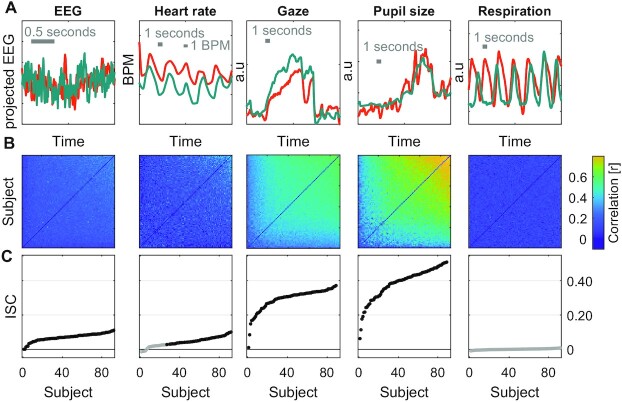
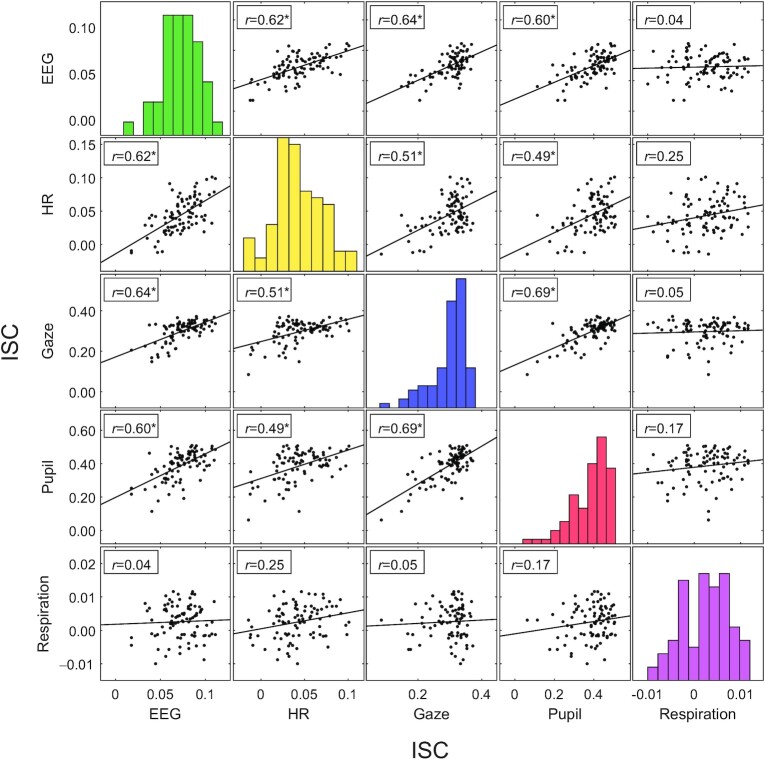
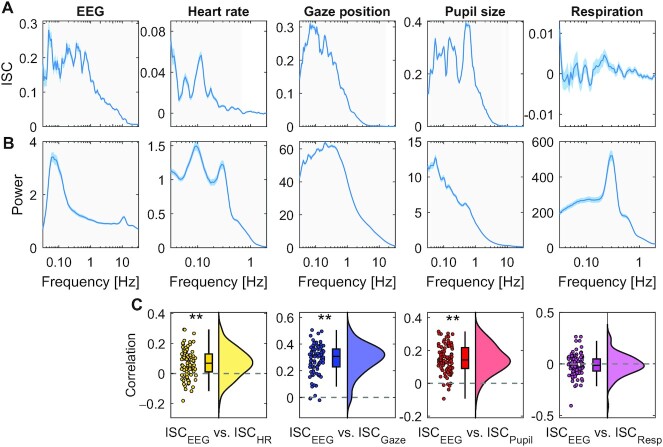
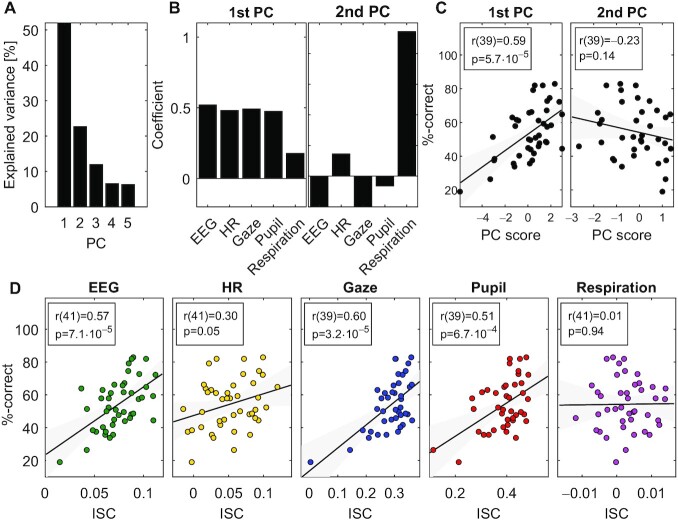
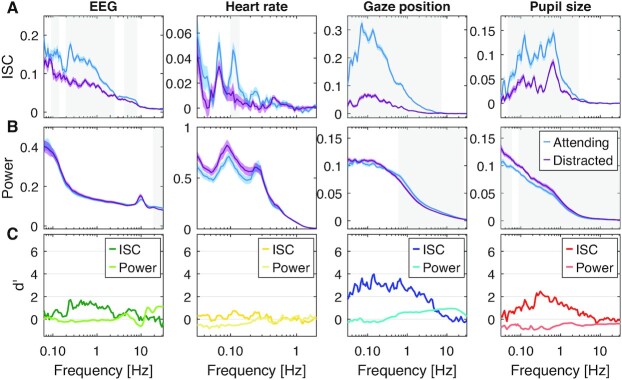
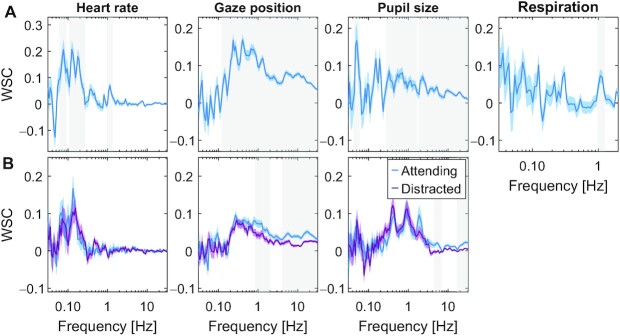
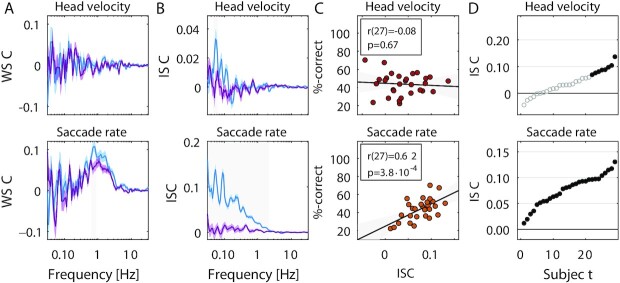
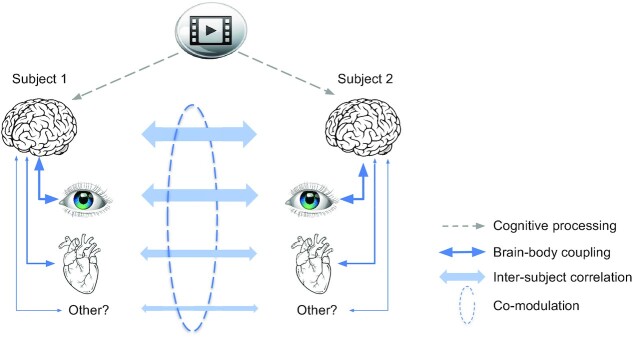
Neural, physiological, and behavioral signals synchronize between human subjects in a variety of settings. Multiple hypotheses have been proposed to explain this interpersonal synchrony, but there is no clarity under which conditions it arises, for which signals, or whether there is a common underlying mechanism. We hypothesized that cognitive processing of a shared stimulus is the source of synchrony between subjects, measured here as intersubject correlation (ISC). To test this, we presented informative videos to participants in an attentive and distracted condition and subsequently measured information recall. ISC was observed for electro-encephalography, gaze position, pupil size, and heart rate, but not respiration and head movements. The strength of correlation was co-modulated in the different signals, changed with attentional state, and predicted subsequent recall of information presented in the videos. There was robust within-subject coupling between brain, heart, and eyes, but not respiration or head movements. The results suggest that ISC is the result of effective cognitive processing, and thus emerges only for those signals that exhibit a robust brain–body connection. While physiological and behavioral fluctuations may be driven by multiple features of the stimulus, correlation with other individuals is co-modulated by the level of attentional engagement with the stimulus.
Overview
The claims and statistics of this paper haven’t been checked yet.
Free: it reads the open-access text and checks the first 5 claims that cite a source we can check. Create a free account to check every claim.
Integrity signals
Registry
Cites
Statistics
Figures
Verification
Claims the paper makes
The claims and statistics of this paper haven’t been checked yet.
Free: it reads the open-access text and checks the first 5 claims that cite a source we can check. Create a free account to check every claim.
Claims other papers make about this one
Each is checked against this paper’s own text: does it say what the citing paper says it does?
The cited source says what the claim attributes to it.
In the citing paper
“Notably, this paradigm does not entail providing participants with any shared stimulus or task (cf. [49, 50, 51]), thereby minimizing the likelihood of synchrony arising from common external input, that is, stimulus‐driven synchrony [52, 53].”
From Interpersonal Synchronization of Autonomic Physiology via Mere Visual Contact (2026) · cites this paper as [49]
Self-check
Percentages, sums and reported differences re-computed from the paper’s own numbers.
The self-check needs the paper’s full text.
Citations
Cites
Nonparametric statistical testing of EEG- and MEG-data
Maris, E., & Oostenveld, R. (2007) · Journal of Neuroscience Methods · doi:10.1016/j.jneumeth.2007.03.024 · Cited by 8,496 · cited 1×
“Since different frequency bands in the frequency-resolved ISC (and WSC) are not independent, we use 1D cluster statistics including random shuffles to correct for multiple comparisons following an established procedure (84, 85).”
MethodRecurrence plots for the analysis of complex systems
MARWAN, N., CARMENROMANO, M., THIEL, M., & KURTHS, J. (2007) · Physics Reports · doi:10.1016/j.physrep.2006.11.001 · Cited by 3,814
Thayer, J. F., Åhs, F., Fredrikson, M., Sollers, J. J., & Wager, T. D. (2012) · Neuroscience & Biobehavioral Reviews · doi:10.1016/j.neubiorev.2011.11.009 · Cited by 3,224 · cited 1×
“For instance, HRV correlates with neural activity measured with fMRI (73).”
BackgroundEffects of parietal injury on covert orienting of attention
Posner, M., Walker, J., Friedrich, F., & Rafal, R. (1984) · The Journal of Neuroscience · doi:10.1523/jneurosci.04-07-01863.1984 · Cited by 2,191
Analyzing Neural Time Series Data: Theory and Practice
Cohen, M. X. (2014) · doi:10.7551/mitpress/9609.001.0001 · Cited by 2,105
Thayer, J. F., & Lane, R. D. (2009) · Neuroscience & Biobehavioral Reviews · doi:10.1016/j.neubiorev.2008.08.004 · Cited by 2,040 · cited 1×
“Indeed, central control is wellestablished and explains the effects of cognition on HR and HR variability (27, 28).”
BackgroundThe pupil as a measure of emotional arousal and autonomic activation
Bradley, M. M., Miccoli, L., Escrig, M. A., & Lang, P. J. (2008) · Psychophysiology · doi:10.1111/j.1469-8986.2008.00654.x · Cited by 1,919 · cited 1×
“The pupil size is known to be affected by luminance, but also higher level factors such as problem solving and cognitive effort (31, 65), affective processing (33, 66), and attention (67).”
BackgroundThayer, J. F., Hansen, A. L., Saus-Rose, E., & Johnsen, B. H. (2009) · Annals of Behavioral Medicine · doi:10.1007/s12160-009-9101-z · Cited by 1,872 · cited 2×
“Indeed, central control is wellestablished and explains the effects of cognition on HR and HR variability (27, 28).”
BackgroundIntersubject synchronization of cortical activity during natural vision
Hasson, U., Nir, Y., Levy, I., Fuhrmann, G., & Malach, R. (2004) · Science · doi:10.1126/science.1089506 · Cited by 1,839 · cited 3×
“We measured ISC for each individual (12, 13), and resolved it on the group level also across time and frequency.”
BackgroundMethodThe Augmented Lagrange Multiplier Method for Exact Recovery of Corrupted Low-Rank Matrices
Lin, Z., Chen, M., & Ma, Y. (2010) · Illinois Digital Environment for Access to Learning and Scholarship (University of Illinois at Urbana-Champaign) · doi:10.48550/arxiv.1009.5055 · Cited by 1,176
Research works printed but not linked: 1
- 36. Parra LC, Haufe S, Dmochowski JP. 2019. Correlated components analysis – extracting reliable dimensions in multivariate data. Neurons Behav Data Anal Theory. 2: 7125.
Cited by
Brain-heart interactions in the neurobiology of consciousness
Candia‐Rivera, D. (2022) · Current Research in Neurobiology · doi:10.1016/j.crneur.2022.100050 · Cited by 122
Relational neuroscience: Insights from hyperscanning research
Felice, S. D., Chand, T., Croy, I., Engert, V., Goldstein, P., Holroyd, C. B., Kirsch, P., Krach, S., Ma, Y., Scheele, D., et al. (2024) · Neuroscience & Biobehavioral Reviews · doi:10.1016/j.neubiorev.2024.105979 · Cited by 86
A practical guide to EEG hyperscanning in joint action research: from motivation to implementation
Zamm, A., Loehr, J. D., Vesper, C., Konvalinka, I., Kappel, S. L., Heggli, O. A., Vuust, P., & Keller, P. E. (2024) · Social Cognitive and Affective Neuroscience · doi:10.1093/scan/nsae026 · Cited by 58
How and why people synchronize: An integrated perspective
daSilva, E. B., & Wood, A. (2025) · Personality and Social Psychology Review · doi:10.1177/10888683241252036 · Cited by 56
“The presence of synchrony during a shared task should not, in itself, be taken as a cue that people are cooperating, however (Madsen & Parra, 2022).”
Gu, C., Peng, Y., Nastase, S. A., Mayer, R. E., & Li, P. (2024) · Proceedings of the National Academy of Sciences · doi:10.1073/pnas.2309054121 · Cited by 45
Audience immersion: validating attentional and physiological measures against self-report
Hammond, H., Armstrong, M., Thomas, G. A., & Gilchrist, I. D. (2023) · Cognitive Research Principles and Implications · doi:10.1186/s41235-023-00475-0 · Cited by 39
Delta-band audience brain synchrony tracks engagement with live and recorded dance
Rai, L. A., Lee, H., Becke, E., Trenado, C., Abad-Hernando, S., Sperling, M., Vidaurre, D., Wald‐Fuhrmann, M., Richardson, D. C., Ward, J. A., et al. (2025) · iScience · doi:10.1016/j.isci.2025.112922 · Cited by 32
Bidirectional brain-body interactions during natural story listening
Madsen, J., & Parra, L. C. (2024) · Cell Reports · doi:10.1016/j.celrep.2024.114081 · Cited by 32
Self-citationGibbs, H. J., Czepiel, A. M., & Egermann, H. (2023) · Frontiers in Psychology · doi:10.3389/fpsyg.2023.1214505 · Cited by 25
Semantic novelty modulates neural responses to visual change across the human brain
Nentwich, M., Leszczyński, M., Russ, B. E., Hirsch, L., Markowitz, N., Sapru, K., Schroeder, C. E., Mehta, A. D., Bickel, S., & Parra, L. C. (2023) · Nature Communications · doi:10.1038/s41467-023-38576-5 · Cited by 22
Self-citationOakes, R. A., Peschel, L., & Barraclough, N. E. (2024) · iScience · doi:10.1016/j.isci.2024.109843 · Cited by 20
Stuldreher, I. V., van Erp, J. B. F., & Brouwer, A.-M. (2023) · Sensors · doi:10.3390/s23063006 · Cited by 18
Xue, X., Li, Y., Liu, S., & Liu, M. (2025) · Annals of Tourism Research · doi:10.1016/j.annals.2025.103955 · Cited by 18
Interpersonal Synchrony Research in Human Groups
Gordon, I. (2025) · Social and Personality Psychology Compass · doi:10.1111/spc3.70068 · Cited by 18
Neural and behavioral reinstatement jointly reflect retrieval of narrative events
Nau, M., Greene, A., Tarder-Stoll, H., Lossio-Ventura, J. A., Pereira, F., Chen, J., Baldassano, C. A., & Baker, C. I. (2025) · Nature Communications · doi:10.1038/s41467-025-62375-9 · Cited by 18
Maximal Memory Capacity Near the Edge of Chaos in Balanced Cortical E-I Networks
Kanamaru, T., Hensch, T. K., & Aihara, K. (2023) · Neural Computation · doi:10.1162/neco_a_01596 · Cited by 18
Audio‐visual concert performances synchronize audience's heart rates
Czepiel, A. M., Fink, L., Scharinger, M., Seibert, C., Wald‐Fuhrmann, M., & Kotz, S. A. (2025) · Annals of the New York Academy of Sciences · doi:10.1111/nyas.15279 · Cited by 17
Bringing social interaction at the core of organizational neuroscience
Boukarras, S., Ferri, D., Frisanco, A., Farnese, M. L., Consiglio, C., Alvino, I., Bianchi, F. P., D'Acunto, A., Боргогни, Л., & Aglioti, S. M. (2022) · Frontiers in Psychology · doi:10.3389/fpsyg.2022.1034454 · Cited by 16
EEG and peripheral markers of viewer ratings: a study of short films
Kosonogov, V., Shelepenkov, D., & Rudenkiy, N. (2023) · Frontiers in Neuroscience · doi:10.3389/fnins.2023.1148205 · Cited by 16
The role of engagement and arousal in emotion regulation: an EEG study
Kosonogov, V., Ntoumanis, I., Hajiyeva, G., & Jääskeläinen, I. P. (2023) · Experimental Brain Research · doi:10.1007/s00221-023-06741-3 · Cited by 15
Reliability for music-induced heart rate synchronization
Nomura, R. (2024) · Scientific Reports · doi:10.1038/s41598-024-62994-0 · Cited by 14
Neural mechanisms of expert persuasion on willingness to pay for sugar
Ntoumanis, I., Davydova, A., Sheronova, J., Panidi, K., Kosonogov, V., Шестакова, А. Н., Jääskeläinen, I. P., & Klucharev, V. A. (2023) · Frontiers in Behavioral Neuroscience · doi:10.3389/fnbeh.2023.1147140 · Cited by 13
Words as social tools (WAT): A reprise
Mazzuca, C., Fini, C., Livio, C. D., Falcinelli, I., Maggio, F., Tummolini, L., & Borghi, A. M. (2024) · Physics of Life Reviews · doi:10.1016/j.plrev.2024.12.011 · Cited by 12
Intersubject correlation as a predictor of attention: a systematic review
Liu, Q., Lin, Y., & Zhang, W. (2025) · BMC Psychology · doi:10.1186/s40359-025-02879-7 · Cited by 12
Nozawa, T., Sas, M. I., Dolan, D., Rajpal, H., Rosas, F. E., Timmermann, C., Mediano, P. A. M., Honda, K., Amano, S., Miyake, Y., et al. (2025) · Scientific Reports · doi:10.1038/s41598-025-90271-1 · Cited by 12
Stuldreher, I. V., Maasland, E., Bottenheft, C., van Erp, J. B. F., & Brouwer, A.-M. (2023) · Frontiers in Neuroergonomics · doi:10.3389/fnrgo.2023.1199347 · Cited by 11
“, 2012), we and others found that inter-subject correlations in body measures such as EDA and heart rate reflect attention as well (Stuldreher et al., 2020a,b; Pérez et al., 2021; Madsen and Parra, 2022).”
InfluentialFrom story to heartbeats: Physiological synchrony in theater audiences.
Carter, F., Richardson, M., Levordashka, A., Campbell, S., Samuels, B., Stanton Fraser, D., & Gilchrist, I. D. (2026) · Psychology of Aesthetics, Creativity, and the Arts · doi:10.1037/aca0000699 · Cited by 10
Heart rate synchrony as a marker of real-world social engagement
He, H., Christensen, J. H., Sørensen, A. J. M., & Konvalinka, I. (2026) · PNAS Nexus · doi:10.1093/pnasnexus/pgag181 · Cited by 10
Xu, S., Zhang, H., Fan, J., Jiang, X., Zhang, M., Guan, J., Ding, H., & Zhang, Y. (2024) · Journal of Speech Language and Hearing Research · doi:10.1044/2024_jslhr-23-00553 · Cited by 9
Physiologically informed predictability of a teammate’s future actions forecasts team performance
Qin, Y., Lee, R. T., Zhang, W., Sun, X., & Sajda, P. (2025) · iScience · doi:10.1016/j.isci.2025.112429 · Cited by 9
Takeuchi, N. (2024) · Mathematical Biosciences & Engineering · doi:10.3934/mbe.2024226 · Cited by 9
Stuldreher, I. V., Merasli, A., Thammasan, N., van Erp, J. B. F., & Brouwer, A.-M. (2022) · Frontiers in Neuroergonomics · doi:10.3389/fnrgo.2021.750248 · Cited by 9
Rhythms of interaction – the timescales of social coordination and why they matter
Hamilton, A. F. D. C., Southgate, V., Miskowiak, K. W., Bjertrup, A. J., Lomoriello, A. S., Felice, S. D., Liu, R., & Konvalinka, I. (2026) · Neuroscience & Biobehavioral Reviews · doi:10.1016/j.neubiorev.2026.106827 · Cited by 9
How to design real-world functional near-infrared spectroscopy studies: a primer
Jones, I. L., Bulgarelli, C., Felice, S. D., Pinti, P., & Hamilton, A. F. D. C. (2025) · Neurophotonics · doi:10.1117/1.nph.13.s1.s10701 · Cited by 9
Horizontes de la transformación digital
Escudero-Nahón, A., & Palacios, R. (2023) · Editorial Transdigital eBooks · doi:10.56162/transdigitalb18 · Cited by 8
A body-brain (dis)equilibrium regulating transitions from health to pathology
Criscuolo, A., Czepiel, A. M., Schwartze, M., & Kotz, S. A. (2025) · Physics of Life Reviews · doi:10.1016/j.plrev.2025.07.003 · Cited by 7
Functional MRI responses to naturalistic stimuli are increasingly typical across early childhood
Tansey, R. C., Graff, K., Rohr, C. S., Dimond, D., Ip, A., Yin, S., Dewey, D., & Bray, S. (2023) · Developmental Cognitive Neuroscience · doi:10.1016/j.dcn.2023.101268 · Cited by 7
Do we all synch alike? Brain–body-environment interactions in ASD
Beker, S., & Molholm, S. (2023) · Frontiers in Neural Circuits · doi:10.3389/fncir.2023.1275896 · Cited by 7
Li, J., Chen, Z., Hao, X., & Liu, W. (2025) · Behavior Research Methods · doi:10.3758/s13428-025-02790-4 · Cited by 7
Narrative predicts cardiac synchrony in audiences
Hammond, H., Armstrong, M., Thomas, G. A., Dalmaijer, E. S., Bull, D., & Gilchrist, I. D. (2024) · Scientific Reports · doi:10.1038/s41598-024-73066-8 · Cited by 7
Streuber, S., Rogula, S., Quirós-Ramírez, M. A., & Pruessner, J. C. (2026) · Scientific Reports · doi:10.1038/s41598-026-35955-y · Cited by 6
Developmental differences in the perception of naturalistic human movements
Ntoumanis, I., Шестакова, А. Н., Koriakina, M. M., Kadieva, D., Kopytin, G., & Jääskeläinen, I. P. (2023) · Frontiers in Human Neuroscience · doi:10.3389/fnhum.2022.1046277 · Cited by 5
Newman, L. A., Cao, M., Täuber, S., & van Vugt, M. K. (2024) · PsyArXiv (OSF Preprints) · doi:10.31234/osf.io/5vgp9 · Cited by 5
Adapting a Live Streamed Digital Theatre Experience Using Physiological Synchrony
Richardson, M., Carter, F., Levordashka, A., Gilchrist, I. D., & Fraser, D. S. (2025) · Projections · doi:10.3167/proj.2025.190305 · Cited by 5
Attentional state, not trait, predicts test performance in video-based learning
Madsen, J., & Parra, L. C. (2025) · iScience · doi:10.1016/j.isci.2025.113622 · Cited by 4
Self-citationGaze cluster analysis reveals heterogeneity in attention allocation and predicts learning outcomes
John, N., Korinth, S. P., Kunter, M., & Baier‐Mosch, F. (2025) · Scientific Reports · doi:10.1038/s41598-025-06654-x · Cited by 4
Trace: A research media player measuring real-time audience engagement
Levordashka, A., Richardson, M., Hirst, R. J., Gilchrist, I. D., & Fraser, D. S. (2025) · Behavior Research Methods · doi:10.3758/s13428-024-02522-0 · Cited by 4
Scaffolding human and AI instruction: Neural alignment and learning gains in online education
Peng, Y., Nastase, S. A., Huang, Y., Li, Y., Guo, Z., & Li, P. (2026) · Neuron · doi:10.1016/j.neuron.2026.04.005 · Cited by 4
The Brain, Body, and Behavior Dataset (BBBD): Multimodal Recordings during Educational Videos
Madsen, J., Kuppa, N., & Parra, L. C. (2026) · Scientific Data · doi:10.1038/s41597-026-07215-1 · Cited by 4
Self-citationWilliams, J. T., Francombe, J., & Murphy, D. T. (2023) · Applied Sciences · doi:10.3390/app13148482 · Cited by 4
Li, Q., Dabranau, A., Kompatsiari, K., & Konvalinka, I. (2025) · bioRxiv (Cold Spring Harbor Laboratory) · doi:10.64898/2025.12.30.695445 · Cited by 3
In Sync With Sound: Interpersonal synchronization as an objective measure of listening engagementPreprint
Lambrechts, L., Accou, B., Vanthornhout, J., Boets, B., & Francart, T. (2025) · bioRxiv (Cold Spring Harbor Laboratory) · doi:10.1101/2025.02.26.639799 · Cited by 3
BaHammam, A. S. (2026) · Journal of Taibah University Medical Sciences · doi:10.1016/j.jtumed.2026.06.008 · Cited by 3
Sanada, M., & Naruse, Y. (2025) · Scientific Reports · doi:10.1038/s41598-025-08191-z · Cited by 3
Monitoring audience engagement using electrodermal activity during an inaugural lecture
Stuldreher, I. V., & Brouwer, A.-M. (2025) · PLoS ONE · doi:10.1371/journal.pone.0326091 · Cited by 3
Carter, F., Gilchrist, I. D., & Fraser, D. S. (2025) · Journal of Cognitive Neuroscience · doi:10.1162/jocn_a_02338 · Cited by 3
Lee, Y., Kim, B., Kim, H., Lee, J., Lee, G., Shin, H., & Gil, Y.-H. (2025) · Proceedings - International Symposium on Mixed and Augmented Reality, ISMAR · doi:10.1109/ismar67309.2025.00143 · Cited by 3
Medvedeva, A. D., Rudenkiy, N., Shelepenkov, D., & Kosonogov, V. (2026) · Behavioural Brain Research · doi:10.1016/j.bbr.2026.116169 · Cited by 2
Gibbs, H. J., & Schiavio, A. (2024) · Research Square · doi:10.21203/rs.3.rs-4581247/v1 · Cited by 2
Camera-Sourced Heart Rate Synchronicity: A Measure of Immersion in Audiovisual Experiences
Williams, J., Francombe, J., & Murphy, D. T. (2024) · Applied Sciences · doi:10.3390/app14167228 · Cited by 2
Exploring Dyadic Cardiovascular Synchronization in Response to High-Arousal Music
Lavezzo, L., Marco, A. D., Viti, A., Ciacchini, R., Conversano, C., Grandjean, D., Scilingo, E. P., Filippa, M., & Nardelli, M. (2025) · IEEE International Symposium on Medical Measurements and Applications (MeMeA) · doi:10.1109/memea65319.2025.11068094 · Cited by 2
Williams, K., Fuchs, A. K., Kuehn, J., Fleck, L., Lerch, S., Cavelti, M., Koenig, J., & Kaess, M. (2025) · Borderline Personality Disorder and Emotion Dysregulation · doi:10.1186/s40479-025-00289-0 · Cited by 2
How stories and narrative move the heart—literally
Beans, C. M. (2022) · Proceedings of the National Academy of Sciences · doi:10.1073/pnas.2206199119 · Cited by 2
Viriyopase, A., & Narajeenron, K. (2025) · JMIR Medical Education · doi:10.2196/69725 · Cited by 2
Meletaki, V., Christensen, J. F., Darda, K. M., Rai, L. A., & Orlandi, A. (2026) · iScience · doi:10.1016/j.isci.2026.117810 · Cited by 2
Schmälzle, R., Cho, H. J., & Turner, M. M. (2026) · bioRxiv (Cold Spring Harbor Laboratory) · doi:10.64898/2026.02.05.703516 · Cited by 2
Hałgas, E. A., Gevers, J., Rispens, S., Wiltshire, T. J., van Eijndhoven, K. H. J., & Westerink, J. H. D. M. (2024) · PsyArXiv (OSF Preprints) · doi:10.31234/osf.io/kd9s2 · Cited by 2
Real-time estimation of overt attention from dynamic features of the face using deep-learningPreprint
Silvan, A., Parra, L. C., & Madsen, J. (2024) · arXiv (Cornell University) · doi:10.48550/arxiv.2409.13084 · Cited by 2
Self-citationInterpersonal Synchronization of Autonomic Physiology via Mere Visual Contact
Koul, A., & Novembre, G. (2026) · Annals of the New York Academy of Sciences · doi:10.1111/nyas.70322 · Cited by 1
“Notably, this paradigm does not entail providing participants with any shared stimulus or task (cf. [ 49–51 ]), thereby minimizing the likelihood of synchrony arising from common external input, that is, stimulus-driven synchrony [ 52, 53 ].”
Vigo, D. E., Tuerlinckx, F., Scaramal, M., Baptista, R. R., Bersenev, E. Y., den Bergh, O. V., & AUBERT, A. E. (2025) · Acta Astronautica · doi:10.1016/j.actaastro.2025.01.060 · Cited by 1
Exploring cardiac physiological synchrony and its implications for stress and anxiety
Escobar, L. S., Robbins, M., Hwang, J., Jung, S.-M., & Park, D. J. (2025) · Ageing and Neurodegenerative Diseases · doi:10.20517/and.2025.14 · Cited by 1
Physiological synchrony in brain and body as a measure of attentional engagement
Stuldreher, I. V. (2023) · doi:10.3990/1.9789036559379 · Cited by 1
Gao, L., Wei, Z., Biswal, B. B., & Di, X. (2026) · Psychoradiology · doi:10.1093/psyrad/kkag026 · Cited by 1
The Influence of Leadership Coaching Competencies on the Success of Digital Transformation Projects
Ivaaturi, K. (2026) · Universal Library of Innovative Research and Studies · doi:10.70315/uloap.ulirs.2026.0301010 · Cited by 1
Real-Time Estimation of Overt Attention from Dynamic Features of the Face Using Deep Learning
Silvan, A., Parra, L. C., & Madsen, J. (2025) · Annual International Conference of the IEEE Engineering in Medicine and Biology Society (EMBC) · doi:10.1109/embc58623.2025.11254013 · Cited by 1
Self-citationBrain-body dynamics are asymmetric and stable across cognitive states
Madsen, J., Silvan, A., Babadi, B., & Parra, L. C. (2026) · Imaging Neuroscience · doi:10.64898/2025.12.22.696055 · Cited by 1
Self-citationCzepiel, A. M. (2023) · Research Publications (Maastricht University) · doi:10.26481/dis.20231002ac · Cited by 1
Portable EEG in groups shows increased brain coupling to strong health messages
Imhof, M. A., Flösch, K., Schmälzle, R., Renner, B., & Schupp, H. T. (2024) · Social Cognitive and Affective Neuroscience · doi:10.1093/scan/nsae087 · Cited by 1
The neuroaesthetics of liveness
Orgs, G. (2026) · Current Opinion in Psychology · doi:10.1016/j.copsyc.2026.102432 · Cited by 1
Schmälzle, R., Wu, J., Lim, S., & Bente, G. (2025) · Journal of Media Psychology Theories Methods and Applications · doi:10.1027/1864-1105/a000457 · Cited by 1
Rubio, M. L., López, A. M. R., Caro, M. R., & Rudnicki, K. (2026) · Disabilities · doi:10.3390/disabilities6010021 · Cited by 1
Carter, F., Richardson, M., Fraser, D. S., & Gilchrist, I. D. (2026) · Entropy · doi:10.3390/e28050503
Hazarika, K., & Gupta, C. N. (2023) · Lecture notes in networks and systems · doi:10.1007/978-981-99-0981-0_7
A pupil-dilation method to test developmental differences in visual synchrony during free viewing
Ghilardi, T., & Ossmy, O. (2026) · Methods in Psychology · doi:10.1016/j.metip.2026.100239
Bello, K., Azzam, I., Breidi, F., & Aqlan, F. (2026) · IISE Transactions on Occupational Ergonomics and Human Factors · doi:10.1080/24725838.2026.2645067
Hammond, H., Armstrong, M., Thomas, G. A., & Gilchrist, I. D. (2024) · Figshare · doi:10.6084/m9.figshare.26583645
Koriakina, M. M., Ntoumanis, I., Blagovechtchenski, E., Pomelova, E. D., Ledneva, T., Agranovich, O. Е., Blank, I. B., Myachykov, A. V., & Shestakova, A. N. (2026) · Frontiers in Human Neuroscience · doi:10.3389/fnhum.2026.1754368
Latent State Synchronization in Dyadic Partners using EEG
Gordon, S. M., King, K., & Rabin, A. (2023) · Conference proceedings/Conference proceedings - IEEE International Conference on Systems, Man, and Cybernetics · doi:10.1109/smc53992.2023.10394383
Qu-Lee, J. W., & Balcetis, E. (2024) · Social and Personality Psychology Compass · doi:10.1111/spc3.12994
Stuldreher, I. V., van Erp, J. B. F., & Brouwer, A. M. (2022) · TNO Repository
What drives intersubject correlation of EEG during auditory narratives?
Fló, E., Cabana, Á., Valle-Lisboa, J. C., Cruse, D., Madsen, J., Parra, L. C., & Sitt, J. D. (2026) · Imaging Neuroscience · doi:10.64898/2026.02.19.706583
Self-citationLespinasse, F. (2023) · Papyrus : Institutional Repository (Université de Montréal) · doi:10.71781/18094
Beyond behavior : electrophysiological markers of conscious processing
Fló, E. (2024) · theses.fr (ABES) · doi:10.70675/b95a2dc0z20a4z4341za655zb201bba1a18c
Programme and Proceedings of the Third Neuroadaptive Technology Conference 2022 (NAT'22)
Zander, T., & Fairclough, S. (2023) · Digital Repository of the BTU Cottbus – Senftenberg (Brandenburg University of Technology) · doi:10.26127/btuopen-6271
Gibbs, H. (2024) · White Rose eTheses Online (University of Leeds, The University of Sheffield, University of York)
Hakim, U. (2025) · UCL Discovery (University College London)
Neural and Cognitive Mechanisms of Real-World Interaction during Adult Learning
Felice, S. D. (2023) · UCL Discovery (University College London)
Caregiver-Child Transactions in the Context of (Co-)Regulation
Williams, K. (2026) · heiDOK (Heidelberg University) · doi:10.11588/heidok.00038113
COIVis : Eye-Tracking-Based Visual Exploration of Concept Learning in MOOC Videos
Zhou, Z., Yu, R., Ma, Y., Ni, H., Li, G., Ye, L., Wang, X., Li, Y., Wang, Y., & Wang, Y. (2026) · IEEE Transactions on Visualization and Computer Graphics · doi:10.1109/tvcg.2026.3693055
Exploring Neural Synchronization with EEG Using Fractal Animations
Cognitive Science Society 2025, Dorosti, S., & Shabani, M. (2025) · eScholarship (California Digital Library) · doi:10.48448/v0jf-bs96
Metadata
- Authors
- Madsen, J., & Parra, L. C.
- Affiliations
- City College of New York (US)
- Corresponding author
- Madsen, Jens
- Venue
- PNAS Nexus
- Publisher
- Oxford University Press (OUP)
- Published
- 2022-03
- Volume
- 1
- Issue
- 1
- Pages
- pgac020-pgac020
- ISSN
- 2752-6542 (ISSN-L)
- PMC
- PMC9802497
- OpenAlex
- W4220920836
- Cited by
- 91
- References
- 85
- Citations by year
- 2026: 20 · 2025: 27 · 2024: 19 · 2023: 21 · 2022: 4
- FWCI
- 16.75
- Type
- journal article
- Language
- en
- Open access
- gold
- doi.org
- Licence
- Locations
- PNAS Nexus (publishedVersion, cc-by)
- PubMed Central (publishedVersion, cc-by)
- PubMed (publishedVersion)
- Funders
- National Science Foundation (DRL-1660548)
- Topics
- Social Sciences › Psychology › Social Psychology › Action Observation and Synchronization
- Life Sciences › Neuroscience › Cognitive Neuroscience › Neural dynamics and brain function
- Health Sciences › Medicine › Cardiology and Cardiovascular Medicine › Heart Rate Variability and Autonomic Control
- Keywords
- interpersonal synchrony, inter-subject correlation, attention, information recall, pupil size, heart rate, respiration, head movement, EEG
About these checks
Registry, retraction, Cites and statistics results are computed, not judged, with one exception: a printed reference that no index lists is read once by a model before it counts as a citation error. Claims are extracted by a model and kept only when their quote appears verbatim in the text; each cited source is then checked, with a model’s help, for whether it says what the claim relies on. Those verdicts can be wrong — read the claim’s quote and the cited source before relying on one.
Statistics and arithmetic are recomputed, not judged.
Confidence bands are shown only for fields calibrated on our annotated test set. None is calibrated yet, so no band is shown.
What counts as a claim ›How we measure confidence ›How we check this ›
Are you an author, or do you see a problem with this page? Request a review
Data sources
Bibliographic data: Semantic Scholar, OpenAlex, Crossref.
Contains information from the Semantic Scholar Academic Graph Datasets, made available under the ODC Attribution License (ODC-BY 1.0).
Semantic Scholar’s data is described in: Kinney, R., et al. (2023). The Semantic Scholar Open Data Platform. arXiv:2301.10140.
