

The origin and evolution of methanogenesis and Archaea are intertwined
Open accessThe DOI matches its Crossref record; 76 of the 76 references it cites were found in a registry or an index.
Abstract
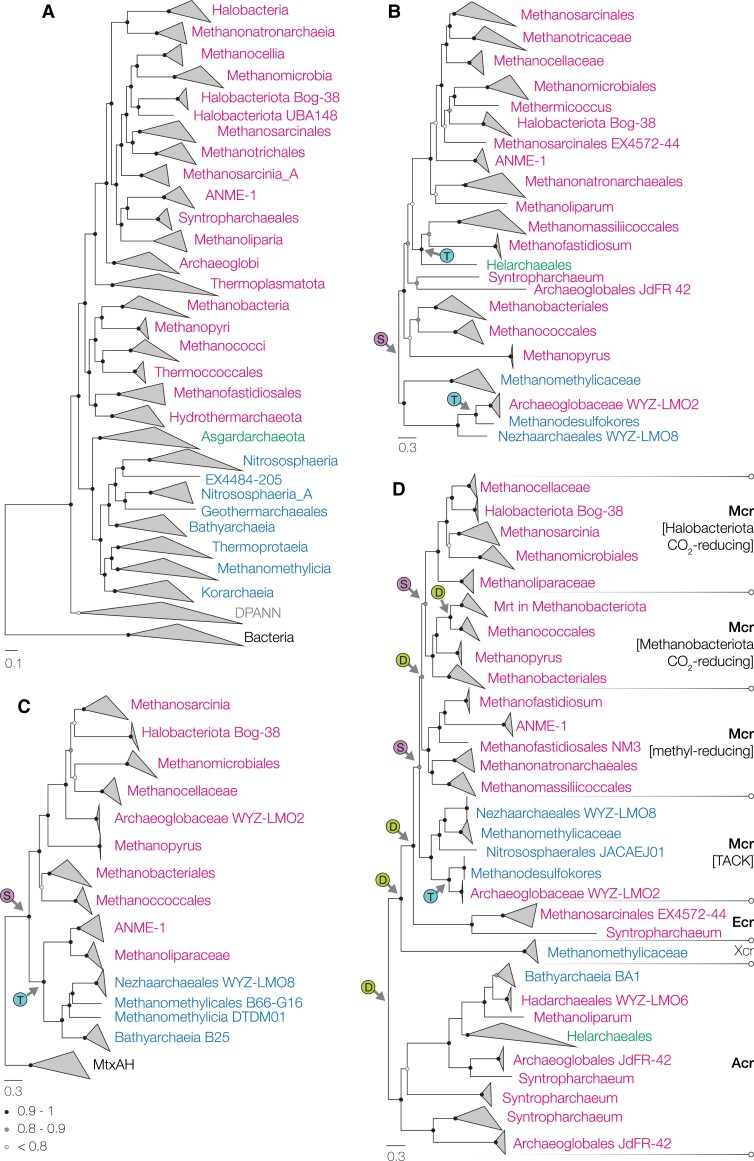
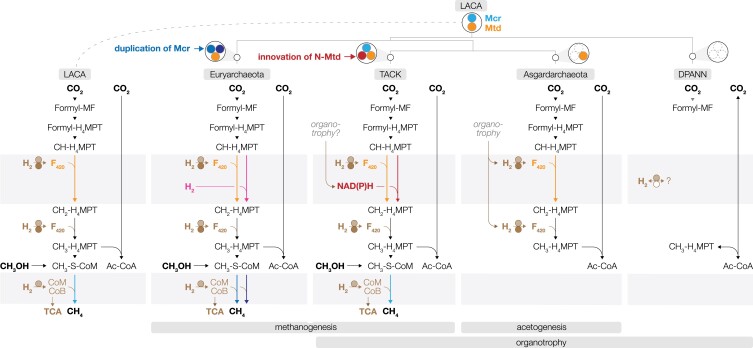
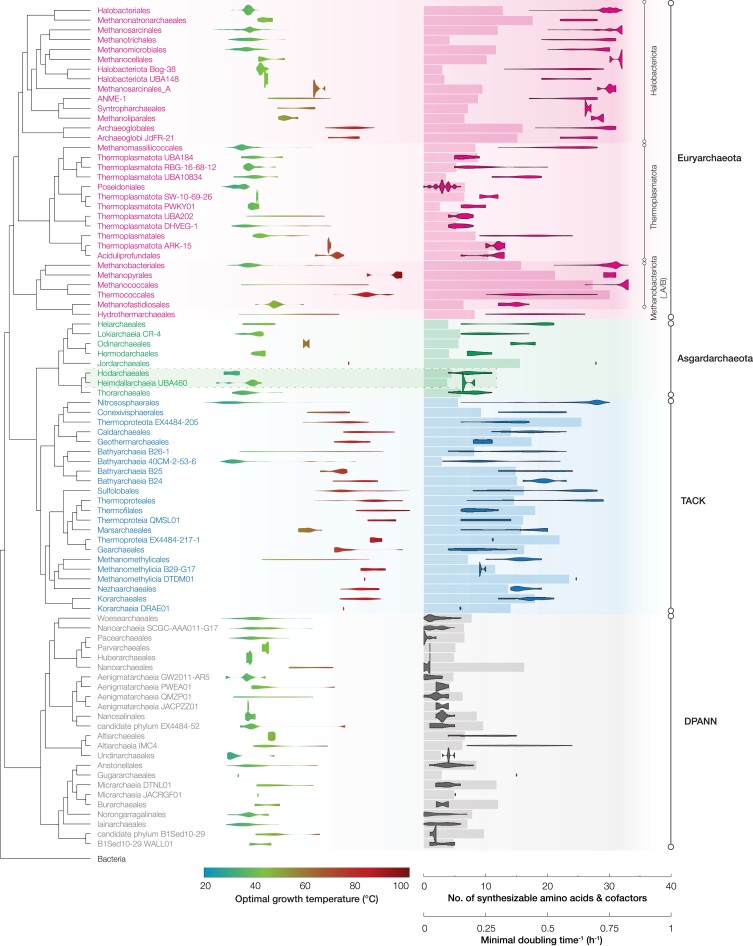
Methanogenesis has been widely accepted as an ancient metabolism, but the precise evolutionary trajectory remains hotly debated. Disparate theories exist regarding its emergence time, ancestral form, and relationship with homologous metabolisms. Here, we report the phylogenies of anabolism-involved proteins responsible for cofactor biosynthesis, providing new evidence for the antiquity of methanogenesis. Revisiting the phylogenies of key catabolism-involved proteins further suggests that the last Archaea common ancestor (LACA) was capable of versatile H2-, CO2-, and methanol-utilizing methanogenesis. Based on phylogenetic analyses of the methyl/alkyl-S-CoM reductase family, we propose that, in contrast to current paradigms, substrate-specific functions emerged through parallel evolution traced back to a nonspecific ancestor, which likely originated from protein-free reactions as predicted from autocatalytic experiments using cofactor F430. After LACA, inheritance/loss/innovation centered around methanogenic lithoautotrophy coincided with ancient lifestyle divergence, which is clearly reflected by genomically predicted physiologies of extant archaea. Thus, methanogenesis is not only a hallmark metabolism of Archaea, but the key to resolve the enigmatic lifestyle that ancestral archaea took and the transition that led to physiologies prominent today.
Overview
The claims and statistics of this paper haven’t been checked yet.
Free: it reads the open-access text and checks the first 5 claims that cite a source we can check. Create a free account to check every claim.
Integrity signals
Registry
Cites
Statistics
Figures
Verification
Claims the paper makes
The claims and statistics of this paper haven’t been checked yet.
Free: it reads the open-access text and checks the first 5 claims that cite a source we can check. Create a free account to check every claim.
Claims other papers make about this one
Each is checked against this paper’s own text: does it say what the citing paper says it does?
The cited source says what the claim attributes to it.
In the citing paper
“Mei et al. (2023) and Williams et al. (2017) found that the ancestral physiology of archaea was likely hydrogen-dependent methanogenesis.”
From Serpentinization as the source of energy, electrons, organics, catalysts, nutrients and pH gradients for the origin of LUCA and life (2023) · cites this paper as Mei et al., 2023
Self-check
Percentages, sums and reported differences re-computed from the paper’s own numbers.
The self-check needs the paper’s full text.
Citations
Cites
1 retracted
Wang, Y., Wegener, G., Williams, T. A., Xie, R., Hou, J., Wang, F., & Xiao, X. (2021) · Science Advances · doi:10.1126/sciadv.abd7180 · Cited by 50
RetractedMAFFT Multiple Sequence Alignment Software Version 7: Improvements in Performance and Usability
Katoh, K., & Standley, D. M. (2013) · Molecular Biology and Evolution · doi:10.1093/molbev/mst010 · Cited by 46,209
Prokka: rapid prokaryotic genome annotation
Seemann, T. (2014) · Bioinformatics · doi:10.1093/bioinformatics/btu153 · Cited by 18,818
IQ-TREE 2: New Models and Efficient Methods for Phylogenetic Inference in the Genomic Era
Minh, B. Q., Schmidt, H. A., Chernomor, O., Schrempf, D., Woodhams, M. D., von Haeseler, A., & Lanfear, R. (2020) · Molecular Biology and Evolution · doi:10.1093/molbev/msaa015 · Cited by 16,873
trimAl: a tool for automated alignment trimming in large-scale phylogenetic analyses
Capella-Gutiérrez, S., Silla-Martínez, J. M., & Gabaldón, T. (2009) · Bioinformatics · doi:10.1093/bioinformatics/btp348 · Cited by 12,751
Parks, D. H., Imelfort, M., Skennerton, C. T., Hugenholtz, P., & Tyson, G. W. (2015) · Genome Research · doi:10.1101/gr.186072.114 · Cited by 12,496
Cd-hit: Accelerated for clustering the next-generation sequencing data
Fu, L., Niu, B., Zhu, Z., Wu, S., & Li, W. (2012) · Bioinformatics · doi:10.1093/bioinformatics/bts565 · Cited by 11,175
(2021) · doi:10.1093/molbev/msab293 · Cited by 5,335
Huerta-Cepas, J., Szklarczyk, D., Heller, D., Hernández-Plaza, A., Forslund, S. K., Cook, H., Mende, D. R., Letunic, I., Rattei, T., Jensen, L. J., et al. (2019) · Nucleic Acids Research · doi:10.1093/nar/gky1085 · Cited by 4,902
Methanogenic archaea: ecologically relevant differences in energy conservation
Thauer, R. K., Kaster, A.-K., Seedorf, H., Buckel, W., & Hedderich, R. (2008) · Nature Reviews Microbiology · doi:10.1038/nrmicro1931 · Cited by 2,184
Cited by
Schwander, L., Brabender, M., Mrnjavac, N., Wimmer, J. L. E., Preiner, M., & Martin, W. F. (2023) · Frontiers in Microbiology · doi:10.3389/fmicb.2023.1257597 · Cited by 65
Eukaryotes’ closest relatives are internally simple syntrophic peptidotrophic archaea
Imachi, H., Nobu, M. K., Ishii, S., Hashiguchi, H., Hirakata, Y., Hosogi, N., Ikuta, T., Isaji, Y., Miyata, M., Miyazaki, M., et al. (2026) · Nature · doi:10.1101/2025.02.26.640444 · Cited by 48
Self-citationCovariation of hot spring geochemistry with microbial genomic diversity, function, and evolution
Colman, D. R., Keller, L. M., Pozo, E. A., Andrade‐Barahona, E., Clair, B. S., Shoemaker, A., Cox, A. D., & Boyd, E. S. (2024) · Nature Communications · doi:10.1038/s41467-024-51841-5 · Cited by 45
“28) 112 .”
Brabender, M., Henriques Pereira, D. P., Mrnjavac, N., Schlikker, M. L., Kimura, Z.-I., Sucharitakul, J., Kleinermanns, K., Tüysüz, H., Buckel, W., Preiner, M., et al. (2024) · Proceedings of the National Academy of Sciences · doi:10.1073/pnas.2318969121 · Cited by 42
“Despite their divergent mechanisms of pumping for ATP synthesis (43, 44), the acetyl-CoA pathway links methanogens and acetogens (84), primordial members of the archaeal and bacterial lineages (72–74), with serpentinizing environments (15, 16, 85), which they still inhabit today (26–30, 53, 74).”
Wang, J., Qu, Y.-N., Evans, P. N., Guo, Q., Zhou, F., Nie, M., Jin, Q., Zhang, Y., Zhai, X., Zhou, M., et al. (2023) · Science Advances · doi:10.1126/sciadv.adg6004 · Cited by 37
Structure of the ATP-driven methyl-coenzyme M reductase activation complex
Ramírez-Amador, F., Paul, S., Kumar, A., Lorent, C., Keller, S., Bohn, S., Nguyen, V. P. T., Lometto, S., Vlegels, D., Kahnt, J., et al. (2025) · Nature · doi:10.1038/s41586-025-08890-7 · Cited by 35
Untapped talents: insight into the ecological significance of methanotrophs and its prospects
Fenibo, E. O., Selvarajan, R., Wang, H., Wang, Y., & Abia, A. L. K. (2023) · The Science of The Total Environment · doi:10.1016/j.scitotenv.2023.166145 · Cited by 39
Rojas-Pirela, M., Andrade-Alviárez, D., Rojas, V., Marcos, M., Salete-Granado, D., Chacón-Arnaude, M., Pérez-Nieto, M. Á., Kemmerling, U., Concepción, J. L., Michels, P. A. M., et al. (2025) · Open Biology · doi:10.1098/rsob.240239 · Cited by 32
Ruiz-Blas, F., Bartholomäus, A., Yang, S., Wagner, D., Henny, C., Russell, J. M., Kallmeyer, J., & Vuillemin, A. (2024) · ISME Communications · doi:10.1093/ismeco/ycae112 · Cited by 25
“Bathyarchaeia are postulated to have arisen at hydrothermal vents [93, 94] and diversified in ferruginous and euxinic environments during the Proterozoic [49, 57], perpetuating several primitive sulfur-based and energy-conserving metabolic features of methylotrophic archaea [59].”
Holistic View and Novel Perspective on Ruminal and Extra-Gastrointestinal Methanogens in Cattle
Aryee, G., Luecke, S. M., Dahlen, C. R., Swanson, K. C., & Amat, S. (2023) · Microorganisms · doi:10.3390/microorganisms11112746 · Cited by 24
Fe/S proteins in microbial sulfur oxidation
Kümpel, C., Grosser, M., Tanabe, T. S., & Dahl, C. (2024) · Biochimica et Biophysica Acta (BBA) - Molecular Cell Research · doi:10.1016/j.bbamcr.2024.119732 · Cited by 19
Evidence for corrin biosynthesis in the last universal common ancestor
Modjewski, L. D., Karavaeva, V., Mrnjavac, N., Knopp, M., Martin, W. F., & Sousa, F. L. (2025) · The FEBS Journal · doi:10.1111/febs.17367 · Cited by 15
“In addition to physiology [48 – 51], isotopes [65 – 67] and phylogeny [47,69,70], metal catalysts provide an independent line of evidence in favour of the antiquity of the acetyl-CoA pathway.”
ATP requirements for growth reveal the bioenergetic impact of mitochondrial symbiosis
Martin, W. F. (2025) · Biochimica et Biophysica Acta (BBA) - Bioenergetics · doi:10.1016/j.bbabio.2025.149564 · Cited by 15
Archaea oxidizing alkanes through alkyl-coenzyme M reductases
Musat, F., Kjeldsen, K. U., Rotaru, A., Chen, S., & Musat, N. (2024) · Current Opinion in Microbiology · doi:10.1016/j.mib.2024.102486 · Cited by 15
The Moon‐Forming Impact and the Autotrophic Origin of Life
Mrnjavac, N., Wimmer, J. L. E., Brabender, M., Schwander, L., & Martin, W. F. (2023) · ChemPlusChem · doi:10.1002/cplu.202300270 · Cited by 13
Microbial oxidation of short-chain gaseous alkanes
Wu, M., Liu, X., Musat, F., & Guo, J. (2025) · Nature Microbiology · doi:10.1038/s41564-025-01982-0 · Cited by 12
Wang, F., Luo, Y., Xue, Z., Feng, Q., Cao, J., Wu, Y., Li, X., & Luo, J. (2025) · Chemical Engineering Journal · doi:10.1016/j.cej.2025.162569 · Cited by 12
Li, Y., Li, Z. L., Qin, X., Ye, B., Niu, Z., Ehreiser, A., Zhang, W., Pan, Y., Qin, L., Shu, R., et al. (2024) · Earth and Planetary Science Letters · doi:10.1016/j.epsl.2024.118834 · Cited by 8
Huang, W.-C., Dombrowski, N., Mahendrarajah, T., Wahl, N. A., Stamatakis, A., Szöllősi, G. J., Williams, T. A., & Spang, A. (2026) · Nature Communications · doi:10.1038/s41467-026-76386-7 · Cited by 8
Saranya, S., & Chellapandi, P. (2025) · Journal of Basic Microbiology · doi:10.1002/jobm.70015 · Cited by 8
Katayama, T., Ikawa, R., Koshigai, M., & Sakata, S. (2023) · Biogeosciences · doi:10.5194/bg-20-5199-2023 · Cited by 8
Glycogen metabolism in methanogens: A key pathway for metabolic response to nutrient availability
Gonzalez-Ordenes, F., Herrera‐Soto, N., Muñoz, S. M., Vallejos, G., Herrera, S. M., Aravena-Valenzuela, I., Urrutia-Santana, A., Castro‐Fernández, V., & Guixé, V. (2024) · Biochemical and Biophysical Research Communications · doi:10.1016/j.bbrc.2024.150978 · Cited by 7
Protasov, E. S., Reeh, H., Liu, P., Poehlein, A., Platt, K., Heimerl, T., Hervé, V., Daniel, R., & Brune, A. (2024) · FEMS Microbiology Ecology · doi:10.1093/femsec/fiae111 · Cited by 7
“Evidence for the presence of obligately methyl-reducing methanogens in many so-far uncultured archaeal lineages has sparked debate about the implications for the evolutionary origin of methanogenesis (Borrel et al. 2019 , Wang et al. 2021 , Mei et al. 2023 ).”
BackgroundEvolutionary Transitions of DNA Replication Origins Between Archaea and Bacteria
Saranya, S. V., Prathiviraj, R., & Chellapandi, P. (2024) · Journal of Basic Microbiology · doi:10.1002/jobm.202400527 · Cited by 7
“Methanogens acquired early in animal evolution but lost in the Carnivora lineages have undergone evolutionary transitions with gut bacteria in humans, ticks, aphids, and insects [8, 55 – 57].”
The early evolution of the glycolytic pathway from autotrophic origins to glycogen and back
Modjewski, L., Johnsen, U., Schönheit, P., & Martin, W. F. (2025) · FEMS Microbiology Reviews · doi:10.1093/femsre/fuaf049 · Cited by 6
Katayama, T., Yoshioka, H., Yamanaka, T., Sakata, S., & Hanamura, Y. (2024) · Biogeosciences · doi:10.5194/bg-21-4273-2024 · Cited by 6
Giulio, M. D. (2025) · Biosystems · doi:10.1016/j.biosystems.2025.105636 · Cited by 5
Giulio, M. D. (2026) · Biosystems · doi:10.1016/j.biosystems.2026.105787 · Cited by 4
Ebadirad, S., Lyons, T. W., & Fournier, G. P. (2025) · Elsevier eBooks · doi:10.1016/b978-0-323-95547-8.00030-6 · Cited by 3
Chai, H.-H., Park, W., & Lim, D. (2026) · International Journal of Molecular Sciences · doi:10.3390/ijms27020995 · Cited by 3
“Beyond the loss of animal productivity, enteric CH 4 is a potent greenhouse gas with a global warming potential 28 times that of CO 2 , positioning methanogenic archaea as a primary target for global climate change mitigation [9–11].”
Unraveling interspecies cross-feeding during anaerobic lignin degradation for bioenergy applications
Kim, M.-J., Cha, I., Li, M., & Park, S.-J. (2024) · Chemosphere · doi:10.1016/j.chemosphere.2024.142588 · Cited by 3
Paquis, P., Pardo-Esté, C., Tapia, J. S., Florez, J. Z., Pérez, V., Molina, V., Cornejo, M., Pérez, P. A., Harrod, C., Jeffrey, W. H., et al. (2025) · Communications Earth & Environment · doi:10.1038/s43247-025-02817-w · Cited by 1
“Phylogenetic analysis of cofactor F 430 biosynthesis proteins further suggests that methanogenic capacity predates the divergence of the TACK superphylum and Euryarchaeota, indicating that the last common ancestor of Archaea may already have possessed versatile methane metabolisms 78 .”
Metabolic controls on nickel isotope fractionation during microbial methanogenesis and acetogenesis
Miyajima, Y., Katayama, T., & Araoka, D. (2026) · Geochimica et Cosmochimica Acta · doi:10.1016/j.gca.2026.05.012 · Cited by 1
The origin and evolution of archaeal Borg extrachromosomal elementsPreprint
Shi, L.-D., Penev, P. I., Kolody, B. C., Miloslavich, L., Lei, S., Sachdeva, R., Rasmussen, A., Tolar, B. B., Francis, C. A., Probst, A. J., et al. (2026) · bioRxiv (Cold Spring Harbor Laboratory) · doi:10.64898/2026.05.22.727314 · Cited by 1
Functional diversity of Archaea in Brazilian Pantanal soda lakes and their role in nutrient cycling
Feitosa, Y. B. (2025) · Digital Library of Theses and Dissertations (Universidade de São Paulo) · doi:10.11606/t.64.2025.tde-11092025-161133
Biological Formation of Sulfide
Jespersen, M., & Wagner, T. (2025) · Wiley eBooks · doi:10.1002/9783527843596.ch6
Wichai, S. (2025) · Asia-Pacific Journal of Science and Technology · doi:10.14456/apst.2025.93
Methanogens Through Time and Space: Impact on Earth’s Planetary Evolution and Biogeochemistry
Tomko, P., Ovando-Ovando, C. I., Boussagol, P., Santiago‐Martínez, M. G., & Visscher, P. T. (2026) · Geosciences · doi:10.3390/geosciences16040144
“Lithotrophic methanogens also share hydrogenases with the Last Universal Common Ancestor (LUCA), which suggests LUCA likely utilized H 2 as part of its metabolism [50,179,180].”
Jelen, B. I., Peralta, Y., Morrison, S. M., Christensen, B., & Moore, E. K. (2026) · Life · doi:10.3390/life16050747
“Metabolic pathways requiring Ni are largely based on methane, carbon monoxide, and hydrogen; these pathways likely originated under the anaerobic reducing conditions of early Earth, but are rarely present in modern multicellular organisms [15,21–23].”
Lv, Z., Wang, F., & Wang, Y. (2026) · The Innovation Life · doi:10.59717/j.xinn-life.2026.100235
Assessing transporter systems of methanogens to boost archaea biotechnology
Telimaa, H., Hilts, A. S., Fink, C., Rittmann, S. K. ‐. R., Scheller, S., & Pende, N. (2026) · Biotechnology Advances · doi:10.1016/j.biotechadv.2026.109004
Kraft, L., Sackett, P. W., & Renaud, G. (2026) · bioRxiv (Cold Spring Harbor Laboratory) · doi:10.64898/2026.08.20.745946
“The latter complements the ongoing efforts to map the full diversity of methanogens and their metabolic pathways [63, 64, 65, 66, 67].”
An integrated culturomic and genomic database and analysis platform for methanogenic archaea
Chen, J., Ren, S., Tong, Z., Guan, Z., Zhang, W., Ren, S., Ma, L., Kong, L., Chong, H., Wang, Z., et al. (2026) · Database · doi:10.1093/database/baag055
“They are also of critical importance for carbon neutrality strategies, bioenergy production, and the study of life’s origins [ 2–4 ].”
He, Q., Peng, X., Shen, W., Zhao, B., Feng, K., Wang, D., Yang, X., Hou, W., Wang, Z., Du, W., et al. (2026) · Journal of Environmental Sciences · doi:10.1016/j.jes.2026.105897
Metadata
- Authors
- Mei, R., Kaneko, M., Imachi, H., & Nobu, M. K.
- Affiliations
- National Institute of Advanced Industrial Science and Technology (JP)
- Geological Survey of Japan (JP)
- Japan Agency for Marine-Earth Science and Technology (JP)
- Corresponding author
- Nobu, Masaru K
- Venue
- PNAS Nexus
- Publisher
- Oxford University Press (OUP)
- Published
- 2023-01-31
- Volume
- 2
- Issue
- 2
- Pages
- pgad023-pgad023
- ISSN
- 2752-6542 (ISSN-L)
- PMC
- PMC9982363
- OpenAlex
- W4318612975
- Cited by
- 37
- References
- 75
- Citations by year
- 2026: 9 · 2025: 10 · 2024: 12 · 2023: 6
- FWCI
- 4.44
- Type
- journal article
- Language
- en
- Open access
- gold
- doi.org
- Licence
- Locations
- PNAS Nexus (publishedVersion, cc-by)
- PubMed Central (publishedVersion, cc-by)
- PubMed (publishedVersion)
- Funders
- Gordon and Betty Moore Foundation (GBMF9743)
- Japan Society for the Promotion of Science (18H03367, 22H04985, 19H04261)
- Topics
- Physical Sciences › Energy › Renewable Energy, Sustainability and the Environment › Anaerobic Digestion and Biogas Production
- Physical Sciences › Physics and Astronomy › Astronomy and Astrophysics › Origins and Evolution of Life
- Life Sciences › Biochemistry, Genetics and Molecular Biology › Molecular Biology › Microbial metabolism and enzyme function
- Keywords
- methanogenesis, archaea, cofactor biosynthesis, F430, parallel evolution, substrate specificity, autocatalysis
About these checks
Registry, retraction, Cites and statistics results are computed, not judged, with one exception: a printed reference that no index lists is read once by a model before it counts as a citation error. Claims are extracted by a model and kept only when their quote appears verbatim in the text; each cited source is then checked, with a model’s help, for whether it says what the claim relies on. Those verdicts can be wrong — read the claim’s quote and the cited source before relying on one.
Statistics and arithmetic are recomputed, not judged.
Confidence bands are shown only for fields calibrated on our annotated test set. None is calibrated yet, so no band is shown.
What counts as a claim ›How we measure confidence ›How we check this ›
Are you an author, or do you see a problem with this page? Request a review
Data sources
Bibliographic data: Semantic Scholar, OpenAlex, Crossref.
Contains information from the Semantic Scholar Academic Graph Datasets, made available under the ODC Attribution License (ODC-BY 1.0).
Semantic Scholar’s data is described in: Kinney, R., et al. (2023). The Semantic Scholar Open Data Platform. arXiv:2301.10140.
