

The best practice for microbiome analysis using R
Open accessThe DOI matches its Crossref record; 64 of the 65 references it cites were found in a registry or an index.
Abstract
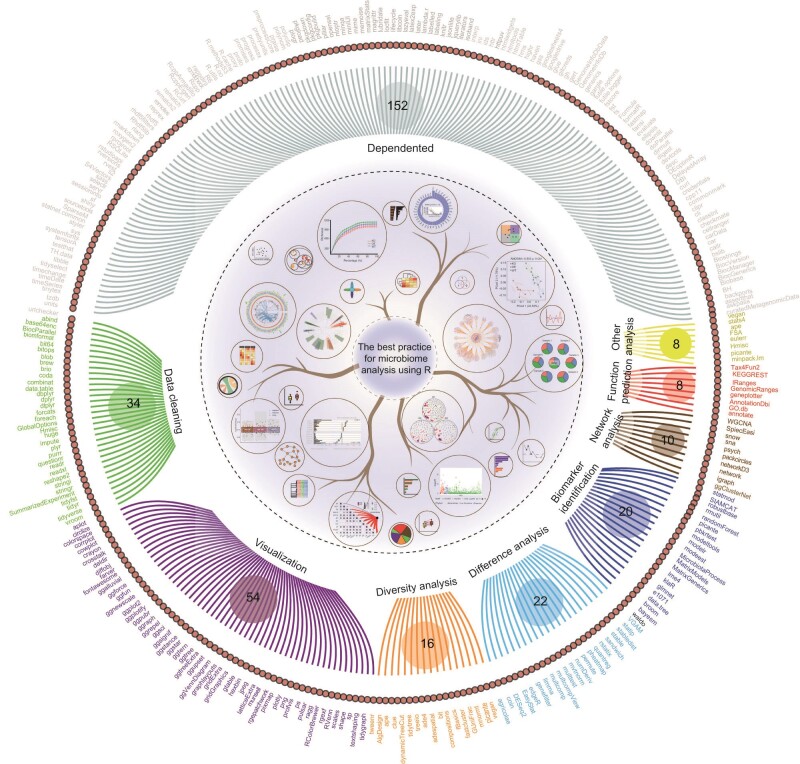
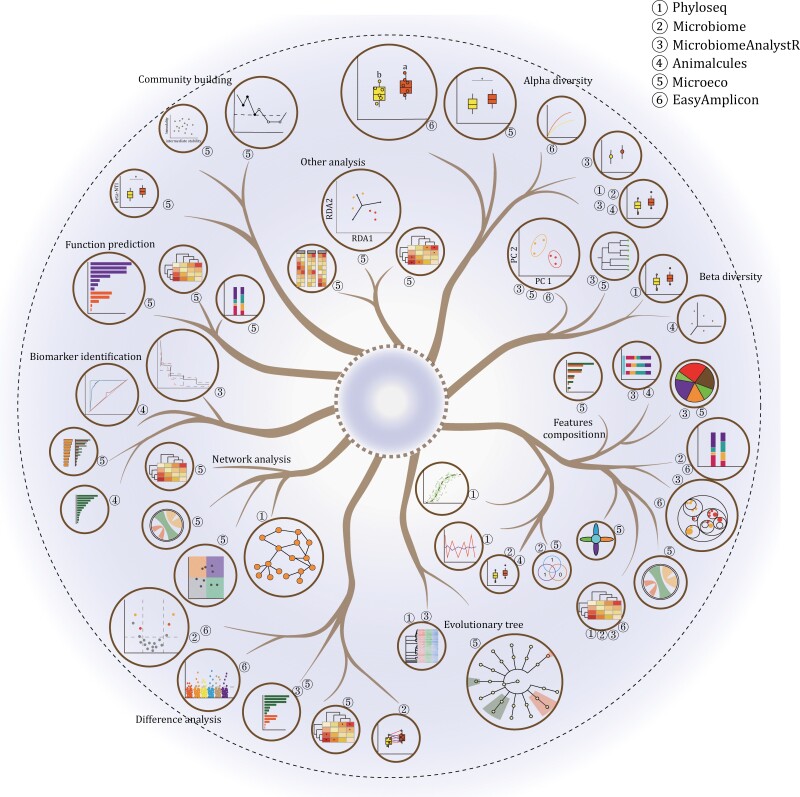
With the gradual maturity of sequencing technology, many microbiome studies have published, driving the emergence and advance of related analysis tools. R language is the widely used platform for microbiome data analysis for powerful functions. However, tens of thousands of R packages and numerous similar analysis tools have brought major challenges for many researchers to explore microbiome data. How to choose suitable, efficient, convenient, and easy-to-learn tools from the numerous R packages has become a problem for many microbiome researchers. We have organized 324 common R packages for microbiome analysis and classified them according to application categories (diversity, difference, biomarker, correlation and network, functional prediction, and others), which could help researchers quickly find relevant R packages for microbiome analysis. Furthermore, we systematically sorted the integrated R packages (phyloseq, microbiome, MicrobiomeAnalystR, Animalcules, microeco, and amplicon) for microbiome analysis, and summarized the advantages and limitations, which will help researchers choose the appropriate tools. Finally, we thoroughly reviewed the R packages for microbiome analysis, summarized most of the common analysis content in the microbiome, and formed the most suitable pipeline for microbiome analysis. This paper is accompanied by hundreds of examples with 10,000 lines codes in GitHub, which can help beginners to learn, also help analysts compare and test different tools. This paper systematically sorts the application of R in microbiome, providing an important theoretical basis and practical reference for the development of better microbiome tools in the future. All the code is available at GitHub github.com/taowenmicro/EasyMicrobiomeR.
Overview
The claims and statistics of this paper haven’t been checked yet.
Free: it reads the open-access text and checks the first 5 claims that cite a source we can check. Create a free account to check every claim.
Integrity signals
Registry
Cites
Statistics
Figures



Verification
Claims the paper makes
The claims and statistics of this paper haven’t been checked yet.
Free: it reads the open-access text and checks the first 5 claims that cite a source we can check. Create a free account to check every claim.
Claims other papers make about this one
Each is checked against this paper’s own text: does it say what the citing paper says it does?
The source backs part of the claim, not all of it — or backs it for a different population, condition or comparison.
In the citing paper
“The main technologies in the microbiome field are metagenomic sequencing and 16 S rRNA sequencing [148–150]”
From Single-cell sequencing to multi-omics: technologies and applications (2024) · cites this paper as [149]
Experimental — accuracy not yet measured
Self-check
Percentages, sums and reported differences re-computed from the paper’s own numbers.
The self-check needs the paper’s full text.
Citations
Cites
Moderated estimation of fold change and dispersion for RNA-seq data with DESeq2
Love, M. I., Huber, W., & Anders, S. (2014) · Genome Biology · doi:10.1186/s13059-014-0550-8 · Cited by 95,106
Robinson, M. D., McCarthy, D. J., & Smyth, G. K. (2010) · Bioinformatics · doi:10.1093/bioinformatics/btp616 · Cited by 41,364
DADA2: High–resolution sample inference from Illumina amplicon data
Callahan, B. J., McMurdie, P. J., Rosen, M. J., Han, A. W., Johnson, A. J. A., & Holmes, S. P. (2016) · Nature Methods · doi:10.1038/nmeth.3869 · Cited by 35,698
QIIME allows analysis of high-throughput community sequencing data
Caporaso, J. G., Kuczynski, J., Stombaugh, J., Bittinger, K., Bushman, F. D., Costello, E. K., Fierer, N., Peña, A. G., Goodrich, J. K., Gordon, J. I., et al. (2010) · Nature Methods · doi:10.1038/nmeth.f.303 · Cited by 34,887
WGCNA: an R package for weighted correlation network analysis
Langfelder, P., & Horvath, S. (2008) · BMC Bioinformatics · doi:10.1186/1471-2105-9-559 · Cited by 27,252
Reproducible, interactive, scalable and extensible microbiome data science using QIIME 2
Bolyen, E., Rideout, J. R., Dillon, M. R., Bokulich, N. A., Abnet, C. C., Al-Ghalith, G. A., Alexander, H., Alm, E. J., Arumugam, M., Asnicar, F., et al. (2019) · Nature Biotechnology · doi:10.1038/s41587-019-0209-9 · Cited by 23,742
Self-citationphyloseq: An R Package for Reproducible Interactive Analysis and Graphics of Microbiome Census Data
McMurdie, P. J., & Holmes, S. (2013) · PLoS ONE · doi:10.1371/journal.pone.0061217 · Cited by 21,322
Search and clustering orders of magnitude faster than BLAST
Edgar, R. C. (2010) · Bioinformatics · doi:10.1093/bioinformatics/btq461 · Cited by 20,826
Schloss, P. D., Westcott, S. L., Ryabin, T., Hall, J. R., Hartmann, M., Hollister, E. B., Lesniewski, R. A., Oakley, B. B., Parks, D. H., Robinson, C. J., et al. (2009) · Applied and Environmental Microbiology · doi:10.1128/aem.01541-09 · Cited by 19,549
Classification and Regression by randomForest
Liaw, A. I., & Wiener, M. C. (2007) · Cited by 18,594
Research works printed but not linked: 7
- Dimitriadou E, Hornik K, Leisch F et al. Misc functions of the Department of Statistics (e1071), TU Wien. R Package 2008; 1: 5– 24.
- Dray S, Blanchet G, Borcard D et al. Package ‘adespatial’. R Package 2018; 1: 3– 8.
- Harrell Jr FE, Harrell Jr MFE. Package ‘hmisc’. CRAN2018 2019; 2019: 235– 236.
- Oksanen J, Kindt R, Legendre P et al. The vegan package. Community Ecol Package 2007; 10: 719.
- Pages H, Aboyoun P, Gentleman R et al. Biostrings: string objects representing biological sequences, and matching algorithms. R Package Version 2016; 2: 10.18129.
- Revelle W, Revelle MW. Package ‘psych’. The Compr R Archive Netw 2015; 337: 338.
- Ripley B, Venables B, Bates DM et al. Package ‘mass’. Cran R 2013; 538: 113– 120.
Cited by
Items 101–147 of 147
Yu, Z., Zhong, Y., Jiang, X. I. E., Wang, M., Yu, R., Zeng, W., & Yang, H. (2026) · LWT · doi:10.1016/j.lwt.2026.119143 · Cited by 1
Soil management modulates vineyard airborne fungal communities and impacts fungal disease pressure
Asinari, F., Bellotti, G., Fedele, G., Puglisi, E., & Caffi, T. (2026) · Frontiers in Plant Science · doi:10.3389/fpls.2026.1770877 · Cited by 1
GhTUA2 promote roots elongation through regulating cell wall synthesis in cotton
Wang, L., Tian, Z., Fu, G., Abduaziz, A., Hu, D., Zhang, H., Wang, G., Liu, L., Li, H., He, S., et al. (2026) · Plant Science · doi:10.1016/j.plantsci.2026.113156 · Cited by 1
Li, H., Gai, H., Hu, X., Ma, Y., Wu, Q., Huang, L., Meng, Y., He, F., Xu, Y., Dong, C., et al. (2026) · Applied Soil Ecology · doi:10.1016/j.apsoil.2026.107088 · Cited by 1
Self-citationThe impact of vasectomy on the seminal microbiome: possible implications and source of microbes
Molina, N. M., Pérez‐Prieto, I., Tenorio, C. M., Gámiz-Aguilera, M., Sola‐Leyva, A., Salas‐Espejo, E., Andrés-León, E., Vargas, E., Canha-Gouveia, A., Leonés-Baños, I., et al. (2026) · Human Reproduction Open · doi:10.1093/hropen/hoag043 · Cited by 1
“Microbiome diversity analyses were conducted in R (v.4.2.3; R Foundation for Statistical Computing, Vienna, Austria) under RStudio (v.2023.12.1+402; Posit Software, PBC, Boston, MA, USA) using phylo-seq, vegan, microviz, and ggplot2 R packages (Wen et al. , 2023).”
InfluentialFulvic Acid Influence on Arsenic Immobilization During Jarosite Bioreduction and Transformation
Shan, Y., Huang, W.-X., Liu, H., Nie, Z., & Xia, J. (2026) · Minerals · doi:10.3390/min16060648 · Cited by 1
Bioinformatic tools for microbiome analysis: from raw sequences to biological insights
Poelzer, J., & Wishart David, S. (2026) · Frontiers in Microbiology · doi:10.3389/fmicb.2026.1913362 · Cited by 1
“For researchers willing to develop basic programming skills, integrated R frameworks such as microeco provide a practical middle ground, offering greater flexibility and reproducibility without the full complexity of custom command-line workflows (Wen et al., 2023).”
InfluentialConference report: CHINAGUT 2023
Li, D. (2023) · iMeta · doi:10.1002/imt2.153 · Cited by 1
Data science to biologists: Insights into microbiomics
Meenatchi, R., Hassan, S., Priya, P. S., Karamveer, K., Prathiviraj, R., Guru, A., & Arockiaraj, J. (2024) · Elsevier eBooks · doi:10.1016/b978-0-323-91631-8.00017-2 · Cited by 1
Thompson, E. R., Shah, A., Zaransky, S., Dhanda, A. K., Bono, K. R., Bono, J., Lamichhane, S., Mudhar, A., Kaye, R. J., Johnson, W. E., et al. (2025) · The Laryngoscope · doi:10.1002/lary.70043 · Cited by 1
Rsearch : An R interface to VSEARCH supporting visualization and parameter tuningPreprint
Stamsaas, C., Rognes, T., Rudi, K., Snipen, L. G., & Vinje, H. (2026) · bioRxiv (Cold Spring Harbor Laboratory) · doi:10.64898/2026.09.10.750626 · Cited by 1
PANOMIQ: A Unified Approach to Whole-Genome, Exome, and Microbiome Data AnalysisPreprint
Srivastava, S., Ehsan, S., Chowdhury, L., Faruk, M. O., Singh, A., Kapoor, A., Bhinder, S., Singh, M. P., & Mishra, D. (2024) · bioRxiv (Cold Spring Harbor Laboratory) · doi:10.1101/2024.09.17.613203 · Cited by 1
Srivastava, A., Kant, P., Agnihotri, V. K., Choure, K., & Vishvakarma, R. (2025) · International Microbiology · doi:10.1007/s10123-025-00677-0
The Role of the Microbiome in Surgical Diseases and Their Management
Thomas, R. M. (2025) · Success in academic surgery · doi:10.1007/978-3-031-83034-1_18
Zhang, D., Hu, J., Gu, B., Cao, B., Lu, J., Chen, Q., Wang, L., Pei, G., Liu, Z., Cheng, M., et al. (2025) · Computational and Structural Biotechnology Journal · doi:10.1016/j.csbj.2025.08.002
Wang, Y., Zeng, X., Wu, M., Lü, B., Wang, J., Chen, S. M., Zhang, A., Huang, M., Zhu, Y., Liu, H., et al. (2025) · Frontiers in Cellular and Infection Microbiology · doi:10.3389/fcimb.2025.1640429
Lecchi, M., Pratesi, P., Illescas, O., Gariboldi, M., & Verderio, P. (2025) · Epidemiology Biostatistics and Public Health · doi:10.54103/2282-0930/29401
amplysis: an R package for microbial composition and diversity analysis using 16S rRNA amplicon data
Su, Z., Zhang, X., Wang, Q., Tang, Q., Yang, D., & Liu, Y. (2025) · Briefings in Functional Genomics · doi:10.1093/bfgp/elaf017
Self-citationShabayek, S., Elkayal, N., Hamad, S., Azab, M., & Abdellah, A. (2025) · Records of Pharmaceutical and Biomedical Sciences/Records of Pharmaceutical & Biomedical Sciences · doi:10.21608/rpbs.2025.435040.1401
Radiological and non-radiological analysis of marine sediment near a nuclear power plant
Souza, I., Pennafirme, S., Bittencourt, J. A. P., Santos, N., SILVA, T. S. H., Silva, A. X., & Lima, I. (2025) · Marine Pollution Bulletin · doi:10.1016/j.marpolbul.2025.119112
Konicek, K. R. (2024) · ScholarSpace (University of Hawaii at Manoa)
Microbiome in women: a focus on physical activity and reproductive health
Pérez‐Prieto, I. (2023) · Institutional Repository of the University of Granada (University of Granada) · Cited by 1
Lin, D., Lin, G., Zheng, J.-J., Qiao, Z.-H., Shangguan, H., Yao, H.-F., Zhang, T.-L., Xu, J.-Y., Li, H., Breed, M. F., et al. (2025) · Microbiome · doi:10.1186/s40168-025-02316-2
Modulating the vector microbiota for the control of vector-borne pathogens
Maître, A. (2024) · theses.fr (ABES) · doi:10.70675/daa0720bzfce2z41d0z8287z0d8583f968ee
Chen, Y., Li, H., Zhang, X., Zhu, J., Kang, J., & Zhu, K. (2026) · Antibiotics · doi:10.3390/antibiotics15040389
Xiang, Z., Xie, X., Wang, B., Wu, Y., Cheng, X. F., & Wang, W. (2026) · Journal of Soils and Sediments · doi:10.1007/s11368-026-04311-y
“The network’s response was quantified by track - ing three metrics (Wen et al. 2023).”
Hendra, H., Leesutthiphonchai, W., Kuncharoen, N., Kasem, S., Jampasa, S., & Chatnaparat, T. (2026) · Journal of Plant Diseases and Protection · doi:10.1007/s41348-026-01258-7
“ASV distribution and bacterial composition were conducted using the microbiome R package (Wen et al. 2023).”
The key role of bathyarchaeota in methane metabolism within coastal ecosystems
Zhong, S., Bing-he, Z., Shen-qiang, G., Ai, C.-H., Zhang, X.-Y., & Wang, Y. (2026) · Environmental Technology & Innovation · doi:10.1016/j.eti.2026.104991
Shen, K., Xu, M., Zhou, W., Zhou, H., Wang, W., Su, Y., He, H., & Yang, S. (2026) · Biology · doi:10.3390/biology15110829
“1.0 and subsequently refined using the ggplot2 package in R [40].”
InfluentialYang, Y., Liu, W., Long, X., Jia, Y., & Yang, X. (2026) · Functional Ecology · doi:10.1111/1365-2435.70374
Guidelines for gut microbiota technology of the chinese anti-cancer association (2025 Edition)
Wang, Q., Guo, Z., Wu, Q., Wang, X., He, M., Liang, J., Li, X., Long, H., Qiao, M., Wang, J., et al. (2026) · Holistic Integrative Oncology · doi:10.1007/s44178-026-00264-x
“The alpha diversity indices with significant differences under different conditions can be screened by the rank sum test [87].”
Uncovering etiological roles for microbial pathogens in the development of Alzheimer's disease (AD)
Thwe, M. N., & Ehrlich, G. D. (2026) · iDEA - Drexel University Institutional Repository · doi:10.17918/00011467
Xu, Y., Li, C., Zhao, Y., Lei, S., Yang, W., Yao, S., Wu, K., Huang, J., Yu, Z., & Chen, S. (2026) · Biomedicines · doi:10.3390/biomedicines14071508
“Microbial diversity analyses (Shannon index and Bray–Curtis dissimilarity) were performed using the “ vegan ” package [24], with beta-diversity signifi-https cance assessed via Permutational Multivariate Analysis of Variance (PERMANOVA).”
Li, R., Dong, W., Yang, Z., Wang, M., Xiong, J., Ma, Y., Hu, X., Yang, Y., Wan, J., Wu, R., et al. (2026) · Genomics Proteomics & Bioinformatics · doi:10.1093/gpbjnl/qzag059
Yeni, D. K., Güven, D., BÜYÜK, F., & Gökmen, M. C. (2026) · Journal of Microbiological Methods · doi:10.1016/j.mimet.2026.107638
Tao, M., Umer, M., You, R., Song, K., Anwar, N., Waseem, M., Zhang, H., Lei, H., Tao, Q., Ren, C., et al. (2026) · Biology · doi:10.3390/biology15151229
“6-2) packages were used to calculate alpha diversity indices [38], including Ob-served ASVs, Shannon index, Simpson, ACE, and Good’s coverage index, and differences between treatment groups were assessed using t -tests.”
Sanabria-Veaz, M. G., Alvarado, D. A., Holscher, H. D., Holthaus, T. A., Khan, N. A., Oleksiak, M., Perez-Tamayo, M., & Revilla, D. (2026) · Current Developments in Nutrition · doi:10.1016/j.cdnut.2026.109094
The microbiome of Cabliers the only cold-water coral reef growing in the Mediterranean
Ullate, A. A. (2026) · Academica-e (Universidad Pública de Navarra)
Ji, X., Shangguan, Y., Jian, J., Heng, X. U., & Liu, H. (2026) · Scientia Sinica Vitae · doi:10.1360/ssv-2026-0162
Devadiga, P., Batgire, J., Karandikar, K., Bhowmick, S., Birje, S., Kerkar, S. C., Nagar, V. S., Patil, D. P., Agrawal, S. R., Shastri, J. S., et al. (2026) · Gut Microbes · doi:10.1080/19490976.2026.2721739
“15”
Miastowska, A., Augustyniak, A., Grygorcewicz, B., & Nawrotek, P. (2026) · Journal of Veterinary Research · doi:10.2478/jvetres-2026-0052
“Currently, there are many libraries facilitating data visualisation and processing, diversity analysis, statistical analyses, biomarker discovery, network and correlation creation, functional analyses and modelling in machine learning (120).”
Pan, T. Y., Liu, Y. J., Sun, H. M., Yang, Z. L., & Feng, B. (2026) · Mycorrhiza · doi:10.1007/s00572-026-01309-9
“…differences in fungal and bacterial community compositions among different plant compartments (root vs. phyllosphere), plant identity, and mycorrhizal types were detected through permutation-based multivariate analysis of variance (PERMANOVA) using the adonis2 function (Wen et al. 2023).”
Self-citationMa, Y., Lu, Y., Geng, M., Wang, Y., & Chen, W.-H. (2026) · Frontiers in Microbiology · doi:10.3389/fmicb.2026.1959463
“Differences in Shannon diversity between paired before-RS and after-RS samples were evaluated using the paired Wilcoxon signed-rank test (Wen et al., 2023).”
QI, H. L., QI, R. J., MAO, L. N., YAN, B. H., YIN, K. D., & LI, X. (2026) · Applied Ecology and Environmental Research · doi:10.15666/aeer/2404_67976832
“0.0; Wen et al., 2023).”
InfluentialWang, M., Li, M., Han, S., Sheng, Z., Li, H., & Yang, Y. (2026) · Land Degradation and Development · doi:10.1002/ldr.70929
Wang, K., Li, K., Dezhi, S., Guo, Y., Li, Z., Zhao, Y., Yin, Y., & Jia, J. (2026) · Frontiers in Microbiology · doi:10.3389/fmicb.2026.1943837
“The ASV abundance tables for bacteria and fungi were separately rarefied using the phyloseq package (version 1.52.0; Wen et al., 2023).”
InfluentialLaryngeal Cancer Microbiome Study Reveals Parvimonas and Campylobacter as Potential Therapy Targets
Lad, H., Shah, A., Thompson, E. R., Javid, S., Chee, R. H., Zaransky, S., Dhanda, A. K., Mudhar, A., Lamichhane, S., Chua, A. T., et al. (2026) · The Laryngoscope · doi:10.1002/lary.71027
Metadata
- Authors
- Wen, T., Niu, G., Chen, T., Shen, Q., Yuan, J., & Liu, Y.-X.
- Affiliations
- Nanjing Agricultural University (CN)
- China Academy of Chinese Medical Sciences (CN)
- Shenzhen Branch, Guangdong Laboratory of Lingnan Modern Agriculture, Genome Analysis Laboratory of the Ministry of Agriculture and Rural Affairs, Agricultural Genomics Institute at Shenzhen, Chinese Academy of Agricultural Sciences , Shenzhen 518120 , China
- Corresponding author
- Yuan, Jun
- Venue
- Protein & Cell
- Publisher
- Oxford University Press (OUP)
- Published
- 2023-05-02
- Volume
- 14
- Issue
- 10
- Pages
- 713-725
- ISSN
- 1674-800X (ISSN-L)
- 1674-8018
- PMC
- PMC10599642
- OpenAlex
- W4367669005
- Cited by
- 139
- References
- 65
- Citations by year
- 2026: 37 · 2025: 52 · 2024: 43 · 2023: 7
- FWCI
- 12.39
- Type
- journal article
- Language
- en
- Open access
- gold
- doi.org
- Licence
- Locations
- Protein & Cell (publishedVersion, cc-by)
- PubMed Central (publishedVersion, cc-by)
- PubMed (publishedVersion)
- Funders
- Agricultural Science and Technology Innovation Program (CAAS-ZDRW202308)
- Natural Science Foundation of China (42277297, 42090060, U21A20182)
- Jiangsu Funding Program for Excellent Postdoctoral Talent (2022ZB325)
- Scientific and Technology Innovation Project
- China Academy of Chinese Medical Sciences (C12021A04115)
- Fundamental Research Funds
- Central Public Welfare Research Institutes (ZZ13-YQ-095)
- Topics
- Life Sciences › Biochemistry, Genetics and Molecular Biology › Molecular Biology › Genomics and Phylogenetic Studies
- Life Sciences › Biochemistry, Genetics and Molecular Biology › Molecular Biology › Gut microbiota and health
- Physical Sciences › Environmental Science › Ecology › Microbial Community Ecology and Physiology
- Keywords
- microbiome analysis, R package, phyloseq, diversity analysis, biomarker discovery, microbial network analysis, functional prediction
- MeSH terms
- Language, Software, Sequence Analysis, DNA, Microbiota
About these checks
Registry, retraction, Cites and statistics results are computed, not judged, with one exception: a printed reference that no index lists is read once by a model before it counts as a citation error. Claims are extracted by a model and kept only when their quote appears verbatim in the text; each cited source is then checked, with a model’s help, for whether it says what the claim relies on. Those verdicts can be wrong — read the claim’s quote and the cited source before relying on one.
Statistics and arithmetic are recomputed, not judged.
Confidence bands are shown only for fields calibrated on our annotated test set. None is calibrated yet, so no band is shown.
What counts as a claim ›How we measure confidence ›How we check this ›
Are you an author, or do you see a problem with this page? Request a review
Data sources
Bibliographic data: Semantic Scholar, OpenAlex, Crossref.
Contains information from the Semantic Scholar Academic Graph Datasets, made available under the ODC Attribution License (ODC-BY 1.0).
Semantic Scholar’s data is described in: Kinney, R., et al. (2023). The Semantic Scholar Open Data Platform. arXiv:2301.10140.
