

Dynamic regulation of glucocorticoid signalling in health and disease
Open accessThe DOI matches its Crossref record; 93 of the 93 references it cites were found in a registry or an index.
Abstract
Activation of the glucocorticoid receptor (GR) by endogenous and synthetic glucocorticoids regulates hundreds of genes to control regulatory networks in development, metabolism, cognition and inflammation. Elucidation of the mechanisms that regulate glucocorticoid action has highlighted the dynamic nature of hormone signalling and provides novel insights into genomic glucocorticoid actions. The major factors that regulate GR function include chromatin structure, epigenetics, genetic variation and the pattern of glucocorticoid hormone secretion. We review our current understanding of the mechanisms that contribute to GR signalling and how these contribute to glucocorticoid sensitivity, resistance and side effects.
Overview
The claims and statistics of this paper haven’t been checked yet.
Free: it reads the open-access text and checks the first 5 claims that cite a source we can check. Create a free account to check every claim.
Integrity signals
Registry
Cites
Statistics
Figures
Verification
Claims the paper makes
The claims and statistics of this paper haven’t been checked yet.
Free: it reads the open-access text and checks the first 5 claims that cite a source we can check. Create a free account to check every claim.
Claims other papers make about this one
Each is checked against this paper’s own text: does it say what the citing paper says it does?
The cited source says what the claim attributes to it.
In the citing paper
“Although the role that altered glucocorticoid sensitivity plays in the etiology of these disease conditions remains unclear, there is little doubt that aberrant glucocorticoid signaling is a mechanism that can influence the maintenance or progression of these disorders”
From From stress to inflammation and major depressive disorder: A social signal transduction theory of depression. (2014) · cites this paper as Biddie, Conway-Campbell, & Lightman, 2012
The cited source says what the claim attributes to it.
In the citing paper
“For instance, ultradian hormone stimulation is known to induce glucocorticoid receptor-mediated pulses of gene transcription [78], and there exists a growing realisation that understanding how the dynamics of glucocorticoid signalling affects gene regulation is key to the design of effective chronotherapies 79, 80.”
From Mathematical Modelling of Endocrine Systems (2019) · cites this paper as [79]
Self-check
Percentages, sums and reported differences re-computed from the paper’s own numbers.
The self-check needs the paper’s full text.
Citations
Cites
The Steroid and Thyroid Hormone Receptor Superfamily
Evans, R. M. (1988) · Science · doi:10.1126/science.3283939 · Cited by 7,439
Epigenetic programming by maternal behavior
Weaver, I. C. G., Cervoni, N., Champagne, F. A., D'Alessio, A. C., Sharma, S., Seckl, J. R., Dymov, S., Szyf, M., & Meaney, M. J. (2004) · Nature Neuroscience · doi:10.1038/nn1276 · Cited by 6,177
Epigenetic regulation of the glucocorticoid receptor in human brain associates with childhood abuse
McGowan, P. O., Sasaki, A., D'Alessio, A. C., Dymov, S., Labonté, B., Szyf, M., Turecki, G., & Meaney, M. J. (2009) · Nature Neuroscience · doi:10.1038/nn.2270 · Cited by 3,531
Physiological functions of glucocorticoids in stress and their relation to pharmacological actions
MUNCK, A., GUYRE, P. M., & HOLBROOK, N. J. (1984) · Endocrine Reviews · doi:10.1210/edrv-5-1-25 · Cited by 3,083
Bird, A. (2007) · Nature · doi:10.1038/nature05913 · Cited by 3,011
Auphan, N., DiDonato, J. A., Rosette, C., Helmberg, A., & Karin, M. (1995) · Science · doi:10.1126/science.270.5234.286 · Cited by 2,390
Role of Transcriptional Activation of IκBα in Mediation of Immunosuppression by Glucocorticoids
Scheinman, R. I., Cogswell, P. C., Lofquist, A. K., & Baldwin, A. S. (1995) · Science · doi:10.1126/science.270.5234.283 · Cited by 1,699
Yang-Yen, H.-F., Chambard, J.-C., Sun, Y.-L., Smeal, T., Schmidt, T. J., Drouin, J., & Karin, M. (1990) · Cell · doi:10.1016/0092-8674(90)90396-v · Cited by 1,553
Immunoregulatory Feedback Between Interleukin-1 and Glucocorticoid Hormones
Besedovsky, H., del Rey, A., Sorkin, E., & Dinarello, C. A. (1986) · Science · doi:10.1126/science.3014662 · Cited by 1,519
High-Resolution Mapping and Characterization of Open Chromatin across the Genome
Boyle, A. P., Davis, S., Shulha, H. P., Meltzer, P., Margulies, E. H., Weng, Z., Furey, T. S., & Crawford, G. E. (2008) · Cell · doi:10.1016/j.cell.2007.12.014 · Cited by 1,415
Research works printed but not linked: 7
- 2009, Journal of Clinical Endocrinology & Metabolism, 94, 4234, 10.1210/jc.2009-1174 · DOI · Paper page
- 2009, Annals of the Rheumatic Diseases, 68, 63, 10.1136/ard.2007.086561 · DOI · Paper page
- 2009, Molecular and Cellular Biology, 29, 5413, 10.1128/mcb.00368-09 · DOI · Paper page
- 2009, Therapeutic Advances in Respiratory Disease, 3, 235, 10.1177/1753465809348648 · DOI · Paper page
- 2010, American Journal of Physiology - Lung Cellular and Molecular Physiology, 299, L281, 10.1152/ajplung.00360.2009 · DOI
- 2010, American Journal Of Pathology, 177, 2366, 10.2353/ajpath.2010.091204 · DOI
- 2009, Endocrine Reviews, 30, 830, 10.1210/er.2009-0013 · DOI · Paper page
Cited by
Slavich, G. M., & Irwin, M. R. (2014) · Psychological Bulletin · doi:10.1037/a0035302 · Cited by 2,206
Russell, G., & Lightman, S. (2019) · Nature Reviews Endocrinology · doi:10.1038/s41574-019-0228-0 · Cited by 1,032
Self-citationGlucocorticoid receptor signaling in health and disease
Kadmiel, M., & Cidlowski, J. A. (2013) · Trends in Pharmacological Sciences · doi:10.1016/j.tips.2013.07.003 · Cited by 849
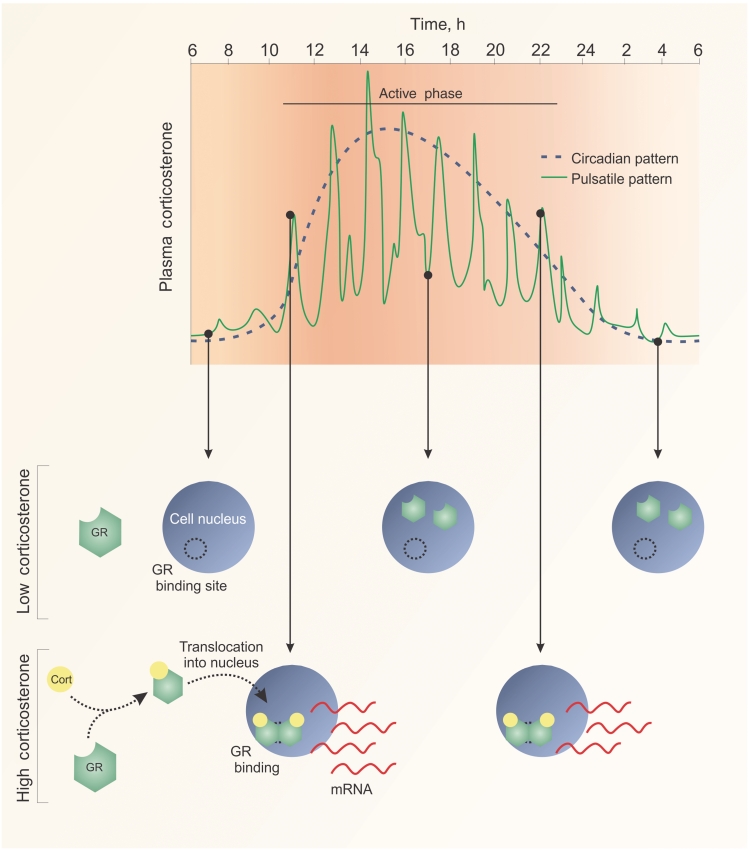
“The synthesis and release of glucocorticoids is under dynamic circadian and ultradian regulation by the hypothalamic-pituitary-adrenal (HPA) axis (Figure 1) [1].”
Dynamics of ACTH and Cortisol Secretion and Implications for Disease
Lightman, S. L., Birnie, M. T., & Conway-Campbell, B. L. (2020) · Endocrine Reviews · doi:10.1210/endrev/bnaa002 · Cited by 439
“Pulses of glucocorticoid have therefore been defined as deterministic for ultradian transcriptional activity, directing ordered recruitment of GR cofactors and the transcriptional machinery to glucocorticoid target genes (96), as shown in Fig.”
Self-citationUnraveling the regulation of hepatic gluconeogenesis
Zhang, X., Yang, S., Chen, J., & Su, Z. (2019) · Frontiers in Endocrinology · doi:10.3389/fendo.2018.00802 · Cited by 314
Metadata
- Authors
- Biddie, S. C., Conway-Campbell, B. L., & Lightman, S. L.
- Affiliations
- University of Bristol (GB)
- Corresponding author
- Lightman, S. L.
- Venue
- Rheumatology
- Publisher
- Oxford University Press (OUP)
- Published
- 2011-09-03
- Volume
- 51
- Issue
- 3
- Pages
- 403-412
- ISSN
- 1462-0324 (ISSN-L)
- 1462-0332
- PMC
- PMC3281495
- OpenAlex
- W2135368430
- Cited by
- 143
- References
- 93
- Citations by year
- 2026: 3 · 2025: 5 · 2024: 8 · 2023: 5 · 2022: 6 · 2021: 9 · 2020: 8 · 2019: 12 · 2018: 6 · 2017: 16 · 2016: 15 · 2015: 9 · 2014: 15 · 2013: 18 · 2012: 7
- FWCI
- 1.38
- Type
- journal article
- Language
- en
- Open access
- hybrid
- doi.org
- Licence
- cc-by-nc
- Locations
- Lara D. Veeken (publishedVersion, cc-by-nc)
- Europe PMC (PubMed Central) (publishedVersion, cc-by-nc)
- PubMed Central (publishedVersion, cc-by-nc)
- PubMed (publishedVersion)
- Explore Bristol Research (submittedVersion)
- Bristol Research (University of Bristol) (submittedVersion)
- Funders
- Wellcome Trust (089647, 089647/Z/09/cZ, 089647/Z/09/c)
- Biotechnology and Biological Sciences Research Council (BB/H015779/1)
- Topics
- Life Sciences › Biochemistry, Genetics and Molecular Biology › Endocrinology › Estrogen and related hormone effects
- Health Sciences › Medicine › Endocrinology, Diabetes and Metabolism › Adrenal Hormones and Disorders
- Life Sciences › Neuroscience › Behavioral Neuroscience › Stress Responses and Cortisol
- Keywords
- glucocorticoid receptor, glucocorticoid signaling, chromatin structure, epigenetics, genetic variation, glucocorticoid secretion, glucocorticoid sensitivity, glucocorticoid resistance, glucocorticoid adverse effects, inflammation, metabolism
- MeSH terms
- Drug Resistance, Glucocorticoids, Humans, Receptors, Glucocorticoid, Signal Transduction
About these checks
Registry, retraction, Cites and statistics results are computed, not judged, with one exception: a printed reference that no index lists is read once by a model before it counts as a citation error. Claims are extracted by a model and kept only when their quote appears verbatim in the text; each cited source is then checked, with a model’s help, for whether it says what the claim relies on. Those verdicts can be wrong — read the claim’s quote and the cited source before relying on one.
Statistics and arithmetic are recomputed, not judged.
Confidence bands are shown only for fields calibrated on our annotated test set. None is calibrated yet, so no band is shown.
What counts as a claim ›How we measure confidence ›How we check this ›
Are you an author, or do you see a problem with this page? Request a review
How to cite
Cite CoChat for the checks on this page, and the paper for its own findings.
- This page
- CoChat. (2026). Citation check: Dynamic regulation of glucocorticoid signalling in health and disease. https://app.cochat.ai/papers/10.1093/rheumatology/ker215
- The paper
- Biddie, S. C., Conway-Campbell, B. L., & Lightman, S. L. (2012). Dynamic regulation of glucocorticoid signalling in health and disease. Rheumatology. https://doi.org/10.1093/rheumatology/ker215
Data sources
Bibliographic data: Semantic Scholar, OpenAlex, Crossref.
Contains information from the Semantic Scholar Academic Graph Datasets, made available under the ODC Attribution License (ODC-BY 1.0).
Semantic Scholar’s data is described in: Kinney, R., et al. (2023). The Semantic Scholar Open Data Platform. arXiv:2301.10140.
