

The DOI matches its Crossref record; 49 of the 50 references it cites were found in a registry or an index.
Psychosis, Delusions and the “Jumping to Conclusions” Reasoning Bias: A Systematic Review and Meta-analysis
Open accessAbstract
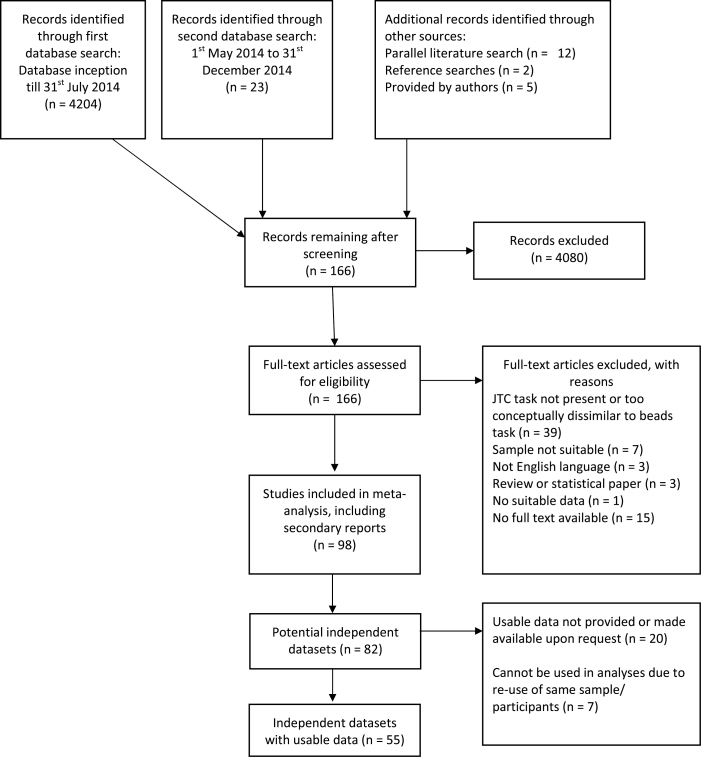
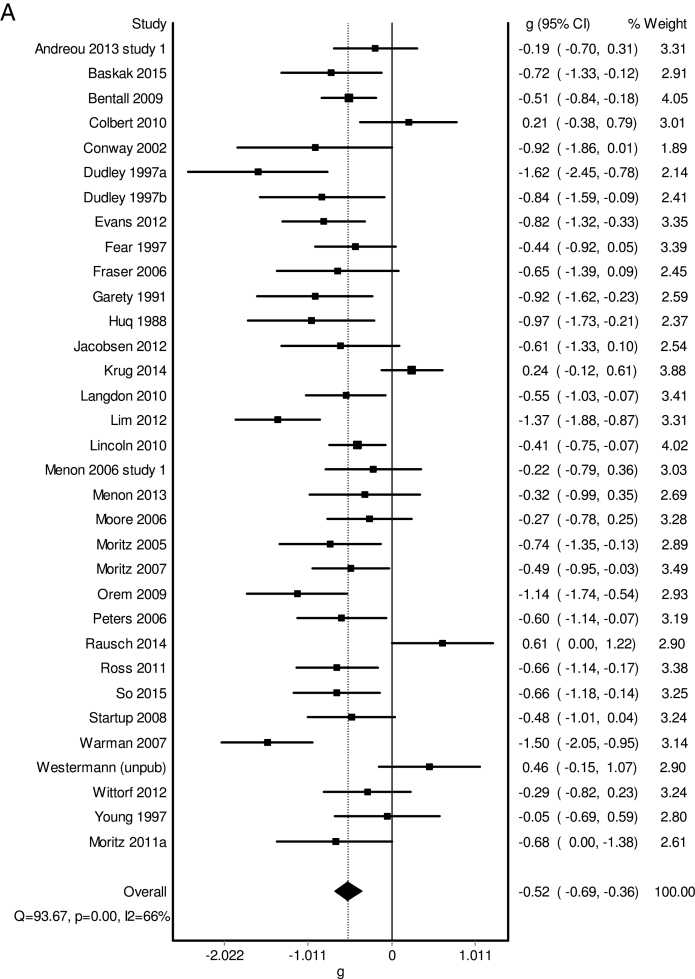
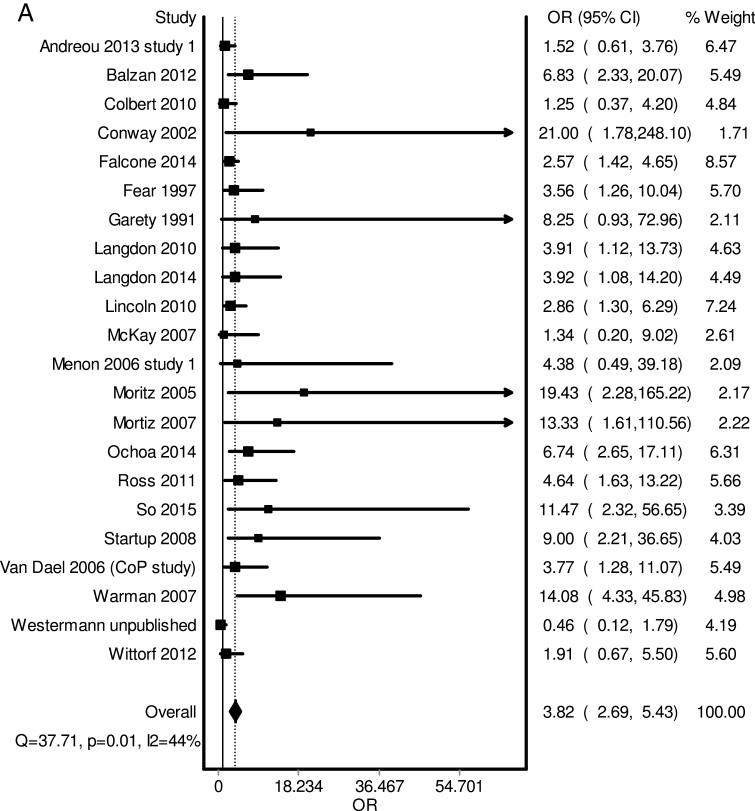
We did a systematic review and meta-analysis to investigate the magnitude and specificity of the "jumping to conclusions" (JTC) bias in psychosis and delusions. We examined the extent to which people with psychosis, and people with delusions specifically, required less information before making decisions. We examined (1) the average amount of information required to make a decision and (2) numbers who demonstrated an extreme JTC bias, as assessed by the "beads task." We compared people with psychosis to people with and without nonpsychotic mental health problems, and people with psychosis with and without delusions. We examined whether reduced data-gathering was associated with increased delusion severity. We identified 55 relevant studies, and acquired previously unpublished data from 16 authors. People with psychosis required significantly less information to make decisions than healthy individuals (k= 33,N= 1935,g= -0.53, 95% CI -0.69, -0.36) and those with nonpsychotic mental health problems (k= 13,N= 667,g= -0.58, 95% CI -0.80, -0.35). The odds of extreme responding in psychosis were between 4 and 6 times higher than the odds of extreme responding by healthy participants and participants with nonpsychotic mental health problems. The JTC bias was linked to a greater probability of delusion occurrence in psychosis (k= 14,N= 770, OR 1.52, 95% CI 1.12, 2.05). There was a trend-level inverse association between data-gathering and delusion severity (k= 18;N= 794;r= -.09, 95% CI -0.21, 0.03). Hence, nonaffective psychosis is characterized by a hasty decision-making style, which is linked to an increased probability of delusions.
Overview
The claims and statistics of this paper haven’t been checked yet.
Run the check — free, no account needed. It reads the open-access text and checks the sources it cites.
Integrity signals
Registry
Cites
Statistics
Figures
Verification
Claims the paper makes
The claims and statistics of this paper haven’t been checked yet.
Run the check — free, no account needed. It reads the open-access text and checks the sources it cites.
Claims other papers make about this one
Each is checked against this paper’s own text: does it say what the citing paper says it does?
In the citing paper
“The typical finding is that those induced to experience negative affect reported significantly more paranoid thoughts and a more pronounced Jumping to Conclusions bias (JTC, for a review see [36] when compared to participants who were not induced to experience negative affect [35, 36].”
From A structural equation model of the relationship between insomnia, negative affect, and paranoid thinking (2017) · cites this paper as [36]
Self-check
Percentages, sums and reported differences re-computed from the paper’s own numbers.
The self-check needs the paper’s full text.
Citations
Cites
Meta-analysis in clinical trials
DerSimonian, R., & Laird, N. (1986) · Controlled Clinical Trials · doi:10.1016/0197-2456(86)90046-2 · Cited by 39,552
Cochrane Handbook for Systematic Reviews of Interventions: Cochrane Book Series
(2008) · doi:10.1002/9780470712184 · Cited by 25,048
Borenstein, M., Hedges, L. V., Higgins, J. P. T., & Rothstein, H. R. (2009) · doi:10.1002/9780470743386 · Cited by 14,225
Borenstein, M., Hedges, L. V., Higgins, J. P. T., & Rothstein, H. R. (2021) · doi:10.1002/9781119558378 · Cited by 9,799
The environment and disease: association or causation?
Hill, A. B. (2015) · Journal of the Royal Society of Medicine · doi:10.1177/0141076814562718 · Cited by 7,804
Varese, F., Smeets, F., Drukker, M., Lieverse, R., Lataster, T., Viechtbauer, W., Read, J., van Os, J., & Bentall, R. P. (2012) · Schizophrenia Bulletin · doi:10.1093/schbul/sbs050 · Cited by 2,436
Harbord, R. M., & Higgins, J. P. T. (2008) · The Stata Journal: Promoting communications on statistics and Stata · doi:10.1177/1536867x0800800403 · Cited by 897
Suspicious minds: The psychology of persecutory delusions
Freeman, D. (2007) · Clinical Psychology Review · doi:10.1016/j.cpr.2006.10.004 · Cited by 814
Peters, E. R., Joseph, S. A., & Garety, P. A. (1999) · Schizophrenia Bulletin · doi:10.1093/oxfordjournals.schbul.a033401 · Cited by 771
Sterne, J. A., Egger, M., & Moher, D. (2008) · Cochrane Handbook for Systematic Reviews of Interventions · doi:10.1002/9780470712184.ch10 · Cited by 651
Probabilistic judgements in deluded and non-deluded subjects
Huq, S. F., Garety, P. A., & Hemsley, D. R. (1988) · The Quarterly Journal of Experimental Psychology Section A · doi:10.1080/14640748808402300 · Cited by 596
Leucht, S., Arbter, D., Engel, R. R., Kissling, W., & Davis, J. M. (2009) · Molecular Psychiatry · doi:10.1038/sj.mp.4002136 · Cited by 489
Psychological interventions for psychosis: A meta-analysis of comparative outcome studies
Turner, D. T., van der Gaag, M., Karyotaki, E., & Cuijpers, P. (2014) · American Journal of Psychiatry · doi:10.1176/appi.ajp.2013.13081159 · Cited by 350
Advances in understanding and treating persecutory delusions: a review
Freeman, D., & Garety, P. (2014) · Social Psychiatry and Psychiatric Epidemiology · doi:10.1007/s00127-014-0928-7 · Cited by 348
The past and future of delusions research: from the inexplicable to the treatable
Garety, P. A., & Freeman, D. H. (2013) · The British Journal of Psychiatry · doi:10.1192/bjp.bp.113.126953 · Cited by 345
Hopping, skipping or jumping to conclusions? Clarifying the role of the JTC bias in delusions
Fine, C., Gardner, M. R., Craigie, J., & Gold, I. (2006) · Cognitive Neuropsychiatry · doi:10.1080/13546800600750597 · Cited by 291
Kontopantelis, E., & Reeves, D. (2010) · Statistical Methods in Medical Research · doi:10.1177/0962280210392008 · Cited by 264
Approximating Pearson Product-Moment Correlations from Kendall's Tau and Spearman's Rho
Rupinski, M. T., & Dunlap, W. P. (1996) · Educational and Psychological Measurement · doi:10.1177/0013164496056003004 · Cited by 233
Normal and abnormal reasoning in people with delusions
Dudley, R. E. J., John, C. H., Young, A. W., & Over, D. E. (1997) · British Journal of Clinical Psychology · doi:10.1111/j.2044-8260.1997.tb01410.x · Cited by 207
Self-citationDelusion formation and reasoning biases in those at clinical high risk for psychosis
Broome, M. R., Johns, L. C., Valli, I., Woolley, J. B., Tabraham, P., Brett, C., Valmaggia, L., Peters, E., Garety, P. A., & McGuire, P. K. (2007) · British Journal of Psychiatry · doi:10.1192/bjp.191.51.s38 · Cited by 204
Speechley, W. J., Whitman, J. C., & Woodward, T. S. (2010) · Journal of Psychiatry and Neuroscience · doi:10.1503/jpn.090025 · Cited by 202
Ross, R. M., McKay, R., Coltheart, M., & Langdon, R. (2015) · Schizophrenia Bulletin · doi:10.1093/schbul/sbu187 · Cited by 198
O’Keeffe, L. M., Greene, R. A., & Kearney, P. M. (2014) · Systematic Reviews · doi:10.1186/2046-4053-3-1 · Cited by 192
Data Gathering: Biased in Psychosis?
Dael, F. V., Versmissen, D., Janssen, I., Myin‐Germeys, I., van Os, J., & A, L. K. M. (2005) · Schizophrenia Bulletin · doi:10.1093/schbul/sbj021 · Cited by 191
Cognitive functioning in delusions: A longitudinal analysis
PETERS, E. R., & Garety, P. A. (2005) · Behaviour Research and Therapy · doi:10.1016/j.brat.2005.03.008 · Cited by 176
Moritz, S., Veckenstedt, R., Randjbar, S., Vitzthum, F., & Woodward, T. S. (2011) · Psychological Medicine · doi:10.1017/s0033291710002618 · Cited by 158
A Randomized Experimental Investigation of Reasoning Training for People With Delusions
Ross, K., Freeman, D. H., Dunn, G., & Garety, P. A. (2009) · Schizophrenia Bulletin · doi:10.1093/schbul/sbn165 · Cited by 150
So, S. H., Freeman, D. H., Dunn, G., Kapur, S., Kuipers, E., Bebbington, P., Fowler, D. G., & Garety, P. A. (2011) · Journal of Abnormal Psychology · doi:10.1037/a0025297 · Cited by 143
The effect of self‐referent material on the reasoning of people with delusions
Dudley, R. E. J., John, C. H., Young, A. W., & Over, D. E. (1997) · British Journal of Clinical Psychology · doi:10.1111/j.2044-8260.1997.tb01262.x · Cited by 128
Self-citationNeuropsychological functioning and jumping to conclusions in delusions
Garety, P., Joyce, E., Jolley, S., Emsley, R., Waller, H., Kuipers, E., Bebbington, P., Fowler, D., Dunn, G., & Freeman, D. (2013) · Schizophrenia Research · doi:10.1016/j.schres.2013.08.035 · Cited by 126
Young, H. F., & Bentall, R. P. (1997) · Psychological Medicine · doi:10.1017/s0033291796004540 · Cited by 122
Garety, P. A., Waller, H., Emsley, R., Jolley, S., Kuipers, E., Bebbington, P., Dunn, G., Fowler, D. G., Hardy, A., & Freeman, D. H. (2014) · Schizophrenia Bulletin · doi:10.1093/schbul/sbu103 · Cited by 120
The jumping to conclusions bias in delusions: Specificity and changeability.
Lincoln, T. M., Ziegler, M., Mehl, S., & Rief, W. (2010) · Journal of Abnormal Psychology · doi:10.1037/a0018118 · Cited by 113
‘Jumping to conclusions’ and delusions in psychosis: Relationship and response to treatment
Menon, M., Mizrahi, R., & Kapur, S. (2007) · Schizophrenia Research · doi:10.1016/j.schres.2007.08.021 · Cited by 112
Moritz, S., Woodward, T. S., & Lambert, M. (2006) · British Journal of Clinical Psychology · doi:10.1348/014466506x129862 · Cited by 105
Jumping to conclusions and the continuum of delusional beliefs
Warman, D. M., Lysaker, P. H., Martin, J. M., Davis, L. W., & Haudenschield, S. L. (2006) · Behaviour Research and Therapy · doi:10.1016/j.brat.2006.09.002 · Cited by 101
Dudley, R. E. J., & Over, D. E. (2003) · Clinical Psychology & Psychotherapy · doi:10.1002/cpp.376 · Cited by 89
Self-citationMenon, M., Pomarol‐Clotet, E., McKenna, P. J., & McCarthy, R. A. (2006) · Cognitive Neuropsychiatry · doi:10.1080/13546800544000046 · Cited by 88
Over-adjustment or miscomprehension? A re-examination of the jumping to conclusions bias
Balzan, R. P., Delfabbro, P., Galletly, C. A., & Woodward, T. S. (2012) · Australian & New Zealand Journal of Psychiatry · doi:10.1177/0004867411435291 · Cited by 81
Moritz, S., Woodward, T. S., & Hausmann, D. (2005) · Schizophrenia Bulletin · doi:10.1093/schbul/sbj034 · Cited by 81
Change in delusions is associated with change in “jumping to conclusions”
Woodward, T. S., Munz, M., Leclerc, C., & Lecomte, T. (2009) · Psychiatry Research · doi:10.1016/j.psychres.2008.10.020 · Cited by 80
Delusions in Schizophrenia: A Phenomenological and Psychological Exploration
Bentham, A. M. M. P., McKay, A., Quemada, I., Clare, L., Eastwood, N., & McKenna, P. J. (1996) · Cognitive Neuropsychiatry · doi:10.1080/135468096396451 · Cited by 74
‘Jumping to conclusions’ in first‐episode psychosis: A longitudinal study
Dudley, R. E. J., Daley, K., Nicholson, M., Shaftoe, D., Spencer, H. M., Cavanagh, K., & Freeston, M. H. (2013) · British Journal of Clinical Psychology · doi:10.1111/bjc.12023 · Cited by 37
Self-citationProbabilistic reasoning in patients with body dysmorphic disorder
Reese, H. E., McNally, R. J., & Wilhelm, S. (2010) · Journal of Behavior Therapy and Experimental Psychiatry · doi:10.1016/j.jbtep.2010.11.005 · Cited by 32
Aberrant Beliefs and Reasoning
(2014) · Psychology Press eBooks · doi:10.4324/9781315797861 · Cited by 24
Jumping to conclusions and the persistence of delusional beliefs in first episode psychosis
Falcone, M. A., Murray, R. M., O’Connor, J. A., Hockey, L. N., Gardner-Sood, P., Forti, M. D., Freeman, D. H., & Jolley, S. (2015) · Schizophrenia Research · doi:10.1016/j.schres.2015.04.019 · Cited by 24
Lincoln, T. M., Salzmann, S., Ziegler, M., & Westermann, S. (2010) · Journal of Behavior Therapy and Experimental Psychiatry · doi:10.1016/j.jbtep.2010.09.005 · Cited by 24
Winton‐Brown, T., Broome, M. R., Allen, P., Valli, I., Howes, O. D., Garety, P. A., Johns, L., & McGuire, P. K. (2014) · European Psychiatry · doi:10.1016/j.eurpsy.2014.09.416 · Cited by 15
Taylor, P. J., Hutton, P., & Dudley, R. E. J. (2014) · Systematic Reviews · doi:10.1186/2046-4053-3-44 · Cited by 8
Self-citation
Cited by
Sorted by citations
Persecutory delusions: a cognitive perspective on understanding and treatment.
Freeman, D. (2016) · The Lancet Psychiatry · doi:10.1016/s2215-0366(16)00066-3 · Cited by 356
Bronstein, M. V., Pennycook, G., Bear, A., Rand, D. G., & Cannon, T. D. (2019) · Journal of Applied Research in Memory and Cognition · doi:10.1016/j.jarmac.2018.09.005 · Cited by 324
Van Eck, R. M., Burger, T. J., Vellinga, A., Schirmbeck, F., & de Haan, L. (2018) · Schizophrenia Bulletin · doi:10.1093/schbul/sbx088 · Cited by 260
McLean, B. F., Mattiske, J. K., & Balzan, R. P. (2016) · Schizophrenia Bulletin · doi:10.1093/schbul/sbw056 · Cited by 231
Eichner, C., & Berna, F. (2016) · Schizophrenia Bulletin · doi:10.1093/schbul/sbv225 · Cited by 218
Metadata
- Authors
- Dudley, R., Taylor, P., Wickham, S., & Hutton, P.
- Affiliations
- Cumbria Northumberland Tyne and Wear NHS Foundation Trust (GB)
- University of Liverpool (GB)
- University of Edinburgh (GB)
- Corresponding author
- Dudley, Robert
- Venue
- Schizophrenia Bulletin
- Publisher
- Oxford University Press (OUP)
- Published
- 2015-10-31
- Volume
- 42
- Issue
- 3
- Pages
- 652-665
- ISSN
- 0586-7614 (ISSN-L)
- 1745-1701
- PMC
- PMC4838082
- OpenAlex
- W2163505421
- Cited by
- 353
- References
- 50
- Citations by year
- 2026: 43 · 2025: 28 · 2024: 29 · 2023: 29 · 2022: 33 · 2021: 43 · 2020: 30 · 2019: 29 · 2018: 38 · 2017: 28 · 2016: 20 · 2015: 1
- FWCI
- 3.99
- Type
- journal article
- Language
- en
- Open access
- hybrid
- doi.org
- Licence
- cc-by-nc
- Locations
- Schizophrenia Bulletin (publishedVersion, cc-by-nc)
- PubMed Central (publishedVersion, cc-by-nc)
- PubMed (publishedVersion)
- Edinburgh Napier Research Repository (Edinburgh Napier University) (submittedVersion, cc-by-nc)
- HighWire Press Open Archive (submittedVersion)
- Research Explorer (The University of Manchester) (submittedVersion, other-oa)
- Edinburgh Research Explorer (University of Edinburgh) (submittedVersion, cc-by-nc)
- Newcastle University ePrints (Newcastle Univesity)
- Topics
- Health Sciences › Medicine › Psychiatry and Mental health › Schizophrenia research and treatment
- Social Sciences › Arts and Humanities › Philosophy › Mental Health and Psychiatry
- Social Sciences › Decision Sciences › General Decision Sciences › Decision-Making and Behavioral Economics
- Keywords
- psychosis, delusions
- MeSH terms
- Decision Making, Delusions, Humans, Psychotic Disorders
About these checks
Registry, retraction, Cites and statistics results are computed, not judged, with one exception: a printed reference that no index lists is read once by a model before it counts as a citation error. Claims are extracted by a model and kept only when their quote appears verbatim in the text; each cited source is then checked, with a model’s help, for whether it says what the claim relies on. Those verdicts can be wrong — read the claim’s quote and the cited source before relying on one.
Statistics and arithmetic are recomputed, not judged.
Confidence bands are shown only for fields calibrated on our annotated test set. None is calibrated yet, so no band is shown.
What counts as a claim ›How we measure confidence ›How we check this ›
Are you an author, or do you see a problem with this page? Request a review
