

The DOI matches its Crossref record; 56 of the 56 references it cites were found in a registry or an index.
Sleep stage prediction with raw acceleration and photoplethysmography heart rate data derived from a consumer wearable device
Open accessAbstract
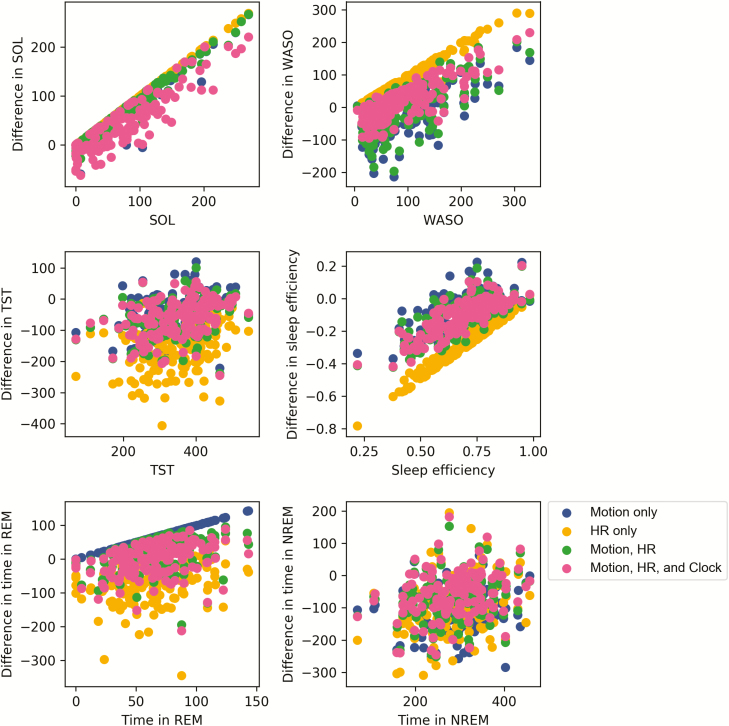
Wearable, multisensor, consumer devices that estimate sleep are now commonplace, but the algorithms used by these devices to score sleep are not open source, and the raw sensor data is rarely accessible for external use. As a result, these devices are limited in their usefulness for clinical and research applications, despite holding much promise. We used a mobile application of our own creation to collect raw acceleration data and heart rate from the Apple Watch worn by participants undergoing polysomnography, as well as during the ambulatory period preceding in lab testing. Using this data, we compared the contributions of multiple features (motion, local standard deviation in heart rate, and “clock proxy”) to performance across several classifiers. Best performance was achieved using neural nets, though the differences across classifiers were generally small. For sleep-wake classification, our method scored 90% of epochs correctly, with 59.6% of true wake epochs (specificity) and 93% of true sleep epochs (sensitivity) scored correctly. Accuracy for differentiating wake, NREM sleep, and REM sleep was approximately 72% when all features were used. We generalized our results by testing the models trained on Apple Watch data using data from the Multi-ethnic Study of Atherosclerosis (MESA), and found that we were able to predict sleep with performance comparable to testing on our own dataset. This study demonstrates, for the first time, the ability to analyze raw acceleration and heart rate data from a ubiquitous wearable device with accepted, disclosed mathematical methods to improve accuracy of sleep and sleep stage prediction.
Overview
The claims and statistics of this paper haven’t been checked yet.
Run the check — free, no account needed. It reads the open-access text and checks the sources it cites.
Integrity signals
Registry
Cites
Statistics
Figures
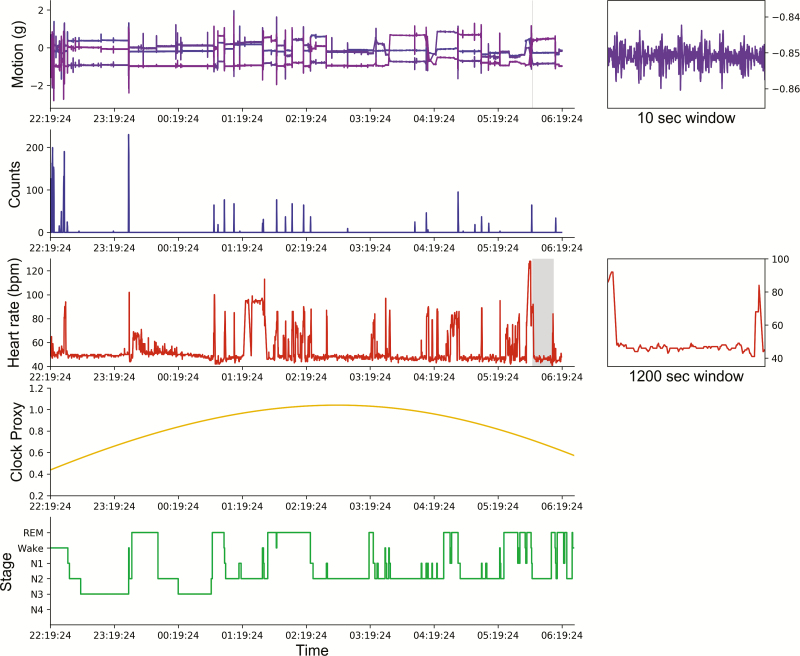
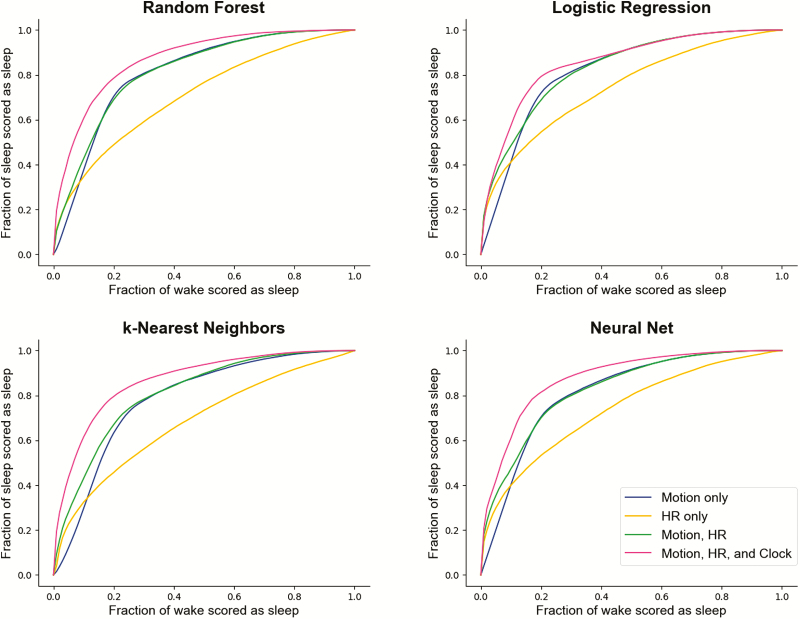
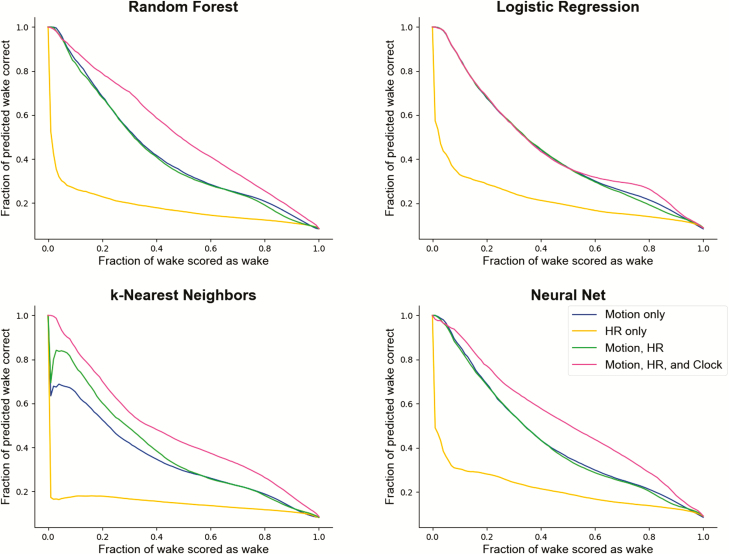
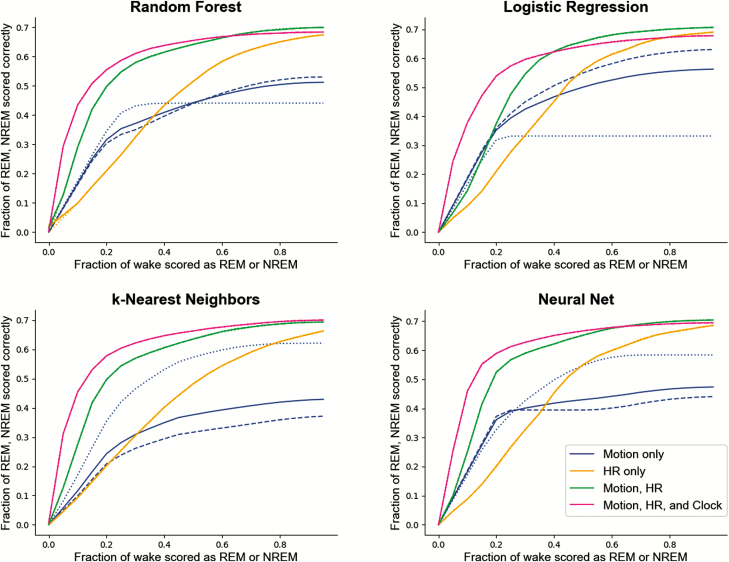
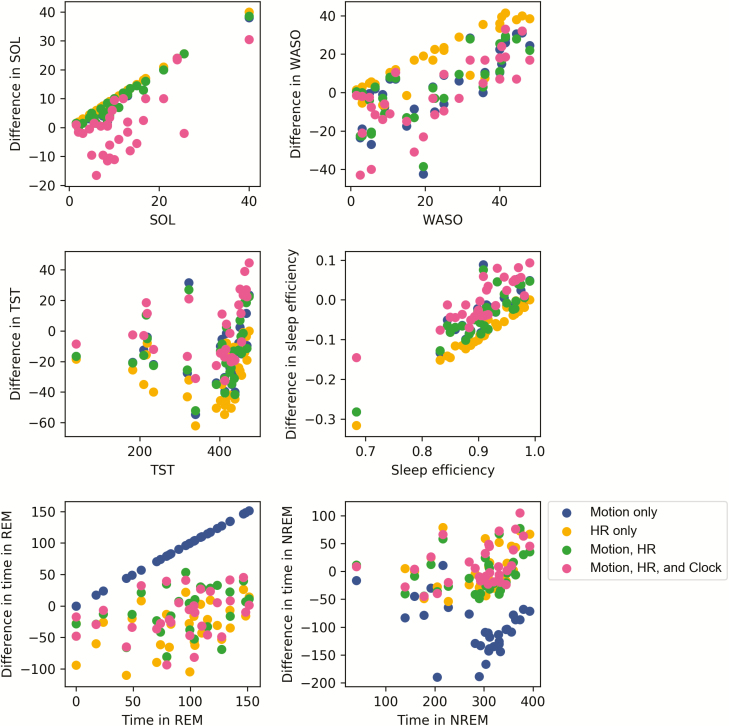
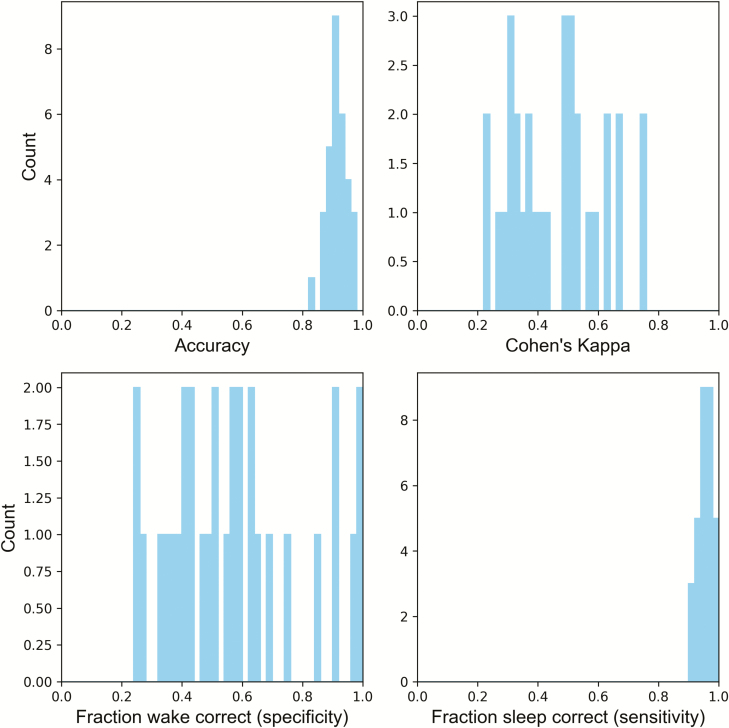
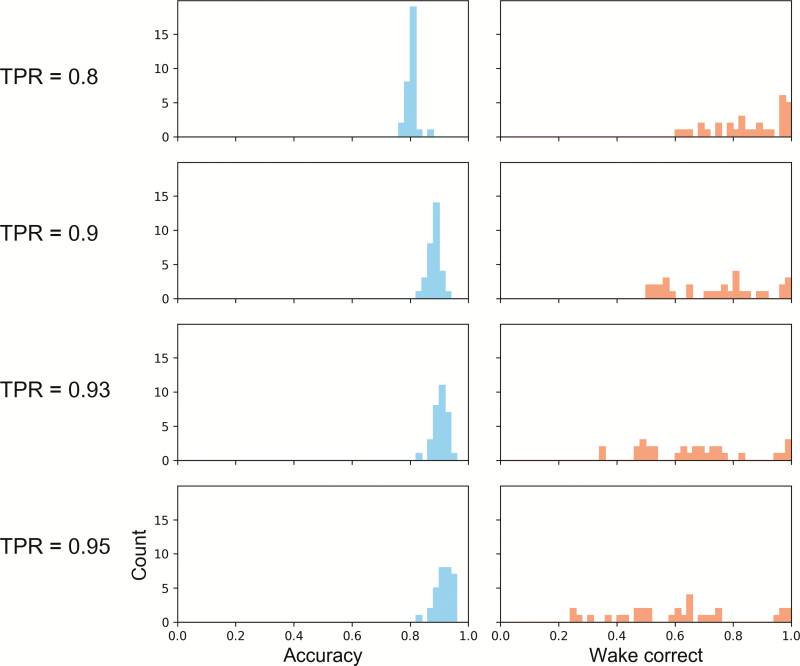
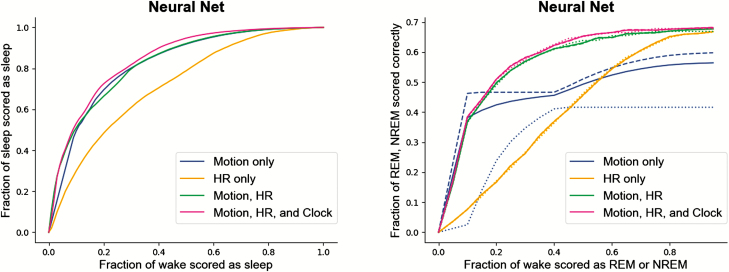
Verification
Claims the paper makes
The claims and statistics of this paper haven’t been checked yet.
Run the check — free, no account needed. It reads the open-access text and checks the sources it cites.
Claims other papers make about this one
Each is checked against this paper’s own text: does it say what the citing paper says it does?
In the citing paper
“Algorithms have used PPG-derived HR [221], PRV [222], [223], RR [222], pulse wave morphology [223], and accelerometry in combination with PPG [222].”
From Wearable Photoplethysmography for Cardiovascular Monitoring (2022) · cites this paper as [221]
Self-check
Percentages, sums and reported differences re-computed from the paper’s own numbers.
The self-check needs the paper’s full text.
Citations
Cites
Scikit-learn: Machine Learning in Python
Pedregosa, F., Varoquaux, G., Gramfort, A., Michel, V., Thirion, B., Grisel, O., Blondel, M., Müller, A., Nothman, J., Louppe, G., et al. (2012) · arXiv · doi:10.48550/arxiv.1201.0490 · Cited by 71,016
STATISTICAL METHODS FOR ASSESSING AGREEMENT BETWEEN TWO METHODS OF CLINICAL MEASUREMENT
Martin Bland, J., & Altman, D. (1986) · The Lancet · doi:10.1016/s0140-6736(86)90837-8 · Cited by 47,965
The meaning and use of the area under a receiver operating characteristic (ROC) curve.
Hanley, J. A., & McNeil, B. J. (1982) · Radiology · doi:10.1148/radiology.143.1.7063747 · Cited by 21,856
A New Method for Measuring Daytime Sleepiness: The Epworth Sleepiness Scale
Johns, M. W. (1991) · Sleep · doi:10.1093/sleep/14.6.540 · Cited by 17,364
(2007) · Cited by 6,530
Saito, T., & Rehmsmeier, M. (2015) · PLOS ONE · doi:10.1371/journal.pone.0118432 · Cited by 5,309
Multi-Ethnic Study of Atherosclerosis: Objectives and Design
Bild, D. E. (2002) · American Journal of Epidemiology · doi:10.1093/aje/kwf113 · Cited by 3,942
Two-Process Model of Sleep Regulation
Binder, M. D., Hirokawa, N., & Windhorst, U. (2008) · Springer eBooks · doi:10.1007/978-3-540-29678-2_6166 · Cited by 3,900
The Role of Actigraphy in the Study of Sleep and Circadian Rhythms
Ancoli-Israel, S., Cole, R., Alessi, C., Chambers, M., Moorcroft, W., & Pollak, C. P. (2003) · Sleep · doi:10.1093/sleep/26.3.342 · Cited by 2,751 · cited 1×
“The current method accepted by the medical and scientific community for objective, longitudinal sleep measurement in the ambulatory setting is actigraphy [3, 4].”
MethodAutomatic sleep/wake identification from wrist activity.
Cole, R., Kripke, D., Gruen, W., Mullaney, D., & Gillin, J. (1992) · Sleep · doi:10.1093/sleep/15.5.461 · Cited by 1,971
Cited by
Sorted by citations
Machine Learning for Healthcare Wearable Devices: The Big Picture
Sabry, F., Eltaras, T., Labda, W., Alzoubi, K., & Malluhi, Q. (2022) · Journal of Healthcare Engineering · doi:10.1155/2022/4653923 · Cited by 321
de Zambotti, M., Goldstein, C. A., Cook, J. D., Menghini, L., Altini, M., Cheng, P., & Robillard, R. (2023) · SLEEP · doi:10.1093/sleep/zsad325 · Cited by 276
Self-citationWearable Photoplethysmography for Cardiovascular Monitoring
Charlton, P. H., Kyriacou, P. A., Mant, J., Marozas, V., Chowienczyk, P., & Alastruey, J. (2022) · Proceedings of the IEEE · doi:10.1109/jproc.2022.3149785 · Cited by 250
The Promise of Sleep: A Multi-Sensor Approach for Accurate Sleep Stage Detection Using the Oura Ring
Altini, M., & Kinnunen, H. O. (2021) · Sensors · doi:10.3390/s21134302 · Cited by 208
A Systematic Review of Sensing Technologies for Wearable Sleep Staging
Imtiaz, S. A. (2021) · Sensors · doi:10.3390/s21051562 · Cited by 174
Metadata
- Authors
- Walch, O., Huang, Y., Forger, D., & Goldstein, C.
- Affiliations
- University of Michigan (US)
- Dartmouth College (US)
- Corresponding author
- Walch, Olivia
- Venue
- Sleep
- Publisher
- Oxford University Press (OUP)
- Published
- 2019-08-13
- Volume
- 42
- Issue
- 12
- ISSN
- 0161-8105 (ISSN-L)
- 1550-9109
- PMC
- PMC6930135
- OpenAlex
- W2937191485
- Cited by
- 240
- References
- 56
- Citations by year
- 2026: 20 · 2025: 42 · 2024: 33 · 2023: 38 · 2022: 39 · 2021: 40 · 2020: 28
- FWCI
- 9.43
- Type
- journal article
- Language
- en
- Open access
- hybrid
- doi.org
- Licence
- Locations
- SLEEP (publishedVersion, cc-by-nc)
- PubMed Central (publishedVersion, cc-by-nc)
- PubMed (publishedVersion)
- Smith ScholarWorks (Smith College) (submittedVersion, cc-by-nc)
- Funders
- Exercise & Sport Science Initiative University of Michigan (U056400, U049702, NSF DMS 1714094)
- Topics
- Physical Sciences › Engineering › Biomedical Engineering › Non-Invasive Vital Sign Monitoring
- Physical Sciences › Computer Science › Computer Vision and Pattern Recognition › Context-Aware Activity Recognition Systems
- Social Sciences › Psychology › Experimental and Cognitive Psychology › Sleep and related disorders
- Keywords
- wearable devices, Apple Watch, accelerometry, photoplethysmography, heart rate, sleep-wake classification, NREM sleep, REM sleep, polysomnography, artificial neural networks, classifier comparison, MESA, cross-dataset generalization
- MeSH terms
- Acceleration, Wearable Electronic Devices, Adult, Algorithms, Data Interpretation, Statistical, Electroencephalography, Female, Forecasting, Heart Rate, Humans, Male, Middle Aged, Sleep Stages, Photoplethysmography, Polysomnography, Young Adult
About these checks
Registry, retraction, Cites and statistics results are computed, not judged, with one exception: a printed reference that no index lists is read once by a model before it counts as a citation error. Claims are extracted by a model and kept only when their quote appears verbatim in the text; each cited source is then checked, with a model’s help, for whether it says what the claim relies on. Those verdicts can be wrong — read the claim’s quote and the cited source before relying on one.
Statistics and arithmetic are recomputed, not judged.
Confidence bands are shown only for fields calibrated on our annotated test set. None is calibrated yet, so no band is shown.
What counts as a claim ›How we measure confidence ›How we check this ›
Are you an author, or do you see a problem with this page? Request a review
