

Human Induced Pluripotent Stem Cells: From Cell Origin, Genomic Stability, and Epigenetic Memory to Translational Medicine
Open accessThe DOI matches its Crossref record; 88 of the 88 references it cites were found in a registry or an index.
Abstract
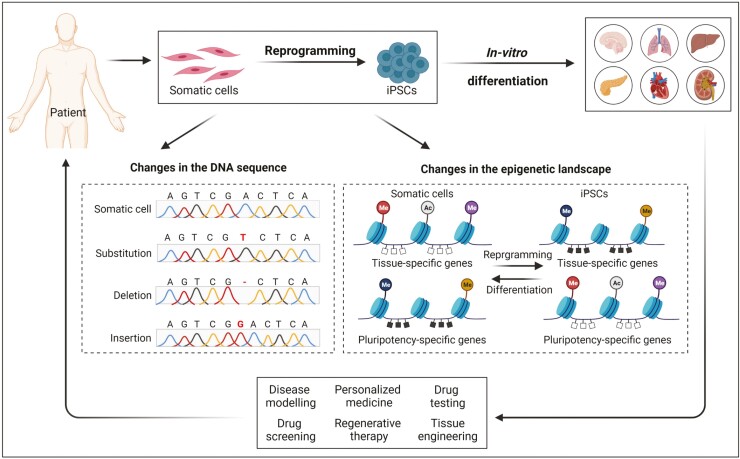
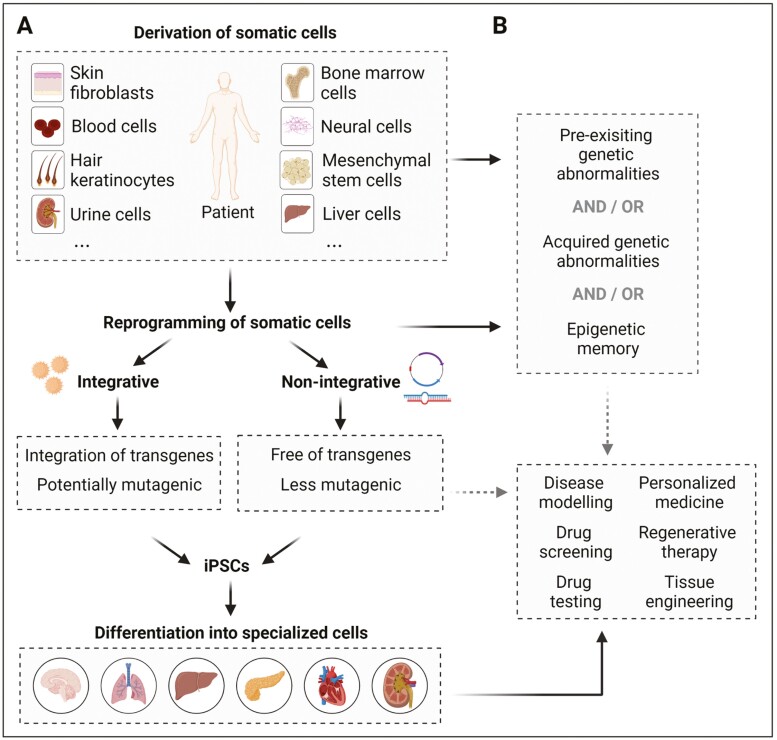
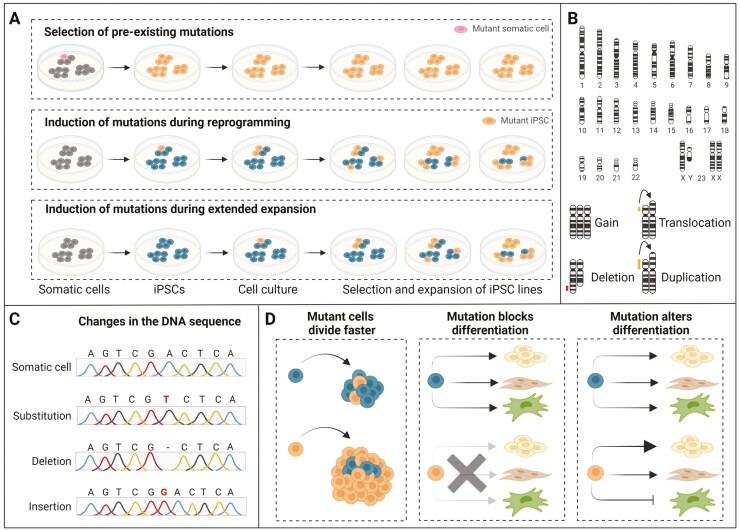
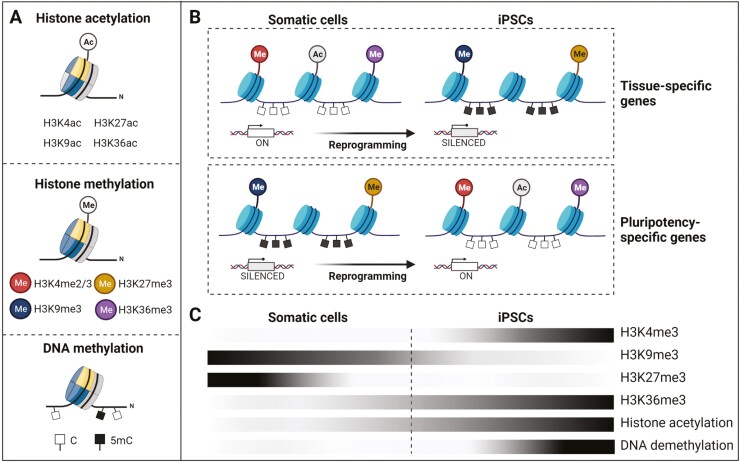
The potential of human induced pluripotent stem cells (iPSCs) to self-renew indefinitely and to differentiate virtually into any cell type in unlimited quantities makes them attractive for in vitro disease modeling, drug screening, personalized medicine, and regenerative therapies. As the genome of iPSCs thoroughly reproduces that of the somatic cells from which they are derived, they may possess genetic abnormalities, which would seriously compromise their utility and safety. Genetic aberrations could be present in donor somatic cells and then transferred during iPSC generation, or they could occur as de novo mutations during reprogramming or prolonged cell culture. Therefore, to warrant the safety of human iPSCs for clinical applications, analysis of genetic integrity, particularly during iPSC generation and differentiation, should be carried out on a regular basis. On the other hand, reprogramming of somatic cells to iPSCs requires profound modifications in the epigenetic landscape. Changes in chromatin structure by DNA methylations and histone tail modifications aim to reset the gene expression pattern of somatic cells to facilitate and establish self-renewal and pluripotency. However, residual epigenetic memory influences the iPSC phenotype, which may affect their application in disease therapeutics. The present review discusses the somatic cell origin, genetic stability, and epigenetic memory of iPSCs and their impact on basic and translational research.
Overview
The claims and statistics of this paper haven’t been checked yet.
Free: it reads the open-access text and checks the first 5 claims that cite a source we can check. Create a free account to check every claim.
Integrity signals
Registry
Cites
Statistics
Figures
Verification
Claims the paper makes
The claims and statistics of this paper haven’t been checked yet.
Free: it reads the open-access text and checks the first 5 claims that cite a source we can check. Create a free account to check every claim.
Claims other papers make about this one
Each is checked against this paper’s own text: does it say what the citing paper says it does?
The cited source says what the claim attributes to it.
In the citing paper
“Reprogramming may also partially erase or leave residual aspects of donorspecific epigenetic memory (Scesa et al. 2021;Li and Darabi 2022;Poetsch et al. 2022).”
From Primary cell cultures versus immortalized cell lines: critical comparative insights into biological fidelity and translational applications (2026) · cites this paper as Poetsch et al. 2022
Self-check
Percentages, sums and reported differences re-computed from the paper’s own numbers.
The self-check needs the paper’s full text.
Citations
Cites
Takahashi, K., & Yamanaka, S. (2006) · Cell · doi:10.1016/j.cell.2006.07.024 · Cited by 26,673
Induction of Pluripotent Stem Cells from Adult Human Fibroblasts by Defined Factors
Takahashi, K., Tanabe, K., Ohnuki, M., Narita, M., Ichisaka, T., Tomoda, K., & Yamanaka, S. (2007) · Cell · doi:10.1016/j.cell.2007.11.019 · Cited by 20,221
Induced Pluripotent Stem Cell Lines Derived from Human Somatic Cells
Yu, J., Vodyanik, M. A., Smuga-Otto, K., Antosiewicz-Bourget, J., Frane, J. L., Tian, S., Nie, J., Jonsdottir, G. A., Ruotti, V., Stewart, R., et al. (2007) · Science · doi:10.1126/science.1151526 · Cited by 10,310 · cited 1×
“10 Currently, blood cells and skin fibroblasts are the most commonly used cell types for reprogramming because (1) they are easy to obtain, (2) conditions for the initial culture of these cells are well established, (3) reprogramming methods for these cells are successfully standardized, and (4) iPSC banking has been…”
BackgroundGenome-wide maps of chromatin state in pluripotent and lineage-committed cells
Mikkelsen, T. S., Ku, M., Jaffe, D. B., Issac, B., Lieberman, E., Giannoukos, G., Alvarez, P., Brockman, W., Kim, T.-K., Koche, R. P., et al. (2007) · Nature · doi:10.1038/nature06008 · Cited by 4,129
Generation of Human Induced Pluripotent Stem Cells by Direct Delivery of Reprogramming Proteins
Kim, D., Kim, C.-H., Moon, J.-I., Chung, Y.-G., Chang, M.-Y., Han, B.-S., Ko, S., Yang, E., Cha, K. Y., Lanza, R., et al. (2009) · Cell stem cell · doi:10.1016/j.stem.2009.05.005 · Cited by 1,814
Generation of Induced Pluripotent Stem Cells Using Recombinant Proteins
Zhou, H., Wu, S., Joo, J. Y., Zhu, S., Han, D. W., Lin, T., Trauger, S., Bien, G., Yao, S., Zhu, Y., et al. (2009) · Cell stem cell · doi:10.1016/j.stem.2009.04.005 · Cited by 1,788
Maherali, N., Sridharan, R., Xie, W., Utikal, J., Eminli, S., Arnold, K., Stadtfeld, M., Yachechko, R., Tchieu, J., Jaenisch, R., et al. (2007) · Cell stem cell · doi:10.1016/j.stem.2007.05.014 · Cited by 1,725
Hotspots of aberrant epigenomic reprogramming in human induced pluripotent stem cells
Lister, R., Pelizzola, M., Kida, Y. S., Hawkins, R. D., Nery, J. R., Hon, G., Antosiewicz-Bourget, J., O’Malley, R., Castanon, R., Klugman, S., et al. (2011) · Nature · doi:10.1038/nature09798 · Cited by 1,549
Autologous Induced Stem-Cell–Derived Retinal Cells for Macular Degeneration
Mandai, M., Watanabe, A., Kurimoto, Y., Hirami, Y., Morinaga, C., Daimon, T., Fujihara, M., Akimaru, H., Sakai, N., Shibata, Y., et al. (2017) · New England Journal of Medicine · doi:10.1056/nejmoa1608368 · Cited by 1,509
Somatic coding mutations in human induced pluripotent stem cells
Gore, A., Li, Z., Fung, H.-L., Young, J. E., Agarwal, S., Antosiewicz-Bourget, J., Canto, I., Giorgetti, A., Israel, M. A., Kiskinis, E., et al. (2011) · Nature · doi:10.1038/nature09805 · Cited by 1,273
Cited by
Exploring the promising potential of induced pluripotent stem cells in cancer research and therapy
Chehelgerdi, M., Behdarvand Dehkordi, F., Chehelgerdi, M., Kabiri, H., Salehian-Dehkordi, H., Abdolvand, M., Salmanizadeh, S., Rashidi, M., Niazmand, A., Ahmadi, S., et al. (2023) · Molecular Cancer · doi:10.1186/s12943-023-01873-0 · Cited by 175
Vascular organoids: unveiling advantages, applications, challenges, and disease modelling strategies
Naderi‐Meshkin, H., Cornelius, V. A., Eleftheriadou, M., Potel, K. N., Setyaningsih, W. A. W., & Margariti, A. (2023) · Stem Cell Research & Therapy · doi:10.1186/s13287-023-03521-2 · Cited by 108
Revolutionizing Disease Modeling: The Emergence of Organoids in Cellular Systems
Silva-Pedrosa, R., Salgado, A. J., & Ferreira, P. E. (2023) · Cells · doi:10.3390/cells12060930 · Cited by 84
Gerli, M., Calà, G., Beesley, M. A., Sina, B., Tullie, L., Sun, K. Y., Panariello, F., Michielin, F., Davidson, J., Russo, F. M., et al. (2024) · Nature Medicine · doi:10.1038/s41591-024-02807-z · Cited by 56
Targeting epigenetic dysregulation in autism spectrum disorders
Herrera, M. L., Paraíso‐Luna, J., Bustos-Martínez, I., & Barco, Á. (2024) · Trends in Molecular Medicine · doi:10.1016/j.molmed.2024.06.004 · Cited by 51
Metadata
- Authors
- Poetsch, M. S., Strano, A., & Guan, K.
- Affiliations
- Technische Universität Dresden (DE)
- Corresponding author
- Guan, Kaomei
- Venue
- Stem Cells
- Publisher
- Oxford University Press (OUP)
- Published
- 2022-03-15
- Volume
- 40
- Issue
- 6
- Pages
- 546-555
- ISSN
- 1066-5099 (ISSN-L)
- 1549-4918
- PMC
- PMC9216482
- OpenAlex
- W4221119954
- Semantic Scholar
- 66bcd4a53bad40feb954b51f838ebf9b30e19579
- Cited by
- 144
- References
- 88
- Citations by year
- 2026: 38 · 2025: 43 · 2024: 35 · 2023: 22 · 2022: 6
- FWCI
- 2.76
- Type
- journal article
- Language
- en
- Open access
- hybrid
- doi.org
- Licence
- Locations
- Stem Cells (publishedVersion, cc-by)
- PubMed Central (publishedVersion, cc-by)
- PubMed (publishedVersion)
- Funders
- Deutsche Forschungsgemeinschaft (288034826–IRTG)
- Immunological and Cellular Strategies in Metabolic Disease
- Free State of Saxony
- European Union
- Topics
- Life Sciences › Biochemistry, Genetics and Molecular Biology › Molecular Biology › Pluripotent Stem Cells Research
- Life Sciences › Biochemistry, Genetics and Molecular Biology › Molecular Biology › Epigenetics and DNA Methylation
- Life Sciences › Biochemistry, Genetics and Molecular Biology › Molecular Biology › CRISPR and Genetic Engineering
- Keywords
- human induced pluripotent stem cells, iPSC reprogramming, genome stability, epigenetic memory, DNA methylation, histone modifications, chromatin structure, pluripotency, iPSC differentiation, iPSC safety, disease modeling, regenerative medicine
- MeSH terms
- Translational Science, Biomedical, Cell Differentiation, Humans, Genomic Instability, Epigenesis, Genetic, Induced Pluripotent Stem Cells, Cellular Reprogramming
About these checks
Registry, retraction, Cites and statistics results are computed, not judged, with one exception: a printed reference that no index lists is read once by a model before it counts as a citation error. Claims are extracted by a model and kept only when their quote appears verbatim in the text; each cited source is then checked, with a model’s help, for whether it says what the claim relies on. Those verdicts can be wrong — read the claim’s quote and the cited source before relying on one.
Statistics and arithmetic are recomputed, not judged.
Confidence bands are shown only for fields calibrated on our annotated test set. None is calibrated yet, so no band is shown.
What counts as a claim ›How we measure confidence ›How we check this ›
Are you an author, or do you see a problem with this page? Request a review
Data sources
Bibliographic data: Semantic Scholar, OpenAlex, Crossref.
Contains information from the Semantic Scholar Academic Graph Datasets, made available under the ODC Attribution License (ODC-BY 1.0).
Semantic Scholar’s data is described in: Kinney, R., et al. (2023). The Semantic Scholar Open Data Platform. arXiv:2301.10140.
