

Interventions for Individuals With High Levels of Needle Fear: Systematic Review of Randomized Controlled Trials and Quasi-Randomized Controlled Trials
Open accessThe DOI matches its Crossref record, with a small difference in title or year; 144 of the 144 references it cites were found in a registry or an index.
Abstract
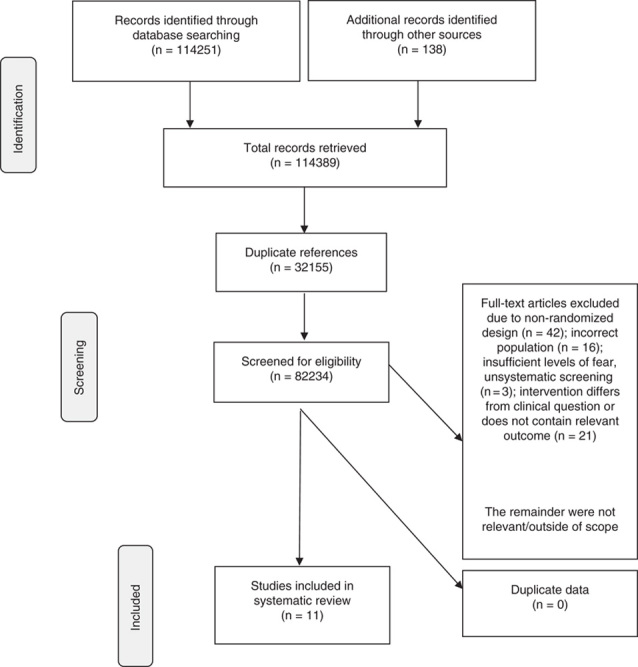
BACKGROUND: This systematic review evaluated the effectiveness of exposure-based psychological and physical interventions for the management of high levels of needle fear and/or phobia and fainting in children and adults. DESIGN/METHODS: A systematic review identified relevant randomized and quasi-randomized controlled trials of children, adults, or both with high levels of needle fear, including phobia (if not available, then populations with other specific phobias were included). Critically important outcomes were self-reported fear specific to the feared situation and stimulus (psychological interventions) or fainting (applied muscle tension). Data were pooled using standardized mean difference (SMD) or relative risk with 95% confidence intervals. RESULTS: The systematic review included 11 trials. In vivo exposure-based therapy for children 7 years and above showed benefit on specific fear (n=234; SMD: -1.71 [95% CI: -2.72, -0.7]). In vivo exposure-based therapy with adults reduced fear of needles posttreatment (n=20; SMD: -1.09 [-2.04, -0.14]) but not at 1-year follow-up (n=20; SMD: -0.28 [-1.16, 0.6]). Compared with single session, a benefit was observed for multiple sessions of exposure-based therapy posttreatment (n=93; SMD: -0.66 [-1.08, -0.24]) but not after 1 year (n=83; SMD: -0.37 [-0.87, 0.13]). Non in vivo e.g., imaginal exposure-based therapy in children reduced specific fear posttreatment (n=41; SMD: -0.88 [-1.7, -0.05]) and at 3 months (n=24; SMD: -0.89 [-1.73, -0.04]). Non in vivo exposure-based therapy for adults showed benefit on specific fear (n=68; SMD: -0.62 [-1.11, -0.14]) but not procedural fear (n=17; SMD: 0.18 [-0.87, 1.23]). Applied tension showed benefit on fainting posttreatment (n=20; SMD: -1.16 [-2.12, -0.19]) and after 1 year (n=20; SMD: -0.97 [-1.91, -0.03]) compared with exposure alone. CONCLUSIONS: Exposure-based psychological interventions and applied muscle tension show evidence of benefit in the reduction of fear in pediatric and adult populations.
Overview
The claims and statistics of this paper haven’t been checked yet.
Free: it reads the open-access text and checks the first 5 claims that cite a source we can check. Create a free account to check every claim.
Integrity signals
Registry
Cites
Statistics
Figures
Verification
Claims the paper makes
The claims and statistics of this paper haven’t been checked yet.
Free: it reads the open-access text and checks the first 5 claims that cite a source we can check. Create a free account to check every claim.
Claims other papers make about this one
Each is checked against this paper’s own text: does it say what the citing paper says it does?
The source backs part of the claim, not all of it — or backs it for a different population, condition or comparison.
In the citing paper
“In addition to in vivo exposure, applied muscle tension, and breathing techniques are commonly employed to reduce vagal activation, anxiety-related respiratory dysregulation, and thus fainting (23, 27, 45, 66, 75–77).”
From Combined Fainting and Psychogenic Non-epileptic Seizures as Significant Therapy Hurdles in Blood-Injury-Injection Phobia: A Mini-Review and Case Report (2022) · cites this paper as [76]
Experimental — accuracy not yet measured
Self-check
Percentages, sums and reported differences re-computed from the paper’s own numbers.
The self-check needs the paper’s full text.
Citations
Cites
Estimating the mean and variance from the median, range, and the size of a sample
Hozo, S. P., Djulbegovic, B., & Hozo, I. (2005) · BMC Medical Research Methodology · doi:10.1186/1471-2288-5-13 · Cited by 9,062
GRADE guidelines: a new series of articles in the Journal of Clinical Epidemiology
Guyatt, G. H., Oxman, A. D., Schünemann, H. J., Tugwell, P., & Knottnerus, A. (2011) · Journal of Clinical Epidemiology · doi:10.1016/j.jclinepi.2010.09.011 · Cited by 3,094
Rossi, P., Andriesse, G. I., Oey, P. L., Wieneke, G. H., Roelofs, J. M. M., & Akkermans, L. M. A. (1998) · Journal of the Neurological Sciences · doi:10.1016/s0022-510x(98)00276-7 · Cited by 767
Treatment of specific phobia in adults
Choy, Y., Fyer, A. J., & Lipsitz, J. D. (2007) · Clinical Psychology Review · doi:10.1016/j.cpr.2006.10.002 · Cited by 571
Psychological approaches in the treatment of specific phobias: A meta-analysis
Wolitzky-Taylor, K. B., Horowitz, J. D., Powers, M. B., & Telch, M. J. (2008) · Clinical Psychology Review · doi:10.1016/j.cpr.2008.02.007 · Cited by 530
One-session treatment for specific phobias
Öst, L.-G. (1989) · Behaviour Research and Therapy · doi:10.1016/0005-7967(89)90113-7 · Cited by 498
Survey of the prevalence of immunization non-compliance due to needle fears in children and adults
Taddio, A., Ipp, M., Thivakaran, S., Jamal, A., Parikh, C., Smart, S., Sovran, J., Stephens, D., & Katz, J. (2012) · Vaccine · doi:10.1016/j.vaccine.2012.05.011 · Cited by 498
Self-citationSilverman, W. K., Kurtines, W. M., Ginsburg, G. S., Weems, C. F., Rabian, B., & Serafini, L. T. (1999) · Journal of Consulting and Clinical Psychology · doi:10.1037//0022-006x.67.5.675 · Cited by 396
(1995) · PubMed · Cited by 375
Management of Vasovagal Syncope: Controlling or Aborting Faints by Leg Crossing and Muscle Tensing
Krediet, C. T. P., van Dijk, N., Linzer, M., van Lieshout, J. J., & Wieling, W. (2002) · Circulation · doi:10.1161/01.cir.0000030939.12646.8f · Cited by 372
Research works printed but not linked: 13
- 26. Hood HK, Antony MM.Davis TEI, Ollendick TH, Öst L-G. Evidence-based assessment and treatment of specific phobias in adults. Intensive One-Session Treatment of Specific Phobias. New York, NY: Springer; 2012:19–42.
- 27. Ollendick TH, Davis TEI.Davis TEI, Ollendick TH, Öst L-G. Evidence-based assessment and treatment of specific phobias in children and adolescents. Intensive One-Session Treatment of Specific Phobias. New York, NY: Springer; 2012:43–56.
- 43. Borenstein M, Hedges LV, Higgins JPT, et al. Introduction to Meta-analysis. West Sussex, UK: John Wiley & Sons; 2009.
- 77. Baralt AR, Dolan JD. Systematic desensitization & cognitive restructuring in the treatment of a self-injection phobia. J Rehabil. 1985;51:35–37.
- 78. Lisowska P, Zoitopoulos L. Cognitive behavioural therapy and severe needle phobia—a case study. J Disabil Oral Health. 2009;10:135–138.
- 114. Cisler JM. Treatment of disgust in blood-injection-injury-phobia: A randomized controlled trial. Dissertation Abstracts International: Section B: The Sciences and Engineering. 2010;70(8-B):5154. [Dissertation].
- 124. Weigold C. The use of hypnosis in the management of needle phobia. Aust J Clin Exp Hypn. 2011;39:189–195.
- 126. Moore KA. “Hypnosis or not?”: brief intervention with hypodermic needle phobic. Aust J Clin Exp Hypn. 1992;20:49–53.
- 128. Gow MA. Treating dental needle phobia using hypnosis. Aust J Clin Exp Hypn. 2002;30:198–202.
- 132. Morgan S. Brief hypnosis for needle phobia. Aust J Clin Exp Hypn. 2001;29:107–115.
- 143. Davis TEI, Ollendick TH, Reuther ET, et al. Davis TEI. One-session treatment: principles and procedures with children and adolescents. Intensive One-Session Treatment of Specific Phobias. New York, NY: Springer; 2012:97–125.
- 145. Öst L-G.Davis TEI, Ollendick TH, Öst L-G. One-session treatment: principles and procedures with adults. Intensive One-Session Treatment of Specific Phobias. New York, NY: Springer; 2012:59–95.
- 160. McMurtry CM, Taddio A, Noel M, et al. Clinical practice guideline for the management of individuals with high levels of needle fear across the lifespan: exposure-based psychological and physical interventions. Clin Pract Pediatr Psychol. Under review.
Cited by
Birnie, K. A., Noel, M., Chambers, C. T., Uman, L. S., & Parker, J. A. (2018) · Cochrane Database of Systematic Reviews · doi:10.1002/14651858.cd005179.pub4 · Cited by 755
Self-citationThe fear of needles: a systematic review and meta-analysis
McLenon, J., & Rogers, M. A. M. (2019) · Journal of Advanced Nursing · doi:10.1111/jan.13818 · Cited by 623
Far From “Just a Poke”: Common Painful Needle Procedures and the Development of Needle Fear
McMurtry, C. M., Pillai Riddell, R., Taddio, A., Racine, N., Asmundson, G. J. G., Noel, M., Chambers, C. T., & Shah, V. (2015) · The Clinical Journal of Pain · doi:10.1097/ajp.0000000000000272 · Cited by 346
Self-citationOrenius, T., LicPsych, Säilä, H., Mikola, K., & Ristolainen, L. (2018) · SAGE Open Nursing · doi:10.1177/2377960818759442 · Cited by 162
“McMurtry et al. (2015) evaluated the effectiveness of exposure-based psychological and physical interventions for the management of high levels of needle fear or phobia and fainting in children and adults.”
BackgroundMcMurtry, C. M., Taddio, A., Noel, M., Antony, M. M., Chambers, C. T., Asmundson, G. J. G., Pillai Riddell, R., Shah, V., MacDonald, N. E., Rogers, J., et al. (2016) · Cognitive Behaviour Therapy · doi:10.1080/16506073.2016.1157204 · Cited by 104
Self-citationApolinário-Hagen, J., Drüge, M., & Fritsche, L. (2020) · Advances in Experimental Medicine and Biology · doi:10.1007/978-981-32-9705-0_17 · Cited by 100
Duncanson, E., Leu, R. K. L., Shanahan, L., Macauley, L., Bennett, P. N., Weichula, R., McDonald, S. P., Burke, A. L. J., Collins, K., Chur‐Hansen, A., et al. (2021) · PLoS ONE · doi:10.1371/journal.pone.0253048 · Cited by 123
Oral delivery of metformin by chitosan nanoparticles for polycystic kidney disease
Wang, J., Chin, D. D., Poon, C. J., Mancino, V., Pham, J., Li, H., Ho, P., Hallows, K. R., & Chung, E. J. (2020) · Journal of Controlled Release · doi:10.1016/j.jconrel.2020.10.047 · Cited by 97
Taddio, A., Shah, V. S., McMurtry, C. M., MacDonald, N. E., Ipp, M., Riddell, R. P., Noel, M. E., & Chambers, C. T. (2015) · Clinical Journal of Pain · doi:10.1097/ajp.0000000000000264 · Cited by 103
“3 This manuscript reports the results for the effects of the following procedural and physical interventions: (1) aspiration during intramuscular (IM) vaccine injection, (2) order of injection for sequential vaccine injections, (3) simultaneous versus sequential injection of multiple vaccines, (4) positioning of the i…”
Self-citationStein, D. J., Craske, M. G., Rothbaum, B. O., Chamberlain, S. R., Fineberg, N. A., Choi, K. W., de Jonge, P., Baldwin, D. S., & Maj, M. (2021) · World Psychiatry · doi:10.1002/wps.20919 · Cited by 60
Meindl, J. N., Saba, S., Gray, M., Stuebing, L., & Jarvis, A. (2019) · Journal of Applied Research in Intellectual Disabilities · doi:10.1111/jar.12637 · Cited by 56
COVID-19 vaccine platforms: Delivering on a promise?
Verdecia, M. A., Kokai‐Kun, J. F., Kibbey, M., Acharya, S., Venema, J., & Atouf, F. (2021) · Human Vaccines & Immunotherapeutics · doi:10.1080/21645515.2021.1911204 · Cited by 61
“results were consistent with estimates that needle phobia affects ~10% of the global population.(10,12,13) Fear of needles”
BackgroundResultBoerner, K. E., Birnie, K. A., Chambers, C. T., Taddio, A., McMurtry, C. M., Noel, M., Shah, V., & Pillai Riddell, R. (2015) · The Clinical Journal of Pain · doi:10.1097/ajp.0000000000000270 · Cited by 46
Self-citationSpecial considerations for clinical trials in fibrodysplasia ossificans progressiva (FOP)
Hsiao, E. C., Rocco, M. D., Cali, A., ZASLOFF, M. A., Mukaddam, M. A., Pignolo, R. J., Grunwald, Z., Netelenbos, J. C., Keen, R. W., Baujat, G., et al. (2018) · British Journal of Clinical Pharmacology · doi:10.1111/bcp.13777 · Cited by 69
Birnie, K. A., Chambers, C. T., Taddio, A., McMurtry, C. M., Noel, M., Pillai Riddell, R., & Shah, V. (2015) · The Clinical Journal of Pain · doi:10.1097/ajp.0000000000000265 · Cited by 44
Self-citationDepression and anxiety in patients with atopic dermatitis
LeBovidge, J., & Schneider, L. C. (2025) · Annals of Allergy Asthma & Immunology · doi:10.1016/j.anai.2025.02.017 · Cited by 40
Characterization of skin blebs from intradermal jet injection: Ex-vivo studies
Simmons, J. A., Davis, J., Thomas, J. B., López, J. A., Blanc, A. L., Allison, H., Slook, H., Lewis, P., Holtz, J., Fisher, P. D., et al. (2019) · Journal of Controlled Release · doi:10.1016/j.jconrel.2019.06.032 · Cited by 37
Popovic, J., Geffner, M. E., Rogol, A. D., Silverman, L. A., Kaplowitz, P. B., Mauras, N., Zeitler, P. S., Eugster, E. A., & Klein, K. O. (2022) · Frontiers in Pediatrics · doi:10.3389/fped.2022.968485 · Cited by 35
“Fear of painful procedures is more common in children than adults (59, 60).”
BackgroundGuillari, A., Giordano, V., Catone, M., Gallucci, M., & Rea, T. (2024) · Journal of Pediatric Nursing · doi:10.1016/j.pedn.2024.06.025 · Cited by 45
Painless injections–a possibility with low level laser therapy
Jagtap, B., Bhate, K., Magoo, S., Kumar, S., Gajendragadkar, K., & Joshi, S. (2019) · Journal of Dental Anesthesia and Pain Medicine · doi:10.17245/jdapm.2019.19.3.159 · Cited by 32
“Thus efforts should be made to decrease this pain [22].”
BackgroundVejzović, V., Bozic, J., Panоva, G., Babajić, M., & Bramhagen, A.-C. (2020) · BMC Pediatrics · doi:10.1186/s12887-020-1937-1 · Cited by 42
Şahin, M., & Eşer, İ. (2018) · Pain Management Nursing · doi:10.1016/j.pmn.2018.07.009 · Cited by 29
“Fear of needles exists on a continuum ranging from none or very little to severe needle fears that cause significant distress and impairment (Mcmurtry et al., 2015).”
BackgroundHumanization interventions in general pediatric wards: a systematic review
Tripodi, M., Siano, M., Mandato, C., Anseris, A. G. E. D., Quitadamo, P., Nuzio, S. G., Siani, P., & Vajro, P. (2019) · European Journal of Pediatrics · doi:10.1007/s00431-019-03370-3 · Cited by 35
Methodology for Knowledge Synthesis of the Management of Vaccination Pain and Needle Fear
Taddio, A., McMurtry, C. M., Shah, V. S., Yoon, E. W., Uleryk, E. M., Riddell, R. P., Lang, E., Chambers, C. T., Noel, M. E., & MacDonald, N. E. (2015) · Clinical Journal of Pain · doi:10.1097/ajp.0000000000000263 · Cited by 33
Self-citationPatki, M., Palekar, S., Reznik, S. E., & Patel, K. R. (2021) · International Journal of Pharmaceutics · doi:10.1016/j.ijpharm.2021.120329 · Cited by 23
Altan, H., Belevcikli, M., Coşgun, A., & Demir, O. (2021) · BMC Anesthesiology · doi:10.1186/s12871-021-01524-1 · Cited by 20
“Parents and children may also delay treatment or avoid dental treatment, exhibit weak cooperation, or develop needle phobia [2, 3].”
BackgroundAttitude and perceptions of patients towards long acting depot injections (LAIs)
Grover, S., Sahoo, S., Subodh, B. N., Malhotra, N., Dua, D., & Avasthi, A. (2019) · Asian Journal of Psychiatry · doi:10.1016/j.ajp.2019.07.052 · Cited by 18
Olakunde, B. O., Pharr, J. R., Adeyinka, D. A., & Conserve, D. F. (2021) · Transgender Health · doi:10.1089/trgh.2020.0141 · Cited by 17
“64 68 Beyond the differences in gender identities, our findings also indicate important sociodemographic disparities in the reasons for never testing for HIV.”
Needle fear: A point prevalence survey of dialysis patients
Shanahan, L., Leu, R. K. L., Whittington, T., Biddle, A., McDonald, S. P., Bennett, P. N., & Jesudason, S. (2019) · Hemodialysis International · doi:10.1111/hdi.12752 · Cited by 15
Initial validation of a virtual blood draw exposure paradigm for fear of blood and needles
Trost, Z., Jones, A. R., Guck, A., Vervoort, T., Kowalsky, J. M., & France, C. R. (2017) · Journal of Anxiety Disorders · doi:10.1016/j.janxdis.2017.03.002 · Cited by 18
“Considerable evidence suggests that in-vivo exposure is among the most effective interventions for blood-injection-injury phobia, as well as variety of other feared experiences or stimuli [4,23,24,37].”
BackgroundAldayel, A. Y., Alharbi, M. M., Almasri, M. S., & Alkhonezan, S. (2019) · SAGE Open Medicine · doi:10.1177/2050312119871066 · Cited by 12
Radisic, G., Duncanson, E., Leu, R. K. L., Collins, K., Burke, A. L. J., Turner, J. K., Chur‐Hansen, A., Donnelly, F., Hill, K. E., McDonald, S. P., et al. (2022) · Pilot and Feasibility Studies · doi:10.1186/s40814-022-00989-2 · Cited by 14
“Although studies have investigated alleviating needle distress in non-dialysis settings, few have been conducted in clinical settings [14].”
BackgroundSuleman, S. K., Yahya, N. B., Nilsson, S., & Enskär, K. (2024) · BMJ Paediatrics Open · doi:10.1136/bmjpo-2024-002881 · Cited by 11
Eaton, M., Que, Z., Zhang, J., Beck, K., Shi, R., McDermott, J. S., Ladisch, M. R., & Yang, Y. (2021) · Pharmaceutical Research · doi:10.1007/s11095-021-03075-z · Cited by 11
Healy, P., Lu, C., Silk, J. S., Lindhiem, O. J., Harper, R., Viswanathan, A., & Babichenko, D. (2023) · JMIR Serious Games · doi:10.2196/42025 · Cited by 13
“Exposure is a core element of CBT for child anxiety, which has been shown to be particularly effective in treating needle phobia [20].”
BackgroundPicturing Bravery: A Rapid Review of Needle Procedures Depicted in Children’s Picture Books
Nauman, H., Dobson, O., Taddio, A., Birnie, K. A., & McMurtry, C. M. (2023) · Children · doi:10.3390/children10071097 · Cited by 10
“This occurs immediately before and during the needle [13,16] 0/1”
BackgroundSelf-citationAlwafi, H. H., Naser, A. Y., Alsaleh, N. A., Asiri, J. K., Almontashri, R. M., Alqarni, L. M., Salawati, R. S., Alsharif, A. A., Aldhahir, A. M., Alqarni, A. A., et al. (2024) · BMC Psychiatry · doi:10.1186/s12888-024-05757-5 · Cited by 12
“However, needle phobia is associated with anxiety and fear, and avoidance behaviour is common among those patients, which can negatively impact the medical treatment and patient outcomes [2, 4].”
BackgroundSulaiman, W. A. W., Saliluddin, S. M., Ong, Y. J., Lim, S. M. S., Mat, L. N. I., Hoo, F. K., Ramachandran, V., Ching, S. M., Basri, H., & Mohamed, M. H. (2017) · Clinical Epidemiology and Global Health · doi:10.1016/j.cegh.2017.05.002 · Cited by 11
Constantin, K. L., Moline, R. L., Riddell, R. P., Spence, J. R., Fiacconi, C. M., Lupo‐Flewelling, K., & McMurtry, C. M. (2022) · Developmental Psychobiology · doi:10.1002/dev.22277 · Cited by 10
Self-citationPain disparities attributed to linguistic minoritization in health care settings
Lim, P. S., Fortier, M. A., & Kain, Z. N. (2024) · Journal of Pain · doi:10.1016/j.jpain.2024.104688 · Cited by 11
Nursing process for a patient with needle phobia: a case study
Mendonça, Â. B., Pereira, E. R., Magnago, C., Silva, R. M. C. R. A., & Martins, A. D. O. (2020) · Revista Brasileira de Enfermagem · doi:10.1590/0034-7167-2019-0095 · Cited by 9
A method for the rapid fabrication of solid metal microneedles
Haider, K., Lijnse, T. M., Lee, C. B., & Dalton, C. (2023) · Microfluidics, BioMEMS, and Medical Microsystems · doi:10.1117/12.2647885 · Cited by 7
Treating specific phobias in young people with autism and severe learning difficulties
Burton, P., Palicka, A., & Williams, T. I. (2017) · The Cognitive Behaviour Therapist · doi:10.1017/s1754470x17000241 · Cited by 9
Hypokalemia Measurement and Management in Patients With Status Asthmaticus on Continuous Albuterol
Cox, C. L., Patel, K. J., Cantu, R. M., Akmyradov, C., & Irby, K. (2022) · Hospital Pediatrics · doi:10.1542/hpeds.2021-006265 · Cited by 7
Karacaoğlu, Y., & Öncü, E. (2020) · Transfusion and Apheresis Science · doi:10.1016/j.transci.2019.102698 · Cited by 11
Using Non-Violent Discipline Tools: Evidence Suggesting the Importance of Attunement
Quail, K. R., & Ward, C. L. (2023) · International Journal of Environmental Research and Public Health · doi:10.3390/ijerph20247187 · Cited by 9
Reducing the Burden of Pain From Vaccination
Siu, W., & Goubert, L. (2015) · Clinical Journal of Pain · doi:10.1097/ajp.0000000000000278 · Cited by 5
von Mücke-Heim, I.-A., Walter, I., Nischwitz, S., & Erhardt, A. (2022) · Frontiers in Psychiatry · doi:10.3389/fpsyt.2022.915058 · Cited by 4
Killian, H. J., Deacy, A. D., Edmundson, E. W., Raab, L., & Schurman, J. V. (2024) · Journal of Pediatric Nursing · doi:10.1016/j.pedn.2024.01.024 · Cited by 7
Saxena, B., Goswami, M., Singh, S., & Saxena, A. (2025) · Lasers in Medical Science · doi:10.1007/s10103-025-04440-9 · Cited by 4
High throughput fabrication of robust solid microneedles
Lijnse, T. M., Haider, K., & Dalton, C. (2022) · doi:10.1117/12.2608804 · Cited by 4
Hiermeier, U. M., & Mofrad, L. (2020) · The Cognitive Behaviour Therapist · doi:10.1017/s1754470x2000046x · Cited by 8
“…and mental distress of the phobic person can prevent healthcare-seeking behaviour (e.g. vaccination, interventions for chronic health conditions, dentistry, etc.) and arguably lead to impediment to the health care system (Emmelkamp and Wittchen, 2009; McMurtry et al., 2015; Taddio et al., 2012).”
BackgroundPrevalence of Needle Phobia Treatments for Participants with Neurodevelopmental Disorders
Berner, S., Lloveras, L. A., Vadakal, S., Skervin, V., Soda, T., & Peters, K. P. (2024) · Behavior and Social Issues · doi:10.1007/s42822-024-00180-7 · Cited by 4
“There are a number of evidence-based treatments for needle phobia that have been evaluated in the literature such as exposure therapy and applied muscle tension (McMurtry et al., 2015).”
Cognitive Behavioral Therapy for Anxiety and Fear in Pediatric Pain Contexts
McMurtry, C. M., Tomlinson, R. M., & Genik, L. M. (2017) · Journal of Cognitive Psychotherapy · doi:10.1891/0889-8391.31.1.41 · Cited by 3
Self-citationThe Problem of Pain: Acute Pain and Procedures
MacKenzie, N. E., Tutelman, P. R., & Chambers, C. T. (2020) · Issues in clinical child psychology · doi:10.1007/978-3-030-35598-2_12 · Cited by 4
Self-citationSiegel, P., & Peterson, B. S. (2025) · Journal of Child Psychology and Psychiatry · doi:10.1111/jcpp.14037 · Cited by 2
Boontor, N., Kaewrudee, S., & Sothornwit, J. (2024) · International Journal of Gynecology & Obstetrics · doi:10.1002/ijgo.15921 · Cited by 3
“23 Additional strategies, such as multiple educational sessions during the antenatal and postpartum periods or incorporating experiences shared by women who have used the implants, may be promising approaches to address these concerns but they require further evaluation.”
Colors and Flavors: Adding Joy to Pediatric Dentistry–A Cross-sectional Study
Dalai, J., & Sisodia, V. (2018) · Journal of Contemporary Dentistry · doi:10.5005/jp-journals-10031-1224 · Cited by 2
Performing venesection in a person with a learning disability
Blair, J. (2022) · Learning Disability Practice · doi:10.7748/ldp.2022.e2186 · Cited by 2
O’Sullivan, T. A., Jayasuriya, P. H., Tsalis, N., Calogero, N., & Manocha, R. (2023) · BMJ Open · doi:10.1136/bmjopen-2022-065706 · Cited by 4
Age regression in the treatment of needle phobia: a case report
Anbar, R. D., Farnan, R., & Lancaster, M. E. (2023) · American Journal of Clinical Hypnosis · doi:10.1080/00029157.2023.2261517 · Cited by 1
“…cognitive behavioral therapy (CBT) with systematic desensitization, a form of exposure therapy in which patients are taught relaxation techniques and are gradually able to interact with their feared stimulus (Jenkins, 2014; McMurtry et al., 2015; Orenius et al., 2018; Sokolowski et al., 2010).”
Allgemeine Aspekte in präoperativen – intraoperativen – postoperativen Abschnitten
Kapfhammer, H. (2023) · Springer eBooks · doi:10.1007/978-3-662-68309-5_2 · Cited by 1
Supporting Adherence and Self-management
Rich, K. L., Varnell, C. D., & Lazear, D. (2024) · Springer eBooks · doi:10.1007/978-3-031-64672-0_11 · Cited by 1
Gaddam, L., Anumala, D., Katuri, K. K., Pedapudi, D., Begum, S., & Boyapati, R. (2025) · Journal of Dental Anesthesia and Pain Medicine · doi:10.17245/jdapm.2025.25.4.263 · Cited by 1
“Therefore, efforts should be made to minimize pain in order to enhance patient comfort and reduce anxiety [22].”
Cocchi, E., Bloise, S., Jusufi, L., & Marchetti, F. (2025) · Pediatric Anesthesia · doi:10.1111/pan.70094 · Cited by 1
Plummer, K., Kotzur, C., Williams, S., Vongkiatkajorn, K., Lee‐Archer, P. F., Doyle, R., Keyser, J., Wighton, A., & Keogh, S. J. (2025) · Journal of Advanced Nursing · doi:10.1111/jan.70411 · Cited by 1
Schmerzreduktion bei Impfungen
Terhardt, M., & Grundhewer, H. (2016) · Monatsschrift Kinderheilkunde · doi:10.1007/s00112-016-0179-7 · Cited by 1
“von kanadischen Arbeitsgruppen, die mit verhaltenstherapeutischen TechnikenanhandvonVideosodercomputerbasiertem „Erziehungsmaterial“ über Injektionsnadeln und Injektionen gute Erfolge in der Bekämpfung von Impfangst erzielen [15].”
BackgroundTranslation of the Medical Fear Survey to Serbian: psychometric properties.
Djoković, J., Milovanović, B., Milovanovic, J. R., Milovanovic, O. Z., Stojić, I., Mrvić, S., Kostić, M., Stefanović, S., & Јаnkovic, S. (2016) · PubMed · Cited by 2
Chrétien, B., Stroiazzo, R., Troussier, L., Houssel, P.-Y. L., Jacquet, M., Lheureux, C., Voyen, S., Court, P., Dolladille, C., Alexandre, J., et al. (2022) · Human Vaccines & Immunotherapeutics · doi:10.1080/21645515.2022.2135918 · Cited by 1
“Many authors have previously proposed intervention in this matter.(24,25) For example, soothing background music has been proposed by Kuntz et al.”
BackgroundYui, H., Otawa, S., Horiuchi, S., Kushima, M., Shinohara, R., Kojima, R., Akiyama, Y., Ooka, T., Miyake, K., Yokomichi, H., et al. (2022) · Health Science Reports · doi:10.1002/hsr2.1036 · Cited by 1
Mindfulness Based Specific Phobia Intervention: A Pilot Study of Dissociated Ego State Resolution
Smith, G. P., & Hartelius, G. (2020) · International Journal of Transpersonal Studies · doi:10.24972/ijts.2020.39.1-2.44 · Cited by 1
Pain reduction in cosmetic injections: Fillers and beyond
Fallahi, H. R., Sabzian, R., Keyhan, S. O., & Zandian, D. (2021) · Elsevier eBooks · doi:10.1016/b978-0-12-818988-7.00009-1
Taking blood from a person with a learning disability: reflections on a parent’s perspective
Hennessy, T., & Doody, O. (2023) · Learning Disability Practice · doi:10.7748/ldp.2023.e2204
Gaining confidence: I.V. skills for new nurses
Smith, D. G. (2023) · Nursing Made Incredibly Easy! · doi:10.1097/01.nme.0000899420.99930.d8
EFFECT OF DISTRACTION METHODS ON ACUTE PAIN IN ADULTS: RANDOMIZED CONTROLLED TRIAL
Çamlıca, T., & Aslan, F. E. (2023) · SDÜ Tıp Fakültesi Dergisi · doi:10.17343/sdutfd.1371829
Martin, S. R., Heyming, T. W., Valdez, B. J., Salas, L. H., Cohen, L. L., Fortier, M. A., Lee, K., Kaplan, S. H., & Kain, Z. N. (2024) · Journal of Emergency Medicine · doi:10.1016/j.jemermed.2024.01.019
Kulkin, H. K. H. (2023) · International Journal of Science and Research (IJSR) · doi:10.21275/sr23627031535
Radisic, G., Duncanson, E., Leu, R. K. L., Collins, K., Burke, A. L., Turner, J. K., Chur‐Hansen, A., Donnelly, F., Hill, K. E., McDonald, S., et al. (2022) · Figshare · doi:10.6084/m9.figshare.19126293
Radisic, G., Duncanson, E., Leu, R. K. L., Collins, K., Burke, A. L., Turner, J. K., Chur-Hansen, A., Donnelly, F., Hill, K. E., McDonald, S., et al. (2022) · Figshare · doi:10.6084/m9.figshare.19126290
Radisic, G., Duncanson, E., Leu, R. K. L., Collins, K., Burke, A. L., Turner, J. K., Chur-Hansen, A., Donnelly, F., Hill, K., McDonald, S., et al. (2022) · Figshare · doi:10.6084/m9.figshare.19126296
Radisic, G., Duncanson, E., Leu, R. K. L., Collins, K., Burke, A. L., Turner, J. K., Chur‐Hansen, A., Donnelly, F., Hill, K. E., McDonald, S., et al. (2022) · Figshare · doi:10.6084/m9.figshare.19126302
Radisic, G., Duncanson, E., Leu, R. K. L., Collins, K., Burke, A. L., Turner, J. K., Chur‐Hansen, A., Donnelly, F., Hill, K. E., McDonald, S., et al. (2022) · Figshare · doi:10.6084/m9.figshare.19126299
Nurjaman, I., Rismayanti, D., Yulianie, R., Jinan, R. R., & Sutrisno, N. W. A. (2026) · Pain Management Nursing · doi:10.1016/j.pmn.2025.12.014
Nauman, H., Truffyn, E. E., Taddio, A., Birnie, K. A., & McMurtry, C. M. (2026) · Nursing Reports · doi:10.3390/nursrep16010031
“…stemmed from relevant clinical practice guidelines and systematic reviews for management of needle pain and fears led by the developers [11–14 , 30 Evidence-based strategies (e.g., distraction, deep breathing, topical anesthetics, exposures) are introduced using language and illustrations…”
Self-citationIzon, E., & Fletcher, H. K. (2026) · Advances in Mental Health and Intellectual Disabilities · doi:10.1108/amhid-10-2025-0048
Dornjuntai, M., Onchan, T., Salung, L., & Sothornwit, J. (2026) · Contraception · doi:10.1016/j.contraception.2025.111320
Understanding Blood–Injection–Injury Phobia: Do Not Miss the Point
McCoy, D. J., Togioka, B. M., Lalwani, K., Chamberlain, M., Marcucci, C., & Wang, J. (2026) · A&A Practice · doi:10.1213/xaa.0000000000002216
Işıyel, E., Mutlu, N., Çakmak, G., & Tekşam, Ö. (2026) · Children · doi:10.3390/children13070843
“Needle-related pain and phobia may carry serious health consequences, including avoidance of pain reporting, reduced vaccine uptake, and delayed or refused treatment [2–4].”
Factors associated with documented distress during venipuncture in routine health checkups
Yuan, Y., YEN, Y.-C., Chu, W., Lin, S.-Y., Hsu, C.-Y., Yang, S.-H., & Lin, C.-F. (2026) · Frontiers in Psychiatry · doi:10.3389/fpsyt.2026.1866329
Li, F., Jin, J., Feng, L., Li, H., & Huang, W. (2026) · Child Care Health and Development · doi:10.1111/cch.70332
Development and validation of the Pediatric Needle Worry questionnaire
Patten, J., Loren, D. M., Parnes, M. F., Constantin, K. L., Thibodaux, L. K., & McMurtry, C. M. (2026) · Journal of Pediatric Psychology · doi:10.1093/jpepsy/jsag061
Self-citation
Metadata
- Authors
- McMurtry, C. M., Noel, M., Taddio, A., Antony, M. M., Asmundson, G. J. G., Riddell, R. P., Chambers, C. T., & Shah, V.
- Affiliations
- Western University (CA)
- University of Calgary (CA)
- Great Ormond Street Hospital (GB)
- Toronto Metropolitan University (CA)
- University of Guelph (CA)
- Corresponding author
- McMurtry, C. Meghan
- Asmundson, Gordon J.G.
- ORCID
- Venue
- The Clinical Journal of Pain
- Published
- 2015-10
- Volume
- 31
- Issue
- Supplement 10
- Pages
- S109-S123
- ISSN
- 0749-8047 (ISSN-L)
- PMC
- PMC4900415
- OpenAlex
- W1468765874
- Cited by
- 94
- References
- 144
- Citations by year
- 2026: 10 · 2025: 5 · 2024: 10 · 2023: 12 · 2022: 14 · 2021: 9 · 2020: 8 · 2019: 7 · 2018: 6 · 2017: 4 · 2016: 3 · 2015: 6
- FWCI
- 0.82
- Type
- journal article
- Language
- en
- Open access
- hybrid
- doi.org
- Licence
- cc-by-nc-nd
- Locations
- Clinical Journal of Pain (publishedVersion, cc-by-nc-nd)
- PubMed Central (publishedVersion, cc-by-nc-nd)
- PubMed (publishedVersion)
- The Atrium (University of Guelph) (submittedVersion, cc-by-nc-nd)
- Scholarship@Western (Western University) (submittedVersion)
- Clinical Journal of Pain
- Funders
- MAYDAY Fund
- Pfizer
- Sanofi
- Novavax
- Canadian Institutes of Health Research (132031_1)
- Topics
- Social Sciences › Psychology › Experimental and Cognitive Psychology › Anxiety, Depression, Psychometrics, Treatment, Cognitive Processes
- Health Sciences › Dentistry › Oral Surgery › Dental Anxiety and Anesthesia Techniques
- Health Sciences › Medicine › Pediatrics, Perinatology and Child Health › Pediatric Pain Management Techniques
- Keywords
- needle fear, needle phobia, in vivo exposure therapy, syncope, procedural fear, children, adults, treatment effectiveness, follow-up outcomes, fear of medical procedures, fear of injection
- MeSH terms
- Adolescent, Adult, Fear, Humans, Needles, Phobic Disorders, Psychotherapy, Randomized Controlled Trials as Topic, Databases, Bibliographic
About these checks
Registry, retraction, Cites and statistics results are computed, not judged, with one exception: a printed reference that no index lists is read once by a model before it counts as a citation error. Claims are extracted by a model and kept only when their quote appears verbatim in the text; each cited source is then checked, with a model’s help, for whether it says what the claim relies on. Those verdicts can be wrong — read the claim’s quote and the cited source before relying on one.
Statistics and arithmetic are recomputed, not judged.
Confidence bands are shown only for fields calibrated on our annotated test set. None is calibrated yet, so no band is shown.
What counts as a claim ›How we measure confidence ›How we check this ›
Are you an author, or do you see a problem with this page? Request a review
Data sources
Bibliographic data: Semantic Scholar, OpenAlex, Crossref.
Contains information from the Semantic Scholar Academic Graph Datasets, made available under the ODC Attribution License (ODC-BY 1.0).
Semantic Scholar’s data is described in: Kinney, R., et al. (2023). The Semantic Scholar Open Data Platform. arXiv:2301.10140.
