

Modification in ICU Design May Affect Delirium and Circadian Melatonin: A Proof of Concept Pilot Study
The DOI matches its Crossref record; 5 of the 5 references it cites were found in a registry or an index.
Abstract
OBJECTIVES: Nonpharmacologic delirium management is recommended by current guidelines, but studies on the impact of ICU design are still limited. The study’s primary purpose was to determine if a multicomponent change in room design prevents ICU delirium. Second, the influence of lighting conditions on serum melatonin was assessed. DESIGN: Prospective observational cohort pilot study. SETTING: The new design concept was established in two two-bed ICU rooms of a university hospital. Besides modifications aimed at stress relief, it includes a new dynamic lighting system. PATIENTS: Seventy-four adult critically ill patients on mechanical ventilation with an expected ICU length of stay of at least 48 hours, treated in modified or standard rooms. INTERVENTIONS: None. MEASUREMENTS AND MAIN RESULTS: The clinical examination included a prospective assessment for depth of sedation, delirium, and pain every 8 hours using validated scores. Blood samples for serum melatonin profiles were collected every 4 hours for a maximum of three 24-hour periods. Seventy-four patients were included in the analysis. Seventy-six percent (n = 28) of patients in the standard rooms developed delirium compared with 46% of patients (n = 17) in the modified rooms (p = 0.017). Patients in standard rooms (vs. modified rooms) had a 2.3-fold higher delirium severity (odds ratio = 2.292; 95% CI, 1.582–3.321; p < 0.0001). Light intensity, calculated using the measure of circadian effective irradiance, significantly influenced the course of serum melatonin (p < 0.0001). Significant interactions (p < 0.001) revealed that differences in serum melatonin between patients in standard and modified rooms were not the same over time but varied in specific periods of time. CONCLUSIONS: Modifications in ICU room design may influence the incidence and severity of delirium. Dedicated light therapy could potentially influence delirium outcomes by modulating circadian melatonin levels.
Overview
The claims and statistics of this paper haven’t been checked yet.
Free: it reads the open-access text and checks the first 5 claims that cite a source we can check. Create a free account to check every claim.
Integrity signals
Registry
Cites
Statistics
Figures
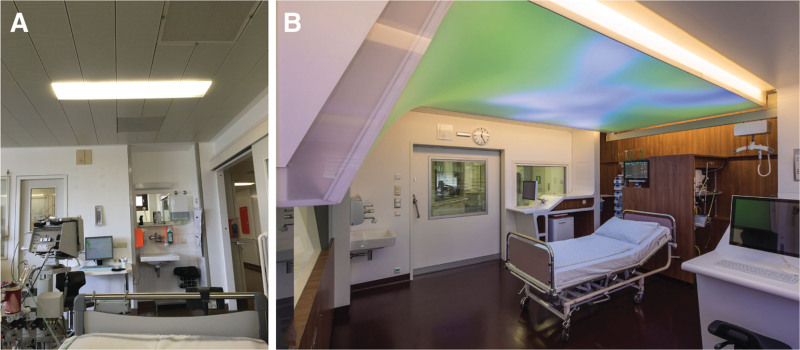
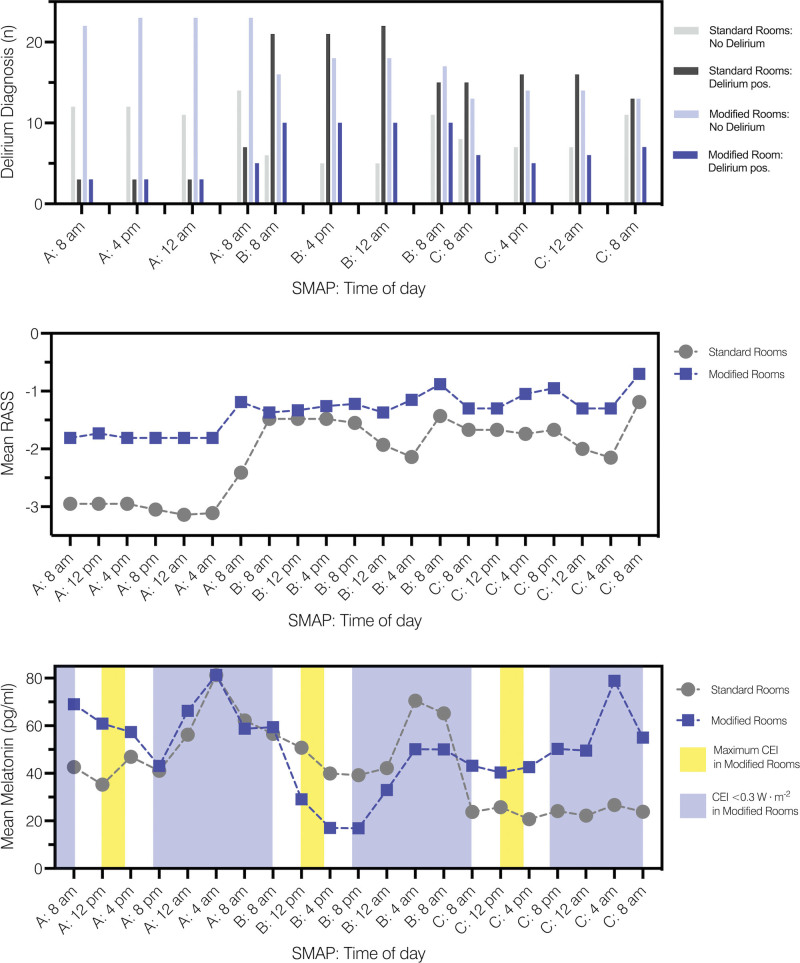
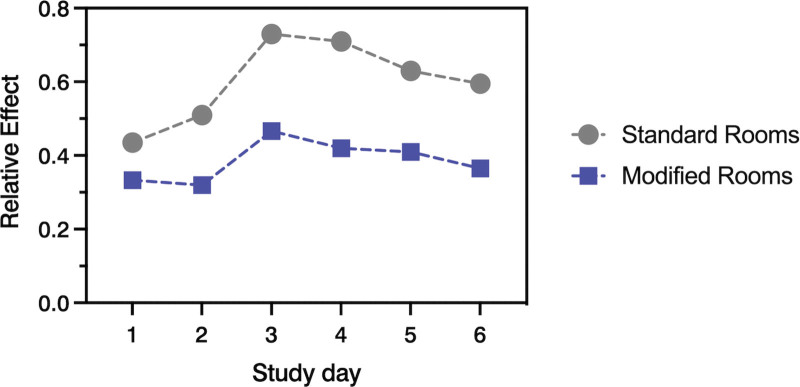
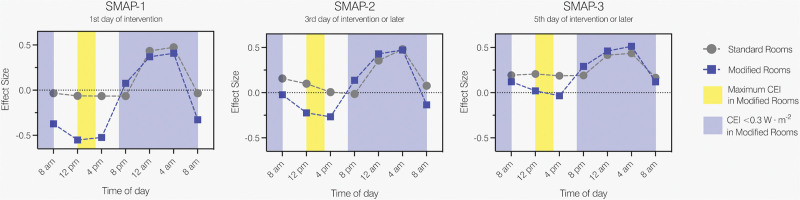
Verification
Claims the paper makes
The claims and statistics of this paper haven’t been checked yet.
Free: it reads the open-access text and checks the first 5 claims that cite a source we can check. Create a free account to check every claim.
Claims other papers make about this one
Each is checked against this paper’s own text: does it say what the citing paper says it does?
In the citing paper
“Some studies suggest a potential reduction in delirium incidence with high-intensity light therapy in intensive care settings, though evidence remains limited to small trials (5).”
From Light therapy in medicine: where do we stand? (2026) · cites this paper as [5]
In the citing paper
“Some studies suggest a potential reduction in delirium incidence with high-intensity light therapy in intensive care settings, though evidence remains limited to small trials (5).”
From Light therapy in medicine: where do we stand? (2026) · cites this paper as [5]
In the citing paper
“Similar mechanisms are involved when using intense light to improve sleep quality and reduce delirium in critically ill patients (5,7).”
From Light therapy in medicine: where do we stand? (2026) · cites this paper as [5]
In the citing paper
“The therapeutic mechanisms appear to involve regulation of serotonin production, melatonin levels, and circadian rhythm normalization (5,37,87).”
From Light therapy in medicine: where do we stand? (2026) · cites this paper as [5]
In the citing paper
“emphasizing that the old light systems or current ICU bed designs either caused glare or were beyond efficient light intensities (<1,000 lux) (5,87).”
From Light therapy in medicine: where do we stand? (2026) · cites this paper as [5]
Self-check
Percentages, sums and reported differences re-computed from the paper’s own numbers.
The self-check needs the paper’s full text.
Citations
Cites
Sessler, C. N., Gosnell, M. S., Grap, M. J., Brophy, G. M., O'Neal, P. V., Keane, K. A., Tesoro, E. P., & Elswick, R. K. (2002) · American Journal of Respiratory and Critical Care Medicine · doi:10.1164/rccm.2107138 · Cited by 3,695
Delirium as a Predictor of Mortality in Mechanically Ventilated Patients in the Intensive Care Unit
Ely, E. W. (2004) · JAMA · doi:10.1001/jama.291.14.1753 · Cited by 3,073
Long-term cognitive impairment after critical illness
Pandharipande, P. P., Girard, T. D., Jackson, J. C., Morandi, A., Thompson, J. L., Pun, B. T., Brummel, N. E., Hughes, C. G., Vasilevskis, E. E., Shintani, A. K., et al. (2013) · New England Journal of Medicine · doi:10.1056/nejmoa1301372 · Cited by 2,842
Action Spectrum for Melatonin Regulation in Humans: Evidence for a Novel Circadian Photoreceptor
Brainard, G. C., Hanifin, J. P., Greeson, J. M., Byrne, B., Glickman, G., Gerner, E., & Rollag, M. D. (2001) · The Journal of Neuroscience · doi:10.1523/jneurosci.21-16-06405.2001 · Cited by 1,930 · cited 1×
“…of correlated data effective irradiance for melatonin suppression, was calculated from data of spectral irradiance of lighting at the patient’s eye level, which was weighted by the action spectrum of melatonin suppression, and integrated above the whole range of effective wavelengths (15, 16).”
MethodThapan, K., Arendt, J., & Skene, D. J. (2001) · The Journal of Physiology · doi:10.1111/j.1469-7793.2001.t01-1-00261.x · Cited by 1,320 · cited 1×
“…of correlated data effective irradiance for melatonin suppression, was calculated from data of spectral irradiance of lighting at the patient’s eye level, which was weighted by the action spectrum of melatonin suppression, and integrated above the whole range of effective wavelengths (15, 16).”
Method
Research works printed but not linked: 39
- Girard TD Exline MC Carson SS; MIND-USA Investigators: Haloperidol and ziprasidone for treatment of delirium in critical illness. N Engl J Med 2018; 379: 2506– 2516 30346242 PMC6364999 · DOI · Paper page
- Smit L Dijkstra-Kersten SMA Zaal IJ: Haloperidol, clonidine and resolution of delirium in critically ill patients: A prospective cohort study. Intensive Care Med 2021; 47: 316– 324 33591422 PMC7952362 · DOI
- Kotfis K van Diem-Zaal I Roberson SW: The future of intensive care: Delirium should no longer be an issue. Crit Care 2022; 26: 200 35790979 PMC9254432 · DOI
- Devlin JW Skrobik Y Gélinas C: Clinical practice guidelines for the prevention and management of pain, agitation/sedation, delirium, immobility, and sleep disruption in adult patients in the ICU. Crit Care Med 2018; 46: e825– e873 30113379 · DOI · Paper page
- Krampe H Denke C Gülden J: Perceived severity of stressors in the intensive care unit: A systematic review and semi-quantitative analysis of the literature on the perspectives of patients, health care providers and relatives. J Clin Med 2021; 10: 3928 34501376 PMC8432195 · DOI
- Pisani MA Friese RS Gehlbach BK: Sleep in the intensive care unit. Am J Respir Crit Care Med 2015; 191: 731– 738 25594808 PMC5447310 · DOI · Paper page
- Telias I Wilcox ME: Sleep and circadian rhythm in critical illness. Crit Care 2019; 23: 82 30850003 PMC6408803 · DOI
- Luetz A Grunow J Mörgeli R: Innovative ICU solutions to prevent and reduce delirium and post-intensive care unit syndrome. Semin Respir Crit Care Med 2019; 40: 673– 686 31826268 · DOI
- Luetz A Uhrlau H Piazena H: Modification of ICU environment is associated with reduced incidence of delirium—results from the VITALITY study. Intensive Care Med Exp 2018; 40: 1305
- Luetz A Weiss B Penzel T: Feasibility of noise reduction by a modification in ICU environment. Physiol Meas 2016; 37: 1041– 1055 27243942 · doi:10.1088/0967-3334/37/7/1041
- Luetz A Piazena H Weiss B: Patient-centered lighting environments to improve health care in the intensive care unit. Clin Health Promotion 2016; 6: 5– 12
- Luetz A He J Weiss B: 850: Parameterized visual content for symptom control in critically ill patients. Crit Care Med 2013; 41: A212 · doi:10.1097/01.ccm.0000440088.60944.fa
- Light and lighting: Basic terms and criteria for specifying lighting requirements, 2018. Available at: 10.3403/30326220. Accessed July 20, 2023 · doi:10.3403/30326220
- Ely EW Margolin R Francis J: Evaluation of delirium in critically ill patients: Validation of the Confusion Assessment Method for the Intensive Care Unit (CAM-ICU). Crit Care Med 2001; 29: 1370– 1379 11445689 · DOI · Paper page
- Ouimet S Riker R Bergeron N: Subsyndromal delirium in the ICU: Evidence for a disease spectrum. Intensive Care Med 2007; 33: 1007– 1013 17404704 · DOI · Paper page
- Collet MO Nielsen AH Larsen LK: Delirium and delirium severity screening in the intensive care—correspondence of screenings tools. Aust Crit Care 2023 Jul 10. [ online ahead of print] 37438182
- Chanques G Viel E Constantin J: The measurement of pain in intensive care unit: Comparison of 5 self-report intensity scales. Pain 2010; 151: 711– 721 20843604 · DOI · Paper page
- Chanques G Payen J-F Mercier G: Assessing pain in non-intubated critically ill patients unable to self report: An adaptation of the Behavioral Pain Scale. Intensive Care Med 2009; 35: 2060– 2067 19697008 · DOI · Paper page
- Wang Y: Generalized estimating equations. By Ziegler A.. New York, NY, Springer, 2011, 159 pages. €49.95 (hardback). ISBN 9781461404989. Aust N Zealand J Stat 2013; 55: 61– 61
- Brunner E Domhof S Langer F: Nonparametric Analysis of Longitudinal Data in Factorial Experiments. New York, NY, J. Wiley, 2002
- Bathke A Brunner E: Recent advances and trends in nonparametric statistics. In: Recent Advances and Trends in Nonparametric Statistics. Akritas MG Politis Dimitris N (Eds), Amsterdam, Elsevier, 2003, pp 109– 120
- Shehabi Y Bellomo R Kadiman S; Sedation Practice in Intensive Care Evaluation (SPICE) Study Investigators and the Australian and New Zealand Intensive Care Society Clinical Trials Group: Sedation intensity in the first 48 hours of mechanical ventilation and 180-day mortality. Crit Care Med 2018; 46: 850– 859 29498938 · DOI · Paper page
- Vincent J-L Shehabi Y Walsh TS: Comfort and patient-centred care without excessive sedation: The eCASH concept. Intensive Care Med 2016; 42: 962– 971 27075762 PMC4846689 · DOI · Paper page
- Zaal IJ Spruyt CF Peelen LM: Intensive care unit environment may affect the course of delirium. Intensive Care Med 2013; 39: 481– 488 23093246 · DOI
- Lindroth H Khan BA Carpenter JS: Delirium severity trajectories and outcomes in ICU patients defining a dynamic symptom phenotype. Ann Am Thorac Soc 2020; 17: 1094– 1103 32383964 PMC7462321 · DOI
- Pisani MA Kong SYJ Kasl SV: Days of delirium are associated with 1-year mortality in an older intensive care unit population. Am J Respir Crit Care Med 2009; 180: 1092– 1097 19745202 PMC2784414 · DOI · Paper page
- Mundigler G Delle-Karth G Koreny M: Impaired circadian rhythm of melatonin secretion in sedated critically ill patients with severe sepsis*. Crit Care Med 2002; 30: 536– 540 11990911 · DOI · Paper page
- Figueroa-Ramos MI Arroyo-Novoa CM Lee KA: Sleep and delirium in ICU patients: A review of mechanisms and manifestations. Intensive Care Med 2009; 35: 781– 795 19165463 · DOI · Paper page
- Lachmann G Ananthasubramaniam B Wünsch VA: Circadian rhythms in septic shock patients. Ann Intensive Care 2021; 11: 64 33900485 PMC8076360 · DOI
- Diaz E Diaz I Del Busto C: Clock genes disruption in the intensive care unit. J Intensive Care Med 2019; 35: 1497– 1504 31510864 · DOI
- Thompson DR Hamilton DK Cadenhead CD: Guidelines for intensive care unit design*. Crit Care Med 2012; 40: 1586– 1600 22511137 · DOI · Paper page
- Nagare R Rea MS Plitnick B: Nocturnal melatonin suppression by adolescents and adults for different levels, spectra, and durations of light exposure. J Biol Rhythms 2019; 34: 178– 194 30803301 PMC6640648 · DOI
- Weiss B Spies C Piazena H: Exposure to light and darkness and its influence on physiological measures of intensive care unit patients—a systematic literature review. Physiol Meas 2016; 37: R73– R87 27510570 · DOI
- Jafarifiroozabadi R Joseph A Bridges W: The impact of daylight and window views on length of stay among patients with heart disease: A retrospective study in a cardiac intensive care unit. J Intensive Med 2023; 3: 155– 164 37188123 PMC10175739 · DOI
- Bullough J Rea MS Stevens RG: Light and magnetic fields in a neonatal intensive care unit. Bioelectromagnetics 1996; 17: 396– 405 8915549 · DOI
- Wunsch H Gershengorn H Mayer SA: The effect of window rooms on critically ill patients with subarachnoid hemorrhage admitted to intensive care. Crit Care 2011; 15: R81 21371299 PMC3219335 · DOI
- Simons KS Laheij RJF van den Boogaard M: Dynamic light application therapy to reduce the incidence and duration of delirium in intensive-care patients: A randomised controlled trial. Lancet Respir Med 2016; 4: 194– 202 26895652 · DOI
- Shigeta H Yasui A Nimura Y: Postoperative delirium and melatonin levels in elderly patients. Am J Surg 2001; 182: 449– 454 11754849 · DOI · Paper page
- Wibrow B Martinez FE Myers E: Prophylactic melatonin for delirium in intensive care (Pro-MEDIC): A randomized controlled trial. Intensive Care Med 2022; 48: 414– 425 35220473 · DOI
Cited by
Light therapy in medicine: where do we stand?
Oyama, Y., Witowski, A., Adamzik, M., Bartels, K., & de la Garza Eckle, T. (2026) · Annals of Translational Medicine · doi:10.21037/atm-2026-0041
“Similar mechanisms are involved when using intense light to improve sleep quality and reduce delirium in critically ill patients (5,7).”
Metadata
- Authors
- Spies, C., Piazena, H., Deja, M., Wernecke, K.-D., Willemeit, T., Luetz, A., & ICU Design Working Group
- Affiliations
- Department of Anesthesiology and Intensive Care Medicine, Charité—Universitätsmedizin Berlin, Corporate Member of Freie Universität Berlin and Humboldt Universität zu Berlin, Berlin, Germany.
- Department of Anesthesiology and Intensive Care Medicine, University Medical Center Schleswig-Holstein, Berlin, Lübeck, Germany.
- Institute Department of Biometry and Clinical Epidemiology, Charité—Universitätsmedizin Berlin, Berlin, Germany.
- Department of Architectural Research, GRAFT Architects Berlin, Berlin, Germany.
- Venue
- Critical Care Medicine
- Published
- 2023-12-19
- Volume
- 52
- Issue
- 4
- Pages
- e182-e192
- ISSN
- 0090-3493
- PMC
- PMC10930376
- Semantic Scholar
- c67380a48606b9b6febb15df56bbcca29d053810
- Cited by
- 37
- References
- 5
- Language
- en
About these checks
Registry, retraction, Cites and statistics results are computed, not judged, with one exception: a printed reference that no index lists is read once by a model before it counts as a citation error. Claims are extracted by a model and kept only when their quote appears verbatim in the text; each cited source is then checked, with a model’s help, for whether it says what the claim relies on. Those verdicts can be wrong — read the claim’s quote and the cited source before relying on one.
Statistics and arithmetic are recomputed, not judged.
Confidence bands are shown only for fields calibrated on our annotated test set. None is calibrated yet, so no band is shown.
What counts as a claim ›How we measure confidence ›How we check this ›
Are you an author, or do you see a problem with this page? Request a review
Data sources
Bibliographic data: Semantic Scholar, OpenAlex, Crossref.
Contains information from the Semantic Scholar Academic Graph Datasets, made available under the ODC Attribution License (ODC-BY 1.0).
Semantic Scholar’s data is described in: Kinney, R., et al. (2023). The Semantic Scholar Open Data Platform. arXiv:2301.10140.
