

Anterior versus Posterior Scoring of Cartilage in Otoplasty: A Retrospective Patient-related Outcome Measurement Study
Open accessThe DOI matches its Crossref record; 14 of the 15 references it cites were found in a registry or an index; none of the 2 sources its claims cite is checked for support yet.
Abstract
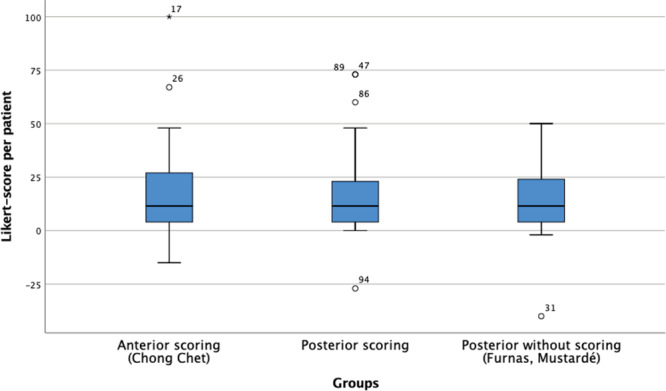
Background: Various surgical techniques are applied to correct prominent ears. However, there are limited data on the effect of otoplasty on patient-related outcome measures, such as cold ears and cold intolerance. This retrospective cohort study describes the occurrence of cold intolerance in 98 patients, with a total of 196 ears in a single center during 6 years (2011–2017). Methods: In this study, 3 groups were identified: group I, anterior scoring of the cartilage (ie, Chong Chet); group II, posterior scoring of the cartilage and suture reposition of the cartilage; and group III, posterior approach without scoring (ie, Furnas and Mustardé). Parents of patients filled in a questionnaire with 40 questions to criticize the effect of surgery. Results: Symptoms of cold intolerance and pain were reported in 44.4% (n = 16) in the anterior scoring group, 48.1% (n = 26) in the posterior scoring group, and 62.5% (n = 5) in the posterior approach group without scoring of the cartilage (P = 0.68). The satisfaction rate was significantly lower in the posterior group without scoring (Likert scale of 17.44 ± 22.01 anterior scoring, 16.02 ± 18.13 posterior scoring, and 11.13 ± 25.87 posterior approach without scoring; P = 0.02). Conclusions: This study underscores the fact that a great part of patients after otoplasty report symptoms of cold intolerance; however, these most often resolve and did not differ between different groups. Patients should be informed about this sequela. Furthermore, overall satisfaction rate was significantly lower in the posterior group without scoring.
Overview
CoChat Summary
TL;DR
This retrospective single-center cohort of 98 otoplasty patients found cold intolerance/pain in roughly half of patients and no significant difference between anterior scoring, posterior scoring, and posterior approach without scoring. Satisfaction was significantly lower in the posterior approach without scoring group, though the authors caution the subgroup was very small.
Key findings
- Cold intolerance and pain were reported by 44.4% (n = 16) of the anterior scoring group, 48.1% (n = 26) of the posterior scoring group, and 62.5% (n = 5) of the posterior approach without scoring group (P = 0.68).
- Satisfaction on a Likert scale from –50 to +50 was significantly lower in the posterior group without scoring: 17.44 ± 22.01 anterior scoring, 16.02 ± 18.13 posterior scoring, and 11.13 ± 25.87 posterior approach without scoring (P = 0.02).
- Complications occurred in 5.6% (n = 2) of the anterior scoring group, 1.9% (n = 1) of the posterior scoring group, and 0% of the posterior approach without scoring group (P = 0.53).
- Among all patients, symptom duration was <6 months in 8.2% (n = 8), 6–12 months in 12.2% (n = 12), 12–24 months in 9.2% (n = 9), and >24 months in 18.4% (n = 18); the discussion states more than 25% complained of cold intolerance lasting >12 months.
Methods
- Retrospective cohort study of 98 patients who underwent surgical correction of prominent ears between 2011 and 2017 at a single center (Meander Medical Centre, Amersfoort, The Netherlands); all patients were operated on both sides.
- Patients were divided into group I anterior scoring (Chong Chet; n = 36), group II posterior scoring with suture reposition (n = 54), and group III posterior approach without scoring (Furnas and Mustardé; n = 8).
- Parents/patients completed a 40-question questionnaire at least 2 years after surgery; outcomes included cold intolerance/pain, Likert satisfaction, revision surgery, and complications, analyzed with Kruskal-Wallis tests and a significance threshold of P < 0.05.
Limitations
- The paper states a response rate of 45.1% (101 respondents, with 3 excluded for >30% missing data), a very small posterior subgroup without scoring (n = 8), no physical examination, and reliance on subjective questionnaire measures.
- The authors state that larger studies and 6-, 12-, and 24-month follow-up are needed to confirm or dismiss the conclusions.
- Evident from the text: this was a retrospective, nonrandomized study in which technique choice depended on severity, cartilage hardness, surgeon preference, and perceived hypersensitivity risk, so confounding by indication is possible; six different plastic surgeons performed the operations.
Model-written summary. Check it against the paper before relying on it.
Integrity signals
Registry
Cites
Statistics
Figures
Verification
Claims the paper makes
0 Valid · 0 Not valid · 2 Not checked · 25 Own results and interpretations
A result the paper reports from its own data — it cites no other source for it, so there is none to check. The quote shows it is in the paper.
In the paper
“Symptoms of cold intolerance and pain were reported in 44.4% (n = 16) in the anterior scoring group, 48.1% (n = 26) in the posterior scoring group, and 62.5% (n = 5) in the posterior approach group without scoring of the cartilage (P = 0.68).”
§ Anterior versus Posterior Scoring of Cartilage in Otoplasty: A Retrospective Patient-related Outcome Measurement Study > Abstract > Results:
plain- Asserted: passes — The authors put it forward as true.
- Checkable: passes — It can be checked against evidence.
- Load-bearing: passes — The paper’s conclusions depend on it.
- Based: passes — The paper gives a reason why it holds.
- Rests on an assumption not shown here.
A result the paper reports from its own data — it cites no other source for it, so there is none to check. The quote shows it is in the paper.
In the paper
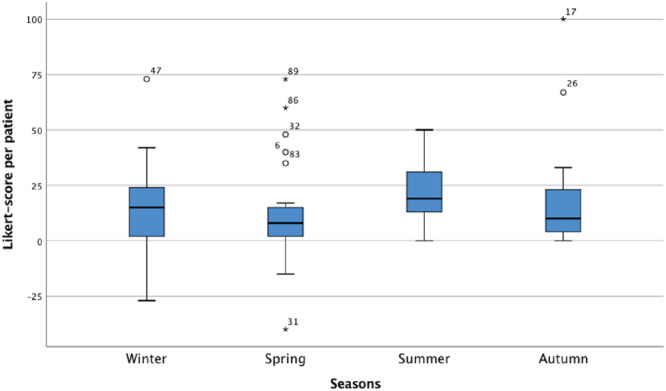
“There were no significant difference in satisfaction rate between the time of surgery in different seasons (P = 0.07).”
§ Anterior versus Posterior Scoring of Cartilage in Otoplasty: A Retrospective Patient-related Outcome Measurement Study > RESULTS
plainn = 98 ·- Asserted: passes — The authors put it forward as true.
- Checkable: passes — It can be checked against evidence.
- Load-bearing: unclear — It is unclear whether the paper’s conclusions depend on it.
- Based: passes — The paper gives a reason why it holds.
- Rests on an assumption not shown here.
A result the paper reports from its own data — it cites no other source for it, so there is none to check. The quote shows it is in the paper.
In the paper
“Neither did the total duration of symptoms (P = 0.39).”
§ Anterior versus Posterior Scoring of Cartilage in Otoplasty: A Retrospective Patient-related Outcome Measurement Study > RESULTS
plainn = 98- Asserted: passes — The authors put it forward as true.
- Checkable: passes — It can be checked against evidence.
- Load-bearing: unclear — It is unclear whether the paper’s conclusions depend on it.
- Based: passes — The paper gives a reason why it holds.
- Rests on an assumption not shown here.
A result the paper reports from its own data — it cites no other source for it, so there is none to check. The quote shows it is in the paper.
In the paper
“Complications did not differ between groups (P = 0.53).”
§ Anterior versus Posterior Scoring of Cartilage in Otoplasty: A Retrospective Patient-related Outcome Measurement Study > RESULTS
plain- Asserted: passes — The authors put it forward as true.
- Checkable: passes — It can be checked against evidence.
- Load-bearing: passes — The paper’s conclusions depend on it.
- Based: passes — The paper gives a reason why it holds.
A result the paper reports from its own data — it cites no other source for it, so there is none to check. The quote shows it is in the paper.
In the paper
“The incidence of cold intolerance between seasons did not differ (P = 0.08).”
§ Anterior versus Posterior Scoring of Cartilage in Otoplasty: A Retrospective Patient-related Outcome Measurement Study > RESULTS
plain- Asserted: passes — The authors put it forward as true.
- Checkable: passes — It can be checked against evidence.
- Load-bearing: unclear — It is unclear whether the paper’s conclusions depend on it.
- Based: passes — The paper gives a reason why it holds.
- Rests on an assumption not shown here.
2 more claims
Create a free account to see all 27 claims and every source verdict.
- It may state two separate claims as one. 9
- The quote only partly states this claim. 5
- Probably not a substantial claim. 11
Self-check
Percentages, sums and reported differences re-computed from the paper’s own numbers.
Each contradiction between two passages listed here was confirmed by an independent check.
Rated minor: it would not touch a result — a value no result rests on, a p-value that stays on the same side of the significance level, or a conflict that is clerical, resolved elsewhere in the paper, or outside its own findings.
In the paper
§ Anterior versus Posterior Scoring of Cartilage in Otoplasty: A Retrospective Patient-related Outcome Measurement Study > RESULTS
“The total duration of symptoms took <6 months in 8.2% of all patients (n = 8), 6–12 months in 12.2% (n = 12), 12–24 months in 9.2% (n = 9), and >24 months in 18.4% (n = 18). In total, 3.1% (n = 3, of which n = 2 anterior scoring group and n = 1 posterior scoring group) did have symptoms of cold intolerance but did not respond to this question (Table 1).”
§ Anterior versus Posterior Scoring of Cartilage in Otoplasty: A Retrospective Patient-related Outcome Measurement Study > RESULTS
“| Presence of symptoms, mo | 16 (44.4) | 26 (48.1) | 5 (62.5) | 47 (48.0) |”
Citations
Cites
Correction of prominent ears by concha-mastoid sutures
FURNAS, D. W. (1968) · Plastic and Reconstructive Surgery · doi:10.1097/00006534-196809000-00001 · Cited by 329
Complications of otoplasty: a literature review.
Limandjaja, G. C., Breugem, C. C., Mink van der Molen, A. B., & Kon, M. (2009) · Journal of Plastic, Reconstructive & Aesthetic Surgery · doi:10.1016/j.bjps.2008.06.043 · Cited by 151
Comparison of cartilage scoring and cartilage sparing otoplasty: a study of 203 cases.
Mandal, A., Bahia, H., Ahmad, T., & Stewart, K. J. (2006) · Journal of Plastic, Reconstructive & Aesthetic Surgery · doi:10.1016/j.bjps.2006.01.055 · Cited by 83
Treatment of Prominent Ears and Otoplasty: A Contemporary Review
Pawar, S. S., Koch, C. A., & Murakami, C. (2015) · JAMA Facial Plastic Surgery · doi:10.1001/jamafacial.2015.0783 · Cited by 48
Otoplasty for the Protruded Ear
Nazarian, R., & Eshraghi, A. (2011) · Seminars in Plastic Surgery · doi:10.1055/s-0031-1288921 · Cited by 47
Long-term results of posterior suturing with postauricular fascial flap otoplasty.
Schaverien, M. V., Al-Busaidi, S., & Stewart, K. J. (2010) · Journal of Plastic, Reconstructive & Aesthetic Surgery · doi:10.1016/j.bjps.2009.09.013 · Cited by 41
Complications after prominent ear correction: a systematic review of the literature.
Sadhra, S. S., Motahariasl, S., & Hardwicke, J. T. (2017) · Journal of Plastic, Reconstructive & Aesthetic Surgery · doi:10.1016/j.bjps.2017.05.033 · Cited by 40
Stewart, K. J., & Lancerotto, L. (2017) · Facial Plastic Surgery Clinics of North America · doi:10.1016/j.fsc.2017.09.002 · Cited by 27
Toplu, Y., Sapmaz, E., Fırat, C., & Toplu, S. A. (2013) · European Archives of Oto-Rhino-Laryngology · doi:10.1007/s00405-013-2799-z · Cited by 24
Management of the prominent ear
Gantous, A., Tasman, A.-J., & Neves, J. C. (2018) · Facial Plastic Surgery Clinics of North America · doi:10.1016/j.fsc.2017.12.010 · Cited by 20
Cited by
Otoplastia en oreja prominente
Nicolás Utrera, Q., Benjamín Zúñiga, P., & David Fuentealba, D. (2022) · Revista de otorrinolaringología y cirugía de cabeza y cuello · doi:10.4067/s0718-48162022000400484 · Cited by 1
Full Anterior Scoring Otoplasty
Serna, E. M., Acosta, R. E. M., García, J. M. M., & García, F. (2024) · Facial Plastic Surgery · doi:10.1055/a-2448-0708
“2 , 3 ) The authors of this paper have found no augmented rates of hematoma, infection, numbness, or cold intolerance, 9 which have been complications and sequelae associated to anterior scoring techniques expressed in other papers.”
Metadata
- Authors
- Smit, J. A., Coenen, D. W., van Amerongen, E. A., Ruhé, P. Q., & Breugem, C. C.
- Affiliations
- Emma Kinderziekenhuis (NL)
- University Medical Center Utrecht (NL)
- Department of Plastic Surgery, Meander Medical Center, Amersfoort, The Netherlands
- Meander Medisch Centrum (NL)
- Corresponding author
- Smit, Johannes A.
- Breugem, Corstiaan C.
- Venue
- Plastic and Reconstructive Surgery, Global Open
- Published
- 2020-06
- Volume
- 8
- Issue
- 6
- Pages
- e2900
- ISSN
- 2169-7574 (ISSN-L)
- PMC
- PMC7339372
- OpenAlex
- W3035244775
- Cited by
- 2
- References
- 15
- Citations by year
- 2024: 1 · 2022: 1
- FWCI
- 0.23
- Type
- journal article
- Language
- en
- Open access
- gold
- doi.org
- Licence
- Locations
- Plastic & Reconstructive Surgery Global Open (publishedVersion, cc-by-nc-nd)
- PubMed Central (publishedVersion, cc-by-nc-nd)
- PubMed (publishedVersion)
- Data Archiving and Networked Services (DANS) (submittedVersion, other-oa)
- DOAJ (DOAJ: Directory of Open Access Journals) (submittedVersion, cc-by-sa)
- Pure Amsterdam UMC (submittedVersion, cc-by)
- Topics
- Health Sciences › Medicine › Surgery › Reconstructive Facial Surgery Techniques
- Health Sciences › Medicine › Surgery › Nasal Surgery and Airway Studies
- Health Sciences › Medicine › Genetics (clinical) › Congenital Ear and Nasal Anomalies
- Keywords
- otoplasty, prominent ears, cold sensitivity, postoperative pain, patient satisfaction, auricular cartilage
About these checks
Registry, retraction, Cites and statistics results are computed, not judged, with one exception: a printed reference that no index lists is read once by a model before it counts as a citation error. Claims are extracted by a model and kept only when their quote appears verbatim in the text; each cited source is then checked, with a model’s help, for whether it says what the claim relies on. Those verdicts can be wrong — read the claim’s quote and the cited source before relying on one.
A language model drew the claims from the paper on 2026-10-10, under version 3 of the claim definition (model deepseek-v4.1-flash, prompt extract-v3).
A second model labelled each claim on 2026-10-10 (model jev-1.13-20260917, definition revision gold-guideline-v0.2).
Statistics and arithmetic are recomputed, not judged.
Confidence bands are shown only for fields calibrated on our annotated test set. None is calibrated yet, so no band is shown.
What counts as a claim ›How we measure confidence ›How we check this ›
Are you an author, or do you see a problem with this page? Request a review
How to cite
Cite CoChat for the checks on this page, and the paper for its own findings.
- This page
- CoChat. (2026). Citation check: Anterior versus Posterior Scoring of Cartilage in Otoplasty: A Retrospective Patient-related Outcome Measurement Study. https://app.cochat.ai/papers/10.1097/gox.0000000000002900
- The paper
- Smit, J. A., Coenen, D. W., van Amerongen, E. A., Ruhé, P. Q., & Breugem, C. C. (2020). Anterior versus Posterior Scoring of Cartilage in Otoplasty: A Retrospective Patient-related Outcome Measurement Study. Plastic and Reconstructive Surgery, Global Open. https://doi.org/10.1097/gox.0000000000002900
Data sources
Bibliographic data: Semantic Scholar, OpenAlex, Crossref.
Contains information from the Semantic Scholar Academic Graph Datasets, made available under the ODC Attribution License (ODC-BY 1.0).
Semantic Scholar’s data is described in: Kinney, R., et al. (2023). The Semantic Scholar Open Data Platform. arXiv:2301.10140.
