

The DOI matches its Crossref record; 27 of the 27 references it cites were found in a registry or an index; none of the 19 sources its claims cite is checked for support yet.
Validation of the revised electronic version of RUCAM for diagnosis of DILI in Chinese patients
Open accessAbstract
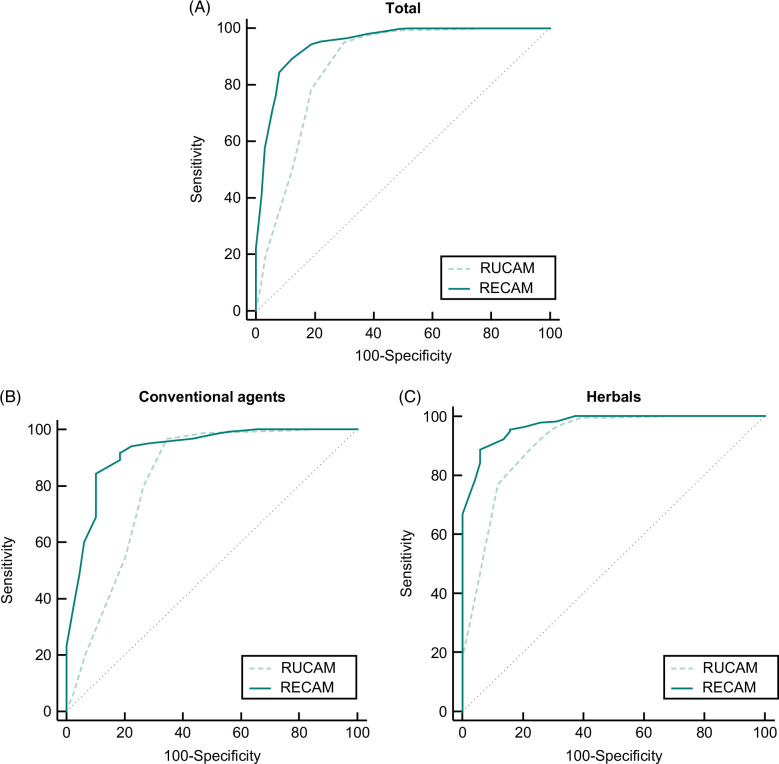
Background & Aims: The Revised Electronic Causality Assessment Method (RECAM), a computerized update of the Roussel Uclaf Causality Assessment Methodology (RUCAM), was recently proposed. In this study, we validated and compared the utility of the RECAM and RUCAM in Chinese patients with a single conventional or herbal agent-induced liver injury. Methods: In this retrospective multicenter cohort of well-established DILI and non-DILI patients from 5 centers in China, the diagnostic performance of the RUCAM and RECAM was compared by AUC analysis. The consistency was evaluated by weighted kappa. The major causes of discrepancy were explored. Results: A total of 481 DILI and 100 non-DILI patients were included. In total, 62.6% of the DILI cases were induced by conventional agents, and 37.4% were induced by herbs. The RECAM had relatively higher AUC than RUCAM for overall [0.947 (0.926–0.964) vs. 0.867 (0.836–0.893), p=0.0016], conventional agents [0.923 (0.890–0.949) vs. 0.819 (0.775–0.858), p=0.0185], and herbs [0.972 (0.941–0.989) vs.0.911 (0.866–0.944), p=0.0199]. Latency, scores associated with hepatitis B, and hepatotoxicity information of the insulting drugs were the 3 main causes for the inconsistency between RECAM and RUCAM scores. Conclusions: The RECAM had relatively better diagnostic performance than RUCAM, with a higher AUC for Chinese DILI patients. Timely updates of the LiverTox category and refinement of serum markers to exclude hepatitis B activity would further improve the applicability of RECAM in areas where the use of herbs and resolution of past HBV infections are common.
Overview
AI snapshot
Written from the paper’s full text.
TL;DR
In a retrospective multicenter Chinese cohort of 481 DILI and 100 non-DILI patients, RECAM had higher AUC than RUCAM overall and in conventional-agent and herbal DILI subgroups. Discrepancies between RECAM and RUCAM were mainly attributed to latency, hepatitis B-related scoring, and LiverTox hepatotoxicity information.
Key findings
- RECAM AUC was higher than RUCAM overall [0.947 (0.926–0.964) vs. 0.867 (0.836–0.893), p=0.0016], for conventional agents [0.923 (0.890–0.949) vs. 0.819 (0.775–0.858), p=0.0185], and for herbs [0.972 (0.941–0.989) vs. 0.911 (0.866–0.944), p=0.0199].
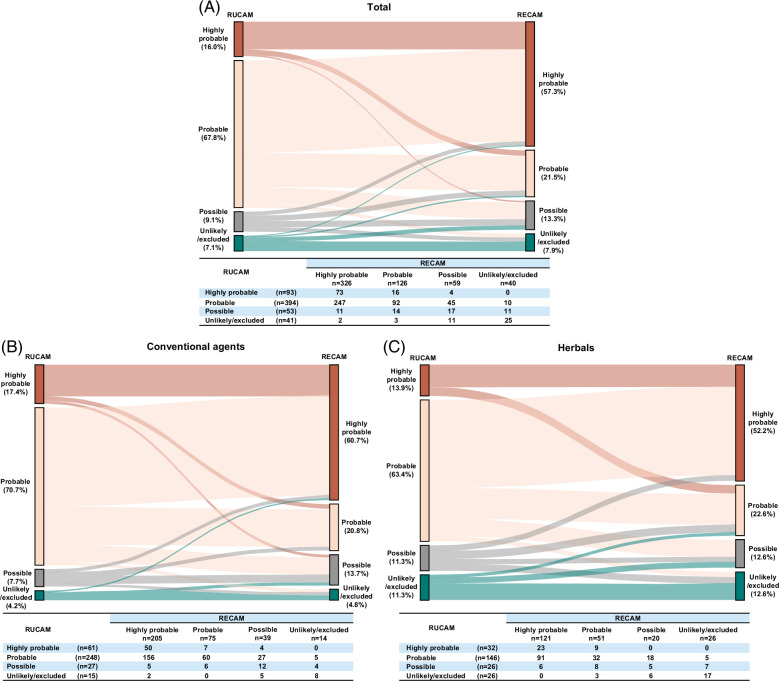
- Among DILI cases, 62.6% were induced by conventional agents and 37.4% by herbs; RECAM graded 68.2% as highly probable vs. 18.7% by RUCAM, while among non-DILI cases 46% were unlikely/excluded by RECAM vs. 38% by RUCAM.
- Overall agreement between RUCAM and RECAM was not good (weighted kappa 0.54 [0.41–0.67]); most discrepancy was RUCAM-probable cases upgraded to RECAM highly probable [247/394 (62.7%)].
- Main causes of inconsistency were latency, scores associated with hepatitis B, and hepatotoxicity information of the implicated drugs; 84 patients received a RECAM score of −3 due to lack of anti-HBc IgM results.
Methods
- Retrospective multicenter cohort from 5 centers in China (Beijing Friendship Hospital, Beijing Ditan Hospital, Shanghai Ruijin Hospital, 905th Hospital of PLA Navy, General Hospital of Eastern Theater Command), reviewing hospitalized patients from January 2015 to December 2021; final sample 581 patients (481 DILI, 100 non-DILI).
- DILI cases required adults ≥18 years, acute liver injury meeting ALT/ALP/total bilirubin criteria, a single implicated conventional drug or one of four well-documented hepatotoxic herbals (Polygonum multiflorum radix, Psoralen, Cortex dictamni, Scutellariae radix), key data for RECAM/RUCAM scoring, and ≥182 days follow-up; diagnoses were verified by 3 senior hepatologists.
- Diagnostic performance was compared by AUC (DeLong method), agreement by weighted kappa, correlation by Spearman rho, and major causes of discrepancy were explored.
Limitations
- The paper states that the retrospective design required excluding many patients with missing key data, which may cause residual selection bias and may be related to the relatively high RECAM AUC.
- The paper states that only single-agent DILI cases were included, so conclusions may not be extrapolated to cases with more than one implicated agent, including mixed conventional and herbal preparations.
- The paper states that patients were not scored independently by 3 hepatologists, so interuser variance between RECAM and RUCAM scoring was not explored; further studies of ease of use with quantifiable indicators are needed. Evident from the text: reproducibility across users and applicability to polypharmacy/mixed exposures remain unquantified.
Model-written summary. Check it against the paper before relying on it.
Integrity signals
Registry
Cites
Statistics
Figures
Verification
Claims the paper makes
55 Own result · 17 Own interpretation · 7 Not checked yet · 5 Own method · 4 Sources not found · 2 No basis given
A result the paper reports from its own data — it cites no other source for it, so there is none to check. The quote shows it is in the paper.
In the paper
“The sensitivity and specificity of the RUCAM for at least possible (≥3), at least probable (≥6), and highly probable (>9) for diagnosing DILI were 99.38% and 38.00%, 95.01% and 70.00%, and 18.71% and 97.00%, respectively (Table 3).”
§ Validation of the revised electronic version of RUCAM for diagnosis of DILI in Chinese patients > RESULTS > The utility of the RUCAM and RECAM for the differentiation of DILI from non-DILI
plain- Asserted: passes — The authors put it forward as true.
- Checkable: passes — It can be checked against evidence.
- Load-bearing: passes — The paper’s conclusions depend on it.
- Based: passes — The paper gives a reason why it holds.
- Rests on an assumption: The expert diagnoses made by three senior hepatologists are a valid reference standard for DILI and non-DILI.
A result the paper reports from its own data — it cites no other source for it, so there is none to check. The quote shows it is in the paper.
In the paper
“Out of the 481 DILI patients, 55 patients had inconsistent RUCAM and RECAM scores”
§ Validation of the revised electronic version of RUCAM for diagnosis of DILI in Chinese patients > RESULTS > The causes of inconsistency between the RUCAM and RECAM
plainn = 481- Asserted: passes — The authors put it forward as true.
- Checkable: passes — It can be checked against evidence.
- Load-bearing: passes — The paper’s conclusions depend on it.
- Based: passes — The paper gives a reason why it holds.
A result the paper reports from its own data — it cites no other source for it, so there is none to check. The quote shows it is in the paper.
In the paper
“Furthermore, the subgroup analyses showed that the RECAM and RUCAM were also applicable for not only conventional drugs but also herb-induced liver injury.”
§ Validation of the revised electronic version of RUCAM for diagnosis of DILI in Chinese patients > DISCUSSION
plain- Asserted: passes — The authors put it forward as true.
- Checkable: passes — It can be checked against evidence.
- Load-bearing: passes — The paper’s conclusions depend on it.
- Based: passes — The paper gives a reason why it holds.
A result the paper reports from its own data — it cites no other source for it, so there is none to check. The quote shows it is in the paper.
In the paper
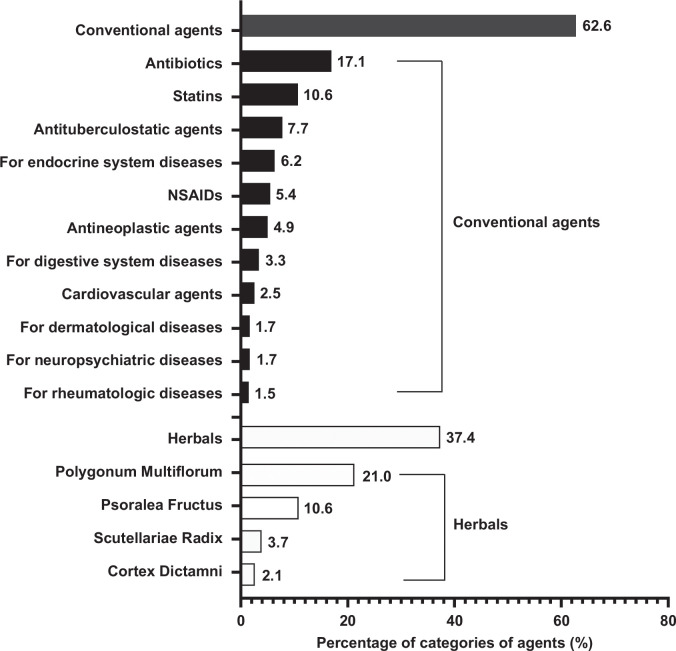
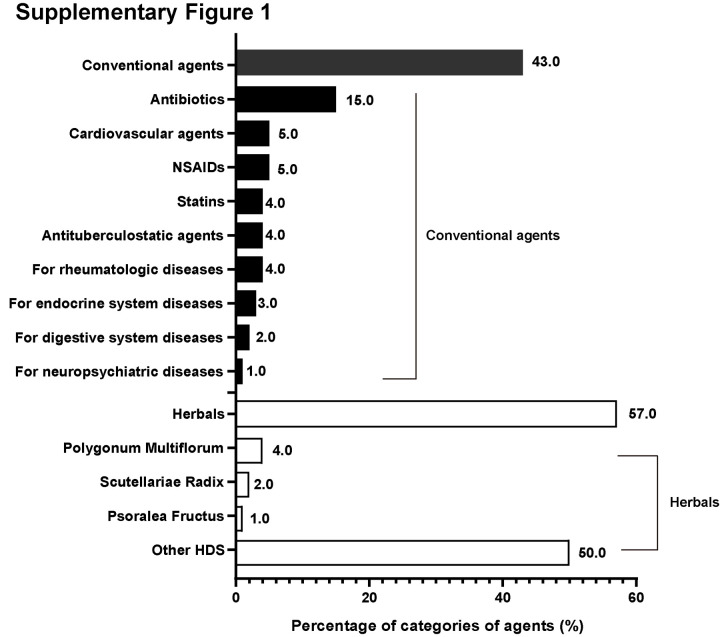
“The order of frequency of the implicated herbs was Polygonum multiflorum (21.0%), Psoralea fructus (10.6%), Scutellariae radix (3.7%), and Cortex dictamni (2.1%).”
§ Validation of the revised electronic version of RUCAM for diagnosis of DILI in Chinese patients > RESULTS > Categories of the implicated agents
plain- Asserted: passes — The authors put it forward as true.
- Checkable: passes — It can be checked against evidence.
- Load-bearing: unclear — It is unclear whether the paper’s conclusions depend on it.
- Based: passes — The paper gives a reason why it holds.
A result the paper reports from its own data — it cites no other source for it, so there is none to check. The quote shows it is in the paper.
In the paper
“Not surprisingly, the likelihood of DILI calculated by both the RUCAM and RECAM was significantly higher in the DILI group than in the non-DILI group.”
§ Validation of the revised electronic version of RUCAM for diagnosis of DILI in Chinese patients > RESULTS > Demographic and baseline laboratory data of the patients
plaincorrelational- Asserted: passes — The authors put it forward as true.
- Checkable: passes — It can be checked against evidence.
- Load-bearing: passes — The paper’s conclusions depend on it.
- Based: passes — The paper gives a reason why it holds.
A result the paper reports from its own data — it cites no other source for it, so there is none to check. The quote shows it is in the paper.
In the paper
“A total of 84 patients had a RECAM score of −3 due to a lack of anti-HBc IgM results.”
§ Validation of the revised electronic version of RUCAM for diagnosis of DILI in Chinese patients > RESULTS > The causes of inconsistency between the RUCAM and RECAM
plaindirectn = 84- Asserted: passes — The authors put it forward as true.
- Checkable: passes — It can be checked against evidence.
- Load-bearing: passes — The paper’s conclusions depend on it.
- Based: passes — The paper gives a reason why it holds.
A result the paper reports from its own data — it cites no other source for it, so there is none to check. The quote shows it is in the paper.
In the paper
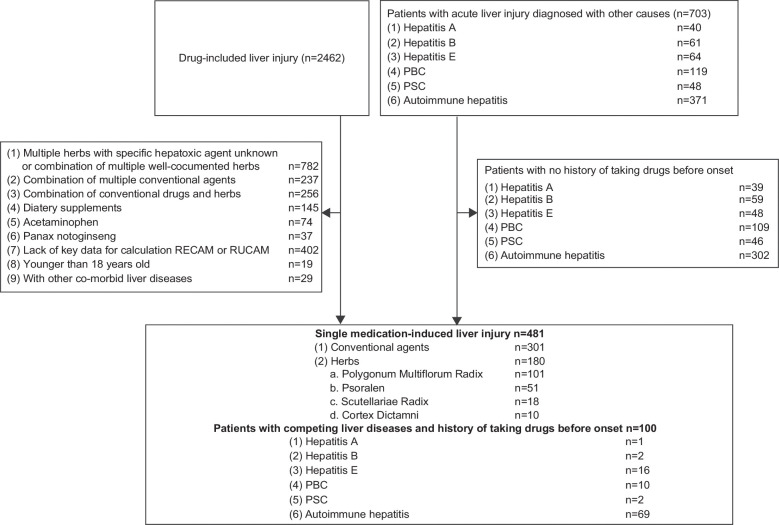
“Finally, a total of 581 patients, including 481 with DILI and 100 with liver diseases of competing etiologies (AIH, PBC, small-duct PSC, and hepatitis A, B, and E) were included in the present study (Figure 1).”
§ Validation of the revised electronic version of RUCAM for diagnosis of DILI in Chinese patients > RESULTS > Demographic and baseline laboratory data of the patients
plainn = 581- Asserted: passes — The authors put it forward as true.
- Checkable: passes — It can be checked against evidence.
- Load-bearing: passes — The paper’s conclusions depend on it.
- Based: passes — The paper gives a reason why it holds.
A result the paper reports from its own data — it cites no other source for it, so there is none to check. The quote shows it is in the paper.
In the paper
“The scores of the DILI patients that underwent liver biopsies were similar among the accordant, upgraded, and downgraded groups (Supplemental Table S3, http://links.lww.com/HC9/A843).”
§ Validation of the revised electronic version of RUCAM for diagnosis of DILI in Chinese patients > RESULTS > The RECAM warnings and liver biopsy played important roles in excluding other etiologies
plainn = 108- Asserted: passes — The authors put it forward as true.
- Checkable: passes — It can be checked against evidence.
- Load-bearing: unclear — It is unclear whether the paper’s conclusions depend on it.
- Based: passes — The paper gives a reason why it holds.
A result the paper reports from its own data — it cites no other source for it, so there is none to check. The quote shows it is in the paper.
In the paper
“Fifty AIH, 10 PBC, and 2 PSC cases received a score of −6 due to diagnostic pathological features of competing liver diseases.”
§ Validation of the revised electronic version of RUCAM for diagnosis of DILI in Chinese patients > RESULTS > The RECAM warnings and liver biopsy played important roles in excluding other etiologies
plaindirectn = 2- Asserted: passes — The authors put it forward as true.
- Checkable: passes — It can be checked against evidence.
- Load-bearing: passes — The paper’s conclusions depend on it.
- Based: passes — The paper gives a reason why it holds.
A result the paper reports from its own data — it cites no other source for it, so there is none to check. The quote shows it is in the paper.
In the paper
“This is important since herbal agents were implicated in ~one-third of the DILI patients in our study.”
§ Validation of the revised electronic version of RUCAM for diagnosis of DILI in Chinese patients > DISCUSSION
plain- Asserted: passes — The authors put it forward as true.
- Checkable: passes — It can be checked against evidence.
- Load-bearing: passes — The paper’s conclusions depend on it.
- Based: passes — The paper gives a reason why it holds.
- It may state two separate claims as one. 37
- Probably not a substantial claim. 15
A result the paper reports from its own data — it cites no other source for it, so there is none to check. The quote shows it is in the paper.
In the paper
“None of the patients in our study received scores of −6 in domain 2 or had hepatitis C, EBV, or HSV.”
§ Validation of the revised electronic version of RUCAM for diagnosis of DILI in Chinese patients > RESULTS > The RECAM warnings and liver biopsy played important roles in excluding other etiologies
plain- Asserted: passes — The authors put it forward as true.
- Checkable: passes — It can be checked against evidence.
- Load-bearing: unclear — It is unclear whether the paper’s conclusions depend on it.
- Based: passes — The paper gives a reason why it holds.
It may state two separate claims as one.
A result the paper reports from its own data — it cites no other source for it, so there is none to check. The quote shows it is in the paper.
In the paper
“However, a total of 32 patients were graded as possible by RUCAM, including 13 AIH, 5 PBC, 1 small-duct PSC, 11 hepatitis E, and 2 Hepatitis B cases.”
§ Validation of the revised electronic version of RUCAM for diagnosis of DILI in Chinese patients > RESULTS > The utility of the RUCAM and RECAM for the differentiation of DILI from non-DILI
plainn = 32- Asserted: passes — The authors put it forward as true.
- Checkable: passes — It can be checked against evidence.
- Load-bearing: unclear — It is unclear whether the paper’s conclusions depend on it.
- Based: passes — The paper gives a reason why it holds.
It may state two separate claims as one.
A result the paper reports from its own data — it cites no other source for it, so there is none to check. The quote shows it is in the paper.
In the paper
“Clinically, all 84 patients fulfilled the clinical course of DILI since they experienced an acute clinical course and also since their abnormal liver chemistries resolved completely without antiviral therapy.”
§ Validation of the revised electronic version of RUCAM for diagnosis of DILI in Chinese patients > RESULTS > The causes of inconsistency between the RUCAM and RECAM
plainn = 84- Asserted: passes — The authors put it forward as true.
- Checkable: passes — It can be checked against evidence.
- Load-bearing: passes — The paper’s conclusions depend on it.
- Based: passes — The paper gives a reason why it holds.
It may state two separate claims as one.
A result the paper reports from its own data — it cites no other source for it, so there is none to check. The quote shows it is in the paper.
In the paper
“In comparison, the sensitivity and specificity of the RECAM for at least possible (≥−3), at least probable (≥4), and highly probable (≥8) for diagnosing DILI were 100.00% and 46.00%, 91.89% and 84.00%, and 68.19% and 95.00%, respectively.”
§ Validation of the revised electronic version of RUCAM for diagnosis of DILI in Chinese patients > RESULTS > The utility of the RUCAM and RECAM for the differentiation of DILI from non-DILI
plain- Asserted: passes — The authors put it forward as true.
- Checkable: passes — It can be checked against evidence.
- Load-bearing: passes — The paper’s conclusions depend on it.
- Based: passes — The paper gives a reason why it holds.
It may state two separate claims as one.
- Rests on an assumption: The expert diagnoses made by three senior hepatologists are a valid reference standard for DILI and non-DILI.
A result the paper reports from its own data — it cites no other source for it, so there is none to check. The quote shows it is in the paper.
In the paper
“Similarly, a total of 38 cases were graded as possible by RECAM, including 23 AIH, 4 PBC, 1 small-duct PSC, 9 hepatitis E, and 1 Hepatitis B case.”
§ Validation of the revised electronic version of RUCAM for diagnosis of DILI in Chinese patients > RESULTS > The utility of the RUCAM and RECAM for the differentiation of DILI from non-DILI
plainn = 38- Asserted: passes — The authors put it forward as true.
- Checkable: passes — It can be checked against evidence.
- Load-bearing: unclear — It is unclear whether the paper’s conclusions depend on it.
- Based: passes — The paper gives a reason why it holds.
It may state two separate claims as one.
A result the paper reports from its own data — it cites no other source for it, so there is none to check. The quote shows it is in the paper.
In the paper
“A total of 185 patients had liver biopsies, including 108 DILI cases and 77 non-DILI cases (64 AIH, 12 PBC, and 1 hepatitis E).”
§ Validation of the revised electronic version of RUCAM for diagnosis of DILI in Chinese patients > RESULTS > The RECAM warnings and liver biopsy played important roles in excluding other etiologies
plainn = 185- Asserted: passes — The authors put it forward as true.
- Checkable: passes — It can be checked against evidence.
- Load-bearing: passes — The paper’s conclusions depend on it.
- Based: passes — The paper gives a reason why it holds.
It may state two separate claims as one.
A result the paper reports from its own data — it cites no other source for it, so there is none to check. The quote shows it is in the paper.
In the paper
“Among these 84 patients, 60 had negative HBsAg, positive anti-HBs, and anti-HBc; 15 had negative HBsAg, positive anti-HBc, and negative HBV DNA; and 8 had negative HBsAg, no anti-HBs, anti-HBc, or HBV DNA data available. One patient had positive HBsAg, HBeAg, and HBcAb, who had been taking entecavir and negative HBV DNA.”
§ Validation of the revised electronic version of RUCAM for diagnosis of DILI in Chinese patients > RESULTS > The causes of inconsistency between the RUCAM and RECAM
plainn = 84- Asserted: passes — The authors put it forward as true.
- Checkable: passes — It can be checked against evidence.
- Load-bearing: passes — The paper’s conclusions depend on it.
- Based: passes — The paper gives a reason why it holds.
It may state two separate claims as one.
A result the paper reports from its own data — it cites no other source for it, so there is none to check. The quote shows it is in the paper.
In the paper
“Only 3 AIH cases were graded as highly probable by RUCAM and 5 by RECAM (Table 2).”
§ Validation of the revised electronic version of RUCAM for diagnosis of DILI in Chinese patients > RESULTS > The utility of the RUCAM and RECAM for the differentiation of DILI from non-DILI
plainn = 3- Asserted: passes — The authors put it forward as true.
- Checkable: passes — It can be checked against evidence.
- Load-bearing: passes — The paper’s conclusions depend on it.
- Based: passes — The paper gives a reason why it holds.
It may state two separate claims as one.
A result the paper reports from its own data — it cites no other source for it, so there is none to check. The quote shows it is in the paper.
In the paper
“The latency after the drug stop of the 2 groups was similar.”
§ Validation of the revised electronic version of RUCAM for diagnosis of DILI in Chinese patients > RESULTS > Demographic and baseline laboratory data of the patients
plain- Asserted: passes — The authors put it forward as true.
- Checkable: passes — It can be checked against evidence.
- Load-bearing: fails — The paper’s conclusions may not depend on it.
- Based: passes — The paper gives a reason why it holds.
Probably not a substantial claim. The paper’s conclusions may not depend on it.
A result the paper reports from its own data — it cites no other source for it, so there is none to check. The quote shows it is in the paper.
In the paper
“Most of the laboratory data, such as the levels of aminotransferase aspartate (AST), alkaline phosphatase, total bilirubin, and INR, were also similar in the 2 groups.”
§ Validation of the revised electronic version of RUCAM for diagnosis of DILI in Chinese patients > RESULTS > Demographic and baseline laboratory data of the patients
plain- Asserted: passes — The authors put it forward as true.
- Checkable: passes — It can be checked against evidence.
- Load-bearing: fails — The paper’s conclusions may not depend on it.
- Based: passes — The paper gives a reason why it holds.
Probably not a substantial claim. The paper’s conclusions may not depend on it.
A result the paper reports from its own data — it cites no other source for it, so there is none to check. The quote shows it is in the paper.
In the paper
“The sensitivity and specificity of the RUCAM for at least possible (≥3), at least probable (≥6), and highly probable (>9) for diagnosing DILI were 99.38% and 38.00%, 95.01% and 70.00%, and 18.71% and 97.00%, respectively (Table 3).”
§ Validation of the revised electronic version of RUCAM for diagnosis of DILI in Chinese patients > RESULTS > The utility of the RUCAM and RECAM for the differentiation of DILI from non-DILI
plain- Asserted: passes — The authors put it forward as true.
- Checkable: passes — It can be checked against evidence.
- Load-bearing: passes — The paper’s conclusions depend on it.
- Based: passes — The paper gives a reason why it holds.
It may state two separate claims as one.
- Rests on an assumption: The expert diagnoses made by three senior hepatologists are a valid reference standard for DILI and non-DILI.
A result the paper reports from its own data — it cites no other source for it, so there is none to check. The quote shows it is in the paper.
In the paper
“However, significantly more females were found in the DILI group.”
§ Validation of the revised electronic version of RUCAM for diagnosis of DILI in Chinese patients > RESULTS > Demographic and baseline laboratory data of the patients
plaincorrelational- Asserted: passes — The authors put it forward as true.
- Checkable: passes — It can be checked against evidence.
- Load-bearing: fails — The paper’s conclusions may not depend on it.
- Based: passes — The paper gives a reason why it holds.
Probably not a substantial claim. The paper’s conclusions may not depend on it.
A result the paper reports from its own data — it cites no other source for it, so there is none to check. The quote shows it is in the paper.
In the paper
“In total, 62.6% of the DILI cases were induced by conventional agents, and 37.4% were induced by herbs.”
- Also stated in: § Categories of the implicated agents · plain
“A total of 62.6% of the DILI cases were attributed to conventional agents, and 37.4% were attributed to herbs.”
§ Validation of the revised electronic version of RUCAM for diagnosis of DILI in Chinese patients > Abstract > Results:
plaindirectn = 100- Asserted: passes — The authors put it forward as true.
- Checkable: passes — It can be checked against evidence.
- Load-bearing: unclear — It is unclear whether the paper’s conclusions depend on it.
- Based: passes — The paper gives a reason why it holds.
It may state two separate claims as one.
- Also stated in: § Categories of the implicated agents · plain
A result the paper reports from its own data — it cites no other source for it, so there is none to check. The quote shows it is in the paper.
In the paper
“A total of 38 (38%) non-DILI cases were graded as unlikely/excluded by RUCAM and 46 (46%) by RECAM.”
§ Validation of the revised electronic version of RUCAM for diagnosis of DILI in Chinese patients > RESULTS > The utility of the RUCAM and RECAM for the differentiation of DILI from non-DILI
plainn = 38- Asserted: passes — The authors put it forward as true.
- Checkable: passes — It can be checked against evidence.
- Load-bearing: passes — The paper’s conclusions depend on it.
- Based: passes — The paper gives a reason why it holds.
It may state two separate claims as one.
A result the paper reports from its own data — it cites no other source for it, so there is none to check. The quote shows it is in the paper.
In the paper
“A total of 24 patients had −6 in domain 1a (including 19 DILI cases, 2 hepatitis E, and 3 AIH), and 1 AIH patient had a score of −6 in domain 1b.”
§ Validation of the revised electronic version of RUCAM for diagnosis of DILI in Chinese patients > RESULTS > The RECAM warnings and liver biopsy played important roles in excluding other etiologies
plainn = 24- Asserted: passes — The authors put it forward as true.
- Checkable: passes — It can be checked against evidence.
- Load-bearing: passes — The paper’s conclusions depend on it.
- Based: passes — The paper gives a reason why it holds.
It may state two separate claims as one.
A result the paper reports from its own data — it cites no other source for it, so there is none to check. The quote shows it is in the paper.
In the paper
“The sensitivity and specificity of the RUCAM for at least possible (≥3), at least probable (≥6), and highly probable (>9) for diagnosing DILI were 99.38% and 38.00%, 95.01% and 70.00%, and 18.71% and 97.00%, respectively (Table 3).”
§ Validation of the revised electronic version of RUCAM for diagnosis of DILI in Chinese patients > RESULTS > The utility of the RUCAM and RECAM for the differentiation of DILI from non-DILI
plain- Asserted: passes — The authors put it forward as true.
- Checkable: passes — It can be checked against evidence.
- Load-bearing: passes — The paper’s conclusions depend on it.
- Based: passes — The paper gives a reason why it holds.
It may state two separate claims as one.
- Rests on an assumption: The expert diagnoses made by three senior hepatologists are a valid reference standard for DILI and non-DILI.
A result the paper reports from its own data — it cites no other source for it, so there is none to check. The quote shows it is in the paper.
In the paper
“The age and gender ratio of the 2 groups were similar.”
§ Validation of the revised electronic version of RUCAM for diagnosis of DILI in Chinese patients > RESULTS > Demographic and baseline laboratory data of the patients
plain- Asserted: passes — The authors put it forward as true.
- Checkable: passes — It can be checked against evidence.
- Load-bearing: fails — The paper’s conclusions may not depend on it.
- Based: passes — The paper gives a reason why it holds.
Probably not a substantial claim. The paper’s conclusions may not depend on it. It may state two separate claims as one.
A result the paper reports from its own data — it cites no other source for it, so there is none to check. The quote shows it is in the paper.
In the paper
“In our study, we found that both the RECAM and RUCAM showed good diagnostic performance.”
§ Validation of the revised electronic version of RUCAM for diagnosis of DILI in Chinese patients > DISCUSSION
plain- Asserted: passes — The authors put it forward as true.
- Checkable: passes — It can be checked against evidence.
- Load-bearing: passes — The paper’s conclusions depend on it.
- Based: passes — The paper gives a reason why it holds.
It may state two separate claims as one.
A result the paper reports from its own data — it cites no other source for it, so there is none to check. The quote shows it is in the paper.
In the paper
“The latency from drug start and stop of the upgraded, concordant, and downgraded groups decreased in turn [30 (9, 85) vs. 25 (10, 50) vs. 5 (1, 126) days, p = 0.534;”
§ Validation of the revised electronic version of RUCAM for diagnosis of DILI in Chinese patients > RESULTS > The causes of inconsistency between the RUCAM and RECAM
plain- Asserted: passes — The authors put it forward as true.
- Checkable: passes — It can be checked against evidence.
- Load-bearing: unclear — It is unclear whether the paper’s conclusions depend on it.
- Based: passes — The paper gives a reason why it holds.
It may state two separate claims as one.
A result the paper reports from its own data — it cites no other source for it, so there is none to check. The quote shows it is in the paper.
In the paper
“Eighty-seven DILI patients got 1 point due to the consistency of the pathological features with DILI, and 21 DILI, 1 hepatitis E, and 14 AIH cases received a score of 0 points due to nondiagnostic features.”
§ Validation of the revised electronic version of RUCAM for diagnosis of DILI in Chinese patients > RESULTS > The RECAM warnings and liver biopsy played important roles in excluding other etiologies
plainn = 87- Asserted: passes — The authors put it forward as true.
- Checkable: passes — It can be checked against evidence.
- Load-bearing: unclear — It is unclear whether the paper’s conclusions depend on it.
- Based: passes — The paper gives a reason why it holds.
It may state two separate claims as one.
A result the paper reports from its own data — it cites no other source for it, so there is none to check. The quote shows it is in the paper.
In the paper
“More patients in the upgraded had taken drugs that are classified as category A or B by the LiverTox Category system and thus, received higher scores of 3, while more patients in the concordant and downgraded groups had taken drugs that are classified as C-X or not listed in Livertox and thus, received lower scores of 0 or 1 although no significant difference was found (p = 0.449).”
§ Validation of the revised electronic version of RUCAM for diagnosis of DILI in Chinese patients > RESULTS > The causes of inconsistency between the RUCAM and RECAM
plain- Asserted: passes — The authors put it forward as true.
- Checkable: passes — It can be checked against evidence.
- Load-bearing: unclear — It is unclear whether the paper’s conclusions depend on it.
- Based: passes — The paper gives a reason why it holds.
It may state two separate claims as one.
A result the paper reports from its own data — it cites no other source for it, so there is none to check. The quote shows it is in the paper.
In the paper
“Our results showed good accuracy of both the RUCAM and RECAM for the diagnosis of DILI caused by conventional or herbal agents.”
§ Validation of the revised electronic version of RUCAM for diagnosis of DILI in Chinese patients > DISCUSSION
plain- Asserted: passes — The authors put it forward as true.
- Checkable: passes — It can be checked against evidence.
- Load-bearing: passes — The paper’s conclusions depend on it.
- Based: passes — The paper gives a reason why it holds.
It may state two separate claims as one.
In the paper
“However, the categories of the implicated drugs are slightly different from the nationwide report,32 and 1 example is the lower proportion of anti-tuberculostatic agents. This is because our study did not include hospitals that are specialized in the treatment of tuberculosis.”
§ Validation of the revised electronic version of RUCAM for diagnosis of DILI in Chinese patients > DISCUSSION
What the sources say
- Not checked yetcites [32] Shen T Liu Y Shang J Xie Q Li J Yan M. Incidence and Etiology of Drug-Induced Liver Injury in Mainland China. Gastroenterology. 2019; 156: 2230– 2241 e11. 30742832
plaindirect- Asserted: passes — The authors put it forward as true.
- Checkable: passes — It can be checked against evidence.
- Load-bearing: unclear — It is unclear whether the paper’s conclusions depend on it.
- Based: passes — The paper gives a reason why it holds.
It may state two separate claims as one.
A result the paper reports from its own data — it cites no other source for it, so there is none to check. The quote shows it is in the paper.
In the paper
“A total of 48 patients had a score of −6 in domain 4.”
§ Validation of the revised electronic version of RUCAM for diagnosis of DILI in Chinese patients > RESULTS > The RECAM warnings and liver biopsy played important roles in excluding other etiologies
plainn = 48- Asserted: passes — The authors put it forward as true.
- Checkable: passes — It can be checked against evidence.
- Load-bearing: fails — The paper’s conclusions may not depend on it.
- Based: passes — The paper gives a reason why it holds.
Probably not a substantial claim. The paper’s conclusions may not depend on it.
A result the paper reports from its own data — it cites no other source for it, so there is none to check. The quote shows it is in the paper.
In the paper
“A total of 17 DILI cases in the downgraded group experienced clinical symptoms, such as fatigue, appetite loss, nausea, or vomiting, within 24 hours after the first dose of implicated drugs. These patients got a score of -6 in the Domain 1a.”
§ Validation of the revised electronic version of RUCAM for diagnosis of DILI in Chinese patients > RESULTS > The causes of inconsistency between the RUCAM and RECAM
plaindirectn = 17- Asserted: passes — The authors put it forward as true.
- Checkable: passes — It can be checked against evidence.
- Load-bearing: passes — The paper’s conclusions depend on it.
- Based: passes — The paper gives a reason why it holds.
It may state two separate claims as one.
A conclusion the paper draws from its own results — it cites no other source for it, so there is none to check. The quote shows it is in the paper.
In the paper
“Second, we included only DILI cases due to a single agent, including conventional and well-identified herbal agents, and the conclusion may not be simply extrapolated into the more common cases with more than 1 implicated agent, including both conventional and herbal preparations.”
§ Validation of the revised electronic version of RUCAM for diagnosis of DILI in Chinese patients > DISCUSSION
hedgedconditional- Asserted: passes — The authors put it forward as true.
- Checkable: passes — It can be checked against evidence.
- Load-bearing: passes — The paper’s conclusions depend on it.
- Based: passes — The paper gives a reason why it holds.
It may state two separate claims as one.
In the paper
“Hayashi PH and Lucena MA et al proposed a Revised Electronic Causality Assessment Method (RECAM),7 which was based on DILI cases caused by a single nonherbal agent from the US DILI Network and the Spanish DILI Registry.”
§ Validation of the revised electronic version of RUCAM for diagnosis of DILI in Chinese patients > INTRODUCTION
What the sources say
- Not matchedcites [7] Hayashi PH Lucena MI Fontana RJ Bjornsson ES Aithal GP Barnhart H. A revised electronic version of RUCAM for the diagnosis of DILI. Hepatology. 2022; 76: 18– 31. 35014066 PMC9233102
Couldn’t be matched to a paper in Crossref, so it can’t be checked.
plain- Asserted: passes — The authors put it forward as true.
- Checkable: passes — It can be checked against evidence.
- Load-bearing: passes — The paper’s conclusions depend on it.
- Based: passes — The paper gives a reason why it holds.
Probably not a substantial claim.
- Not matched
A conclusion the paper draws from its own results — it cites no other source for it, so there is none to check. The quote shows it is in the paper.
In the paper
“The RECAM had relatively better diagnostic performance than RUCAM, with a higher AUC for Chinese DILI patients.”
§ Validation of the revised electronic version of RUCAM for diagnosis of DILI in Chinese patients > Abstract > Conclusions:
plaincorrelational- Asserted: passes — The authors put it forward as true.
- Checkable: passes — It can be checked against evidence.
- Load-bearing: passes — The paper’s conclusions depend on it.
- Based: passes — The paper gives a reason why it holds.
It may state two separate claims as one.
- Rests on an assumption: The expert diagnoses made by three senior hepatologists are a valid reference standard for DILI and non-DILI.
- Rests on an assumption: The included Chinese patients are representative of Chinese DILI patients.
What the paper did — it cites no source for this, so there is none to check. The quote shows it is in the paper.
In the paper
“First, as a retrospective study, we had to exclude many patients with key data missing, which may lead to residual biases in case selection and might be related to the relatively high AUC for RECAM.”
§ Validation of the revised electronic version of RUCAM for diagnosis of DILI in Chinese patients > DISCUSSION
hedgedconditional- Asserted: passes — The authors put it forward as true.
- Checkable: passes — It can be checked against evidence.
- Load-bearing: unclear — It is unclear whether the paper’s conclusions depend on it.
- Based: passes — The paper gives a reason why it holds.
It may state two separate claims as one.
In the paper
“The Revised Electronic Causality Assessment Method (RECAM), a computerized update of the Roussel Uclaf Causality Assessment Methodology (RUCAM), was recently proposed.”
§ Validation of the revised electronic version of RUCAM for diagnosis of DILI in Chinese patients > Abstract > Background & Aims:
What the sources say
- Not matchedcites [7] Hayashi PH Lucena MI Fontana RJ Bjornsson ES Aithal GP Barnhart H. A revised electronic version of RUCAM for the diagnosis of DILI. Hepatology. 2022; 76: 18– 31. 35014066 PMC9233102
Couldn’t be matched to a paper in Crossref, so it can’t be checked.
plain- Asserted: passes — The authors put it forward as true.
- Checkable: passes — It can be checked against evidence.
- Load-bearing: passes — The paper’s conclusions depend on it.
- Based: passes — The paper gives a reason why it holds.
Probably not a substantial claim. It may state two separate claims as one.
- Not matched
What the paper did — it cites no source for this, so there is none to check. The quote shows it is in the paper.
In the paper
“We recruited patients in whom only a single culprit drug had been documented and who had a detailed medical history, a thorough evaluation for competing causes, and a follow-up for at least 182 days after the onset of liver injury.”
§ Validation of the revised electronic version of RUCAM for diagnosis of DILI in Chinese patients > METHODS > The case identification process for DILI patients
plain- Asserted: passes — The authors put it forward as true.
- Checkable: passes — It can be checked against evidence.
- Load-bearing: passes — The paper’s conclusions depend on it.
- Based: passes — The paper gives a reason why it holds.
Probably not a substantial claim. It may state two separate claims as one.
What the paper did — it cites no source for this, so there is none to check. The quote shows it is in the paper.
In the paper
“Third, we did not design the scoring of each patient by 3 hepatologists independently, and the interuser variance between RECAM and RUCAM scoring was not explored in our study.”
§ Validation of the revised electronic version of RUCAM for diagnosis of DILI in Chinese patients > DISCUSSION
plain- Asserted: passes — The authors put it forward as true.
- Checkable: passes — It can be checked against evidence.
- Load-bearing: fails — The paper’s conclusions may not depend on it.
- Based: passes — The paper gives a reason why it holds.
Probably not a substantial claim. The paper’s conclusions may not depend on it. It may state two separate claims as one.
None of the sources cited for this claim have been checked yet.
In the paper
“The Roussel Uclaf Causality Assessment Methodology (RUCAM), originally published in 19931,2 and updated in 2015,3 is widely used for the diagnosis of DILI.”
§ Validation of the revised electronic version of RUCAM for diagnosis of DILI in Chinese patients > INTRODUCTION
What the sources say
- Not checked yetcites [1] Danan G Benichou C. Causality assessment of adverse reactions to drugs--I. A novel method based on the conclusions of international consensus meetings: Application to drug-induced liver injuries. J Clin Epidemiol. 1993; 46: 1323– 1330. 8229110
- Not checked yetcites [2] Benichou C Danan G Flahault A. Causality assessment of adverse reactions to drugs--II. An original model for validation of drug causality assessment methods: Case reports with positive rechallenge. J Clin Epidemiol. 1993; 46: 1331– 1336. 8229111
- Not checked yetcites [3] Danan G Teschke R. RUCAM in drug and herb induced liver injury: The Update. Int J Mol Sci. 2015; 17: 14. 26712744 PMC4730261
plain- Asserted: passes — The authors put it forward as true.
- Checkable: passes — It can be checked against evidence.
- Load-bearing: fails — The paper’s conclusions may not depend on it.
- Based: passes — The paper gives a reason why it holds.
Probably not a substantial claim. The paper’s conclusions may not depend on it. It may state two separate claims as one.
None of the sources cited for this claim have been checked yet.
In the paper
“However, several limitations remain, such as the subjectiveness in terms of ruling out competing etiologies and the existence of interobserver and intraobserver variation.4,5,6”
§ Validation of the revised electronic version of RUCAM for diagnosis of DILI in Chinese patients > INTRODUCTION
What the sources say
- Not checked yetcites [4] García-Cortés M Stephens C Lucena MI Fernández-Castañer A Andrade RJ. Causality assessment methods in drug induced liver injury: Strengths and weaknesses. Journal of Hepatology. 2011; 55: 683– 691. 21349301
- Not checked yetcites [5] Teschke R Wolff A Frenzel C Schwarzenboeck A Schulze J Eickhoff A. Drug and herb induced liver injury: Council for International Organizations of Medical Sciences scale for causality assessment. World J Hepatol. 2014; 6: 17– 32. 24653791 PMC3953808
- Not checked yetcites [6] Teschke R Eickhoff A Schulze J. Drug- and herb-induced liver injury in clinical and translational hepatology: Causality assessment methods, quo vadis? J Clin Transl Hepatol. 2013; 1: 59– 74. 26357608 PMC4521275
plain- Asserted: passes — The authors put it forward as true.
- Checkable: passes — It can be checked against evidence.
- Load-bearing: passes — The paper’s conclusions depend on it.
- Based: passes — The paper gives a reason why it holds.
It may state two separate claims as one.
A conclusion the paper draws from its own results — it cites no other source for it, so there is none to check. The quote shows it is in the paper.
In the paper
“The latency, the LiverTox Category information on the implicated agents, and the lack of IgM anti-HBc information were the main reasons for the discrepancies between the RECAM and RUCAM scores.”
§ Validation of the revised electronic version of RUCAM for diagnosis of DILI in Chinese patients > DISCUSSION
plaindirect- Asserted: passes — The authors put it forward as true.
- Checkable: passes — It can be checked against evidence.
- Load-bearing: passes — The paper’s conclusions depend on it.
- Based: passes — The paper gives a reason why it holds.
It may state two separate claims as one.
The paper states this without a source or data behind it here, so there is nothing to check it against. The quote shows it is in the paper.
In the paper
“However, both the RECAM and RUCAM were derived from Caucasian patients with DILI induced by conventional nonherbal drugs.”
§ Validation of the revised electronic version of RUCAM for diagnosis of DILI in Chinese patients > INTRODUCTION
plain- Asserted: passes — The authors put it forward as true.
- Checkable: passes — It can be checked against evidence.
- Load-bearing: passes — The paper’s conclusions depend on it.
- Based: passes — The paper gives a reason why it holds.
It may state two separate claims as one.
In the paper
“Compared with the RUCAM, the RECAM seems to have a better overall agreement with expert opinion and better sensitivity to detect highly probable cases.7”
§ Validation of the revised electronic version of RUCAM for diagnosis of DILI in Chinese patients > INTRODUCTION
What the sources say
- Not matchedcites [7] Hayashi PH Lucena MI Fontana RJ Bjornsson ES Aithal GP Barnhart H. A revised electronic version of RUCAM for the diagnosis of DILI. Hepatology. 2022; 76: 18– 31. 35014066 PMC9233102
Couldn’t be matched to a paper in Crossref, so it can’t be checked.
hedgedcorrelational- Asserted: passes — The authors put it forward as true.
- Checkable: passes — It can be checked against evidence.
- Load-bearing: passes — The paper’s conclusions depend on it.
- Based: passes — The paper gives a reason why it holds.
Probably not a substantial claim. It may state two separate claims as one.
- Not matched
What the paper did — it cites no source for this, so there is none to check. The quote shows it is in the paper.
In the paper
“The diagnoses of DILI were verified by 3 senior hepatologists based on medical history, laboratory data, and clinical course.”
§ Validation of the revised electronic version of RUCAM for diagnosis of DILI in Chinese patients > METHODS > The case identification process for DILI patients
plain- Asserted: passes — The authors put it forward as true.
- Checkable: passes — It can be checked against evidence.
- Load-bearing: passes — The paper’s conclusions depend on it.
- Based: passes — The paper gives a reason why it holds.
Probably not a substantial claim.
In the paper
“Particularly, it would be more difficult to assess the causality of many more herbal medicines with multiple mixtures, which have not yet been indexed in LiverTox.26”
§ Validation of the revised electronic version of RUCAM for diagnosis of DILI in Chinese patients > DISCUSSION
What the sources say
- Not matchedcites [26] Chinese and other Asian Herbal Medicines. LiverTox: Clinical and Research Information on Drug-Induced Liver Injury. Bethesda (MD): PMID: 31643904.
Couldn’t be matched to a paper in Crossref, so it can’t be checked.
hedgeddirect- Asserted: passes — The authors put it forward as true.
- Checkable: passes — It can be checked against evidence.
- Load-bearing: fails — The paper’s conclusions may not depend on it.
- Based: passes — The paper gives a reason why it holds.
Probably not a substantial claim. The paper’s conclusions may not depend on it.
- Not matched
A conclusion the paper draws from its own results — it cites no other source for it, so there is none to check. The quote shows it is in the paper.
In the paper
“Most of the AIH patients received scores of −6, which indicated that it would be questionable to implicate DILI as the cause of liver injury in those cases.”
§ Validation of the revised electronic version of RUCAM for diagnosis of DILI in Chinese patients > DISCUSSION
hedged- Asserted: passes — The authors put it forward as true.
- Checkable: passes — It can be checked against evidence.
- Load-bearing: passes — The paper’s conclusions depend on it.
- Based: passes — The paper gives a reason why it holds.
It may state two separate claims as one.
- Rests on an assumption: The RECAM −6 score indicates an alternate diagnosis rather than DILI.
None of the sources cited for this claim have been checked yet.
In the paper
“The histological features of DILI can mimic any hepatic injury pattern and thus, pose a great challenge for pathologists.29,30,31”
§ Validation of the revised electronic version of RUCAM for diagnosis of DILI in Chinese patients > DISCUSSION
What the sources say
- Not checked yetcites [29] Kleiner DE. The histopathological evaluation of drug-induced liver injury. Histopathology. 2017; 70: 81– 93. 27960237
- Not checked yetcites [30] Kleiner DE. Histopathological challenges in suspected drug-induced liver injury. Liver Int. 2018; 38: 198– 209. 28865179
- Not checked yetcites [31] Kleiner DE Chalasani NP Lee WM Fontana RJ Bonkovsky HL Watkins PB. Hepatic histological findings in suspected drug-induced liver injury: Systematic evaluation and clinical associations. Hepatology. 2014; 59: 661– 670. 24037963 PMC3946736
plaindirect- Asserted: passes — The authors put it forward as true.
- Checkable: passes — It can be checked against evidence.
- Load-bearing: fails — The paper’s conclusions may not depend on it.
- Based: passes — The paper gives a reason why it holds.
Probably not a substantial claim. The paper’s conclusions may not depend on it. It may state two separate claims as one.
What the paper did — it cites no source for this, so there is none to check. The quote shows it is in the paper.
In the paper
“The study protocol was reviewed and approved by the Institutional Review Board with a waiver for informed consent at each of the 5 participating centers (No. 2022-P2-351-01).”
§ Validation of the revised electronic version of RUCAM for diagnosis of DILI in Chinese patients > METHODS > Study design and data source
plain- Asserted: passes — The authors put it forward as true.
- Checkable: passes — It can be checked against evidence.
- Load-bearing: fails — The paper’s conclusions may not depend on it.
- Based: passes — The paper gives a reason why it holds.
Probably not a substantial claim. The paper’s conclusions may not depend on it.
A conclusion the paper draws from its own results — it cites no other source for it, so there is none to check. The quote shows it is in the paper.
In the paper
“This result indicated that, based on the point rules in the RECAM system, DILI patients with a latency ≤ 1 day or > 90 days tend to be downgraded, and it tends to upgrade those with a latency between 2 and 90 days.”
§ Validation of the revised electronic version of RUCAM for diagnosis of DILI in Chinese patients > DISCUSSION
hedgeddirectn = 17- Asserted: passes — The authors put it forward as true.
- Checkable: passes — It can be checked against evidence.
- Load-bearing: passes — The paper’s conclusions depend on it.
- Based: passes — The paper gives a reason why it holds.
It may state two separate claims as one.
A conclusion the paper draws from its own results — it cites no other source for it, so there is none to check. The quote shows it is in the paper.
In the paper
“The LiverTox category information on the implicated agents seemed to be another potential reason for the inconsistency between the RUCAM and RECAM though no statistical significance was found among the 3 groups.”
§ Validation of the revised electronic version of RUCAM for diagnosis of DILI in Chinese patients > RESULTS > The causes of inconsistency between the RUCAM and RECAM
hedgedconditional- Asserted: passes — The authors put it forward as true.
- Checkable: passes — It can be checked against evidence.
- Load-bearing: unclear — It is unclear whether the paper’s conclusions depend on it.
- Based: passes — The paper gives a reason why it holds.
It may state two separate claims as one.
The paper relies on this without support.
DILI is a diagnosis of exclusion due to the absence of specific biomarkers.
“With variable clinical manifestations and outcomes, DILI is a diagnosis of exclusion due to the absence of specific biomarkers.”
The paper relies on this without support.
The expert diagnoses made by three senior hepatologists are a valid reference standard for DILI and non-DILI.
“The diagnoses of DILI were verified by 3 senior hepatologists based on medical history, laboratory data, and clinical course.”
The paper relies on this without support.
The included Chinese patients are representative of Chinese DILI patients.
“In this study, we validated and compared the utility of the RECAM and RUCAM in Chinese patients with a single conventional or herbal agent-induced liver injury.”
The paper relies on this without support.
The RECAM −6 score indicates an alternate diagnosis rather than DILI.
“The RECAM sets a −6 score as a warning of alternate diagnosis rather than DILI.”
Claims other papers make about this one
Each is checked against this paper’s own text: does it say what the citing paper says it does?
The source backs part of the claim, not all of it — or backs it for a different population, condition or comparison.
In the citing paper
“Single conventional drugs were responsible for the injury in 63% of cases and HDS in the remaining 37% (P. multiflorum accounted for the 21.0% of HDS cases).”
From Methods for causality assessment of idiosyncratic drug‐induced liver injury (2025) · cites this paper as [51]
Experimental — accuracy not yet measuredThe cited source says what the claim attributes to it.
In the citing paper
“Criteria responsible for the poorer agreement between the two scales were latency, hepatitis B exclusion criteria, and hepatotoxicity information of the culprit drugs.”
From Methods for causality assessment of idiosyncratic drug‐induced liver injury (2025) · cites this paper as [51]
The cited source says what the claim attributes to it.
In the citing paper
“In this study, the absence of anti‐HBc IgM testing resulted in downgrading by the RECAM in patients with negative HBsAg.”
From Methods for causality assessment of idiosyncratic drug‐induced liver injury (2025) · cites this paper as [51]
The cited source says what the claim attributes to it.
In the citing paper
“The authors found an overall better diagnostic performance of RECAM than RUCAM with a higher AUC (.947 (.926–.964) vs. .867 (.836–.893), p = .0016).”
From Methods for causality assessment of idiosyncratic drug‐induced liver injury (2025) · cites this paper as [51]
In the citing paper
“In a comparative study of the RUCAM and RECAM scales in five Chinese hospitals, where these scales were retrospectively applied to 481 DILI and 100 non‐DILI patients, the overall agreement between the scales was low, with a weighted kappa of .54.”
From Methods for causality assessment of idiosyncratic drug‐induced liver injury (2025) · cites this paper as [51]
In the citing paper
“RECAM and RUCAM were also applicable for not only conventional drugs but also herb‐induced liver injury.”
From Methods for causality assessment of idiosyncratic drug‐induced liver injury (2025) · cites this paper as [51]
In the citing paper
“Interestingly, in this study by Zhao et al. 51 both RECAM and RUCAM performed well in cases of correctly identified hepatotoxic herbs (P. multiflorum, Psoralen, Scutellariae radix and Cortex dictamni).”
From Methods for causality assessment of idiosyncratic drug‐induced liver injury (2025) · cites this paper as [51]
Self-check
Percentages, sums and reported differences re-computed from the paper’s own numbers.
Each contradiction between two passages listed here was confirmed by an independent check.
Rated minor: it would not touch a result — a value no result rests on, a p-value that stays on the same side of the significance level, or a conflict that is clerical, resolved elsewhere in the paper, or outside its own findings.
In the paper
§ Validation of the revised electronic version of RUCAM for diagnosis of DILI in Chinese patients > RESULTS > The utility of the RUCAM and RECAM for the differentiation of DILI from non-DILI
“and highly probable (>9) for diagnosing DILI were 99.38% and 38.00%, 95.01% and 70.00%, and 18.71% and 97.00%, respectively (Table 3).”
§ Validation of the revised electronic version of RUCAM for diagnosis of DILI in Chinese patients > RESULTS > The utility of the RUCAM and RECAM for the differentiation of DILI from non-DILI
“| RUCAM (>8)Highly probable | 18.71 (15.32-22.49) | 97.00 (91.48-99.38) | 32.19 (28.40-36.15) | 96.77 (90.86-99.33) | 19.88 (16.43-23.70) |”
Rated minor: it would not touch a result — a value no result rests on, a p-value that stays on the same side of the significance level, or a conflict that is clerical, resolved elsewhere in the paper, or outside its own findings.
In the paper
§ Validation of the revised electronic version of RUCAM for diagnosis of DILI in Chinese patients > RESULTS > Demographic and baseline laboratory data of the patients
“However, significantly more females were found in the DILI group.”
§ Validation of the revised electronic version of RUCAM for diagnosis of DILI in Chinese patients > RESULTS > Demographic and baseline laboratory data of the patients
“| Female proportion (%) | 334 (69.4) | 71 (71.0) | 0.757 |”
Rated minor: it would not touch a result — a value no result rests on, a p-value that stays on the same side of the significance level, or a conflict that is clerical, resolved elsewhere in the paper, or outside its own findings.
In the paper
§ Validation of the revised electronic version of RUCAM for diagnosis of DILI in Chinese patients > RESULTS > The causes of inconsistency between the RUCAM and RECAM
“3 (0, 30) vs. 0 (0, 30) vs. 0 (0, 2) days, p < 0.001”
§ Validation of the revised electronic version of RUCAM for diagnosis of DILI in Chinese patients > RESULTS > The causes of inconsistency between the RUCAM and RECAM
“| Onset after drug stop (days) | 3 (0, 30) | 0 (0, 2) | 0 (0, 3) | 0.003 |”
Rated minor: it would not touch a result — a value no result rests on, a p-value that stays on the same side of the significance level, or a conflict that is clerical, resolved elsewhere in the paper, or outside its own findings.
In the paper
§ Validation of the revised electronic version of RUCAM for diagnosis of DILI in Chinese patients > RESULTS > The RECAM warnings and liver biopsy played important roles in excluding other etiologies
“A total of 185 patients had liver biopsies, including 108 DILI cases and 77 non-DILI cases (64 AIH, 12 PBC, and 1 hepatitis E).”
§ Validation of the revised electronic version of RUCAM for diagnosis of DILI in Chinese patients > RESULTS > The utility of the RUCAM and RECAM for the differentiation of DILI from non-DILI
“| PBC (n=10) | 0 (0.0) | 5 (50.0) | 5 (50.0) | 0 (0.0) | 0 (0.0) | 0 (0.0) | 4 (40.0) | 6 (60.0) |”
Citations
Cites
Danan, G., & Benichou, C. (1993) · Journal of Clinical Epidemiology · doi:10.1016/0895-4356(93)90101-6 · Cited by 1,481
Criteria of drug-induced liver disorders
(1990) · Journal of Hepatology · doi:10.1016/0168-8278(90)90124-a · Cited by 1,106
Mack, C. L., Adams, D., Assis, D. N., Kerkar, N., Manns, M. P., Mayo, M. J., Vierling, J. M., Alsawas, M., Murad, M. H., & Czaja, A. J. (2020) · Hepatology · doi:10.1002/hep.31065 · Cited by 983
Lindor, K. D., Bowlus, C. L., Boyer, J., Levy, C., & Mayo, M. (2019) · Hepatology · doi:10.1002/hep.30145 · Cited by 913 · cited 1×
“[9] All the small-bile-duct PSC patients had no obvious biliary strictures or preste-notic dilatations in MRCP.”
BackgroundRUCAM in Drug and Herb Induced Liver Injury: The Update
Danan, G., & Teschke, R. (2015) · International Journal of Molecular Sciences · doi:10.3390/ijms17010014 · Cited by 729
Incidence and Etiology of Drug-Induced Liver Injury in Mainland China
Shen, T., Liu, Y., Shang, J., Xie, Q., Li, J., Yan, M., Xu, J., Niu, J., Liu, J., Watkins, P. B., et al. (2019) · Gastroenterology · doi:10.1053/j.gastro.2019.02.002 · Cited by 615
Self-citationUpdate of the statements on biology and clinical impact of occult hepatitis B virus infection
Raimondo, G., Locarnini, S., Pollicino, T., Levrero, M., Zoulim, F., Lok, A. S., Allain, J.-P., Berg, T., Bertoletti, A., Brunetto, M. R., et al. (2019) · Journal of Hepatology · doi:10.1016/j.jhep.2019.03.034 · Cited by 572
Benichou, C., Danan, G., & Flahault, A. (1993) · Journal of Clinical Epidemiology · doi:10.1016/0895-4356(93)90102-7 · Cited by 491
Liver injury from herbals and dietary supplements in the U.S. Drug-Induced Liver Injury Network
Navarro, V. J., Barnhart, H., Bonkovsky, H. L., Davern, T., Fontana, R. J., Grant, L., Reddy, R. K., Seeff, L. B., Serrano, J., Sherker, A. H., et al. (2014) · Hepatology · doi:10.1002/hep.27317 · Cited by 418
Kleiner, D. E., Chalasani, N. P., Lee, W. M., Fontana, R. J., Bonkovsky, H. L., Watkins, P. B., Hayashi, P. H., Davern, T. J., Navarro, V., Reddy, R., et al. (2014) · Hepatology · doi:10.1002/hep.26709 · Cited by 396
Cited by
Sorted by citations
Artificial Intelligence: An Emerging Tool for Studying Drug‐Induced Liver Injury
Niu, H., Álvarez‐Álvarez, I., & Chen, M. (2025) · Liver International · doi:10.1111/liv.70038 · Cited by 18
Methods for causality assessment of idiosyncratic drug‐induced liver injury
García‐Cortés, M., Matilla‐Cabello, G., & Lucena, M. I. (2025) · Liver International · doi:10.1111/liv.16083 · Cited by 15
Ciricillo, J. A., Myer, A. S., Yeboah‐Korang, A., Osman, A., Rahim, F., Goldfarb, D. G., Sharma, Y., Louissaint, J., Sherman, K. E., & Fontana, R. J. (2024) · The American Journal of Gastroenterology · doi:10.14309/ajg.0000000000003147 · Cited by 6
Ivashkin, V. T., Drapkina, О. M., Raikhelson, K. L., Okovityi, S. V., Maevskaya, M. V., Grechishnikova, V. R., Жаркова, М. С., Khlynova, O. V., Gladkov, O. A., Deeva, Т. A., et al. (2026) · Russian Journal of Gastroenterology Hepatology Coloproctology · doi:10.22416/1382-4376-2026-36-1-70-146 · Cited by 2
Analysis of risk factors for herb-induced liver injury: a retrospective study from China
Wang, P., Liang, X., Guangyu, C., Fan, Q., Li, Q., Dai, F., Liu, Y., Jiang, Z., Luo, T., Hu, J., et al. (2026) · Frontiers in Pharmacology · doi:10.3389/fphar.2026.1766238 · Cited by 1
An update on drug‐induced liver injury—What's new?
Bjornsson, E. S., & Andrade, R. J. (2026) · Journal of Internal Medicine · doi:10.1111/joim.70111 · Cited by 1
Xiong, Y., Xin, H., Shi, C., Guo, X., Chen, Y., Huang, C., Ma, F., Ge, Y., & Yang, J. (2025) · Frontiers in Pharmacology · doi:10.3389/fphar.2025.1558054 · Cited by 1
DILI Differences and Similarities between the US and Europe
Toro-Ortiz, J. P., Andrade, R. J., & Pinazo-Bandera, J. (2026) · Current Hepatology Reports · doi:10.1007/s11901-026-00733-x
Autoimmune Hepatitis and Drug-Induced Liver Injury in Japan
Nishikawa, H., Kim, S. K., & Asai, A. (2025) · Journal of Clinical Medicine · doi:10.3390/jcm14134514
Acute liver failure caused by alkaloids from traditional Chinese medicine: A case report
Zhu, X.-Y., Zhao, Y.-T., Su, C.-S., Yuan, X., Zhang, S., & Nashan, B. (2025) · World Journal of Hepatology · doi:10.4254/wjh.v17.i10.109575
Anticancer Drug-induced Liver Injury
Goel, A., & Madan, K. (2025) · Tropical Gastroenterology · doi:10.4103/tg.tg_1_25
Cao, M., Duan, X., Li, J., Zhou, Z., & Jin, H. (2026) · Future Integrative Medicine · doi:10.14218/fim.2026.00017
Metadata
- Authors
- Zhao, X., Wang, Y., Lai, R., Wang, X., Yu, Y., Li, M., Zhao, H., Ma, Z., Li, M., Guo, T., Han, X., Meng, Y., Zhang, M., Su, Y., Hao, K., Deng, Y., Kong, Y., Li, Z., Xie, Q., Xie, W., Chen, C., & Jia, J.
- Affiliations
- Capital Medical University (CN)
- Shanghai Jiao Tong University (CN)
- Liver Disease Research Center, 905th Hospital of PLA Navy, China
- Nanjing University of Chinese Medicine (CN)
- Corresponding author
- Li, Min
- Li, Mengqi
- Li, Zhenyu
- Xie, Qing
- Xie, Wen
- Chen, Chengwei
- Jia, Jidong
- ORCID
- Venue
- Hepatology Communications
- Published
- 2024-03-11
- Volume
- 8
- Issue
- 4
- ISSN
- 2471-254X (ISSN-L)
- PMC
- PMC10932528
- OpenAlex
- W4392638131
- Cited by
- 12
- References
- 27
- Citations by year
- 2026: 5 · 2025: 5 · 2024: 2
- FWCI
- 2.89
- Type
- journal article
- Language
- en
- Open access
- gold
- doi.org
- Licence
- Locations
- Hepatology Communications (publishedVersion, cc-by-nc-nd)
- PubMed Central (publishedVersion, cc-by-nc-nd)
- PubMed (publishedVersion)
- Topics
- Life Sciences › Pharmacology, Toxicology and Pharmaceutics › Pharmacology › Drug-Induced Hepatotoxicity and Protection
- Life Sciences › Pharmacology, Toxicology and Pharmaceutics › Toxicology › Pharmacovigilance and Adverse Drug Reactions
- Health Sciences › Medicine › Complementary and alternative medicine › Complementary and Alternative Medicine Studies
- Keywords
- drug-induced liver injury, RUCAM, causality assessment, diagnostic accuracy, Chinese patients, hepatitis B, hepatotoxicity
- MeSH terms
- China, Electronics, Hepatitis B, Humans, Chemical and Drug Induced Liver Injury
About these checks
Registry, retraction, Cites and statistics results are computed, not judged, with one exception: a printed reference that no index lists is read once by a model before it counts as a citation error. Claims are extracted by a model and kept only when their quote appears verbatim in the text; each cited source is then checked, with a model’s help, for whether it says what the claim relies on. Those verdicts can be wrong — read the claim’s quote and the cited source before relying on one.
A language model drew the claims from the paper on 2026-11-10, under version 3 of the claim definition (model deepseek-v4.1-flash, prompt extract-v3).
A second model labelled each claim on 2026-11-10 (model jev-1.13-20260917, definition revision gold-guideline-v0.2).
Statistics and arithmetic are recomputed, not judged.
Confidence bands are shown only for fields calibrated on our annotated test set. None is calibrated yet, so no band is shown.
What counts as a claim ›How we measure confidence ›How we check this ›
Are you an author, or do you see a problem with this page? Request a review
