

Efficacy of a transdiagnostic emotion-focused exposure treatment for chronic pain patients with comorbid anxiety and depression: a randomized controlled trial
Open accessThe DOI matches its Crossref record; 49 of the 51 references it cites were found in a registry or an index.
Abstract
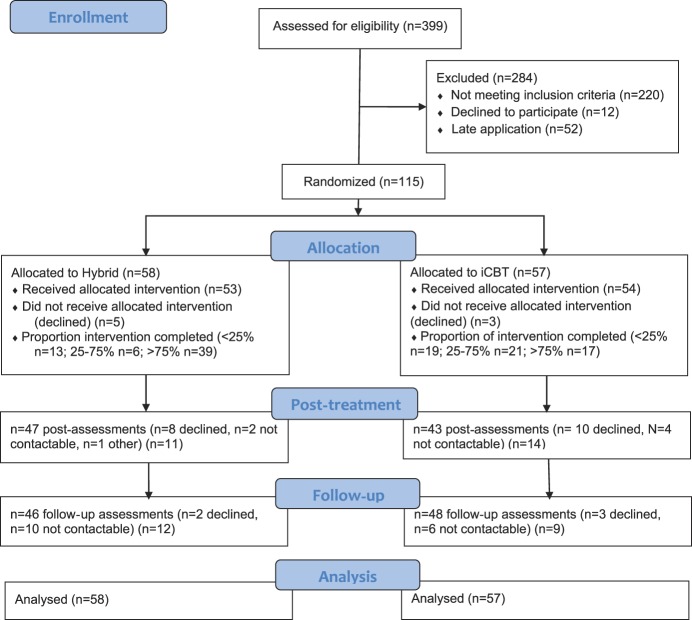
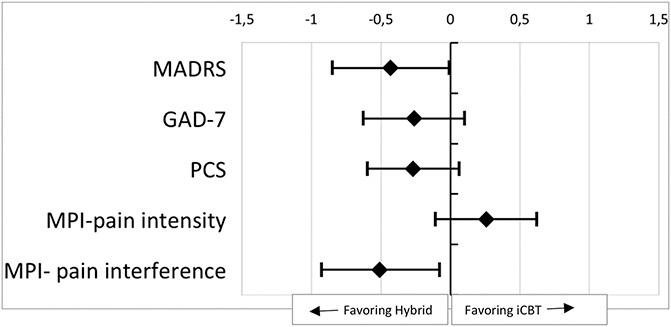
The comorbidity between chronic pain and emotional problems has proven difficult to address with current treatment options. This study addresses the efficacy of a transdiagnostic emotion–focused exposure treatment (“hybrid”) for chronic pain patients with comorbid emotional problems. Adults (n = 115) with chronic musculoskeletal pain and functional and emotional problems were included in a 2-centre, parallel randomized controlled, open-label trial comparing this treatment to an active control condition receiving a guided Internet-delivered pain management treatment based on CBT principles (iCBT). The hybrid treatment (n = 58, 10-16 sessions) integrates exposure in vivo for chronic pain based on the fear-avoidance model with an emotion-regulation approach informed by procedures in Dialectical Behavior Therapy. The iCBT (n = 57; 8 treatment modules) addresses topics such as pain education, coping strategies, relaxation, problem solving, stress, and sleep management using standard CBT techniques. Patient-reported outcomes were assessed before and after treatment as well as at a 9-month primary end point. Across conditions, 78% participants completed post-treatment and 81% follow-up assessment. Intent-to-treat analyses showed that the hybrid had a significantly better post-treatment outcome on pain catastrophizing (d = 0.39) and pain interference (d = 0.63) and significantly better follow-up outcomes on depression (d = 0.43) and pain interference (d = 0.51). There were no differences on anxiety and pain intensity. Observed proportions of clinically significant improvement favoured the hybrid on all but one comparison, but no statistically significant differences were observed. We conclude that the hybrid emotion–focused treatment may be considered an acceptable, credible, and efficacious treatment option for chronic pain patients with comorbid emotional problems.
Overview
The claims and statistics of this paper haven’t been checked yet.
Free: it reads the open-access text and checks the first 5 claims that cite a source we can check. Create a free account to check every claim.
Integrity signals
Registry
Cites
Statistics
Figures
Verification
Claims the paper makes
The claims and statistics of this paper haven’t been checked yet.
Free: it reads the open-access text and checks the first 5 claims that cite a source we can check. Create a free account to check every claim.
Claims other papers make about this one
Each is checked against this paper’s own text: does it say what the citing paper says it does?
The source backs part of the claim, not all of it — or backs it for a different population, condition or comparison.
In the citing paper
“Since no established cut off-score exist, a mean score above midpoint (≥25) was considered satisfactory, in line with for example Boersma et al. 2019 (42).”
From Internet-delivered acceptance and commitment therapy (iACT) for chronic pain—feasibility and preliminary effects in clinical and self-referred patients (2020) · cites this paper as [42]
Experimental — accuracy not yet measuredThe source backs part of the claim, not all of it — or backs it for a different population, condition or comparison.
In the citing paper
“Another study (Boersma et al., 2019) demonstrated significant changes in the reduction of pain interference in hybrid therapy (exposure in vivo and dialectical behavior therapy) compared to CBT at post-treatment with very small effect size (d = 0.02)”
From A systematic review of cognitive behavioral therapy-based interventions for comorbid chronic pain and clinically relevant psychological distress (2023) · cites this paper as Boersma et al., 2019
Experimental — accuracy not yet measuredThe source backs part of the claim, not all of it — or backs it for a different population, condition or comparison.
In the citing paper
“Another study (Boersma et al., 2019) identified significant differences in the reduction of depressive symptoms at follow-up with a small effect size (d = 0.25) in favor of hybrid therapy (exposure in vivo and DBT) compared to CBT.”
From A systematic review of cognitive behavioral therapy-based interventions for comorbid chronic pain and clinically relevant psychological distress (2023) · cites this paper as Boersma et al., 2019
Experimental — accuracy not yet measuredThe source backs part of the claim, not all of it — or backs it for a different population, condition or comparison.
In the citing paper
“and at follow-up with small effect size (d = 0.25).”
From A systematic review of cognitive behavioral therapy-based interventions for comorbid chronic pain and clinically relevant psychological distress (2023) · cites this paper as Boersma et al., 2019
Experimental — accuracy not yet measuredThe source backs part of the claim, not all of it — or backs it for a different population, condition or comparison.
In the citing paper
“another study (Boersma et al., 2019) reported significant differences in the decrease of pain catastrophizing at post-treatment with a small effect size (d = 0.26), but not at follow-up, in favor of hybrid therapy (exposure in vivo and dialectical behavior therapy) compared to CBT.”
From A systematic review of cognitive behavioral therapy-based interventions for comorbid chronic pain and clinically relevant psychological distress (2023) · cites this paper as Boersma et al., 2019
Experimental — accuracy not yet measured
4 more claims about this paper
Create a free account to see every claim other papers make about this one.
Self-check
Percentages, sums and reported differences re-computed from the paper’s own numbers.
The self-check needs the paper’s full text.
Citations
Cites
The Hospital Anxiety and Depression Scale
Zigmond, A. S., & Snaith, R. P. (1983) · Acta Psychiatrica Scandinavica · doi:10.1111/j.1600-0447.1983.tb09716.x · Cited by 47,139
A Brief Measure for Assessing Generalized Anxiety Disorder: The GAD-7
Spitzer, R. L., Kroenke, K., Williams, J. B. W., & Löwe, B. (2006) · Archives of Internal Medicine · doi:10.1001/archinte.166.10.1092 · Cited by 31,765
(1998) · The Journal of Clinical Psychiatry · Cited by 19,139
Depression and quality of life in older persons: A review
Sivertsen, H., Bjørkløf, G. H., Engedal, K., Selbæk, G., & Helvik, A.-S. (2015) · Dementia and Geriatric Cognitive Disorders · doi:10.1159/000437299 · Cited by 14,152
A new depression scale designed to be sensitive to change
Montgomery, S. A., & Åsberg, M. (1979) · British Journal of Psychiatry · doi:10.1192/bjp.134.4.382 · Cited by 13,962
Missing data: our view of the state of the art
Schafer, J. L., & Graham, J. W. (2002) · Psychological Methods · doi:10.1037/1082-989x.7.2.147 · Cited by 11,638
(1998) · PubMed · Cited by 10,216
The validity of the Hospital Anxiety and Depression Scale
Bjelland, I., Dahl, A. A., Haug, T. T., & Neckelmann, D. (2002) · Journal of Psychosomatic Research · doi:10.1016/s0022-3999(01)00296-3 · Cited by 9,779
The Pain Catastrophizing Scale: Development and validation.
Sullivan, M. J. L., Bishop, S. R., & Pivik, J. (1995) · Psychological Assessment · doi:10.1037//1040-3590.7.4.524 · Cited by 8,227
Jacobson, N. S., & Truax, P. (1991) · Journal of Consulting and Clinical Psychology · doi:10.1037/0022-006x.59.1.12 · Cited by 7,770
Research works printed but not linked: 3
- Harvey AG Watkins E Mansell W Shafran R Cognitive behavioural processes across psychological disorders. Oxford: Oxford University Press, 2004.
- Koerner K Doing dialectical behavior therapy: a practical guide. New York: The Guilford Press, 2012.
- Vlaeyen J Morley S Linton SJ Boersma K de Jong J Pain-related fear: exposure based treatment for chronic pain. Seattle, WA: IASP press, 2012.
Cited by
Items 101–127 of 127
Douleur chronique et thérapies comportementales et cognitives (TCC)
Vlaeyen, J. W. S., Morley, S., Boersma, K., de Jong, J. R., & Linton, S. J. (2021) · In Press eBooks · doi:10.3917/pres.laroc.2021.01.0061 · Cited by 1
Self-citationKong, J., Xu, H., Ji, X., Zhang, J., Yang, H., Ya, Z., Heffner, K. L., Wang, C., & Zhang, N. (2020) · Psychiatry and Clinical Psychopharmacology · doi:10.5455/pcp.20200530013456 · Cited by 2
Change in Health-Related Quality of Life in Cochlear Implant Recipients in China
Zheng, W., Cao, W., Chen, S., Li, Y., Wang, Y., Yao, K., & Qiu, J. (2022) · Journal of Healthcare Engineering · doi:10.1155/2022/1770580 · Cited by 1
“Emotion regulation may be one factor of pain development and maintenance [15, 16].”
BackgroundRetractedVallejo, M. Á., Rivera, J., & Vallejo-Slocker, L. (2021) · doi:10.2196/preprints.30207
Impacto motivacional evocado por imagens de movimento do ombro em participantes com dor no ombro
Tozzo, M. C. (2022) · Digital Library of Theses and Dissertations (Universidade de São Paulo) · doi:10.11606/d.17.2022.tde-03012023-103830
The effectiveness of pain-based training program on depression and anxiety in cancer patients
Miraveisi, S., Ahmadian, H., Moradi, O., & Ghaderi, B. (2023) · Shenakht Journal of Psychology and Psychiatry · doi:10.32598/shenakht.10.2.107
Ezcurra, C. M. (2023) · Research Publications (Maastricht University) · doi:10.26481/dis.20230629ce
Schemer, L., In‐Albon, T., Basten, U., Karbach, J., Könen, T., Lischetzke, T., & Glombiewski, J. A. (2024) · Die Psychotherapie · doi:10.1007/s00278-024-00725-6
Gilron, I. (2024) · Pain · doi:10.1097/j.pain.0000000000003414 · Cited by 1
Abrahamsson, P., Boersma, K., & Buhrman, M. (2024) · Scandinavian Journal of Pain · doi:10.1515/sjpain-2024-0039
Self-citationYu, L., Zhu, X., Duan, W., Yang, K., Hu, J., & Zhang, Y. (2025) · Anesthesia & Analgesia · doi:10.1213/ane.0000000000007411
Chamani, M., Aghaee, H., Taher, M., & Tabatabai, S. M. (2024) · پویایی روانشناختی در اختلالهای خلقی. · doi:10.61838/kman.pdmd.3.4.9
Delivering CPT in the Context of Traumatic Brain Injury and Physical Health Conditions
Jak, A. J., & Dell, K. C. (2025) · CBT: science into practice · doi:10.1007/978-3-031-87356-0_6
Pululu, A. M., Magoga, M. K., Lubaki, F. N., Mvuanda, G. D., Ngangu, D. B., & Nkodila, A. N. (2025) · OALib · doi:10.4236/oalib.1113680
Norman‐Nott, N., Rizzo, R. R. N., Hesam‐Shariati, N., Schroeder, J., Suh, J., McAuley, J. H., Quidé, Y., & Gustin, S. M. (2025) · International Journal of Clinical and Health Psychology · doi:10.1016/j.ijchp.2025.100638
“Building on preliminary trials of DBT for chronic pain (Boersma et al., 2019; Linton & Fruzzetti, 2014; Linton, 2010; Barrett et al., 2021; Sysko, Thorkelson & Szigethy, 2016; Norman-Nott et al., 2022), the iDBT-Pain RCT compared this intervention to treatment-as-usual, prioritising emotion…”
Hybelius, J., Gustavsson, A., af Winklerfelt Hammarberg, S., Toth-Pal, E., Johansson, R., Ljótsson, B., & Axelsson, E. (2022) · Figshare · doi:10.6084/m9.figshare.20342406
Albajes, K., Barrios, V., Keegan, E. G., Queraltó, J. M., Miracco, M., & Jones, L. E. (2026) · Journal of Contextual Behavioral Science · doi:10.1016/j.jcbs.2026.100975
Eather, C.-E., Sullivan, C. M., Sterling, M. M., Armfield, N. R., Liimatainen, J., Chandra, S. S., & Elphinston, R. A. (2026) · Pain · doi:10.1097/j.pain.0000000000003959
Neurocognitive impairments in chronic pain: Transdiagnostic approach and clinical implications
Guerra-Armas, J., Moral-Muñoz, J. A., Roldán‐Ruiz, A., Montero-Cuadrado, F., & Ceniza-Bordallo, G. (2026) · Neuroscience & Biobehavioral Reviews · doi:10.1016/j.neubiorev.2026.106711
Sadeghpour, M., Mirzaian, B., & Noruzi, A. (2026) · Rooyesh Psychological Journal · doi:10.66224/rooyesh.15.2.241
Zetterberg, H., Zhao, X., Bergbom, S., Lennartsson, R., Flink, I. K., Linton, S. J., & Boersma, K. (2026) · European Journal of Pain · doi:10.1002/ejp.70310
“This can be compared to our efficacy randomized controlled trial, where 43% of participants showed clinically significant improvement on at least one of the outcomes (Boersma et al. 2019).”
InfluentialSelf-citationDing, X., Li, X., Zhang, Y.-Y., Zhou, M., Lin, Y.-W., Hu, W., Wu, X.-L., Li, R., Zhuang, Y.-L., Zhou, C.-H., et al. (2026) · Acta Pharmacologica Sinica · doi:10.1038/s41401-026-01849-y
Psychotherapy Approaches and Behavioral Modification Strategies
Royuela-Colomer, E., Navarrete, J., Sanabria‐Mazo, J. P., Neblett, R., & Luciano, J. V. (2026) · Springer eBooks · doi:10.1007/978-3-032-21675-5_32
Aaron, R. V., Pasko, K., Johnson, S., & Rassu, F. S. (2026) · Clinical Journal of Pain · doi:10.1097/ajp.0000000000001404
Liu, W., Han, W., Dou, Z., Liu, K., Zhao, R., Xie, R., Wu, S.-X., Li, Z.-Z., & Luo, C. (2026) · Cell Reports · doi:10.1016/j.celrep.2026.118112
Chinawa, F. C. (2026) · JOURNAL OF HUMANITIES AND SOCIAL POLICY · doi:10.56201/jhsp.vol.11.no3.2025.pg108.120
Remskar, M., Greaves, C. J., Chew-Graham, C., Stathi, A., Andersson, G., Kingstone, T., Hayhoe, S., & Lambert, J. D. (2026) · PLoS ONE · doi:10.1371/journal.pone.0355366
“It was measured via the Generalized Anxiety Disorder 7-item scale (GAD-7) [34,36,41,42,45,49,68], the HADS-A subscale [32,53,59], Beck Anxiety Inventory (BAI) [31,38,50] or the State-Trait Anxiety Inventory (STAI) [52,66].”
Influential
Metadata
- Authors
- Boersma, K., Södermark, M., Hesser, H., Flink, I. K., Gerdle, B., & Linton, S. J.
- Affiliations
- Örebro University (SE)
- Linköping University (SE)
- Corresponding author
- Boersma, Katja
- Venue
- Pain
- Published
- 2019-04-06
- Volume
- 160
- Issue
- 8
- Pages
- 1708-1718
- ISSN
- 0304-3959 (ISSN-L)
- 1872-6623
- PMC
- PMC6687409
- OpenAlex
- W2936028955
- Semantic Scholar
- edb20400a31026f247582bb97af76093b281611a
- Cited by
- 123
- References
- 51
- Citations by year
- 2026: 12 · 2025: 13 · 2024: 22 · 2023: 19 · 2022: 26 · 2021: 16 · 2020: 11 · 2019: 4
- FWCI
- 8.83
- Type
- journal article
- Language
- en
- Open access
- hybrid
- doi.org
- Licence
- Locations
- Pain (publishedVersion, cc-by-nc-nd)
- PubMed Central (publishedVersion, cc-by-nc-nd)
- PubMed (publishedVersion)
- Funders
- AFA Försäkring
- Topics
- Health Sciences › Health Professions › Physical Therapy, Sports Therapy and Rehabilitation › Musculoskeletal pain and rehabilitation
- Social Sciences › Psychology › Experimental and Cognitive Psychology › Anxiety, Depression, Psychometrics, Treatment, Cognitive Processes
- Health Sciences › Medicine › Anesthesiology and Pain Medicine › Pain Management and Treatment
- Keywords
- chronic pain, musculoskeletal pain, anxiety comorbidity, comorbid depression, transdiagnostic treatment, hybrid therapy, fear-avoidance model, emotion regulation, dialectical behavior therapy, internet-based cognitive behavioral therapy, pain catastrophizing, pain interference, depression
- MeSH terms
- Adaptation, Psychological, Adult, Anxiety, Depression, Emotions, Female, Humans, Implosive Therapy, Male, Middle Aged, Cognitive Behavioral Therapy, Treatment Outcome, Chronic Pain, Pain Management
About these checks
Registry, retraction, Cites and statistics results are computed, not judged, with one exception: a printed reference that no index lists is read once by a model before it counts as a citation error. Claims are extracted by a model and kept only when their quote appears verbatim in the text; each cited source is then checked, with a model’s help, for whether it says what the claim relies on. Those verdicts can be wrong — read the claim’s quote and the cited source before relying on one.
Statistics and arithmetic are recomputed, not judged.
Confidence bands are shown only for fields calibrated on our annotated test set. None is calibrated yet, so no band is shown.
What counts as a claim ›How we measure confidence ›How we check this ›
Are you an author, or do you see a problem with this page? Request a review
Data sources
Bibliographic data: Semantic Scholar, OpenAlex, Crossref.
Contains information from the Semantic Scholar Academic Graph Datasets, made available under the ODC Attribution License (ODC-BY 1.0).
Semantic Scholar’s data is described in: Kinney, R., et al. (2023). The Semantic Scholar Open Data Platform. arXiv:2301.10140.
