

Efficacy of a transdiagnostic emotion-focused exposure treatment for chronic pain patients with comorbid anxiety and depression: a randomized controlled trial
Open accessThe DOI matches its Crossref record; 49 of the 51 references it cites were found in a registry or an index.
Abstract
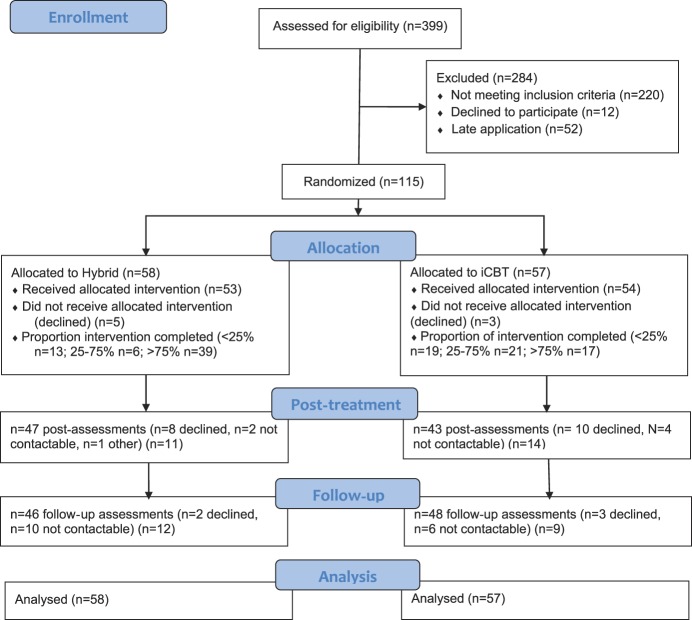
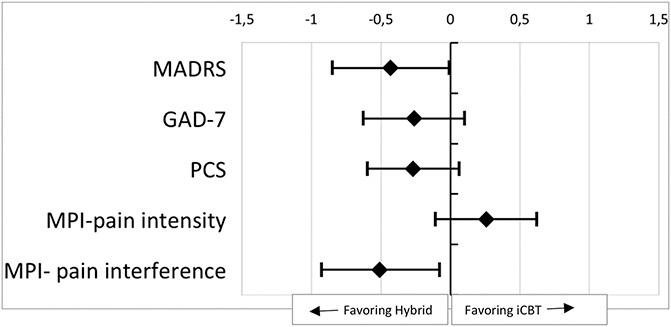
The comorbidity between chronic pain and emotional problems has proven difficult to address with current treatment options. This study addresses the efficacy of a transdiagnostic emotion–focused exposure treatment (“hybrid”) for chronic pain patients with comorbid emotional problems. Adults (n = 115) with chronic musculoskeletal pain and functional and emotional problems were included in a 2-centre, parallel randomized controlled, open-label trial comparing this treatment to an active control condition receiving a guided Internet-delivered pain management treatment based on CBT principles (iCBT). The hybrid treatment (n = 58, 10-16 sessions) integrates exposure in vivo for chronic pain based on the fear-avoidance model with an emotion-regulation approach informed by procedures in Dialectical Behavior Therapy. The iCBT (n = 57; 8 treatment modules) addresses topics such as pain education, coping strategies, relaxation, problem solving, stress, and sleep management using standard CBT techniques. Patient-reported outcomes were assessed before and after treatment as well as at a 9-month primary end point. Across conditions, 78% participants completed post-treatment and 81% follow-up assessment. Intent-to-treat analyses showed that the hybrid had a significantly better post-treatment outcome on pain catastrophizing (d = 0.39) and pain interference (d = 0.63) and significantly better follow-up outcomes on depression (d = 0.43) and pain interference (d = 0.51). There were no differences on anxiety and pain intensity. Observed proportions of clinically significant improvement favoured the hybrid on all but one comparison, but no statistically significant differences were observed. We conclude that the hybrid emotion–focused treatment may be considered an acceptable, credible, and efficacious treatment option for chronic pain patients with comorbid emotional problems.
Overview
The claims and statistics of this paper haven’t been checked yet.
Free: it reads the open-access text and checks the first 5 claims that cite a source we can check. Create a free account to check every claim.
Integrity signals
Registry
Cites
Statistics
Figures
Verification
Claims the paper makes
The claims and statistics of this paper haven’t been checked yet.
Free: it reads the open-access text and checks the first 5 claims that cite a source we can check. Create a free account to check every claim.
Claims other papers make about this one
Each is checked against this paper’s own text: does it say what the citing paper says it does?
The source backs part of the claim, not all of it — or backs it for a different population, condition or comparison.
In the citing paper
“Since no established cut off-score exist, a mean score above midpoint (≥25) was considered satisfactory, in line with for example Boersma et al. 2019 (42).”
From Internet-delivered acceptance and commitment therapy (iACT) for chronic pain—feasibility and preliminary effects in clinical and self-referred patients (2020) · cites this paper as [42]
Experimental — accuracy not yet measuredThe source backs part of the claim, not all of it — or backs it for a different population, condition or comparison.
In the citing paper
“Another study (Boersma et al., 2019) demonstrated significant changes in the reduction of pain interference in hybrid therapy (exposure in vivo and dialectical behavior therapy) compared to CBT at post-treatment with very small effect size (d = 0.02)”
From A systematic review of cognitive behavioral therapy-based interventions for comorbid chronic pain and clinically relevant psychological distress (2023) · cites this paper as Boersma et al., 2019
Experimental — accuracy not yet measuredThe source backs part of the claim, not all of it — or backs it for a different population, condition or comparison.
In the citing paper
“Another study (Boersma et al., 2019) identified significant differences in the reduction of depressive symptoms at follow-up with a small effect size (d = 0.25) in favor of hybrid therapy (exposure in vivo and DBT) compared to CBT.”
From A systematic review of cognitive behavioral therapy-based interventions for comorbid chronic pain and clinically relevant psychological distress (2023) · cites this paper as Boersma et al., 2019
Experimental — accuracy not yet measuredThe source backs part of the claim, not all of it — or backs it for a different population, condition or comparison.
In the citing paper
“and at follow-up with small effect size (d = 0.25).”
From A systematic review of cognitive behavioral therapy-based interventions for comorbid chronic pain and clinically relevant psychological distress (2023) · cites this paper as Boersma et al., 2019
Experimental — accuracy not yet measuredThe source backs part of the claim, not all of it — or backs it for a different population, condition or comparison.
In the citing paper
“another study (Boersma et al., 2019) reported significant differences in the decrease of pain catastrophizing at post-treatment with a small effect size (d = 0.26), but not at follow-up, in favor of hybrid therapy (exposure in vivo and dialectical behavior therapy) compared to CBT.”
From A systematic review of cognitive behavioral therapy-based interventions for comorbid chronic pain and clinically relevant psychological distress (2023) · cites this paper as Boersma et al., 2019
Experimental — accuracy not yet measured
4 more claims about this paper
Create a free account to see every claim other papers make about this one.
Self-check
Percentages, sums and reported differences re-computed from the paper’s own numbers.
The self-check needs the paper’s full text.
Citations
Cites
The Hospital Anxiety and Depression Scale
Zigmond, A. S., & Snaith, R. P. (1983) · Acta Psychiatrica Scandinavica · doi:10.1111/j.1600-0447.1983.tb09716.x · Cited by 47,139
A Brief Measure for Assessing Generalized Anxiety Disorder: The GAD-7
Spitzer, R. L., Kroenke, K., Williams, J. B. W., & Löwe, B. (2006) · Archives of Internal Medicine · doi:10.1001/archinte.166.10.1092 · Cited by 31,765
(1998) · The Journal of Clinical Psychiatry · Cited by 19,139
Depression and quality of life in older persons: A review
Sivertsen, H., Bjørkløf, G. H., Engedal, K., Selbæk, G., & Helvik, A.-S. (2015) · Dementia and Geriatric Cognitive Disorders · doi:10.1159/000437299 · Cited by 14,152
A new depression scale designed to be sensitive to change
Montgomery, S. A., & Åsberg, M. (1979) · British Journal of Psychiatry · doi:10.1192/bjp.134.4.382 · Cited by 13,962
Missing data: our view of the state of the art
Schafer, J. L., & Graham, J. W. (2002) · Psychological Methods · doi:10.1037/1082-989x.7.2.147 · Cited by 11,638
(1998) · PubMed · Cited by 10,216
The validity of the Hospital Anxiety and Depression Scale
Bjelland, I., Dahl, A. A., Haug, T. T., & Neckelmann, D. (2002) · Journal of Psychosomatic Research · doi:10.1016/s0022-3999(01)00296-3 · Cited by 9,779
The Pain Catastrophizing Scale: Development and validation.
Sullivan, M. J. L., Bishop, S. R., & Pivik, J. (1995) · Psychological Assessment · doi:10.1037//1040-3590.7.4.524 · Cited by 8,227
Jacobson, N. S., & Truax, P. (1991) · Journal of Consulting and Clinical Psychology · doi:10.1037/0022-006x.59.1.12 · Cited by 7,770
Depression and Pain Comorbidity: A Literature Review
Bair, M. J., Robinson, R. L., Katon, W., & Kroenke, K. (2003) · Archives of Internal Medicine · doi:10.1001/archinte.163.20.2433 · Cited by 3,463 · cited 1×
“There is a marked co-occurrence between chronic pain and emotional problems, which has proven difficult to address parsimoniously and effectively with state-of-the-art treatments.(2,4) A recent meta-analysis on prognostic factors for multidisciplinary pain rehabilitation outcome shows that emotional distress and cogni…”
BackgroundPsychometric properties of the credibility/expectancy questionnaire
Devilly, G. J., & Borkovec, T. D. (2000) · Journal of Behavior Therapy and Experimental Psychiatry · doi:10.1016/s0005-7916(00)00012-4 · Cited by 2,295 · cited 2×
“To assess treatment credibility, we used 3 questions of the Credibility/Expectancy Questionnaire.(15) At mid-treatment (after session 6 in the hybrid and module 4 in the iCBT), participants were asked to rate: (1) whether they considered their assigned treatment to be logical for them (numerical rating scale 0-10), (2…”
MethodThe West Haven-Yale Multidimensional Pain Inventory (WHYMPI)
Kerns, R. D., Turk, D. C., & Rudy, T. E. (1985) · Pain · doi:10.1016/0304-3959(85)90004-1 · Cited by 2,128
Psychological therapies for the management of chronic pain (excluding headache) in adults
Williams, A. C. D. C., Eccleston, C., & Morley, S. (2012) · Cochrane Database of Systematic Reviews · doi:10.1002/14651858.cd007407.pub3 · Cited by 1,634
Andersson, G., Cuijpers, P., Carlbring, P., Riper, H., & Hedman, E. (2014) · World Psychiatry · doi:10.1002/wps.20151 · Cited by 1,077
Synthesizing standardized mean‐change measures
Becker, B. J. (1988) · British Journal of Mathematical and Statistical Psychology · doi:10.1111/j.2044-8317.1988.tb00901.x · Cited by 889 · cited 1×
“Within-group effect sizes (Cohen’s d) were calculated for descriptive purposes using the pooled SD at pre-treatment assessment as the denominator.(5) All primary outcome analyses were conducted using Mplus Version 8.”
MethodJacobson, N. S., Roberts, L. J., Berns, S. B., & McGlinchey, J. B. (1999) · Journal of Consulting and Clinical Psychology · doi:10.1037/0022-006x.67.3.300 · Cited by 853 · cited 2×
“To estimate clinical significance at post-treatment and 9-month follow-up, we used the criteria of Jacobson and Truax21 and Jacobson et al.22 We calculated the reliable change index using the pooled SD of the observed sample at baseline and test–retest reliability of the measures (see under measures).”
MethodVan Breukelen, G. J. P. (2006) · Journal of Clinical Epidemiology · doi:10.1016/j.jclinepi.2006.02.007 · Cited by 765
Understanding the co-occurrence of anxiety disorders and chronic pain: state-of-the-art
Asmundson, G. J. G., & Katz, J. (2009) · Depression and Anxiety · doi:10.1002/da.20600 · Cited by 756 · cited 1×
“There is a marked co-occurrence between chronic pain and emotional problems, which has proven difficult to address parsimoniously and effectively with state-of-the-art treatments.(2,4) A recent meta-analysis on prognostic factors for multidisciplinary pain rehabilitation outcome shows that emotional distress and cogni…”
BackgroundThe fear-avoidance model of pain
Vlaeyen, J. W. S., Crombez, G., & Linton, S. J. (2016) · Pain · doi:10.1097/j.pain.0000000000000574 · Cited by 716
Self-citationLinton, S. J., & Halldén, K. (1998) · The Clinical Journal of Pain · doi:10.1097/00002508-199809000-00007 · Cited by 627
Self-citationLinton, S. J., & Boersma, K. (2003) · The Clinical Journal of Pain · doi:10.1097/00002508-200303000-00002 · Cited by 523
Self-citationSvanborg, P., & Åsberg, M. (2001) · Journal of Affective Disorders · doi:10.1016/s0165-0327(00)00242-1 · Cited by 481 · cited 1×
“All measures are frequently used and validated in a Swedish context.(6,7,9,24,46)”
MethodArnberg, F. K., Linton, S. J., Hultcrantz, M., Heintz, E., & Jonsson, U. (2014) · PLoS ONE · doi:10.1371/journal.pone.0098118 · Cited by 330
Self-citationBuer, N., & Linton, S. J. (2002) · Pain · doi:10.1016/s0304-3959(02)00265-8 · Cited by 319 · cited 1×
“All measures are frequently used and validated in a Swedish context.(6,7,9,24,46)”
MethodSelf-citationJohansson, R., Carlbring, P., Heedman, Å., Paxling, B., & Andersson, G. (2013) · PeerJ · doi:10.7717/peerj.98 · Cited by 309
Macea, D. D., Gajos, K., Daglia Calil, Y. A., & Fregni, F. (2010) · The Journal of Pain · doi:10.1016/j.jpain.2010.06.005 · Cited by 289 · cited 1×
“This being said, improvements in the iCBT arm were comparable or possibly somewhat larger than those found in other (Internet and face-to-face) CBT studies for chronic pain.(13,16,36,51) This may add confidence to an interpretation of the between-group differences as indicative of an incremental effect of the hybrid t…”
ResultPsychological therapies (Internet-delivered) for the management of chronic pain in adults
Eccleston, C., Fisher, E., Craig, L., Duggan, G. B., Rosser, B. A., & Keogh, E. (2014) · Cochrane Database of Systematic Reviews · doi:10.1002/14651858.cd010152.pub2 · Cited by 271 · cited 1×
“This being said, improvements in the iCBT arm were comparable or possibly somewhat larger than those found in other (Internet and face-to-face) CBT studies for chronic pain.(13,16,36,51) This may add confidence to an interpretation of the between-group differences as indicative of an incremental effect of the hybrid t…”
ResultLumley, M. A., Schubiner, H., Lockhart, N. A., Kidwell, K. M., Harte, S. E., Clauw, D. J., & Williams, D. A. (2017) · Pain · doi:10.1097/j.pain.0000000000001036 · Cited by 242
Controlled trial of Internet-based treatment with telephone support for chronic back pain
Buhrman, M., Fältenhag, S., Ström, L., & Andersson, G. (2004) · Pain · doi:10.1016/j.pain.2004.07.021 · Cited by 232
Internet interventions for chronic pain including headache: a systematic review
Buhrman, M., Gordh, T., & Andersson, G. (2016) · Internet Interventions · doi:10.1016/j.invent.2015.12.001 · Cited by 223
Fantino, B., & Moore, N. (2009) · BMC Psychiatry · doi:10.1186/1471-244x-9-26 · Cited by 200
Morley, S., Williams, A., & Hussain, S. (2008) · Pain · doi:10.1016/j.pain.2008.02.025 · Cited by 194
Bergström, G., Jensen, I. B., Bodin, L., Linton, S. J., Nygren, Å. L., & Carlsson, S. G. (1998) · Pain · doi:10.1016/s0304-3959(97)00210-8 · Cited by 186
Self-citationGlenn, D., Golinelli, D., Rose, R. D., Roy-Byrne, P., Stein, M. B., Sullivan, G., Bystritksy, A., Sherbourne, C., & Craske, M. G. (2013) · Journal of Consulting and Clinical Psychology · doi:10.1037/a0033403 · Cited by 166 · cited 1×
“Indeed, studies showing a positive relation between adherence and outcomes in CBT for emotional disorders often do not satisfactorily address important preexisting factors such as symptom severities and comorbidities, as well as other important aspects of treatment such as session content.(18) Although acceptability r…”
BackgroundA Transdiagnostic Approach to Pain and Emotion
Linton, S. J. (2013) · Journal of Applied Biobehavioral Research · doi:10.1111/jabr.12007 · Cited by 147 · cited 2×
“Our treatment model is based on a so-called transdiagnostic approach, which is conceptually rooted in the idea that chronic pain and emotional problems share certain cognitive and behavioral processes that maintain and contribute to the exacerbation of the observed comorbidities.(19,33) The results of this study sugge…”
MethodSelf-citationAndersson, G., Buhrman, M., Nilsson-Ihrfeldt, E., Jannert, M., & Ström, L. (2011) · Journal of Rehabilitation Medicine · doi:10.2340/16501977-0805 · Cited by 121
Psychological therapy for centralized pain: an integrative assessment and treatment model
Lumley, M. A., & Schubiner, H. (2019) · Psychosomatic Medicine · doi:10.1097/psy.0000000000000654 · Cited by 116 · cited 1×
“Indeed, the hybrid protocol may be improved by integrating more direct ways to influence pain intensity itself, such as by using methods from EAET or by more extensively targeting reappraisal of damage interpretations.(27) Another feature in our results on pain intensity worth noting is that, at follow-up, the outcome…”
MethodZimmerman, M., Chelminski, I., & Posternak, M. (2004) · International Clinical Psychopharmacology · doi:10.1097/00004850-200401000-00001 · Cited by 105
Sullivan, M. J. L., Adams, H., Thibault, P., Corbière, M., & Stanish, W. D. (2006) · Journal of Occupational Rehabilitation · doi:10.1007/s10926-005-9013-0 · Cited by 101
Experiences of non-adherence to Internet-delivered cognitive behavior therapy: a qualitative study
Johansson, O., Michel, T., Andersson, G., & Paxling, B. (2015) · Internet Interventions · doi:10.1016/j.invent.2015.02.006 · Cited by 99
Tseli, E., Boersma, K., Stålnacke, B.-M., Enthoven, P., Gerdle, B., Äng, B. O., & Grooten, W. J. A. (2019) · The Clinical Journal of Pain · doi:10.1097/ajp.0000000000000669 · Cited by 96
Self-citationInternet-Delivered Exposure Therapy for Fibromyalgia: A Randomized Controlled Trial
Hedman-Lagerlöf, M., Hedman-Lagerlöf, E., Axelsson, E., Ljótsson, B., Engelbrektsson, J., Hultkrantz, S., Lundbäck, K., Björkander, D., Wicksell, R. K., Flink, I., et al. (2018) · The Clinical Journal of Pain · doi:10.1097/ajp.0000000000000566 · Cited by 79
Self-citationLumley, M. A., Cohen, J. L., Stout, R. L., Neely, L. C., Sander, L. M., & Burger, A. J. (2008) · Psychotherapy: Theory, Research, Practice, Training · doi:10.1037/0033-3204.45.2.165 · Cited by 67 · cited 1×
“Examples are treatments focusing on emotion awareness and expression,(28) exposure in vivo,(20,32) and emotional exposure.(29) Although these treatments vary in theoretical underpinnings, they all key on changing negative emotion.”
BackgroundBergström, K. G., Jensen, I. B., Linton, S. J., & Nygren, Å. L. (1999) · European Journal of Pain · doi:10.1016/s1090-3801(99)90053-8 · Cited by 63 · cited 1×
“All measures are frequently used and validated in a Swedish context.(6,7,9,24,46)”
MethodSelf-citationBuhrman, M., Fredriksson, A., Edström, G., Shafiei, D., Tärnqvist, C., Ljótsson, B., Hursti, T., Gordh, T., & Andersson, G. (2013) · European Journal of Pain · doi:10.1002/j.1532-2149.2012.00244.x · Cited by 60
A hybrid emotion-focused exposure treatment for chronic pain: A feasibility study
Linton, S. J., & Fruzzetti, A. E. (2014) · Scandinavian Journal of Pain · doi:10.1016/j.sjpain.2014.05.008 · Cited by 41 · cited 1×
“We tested the effects of this treatment in a feasibility study with a single-case experimental design with promising results.(34) An important next step is to establish whether effects generalize and the treatment produces significant changes in key emotion and pain-related outcomes for a broader range of patients.”
MethodSelf-citationApplying dialectical behavior therapy to chronic pain: A case study
Linton, S. J. (2010) · Scandinavian Journal of Pain · doi:10.1016/j.sjpain.2009.09.005 · Cited by 35
Self-citationSvanberg, M., Stålnacke, B., Enthoven, P., Brodda-Jansen, G., Gerdle, B., & Boersma, K. (2017) · Journal of Rehabilitation Medicine · doi:10.2340/16501977-2212 · Cited by 24 · cited 1×
“to participate in a multimodal pain management program.(45) This could indicate that some pain patients, while highly emotionally distressed, are more somatically focused and opt for other more biomedical directions of care.”
BackgroundSelf-citation
Research works printed but not linked: 3
- Harvey AG Watkins E Mansell W Shafran R Cognitive behavioural processes across psychological disorders. Oxford: Oxford University Press, 2004.
- Koerner K Doing dialectical behavior therapy: a practical guide. New York: The Guilford Press, 2012.
- Vlaeyen J Morley S Linton SJ Boersma K de Jong J Pain-related fear: exposure based treatment for chronic pain. Seattle, WA: IASP press, 2012.
Cited by
Aaron, R. V., Ravyts, S. G., Carnahan, N. D., Bhattiprolu, K., Harte, N., McCaulley, C. C., Vitalicia, L., Rogers, A. B., Wegener, S. T., & Dudeney, J. (2025) · JAMA Network Open · doi:10.1001/jamanetworkopen.2025.0268 · Cited by 251
Lumley, M. A., & Schubiner, H. (2019) · Current Rheumatology Reports · doi:10.1007/s11926-019-0829-6 · Cited by 155
“Finally, because emotion-focused treatments can be unsettling or frightening to some patients, the inclusion of emotional regulation skills training might help more patients successfully engage in emotional processing, as suggested by a recent clinical trial [47].”
BackgroundBehavioral Conceptualization and Treatment of Chronic Pain
Vlaeyen, J. W. S., & Crombez, G. (2020) · Annual Review of Clinical Psychology · doi:10.1146/annurev-clinpsy-050718-095744 · Cited by 144
Song, Q., Wei, A., Xu, H., Gu, Y., Jiang, Y. Q., Dong, N., Zheng, C., Wang, Q., Gao, M., Sun, S., et al. (2024) · Nature Neuroscience · doi:10.1038/s41593-023-01519-w · Cited by 149
“Consistent with clinical reports 12,36 , mice with SNI showed robust anxiodepressive-like behaviors 6 weeks after surgery, spending less time in the central zone and more time in the peripheral zone in the open-field test (OFT) with normal locomotion activity (Fig.”
Neuroimmune Mechanisms Underlying Neuropathic Pain: The Potential Role of TNF-α-Necroptosis Pathway
Duan, Y.-W., Chen, S., Li, Q., & Zang, Y. (2022) · International Journal of Molecular Sciences · doi:10.3390/ijms23137191 · Cited by 129
Metadata
- Authors
- Boersma, K., Södermark, M., Hesser, H., Flink, I. K., Gerdle, B., & Linton, S. J.
- Affiliations
- Örebro University (SE)
- Linköping University (SE)
- Corresponding author
- Boersma, Katja
- Venue
- Pain
- Published
- 2019-04-06
- Volume
- 160
- Issue
- 8
- Pages
- 1708-1718
- ISSN
- 0304-3959 (ISSN-L)
- 1872-6623
- PMC
- PMC6687409
- OpenAlex
- W2936028955
- Semantic Scholar
- edb20400a31026f247582bb97af76093b281611a
- Cited by
- 123
- References
- 51
- Citations by year
- 2026: 12 · 2025: 13 · 2024: 22 · 2023: 19 · 2022: 26 · 2021: 16 · 2020: 11 · 2019: 4
- FWCI
- 8.83
- Type
- journal article
- Language
- en
- Open access
- hybrid
- doi.org
- Licence
- Locations
- Pain (publishedVersion, cc-by-nc-nd)
- PubMed Central (publishedVersion, cc-by-nc-nd)
- PubMed (publishedVersion)
- Funders
- AFA Försäkring
- Topics
- Health Sciences › Health Professions › Physical Therapy, Sports Therapy and Rehabilitation › Musculoskeletal pain and rehabilitation
- Social Sciences › Psychology › Experimental and Cognitive Psychology › Anxiety, Depression, Psychometrics, Treatment, Cognitive Processes
- Health Sciences › Medicine › Anesthesiology and Pain Medicine › Pain Management and Treatment
- Keywords
- chronic pain, musculoskeletal pain, anxiety comorbidity, comorbid depression, transdiagnostic treatment, hybrid therapy, fear-avoidance model, emotion regulation, dialectical behavior therapy, internet-based cognitive behavioral therapy, pain catastrophizing, pain interference, depression
- MeSH terms
- Adaptation, Psychological, Adult, Anxiety, Depression, Emotions, Female, Humans, Implosive Therapy, Male, Middle Aged, Cognitive Behavioral Therapy, Treatment Outcome, Chronic Pain, Pain Management
About these checks
Registry, retraction, Cites and statistics results are computed, not judged, with one exception: a printed reference that no index lists is read once by a model before it counts as a citation error. Claims are extracted by a model and kept only when their quote appears verbatim in the text; each cited source is then checked, with a model’s help, for whether it says what the claim relies on. Those verdicts can be wrong — read the claim’s quote and the cited source before relying on one.
Statistics and arithmetic are recomputed, not judged.
Confidence bands are shown only for fields calibrated on our annotated test set. None is calibrated yet, so no band is shown.
What counts as a claim ›How we measure confidence ›How we check this ›
Are you an author, or do you see a problem with this page? Request a review
Data sources
Bibliographic data: Semantic Scholar, OpenAlex, Crossref.
Contains information from the Semantic Scholar Academic Graph Datasets, made available under the ODC Attribution License (ODC-BY 1.0).
Semantic Scholar’s data is described in: Kinney, R., et al. (2023). The Semantic Scholar Open Data Platform. arXiv:2301.10140.
