

The DOI matches its Crossref record; 38 of the 38 references it cites were found in a registry or an index.
Prevalence of Comorbidities in Asthma and Nonasthma Patients: A Meta-analysis
Open accessAbstract
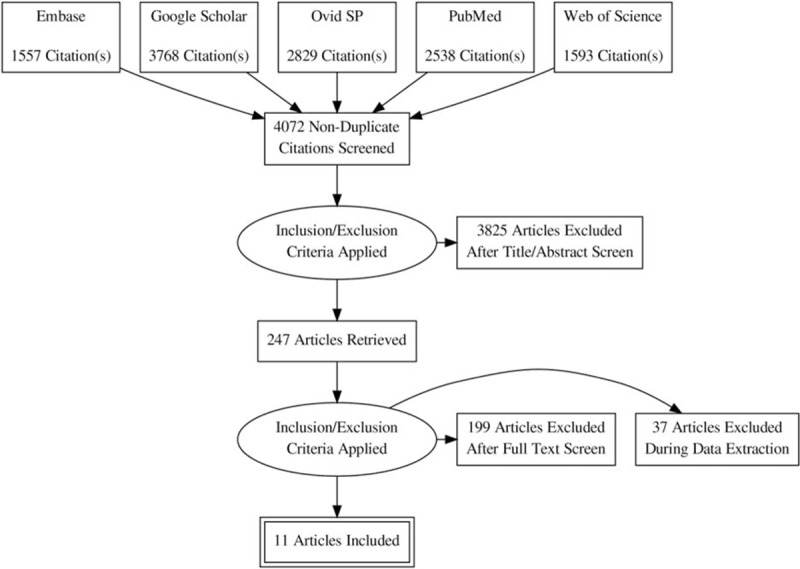
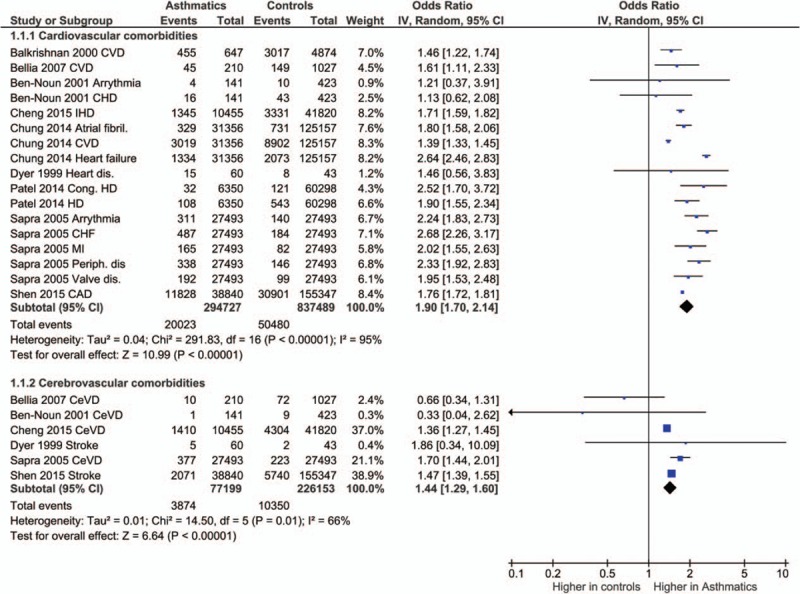
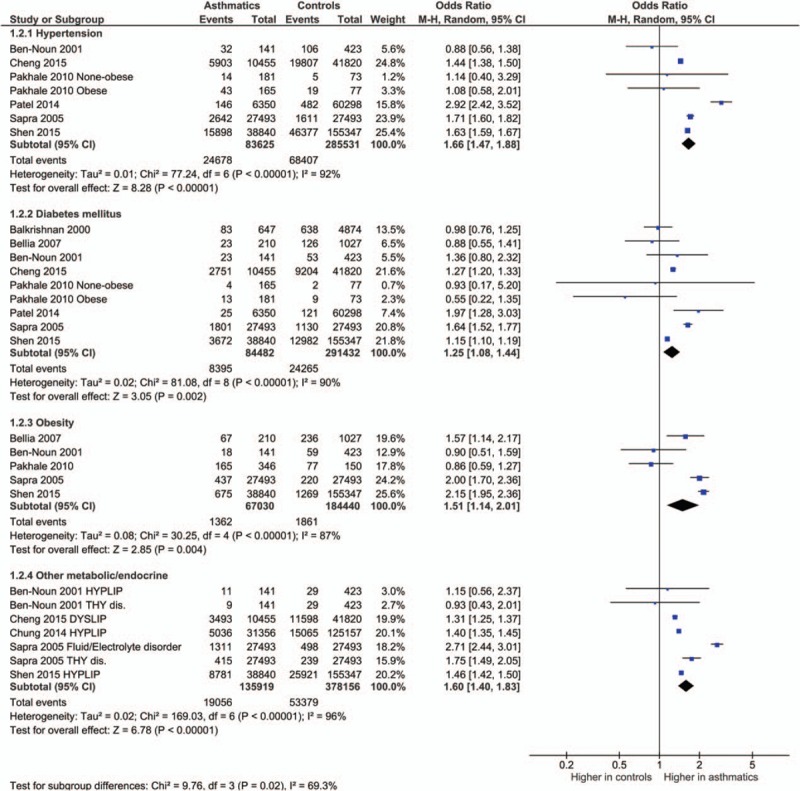
This study compares the prevalence rates of comorbidities between asthma and nonasthma control patients reported in the literature.Literature was searched in several electronic databases. After the selection of studies by following précised eligibility criteria, meta-analyses of odds ratios were carried out with subgroup and sensitivity analyses.Eleven studies studying 117,548 asthma patients compared with 443,948 non-asthma controls were included in the meta-analysis. The prevalence of cardiovascular comorbidities (odds ratio (OR): [95% CI] 1.90 [1.70, 2.14]; P < 0.00001), cerebrovascular comorbidities (OR 1.44 [1.29, 1.60]; P < 0.00001), obesity (OR 1.51 [1.14, 2.01]; P < 0.00001), hypertension (OR 1.66 [1.47, 1.88]; P < 0.00001, diabetes (OR 1.25 [1.08, 1.44]; P < 0.00001), other metabolic and endocrine comorbidities (OR 1.60 [1.40, 1.83]; P < 0.00001), psychiatric and neurological comorbidities (OR 1.62 [1.44, 1.82]; P < 0.00001), gut and urinary comorbidities (OR 1.91 [1.47, 2.49]; P < 0.00001),), cancer (OR 1.17 [1.10, 1.25]; P < 0.00001), and respiratory comorbidities (OR 5.60 [4.22, 7.44]; P < 0.00001) were significantly higher in the asthma patients in comparison with nonasthma controls.Asthma is associated with significantly higher comorbidities including cardio-/cerebrovascular diseases, obesity, hypertension, diabetes, psychiatric and neurological comorbidities, gut and urinary conditions, cancer, and respiratory problems other than asthma. Respiratory comorbidities are found 5 times more prevalent in asthma than in non-asthma patients.
Overview
The claims and statistics of this paper haven’t been checked yet.
Run the check — free, no account needed. It reads the open-access text and checks the sources it cites.
Integrity signals
Registry
Cites
Statistics
Figures
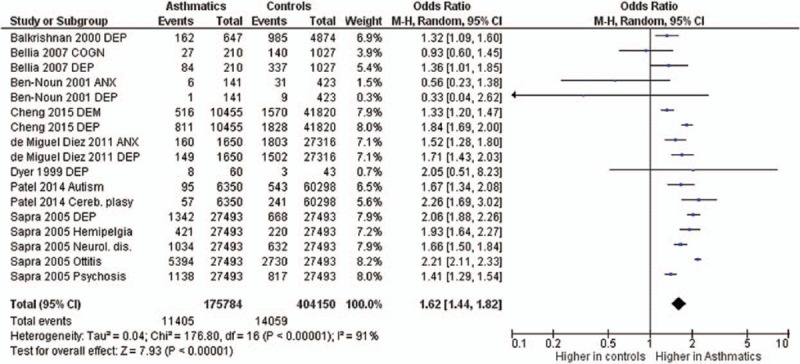
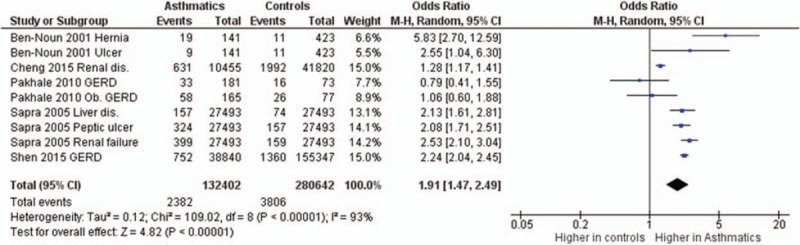
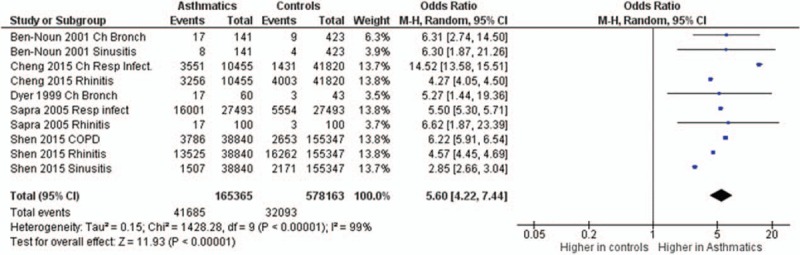
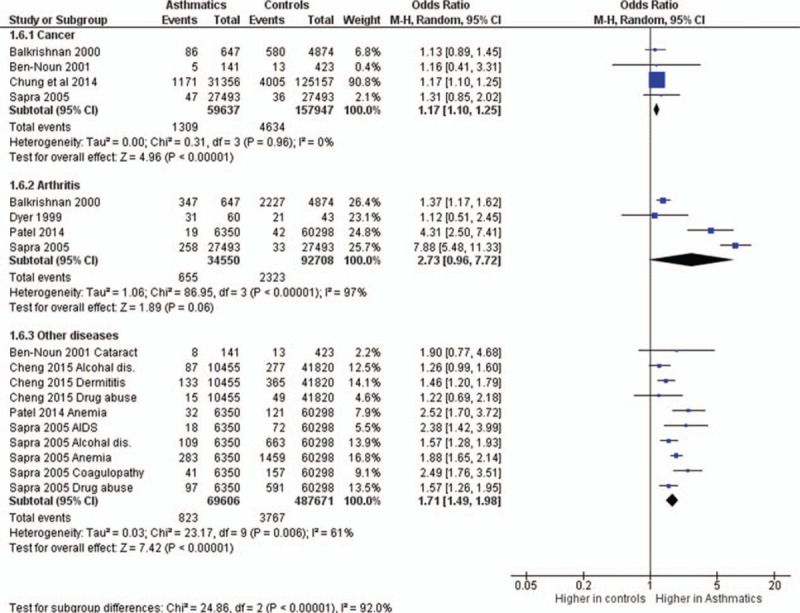
Verification
Claims the paper makes
The claims and statistics of this paper haven’t been checked yet.
Run the check — free, no account needed. It reads the open-access text and checks the sources it cites.
Claims other papers make about this one
Each is checked against this paper’s own text: does it say what the citing paper says it does?
In the citing paper
“Physical health factors, such as high BMI and co-occurring health conditions, were extremely common in people with asthma, consistent with existing literature.16”
From A systematic review of psychological, physical health factors, and quality of life in adult asthma (2019) · cites this paper as [16]
In the citing paper
“This was found throughout the included papers and is consistent with previous research (e.g. refs 8,16).”
From A systematic review of psychological, physical health factors, and quality of life in adult asthma (2019) · cites this paper as [16]
Self-check
Percentages, sums and reported differences re-computed from the paper’s own numbers.
The self-check needs the paper’s full text.
Citations
Cites
Preferred Reporting Items for Systematic Reviews and Meta-Analyses: the PRISMA statement
Moher, D., Liberati, A., Tetzlaff, J., Altman, D. G., & for the PRISMA Group (2009) · BMJ · doi:10.1136/bmj.b2535 · Cited by 83,823
Preferred Reporting Items for Systematic Reviews and Meta-Analyses: The PRISMA Statement
Moher, D., Liberati, A., Tetzlaff, J., Altman, D. G., & The PRISMA Group (2009) · PLoS Medicine · doi:10.1371/journal.pmed.1000097 · Cited by 64,042
Prospective Study of Body Mass Index, Weight Change, and Risk of Adult-onset Asthma in Women
Camargo, C. A., Weiss, S. T., Zhang, S., Willett, W. C., & Speizer, F. E. (1999) · Archives of Internal Medicine · doi:10.1001/archinte.159.21.2582 · Cited by 849
Patterns of Comorbidities in Newly Diagnosed COPD and Asthma in Primary Care
Soriano, J. B., Visick, G. T., Muellerova, H., Payvandi, N., & Hansell, A. L. (2005) · Chest · doi:10.1378/chest.128.4.2099 · Cited by 615
Risk factors of frequent exacerbations in difficult-to-treat asthma
Brinke, A. T., Sterk, P. J., Masclee, A., Spinhoven, P., Schmidt, J. T., Zwinderman, A. H., Rabe, K. F., & Bel, E. H. (2005) · European Respiratory Journal · doi:10.1183/09031936.05.00037905 · Cited by 485
Body Mass and Glucocorticoid Response in Asthma
Sutherland, E. R., Goleva, E., Strand, M. J., Beuther, D. A., & Leung, D. Y. M. (2008) · American Journal of Respiratory and Critical Care Medicine · doi:10.1164/rccm.200801-076oc · Cited by 355
The relationship between obesity and asthma severity and control in adults
Mosen, D. M., Schatz, M. X., Magid, D. J., & Camargo, C. A. (2008) · Journal of Allergy and Clinical Immunology · doi:10.1016/j.jaci.2008.06.024 · Cited by 342
Schnell, K. M., Weiss, C. O., Lee, T. A., Krishnan, J. A., Leff, B. A., Wolff, J. L., & Boyd, C. M. (2012) · BMC Pulmonary Medicine · doi:10.1186/1471-2466-12-26 · Cited by 275
Boulet, L., & Boulay, M. (2011) · Expert Review of Respiratory Medicine · doi:10.1586/ers.11.34 · Cited by 260
Erle, D. J., & Sheppard, D. (2014) · The Journal of Cell Biology · doi:10.1083/jcb.201401050 · Cited by 258
Cited by
Sorted by citations
Volmer, T., Effenberger, T., Trautner, C., & Buhl, R. (2018) · European Respiratory Journal · doi:10.1183/13993003.00703-2018 · Cited by 322
Association of Obstructive Sleep Apnea with Asthma: A Meta-Analysis
Kong, D., Qin, Z., Shen, H., Jin, H., Wang, W., & Wang, Z.-F. (2017) · Scientific Reports · doi:10.1038/s41598-017-04446-6 · Cited by 148
A systematic review of psychological, physical health factors, and quality of life in adult asthma
Stanescu, S., Kirby, S. E., Thomas, M., Yardley, L., & Ainsworth, B. (2019) · npj Primary Care Respiratory Medicine · doi:10.1038/s41533-019-0149-3 · Cited by 124
Anxiety in asthma: a systematic review and meta-analysis
Ye, G., Baldwin, D. S., & Hou, R. H. (2021) · Psychological Medicine · doi:10.1017/s0033291720005097 · Cited by 124
IgE-Mediated Multimorbidities in Allergic Asthma and the Potential for Omalizumab Therapy
Humbert, M. J. C., Bousquet, J., Bachert, C., Palomares, Ó., Pfister, P., Kottakis, I., Jaumont, X., Thomsen, S. F., & Papadopoulos, N. G. (2019) · The Journal of Allergy and Clinical Immunology In Practice · doi:10.1016/j.jaip.2019.02.030 · Cited by 113
Metadata
- Authors
- Su, X., Ren, Y., Li, M., Zhao, X., Kong, L., & Kang, J.
- Affiliations
- First Hospital of China Medical University (CN)
- Corresponding author
- Su, Xinming
- Venue
- Medicine
- Published
- 2016-05
- Volume
- 95
- Issue
- 22
- Pages
- e3459
- ISSN
- 0025-7974 (ISSN-L)
- PMC
- PMC4900697
- OpenAlex
- W2411471160
- Cited by
- 110
- References
- 37
- Citations by year
- 2026: 8 · 2025: 4 · 2024: 14 · 2023: 15 · 2022: 10 · 2021: 15 · 2020: 11 · 2019: 18 · 2018: 10 · 2017: 5
- FWCI
- 1.29
- Type
- journal article
- Language
- en
- Open access
- gold
- doi.org
- Licence
- cc-by
- Locations
- Medicine (publishedVersion, cc-by)
- Europe PMC (PubMed Central) (publishedVersion, cc-by)
- PubMed Central (publishedVersion, cc-by)
- PubMed (publishedVersion)
- Funders
- National Natural Science Foundation of China (2013225049, 81300024)
- Department of Science and Technology of Liaoning Province (2013225049)
- Topics
- Health Sciences › Medicine › Pulmonary and Respiratory Medicine › Asthma and respiratory diseases
- Health Sciences › Medicine › Pulmonary and Respiratory Medicine › Chronic Obstructive Pulmonary Disease (COPD) Research
- Health Sciences › Medicine › Epidemiology › Chronic Disease Management Strategies
- Keywords
- asthma, comorbidities, cardiovascular comorbidity, obesity, hypertension, diabetes mellitus, psychiatric comorbidity, neurological comorbidity, respiratory comorbidities, cancer, prevalence, chronic disease burden, comorbidity risk factors
- MeSH terms
- Asthma, Cardiovascular Diseases, Cerebrovascular Disorders, Endocrine System Diseases, Humans, Global Health, Comorbidity, Prevalence
About these checks
Registry, retraction, Cites and statistics results are computed, not judged, with one exception: a printed reference that no index lists is read once by a model before it counts as a citation error. Claims are extracted by a model and kept only when their quote appears verbatim in the text; each cited source is then checked, with a model’s help, for whether it says what the claim relies on. Those verdicts can be wrong — read the claim’s quote and the cited source before relying on one.
Statistics and arithmetic are recomputed, not judged.
Confidence bands are shown only for fields calibrated on our annotated test set. None is calibrated yet, so no band is shown.
What counts as a claim ›How we measure confidence ›How we check this ›
Are you an author, or do you see a problem with this page? Request a review
