

The association between maternal hyperglycemia and perinatal outcomes in gestational diabetes mellitus patients: A retrospective cohort study
Open accessThe DOI matches its Crossref record; 24 of the 24 references it cites were found in a registry or an index.
Abstract
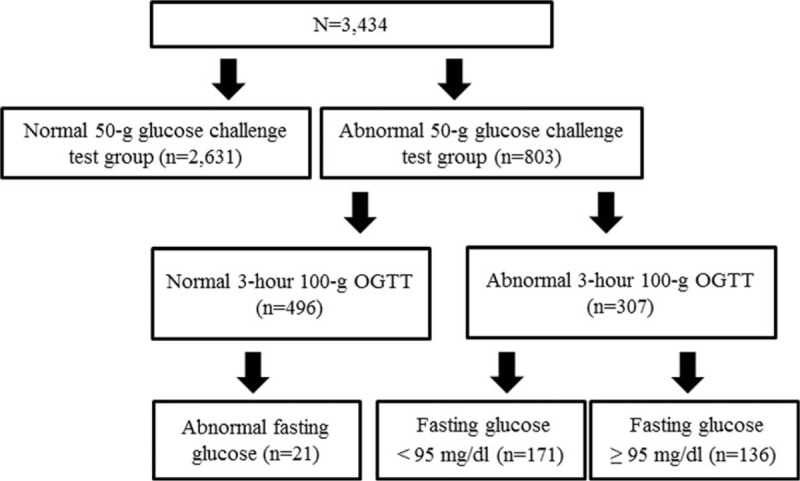
Pregnancies complicated by gestational diabetes mellitus (GDM) are associated with increased risks of adverse maternal and fetal outcomes. The risks of adverse pregnancy outcomes differ depending on the glucose values among GDM patients. For accurate and effective prenatal counseling, it is necessary to understand the relationship between different maternal hyperglycemia values and the severity of adverse outcomes. With this objective, this study reexamines the relationship between maternal hyperglycemia versus maternal and perinatal outcomes in GDM patients. For this study, maternal hyperglycemia was diagnosed using the 2-step diagnostic approach.Medical records of 3434 pregnant women, who received the 50-g glucose challenge test (GCT) between March 2001 and April 2013, were reviewed. As a result, 307 patients were diagnosed with GDM, and they were divided into 2 groups according to their fasting glucose levels. A total of 171 patients had normal fasting glucose level (<95 mg/dL), and 136 patients had abnormal fasting glucose level (≥95 mg/dL). The 50-g GCT results were subdivided by 20-unit increments (140-159, n = 123; 160-179, n = 84; 180-199, n = 50; and ≥200, n = 50), and the maternal and perinatal outcomes were compared against the normal 50-g GCT group (n = 307).Maternal fasting blood glucose (FBG) level showed clear association with adverse perinatal outcomes. The odds ratio (OR) of macrosomia was 6.72 (95% CI: 2.59-17.49, P < 0.001) between the 2 groups. The ORs of large for gestational age (LGA) and neonatal hypoglycemia were 3.75 (95% CI: 1.97-7.12, P < 0.001) and 1.65 (95% CI: 0.79-3.43, P = 0.183), respectively. Also, the results of the 50-g GCT for each category showed strong association with increased risks of adverse perinatal outcomes compared to the normal 50-g GCT group. The OR of macrosomia (up to 20.31-fold), LGA (up to 6.15-fold), and neonatal hypoglycemia (up to 84.00-fold) increased with increasing 50-g GCT result.
Overview
The claims and statistics of this paper haven’t been checked yet.
Free: it reads the open-access text and checks the first 5 claims that cite a source we can check. Create a free account to check every claim.
Integrity signals
Registry
Cites
Statistics
Figures
Verification
Claims the paper makes
The claims and statistics of this paper haven’t been checked yet.
Free: it reads the open-access text and checks the first 5 claims that cite a source we can check. Create a free account to check every claim.
Claims other papers make about this one
Each is checked against this paper’s own text: does it say what the citing paper says it does?
The source backs part of the claim, not all of it — or backs it for a different population, condition or comparison.
In the citing paper
“The HAPO study showed that increasing glycemia is associated with increased neonatal adverse outcomes such as macrosomia, neonatal hypoglycemia, and cesarean delivery.64,115–119”
From American Association of Clinical Endocrinology Clinical Practice Guideline: Developing a Diabetes Mellitus Comprehensive Care Plan-2022 Update. (2022) · cites this paper as [117]
Experimental — accuracy not yet measuredThe source backs part of the claim, not all of it — or backs it for a different population, condition or comparison.
In the citing paper
“In women with preexisting DM and GDM, postprandial rather than preprandial glucose levels were associated with better neonatal and maternal outcomes.117,122”
From American Association of Clinical Endocrinology Clinical Practice Guideline: Developing a Diabetes Mellitus Comprehensive Care Plan-2022 Update. (2022) · cites this paper as [117]
Experimental — accuracy not yet measured
Self-check
Percentages, sums and reported differences re-computed from the paper’s own numbers.
The self-check needs the paper’s full text.
Citations
Cites
2 retracted
ACOG Practice Bulletin No. 30: Gestational Diabetes
(2001) · Obstetrics & Gynecology · doi:10.1097/00006250-200109000-00037 · Cited by 301
Retracted- Retracted
Report of the Expert Committee on the Diagnosis and Classification of Diabetes Mellitus
The Expert Committee on the Diagnosis and Classification of Diabetes Mellitus* (2002) · Diabetes Care · doi:10.2337/diacare.25.2007.s5 · Cited by 10,338
Hyperglycemia and adverse pregnancy outcomes
(2008) · New England Journal of Medicine · doi:10.1056/nejmoa0707943 · Cited by 5,563
Predicting Preschooler Obesity at Birth: The Role of Maternal Obesity in Early Pregnancy
Whitaker, R. C. (2004) · Pediatrics · doi:10.1542/peds.114.1.e29 · Cited by 818
Hyperglycemia and Adverse Pregnancy Outcome (HAPO) Study
The HAPO Study Cooperative Research Group (2009) · Diabetes · doi:10.2337/db08-1112 · Cited by 702
Gestational diabetes: The consequences of not treating
Langer, O., Yogev, Y., Most, O., & Xenakis, E. M. J. (2005) · American Journal of Obstetrics and Gynecology · doi:10.1016/j.ajog.2004.11.039 · Cited by 677 · cited 2×
“Langer et al[6] demonstrated that every 10mg/dL increment in fasting blood glucose (FBG) resulted in 15% increase in adverse composite outcomes.”
Backgroundde Veciana, M., Major, C. A., Morgan, M. A., Asrat, T., Toohey, J. S., Lien, J. M., & Evans, A. T. (1995) · New England Journal of Medicine · doi:10.1056/nejm199511093331901 · Cited by 666 · cited 1×
“The odds ratio for perinatal outcomes was 6.72 (95% CI: 2.59–17.49, P 0.001) with macrosomia, 3.75 (95% CI: 1.97–7.12, P 0.001) with LGA, and 1.65 (95% CI: 0.79–3.43, P=0.183) with neonatal hypoglycemia.”
InfluentialMaternal postprandial glucose levels and infant birth weight: the diabetes in early pregnancy study
Jovanovic-Peterson, L., Peterson, C. M., Reed, G. F., Metzger, B. E., Mills, J. L., Knopp, R. H., & Aarons, J. H. (1991) · American Journal of Obstetrics and Gynecology · doi:10.1016/0002-9378(91)90637-7 · Cited by 411 · cited 1×
“Previous studies have found that postprandial hyperglycemia was associated with excessive fetal growth in GDM patients requiring insulin therapy or pregestational diabetes patients.([7,8]) Other studies have indicated that meal-related glucose threshold measurement did not increase the risk of adverse fetal outcomes.”
Maternal postprandial glucose levels and infant birth weight: The Diabetes in Early Pregnancy Study
Jovanovic‐Peterson, L., Peterson, C., Reed, G., Metzger, B., Mills, J., Knopp, R., & Aarons, J. (1991) · International Journal of Gynecology & Obstetrics · doi:10.1016/0020-7292(91)90499-u · Cited by 322
Cited by
Epidemiology and management of gestational diabetes
Sweeting, A., Hannah, W., Backman, H., Catalano, P., Feghali, M., Herman, W. H., Hivert, M.-F., Immanuel, J., Meek, C., Oppermann, M. L., et al. (2024) · The Lancet · doi:10.1016/s0140-6736(24)00825-0 · Cited by 585
Blonde, L., Umpierrez, G. E., Reddy, S. S., McGill, J. B., Berga, S. L., Bush, M., Chandrasekaran, S., DeFronzo, R. A., Einhorn, D., Galindo, R. J., et al. (2022) · Endocrine Practice · doi:10.1016/j.eprac.2022.08.002 · Cited by 507
Adank, M. C., Benschop, L. H., Kors, A. W., Peterbroers, K. R., Gregoor, A. M. S., Mulder, M. T., Schalekamp–Timmermans, S., van Lennep, J. E. R., & Steegers, E. A. P. (2020) · BMC Medicine · doi:10.1186/s12916-020-01730-7 · Cited by 96
Tarry-Adkins, J. L., Aiken, C. E., & Ozanne, S. E. (2020) · PLoS Medicine · doi:10.1371/journal.pmed.1003126 · Cited by 73
Dayyani, I., Terkildsen Maindal, H., Rowlands, G., & Lou, S. (2019) · Scandinavian Journal of Caring Sciences · doi:10.1111/scs.12655 · Cited by 51
Muche, A. A., Olayemi, O. O., & Gete, Y. K. (2020) · Midwifery · doi:10.1016/j.midw.2020.102713 · Cited by 45
Alharbi, K. K., Alsulaiman, A. M., Shedaid, M. K. B., Al-Shangiti, A. M., Marie, M. A. M., Al‐Sheikh, Y. A., & Khan, I. A. (2019) · Annals of Saudi Medicine · doi:10.5144/0256-4947.2019.309 · Cited by 37
Lokman, E. F., Saparuddin, F., Muhammad, H., Omar, M. H., & Zulkapli, A. (2019) · Integrative Medicine Research · doi:10.1016/j.imr.2019.05.006 · Cited by 36
Chirwa, S., Nwabuisi, C. R., Ladson, G. M., Korley, L., Whitty, J. E., Atkinson, R., & Clark, J. T. (2018) · International Journal of Environmental Research and Public Health · doi:10.3390/ijerph15102287 · Cited by 19
Repercussões do diabetes mellitus no feto: alterações obstétricas e malformações estruturais
Rios, W. L. F., Melo, N. C. E., de Moraes, C. L., Mendonça, C. R., & do Amaral, W. N. (2019) · Femina · doi:10.61622/0100-7254475201907 · Cited by 19
Seo, N., Lee, Y. M., Kim, Y., Sung, J., Hur, K. Y., Choi, S., Roh, C., & Oh, S. (2023) · Journal of Korean Medical Science · doi:10.3346/jkms.2023.38.e268 · Cited by 12
Antenatal maternal hypoglycemia in women with gestational diabetes mellitus and neonatal outcomes
Harrison, R. K., Saravanan, V., Davitt, C. C., Cruz, M., & Palatnik, A. (2022) · Journal of Perinatology · doi:10.1038/s41372-022-01350-4 · Cited by 12
Ramasammy, R., Munisammy, L., Sweta, K., Selvakumar, S., Velu, K., Rani, J. V., & Kajalakshmy, S. (2021) · Meta Gene · doi:10.1016/j.mgene.2021.100856 · Cited by 9
Liu, X.-N., & Pang, J. (2018) · Medicine · doi:10.1097/md.0000000000010819 · Cited by 8
Can alanine aminotransferase measured in early pregnancy predict macrosomia?
Bulut, A. N., Ceyhan, V., & Dolanbay, M. (2022) · Journal of Obstetrics and Gynaecology · doi:10.1080/01443615.2022.2039905 · Cited by 7
Thomas, L. V., Jurkovitz, C. T., Zhang, Z., Fawcett, M., & Lenhard, M. J. (2024) · AJPM Focus · doi:10.1016/j.focus.2024.100201 · Cited by 6
Early onset gestational diabetes mellitus: A case report and importance of early screening
Najmi, A., Atal, S., Sadasivam, B., Singh, P., & Ray, A. (2019) · Journal of Family Medicine and Primary Care · doi:10.4103/jfmpc.jfmpc_290_19 · Cited by 4
Association of Normal-Range Hemoglobin A1c Value During Midpregnancy with Adverse Birth Outcomes
Zhang, L., Zhai, R., Huo, Z., Wei, Z., Zhang, Z., Wei, R., & Man, D. (2021) · International Journal of General Medicine · doi:10.2147/ijgm.s313952 · Cited by 3
Arslanca, Ş. B., & Çağlar, A. T. (2023) · Journal of Perinatal Medicine · doi:10.1515/jpm-2023-0199 · Cited by 3
Xia, L., Fan, L., Huang, J., Zhao, Y., Tian, L., Chen, H., Cai, L., Wu, Q., & Xia, L. (2024) · Reproductive Biology and Endocrinology · doi:10.1186/s12958-024-01313-8 · Cited by 3
Wang, W., Meng, X., Sun, Y., Yin, B., Ding, L., Zhang, L., Ma, M., Zhu, B., & Shen, Y. (2024) · Journal of Biological Regulators and Homeostatic Agents/Journal of Biological Regulators & Homeostatic Agents · doi:10.23812/j.biol.regul.homeost.agents.20243806.376 · Cited by 3
Jaihow, S., Pensuksan, W. C., Phasuk, N., Narkkul, U., Scholand, S. J., & Punsawad, C. (2025) · The Journal of Maternal-Fetal & Neonatal Medicine · doi:10.1080/14767058.2025.2578122 · Cited by 2
Jaihow, S., Phasuk, N., Narkkul, U., Pensuksan, W. C., Scholand, S. J., & Punsawad, C. (2023) · International Journal of Environmental Research and Public Health · doi:10.3390/ijerph20227038 · Cited by 2
Ladan, A., Oche, M., Awosan, K. J., Adamu, A., Ibrahim, U., Ibrahim, A., Hashim, B., & Musa, J. (2024) · Annals of Basic and Medical Sciences · doi:10.51658/abms.202441.13 · Cited by 2
Gestational Diabetes and Its Effects on Neonatal Outcome- A Prospective Cohort Study
Chomon, F. A., Mortoza, A. S. M., & Khan, S. J. (2022) · Scholars Journal of Applied Medical Sciences · doi:10.36347/sjams.2022.v10i12.006 · Cited by 1
Birati, Y., & Bloch, J. R. (2020) · iDEA - Drexel University Institutional Repository · doi:10.17918/00001022 · Cited by 1
Paternal Ages and Genetic Diseases and Congenital Anomalies
Hamood, N. (2021) · STARS (University of Central Florida) · Cited by 1
Zareei, S., Behrasi, F., Naghizadeh, M. M., Talebzadeh, F., Kharmandar, A., Farjam, M., & Homayounfar, R. (2023) · BMC Women s Health · doi:10.1186/s12905-023-02528-4
Guía de manejo clínico para la diabetes gestacional. Sociedad Chilena de Diabetología (SOCHIDIAB)
Strodthoff, K., Pérez-Zavala, C., Contreras-Millán, A., González-Zenteno, C., Hernández-Maetschl, S., Duarte-Silva, L., Del-Favero-Tocornal, M., Díaz-Canepa, M., Elgueta-Rodríguez, K. I., Figueroa-Ponce, M., et al. (2026) · Revista chilena de nutrición · doi:10.64159/rchnut-53-4-9
Huo, Y., Li, Y., Jin, X., Kuang, X., Fang, L., Sun, F., Zhou, P., & Wang, R. (2026) · Clinical and Experimental Obstetrics & Gynecology · doi:10.31083/ceog48617
Rasekaba, T. M. (2017) · Minerva Access (University of Melbourne)
Galalain, S. M., Muhammad, S., Shehu, H., & Hudu, S. A. (2024) · Annals of Basic and Medical Sciences · doi:10.51658/abms.202452.13
Francaitė-Daugėlienė, M. (2018) · Lithuanian University of Health Sciences
2025-02-21 (2025) · Journal of Sheikh Zayed Medical College · doi:10.47883/jszmc.v14i4.282
Sirichareon, C., Sritippayawan, S., Amatyakul, P., Dejarkom, S., Dandamrongrak, P., & Chattrapiban, T. (2026) · Buddhachinaraj Medical Journal
Neonatal Morbidity Across the Fetal Growth Spectrum in Gestational Diabetes Mellitus
Massalha, M., DeFrance, B., Malinowski, K., Sahra, N., Barrett, J. F., & Ashwal, E. (2026) · Neonatology · doi:10.1159/neo/adsag032
Metadata
- Authors
- Cho, H. Y., Jung, I., & Kim, S. J.
- Affiliations
- Yonsei University (KR)
- Corresponding author
- Cho, Hee Young
- Venue
- Medicine
- Published
- 2016-09
- Volume
- 95
- Issue
- 36
- Pages
- e4712
- ISSN
- 0025-7974 (ISSN-L)
- PMC
- PMC5023889
- OpenAlex
- W2513400440
- Semantic Scholar
- 89786930c760d8524d07503da81f3427fdd75845
- Cited by
- 23
- References
- 24
- Citations by year
- 2025: 1 · 2024: 3 · 2023: 4 · 2022: 3 · 2021: 2 · 2020: 3 · 2019: 5 · 2018: 2
- FWCI
- 3.01
- Type
- journal article
- Language
- en
- Open access
- gold
- doi.org
- Licence
- cc-by-nc-nd
- Locations
- Medicine (publishedVersion, cc-by-nc-nd)
- PubMed Central (publishedVersion, cc-by-nc-nd)
- PubMed (publishedVersion)
- YUHSpace (Yonsei University Medical Library) (submittedVersion, cc-by-nc-nd)
- Topics
- Health Sciences › Medicine › Obstetrics and Gynecology › Gestational Diabetes Research and Management
- Health Sciences › Medicine › Endocrinology, Diabetes and Metabolism › Diabetes Management and Research
- Health Sciences › Medicine › Pediatrics, Perinatology and Child Health › Maternal and Neonatal Healthcare
- Keywords
- gestational diabetes mellitus, maternal hyperglycemia, fasting blood glucose, perinatal outcomes, macrosomia, large for gestational age, neonatal hypoglycemia, 50-g glucose challenge test, adverse pregnancy outcomes, prenatal counseling, neonatal outcomes, fetal outcomes
- MeSH terms
- Adult, Blood Glucose, Female, Fetal Macrosomia, Humans, Hypoglycemia, Infant, Newborn, Male, Pregnancy, Retrospective Studies
About these checks
Registry, retraction, Cites and statistics results are computed, not judged, with one exception: a printed reference that no index lists is read once by a model before it counts as a citation error. Claims are extracted by a model and kept only when their quote appears verbatim in the text; each cited source is then checked, with a model’s help, for whether it says what the claim relies on. Those verdicts can be wrong — read the claim’s quote and the cited source before relying on one.
Statistics and arithmetic are recomputed, not judged.
Confidence bands are shown only for fields calibrated on our annotated test set. None is calibrated yet, so no band is shown.
What counts as a claim ›How we measure confidence ›How we check this ›
Are you an author, or do you see a problem with this page? Request a review
Data sources
Bibliographic data: Semantic Scholar, OpenAlex, Crossref.
Contains information from the Semantic Scholar Academic Graph Datasets, made available under the ODC Attribution License (ODC-BY 1.0).
Semantic Scholar’s data is described in: Kinney, R., et al. (2023). The Semantic Scholar Open Data Platform. arXiv:2301.10140.
