

The DOI matches its Crossref record; 53 of the 53 references it cites were found in a registry or an index.
Effects of elastic resistance exercise on body composition and physical capacity in older women with sarcopenic obesity: A CONSORT-compliant prospective randomized controlled trial
Open accessAbstract
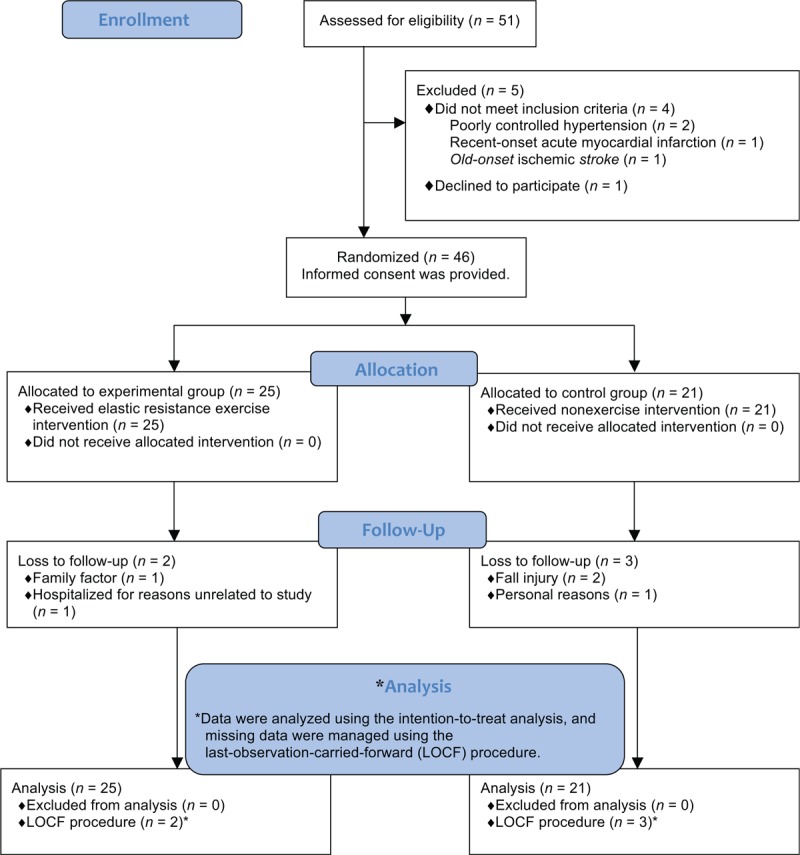
BACKGROUND: Sarcopenia is associated with loss of muscle mass and an increased risk of physical disability in elderly people. However, the prevalence of sarcopenia has increased in obese elderly populations. The purpose of this study was to identify the clinical efficacy of elastic resistance exercise training (RET) in patients with sarcopenic obesity. METHODS: This study was conducted at the rehabilitation center of a university-based teaching hospital and was designed as a prospective and randomized controlled trial with an intention-to-treat analysis. A total of 46 women aged 67.3 (5.2) years were randomly assigned to an experimental group (EG) and control group (CG). The EG underwent elastic RET for 12 weeks, and the CG received no RET intervention. All outcome measures were assessed at the baseline and posttest, including body composition measured using dual-energy X-ray absorptiometry, muscle quality (MQ) defined as a ratio of muscular strength to muscle mass, and physical capacity assessed using functional mobility tests. One-way analysis of covariance and Pearson correlation were used to compare outcomes between the 2 groups and to identify the relationship between changes in body composition and physical outcomes, respectively. A chi-square test was performed to identify differences in qualitative data between the 2 groups. RESULTS: At the posttest, a significant between-group difference was observed in fat-free mass, MQ, and physical capacity (all P < .05); and a significant correlation was found between leg-lean-mass change and gait speed (r = 0.36; P < .05). After 12 weeks of elastic RET intervention, the EG had significantly fewer patients exhibiting sarcopenia (P < .05) and experiencing physical difficulty (P < .001) than the CG. CONCLUSION: The present data suggest that elastic resistance exercise exerted benefits on the body composition, MQ, and physical function in patients with sarcopenic obesity. Regular exercise incorporating elastic RET should be used to attenuate muscle mass loss and prevent physical difficulty in obese older adults with sarcopenia on reconditioning therapy. TRIAL REGISTRATION: Chinese Clinical Trial Registry, ChiCTR-IPR-15006069.
Overview
The claims and statistics of this paper haven’t been checked yet.
Run the check — free, no account needed. It reads the open-access text and checks the sources it cites.
Integrity signals
Registry
Cites
Statistics
Figures
Verification
Claims the paper makes
The claims and statistics of this paper haven’t been checked yet.
Run the check — free, no account needed. It reads the open-access text and checks the sources it cites.
Claims other papers make about this one
Each is checked against this paper’s own text: does it say what the citing paper says it does?
The cited source doesn’t support the claim as written.
In the citing paper
“The sample size was calculated based on the ASMI, the primary outcome variable of the study. Reference was made to previous studies in older adults with SO, where the minimal detectable change in the ASM was 0.5 kg [26]. Considering the extended duration of the intervention, the higher number of sessions, and the fact that all sessions were delivered by qualified health professionals, a more dem”
From Efficacy of Power Training on Sarcopenic Obesity in Community-Dwelling Older Women: A 32-Week Randomized Clinical Trial (2025) · cites this paper as [27]
Checked by a reasoning model — may be wrong.
Experimental — accuracy not yet measuredThe source backs part of the claim, not all of it — or backs it for a different population, condition or comparison.
In the citing paper
“In terms of adiposity-related variables, PT was also effective in reducing BF% and VF, consistent with previous trials [27,34,35,36].”
From Efficacy of Power Training on Sarcopenic Obesity in Community-Dwelling Older Women: A 32-Week Randomized Clinical Trial (2025) · cites this paper as [27]
Experimental — accuracy not yet measuredThe source backs part of the claim, not all of it — or backs it for a different population, condition or comparison.
In the citing paper
“These findings align with results from similar studies, which have consistently demonstrated that PT enhances muscle power, a key factor in improving functional performance in older adults [27,39,40].”
From Efficacy of Power Training on Sarcopenic Obesity in Community-Dwelling Older Women: A 32-Week Randomized Clinical Trial (2025) · cites this paper as [27]
Experimental — accuracy not yet measuredThe cited source says what the claim attributes to it.
In the citing paper
“Similar improvements were reported in previous studies [27,31], although our trial showed larger effect sizes, likely due to the longer duration, supervised progression, and intensity control.”
From Efficacy of Power Training on Sarcopenic Obesity in Community-Dwelling Older Women: A 32-Week Randomized Clinical Trial (2025) · cites this paper as [27]
In the citing paper
“Several clinical trials have shown that nutrition interventions and physical exercise improve relevant parameters regarding sarcopenic obesity such as grip strength, body fat and muscle mass [5, 13–17].”
From Effects of nutrition and exercise interventions on persons with sarcopenic obesity: an umbrella review of meta-analyses of randomised controlled trials (2023) · cites this paper as [16]
Self-check
Percentages, sums and reported differences re-computed from the paper’s own numbers.
The self-check needs the paper’s full text.
Citations
Cites
Faul, F., Erdfelder, E., Lang, A.-G., & Buchner, A. (2007) · Behavior Research Methods · doi:10.3758/bf03193146 · Cited by 65,971
Sarcopenia: European consensus on definition and diagnosis
Cruz-Jentoft, A. J., Baeyens, J. P., Bauer, J. M., Boirie, Y., Cederholm, T., Landi, F., Martin, F. C., Michel, J.-P., Rolland, Y., Schneider, S. M., et al. (2010) · Age and Ageing · doi:10.1093/ageing/afq034 · Cited by 11,601
Sarcopenia in Asia: Consensus Report of the Asian Working Group for Sarcopenia
Chen, L.-K., Liu, L.-K., Woo, J., Assantachai, P., Auyeung, T.-W., Bahyah, K. S., Chou, M.-Y., Chen, L.-Y., Hsu, P.-S., Krairit, O., et al. (2014) · Journal of the American Medical Directors Association · doi:10.1016/j.jamda.2013.11.025 · Cited by 4,051
Predicting the Probability for Falls in Community-Dwelling Older Adults Using the Timed Up & Go Test
Shumway‐Cook, A., Brauer, S., & Woollacott, M. H. (2000) · Physical Therapy · doi:10.1093/ptj/80.9.896 · Cited by 3,355
Janssen, I., Heymsfield, S. B., & Ross, R. (2002) · Journal of the American Geriatrics Society · doi:10.1046/j.1532-5415.2002.50216.x · Cited by 3,139
Physical Activity and Public Health in Older Adults
Nelson, M. E., Rejeski, W. J., Blair, S. N., Duncan, P. W., Judge, J. O., King, A. C., Macera, C. A., & Castaneda‐Sceppa, C. (2007) · Circulation · doi:10.1161/circulationaha.107.185650 · Cited by 3,057
A 30-s chair-stand test as a measure of lower body strength in community-residing older adults.
Jones, C. J., Rikli, R. E., & Beam, W. C. (1999) · Research Quarterly for Exercise and Sport · doi:10.1080/02701367.1999.10608028 · Cited by 2,921
Boutron, I., Moher, D., Altman, D. G., Schulz, K. F., Ravaud, P., & for the CONSORT Group* (2008) · Annals of Internal Medicine · doi:10.7326/0003-4819-148-4-200802190-00008 · Cited by 2,292
Predicting the Probability for Falls in Community-Dwelling Older Adults
Shumway‐Cook, A., Baldwin, M., Polissar, N. L., & Gruber, W. C. (1997) · Physical Therapy · doi:10.1093/ptj/77.8.812 · Cited by 1,593
Skeletal Muscle Cutpoints Associated with Elevated Physical Disability Risk in Older Men and Women
Janssen, I. (2004) · American Journal of Epidemiology · doi:10.1093/aje/kwh058 · Cited by 1,190
Cited by
Sorted by citations
Items 201–201 of 201
Li, Z., Gao, F., Liu, Y., & Liu, N. (2026) · Frontiers in Physiology · doi:10.3389/fphys.2026.1970041
Metadata
- Authors
- Liao, C.-D., Tsauo, J.-Y., Lin, L.-F., Huang, S.-W., Ku, J.-W., Chou, L.-C., & Liou, T.-H.
- Affiliations
- National Taiwan University (TW)
- Taipei Medical University-Shuang Ho Hospital (TW)
- Taipei Medical University (TW)
- Corresponding author
- Liou, Tsan-Hon
- Venue
- Medicine
- Published
- 2017-06
- Volume
- 96
- Issue
- 23
- Pages
- e7115
- ISSN
- 0025-7974 (ISSN-L)
- PMC
- PMC5466239
- OpenAlex
- W2624280532
- Cited by
- 201
- References
- 53
- Citations by year
- 2026: 19 · 2025: 38 · 2024: 19 · 2023: 29 · 2022: 29 · 2021: 17 · 2020: 21 · 2019: 15 · 2018: 14
- FWCI
- 10.11
- Type
- journal article
- Language
- en
- Open access
- gold
- doi.org
- Licence
- cc-by
- Locations
- Medicine (publishedVersion, cc-by)
- Europe PMC (PubMed Central) (publishedVersion, cc-by)
- PubMed Central (publishedVersion, cc-by)
- PubMed (publishedVersion)
- Funders
- National Science Council (MOST 105)
- Ministry of Science and Technology, Taiwan (MOST 105-, MOST105-2314-B038-075)
- Taipei Medical University
- Topics
- Health Sciences › Medicine › Physiology (medical) › Nutrition and Health in Aging
- Health Sciences › Medicine › Geriatrics and Gerontology › Frailty in Older Adults
- Life Sciences › Biochemistry, Genetics and Molecular Biology › Molecular Biology › Muscle Physiology and Disorders
- Keywords
- sarcopenic obesity, sarcopenia, older women, body composition, muscle quality, physical capacity, fat-free mass, muscle mass loss, walking speed, functional mobility
- MeSH terms
- Aged, Analysis of Variance, Body Composition, Exercise Test, Female, Humans, Obesity, Organ Size, Physical Fitness, Absorptiometry, Photon, Treatment Outcome, Muscle, Skeletal, Muscle Strength, Resistance Training, Sarcopenia
About these checks
Registry, retraction, Cites and statistics results are computed, not judged, with one exception: a printed reference that no index lists is read once by a model before it counts as a citation error. Claims are extracted by a model and kept only when their quote appears verbatim in the text; each cited source is then checked, with a model’s help, for whether it says what the claim relies on. Those verdicts can be wrong — read the claim’s quote and the cited source before relying on one.
Statistics and arithmetic are recomputed, not judged.
Confidence bands are shown only for fields calibrated on our annotated test set. None is calibrated yet, so no band is shown.
What counts as a claim ›How we measure confidence ›How we check this ›
Are you an author, or do you see a problem with this page? Request a review
