

The DOI matches its Crossref record; 31 of the 31 references it cites were found in a registry or an index.
Rapamycin treatment for amyotrophic lateral sclerosis: Protocol for a phase II randomized, double-blind, placebo-controlled, multicenter, clinical trial (RAP-ALS trial)
Open accessAbstract
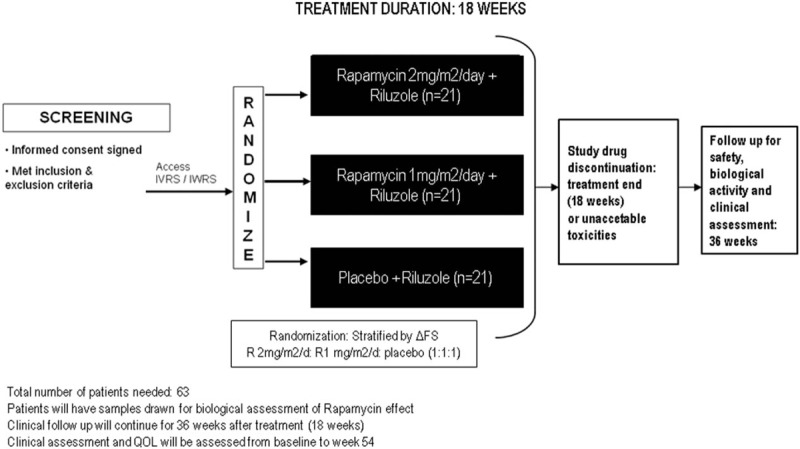
INTRODUCTION: Misfolded aggregated proteins and neuroinflammation significantly contribute to amyotrophic lateral sclerosis (ALS) pathogenesis, hence representing therapeutic targets to modify disease expression. Rapamycin inhibits mechanistic target of Rapamycin (mTOR) pathway and enhances autophagy with demonstrated beneficial effects in neurodegeneration in cell line and animal models, improving phenotype in SQSTM1 zebrafish, in Drosophila model of ALS-TDP, and in the TDP43 mouse model, in which it reduced neuronal loss and TDP43 inclusions. Rapamycin also expands regulatory T lymphocytes (Treg) and increased Treg levels are associated with slow progression in ALS patients.Therefore, we planned a randomized clinical trial testing Rapamycin treatment in ALS patients. METHODS: RAP-ALS is a phase II randomized, double-blind, placebo-controlled, multicenter (8 ALS centers in Italy), clinical trial. The primary aim is to assess whether Rapamycin administration increases Tregs number in treated patients compared with control arm. Secondary aims include the assessment of safety and tolerability of Rapamycin in patients with ALS; the minimum dosage to have Rapamycin in cerebrospinal fluid; changes in immunological (activation and homing of T, B, NK cell subpopulations) and inflammatory markers, and on mTOR downstream pathway (S6RP phosphorylation); clinical activity (ALS Functional Rating Scale-Revised, survival, forced vital capacity); and quality of life (ALSAQ40 scale). DISCUSSION: Rapamycin potentially targets mechanisms at play in ALS (i.e., autophagy and neuroinflammation), with promising preclinical studies. It is an already approved drug, with known pharmacokinetics, already available and therefore with significant possibility of rapid translation to daily clinics. Findings will provide reliable data for further potential trials. ETHICS AND DISSEMINATION: The study protocol was approved by the Ethics Committee of Azienda Ospedaliero Universitaria of Modena and by the Ethics Committees of participating centers (Eudract n. 2016-002399-28) based on the Helsinki declaration.
Overview
The claims and statistics of this paper haven’t been checked yet.
Run the check — free, no account needed. It reads the open-access text and checks the sources it cites.
Integrity signals
Registry
Cites
Statistics
Figures
Verification
Claims the paper makes
The claims and statistics of this paper haven’t been checked yet.
Run the check — free, no account needed. It reads the open-access text and checks the sources it cites.
Claims other papers make about this one
Each is checked against this paper’s own text: does it say what the citing paper says it does?
In the citing paper
“Autophagy induction using MTOR inhibitors is currently being tested in ALS – a phase II trial of rapamycin (sirolimus) for ALS patients began in 2018 [498].”
From Autophagy and ALS: mechanistic insights and therapeutic implications (2022) · cites this paper as [498]
Self-check
Percentages, sums and reported differences re-computed from the paper’s own numbers.
The self-check needs the paper’s full text.
Citations
Cites
1 retracted
Nalbandian, A., Llewellyn, K. J., Nguyen, C. C., Yazdi, P. G., & Kimonis, V. E. (2015) · PLoS ONE · doi:10.1371/journal.pone.0122888 · Cited by 89
RetractedEl Escorial revisited: revised criteria for the diagnosis of amyotrophic lateral sclerosis
Brooks, B. R., Miller, R. G., Swash, M., & Munsat, T. L. (2000) · Amyotrophic Lateral Sclerosis and Other Motor Neuron Disorders · doi:10.1080/146608200300079536 · Cited by 5,433
Autophagy and Viruses: Adversaries or Allies?
Dong, X., & Levine, B. (2013) · Journal of Innate Immunity · doi:10.1159/000346388 · Cited by 4,444
Rapamycin fed late in life extends lifespan in genetically heterogeneous mice
Harrison, D. E., Strong, R., Sharp, Z. D., Nelson, J. F., Astle, C. M., Flurkey, K., Nadon, N. L., Wilkinson, J. E., Frenkel, K., Carter, C. S., et al. (2009) · Nature · doi:10.1038/nature08221 · Cited by 3,766
Loss of autophagy in the central nervous system causes neurodegeneration in mice
Komatsu, M., Waguri, S., Chiba, T., Murata, S., Iwata, J.-I., Tanida, I., Ueno, T., Koike, M., Uchiyama, Y., Kominami, E., et al. (2006) · Nature · doi:10.1038/nature04723 · Cited by 3,500
Ravikumar, B., Vacher, C., Berger, Z., Davies, J. E., Luo, S., Oroz, L. G., Scaravilli, F., Easton, D. F., Duden, R., O'Kane, C. J., et al. (2004) · Nature Genetics · doi:10.1038/ng1362 · Cited by 2,347
Shi, C.-S., Shenderov, K., Huang, N.-N., Kabat, J., Abu-Asab, M., Fitzgerald, K. A., Sher, A., & Kehrl, J. H. (2012) · Nature Immunology · doi:10.1038/ni.2215 · Cited by 1,367
The EFNS Task Force on Diagnosis and Management of Amyotrophic Lateral Sclerosis:, Andersen, P. M., Abrahams, S., Borasio, G. D., de Carvalho, M., Chio, A., Van Damme, P., Hardiman, O., Kollewe, K., Morrison, K. E., et al. (2012) · European Journal of Neurology · doi:10.1111/j.1468-1331.2011.03501.x · Cited by 1,117
Self-citationEfficacy and safety of sirolimus in lymphangioleiomyomatosis
McCormack, F. X., Inoue, Y., Moss, J., Singer, L. G., Strange, C., Nakata, K., Barker, A. F., Chapman, J. T., Brantly, M. L., Stocks, J. M., et al. (2011) · New England Journal of Medicine · doi:10.1056/nejmoa1100391 · Cited by 1,099
Exome sequencing in amyotrophic lateral sclerosis identifies risk genes and pathways
Cirulli, E. T., Lasseigne, B. N., Petrovski, S., Sapp, P. C., Dion, P. A., Leblond, C. S., Couthouis, J., Lu, Y.-F., Wang, Q., Krueger, B. J., et al. (2015) · Science · doi:10.1126/science.aaa3650 · Cited by 966
Cited by
Sorted by citations
Items 101–130 of 130
Drugs that act on the respiratory tract
Yogaratnam, D., Carey, K. M., Coppenrath, V. A., Dawson, A., Harris, M., LaMothe, A. B. W., Pourhosseini, P., & Lynch, A. M. (2021) · Side effects of drugs annual · doi:10.1016/bs.seda.2021.09.001 · Cited by 3
ALS: A Silent Slayer of Motor Neurons. Traditional Chinese Herbal Medicine as an Effective Therapy
Rai, A., Shukla, S., Gupta, R. K., & Mishra, A. (2025) · Current Pharmaceutical Design · doi:10.2174/0113816128329141241205063352 · Cited by 9
Amyotrofik Lateral Skleroz Patofizyolojisi ve Tedavi Yaklaşımları
YILDIRIM, Z., TOKTAŞ, D. N., DEMİR, Ö., Gül, Z., & Utsukarçi, B. Ş. (2023) · Hacettepe University Journal of the Faculty of Pharmacy · doi:10.52794/hujpharm.1064372 · Cited by 3
Proteomics Analysis of Lymphoblastoid Cell Lines from Patients with Amyotrophic Lateral Sclerosis
Whitham, D., Belenkiy, E., Darie, C. C., & Radu, A. (2023) · Molecules · doi:10.3390/molecules28052014 · Cited by 2
Zhang, N., Su, W., Chen, T., Zhang, Q., Cao, B., Wang, Y., & Chen, Y. (2026) · Journal of Neuroinflammation · doi:10.1186/s12974-025-03677-z · Cited by 2
Tregs levels and phenotype modifications during Amyotrophic Lateral Sclerosis course
Zucchi, E., Banchelli, F., Simonini, C., Biasi, S. D., Martinelli, I., Gianferrari, G., Tartaro, D. L., Cossarizza, A., D’Amico, R., & Mandrioli, J. (2025) · Frontiers in Immunology · doi:10.3389/fimmu.2024.1508974 · Cited by 2
Self-citationNew opportunities for treatment of neurodegenerative disease through the modulation of TDP-43
Apontes, P. (2021) · Elsevier eBooks · doi:10.1016/b978-0-12-820066-7.00008-4 · Cited by 2
Biswal, S., Borgonovo, J. E., Freites, C. L., Martínez‐Cerdeño, V., Mishra, R., Maurya, S. K., & Muñoz, E. M. (2025) · Frontiers in Immunology · doi:10.3389/fimmu.2025.1644278 · Cited by 2
Immunotherapy for Neurodegenerative Movement Disorders
Mosley, R. L., Saleh, M., & Olson, K. E. (2024) · Springer eBooks · doi:10.1007/978-3-031-68237-7_52 · Cited by 1
Prion-like Protein TDP-43: Mechanisms, Diagnosis, and Therapeutic Prospects
Shimamura, M. I., & Satoh, K. (2026) · Pathogens · doi:10.3390/pathogens15090890 · Cited by 1
THE RELATION BETWEEN JOB SATISFACTION AND PROFESSIONAL BURNOUT IN EDUCATIONAL ORGANIZATIONS
Yarım, M. A. (2021) · Problems of Education in the 21st Century · doi:10.33225/pec/21.79.544 · Cited by 1
Guareschi, S., Ravasi, M., Baldessari, D., Pozzi, S., Zaffino, T., Melazzini, M. G., & Ambrosini, A. (2023) · Frontiers in Research Metrics and Analytics · doi:10.3389/frma.2023.1067981 · Cited by 2
Enfermedades de las motoneuronas
Matos, J. A. P., Oliviero, A., & Martín, M. M. (2019) · Medicine - Programa de Formación Médica Continuada Acreditado · doi:10.1016/j.med.2019.03.022 · Cited by 1
Leri, M., Bucciantini, M., & Stefani, M. (2019) · Florence Research (University of Florence)
Understanding Motor Disorders Using Flies
Chaplot, K., Ratnaparkhi, A., & Ratnaparkhi, G. S. (2019) · Springer eBooks · doi:10.1007/978-981-13-2218-1_5
Mammalian target of rapamycin complexes
Querfurth, H. W., & Lee, H. (2020) · Elsevier eBooks · doi:10.1016/b978-0-12-815868-5.00022-0
The role of TDP-43 protein in amyotrophic lateral sclerosis
Włodarczyk, P., Witczak, M., Gajewska, A., Chady, T., & Piotrowski, I. (2022) · Journal of Medical Science · doi:10.20883/medical.e710
Pathophysiology of COVID‐19‐Related Extrapyramidal Disorders
Cavallieri, F., Zedde, M., Fioravanti, V., Grisanti, S., Napoli, M., Moratti, C., Pascarella, R., Moro, E., & Valzania, F. (2024) · Advances in experimental medicine and biology · doi:10.1007/978-3-031-61939-7_6
Rehman, A. S., Tasleem, A., Tiwari, P., Hattiwale, S. H., Jamal, A., & Parvez, S. (2025) · Brain Research · doi:10.1016/j.brainres.2025.149881
Trist, B. G., Fifita, J. A., Hogan, A. L., Grima, N., Smith, B. N., Troakes, C., Vance, C. A., Shaw, C. E., Al-Sarraj, S., Blair, I. P., et al. (2022) · Figshare · doi:10.6084/m9.figshare.20652143
Zucchi, E., Bonetto, V., Sorarù, G., Martinelli, I., Parchi, P., Liguori, R., & Mandrioli, J. (2020) · Figshare · doi:10.6084/m9.figshare.13101124
Self-citationde Calbiac, H. (2019) · theses.fr (ABES) · doi:10.70675/bafe951fz8332z4b0azb55bzac8a4af1955b
Kinase inhibition for nononcologic diseases
Xie, Z., Hu, X.-Q., & Liao, C. (2026) · Elsevier eBooks · doi:10.1016/b978-0-443-43974-2.00009-4
Mohamed, L. A. A. H., Shalaby, M. F., Williamson, R., McLean, S. L., & Kantamneni, S. (2026) · bioRxiv (Cold Spring Harbor Laboratory) · doi:10.64898/2026.07.01.735805
Arribas‐Álvarez, I., Algar, S., Picallos-Rabina, P., Sánchez-Merino, A., Marcos‐Ramiro, B., Collado, M., Vázquez‐Villa, H., López-Rodríguez, M. L., & Benhamú, B. (2026) · Journal of Medicinal Chemistry · doi:10.1021/acs.jmedchem.6c00412
Mitophagy in neuronal health and disease: from mechanisms to neurodegeneration
Basak, B., Riley, J. F., Nataraj, N. M., & Holzbaur, E. L. F. (2026) · Journal of Clinical Investigation · doi:10.1172/jci199847 · Cited by 1
BindingDB (2023) · UC San Diego · doi:10.7270/q22z19m2
Metadata
- Authors
- Mandrioli, J., D’Amico, R., Zucchi, E., Gessani, A., Fini, N., Fasano, A., Caponnetto, C., Chiò, A., Dalla Bella, E., Lunetta, C., Mazzini, L., Marinou, K., Sorarù, G., de Biasi, S., Lo Tartaro, D., Pinti, M., & Cossarizza, A.
- Affiliations
- University of Modena and Reggio Emilia (IT)
- Ospedale Policlinico San Martino (IT)
- Azienda Ospedaliera Citta' della Salute e della Scienza di Torino (IT)
- Azienda Ospedaliero Universitaria Maggiore della Carita (IT)
- Corresponding author
- Mandrioli, Jessica
- ORCID
- Venue
- Medicine
- Published
- 2018-06
- Volume
- 97
- Issue
- 24
- Pages
- e11119
- ISSN
- 0025-7974 (ISSN-L)
- PMC
- PMC6024184
- OpenAlex
- W2807994366
- Cited by
- 128
- References
- 31
- Citations by year
- 2026: 6 · 2025: 7 · 2024: 9 · 2023: 11 · 2022: 24 · 2021: 27 · 2020: 26 · 2019: 18
- FWCI
- 12.20
- Type
- journal article
- Language
- en
- Open access
- gold
- doi.org
- Licence
- cc-by
- Locations
- Medicine (publishedVersion, cc-by)
- Europe PMC (PubMed Central) (publishedVersion, cc-by)
- PubMed Central (publishedVersion, cc-by)
- PubMed (publishedVersion)
- Archivio Istituzionale della Ricerca (Universita Degli Studi Di Milano) (submittedVersion, cc-by)
- IRIS UNIMORE (University of Modena and Reggio Emilia) (submittedVersion, cc-by)
- Institutional Research Information System University of Turin (University of Turin) (submittedVersion, other-oa)
- Padua Research Archive (University of Padova) (submittedVersion, cc-by)
- Funders
- Università Degli Studi di Modena e Reggio Emila
- Università degli Studi di Padova
- Università degli Studi di Torino
- Topics
- Health Sciences › Medicine › Clinical Neurology › Amyotrophic Lateral Sclerosis Research
- Life Sciences › Neuroscience › Cellular and Molecular Neuroscience › Alzheimer's disease research and treatments
- Health Sciences › Medicine › Clinical Neurology › Multiple Sclerosis Research Studies
- Keywords
- amyotrophic lateral sclerosis, rapamycin, mTOR signaling, autophagy, neuroinflammation, regulatory T cells, TDP-43, S6 phosphorylation, cerebrospinal fluid drug concentration, immunological markers, neurodegeneration, drug repurposing, ALS Functional Rating Scale, survival, forced vital capacity, quality of life
- MeSH terms
- Amyotrophic Lateral Sclerosis, Double-Blind Method, Humans, Immunosuppressive Agents, Italy, Quality of Life, Research Design, Biomarkers, Survival Rate, Treatment Outcome, Sirolimus, TOR Serine-Threonine Kinases
About these checks
Registry, retraction, Cites and statistics results are computed, not judged, with one exception: a printed reference that no index lists is read once by a model before it counts as a citation error. Claims are extracted by a model and kept only when their quote appears verbatim in the text; each cited source is then checked, with a model’s help, for whether it says what the claim relies on. Those verdicts can be wrong — read the claim’s quote and the cited source before relying on one.
Statistics and arithmetic are recomputed, not judged.
Confidence bands are shown only for fields calibrated on our annotated test set. None is calibrated yet, so no band is shown.
What counts as a claim ›How we measure confidence ›How we check this ›
Are you an author, or do you see a problem with this page? Request a review
