

Effect of rational emotive behavior therapy on stress management and irrational beliefs of special education teachers in Nigerian elementary schools
Open accessThe DOI matches its Crossref record; 42 of the 42 references it cites were found in a registry or an index.
Abstract
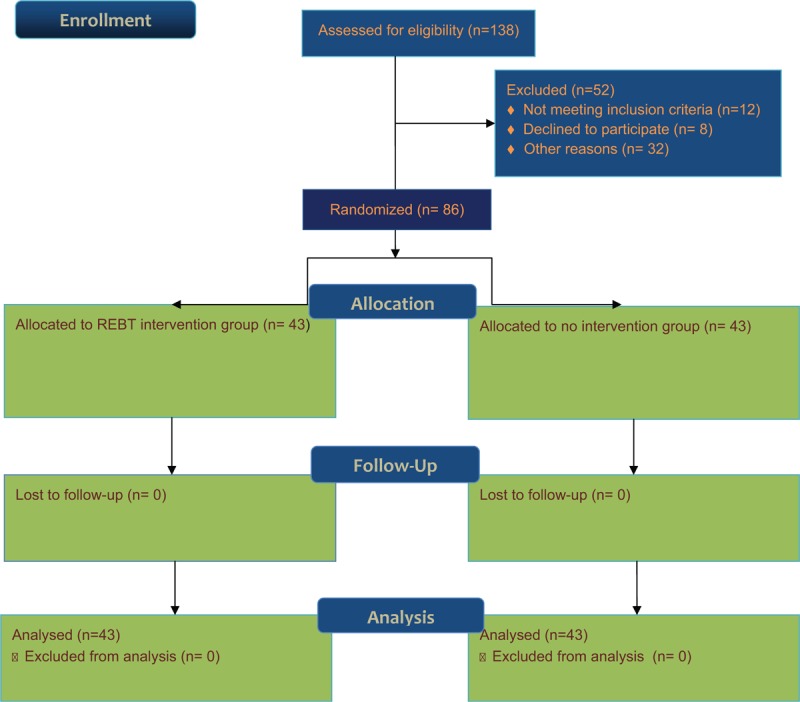
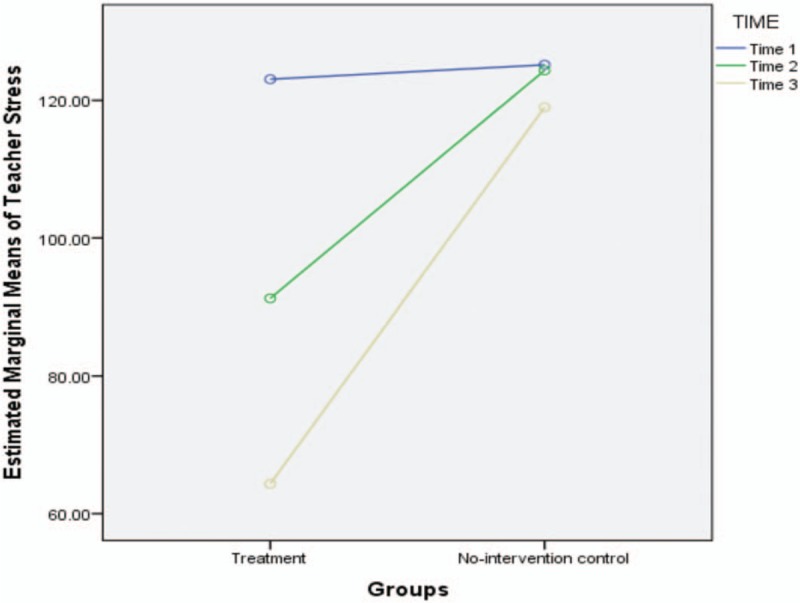
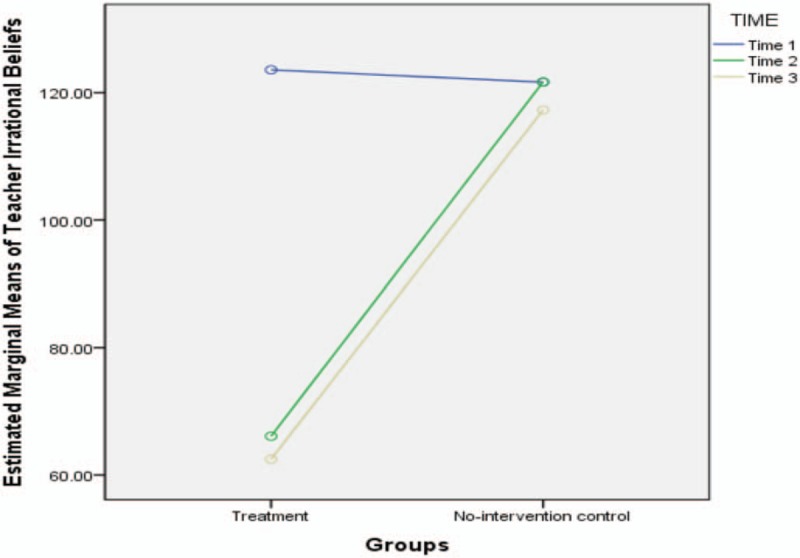
BACKGROUND/OBJECTIVE: From a rational emotive behavior therapy viewpoint, stress-related disorders originate from irrational beliefs and self-defeating philosophies and attitude. Individuals affected by stress are different from those ones with neurotic problems mainly because the stressed individuals have irrational beliefs about specific, short-term, or more readily identifiable events, in contrast to the more mundane and diffuse difficulties faced by neurotic persons. The present study aimed to examine the impact of a rational emotive behavior therapy (REBT) intervention on the stress levels and irrational beliefs among special education teachers in elementary schools in Nigeria. METHODS: We employed a group randomized controlled trial design for this study. Eighty six participants recruited from elementary schools in the South-eastern part of the country were randomly assigned to either a treatment group (n = 43) or no-intervention control group (n = 43). We used the REBT Stress Management Manual to conduct the intervention. Stress levels and irrational beliefs were assessed using self-report questionnaires. Participants in the treatment group took part in the REBT program for 12 weeks and a follow-up program for 2 weeks. Analysis of the data was completed through a 2 × 3 within × between-subjects repeated measures analysis of variance, and independent samples t test. RESULTS: Results showed that the REBT group experienced a significant mean decline in stress levels and their beliefs shifted to rational ones both at post-treatment and follow-up. In contrast, the participants in the no-intervention control group showed no improvements at either posttreatment or follow-up sessions. CONCLUSION: Rational-emotive behavior therapy is an effective therapeutic modality that can be applied by REBT clinicians for the management of stress. Additional clinical assessments will be necessary to further confirm the impact of an REBT intervention on teachers' stress management and irrational beliefs in Nigerian elementary school setting.
Overview
The claims and statistics of this paper haven’t been checked yet.
Free: it reads the open-access text and checks the first 5 claims that cite a source we can check. Create a free account to check every claim.
Integrity signals
Registry
Cites
Statistics
Figures
Verification
Claims the paper makes
The claims and statistics of this paper haven’t been checked yet.
Free: it reads the open-access text and checks the first 5 claims that cite a source we can check. Create a free account to check every claim.
Claims other papers make about this one
Each is checked against this paper’s own text: does it say what the citing paper says it does?
The source backs part of the claim, not all of it — or backs it for a different population, condition or comparison.
In the citing paper
“Previous studies have also found that the rational-emotive behavior therapy (REBT) is effective in improving conditions associated with negative thoughts such as job stress, burnout, and irrational beliefs[9,10,13].”
From Clinical benefits of rational-emotive stress management therapy for job burnout and dysfunctional distress of special education teachers (2020) · cites this paper as [9]
Experimental — accuracy not yet measuredThe source backs part of the claim, not all of it — or backs it for a different population, condition or comparison.
In the citing paper
“These teachers may develop burnout which could be associated with enormous emotional and physical distress, especially in a situation where the children are not making substantial improvement[9-11].”
From Clinical benefits of rational-emotive stress management therapy for job burnout and dysfunctional distress of special education teachers (2020) · cites this paper as [9]
Experimental — accuracy not yet measuredThe source backs part of the claim, not all of it — or backs it for a different population, condition or comparison.
In the citing paper
“Other REBT practitioners demonstrated that the REBT framework contributes independently to the understanding of burnout symptoms and distress[9,18,42].”
From Clinical benefits of rational-emotive stress management therapy for job burnout and dysfunctional distress of special education teachers (2020) · cites this paper as [9]
Experimental — accuracy not yet measuredThe cited source says what the claim attributes to it.
In the citing paper
“This could be because special education teachers are expected to modify the school curriculum in order to attend to the individual needs of their special learners. This and the stress of coping with learning difficulties and aggressive behavior of special learners, and the use of diverse behavior modification techniques tend to aggravate the plight of special education teachers[8,9].”
From Clinical benefits of rational-emotive stress management therapy for job burnout and dysfunctional distress of special education teachers (2020) · cites this paper as [9]
The cited source says what the claim attributes to it.
In the citing paper
“Hence, rational-emotive behavioral treatment is meant to therapeutically assist clients to argue irrational beliefs and achieve adaptive and/or efficient beliefs which are associated with healthy living[9,10,12-15,21].”
From Clinical benefits of rational-emotive stress management therapy for job burnout and dysfunctional distress of special education teachers (2020) · cites this paper as [9]
Self-check
Percentages, sums and reported differences re-computed from the paper’s own numbers.
The self-check needs the paper’s full text.
Citations
Cites
Statistical power analyses using G∗Power 3.1: tests for correlation and regression analyses
Faul, F., Erdfelder, E., Buchner, A., & Lang, A.-G. (2009) · Behavior Research Methods · doi:10.3758/brm.41.4.1149 · Cited by 37,615
Working in Special Education: Factors that Enhance Special Educators' Intent to Stay
Gersten, R., Keating, T., Yovanoff, P., & Harniss, M. K. (2001) · Exceptional Children · doi:10.1177/001440290106700408 · Cited by 397
The Challenge of Staffing Our Schools.
Darling‐Hammond, L. (2001) · Educational leadership · Cited by 287
Inclusion: identifying potential stressors for regular class teachers
Forlin, C. (2001) · Educational Research · doi:10.1080/00131880110081017 · Cited by 284
Kyriacou, C., & Sutcliffe, J. (1978) · Educational Studies · doi:10.1080/0305569780040101 · Cited by 283
Coping Strategies and the Impact of Challenging Behaviors on Special Educators' Burnout
Hastings, R. P., & Brown, T. (2002) · Mental Retardation · doi:10.1352/0047-6765(2002)040<0148:csatio>2.0.co;2 · Cited by 187 · cited 1×
“If left untreated, high stress level can result in low productivity, absenteeism, poor work performance,([16]) job dissatisfaction,([3,7,20]) and attrition in the”
BackgroundImpairment as a Human Constant: Cross‐Cultural and Historical Perspectives on Variation
Scheer, J., & Groce, N. (1988) · Journal of Social Issues · doi:10.1111/j.1540-4560.1988.tb02046.x · Cited by 157
Stress among Special Education Teachers in Malaysia
Ghani, M. Z., Ahmad, A. C., & Ibrahim, S. (2014) · Procedia - Social and Behavioral Sciences · doi:10.1016/j.sbspro.2013.12.648 · Cited by 101 · cited 1×
“Given the negative societal perception of teachers, many educators are also at risk of abandoning the teaching profession altogether.([6,38]) One of the psychological therapies for managing teacher stress is discussed in the subsequent section.”
BackgroundBurnout Among Special Education Teachers in Self-Contained Cross-Categorical Classrooms
Sloan Nichols, A., & LaPlante Sosnowsky, F. (2002) · Teacher Education and Special Education: The Journal of the Teacher Education Division of the Council for Exceptional Children · doi:10.1177/088840640202500108 · Cited by 98
Antoniou, A.-S., Polychroni, F., & Kotroni, C. (2009) · International Journal of Special Education (IJSE) · Cited by 94
SYMPOSIUM ON TEACHER STRESS: Occupational stress among vocational teachers
Pithers, R. T., & Fogarty, G. J. (1995) · British Journal of Educational Psychology · doi:10.1111/j.2044-8279.1995.tb01127.x · Cited by 92
A stress management course to prevent teacher distress
de Jesús, S. N., & Conboy, J. (2001) · International Journal of Educational Management · doi:10.1108/09513540110384484 · Cited by 83
Bernard, M. E. (2016) · Journal of Rational-Emotive & Cognitive-Behavior Therapy · doi:10.1007/s10942-016-0238-y · Cited by 83
Correlates of Psychological Distress among Secondary School Teachers
Punch, K. F., & Tuettemann, E. (1990) · British Educational Research Journal · doi:10.1080/0141192900160405 · Cited by 81
Fimian, M. J., & Santoro, T. M. (1983) · Exceptional Children · doi:10.1177/001440298304900608 · Cited by 78
The ABCs of Managing Teacher Stress
Nagel, L., & Brown, S. (2003) · The Clearing House A Journal of Educational Strategies Issues and Ideas · doi:10.1080/00098650309602015 · Cited by 77
Knaus, W. J. (1977) · Theory Into Practice · doi:10.1080/00405847709542709 · Cited by 76
Coping with job‐related stress: The case of teachers
Schonfeld, I. S. (1990) · Journal of Occupational Psychology · doi:10.1111/j.2044-8325.1990.tb00516.x · Cited by 75
Special education teachers under stress: evidence from a Greek national study
Kokkinos, C. M., & Davazoglou, A. M. (2009) · Educational Psychology · doi:10.1080/01443410902971492 · Cited by 68 · cited 1×
“Other concerns that may exacerbate the stress level of special education teachers include complexity in implementing the curriculum of special education; ensuring the safety of the children([17]); managing large class sizes, lack of administrative supports, and job dissatisfaction([33]); inadequate school facilities f…”
Background(1977) · Cited by 67
Teachers Irrational beliefs and their relationship to distress in the profession
Toro, L. B., & Ursúa, M. P. (2006) · Psychology in Spain · Cited by 61
Ogbuanya, T. C., Eseadi, C., Orji, C. T., Ohanu, I. B., Bakare, J., & Ede, M. O. (2017) · Medicine · doi:10.1097/md.0000000000006891 · Cited by 58
Self-citationUgwoke, S. C., Eseadi, C., Igbokwe, C. C., Chiaha, G. T. U., Nwaubani, O. O., Orji, C. T., Ugwuanyi, L. T., Chukwuma, I. S., Edikpa, E. C., Ogakwu, V. N., et al. (2017) · Medicine · doi:10.1097/md.0000000000007658 · Cited by 57
Self-citationSzentágotai, A., & Freeman, A. (2007) · Digital Commons - PCOM (Philadelphia College of Osteopathic Medicine) · Cited by 56
Ogbuanya, T. C., Eseadi, C., Orji, C. T., Omeje, J. C., Anyanwu, J. I., Ugwoke, S. C., & Edeh, N. C. (2019) · Psychological Reports · doi:10.1177/0033294117748587 · Cited by 49
Self-citationEffectiveness of Rational-Emotive Education: A Quantitative Meta-Analytical Study
Trip, S., Vernon, A., & McMahon, J. M. (2007) · Journal of Evidence-Based Psychotherapies · Cited by 48
Rational emotive behaviour therapy in the treatment of stress
Abrams, M., & Ellis, A. (1994) · British Journal of Guidance & Counselling · doi:10.1080/03069889400760051 · Cited by 48
Witchcraft stigmatization in Nigeria: Challenges and successes in the implementation of child rights
Secker, E. (2012) · International Social Work · doi:10.1177/0020872812459065 · Cited by 47
Preparing Future Teachers to Respond to Stress: Sources and Solutions
Brown, S., & Nagel, L. (2004) · Action in Teacher Education · doi:10.1080/01626620.2004.10463311 · Cited by 41
The Application of Rational-Emotive Theory and Therapy to School-Aged Children
DiGiuseppe, R., & Bernard, M. E. (1990) · School Psychology Review · doi:10.1080/02796015.1990.12085466 · Cited by 40
Ogbuanya, T. C., Eseadi, C., Orji, C. T., Anyanwu, J. I., Omeje, J. C., & Otu, M. S. (2017) · Journal of Rational-Emotive & Cognitive-Behavior Therapy · doi:10.1007/s10942-017-0282-2 · Cited by 30
Self-citationDealing with the Stress of Teachers
Reglin, G. L., & Reitzammer, A. F. (1998) · Cited by 29
Inclusive Education: Teachers and the Changing Culture of Schooling
Vlachou, A., & Barton, L. (1994) · British Journal of Special Education · doi:10.1111/j.1467-8578.1994.tb00101.x · Cited by 29 · cited 1×
“When the children are not making tangible progress, the teachers experience enormous emotional and physical distress.([3,16,18,25]) The stress teachers experience can be measured with the transactional model of stress, which views stress as an interaction between the worker and the external demands, threats, and situa…”
BackgroundLife stress and anger: Moderating effects of type a irrational beliefs
Hart, K. E., Turner, S. H., Hittner, J. B., Cardozo, S. R., & Paras, K. C. (1991) · Personality and Individual Differences · doi:10.1016/0191-8869(91)90250-f · Cited by 27
Forman, M. A., Tosi, D. J., & Rudy, D. R. (1987) · Journal of Rational-Emotive & Cognitive-Behavior Therapy · doi:10.1007/bf01073816 · Cited by 27
TEACHER IRRATIONAL BELIEF SCALE - PRELIMINARY NORMS FOR ROMANIAN POPULATION
Bora, C. H., Bernard, M. E., Trip, S., Decsei-Radu, A., & Chereji, S. V. (2009) · Journal of Evidence-Based Psychotherapies · Cited by 22
(2010) · New Horizons in Education · Cited by 21
Decker, T. W., Williams, J. M., & Hall, D. (1982) · Psychological Reports · doi:10.2466/pr0.1982.50.3c.1327 · Cited by 17
Teachers Irrational beliefs and their relationship to distress in the profession
Bermejo Toro, L., & Prieto Ursúa, M. (2017) · Comillas Repository (Comillas Pontifical University) · Cited by 16
Irrational beliefs and psychosomatic disorders
Woods, P. J., & Lyons, L. C. (1990) · Journal of Rational-Emotive & Cognitive-Behavior Therapy · doi:10.1007/bf01072091 · Cited by 13
Irrational beliefs and the impact of stressful life events
Vestre, N. D., & Burnis, J. J. (1987) · Journal of Rational-Emotive & Cognitive-Behavior Therapy · doi:10.1007/bf01080526 · Cited by 11
[Psychophysiologic approaches in the etiology and therapy of psychosomatic disorders].
Larbig, W. (1978) · PubMed · Cited by 2
Research works printed but not linked: 26
- Eze PO. Effect of rational emotive behavior therapy on work stress of special educators in Enugu State. (Postgraduate Diploma Thesis). Nsukka: University of Nigeria; 2016.
- Álvarez C Blanco J Aguado M Revisión teórica del burnout o desgaste profesional en trabajadores de la docencia [Theoretical revision of burnout or professional burnout in teaching workers.]. Caesura 1993; 2: 47– 65.
- Nichols AS Sosonowsky FL Burnout among special education teacher in self-contained crisis categorical classrooms. TESE 2002; 1: 71– 86.
- Antoniou AS, Polychroni F, Walters B. Sources of stress and professional burnout of teachers of special education needs in Greece. Proceedings of the International Special Education Congress; 2000.
- Agbo I. Assessment of stress of teachers of primary school pupils in Enugu State. (Master's Thesis). Awka: Nnamdi Azikiwe University; 2012.
- Copper CL Psychosocial Stress and Cancer. Chichester: Wiley; 2002.
- Katsafanas JD. The roles and responsibilities of special education teachers. (Doctoral dissertation). University of Pittsburgh; 2007.
- Castro JAC León FJG Giménez ML Prevalencia del Síndrome de Burnout en los maestros. Resultados de una investigación preliminar [Prevalence of burnout syndrome in teachers. Results of a preliminary investigation]. Revista Psicología 2003; 7: 1– 21.
- Brownell MT, Smith S, Miller D. Attrition of special educators: why they leave and where they go. Proceedings of the National Dissemination Forum on Issues Related to Special Education, Teacher Satisfaction, Retention, and Attrition (227–234); 1995.
- Ellis A Cooper C Payne R What people can do for themselves to cope with stress. Stress at Work. New York: Wiley; 1978 209– 22.
- Ellis A Overcoming Resistance: A Rational Emotive Behavior Therapy Integrative Approach. 2nd ed. New York: Springer; 2002.
- Spencer S. Rational emotive behavior therapy: its effectiveness with children. (Master's Thesis). The Graduate School University of Winconsin; 2005.
- Ellis A Bernard ME Ellis A Bernard ME What is rational–emotive therapy? Clinical Applications of Rational Emotive behaviour Therapy. New York: Plenum Press; 1985 1– 30.
- Dryden W Branch R The Fundamentals of Rational Emotive Behaviour Therapy: A Training Handbook. Chichester: Wiley; 2008.
- Ellis A Bernard ME Rational Emotive Behavioral Approaches to Childhood Disorders: Theory, Practice and Research. New York: Springer; 2006.
- Bernard ME Joyce MR Rosewarne P Ellis A Bernard ME Helping teachers cope with stress: a rational emotive approach. Plenum Press, Rational-Emotive Approaches to the Problems of Childhood. New York: 1983.
- Ellis A Dryden W The Practice of Rational Emotive Behavior Therapy. 2nd ed. New York: Springer; 1997.
- Adomeh OC Fostering emotional adjustment among Nigerian adolescents with rational emotive behavior therapy. Educ Res Ther 2006; 29: 21– 9.
- Lupu V Ifene F The impact of rational emotive behavior education on anxiety in teenagers. J Cogn Behav Psychother 2009; 9: 95– 105.
- Mahfar M, Amat-Senin A. Managing stress at workplace using the rational- emotive behavioural therapy (REBT). International Conference on Human ResourceDevelopment, 5–7th April, 2015, Johor, Bahru; 2015.
- Ellis A Abrams M Brief Psychotherapy in Medical and Health Practice. New York: Springer; 1978.
- Phadke KM Some innovations in RET theory and practice. Rational Living 1982; 17: 25– 30.
- Digiuseppe RA Doyle KA Dryden W A Practitioner's Guide to Rational Emotive Behavior Therapy. New York: Oxford University Press; 2013.
- David AR Szamoskozi S A meta-analytical study on the effects of cognitive behavioral techniques for reducing distress in organizations. J Cogn Behav Psychother 2011; 11: 221– 36.
- Dryden W Ellis A Rational emotive behavior therapy. Handbook of Cognitive-Behavioral Therapies The Guilford Press, 2nd ed. New York: 2001.
- Gliem JA, Gliem RR. Calculating, interpreting, and reporting Cronbach's alpha reliability coefficient for Likert-type scales. Paper presented at the Midwest Research-to-Practice Conference in Adult, Continuing, and Community Education, The Ohio State University, Columbus, OH, October 8–10; 2003.
Cited by
Interventions to Reduce Stress and Burnout among Teachers: A Scoping Review
Agyapong, B., Brett-MacLean, P., Burback, L., Agyapong, V. I. O., & Wei, Y. (2023) · International Journal of Environmental Research and Public Health · doi:10.3390/ijerph20095625 · Cited by 286
“REOHC significantly decreased job burnout and emotional exhaustion among special needs teachers [46,48,49].”
BackgroundInfluentialBeames, J. R., Spanos, S., Roberts, A., McGillivray, L., Li, S., Newby, J. M., O’Dea, B., & Werner-Seidler, A. (2023) · Educational Psychology Review · doi:10.1007/s10648-023-09720-w · Cited by 109
Factors influencing teacher wellbeing and burnout in schools: A scoping review1
Sohail, M. M., Baghdady, A., Choi, J., Huynh, H. V., Whetten, K., & Proeschold‐Bell, R. J. (2023) · Work · doi:10.3233/wor-220234 · Cited by 131
Ede, M. O., Anyanwu, J. I., Onuigbo, L. N., Ifelunni, C. O., Albi-Oparaocha, F. C., Okenyi, E. C., Agu, M. A., Ugwuanyi, L. T., Ugwuanyi, C. S., Eseadi, C., et al. (2020) · Journal of Rational-Emotive & Cognitive-Behavior Therapy · doi:10.1007/s10942-020-00342-7 · Cited by 89
Self-citationA systematic review of the nature and efficacy of Rational Emotive Behaviour Therapy interventions
King, A. M., Plateau, C. R., Turner, M. J., Young, P. A., & Barker, J. B. (2024) · PLoS ONE · doi:10.1371/journal.pone.0306835 · Cited by 65
Metadata
- Authors
- Onuigbo, L. N., Eseadi, C., Ugwoke, S. C., Nwobi, A. U., Anyanwu, J. I., Okeke, F. C., Agu, P. U., Oboegbulem, A. I., Chinweuba, N. H., Agundu, U.-V., Ololo, K. O., Okpoko, C., Nwankwor, P. P., Eze, U. N., & Eze, P.
- Affiliations
- University of Nigeria (NG)
- Alex Ekwueme Federal University, Ndufu-Alike (NG)
- Corresponding author
- Ugwoke, Samuel Chidiume
- ORCID
- Venue
- Medicine
- Published
- 2018-09
- Volume
- 97
- Issue
- 37
- Pages
- e12191
- ISSN
- 0025-7974 (ISSN-L)
- PMC
- PMC6156037
- OpenAlex
- W2893472742
- Semantic Scholar
- 1e7ef8e1e37b2b7f1eea7e070d5f62174d7e54b5
- Cited by
- 64
- References
- 42
- Citations by year
- 2026: 1 · 2025: 5 · 2024: 10 · 2023: 13 · 2022: 9 · 2021: 13 · 2020: 8 · 2019: 4
- FWCI
- 7.34
- Type
- journal article
- Language
- en
- Open access
- gold
- doi.org
- Licence
- cc-by-nc-nd
- Locations
- Medicine (publishedVersion, cc-by-nc-nd)
- Europe PMC (PubMed Central) (publishedVersion, cc-by-nc-nd)
- PubMed Central (publishedVersion, cc-by-nc-nd)
- PubMed (publishedVersion)
- Topics
- Social Sciences › Psychology › Clinical Psychology › Psychological Treatments and Assessments
- Social Sciences › Psychology › Developmental and Educational Psychology › Behavioral and Psychological Studies
- Social Sciences › Psychology › Developmental and Educational Psychology › Student Stress and Coping
- Keywords
- rational emotive behavior therapy, stress management, irrational beliefs, special education teachers, teacher stress, elementary school, Nigerian teachers
- MeSH terms
- School Teachers, Occupational Stress, Behavior Therapy, Education, Special, Humans, Nigeria
About these checks
Registry, retraction, Cites and statistics results are computed, not judged, with one exception: a printed reference that no index lists is read once by a model before it counts as a citation error. Claims are extracted by a model and kept only when their quote appears verbatim in the text; each cited source is then checked, with a model’s help, for whether it says what the claim relies on. Those verdicts can be wrong — read the claim’s quote and the cited source before relying on one.
Statistics and arithmetic are recomputed, not judged.
Confidence bands are shown only for fields calibrated on our annotated test set. None is calibrated yet, so no band is shown.
What counts as a claim ›How we measure confidence ›How we check this ›
Are you an author, or do you see a problem with this page? Request a review
Data sources
Bibliographic data: Semantic Scholar, OpenAlex, Crossref.
Contains information from the Semantic Scholar Academic Graph Datasets, made available under the ODC Attribution License (ODC-BY 1.0).
Semantic Scholar’s data is described in: Kinney, R., et al. (2023). The Semantic Scholar Open Data Platform. arXiv:2301.10140.
