

A randomized clinical trial of comprehensive education and care program compared to basic care for reducing anxiety and depression and improving quality of life and survival in patients with hepatocellular carcinoma who underwent surgery
Open accessThe DOI matches its Crossref record; 24 of the 24 references it cites were found in a registry or an index.
Abstract
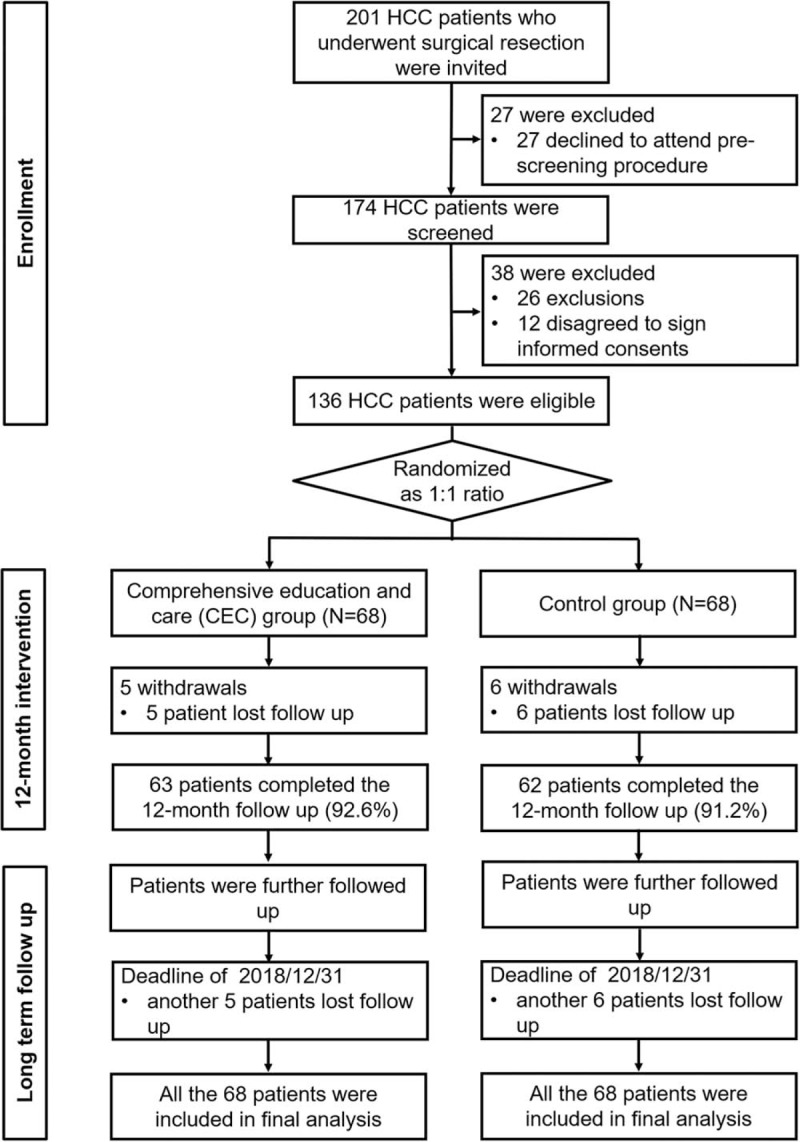
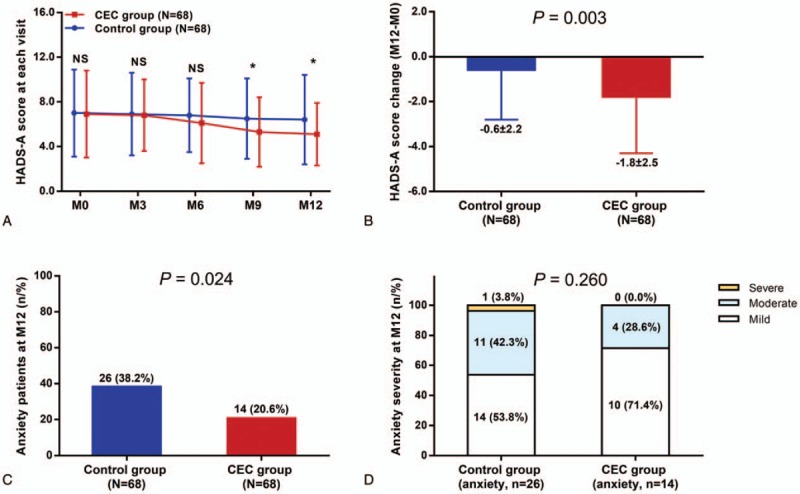
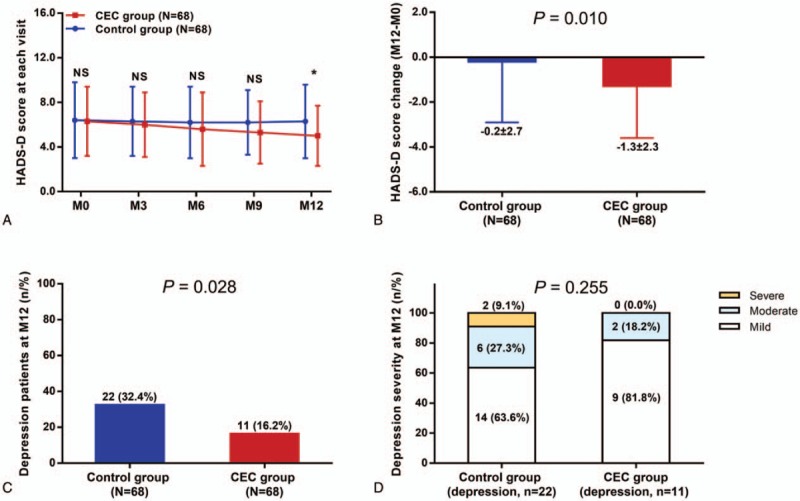
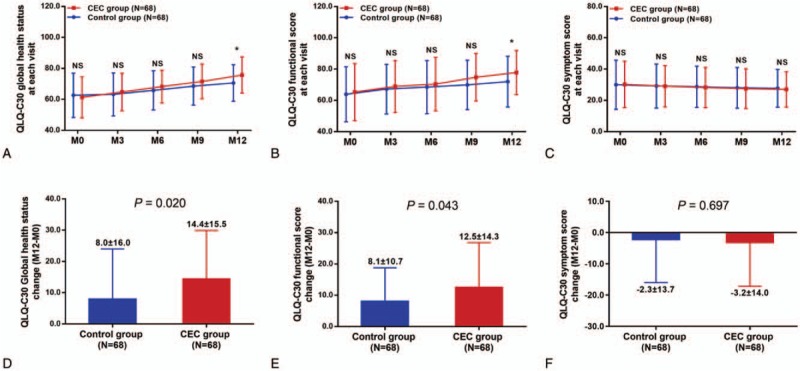
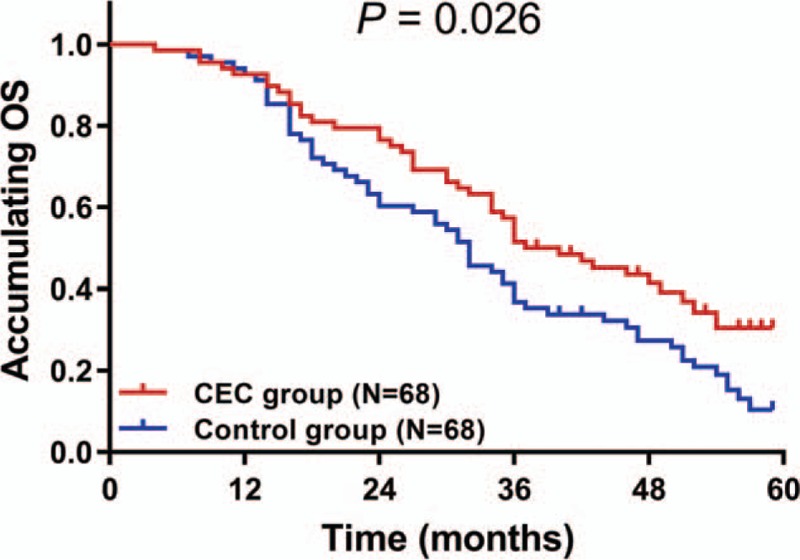
This study aimed to investigate the effect of comprehensive education and care (CEC) program on anxiety, depression, quality of life, and survival in patients with hepatocellular carcinoma (HCC) who underwent surgical resection. Totally 136 patients with HCC who underwent hepatectomy were randomly assigned to CEC group and control group as 1:1 ratio. CEC group received health education, psychological nursing, caring activity, and telephone condolence, whereas control group received basic health education and rehabilitation for 12 months. Anxiety and depression were assessed by Hospital Anxiety and Depression Scale (HADS); quality of life was evaluated using European Organization for Research and Treatment of Cancer Quality of Life Questionnaire (QLQ-C30). HADS-Anxiety (HADS-A) score was decreased at 9 month (M9) and M12, and reduction in HADS-A score (M12-M0) was greater in CEC group compared with control group. At M12, percentage of anxiety patients was less, but anxiety severity was similar in CEC group compared with control group. HADS-Depression (HADS-D) score was decreased at M12, and reduction in HADS-D score (M12-M0) was greater in CEC group compared with control group. At M12, percentage of depression patients were less but depression severity was similar in CEC group compared with control group. In addition, QLQ-C30 global health status and functional score was increased at M12, and score improvement (M12-M0) was greater in CEC group compared with control group. In addition, overall survival was longer in CEC group compared with control group. CEC relieves anxiety and depression, improves quality of life, and prolongs survival in patients with HCC underwent surgical resection.
Overview
The claims and statistics of this paper haven’t been checked yet.
Free: it reads the open-access text and checks the first 5 claims that cite a source we can check. Create a free account to check every claim.
Integrity signals
Registry
Cites
Statistics
Figures
Verification
Claims the paper makes
The claims and statistics of this paper haven’t been checked yet.
Free: it reads the open-access text and checks the first 5 claims that cite a source we can check. Create a free account to check every claim.
Self-check
Percentages, sums and reported differences re-computed from the paper’s own numbers.
The self-check needs the paper’s full text.
Citations
Cites
The Hospital Anxiety and Depression Scale
Zigmond, A. S., & Snaith, R. P. (1983) · Acta Psychiatrica Scandinavica · doi:10.1111/j.1600-0447.1983.tb09716.x · Cited by 47,139 · cited 1×
“3 the HADS-A score and HADS-D score, the severity of anxiety and depression was classified as follows: 0 to 7, no anxiety/ depression; 8 to 10, mild anxiety/depression; 11 to 14, moderate anxiety/depression; 15 to 21, severe anxiety/depression.([10]) In addition, according to QLQ-C30 Scoring Manual, all scales and sin…”
MethodDepression and quality of life in older persons: A review
Sivertsen, H., Bjørkløf, G. H., Engedal, K., Selbæk, G., & Helvik, A.-S. (2015) · Dementia and Geriatric Cognitive Disorders · doi:10.1159/000437299 · Cited by 14,152
Forner, A., Reig, M., & Bruix, J. (2018) · The Lancet · doi:10.1016/s0140-6736(18)30010-2 · Cited by 5,531
Depression and cancer mortality: a meta-analysis
Pinquart, M., & Duberstein, P. R. (2010) · Psychological Medicine · doi:10.1017/s0033291709992285 · Cited by 1,083 · cited 1×
“For instance, depression, hopelessness, and emotional repression are predictive factors for shorter survival in patients with cancer.([20]) Based on that, the effects of educational and psychological interventions on survival in patients with cancer have been investigated.”
BackgroundRecent progress in understanding, diagnosing, and treating hepatocellular carcinoma
Maluccio, M., & Covey, A. (2012) · CA: A Cancer Journal for Clinicians · doi:10.3322/caac.21161 · Cited by 840 · cited 3×
“The survival of patients with HCC has been improved during the past decades largely due to the surveillance of HCC upon high-risk population, such as those with hepatitis B/C viruses infection or nonalcoholic fatty liver disease, and surgery for patients with early-stage HCC.([2]) However, problems also coexist with t…”
BackgroundInfluentialInfluence of psychological response on survival in breast cancer: a population-based cohort study
Watson, M., Haviland, J., Greer, S., Davidson, J., & Bliss, J. (1999) · The Lancet · doi:10.1016/s0140-6736(98)11392-2 · Cited by 705 · cited 1×
“It has been demonstrated that psychological factors are associated with survival in patients with cancer.([19]) For instance, depression, hopelessness, and emotional repression are predictive factors for shorter survival in patients with cancer.”
BackgroundPsychologic intervention improves survival for breast cancer patients: A randomized clinical trial
Andersen, B. L., Yang, H., Farrar, W. B., Golden‐Kreutz, D. M., Emery, C. F., Thornton, L. M., Young, D. C., & Carson, W. E. (2008) · Cancer · doi:10.1002/cncr.23969 · Cited by 493 · cited 1×
“One educational and psychological intervention conducted in patients who are surgically treated for regional breast cancer results in reduced risk of breast cancer recurrence and lower risk of death.([21]) Another psychological therapy conducted in varying kinds of medically incurable metastatic cancer is also shown t…”
BackgroundDjukanovic, I., Carlsson, J., & Årestedt, K. (2017) · Health and Quality of Life Outcomes · doi:10.1186/s12955-017-0759-9 · Cited by 326 · cited 1×
“8 conducted the CEC program in patients with HCC underwent surgical resection, and used HADS-A/D scores to assess anxiety and depression, which were previously shown to have internal consistency and invariant regarding to sex.([17]) Our study disclosed that the anxiety and depression were reduced, and quality of life…”
ResultThomas, M. L., Elliott, J. E., Rao, S. M., Fahey, K. F., Paul, S. M., & Miaskowski, C. (2012) · Oncology Nursing Forum · doi:10.1188/12.onf.39-49 · Cited by 133
Effectiveness of nursing interventions among patients with cancer: An overview of systematic reviews
Tuominen, L., Stolt, M., Meretoja, R., & Leino‐Kilpi, H. (2019) · Journal of Clinical Nursing · doi:10.1111/jocn.14762 · Cited by 81 · cited 1×
“In addition, a systemic review about the effectiveness of nursing interventions illustrated that psychological nursing intervention has a significant effect on spiritual well-being, including reducing anxiety and distress, sleep, and fatigue meliorating in various cancer patients.([16]) These evidences emphasize the e…”
Background
Cited by
Management of Anxiety and Depression in Adult Survivors of Cancer: ASCO Guideline Update
Andersen, B. L., Lacchetti, C., Ashing, K., Berek, J. S., Berman, B. S., Bolte, S., Dizon, D. S., Given, B., Nekhlyudov, L., Pirl, W., et al. (2023) · Journal of Clinical Oncology · doi:10.1200/jco.23.00293 · Cited by 318
“Regarding the latter, many studies (one third) began with baseline group differences, a circumstance less likely when ran-domizing within strata, as variables potentially correlated with the outcome can reduce nuisance subject variance.”
Tan, D. J. H., Quek, S. X. Z., Yong, J. N., Suresh, A., Koh, K. X. M., Lim, W. H., Quek, J., Tang, A. S. P., Tan, C., Nah, B. K. Y., et al. (2022) · Clinical and Molecular Hepatology · doi:10.3350/cmh.2022.0136 · Cited by 61
Dhital, P., Sharma, K., Poudel, P., & Dhital, P. R. (2018) · Nursing Research and Practice · doi:10.1155/2018/4181952 · Cited by 58
Graf, J., & Stengel, A. (2021) · Frontiers in Psychology · doi:10.3389/fpsyg.2021.662777 · Cited by 64
Liu, Y., Chen, J., Pan, Y., Cai, Y., Ge, C., Chu, H., Xia, C., Song, Y., Chen, Y., Wu, B. Y., et al. (2020) · Psychology Health & Medicine · doi:10.1080/13548506.2020.1825756 · Cited by 31
Metadata
- Authors
- Wang, J., Yan, C., & Fu, A.
- Affiliations
- Hepatobiliary and Pancreatic Surgery
- Central Hospital of Wuhan (CN)
- Corresponding author
- Fu, Adan
- Venue
- Medicine
- Published
- 2019-11
- Volume
- 98
- Issue
- 44
- Pages
- e17552
- ISSN
- 0025-7974 (ISSN-L)
- 1536-5964
- PMC
- PMC6946196
- OpenAlex
- W2986127495
- Semantic Scholar
- a51a559f846728aa99feb2c627e8d83d3dffe39c
- Cited by
- 44
- References
- 24
- Citations by year
- 2026: 4 · 2025: 6 · 2024: 3 · 2023: 9 · 2022: 7 · 2021: 7 · 2020: 6
- FWCI
- 2.09
- Type
- journal article
- Language
- en
- Open access
- gold
- doi.org
- Licence
- Locations
- Medicine (publishedVersion, cc-by-nc)
- PubMed Central (publishedVersion, cc-by-nc)
- PubMed (publishedVersion)
- Topics
- Health Sciences › Medicine › Oncology › Cancer survivorship and care
- Health Sciences › Medicine › Hepatology › Hepatocellular Carcinoma Treatment and Prognosis
- Health Sciences › Nursing › Research and Theory › Nursing care and research
- Keywords
- hepatocellular carcinoma, anxiety, depression, quality of life, overall survival, hepatectomy, psychological nursing, health education, postoperative care
- MeSH terms
- Adult, Aged, Anxiety, Counseling, Depression, Female, Health Status, Carcinoma, Hepatocellular, Humans, Liver Neoplasms, Male, Middle Aged, Patient Education as Topic, Psychotherapy, Group, Quality of Life, Telephone
About these checks
Registry, retraction, Cites and statistics results are computed, not judged, with one exception: a printed reference that no index lists is read once by a model before it counts as a citation error. Claims are extracted by a model and kept only when their quote appears verbatim in the text; each cited source is then checked, with a model’s help, for whether it says what the claim relies on. Those verdicts can be wrong — read the claim’s quote and the cited source before relying on one.
Statistics and arithmetic are recomputed, not judged.
Confidence bands are shown only for fields calibrated on our annotated test set. None is calibrated yet, so no band is shown.
What counts as a claim ›How we measure confidence ›How we check this ›
Are you an author, or do you see a problem with this page? Request a review
Data sources
Bibliographic data: Semantic Scholar, OpenAlex, Crossref.
Contains information from the Semantic Scholar Academic Graph Datasets, made available under the ODC Attribution License (ODC-BY 1.0).
Semantic Scholar’s data is described in: Kinney, R., et al. (2023). The Semantic Scholar Open Data Platform. arXiv:2301.10140.
