

Impact of physical exercise on children with attention deficit hyperactivity disorders: Evidence through a meta-analysis
Open accessThe DOI matches its Crossref record, with a small difference in title or year; 47 of the 49 references it cites were found in a registry or an index.
Abstract
Background: Attention deficit hyperactivity disorder (ADHD) which is characterized by developmentally inappropriate levels of attention, hyperactivity and impulsivity, is considered as the most common neurodevelopmental disorder in childhood. Physical exercise has shown to have several benefits in the improvement of children with ADHD. In this meta-analysis, we aimed to systematically show, with evidence, the impact of physical exercise on children with ADHD. Methods: Web of Science, MEDLINE, EMBASE, Google Scholar, Cochrane Central and http://www.ClinicalTrials.gov were the searched sources for studies which were based on the impact of physical exercise on children with ADHD. Relevant endpoints were assessed. This evidence based meta-analysis was carried out by the most relevant RevMan 5.3 software. Due to the involvement of continuous data (mean and standard deviation), weight mean difference (WMD) with 95% confidence intervals (CI) were used to represent the final analysis. A significant level of P≤ .05 was set and a fixed statistical effect model was used throughout the analysis. Results: Fourteen studies with a total number of 574 participants with ADHD were included in this evidenced based meta-analysis. Two hundred and seventy six (276) participants were assigned to the physical activity group whereas 298 participants were assigned to the control group. Results of this analysis showed that anxiety and depression were significantly improved with physical activity in these children with ADHD (WMD: -1.84; 95% CI: [-2.65 – (-1.03)],P = .00001). Hyperactive/impulsive symptoms (WMD: -0.01; 95% CI: [-0.32 – 0.29],P = .93) and inattention symptoms (WMD: -0.22; 95% CI: [-0.51 – 0.08],P = .15) were also improved with physical exercise but the results were not statistically significant. This evidence based analysis showed thought problems (WMD: -3.49; 95% CI: [-5.51 – (-1.47)],P = .0007), social problems (WMD: -5.08; 95% CI: [-7.34 – (-2.82)],P = .0001), and aggressive behaviors (WMD: -3.90; 95% CI: [-7.10 – (-0.70)],P = .02) to have significantly been improved in participants with ADHD who were assigned to physical activity group. Conclusions: This current meta-analysis showed with evidence, that physical exercise has a major contribution owing to significant improvement in anxiety and depression, aggressive behaviors, thought and social problems among children suffering from ADHD. Therefore, physical exercise should be incorporated in the daily life of children with ADHD. Further future research should be able to confirm this hypothesis.
Overview
The claims and statistics of this paper haven’t been checked yet.
Free: it reads the open-access text and checks the first 5 claims that cite a source we can check. Create a free account to check every claim.
Integrity signals
Registry
Cites
Statistics
Figures
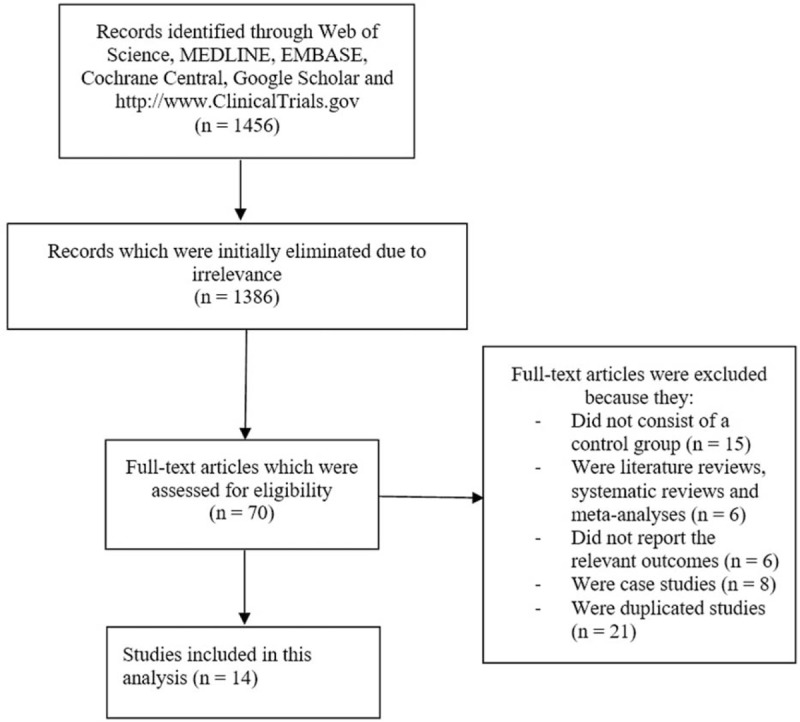
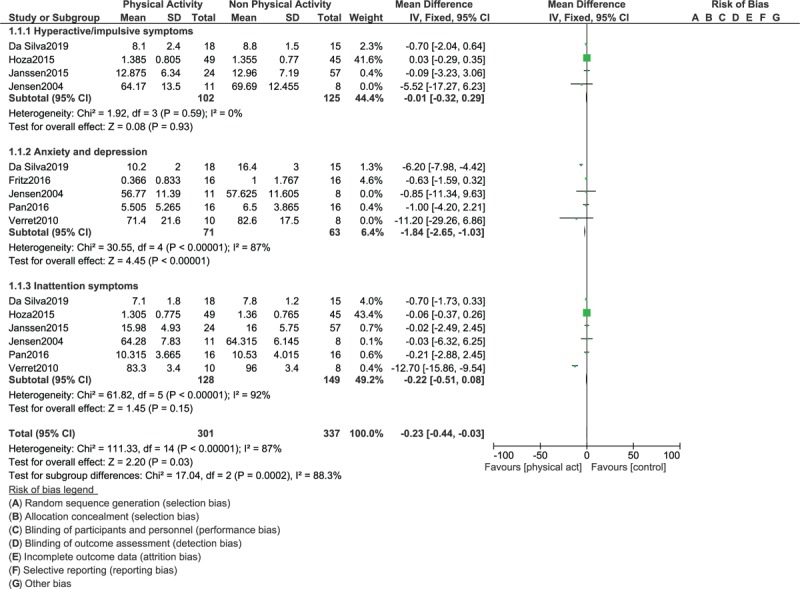
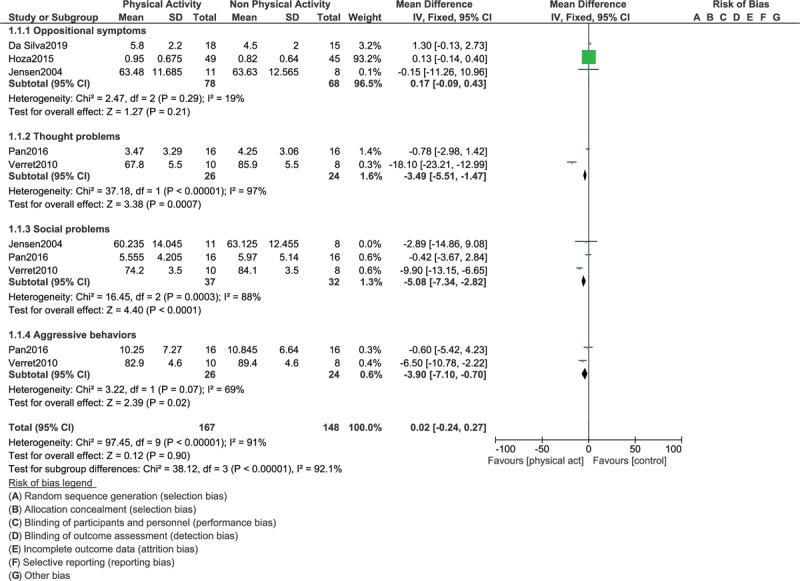
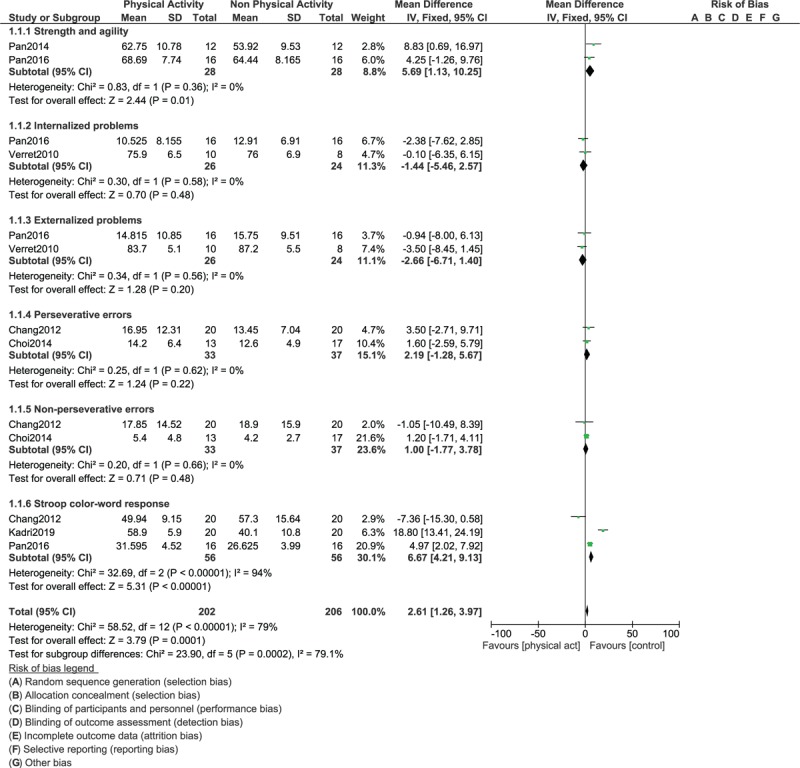
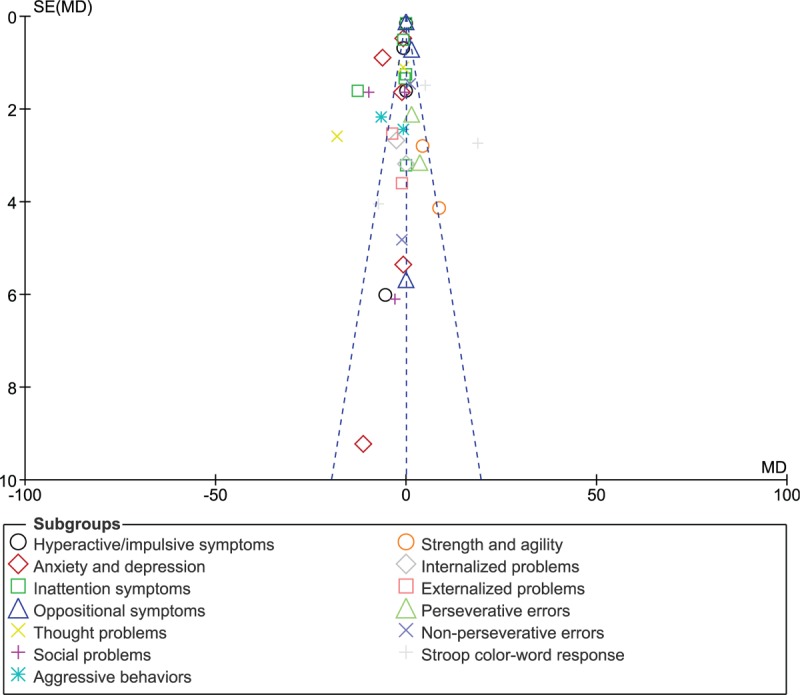
Verification
Claims the paper makes
The claims and statistics of this paper haven’t been checked yet.
Free: it reads the open-access text and checks the first 5 claims that cite a source we can check. Create a free account to check every claim.
Claims other papers make about this one
Each is checked against this paper’s own text: does it say what the citing paper says it does?
The source backs part of the claim, not all of it — or backs it for a different population, condition or comparison.
In the citing paper
“but significant reductions in anxiety and depression (5 studies, 164 participants) (Zang, 2019).”
From The World Federation of ADHD International Consensus Statement: 208 Evidence-based conclusions about the disorder (2021) · cites this paper as Zang, 2019
Experimental — accuracy not yet measuredThe cited source says what the claim attributes to it.
In the citing paper
“Another meta-analysis found no significant effect of exercise on either hyperactivity/impulsivity (4 studies, 227 participants) or inattention symptoms (6 studies, 277 participants), but significant reductions in anxiety and depression (5 studies, 164 participants) (Zang, 2019).”
From The World Federation of ADHD International Consensus Statement: 208 Evidence-based conclusions about the disorder (2021) · cites this paper as Zang, 2019
The cited source says what the claim attributes to it.
In the citing paper
“Another meta-analysis found no significant effect of exercise on either hyperactivity/impulsivity (4 studies, 227 participants) or inattention symptoms (6 studies, 277 participants), but significant reductions in anxiety and depression (5 studies, 164 participants) (Zang, 2019).”
From The World Federation of ADHD International Consensus Statement: 208 Evidence-based conclusions about the disorder (2021) · cites this paper as Zang, 2019
Self-check
Percentages, sums and reported differences re-computed from the paper’s own numbers.
The self-check needs the paper’s full text.
Citations
Cites
Liberati, A., Altman, D. G., Tetzlaff, J., Mulrow, C., Gøtzsche, P. C., Ioannidis, J. P. A., Clarke, M., Devereaux, P. J., Kleijnen, J., & Moher, D. (2009) · PLoS Medicine · doi:10.1371/journal.pmed.1000100 · Cited by 28,164
Liberati, A., Altman, D. G., Tetzlaff, J., Mulrow, C., Gotzsche, P. C., Ioannidis, J. P. A., Clarke, M., Devereaux, P. J., Kleijnen, J., & Moher, D. (2009) · BMJ · doi:10.1136/bmj.b2700 · Cited by 17,648
Stang, A. (2010) · European Journal of Epidemiology · doi:10.1007/s10654-010-9491-z · Cited by 17,396 · cited 1×
“The quality assessment of the randomized trials was carried out with reference to the criteria suggested by the Cochrane Collaboration([19]) and the quality assessment of the observational studies was carried out by the Newcastle Ottawa Scale (NOS).([20])”
MethodMolina, B. S. G., Hinshaw, S. P., Swanson, J. M., Arnold, L. E., Vitiello, B., Jensen, P. S., Epstein, J. N., Hoza, B., Hechtman, L., Abikoff, H. B., et al. (2009) · Journal of the American Academy of Child & Adolescent Psychiatry · doi:10.1097/chi.0b013e31819c23d0 · Cited by 1,182 · cited 1×
“Poor adherence,([12]) partial or non-response to medications,([13]) and uncertainty about the long-term costs of medications,([14]) beneficial and side effects are the other limitations of pharmacological therapy for ADHD.”
BackgroundDalsgaard, S., Østergaard, S. D., Leckman, J. F., Mortensen, P. B., & Pedersen, M. G. (2015) · The Lancet · doi:10.1016/s0140-6736(14)61684-6 · Cited by 681 · cited 1×
“This disorder is also associated with substantial long-term depressive outcomes and mortality.([9]) To improve the symptoms of ADHD in these children, pharmacological treatment is associated with long-term beneficial effects and has been considered as first line therapy.”
BackgroundThe epidemiology of attention‐deficit/hyperactivity disorder (ADHD): A public health view
Rowland, A. S., Lesesne, C. A., & Abramowitz, A. J. (2002) · Mental Retardation and Developmental Disabilities Research Reviews · doi:10.1002/mrdd.10036 · Cited by 495 · cited 1×
“The diagnosis is mainly based on parents’ and teachers’ reports, with reference to learning disabilities, anxiety and conduction disorders.([2]) Children with ADHD often have significant impairment in occupational,([3]) health,([4]) social([5]) and academic([6]) domains contributing to motivational and learning disabi…”
BackgroundYoung Adult Educational and Vocational Outcomes of Children Diagnosed with ADHD
Kuriyan, A. B., Pelham, W. E., Molina, B. S. G., Waschbusch, D. A., Gnagy, E. M., Sibley, M. H., Babinski, D. E., Walther, C., Cheong, J., Yu, J., et al. (2013) · Journal of Abnormal Child Psychology · doi:10.1007/s10802-012-9658-z · Cited by 406 · cited 1×
“Children with ADHD often have significant impairment in occupational,([3]) health,([4]) social([5]) and academic([6]) domains contributing to motivational and learning disabilities and anxiety disorders as well as impulsive behaviors resulting in a negative impact on themselves and therefore contribute to the developm…”
BackgroundMortality, ADHD, and Psychosocial Adversity in Adults With Childhood ADHD: A Prospective Study
Barbaresi, W. J., Colligan, R. C., Weaver, A. L., Voigt, R. G., Killian, J. M., & Katusic, S. K. (2013) · Pediatrics · doi:10.1542/peds.2012-2354 · Cited by 401
Review of Medication Adherence in Children and Adults with ADHD
Adler, L. D., & Nierenberg, A. A. (2010) · Postgraduate Medicine · doi:10.3810/pgm.2010.01.2112 · Cited by 295 · cited 1×
“Poor adherence,([12]) partial or non-response to medications,([13]) and uncertainty about the long-term costs of medications,([14]) beneficial and side effects are the other limitations of pharmacological therapy for ADHD.”
BackgroundVerret, C., Guay, M.-C., Berthiaume, C., Gardiner, P., & Béliveau, L. (2012) · Journal of Attention Disorders · doi:10.1177/1087054710379735 · Cited by 294 · cited 1×
“responses (-), perseverative errors (-), non-perseverative errors (-), conceptual level responses (+), categories completed (+) Verret, 2010([25]) Anxiety-depression, withdrawal-depression, somatic complaints, social problems, thought problems, attention problems, rule-breaking”
Background
Research works printed but not linked: 1
- Higgins JP Assessing risk of bias in included studies, in Cochrane handbook for systematic reviews of interventions. Wiley 2008; 187– 241.
Cited by
Items 101–124 of 124
Telesna dejavnost kot način spoprijemanja s hiperaktivnostjo
Ristevski, A. (2024) · Repository of the University of Ljubljana (University of Ljubljana)
Notter, H. (2025) · IUScholarWorks (Indiana University)
Bawono, E. (2024) · ePrints - UNY (Yogyakarta State University)
Vpliv telesne aktivnosti na motnjo pozornosti s hiperaktivnostjo pri otrocih in mladostnikih
Unuk, T. (2023) · University of Maribor digital library (University of Maribor)
Liikehallintakyvyn harjoittaminen: Opas ADHD-lasten kanssa toimiville
Aho, M. (2024) · Theseus (Ammattikorkeakoulujen)
Coll‐Martín, T. (2023) · Institutional Repository of the University of Granada (University of Granada)
Kosak, L.-A. (2024) · Papyrus : Institutional Repository (Université de Montréal) · doi:10.71781/23864
Quality of life in children with ADHD : an integrative review
Krook, J., & Wallin, J. (2025) · DiVA (Digitala Vetenskapliga Arkivet)
Silva, D. O. (2022) · Portuguese National Funding Agency for Science, Research and Technology (RCAAP Project by FCT) · doi:10.34626/6w4h-sh73
Vourdoumpa, A., Paltoglou, G., Manou, M., Koutaki, D., Kassari, P., Papadopoulou, M., Kolaitis, G. A., & Charmandari, E. (2026) · Nutrients · doi:10.3390/nu18010150
Kankare, M. (2025) · UTUPub (University of Turku)
Beneficios del ejercicio en los síntomas del TDAH en jóvenes: una revisión
Muñoz, L. G. (2025) · Academica-e (Universidad Pública de Navarra)
Keshvari, S., & Soltani, P. (2026) · Current Psychology · doi:10.1007/s12144-026-09414-w
“Such approaches have been associated with improvements in social skills, behav - iour, and cognitive development (Zang, 2019).”
The Role of Physical Exercise in Reducing Adhd Symptoms in School-Aged Children
Krivokapić, O. (2024) · Спортске науке и здравље - АПЕИРОН · doi:10.7251/ssh2402217k
Mokracka, J. M., Kręcina, F., Kaczmarek, W., Fitz, E., Brzeźniak, M., Gil, K., Daniek, J., Drelich, K., Karbowniczek, A., & Grabarczyk, A. (2026) · Quality in Sport · doi:10.12775/qs.2026.59.72769
O’Neill, C., Greene, K., Sidorov, S., Bisaillon, L. M., Clemmer, L., Gordon, H., Benson, K., Blount, T., Danzitz, R., Duellman, N., et al. (2026) · Digital Commons - Longwood (Longwood University)
Kim, B., Jang, D., Park, E., & Kim, J.-W. (2026) · Journal of Paediatrics and Child Health · doi:10.1111/jpc.70570
Schulz, H. M., Ruf, A., Siegl, A., Arteaga-Henríquez, G., Ramos-Sayalero, C., Kilencz, T., Bitter, I., Hausmann, C., Ebner‐Priemer, U., Réthelyi, J., et al. (2026) · Mental health and physical activity · doi:10.1016/j.mhpa.2026.100824
“Although the effects on the core ADHD symptoms may thus be smaller than initially assumed, structured exercise interventions have also been shown to significantly reduce comorbid anxiety and depression, thereby indirectly alleviating overall symptom burden (Zang, 2019).”
Yamaguchi, T., Watanabe, J., ONISHI, K., & Ito, T. (2026) · Brain and Development · doi:10.1016/j.braindev.2026.104608
Calzada-Rodríguez, J. I., Mendoza-Muñoz, M., Carlos‐Vivas, J., & Bermejo, L. M. (2026) · Review of Education · doi:10.1002/rev3.70240
Nazarova, V. A., Sokolov, A. V., Chubarev, V. N., Tarasov, V. V., & Schiöth, H. B. (2022) · doi:10.3389/fphar.2022.1066988.s001
Li, D., Li, L., Zang, W., Wang, D., Miao, C., Li, C., Zhou, L., & Yan, J. (2023) · doi:10.3389/fphys.2023.1189443.s001
Ganjeh, P., Hagmayer, Y., Meyer, T., Kuhnert, R., Ravens-Sieberer, U., von Steinbuechel, N., Rothenberger, A., & Becker, A. (2022) · doi:10.3389/fnbeh.2022.933139.s001
Metadata
- Authors
- Zang, Y.
- Affiliations
- Nanjing University (CN)
- Corresponding author
- Zang, Yu
- Venue
- Medicine
- Published
- 2019-11
- Volume
- 98
- Issue
- 46
- Pages
- e17980
- ISSN
- 0025-7974 (ISSN-L)
- 1536-5964
- PMC
- PMC6867774
- OpenAlex
- W2986647495
- Semantic Scholar
- 93da4f51f27ea2ce301a3188e9a670734d9e1307
- Cited by
- 89
- References
- 49
- Citations by year
- 2026: 9 · 2025: 19 · 2024: 14 · 2023: 12 · 2022: 17 · 2021: 13 · 2020: 4 · 2019: 1
- FWCI
- 1.47
- Type
- journal article
- Language
- en
- Open access
- gold
- doi.org
- Locations
- Medicine (publishedVersion, cc-by)
- Europe PMC (PubMed Central) (publishedVersion, cc-by)
- PubMed Central (publishedVersion, cc-by)
- PubMed (publishedVersion)
- Topics
- Health Sciences › Medicine › Psychiatry and Mental health › Attention Deficit Hyperactivity Disorder
- Health Sciences › Medicine › Public Health, Environmental and Occupational Health › Physical Activity and Health
- Life Sciences › Neuroscience › Cognitive Neuroscience › Autism Spectrum Disorder Research
- Keywords
- attention deficit hyperactivity disorder, physical activity, children, anxiety, depression, hyperactive-impulsive symptoms, inattentive symptoms, aggression, social problems, thought problems, neurodevelopmental disorders, exercise intervention outcomes, non-pharmacological treatment, academic performance, motor coordination, motor speed, motor agility, motor endurance, motor flexibility
- MeSH terms
- Aggression, Anxiety, Attention, Attention Deficit Disorder with Hyperactivity, Child, Depression, Humans, Interpersonal Relations, Mental Health, Exercise
About these checks
Registry, retraction, Cites and statistics results are computed, not judged, with one exception: a printed reference that no index lists is read once by a model before it counts as a citation error. Claims are extracted by a model and kept only when their quote appears verbatim in the text; each cited source is then checked, with a model’s help, for whether it says what the claim relies on. Those verdicts can be wrong — read the claim’s quote and the cited source before relying on one.
Statistics and arithmetic are recomputed, not judged.
Confidence bands are shown only for fields calibrated on our annotated test set. None is calibrated yet, so no band is shown.
What counts as a claim ›How we measure confidence ›How we check this ›
Are you an author, or do you see a problem with this page? Request a review
Data sources
Bibliographic data: Semantic Scholar, OpenAlex, Crossref.
Contains information from the Semantic Scholar Academic Graph Datasets, made available under the ODC Attribution License (ODC-BY 1.0).
Semantic Scholar’s data is described in: Kinney, R., et al. (2023). The Semantic Scholar Open Data Platform. arXiv:2301.10140.
